Page 1 of 8
Chapter 9: Managing Supplier Quality in the
Supply Chain
Chapter Outline
• The Value Chain
• Supplier Alliances
• Supplier Development
• Applying the Contingency Perspective to Supplier Partnering
Overview
The theme of this chapter is the relationship between suppliers, producers, and
consumers. The chapter discusses the roles of purchasing, supplier development,
logistics, and other supply chain functions. The interrelationship between these interests
is discussed and analyzed.
The ISO standard TS 16949 was presented here as a good example of how
automakers are developing and evaluating their suppliers. Supplier development efforts
have resulted in greatly improved product quality for many firms.
As firms learn more about developing suppliers, new practices will emerge. The
eventual goal of supplier development is that the supplier resembles a de facto subsidiary
of your company.
Page 2 of 8
Discussion Questions
1. What is the supply value chain? How does the supply value chain help
organizations manage their supply chains?
The supply chain is the set of all activities that the company performs and how they
interact with each other. The value chain breaks down the activities of the company into
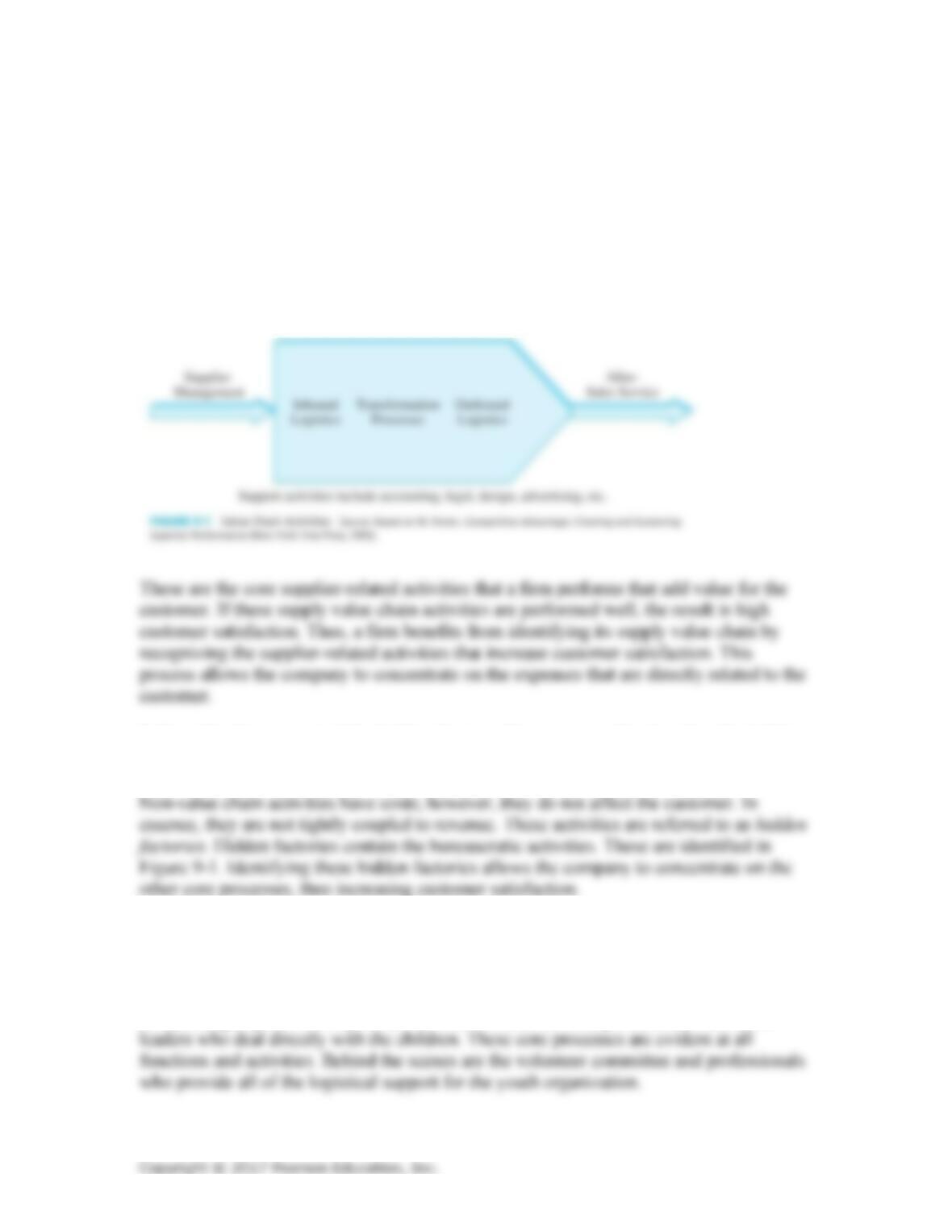
its component parts in order to identify and reduce internal competition. Figure 9-1
displays the value chain.
2. Describe the concept of the hidden factory. How can a realization that the hidden
factory exists help managers?
3. Think about a job that you have had or a volunteer organization with which you
have been associated. Did this organization have a hidden factory? If so, describe at
least two activities that you would associate with the organization’s hidden factory.
In a youth group such as Boy Scouts or Girls Scouts, the core processes are the adult
Page 3 of 8
4. Describe the concept of chain of customers. How does this concept benefit the
ultimate consumer of a product or service?
One aspect of the value chain is the chain of customers. This implies that if you look at
the value chain horizontally, each step or link in the chain is a person performing tasks
5. What is the purpose of single sourcing? How can single sourcing help firms meet
their quality objectives?
Single sourcing refers to the use of a single supplier for a specific item. The advantage of
this is that the relationship between the two companies becomes highly important to both
parties. If single sourcing is effective, page 215 explains:
6. What are two of the most commonly used sole-source filters? Do you believe that
these sources are appropriate? Please explain your answer.
7. What is the purpose of a supplier certification or qualification program? What is
the difference between a supplier certification program and a supplier development
program?
A supplier certification or qualification program is an intensive investigation into the
8. How does electronic data interchange facilitate the supply-chain process?
Electronic data interchange is a system by which the customer’s and supplier’s
9. How does the contingency perspective apply to supplier partnering?
10. What is a supplier audit? How does a supplier audit differ from a supplier
certification program?
11. Describe the concept that is referred to as supplier alliances. How does this
concept differ from the traditional form of supplier–customer relationship?
Page 214 states: Supplier–alliance relationships have emerged that treat suppliers as de
facto subsidiaries of the customer’s organization. We say de facto subsidiaries because as
12. ISO/TS 16949 is a concept that was developed by Chrysler, Ford, and General
Motors. Explain what ISO/TS 16949 is and how it has helped its developers.
This concept is defined on page 221. ISO/TS 16949 is a standard that specifies the quality
system requirements for the design/development, production, and, where relevant,
installation and servicing of automotive-related products.
13. Is ISO/TS 16949 a good thing for auto suppliers as well as auto manufacturers?
Explain your answer.
The standard makes clear the expectations that the auto manufacturers have of the auto
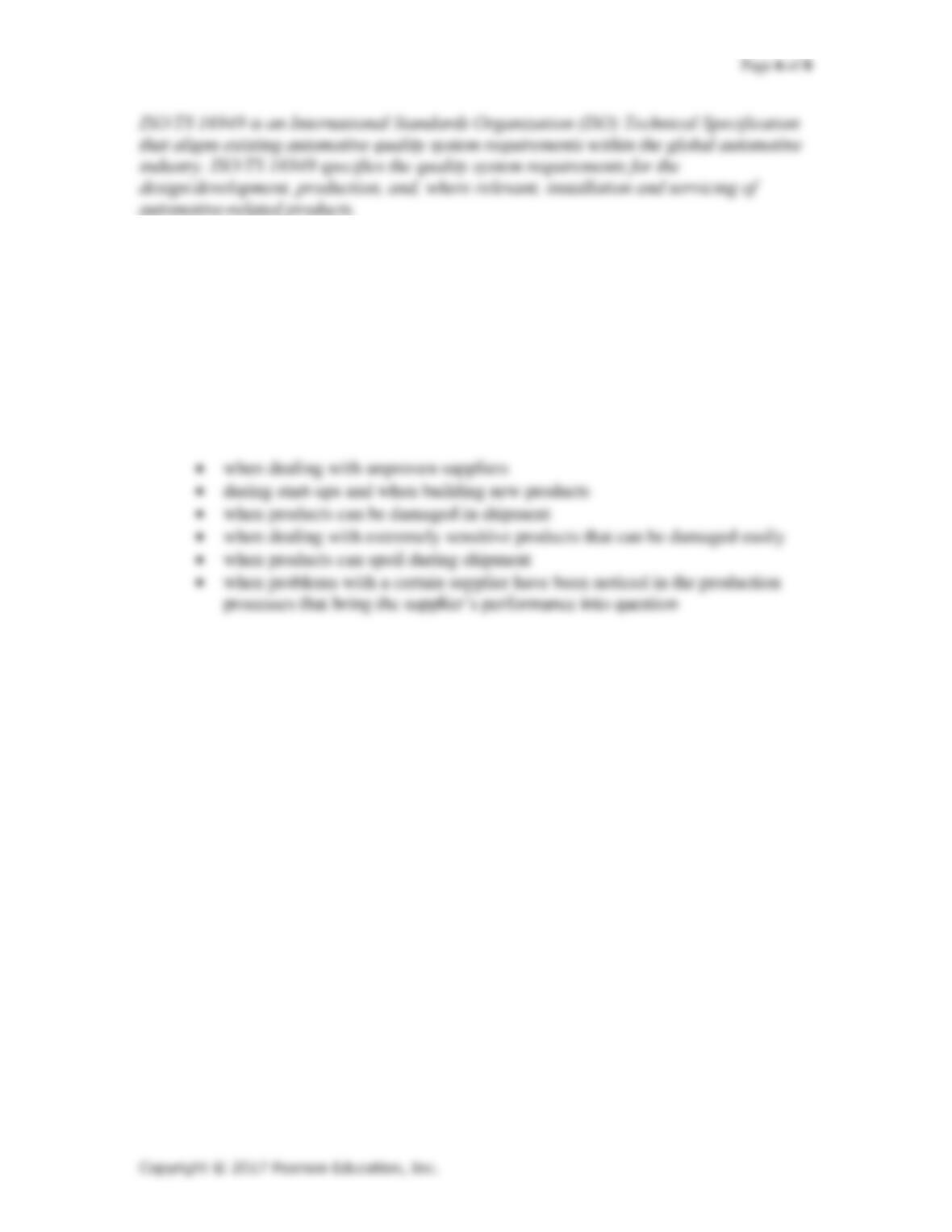
14. How does ISO/TS 16949 differ from ISO 9000:2008? Is the distinction between
the two quality concepts important for the adopters of ISO/TS 16949?
As ISO 9000 gained universal acceptance in the automotive industry, the need for a
standard that was designed for the automotive industry was discussed. After some
revision, IS/TS 16949 was developed to fill this need. This standard is defined on page
221:
15. What is acceptance sampling? When is acceptance sampling needed?
Acceptance sampling is a statistical procedure in which a predefined number of products
are inspected for quality. This number of items can range from 100% to a small sample.
There is a fair amount of controversy over this procedure. Deming stated that sampling
can be most effective in a controlled number of cases as opposed to inspecting all
products. (Refer to Acceptance Sampling 9A in this Instructors Manual.)
Acceptance sampling might be needed regarding the following:
Case 9-1: AT&T: Setting High Standards for Suppliers and Rewarding
Supplier Performance
1. Do you believe that AT&T’s standards for its suppliers are too rigid? Why or
why not?
2. Is the Supplier Quality Report a good idea or are monthly reports too frequent
and intrusive? Please explain your answer.
Again, the obvious answer is that the Supplier Quality Report represents a good vehicle
3. Do you believe suppliers should receive awards and designations of merit from
the companies that purchase its products? Please explain your answer.
Case 9-2: Managing the Supply Chain at Honeywell
1. Why does Honeywell spend so much time dealing with supply chain management
issues? Wouldn’t the company be better off focusing on its own manufacturing
operations? Explain your answer.
Like many firms, Honeywell does not make all of the components that go into its finished
products. The company uses a number of suppliers that provide component parts to
2. What aspect or aspects of Honeywell’s approach to supply chain management
appear to be particularly prudent? Can you suggest any additions to Honeywell’s
supply chain management program?
3. Do you believe that Honeywell’s approach to supply chain management creates a
win-win situation between the company and its suppliers? Why or why not?