
Chapter 9: Managing Teams P a g e | 13
Self-Assessment
WORKING IN GROUPS
Todays students tend to have a great deal of experience working in groups. But that doesnt mean that
they all like to do so. The assessment in this chapter measures the extent to which they are more collective
or individualistic.
In-Class Use
Give students 5 7 minutes to complete the inventory. The research supporting this inventory can be found
in B. L. Kirkman & D. L. Shapiro, The Impact of Cultural Values on Employee Resistance to Teams:
Toward a Model of Globalized Self-Managing Work Team Effectiveness, Academy of Management
Review 22, no. 3 (1997): 730757.
Scoring
Scoring instructions are given at the end of the inventory. Students will compute a raw score, but they
will want to know what it means. Here is what you can tell them:
Your score indicates your level of individualism-collectivism. As you read in the chapter,
individualism-collectivism is the degree to which a person believes that people should be self–
sufficient, and that loyalty to ones self is more important than loyalty to ones team or company.
Management Workplace
Management Workplace videos can support several in-class uses. In most cases you can build an entire
50-minute class around them. Alternatively, they can provide a springboard into a group lesson plan. The
Management Workplace video for Chapter 9 would be a nice companion to your introduction to the
course on the first day teaching this chapter.
VIDEO: HOLDEN OUTERWEAR
Leading Teams
Summary:
At Holden Outerwear, its all about teamwork. Founder Mikey LeBlanc believes that teamwork is critical
to the companys position as an innovation leader. Holdens use of teams is something that emerged out
of necessity. For much of the companys brief history, managers worked independently on design
projects. But as the company grew, LeBlanc needed more designers, and he began looking to outside
freelancers for help. Nikki Brush, a design and development manager at Holden, remembers when she
was first brought on as a freelancer. Today she is a full time manager at the company. The switch from
freelancer to in-house manager has been positive for Nikki Brush, although her role on the team has
changed.
Chapter 9: Managing Teams P a g e | 14
Discussion Questions:
1. What type of team did Nikki Brush participate in when she was a freelancer? What type of team
does she participate in as a full-time employee at Holden?
When Nikki Brush was an outside freelancer working on Holden projects, she was a member of a
virtual team. Virtual teams are comprised of members who are geographically dispersed but who
2. What are the advantages and disadvantages of using teams at Holden? What can managers do to
help avoid the disadvantages?
The use of teams at Holden Outerwear has several positive benefits. It helps employees develop
trust in one another. Teams also increase the level of creativity and inspiration at the company by
increasing the overall talent level. Also, the use of teams helps everyone learn from each other
and improve in what they do.
3. What steps do the leaders of Holden take to insure that their workgroups have high levels of
cohesion?
The leaders of Holden are very intentional, and yet very careful, to create a team that works well
together. One way in which they encourage cohesion is by recognizing the very importance of
Chapter 9: Managing Teams P a g e | 15
Workplace Video Quiz
Students are able to take the following video quiz on CourseMate. The video is broken into segments, and
each segment has related questions to make sure students understand how the clip connects to the chapter
concepts.
Video Segment 1
Video segment title Leading Teams
Start time (in sec) 0:00
Stop time (in sec) 2:38
Quiz Question 1 Holden designer Nikki Brush recalls a team project that failed because
individual members refused to take ownership and responsibility. This is a
common problem of teams known as:
a. Groupthink
Quiz Question 2 Designer Nikki Brush states that a teams success is based upon all the
following except:
a. Effort by all members
b. Trust
c. Competition between team members
d. Common goals
Correct option c: Competition between team members
Feedback According to Nikki Brush, the success of a team is based on cooperation
and mutual trust.
Quiz Question 3 According to Holden founder Mikey LeBlanc, why are teams
advantageous for product development?
a. Teams bring together people with expertise
Video Segment 2
Video segment title Leading Teams
Start time (in sec) 2:39
Stop time (in sec) 4:22
Quiz Question 1 The small size of Holdens garment design team is likely to result in all of
the following except:
a. Strong work relationships
b. The broadest diversity of team member skills, creativity, and
characteristics
Quiz Question 2 Which fact about Holdens design process indicates the occasional use of
virtual teams?
a. Holden teams often include outside freelancers
b. Holdens team began with two members
c. Holden wants team members to share common aesthetic goals
d. All of these
Correct option a: Holden teams often include outside freelancers
Feedback Virtual teams are groups of geographically or organizationally dispersed
coworkers who use telecommunication and information technology to
accomplish a task.
Quiz Question 3 What likely persuaded Holden to include outside freelancers into its
garment-design team process?
Chapter 9: Managing Teams P a g e | 17
Video Segment 3
Video segment title Leading Teams
Start time (in sec) 4:24
Stop time (in sec) 6:30
Quiz Question 1 Nikki Brush was hired on at Holden to work with other employees on a
common set of tasks, goals, and responsibilities. This indicates that Brush
was a member of a:
a. Group
b. Work team
Quiz Question 2 According to designer Nikki Brush, the team at Holden is small, has a
good working relationship, has clearly defined goals, and is comprised of
people with the right expertise. This indicates that the team is:
a. A horizontal team
b. A vertical/functional team
c. Highly cohesive
d. Storming
Correct option c: Highly cohesive
Feedback Cohesiveness is the extent to which team members are attracted to a team
and motivated to remain in it.
Quiz Question 3 Product design is work that requires significant creative output from
individuals. Holdens teams could interfere with this output because:
Additional Assignments and Activities
Review Questions
1. What are the advantages and disadvantages of teams?
2. How does a manager know when to use teams and when not to use them?
3. Sketch the team autonomy continuum and describe the five teams with different levels of autonomy.
Low autonomy High Autonomy
A B C D E
(A) Traditional work group: composed of two or more people who work together to achieve a
shared goal.
4. Describe the three types of special teams that do not fit easily onto the team autonomy continuum.
Cross-functional, virtual, and project teams do not easily fit onto the team autonomy continuum.
5. Outline the stages of team development and briefly describe what happens at each stage.
Stages of team development are:
Forming: the first stage of team development in which team members meet each other, form
initial impressions, and begin to establish team norms.
Teams do not necessarily stay together forever once they reach the performing stage. The stages
teams go through as they break up reflect a reversal through the stages they passed through to reach
performance level:
6. What role does cohesiveness play in team performance?
Cohesiveness is another important characteristic of work teams. Cohesiveness is the extent to which
team members are attracted to a team and motivated to remain in it. To start, cohesive groups have a
7. Describe two main types of conflict that occur in teams. How can teams use conflict effectively?
Conflict and disagreement are inevitable in most teams. The key to dealing with team conflict is to
maximize cognitive conflict, which focuses on issue-related differences, and minimize affective
So, what can managers do to manage team conflict? They can:
Chapter 9: Managing Teams P a g e | 20
8. What should managers consider when selecting employees for teamwork?
Managers need to consider whether an individual has a preference for teamwork, whether the team
level is high enough, and how diverse the team is. An individual with a preference for teamwork
9. What must happen for stretch goals to motivate teams?
10. What challenges do companies face when compensating employees for work done in teams?
Compensating teams correctly is very difficult. For instance, one survey found that only 37 percent of
companies were satisfied with their team compensation plans and even fewer, just 10 percent,
Chapter 9: Managing Teams P a g e | 21
Develop Your Career Potential
A QUICK CHECK OF YOUR TEAM SKILLS
Purpose
Not everyone is well suited to teamwork. The point of this assignment is to give students some insight
into their capabilities as team members.
Setting It Up
Tell students to come to class with the inventory completed and their scores calculated. If your students
are part of teams and those teams have had a chance to work together, it can also be useful to have
Reviewing Scores
This inventory has five components: honoring team values and agreements, promoting team development,
helping make team decisions, coordinating and carrying out team tasks, and handling difficult issues with
the team.
If the class is small, ask each student to report their subscores on each dimension and plot those
frequency distributions on the board or an overhead for others to see. This gives students some normative
data for judging their strengths and weaknesses.
Or, before discussing the scores, have each group come up with three things it’s not doing well and
three things it is doing well. Have each group present that list to the class. Also, have each group give
itself a score on a scale of 0 to 100 in terms of how well the group is working and performing. For
EVALUATE YOUR TEAM SKILLS
Step 1: Answer the following questions the way that you think other members of your team would if
they were describing your actions. Use this scale for your responses:
1 Almost never
2 Seldom
3 Sometimes
4 Usually
5 Almost always

Chapter 9: Managing Teams P a g e | 22
I. Honor Team Values and Agreements
As a team member, (your name):
a. shows appreciation for other team members ideas. _____
b. helps other team members cope with change. _____
c. encourages others to use their strengths. _____
d. helps the team develop a productive relationship with other teams. _____
e. willingly assumes a leadership role when needed. _____
Total for Section I: _____
II. Promote Team Development
As a team member, (your name):
a. volunteers for all types of tasks, including the hard ones. _____
b. helps orient and train new team members. _____
c. helps organize and run effective meetings. _____
d. helps examine how we are doing as a team and makes any necessary changes in the way we work
together. _____
e. helps identify milestones and mini-successes to celebrate. _____
Total for Section II: _____
III. Help Make Team Decisions
As a team member, (your name):
a. analyzes what a decision entails. _____
b. ensures that the team selects and includes the appropriate people in the decision process. _____
c. clearly states his or her concerns. _____
d. searches for common ground when team members have different views. _____
e. actively supports the teams decisions. _____
Total for Section III: _____
IV. Coordinate and Carry Out Team Tasks
As a team member, (your name):
a. helps identify the information, skills, and resources necessary to accomplish team tasks. _____
b. helps formulate and agree on a plan to meet performance goals. _____
c. stays abreast of what is happening in other parts of the organization and brings that information to
the team. _____
d. finds innovative ways to meet the needs of the team and of others in the organization. _____
e. maintains a win-win outlook in all dealings with other teams. _____
Total for Section IV: _____
V. Handle Difficult Issues with the Team
As a team member, (your name):
a. brings team issues and problems to the teams attention. _____
b. encourages others on the team to state their views. _____
c. helps build trust among team members by speaking openly about the teams problems. _____
d. gives specific, constructive, and timely feedback to others. _____
e. admits when he or she has made a mistake. _____
Total for Section V: _____
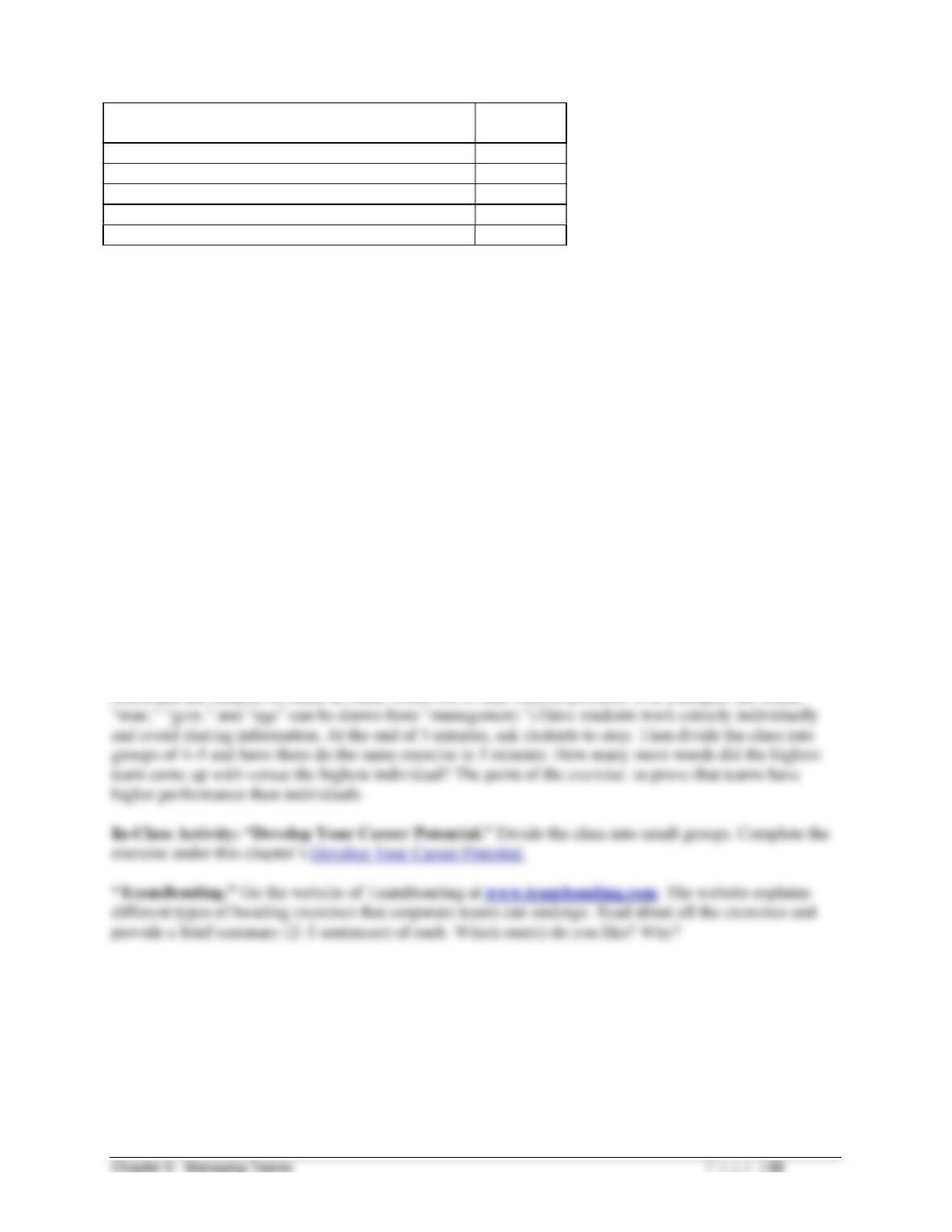
Step 2: Transfer the section totals to this table:
Category Total
Score
Honor team values and agreements. _____
Promote team development. _____
Help make team decisions. _____
Coordinate and carry out team tasks. _____
Handle difficult issues with the team. _____
Interpreting Scores
A score of 20 or above in any activity indicates an area of strength.
A score of below 20 in any activity indicates an area that needs more attention.
Questions to Ask Yourself
Looking at your scores, what areas are your strengths? How can you maintain these strengths? What areas
are weaknesses? What steps can you take to turn these areas into strengths?
Source:
M. A. West, ed., Handbook of Work Group Psychology (Chichester, UK: Wiley, 1996).
Additional Activities
Out-of-Class Project: “Model Teams.” Divide the class into small groups. Each group should
thoroughly research a particular team that they believe has been successful. The team can be an industrial
one, a sports team, a military team, or any other group that considers itself a team. Each group should
cover the following in the research: 1) What are the characteristics of this model team? 2) What
difficulties have they encountered as a team? 3) How did they overcome these difficulties? 4) How were
the teams successful? Students should come to class prepared to discuss or present their research.
In-Class Activity: “Two or More Heads Are Better Than One.” Write the word management on the
board and ask students to make as many words out of that word as possible. (For example, the words
“Sports Teams.” Look up the website of your favorite sports team (any sport). What are the
characteristics of this team? What makes them so successful (or unsuccessful, if that is the case)? Why
has the team survived so many years?