EXERCISE 9-4 9-21
(C) Slope at 4 : 150.xm Equation of tangent line at (4, (4)) : 528 150( 4)fy x or
16. 2
11
( ) ; (2) 0.2. Equation of tangent line: 0.2 0.16( 2)
5
1
fx f y x
x
or
18. 4
() ; (1) 1.fx x f Equation of tangent line: 14(1)or 43.yxyx
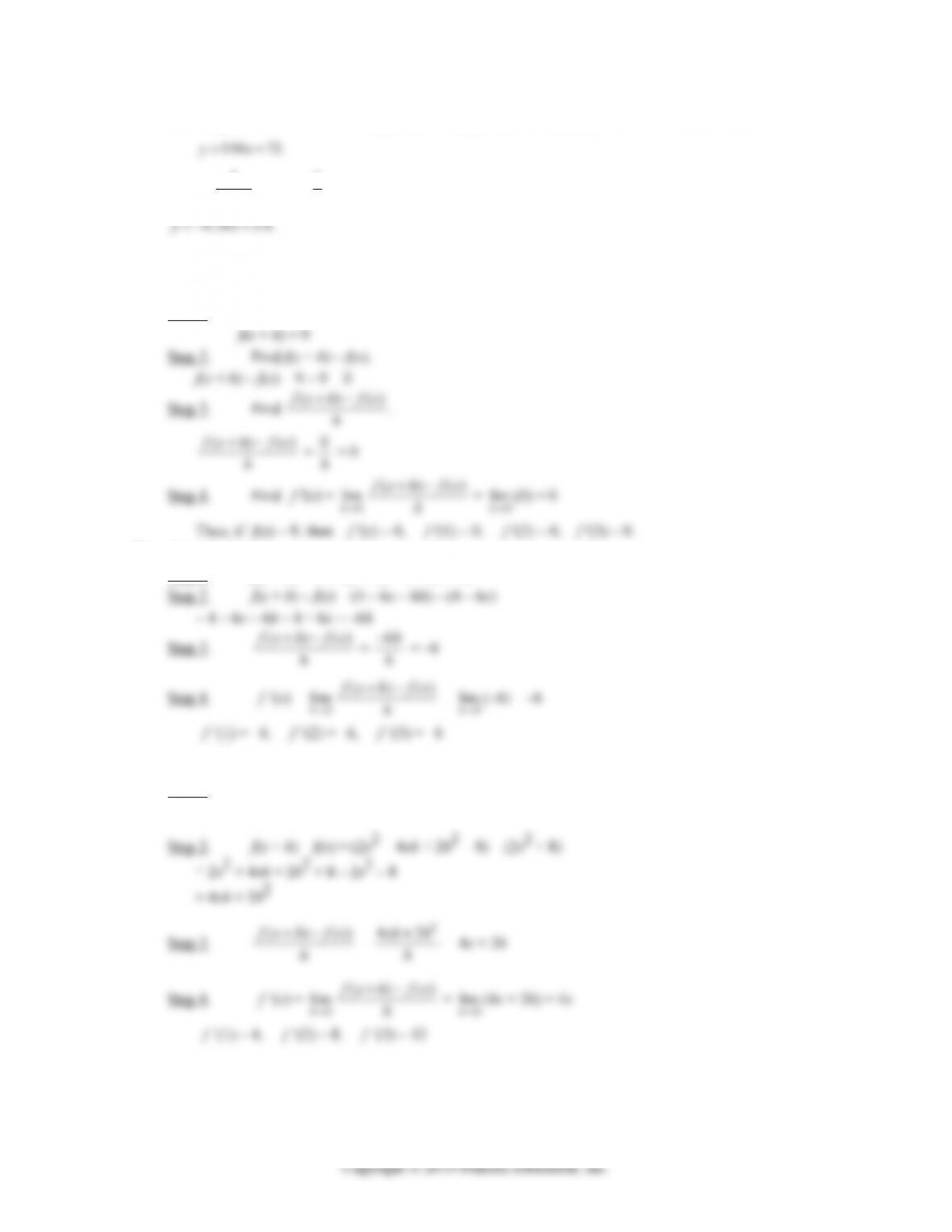
20. f(x) = 9
Step 1. Find f(x + h).
22. f(x) = 4 – 6x
Step 1. f(x + h) = 4 – 6(x + h) = 4 – 6x – 6h
24. f(x) = 2x2 + 8
Step 1. f(x + h) = 2(x + h)2 + 8 = 2(x2 + 2xh + h2) + 8
= 2x2 + 4xh + 2h2 + 8
EXERCISE 9-4 9-23
Copyright © 2019 Pearson Education, Inc.
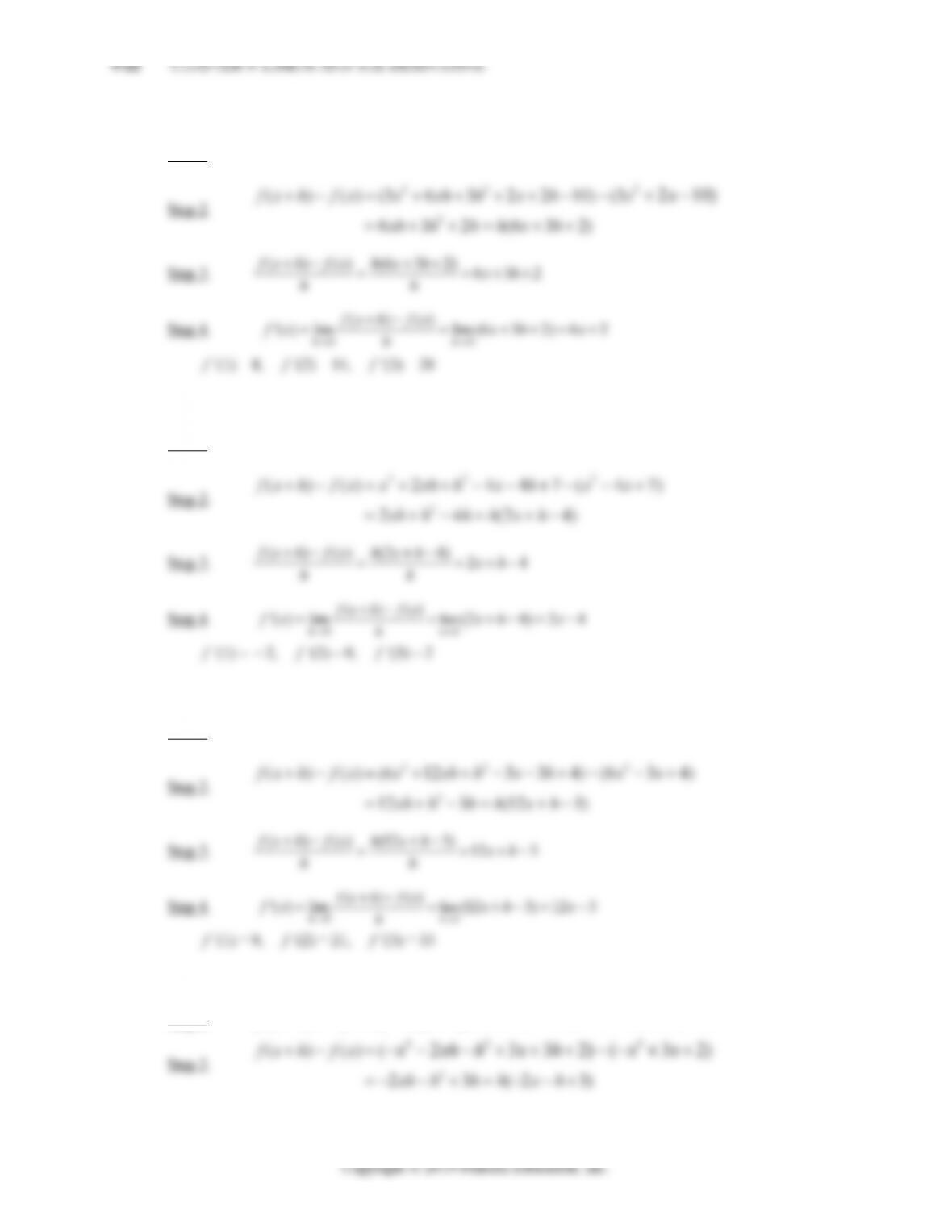
Step 3. ()()
f
xh fx
h
= (2 3) 23
hxh xh
h
f
xh fx
= 0
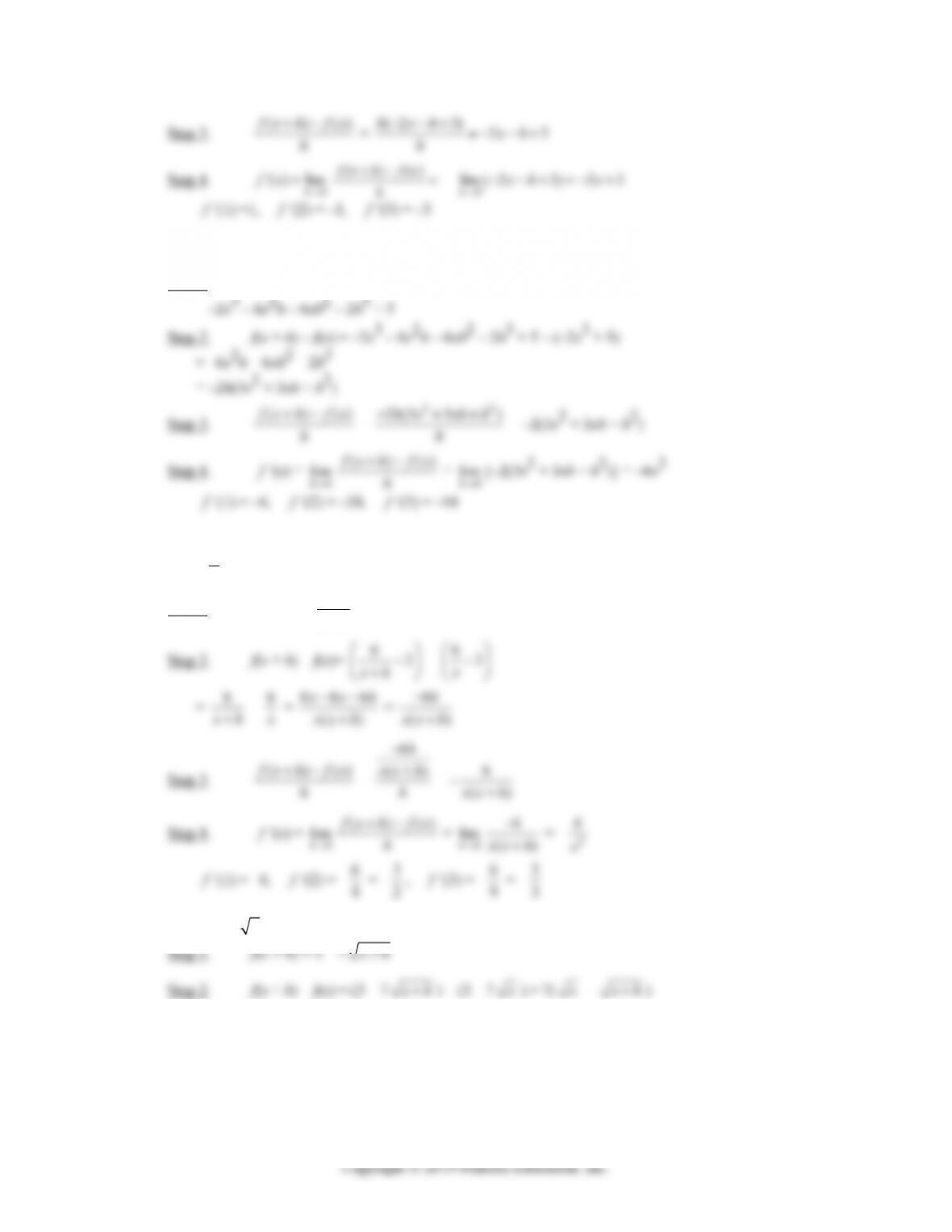
34. f(x) = –2x3 + 5
Step 1. f(x + h) = –2(x + h)3 + 5 = –2(x3 + 3x2h + 3xh2 + h3) + 5
36. f(x) = 6
x
– 2
Step 1. f(x + h) = 6
x
h – 2
x
x
x
x
x
38. f(x) = 3 – 7
x
x
9-24 CHAPTER 9: LIMITS AND THE DERIVATIVE
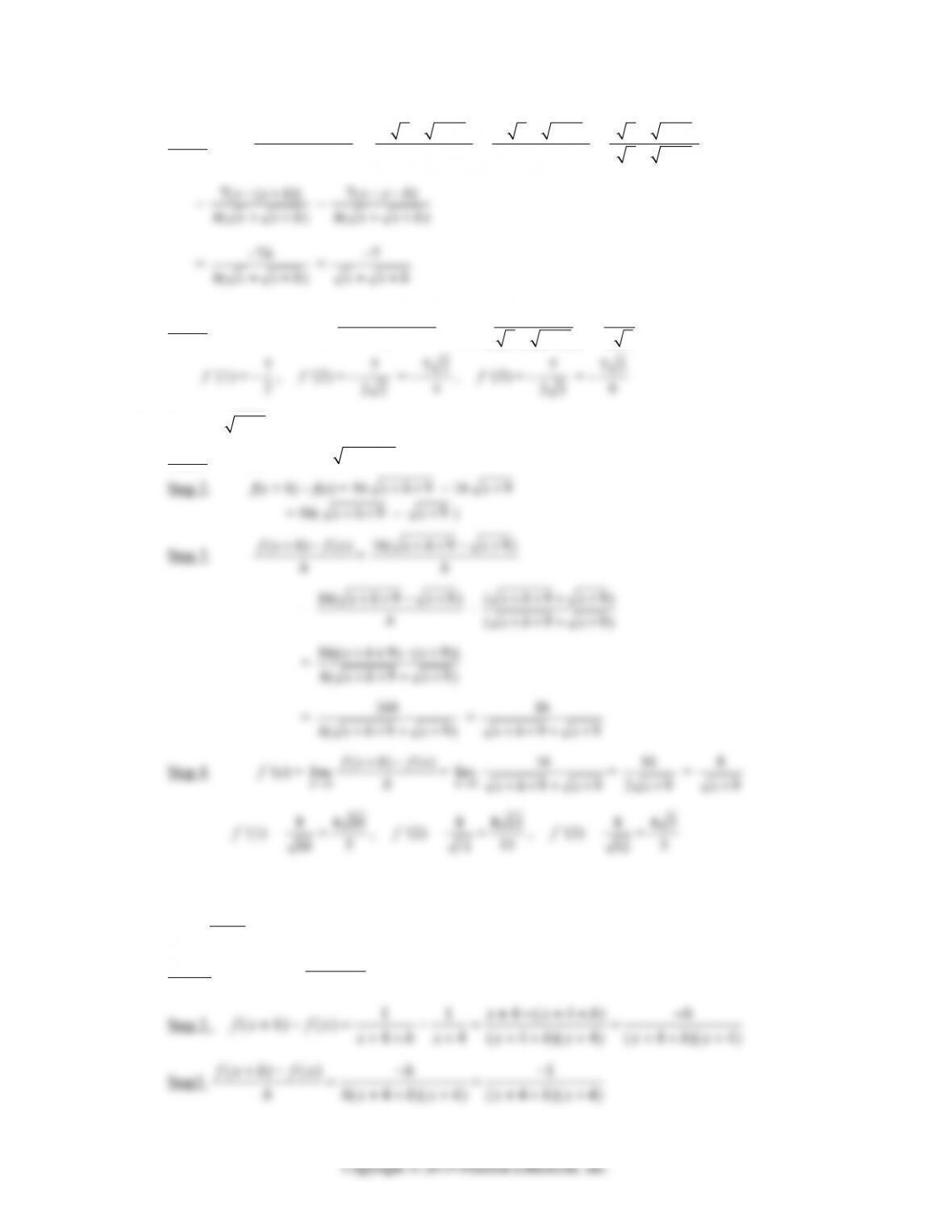
Step 3. ()()
f
xh fx
h
= 7( )
x
xh
h
= 7( )
x
xh
h
· ()
()
x
xh
x
xh
x
7( ( ))
x
xh
x
xh
Step 4. f ‘(x) = 0
lim
h
()()
f
xh fx
h
= 0
lim
h
7
x
xh
= 7
2
x
40. f(x) = 16 9x
Step 1. f(x + h) = 16 9xh
f
42. f (x)1.
4x
Step 1. 1
() 4
fx h
x
h
xxh h
EXERCISE 9-4 9-25
Copyright © 2019 Pearson Education, Inc.
Step 4. 2
00
()() 1 1
‘( ) lim lim .
(4)(4)
(4)
hh
fx h fx
fx hxhx
x
111
‘(1) , ‘(2) , ‘(3)
25 36 49
ff f
44. f (x)2
x
x
Step1. () 2
x
h
fx h
x
h
xh x xhx xx h h
916825
46. y = f(x) = x2 + x
(A) f(2) = 22 + 2 = 6, f(4) = 42 + 4 = 20
ff
= 14
(B) f(2) = 6, f(2 + h) = (2 + h)2 + (2 + h)= 4 + 4h + h2 + 2 + h
=
h
(C) Slope of tangent line at (2, f(2)):
(2 ) (2)fhf
= 0
(D) Equation of tangent line at (2, f(2)):
48. f(x) = x2 + x
(A) Average velocity: (4) (2)
42
ff
=
22
(4) 4 ((2) 2)
2
= 16 4 6
2
= 7 meters per second
=
2
(2 ) (2 ) 6hh
2
44 2 6hh h
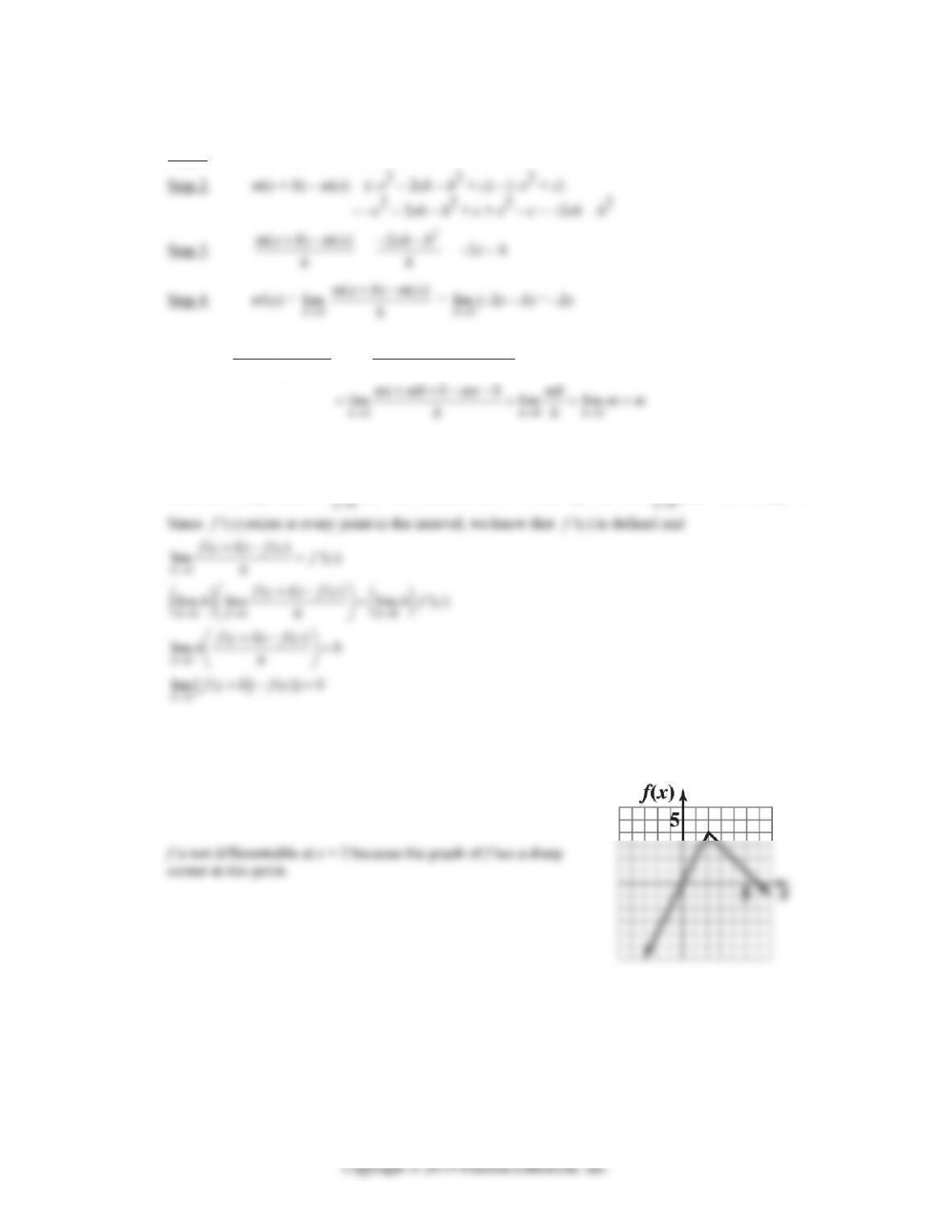
EXERCISE 9-4 9-27
(B) m(x) = –x2 + c
Step 1. m(x + h) = –(x + h)2 + c = –x2 – 2xh – h2 + c
64. True:
0
0
lim
()
()()
lim
h
h
mx h b mx b
fx h fx
hh
66. Let
,cab. We wish to show that
lim ( ) ( )
xc
f
xfc
. If we let hxc, then
x
hc, and this
statement is equivalent to 0()l)i(m
f
ch fc
fc h fc
f
f
00 0
0
0
lim li
lim ‘( )
()()
0
m
lim
(()lim ) 0
hh
h
h
h
hh
f
c
h
fc h fc
hh
fc h fc
68. False. For example, () | |
f
xxhas a sharp corner at 0x, but is continuous there.
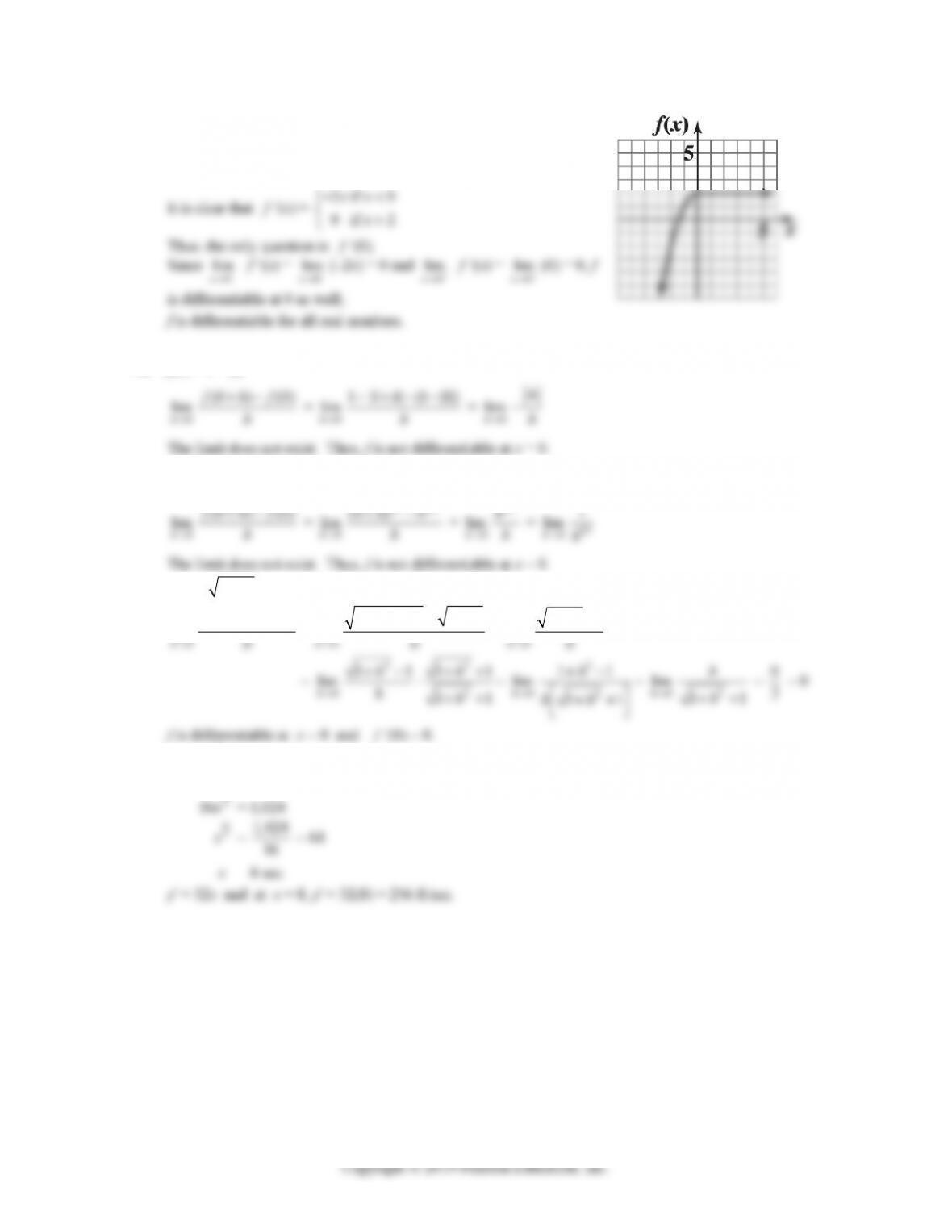
70. The graph of f(x) = 2if 2
6if 2
xx
xx
is:
9-28 CHAPTER 9: LIMITS AND THE DERIVATIVE
72. f(x) =
2if 0
2
if 0
2
x
x
x
xx
f is differentiable for all real numbers.
74. f(x) = 1 – |x|
(0 ) (0)fhf
= 0
1|0 |(1|0|)h
= 0
h
76. f(x) = x2/3
2/3 2/3
2/3
78. f(x) = 2
1
x
0
lim
(0 ) (0)fhf
= 0
lim
22
1(0 ) 10h
= 0
lim
2
11h
2
11h
2
11
h
2
11
h
h
80. y = 16x2
Now, if y = 1,024 ft, then
EXERCISE 9-4 9-29
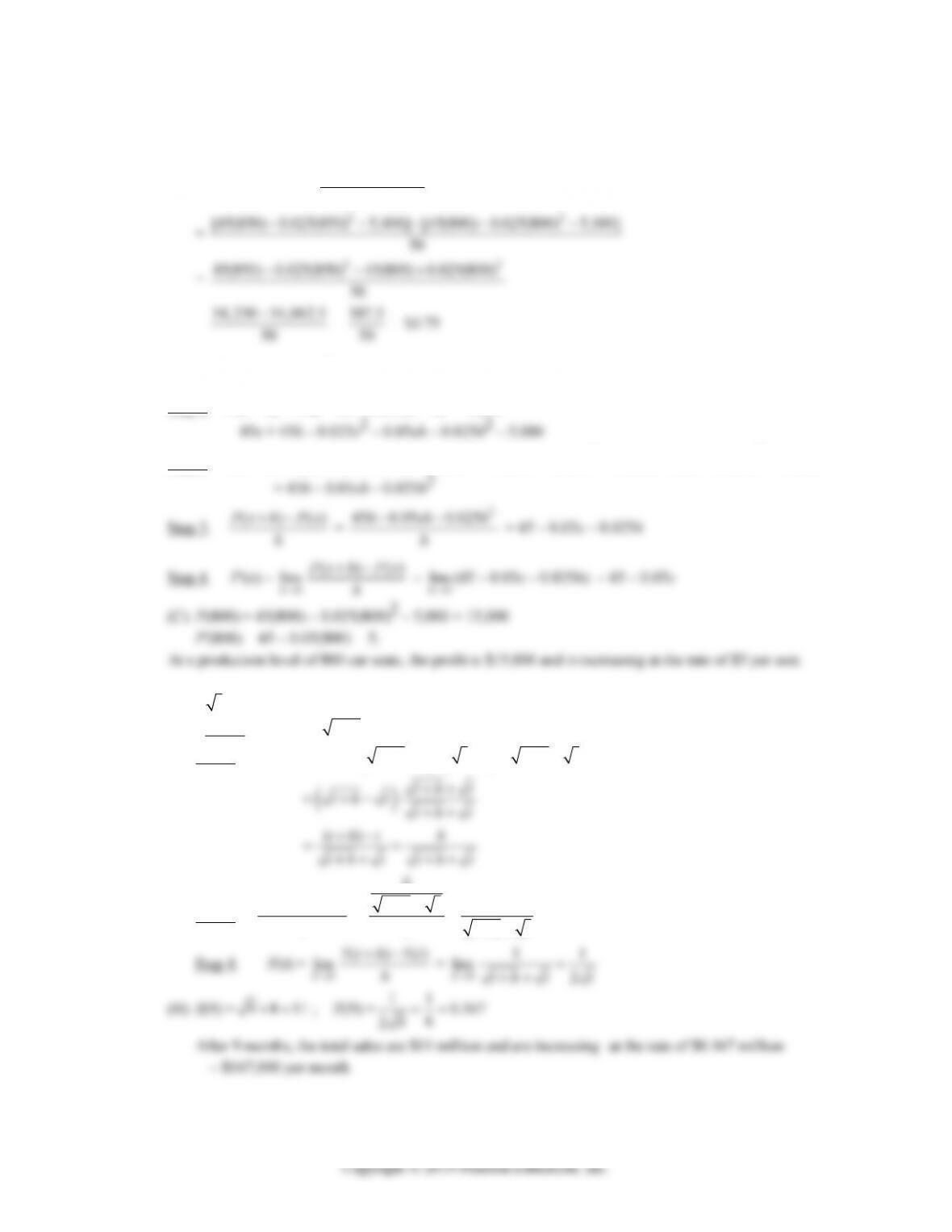
82. P(x) = 45x – 0.025x2 – 5,000, 0 ≤ x ≤ 2,400.
(A) Average change = (850) (800)
850 800
PP
22
[45(850) 0.025(850) 5,000] [45(800) 0.025(800) 5,000]
(B) P(x) = 45x – 0.025x2 – 5,000
Step 1. P(x + h) = 45(x + h) – 0.025(x + h)2 – 5,000
Step 2. P(x + h) – P(x) = (45x + 45h – 0.025x2 – 0.05xh – 0.025h2 – 5,000) – (45x – 0.025x2 – 5,000)
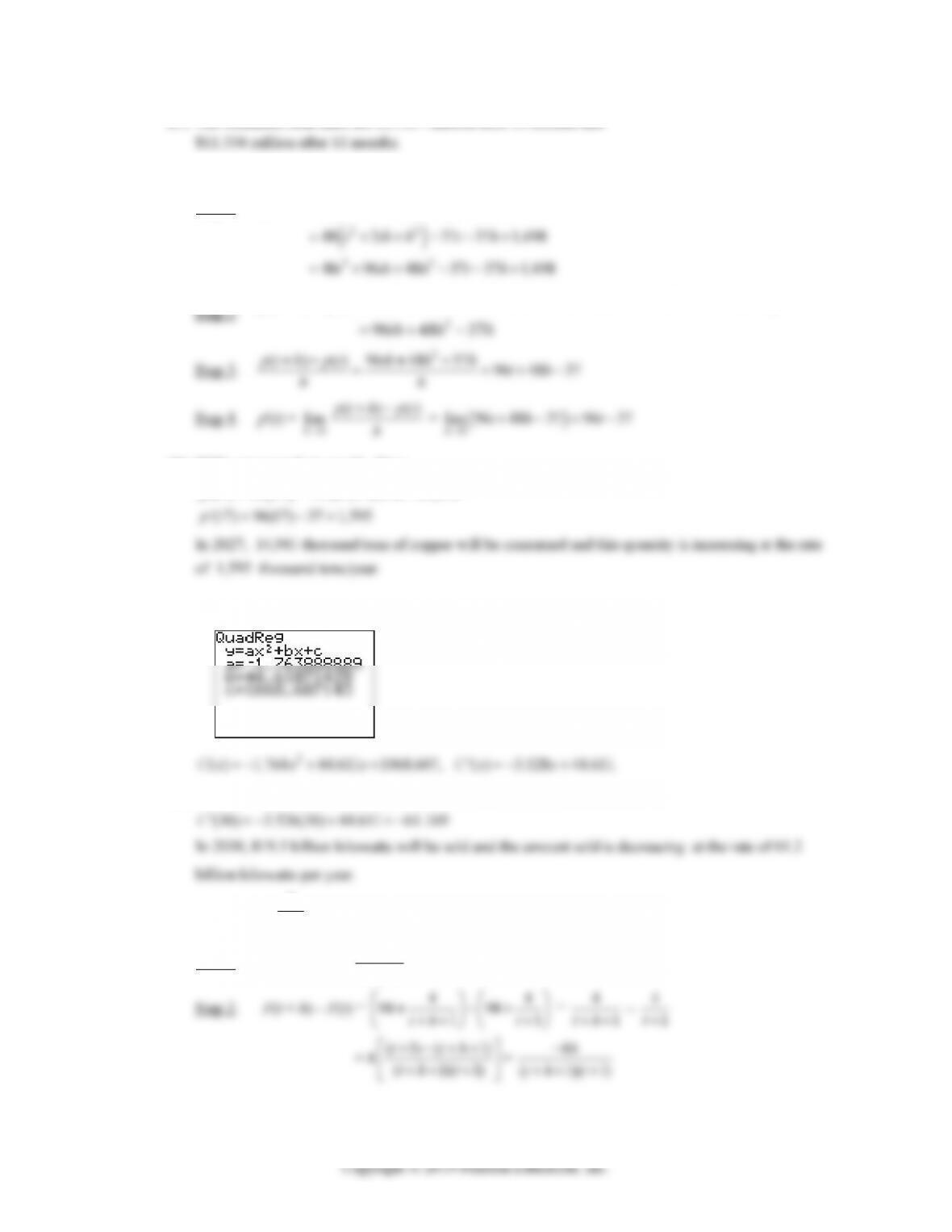
84. S(t) = 8t
(A) Step 1. S(t + h) = 8th
Step 2. S(t + h) – S(t) =
88th t th t
()
th t
th t th t
th t h
th t th t
Step 3. ()()St h St
h
= 1
h
th t
hth t
()()St h St
= 0
11
9-30 CHAPTER 9: LIMITS AND THE DERIVATIVE
(C) The estimated total sales are $11.167 million after 10 months and
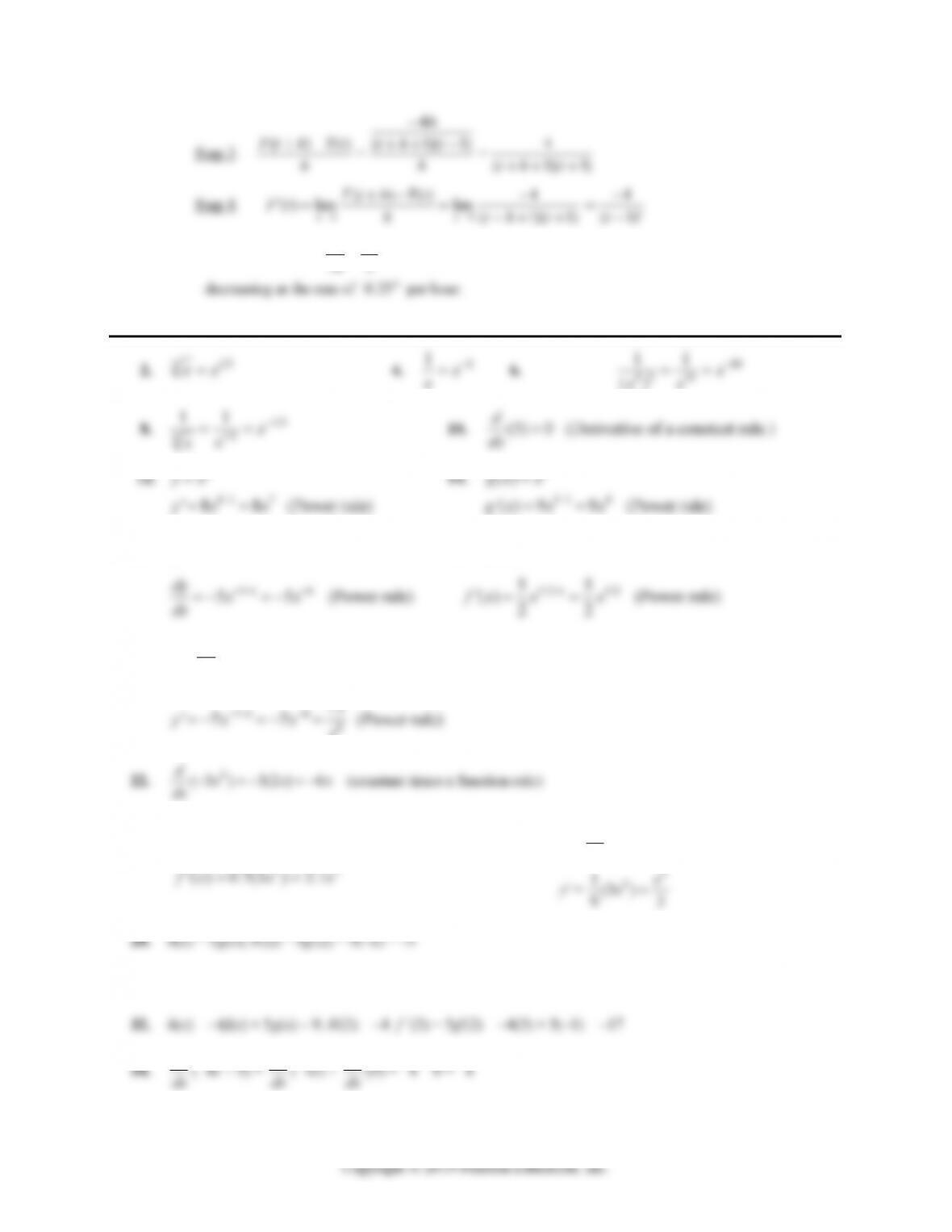
86. (A) 2
( ) 48 37 1,698pt t t
Step 1.
2
()48()37 1,698
pt h t h t h
22 2
( ) ( ) 48 96 48 37 37 1,698 (48 37 1,698)
pt h pt t th h t h t t
(B) 2027 corresponds to t = 17. Thus
2
(17) 48 17 37(17) 1,698 14,941
p
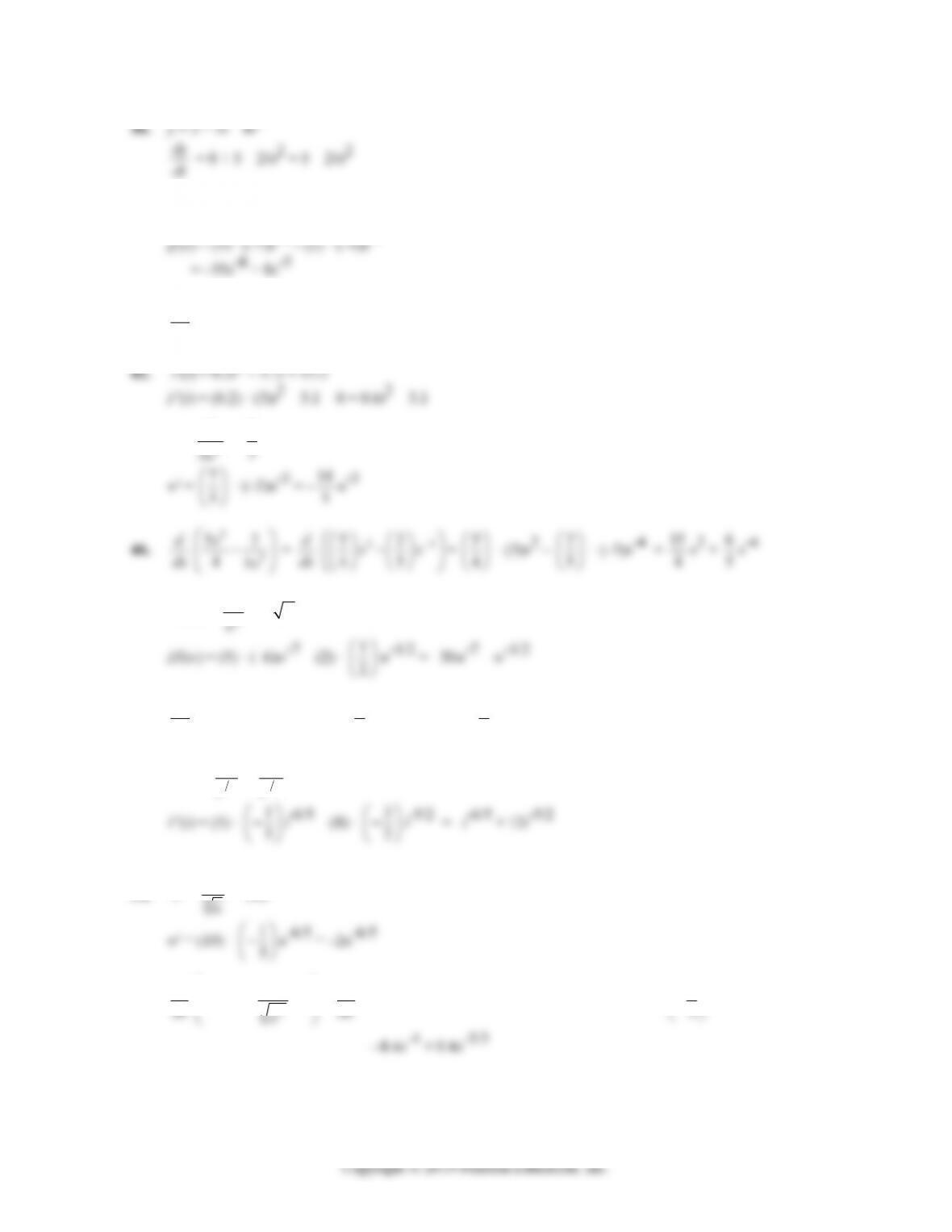
88. (A) Quadratic regression model
(B) 2
(30) 1.764(30) 44.611(30) 1068.607 819.337
C
;
90. (A) F(t) = 98 + 4
1t
Step 1. F(t + h) = 98 + 4
1th
EXERCISE 9-5 9-31
Copyright © 2019 Pearson Education, Inc.
Step 3. ()F() 4
(1)(1)
(1)(1)
4
+- –
++ +
==
++ +
–h
Ft h t th t
hhtht
Step 4. 2
00
()F() 4 4
() lim lim(1)(1)(1)
+- – –
== =
++ + +
hh
Ft h t
F’ t hthtt
(B) 41
(3) 99, ‘(3) .
FF
The body temperature 3 hours after taking the medicine is o
99 and is
EXERCISE 9-5
3
1
11
16. 5
yx
18. 5/2
()
f
xx
dy xx
dx
55
22
20. 7
7
1
yx
x
dx
24.
3
( ) 0.7
f
xx
f
x
26. y =
3
9
x
2
2
30. h(x) = g(x) – f(x); h‘(2) = g‘(2) – f ‘(2) = –1 – 3 = –4
9-32 CHAPTER 9: LIMITS AND THE DERIVATIVE
Copyright © 2019 Pearson Education, Inc.
36. y = 2 + 5t – 8t3
dy
dt = 0 + 5 – 24t2 = 5 – 24t2
38. g(x) = 5x-7 – 2x-4
40. d
du (2u4.5 – 3.1u + 13.2) = (2) · (4.5)u3.5 – 3.1 + 0 = 9u3.5 – 3.1
44. w = 2
7
48. H(w) = 6
5
2
50. d
du (8u3/4 + 4u-1/4) = (8) · 3
4
u-1/4 + (4) · 1
4
u-5/4 = 6u-1/4 – u-5/4
52. F(t) = 15
5
t – 32
8
t = 5t-1/5 – 8t-3/2
5
2
54. w = 5
10
5
56. d
3
0.6
2.8 7x
= d
x-5/3 + 0
EXERCISE 9-5 9-33
58. f(x) = 2x2 + 8x
(B) Slope of the graph of f at x = 2: f ‘(2) = 4(2) + 8 = 16
(C) Tangent line at x = 2: y – y1 = m(x – x1)
(D) The tangent line is horizontal at the values x = c such that
60. f(x) = x4 – 32x2 + 10
(A) f‘(x) = 4x3 – 64x
(B) Slope of the graph of f at x = 2: f ‘(2) = 4(2)3 – 64(2) = –96
(C) Tangent line at x = 2: y – y1 = m(x – x1), where
(D) Solve f ‘(x) = 0 for x:
62. f(x) = 80x – 10x2
(A) v = f ‘(x) = 80 – 20x
9-34 CHAPTER 9: LIMITS AND THE DERIVATIVE
(B) 0x
v = f ‘(0) = 80 ft/sec.
(C) Solve v = f ‘(x) = 0 for x:
64. f(x) = x3 – 9x2 + 24x
(A) v = f ‘(x) = 3x2 – 18x + 24
x
68. 1/3
‘( ) 4 4 4; ‘( ) 0 at 2.3247.fx x x fx x
72. 32
‘( ) 7.8 16.2 10; ‘( ) 0 at 1.2391, 1.6400, 4.9209.fx x x x fx x
74. The tangent line to the graph of a parabola at the vertex is a horizontal line. Therefore, to find the x
78. y = (2x – 5)2; y‘ = (2)(2x – 5)(2) = 8x – 20
2
25x
x
= 1 + 2
25
x
dx = 0 + (25) · (–2)x-3 = –50x-3
82. f(x) =
53
3
242
x
xx
x
=
53
333
242
x
xx
x
xx
= 2x2 – 4 + 2x-2; f ‘(x) = 4x – 4x-3
84. False: The function 1
()fx
x
is a counter-example.
EXERCISE 9-5 9-35
Copyright © 2019 Pearson Education, Inc.
Step1. ()()()
f
xh uxh vxh
f
hh
hh
90. S(t) = 0.015t4 + 0.4t3 + 3.4t2 + 10t – 3
(A) S‘(t) = (0.015)·(4)t3 + (0.4)·(3)t2 + (3.4)(2)t + 10 – 0 = 0.06t3 + 1.2t2 + 6.8t + 10
(B) S(4) = 0.015(4)4 + 0.4(4)3 + 3.4(4)2 + 10(4) – 3 = 120.84,
92. x = 10 + 180
p, 2 ≤ p ≤ 10
For p = 5, x = 10 + 180
5 = 10 + 36 = 46
f
9-36 CHAPTER 9: LIMITS AND THE DERIVATIVE
94 . (A) Cubic Regression model
(B)
2
‘( ) 0.001401 0.055286 0.265952
Fx x x
96. C(x) = 2
0.1
x
= 0.1x-2
C‘(x) = –0.2x-3 = – 3
0.2
x
, the instantaneous rate of change of concentration at x miles.
98. y = 21 32
x
, 0 ≤ x ≤ 8.
First, find y = 21 32
x
= 21x2/3 .
Then y’ = 21 1/3
2
3x
= 14x-1/3 = 1/3
14
x
= 3
14
x
, is the rate of learning at the end of x hours.
(A) Rate of learning at the end of 1 hour:
14
(B) Rate of learning at the end of 8 hours:
14
EXERCISE 9-6
4. ( ) 0.1 3; ( 10) 0.1( 10) 3 2, ( 10.1) 0.1( 10.1) 3 1.99fx x f f
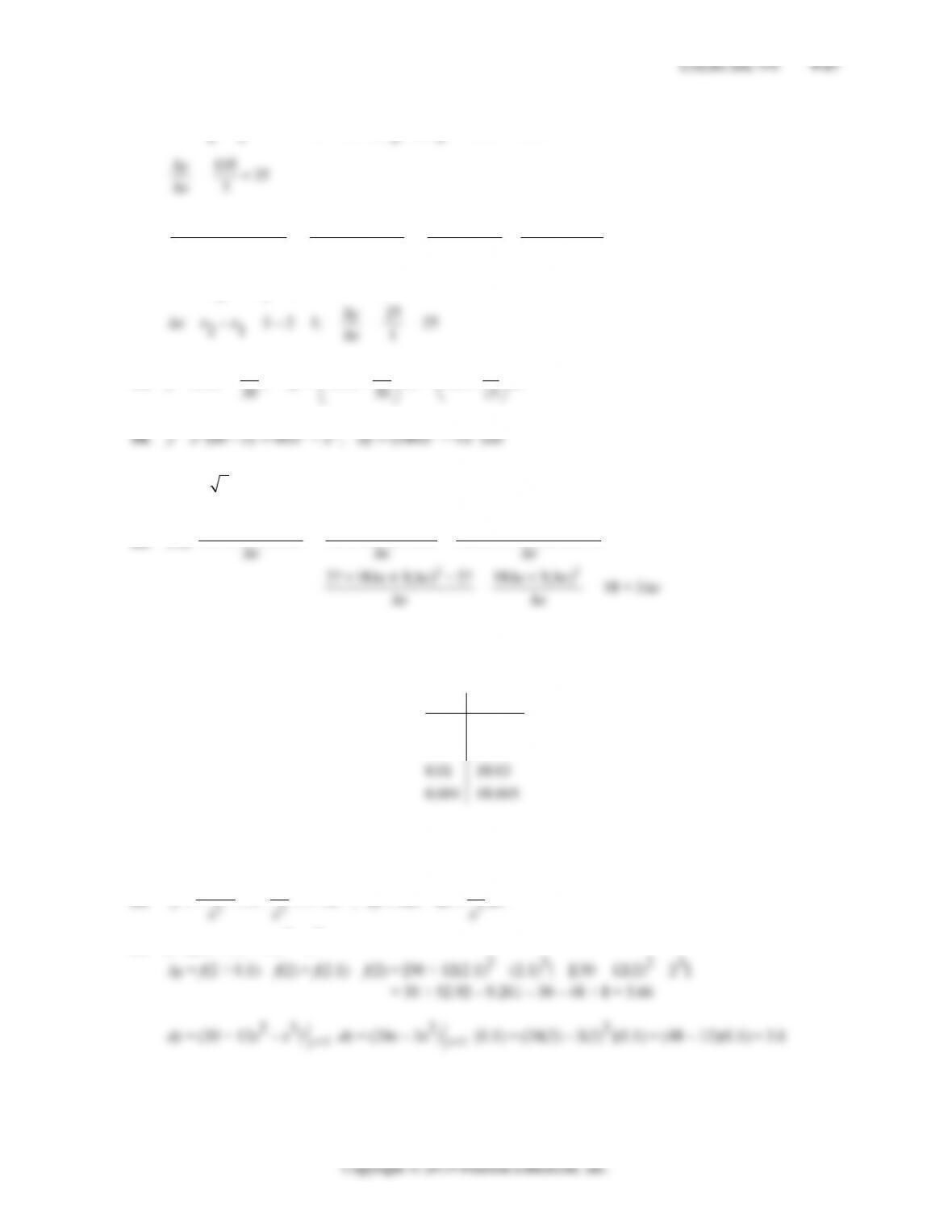
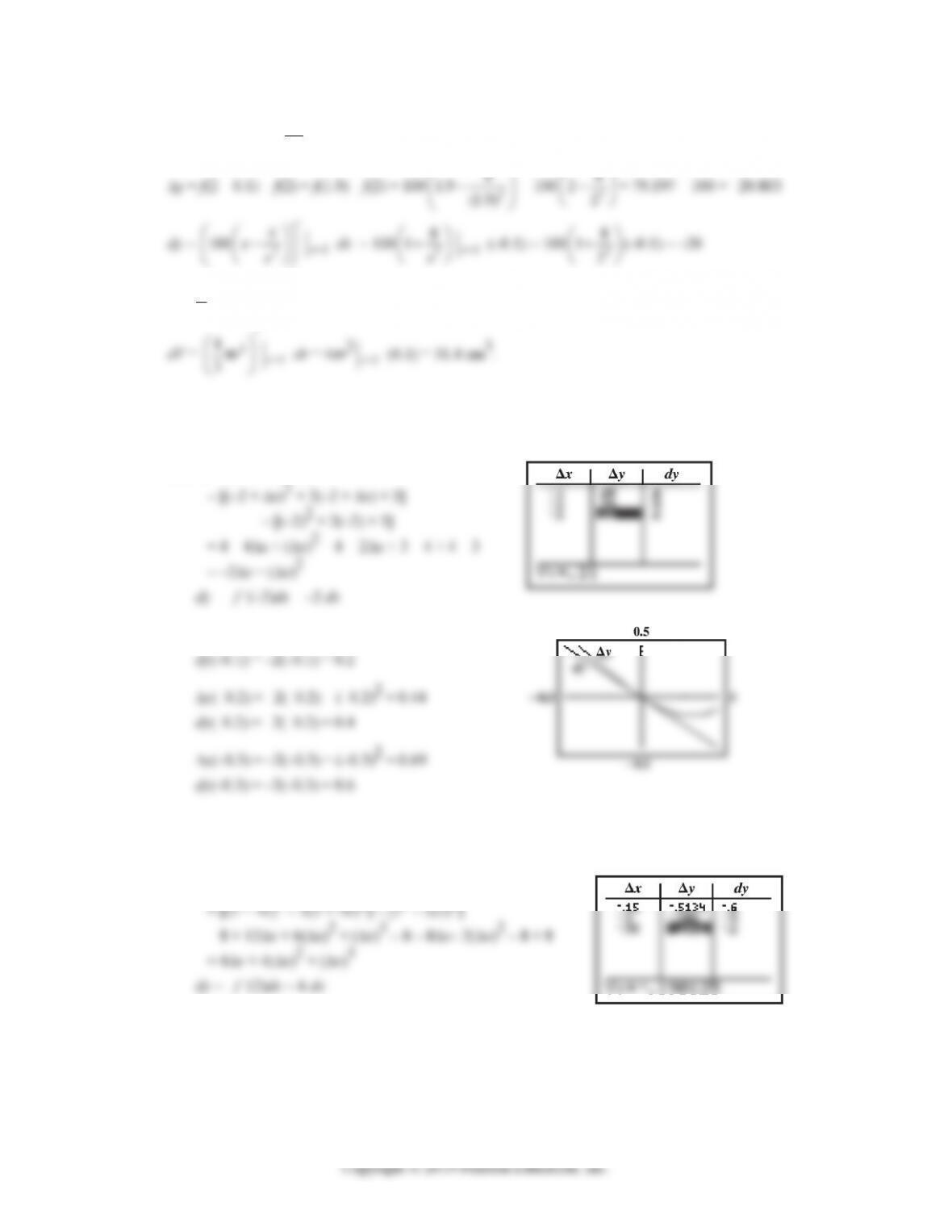
9-38 CHAPTER 9: LIMITS AND THE DERIVATIVE
30. y = f(x) = 100 2
4
x
x
4
4
x
32. V = 4
3πr3, r = 5 cm, dr = ∆r = 0.1 cm.
4
3
‘
34. f(x) = x2 + 2x + 3; f ‘(x) = 2x + 2; x = –2; ∆x = dx (C)
(A) ∆y = f(–2 + ∆x) – f(–2)
(B) ∆y(–0.1) = –2(–0.1) + (–0.1)2 = 0.21
dy(–0.3) = –2(–0.3) = 0.6
36. f(x) = x3 – 2x2; f ‘(x) = 3x2 – 4x; x = 2, ∆x = dx (C)
(A) ∆y = f(2 + ∆x) – f(2)
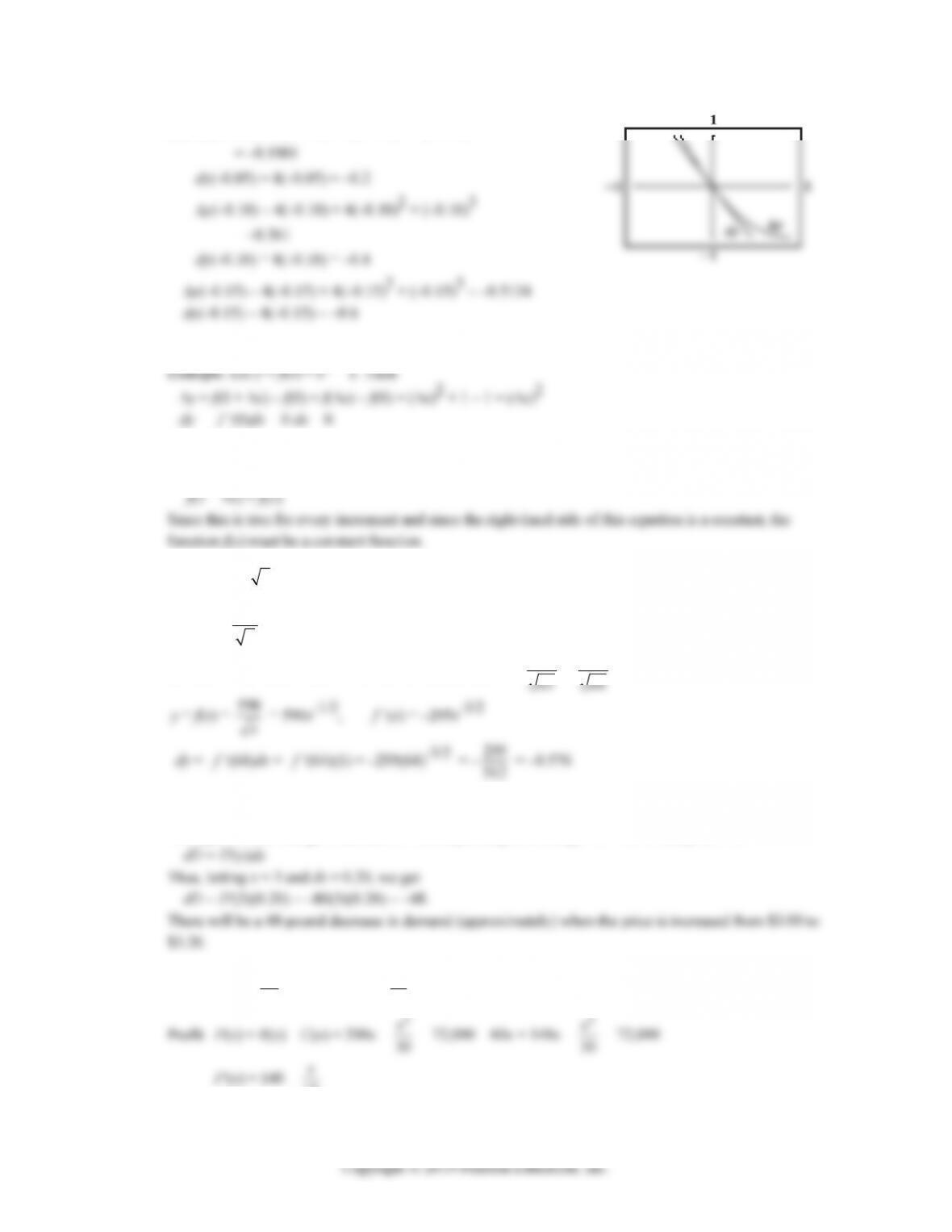
EXERCISE 9-6 9-39
(B) ∆y(–0.05) = 4(–0.05) + 4(–0.05)2 + (–0.05)3
38. False.
40. True.
∆y = f(2 + ∆x) – f(2) = 0 implies that
42. y = (2x2 – 4)
x
= (2x2 – 4)(x)1/2 = 5/2 1/2 3/2 1/2
24, (52).
x
xdyx xdx
44. y = f(x) = 590
x
= 590x-1/2; x = 64, ∆x = dx = 1.
∆y = f(x + ∆x) – f(x) = f(64 + 1) – f(64) = f(65) – f(64) = 590
x
46. Given D(x) = 1,000 – 40x2, 1 ≤ x ≤ 5. Then, D‘(x) = –80x.
The approximate change in demand dD corresponding to a change ∆x = dx in the price x is:
48. R(x) = 200x –
2
30
x
; R‘(x) = 200 – 15
x
2
x
2
x
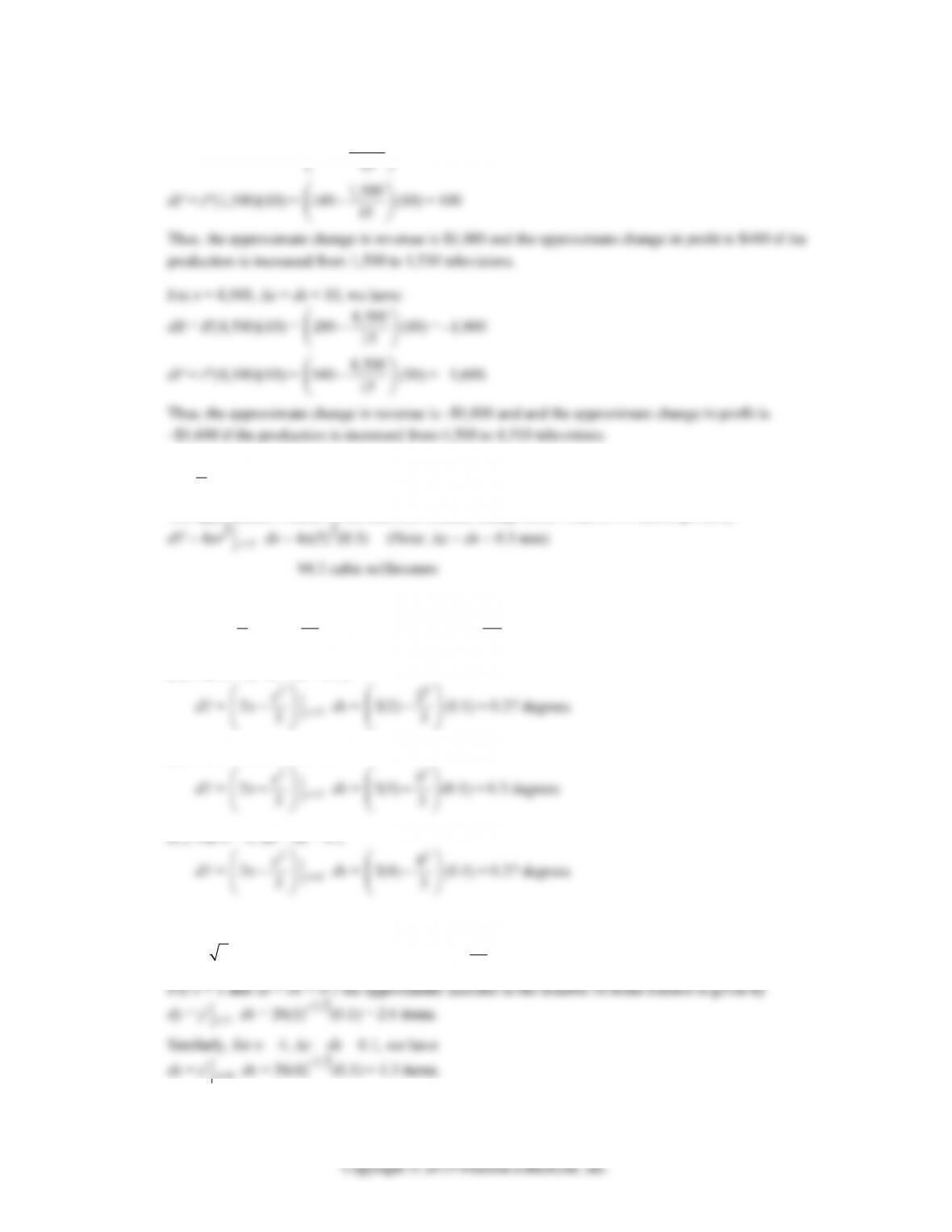
9-40 CHAPTER 9: LIMITS AND THE DERIVATIVE
Now, for x = 1,500, ∆x = dx = 10, we get
dR = R‘(1,500)(10) = 1, 500
200 15
(10) = 1,000
50. V = 4
3
πr3; V‘ = 4πr2.
The approximate volume of the shell for a radius change from 5 mm to 5.3 mm is given by:
52. T = x23
2
1,
99
x
x
x
0 ≤ x ≤ 6;
2
‘2 .
3
x
Tx
(A) For x = 2, ∆x = dx = 0.1,
2
x
2
2
(B) For x = 3, ∆x = dx =0.1
2
x
2
3
(C) For x = 4, ∆x = dx = 0.1
2
x
2
4
54. y = 52
x
, 0 ≤ x ≤ 9; y = 52x1/2 and hence y‘ = 52
2x-1/2 = 26x-1/2.