CASE 9
Enron: Questionable Accounting Leads to
Collapse
CASE NOTES FOR INSTRUCTORS
The purpose of this case is to show how it is possible for a well-known and respected company to become
swept up in unethical and illegal business practices, which can result in damage to thousands of
employees, investors, and other stakeholders. Although this case is complex and involves many actors,
one important point that emerges is how a number of individuals, including attorneys, auditors,
executives, and employees, apparently worked together to achieve Enron’s objectives, even though these
objectives were unethical and often not in the best interests of stakeholders.
Since the collapse of Enron, many executives who worked for the company or had business dealings with
it have been swept up in the investigations and prosecutions of the former energy giant. Many of the
people convicted of crimes connected to Enron have already served their sentences, but Jeff Skilling
remains in prison after being convicted of honest services fraud. However, in June 2010 the United States
Supreme Court ruled that Skilling should not have been tried under the honest services law because it was
intended for bribes and kickbacks, not for conduct that is ambiguous or vague. However, the court’s
decision did not overturn Skilling’s conviction, but sent the case back to a lower court for evaluation. To
this day, Jeffrey Skilling continues to maintain his innocence and appeal his case. In April of 2012, the
Supreme Court denied his appeal, claiming any errors made in the trial were negligible. However, the
following year a federal judge reduced Skilling’s sentence to 14 years.
Case 9: Enron: Questionable Accounting Leads to Collapse 101
QUESTIONS AND DISCUSSION
1. How did the corporate culture of Enron contribute to its bankruptcy?
Most students will agree that Enron appears to have had a highly unethical corporate culture.
However, this point may be missed by students who are unfamiliar with business ethics and by those
who view Enron’s difficulties as stemming from accounting or auditing problems. In reality, the root
2. Did Enron’s bankers, auditors, and attorneys contribute to Enron’s demise? If so, how?
All corporations are supposed to have a number of different gatekeepers in place who ensure that the
business’ dealings are transparent and in compliance with the law. However, in the case of Enron,
these gatekeepers, such as accountants, independent auditors, and government regulators, failed to
Students can also take this opportunity to discuss the roles of individuals and personal responsibility
within the larger corporate structure. Several gatekeepers and employees had opportunities to uncover
and report ethical lapses, but very few people ever questioned Enron’s practices. Highly idealistic
students could argue that individuals could have prevented the company’s collapse and worked to
influence the corporate culture; however, other students may argue that it is easy to become swept
away in an unethical environment, particularly if the organization is powerful and respected like
Enron was.
102 Case 9: Enron: Questionable Accounting Leads to Collapse
3. What role did the company’s chief financial officer play in creating the problems that led to Enron’s
financial problems?
This question should help students better understand the role of the chief financial officer (CFO), a
role filled at Enron by Andrew Fastow, who was key in creating Enron’s financial problems.
Representing the final word on a corporation’s finances, the CFO plays a very important role in most
firms. At Enron, most believe that it was Fastow who masterminded many of the unethical/illegal
financial transactions that ultimately led to the destabilization and demise of the company. In his
position as CFO, Fastow had access to information and numbers to which Skilling and Lay did not.
He was in a unique position to manipulate Enron’s financial reports to make Enron appear strong and
profitable no matter how unstable the company actually was.
ADDITIONAL RESOURCES
• Ungagged.net: The Other Side of the Enron Story offers the perspectives of Enron employees
who believe they were the victims of the federal government’s desire to get convictions and place
Case 9: Enron: Questionable Accounting Leads to Collapse 103
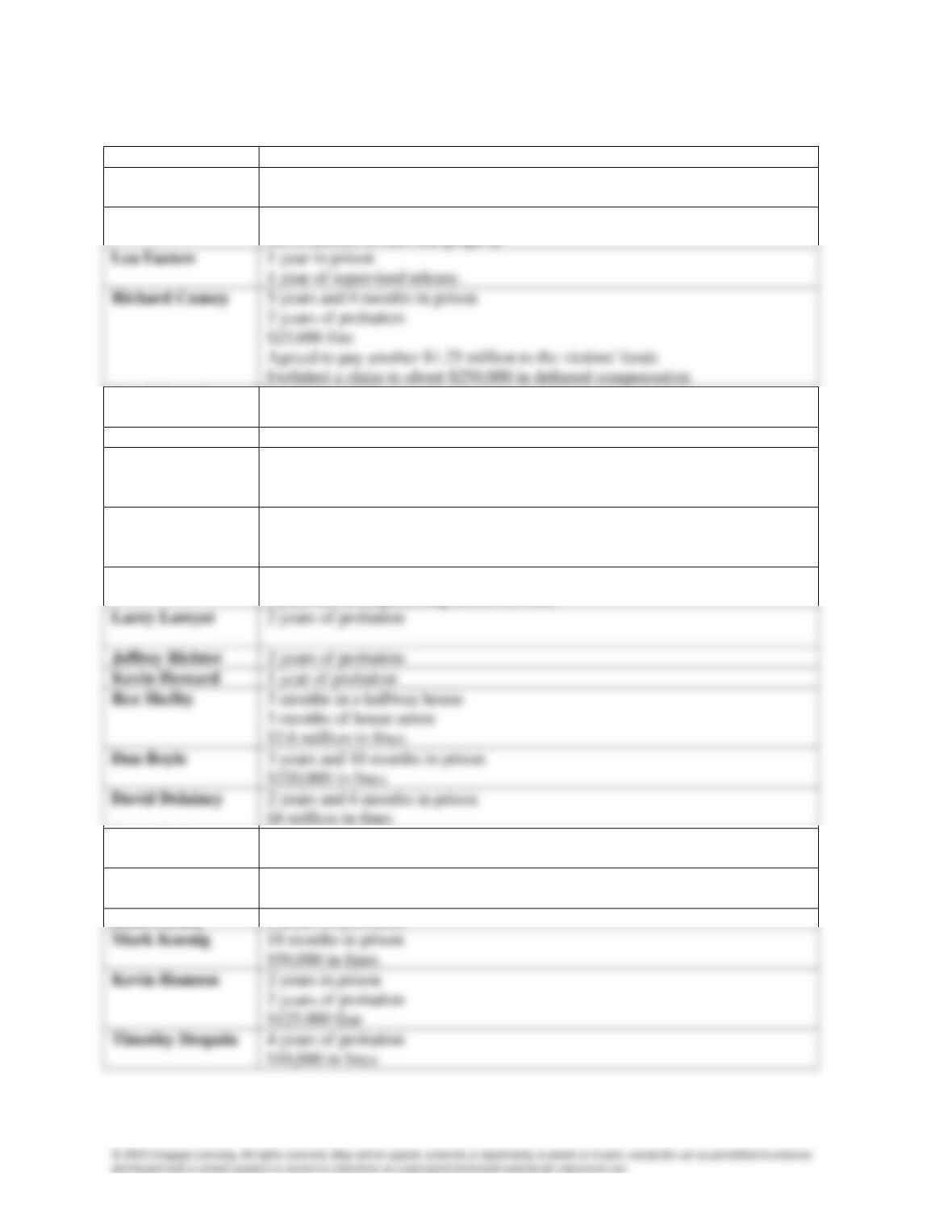
Key Enron Figures and Their Sentences
Name
Sentence
Jeffrey Skilling
24 years and 4 months in prison; sentence reduced to 14 years
$45 million in fines
Andrew Fastow
6 years in prison
$23.8 million in cash and property
Lea Fastow
1 year in prison
1 year of supervised release.
$25,000 fine
Agreed to pay another $1.25 million to the victims’ funds
Forfeited a claim to about $250,000 in deferred compensation
Ben Glisan Jr.
5 years in prison
Michael Kopper
37 months in prison, served 23 months
Jordan Mintz
$25,000 in civil fines
$1 in disgorgement
2 year ban from practicing before the SEC
David Duncan
$25,000 in civil fines
$1 in disgorgement
2 year ban from practicing before the SEC
Timothy Belden
$2.1 million in fines
2 year ban from practicing before the SEC
Larry Lawyer
2 years of probation
Jeffrey Richter
2 years of probation
Kevin Howard
1 year of probation
3 months of house arrest
$3.6 million in fines
Dan Boyle
3 years and 10 months in prison
$320,000 in fines
David Delainey
2 years and 6 months in prison
$8 million in fines
Paula Rieker
2 years of probation
Kenneth Rice
27 months in prison
$15 million in fines
John Forney
2 years of probation
Mark Koenig
18 months in prison
$50,000 in fines.
2 years of probation
$125,000 fine
Timothy Despain
4 years of probation
$10,000 in fines