Chapter 09 – Management of Quality
9-1
CHAPTER 9
MANAGEMENT OF QUALITY
Teaching Notes
This chapter is devoted to quality management. It presents a definition of quality, discusses the
importance of quality and the determinations of quality, highlights the views of leading experts on
Total Quality Management (TQM) is a popular approach that:
2. Defines quality in terms of customer requirements.
4. Uses statistical reasoning with data to solve problems and to improve the process.
6. Utilizes appropriate education and training to everyone in the organization in a continuous
fashion.
8. Encourages empowerment of the employees in the work place in order to improve job design,
job performance and continuous improvement in all aspects of the organization.
TQM is an approach that views quality improvement as a never-ending quest to improve the
conversion process so that the level of customer satisfaction continually rises. Since the Japanese have
been so successful in continuously improving the quality of their products and services, Kaizen, or

Chapter 09 – Management of Quality
9-2
The material in this chapter is divided into the following major topics
1. Overview of TQM
3. Continuous Process Improvement
4. Seven Quality Tools
a. Check Sheets
5. Strategic Issues in implementing TQM
6. Plan-Do-Study-Act Cycle
7. Methods for Generating Ideas
a. Run Charts
Chapter 09 – Management of Quality
9-3
Reading: Benchmarking Corp. Web sites of Fortune 500 Companies
Reason for the importance of each factor.
Factor
Importance
1
Use of meta tags
Conveys information to web crawlers about the
site.
6
Speed of loading
Some potential viewers will not be willing to wait
if loading is slow.
7
Bad links
Frustrates visitors, and doesn’t give impression of
a site that is “current.”
documents on any web site. It details how
information collected from visitors will be treated.
12
Presence of a search engine
Allows visitors to easily find what they are
looking for on the site.
13
Translation to multiple languages
Broadens the potential audience.
Answers to Discussion and Review Questions
1. a. Convenience: the availability and accessibility of the service.
Reliability: the ability to perform a service dependably, consistently, and accurately.
Responsiveness: the willingness of service providers to help customers in unusual
situations and to deal with problems.
b. The primary determinants of quality are design, conformance to design (materials and
workmanship), ease of use (partly related to design, but also a function of user
instructions and sometimes training), and service after delivery.
2. Design quality refers to the degree to which a product or service would ideally be fit for use.
Quality of conformance refers to how well a product or service matches design specifications.
Chapter 09 – Management of Quality
9-4
b. Organizations must pay special attention to their potential liability due to damages or
injuries resulting from either faulty design or poor workmanship.
4.
Dimension
Television Set
Performance
On, off, sound, color, picture
Special features
Remote control, inset picture, stereo sound
Reliability
Infrequency of breakdowns and repair work
Durability
Useful life in terms of time and use
Service after sale
Handling of complaints, requests for information, repair
work (cost, time, reliability, courtesy and trust)
Conformance
Meets or exceeds our expectations
Safety
UL approved
Aesthetics
Shiny black cabinet
Dimension
Restaurant Meal (Product)
Performance
Taste, smell, color, arrangement of food, cleanliness,
tableware
Special features
Specialties of the house, wines, cocktails, desserts,
atmosphere, music
Reliability
Consistently excellent day after day
Conformance
Meets or exceeds our expectations
Service after sale
Friendly, courteous, appreciative
Safety
Sanitary handling
Aesthetics
Looks appetizing
Dimension
Restaurant Meal (Service)
Performance
Friendly, courteous, appreciative, timely, manners, poise,
nimbleness, knowledge of food and wines
Special features
Extra service, special favors, knowledge of customer—likes,
dislikes, special dates, makes customer feel special
Reliability
Consistently excellent day after day in every way
Conformance
Meets or exceeds our expectations
Service after sale
Friendly, courteous, appreciative
Safety
Careful with hot beverages, carrying loads of dishes
Aesthetics
Clean uniforms
Chapter 09 – Management of Quality
9-5
Dimension
Painting a House
Performance
Neatness, cleanliness, appearance, thoroughness, reasonable
speed
Special features
Knowledge of colors, minor repairs, suggestions, knowledge
of paint
Dimension
Surgery and after-surgery care
Performance
Surgery successful and after care appropriate .
Special features
An attentive and caring staff.
Reliability
Consistent, meets or exceeds medical standards, experienced
staff.
Durability
How well the surgery holds up.
Conformance
Meets or exceeds medical standards and expectations.
Service after sale
Addresses any concerns after leaving surgical center.
Safety
Cleanliness, patient safety and well being.
Aesthetics
Setting is calming, restful.
5. a. (Various responses.)
b. Among the possible reasons: Often these are the extremes – A customer is either very
6. A major component of the quality-ethics interface involves firms knowingly allowing
substandard products to be manufactured and sold or organizations knowingly providing
substandard service to customers.
Reliability
Consistently excellent job after job
Durability
Length of time it lasts and looks good
Conformance
Meets or exceeds our expectations
Service after sale
Cleans up mess, friendly, courteous, appreciative
Safety
Careful with ladders, tools and paint not in walkways
Aesthetics
Appearance of completed work
Chapter 09 – Management of Quality
9-6
7. Quality Gurus:
W. Edwards Deming: Deming is known as the senior quality guru. He was a statistics
professor at New York University. He went to Japan to assist the Japanese in improving
quality and productivity. As a result of his successful accomplishments in Japan, the Japanese
established the prestigious Deming prize, which is awarded annually to firms that distinguish
The key elements of Deming’s 14 points are: constancy of purpose, continual improvement,
and profound knowledge. Profound knowledge has four key components:
a. An appreciation for a system.
b. A theory of variation (develop a system to reduce the variation in output and distinguish
between special and common causes of variation).
8. a. ISO 9000 is a set of international standards on quality management. The International
Organization for Standardization (ISO) promotes worldwide standards that will improve
efficiency and productivity. The ISO 9000 standards are important for doing business
internationally, especially in Europe. Over 40,000 companies are certified by ISO. In
b. One is an award, the other certifies a level of competence. The Baldrige Award is
designed to stimulate quality improvement efforts and recognize achievements in U.S.
Chapter 09 – Management of Quality
9-7
9. Quality management emphasizes preventing mistakes or correcting them after they occur.
There is a direct trade-off between investment in quality programs and investment in failure
costs. If the quality is poor, the failure costs will be high. The productivity can be
10. TQM is a quest for quality that involves everyone in the organization. The key elements of the
TQM approach are continuous improvement and an emphasis on customer satisfaction.
11. Seven Quality tools are:
a. Check sheet: A tool for organizing and collecting data. It is a tally of problems and other
events by category.
e. Pareto chart: A chart that arranges categories from highest frequency of occurrence to
lowest frequency of occurrence. Pareto chart distinguishes the few critical factors from the
many trivial factors.
f. Control chart: A statistical chart of time ordered values of a sample statistic. It involves
setting upper and lower limits to determine potential causes of problems in a given
process.
12. a. Brainstorming is a technique in which a group of people share ideas and thoughts in a
relaxed atmosphere on various problems in order to stimulate unrestrained collective
thinking.
13. There are four basic steps in the plan-do-study-act cycle:
Plan. Begin by studying the current process. Standardize that process. Then collect data in
order to identify problems. Next, analyze data and develop a plan for improvement.
Specify measures to be used for evaluating the plan.
Chapter 09 – Management of Quality
9-8
Do. Implement the plan, on a small scale if possible. Document any changes that are made
during this phase. Collect data systematically for evaluation.
14. Steps of Problem Solving:
a. Define the problem and establish an improvement goal
b. Collect data
15. a. Pareto Analysis: Assume that a company has just been bought by another company. Based
on an initial study, it has been established that the organization is suffering from
numerous quality problems. A committee is formed to study the quality related
problems. One of the first tasks of the committee is to enumerate the various problems
experienced by this company and identify the more important problems so that we can
take corrective action. In this context, the company is considering to use Pareto
analysis to differentiate the few important problems from many trivial problems.
c. Flow chart: The company has moved one of its plants to a new location. In the process of
moving, the layout of the plant was altered. As a result of the alteration the company is
having difficulty locating material and controlling its operations. The plant manager thinks
Chapter 09 – Management of Quality
9-9
16. Steps of process improvement:
a. Process Mapping.
17. See textbook for the answer to problem 14.
Taking Stock
1. The more a company spends on quality improvement, the higher the potential quality of the
product. In some cases, while improving quality, we can simultaneously reduce our cost
because of elimination of waste and duplicate effort. However, spending more money on
2. Setting priorities for quality improvement need to vertically transcend the entire organization.
Therefore, at the macro level, upper management needs to be heavily involved in determining
the desired level of quality. Obviously, marketing department, due to its close contact with the
3. The technology had a profound impact on quality. Improvement in measurement systems
drastically improved the measurement of quality. Computer technology has enabled many
Critical Thinking Exercise
1. Possibly, the cost of the wages of the additional repair personnel was being observed by the

Chapter 09 – Management of Quality
9-10
2. Customer retention is important because it typically costs a lot less to retain current customers
than it does to attract new customers. One possible reason that “satisfied customers” leave is
that “customer satisfaction” is not enough. Retention may require exceeding customer
expectations. Another possibility is that no matter what you do, you won’t be able to retain
some customers.
3. Compared to decentralized processing, a single processing facility would entail more
transportation to and from, so more chances for contamination as well as higher transportation
4. Student answers will vary.
Chapter 09 – Management of Quality
9-11
Memo Writing Exercises
1. Benefits of doing a task correctly the first time will prevent duplication of effort later when we
2. Entering the Baldrige Award competition will increase the quality consciousness of our
company. It will motivate the company and its workers to improve quality, productivity, and
3. TQM is a never ending pursuit of quality that involves everyone in the organization. It
emphasizes the customer, customer defined quality, employee empowerment, and continuous
improvement of the processes. If implemented correctly, it will lead to significant
improvements in quality of products or services and productivity of the firm’s operations.
4. There is always fear of change and people often react negatively to it. Try to get as many of
the participants involved as possible. Make sure they know how it will benefit them. There is
5. Let’s discuss grocery shopping. If grocery shopping is not done correctly the first time, we
may have to make an extra trip to the grocery store for an item that was forgotten. Dinner may
Chapter 09 – Management of Quality
Solutions
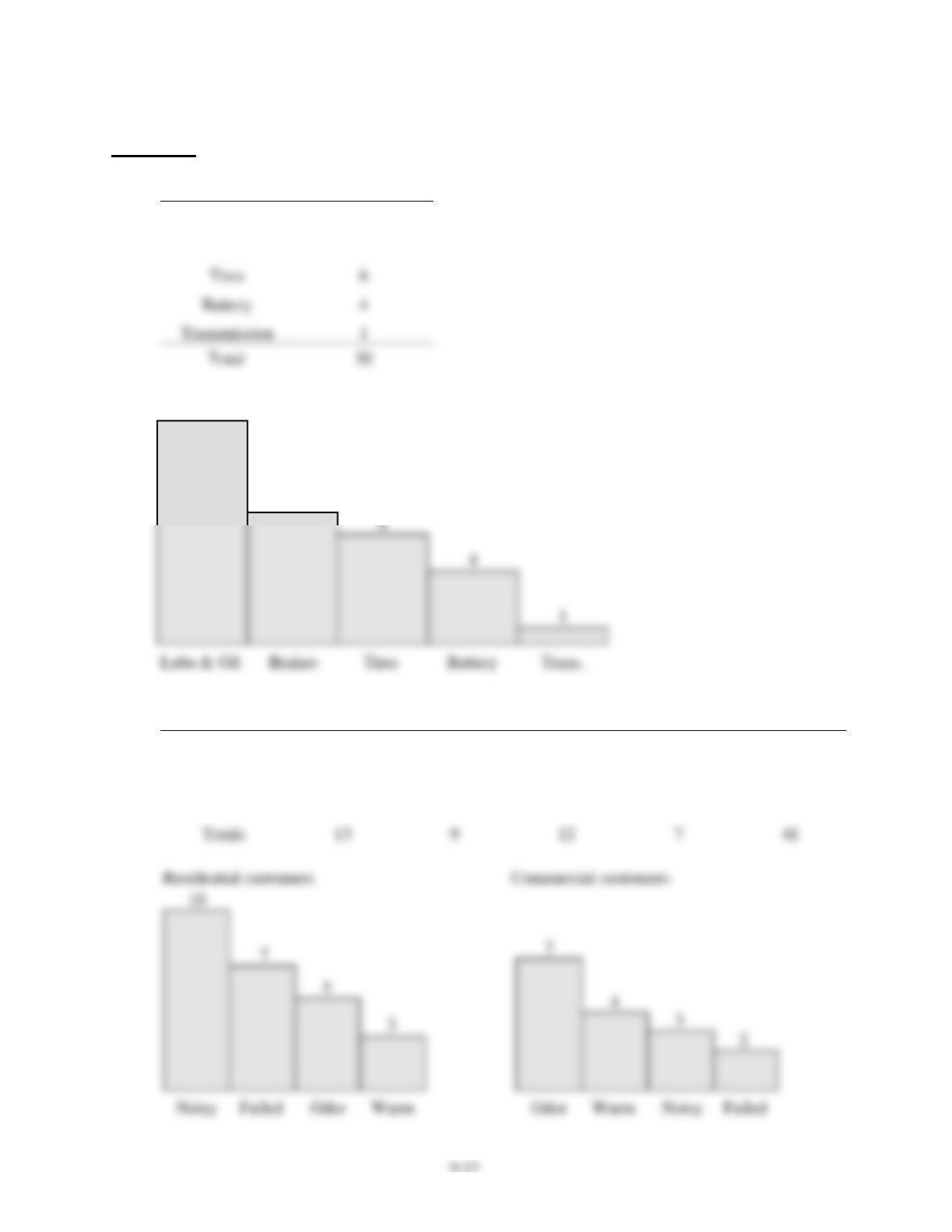
1.
Checksheet
Work Type
Frequency
Lube and Oil
12
Brakes
7
4
Pareto
4
1
2.
Checksheet
Problem
Customer Type
Noisy
Failed
Odor
Warm
Totals
Residential
10
7
5
3
25
Commercial
3
2
7
4
16
13
9
12
7
41
12
7
Chapter 09 – Management of Quality
9-13
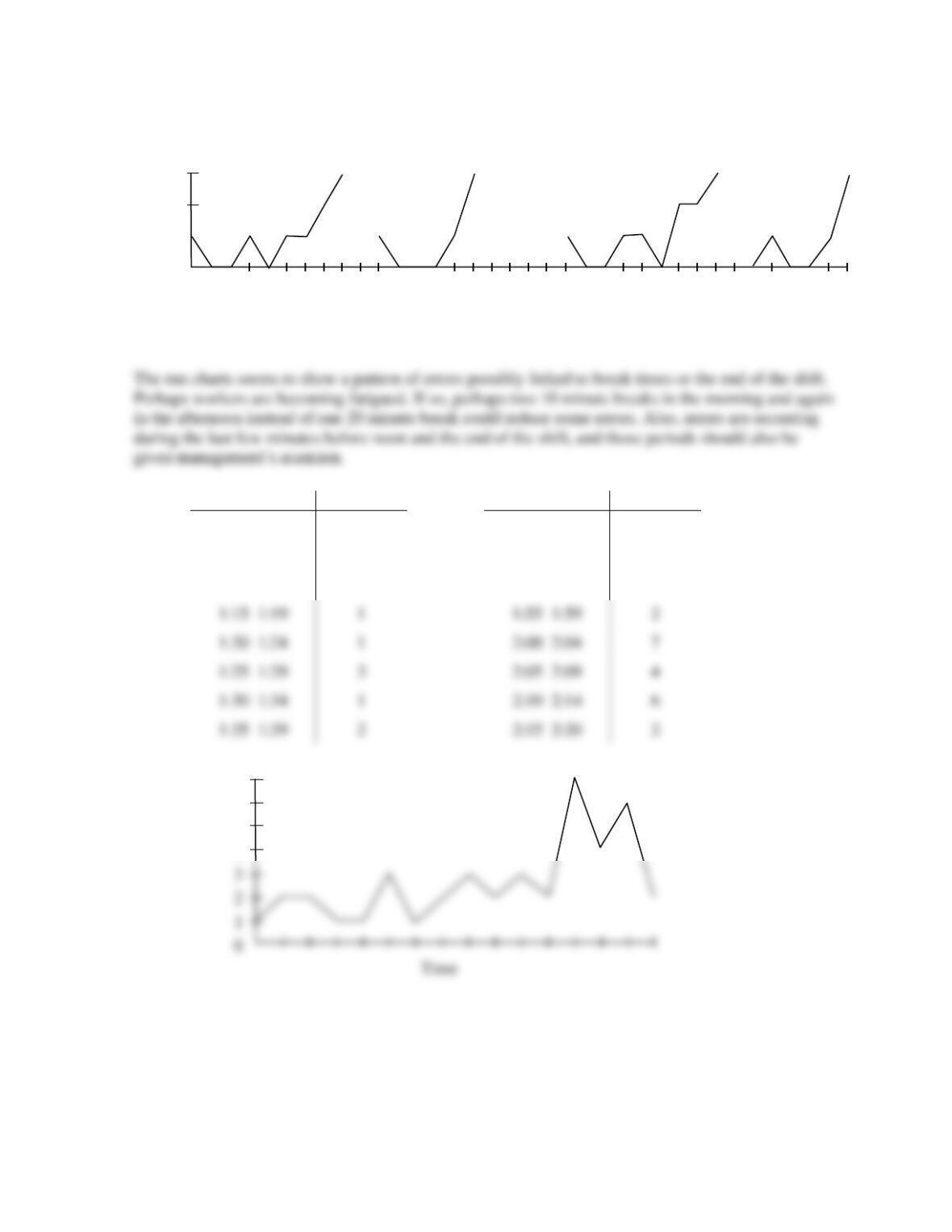
3.
4.
Time
Count
Time
Count
1:00–1:04
1
1:40–1:44
3
1:05–1:09
2
1:45–1:49
2
1:10–1:14
2
1:50–1:54
3
1:15–1:19
1
1:55–1:59
2
1:20–1:24
1
2:00–2:04
7
1:25–1:29
3
2:05–2:09
4
1:30–1:34
1
2:10–2:14
6
1:35–1:39
2
2:15–2:20
2
break lunch break
3
2
1
0
•
•
•
•
•
•
•
•
•
•
•
•
•
•
•
•
•
•
•
•
•
•
•
•
•
•
•
•
•
•
7
6
5
4
Chapter 09 – Management of Quality
9-14
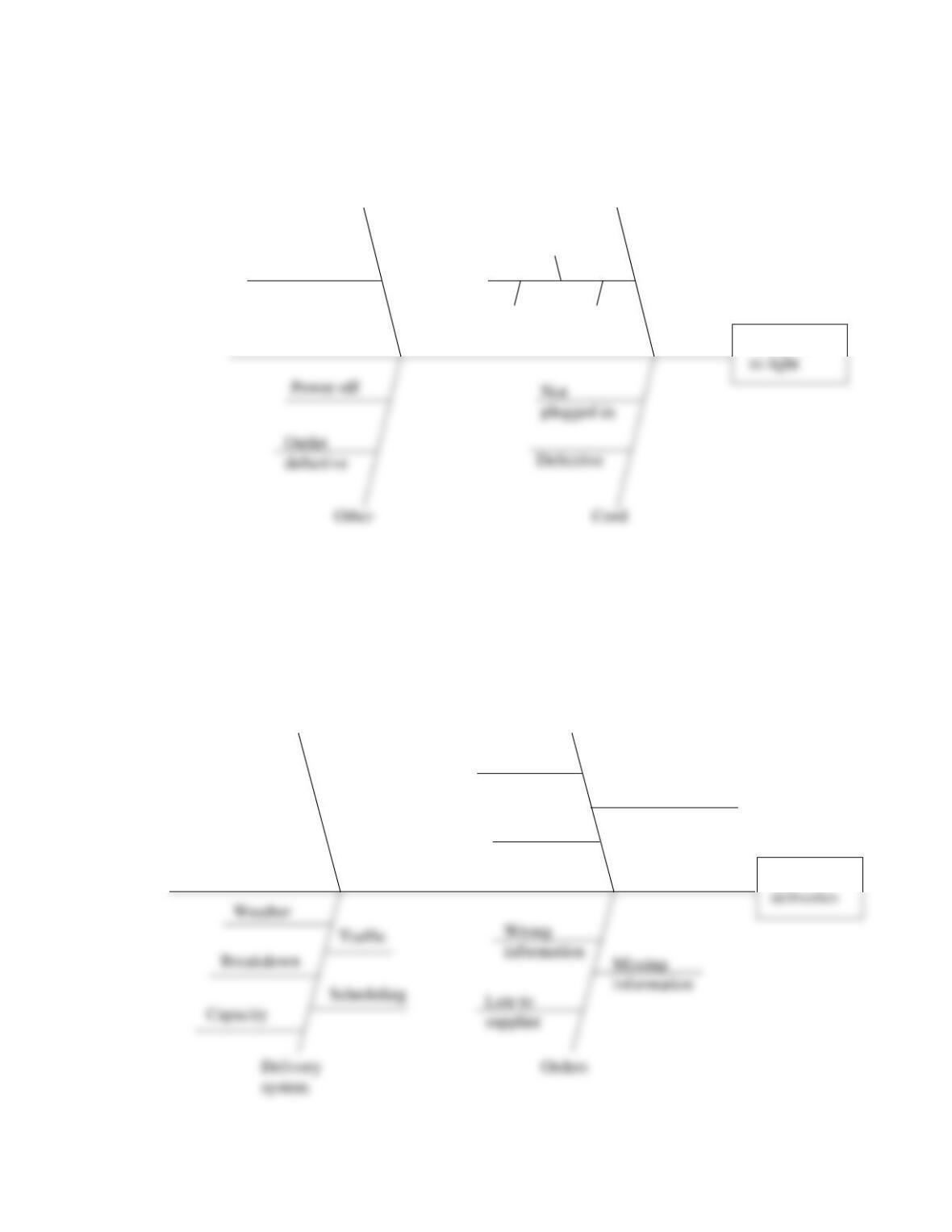
Bulb
Supplier
Inadequate
record keeping
Insufficient
capacity
Poor
scheduling
Late
Not
plugged in
Person
Lamp
Missing
Didn’t turn
completely on
Burned
out
Loose
Lamp fails
5.
6.
Weather