Chapter 09 – Human Resource Management: Getting the Right People for Managerial Success
9-21
(1) Reliability is the degree to which a test measures the same
thing consistently, so that an individual’s score remains about
Interactive Classroom Material:
PRACTICAL ACTION: Personality Tests: How a Sporting-Goods Chain Screens
Job Applicants Online (p. 272)
At Finish Line, a nationwide chain of sporting-goods stores, store managers use the
results of Web-based personality tests developed by Unicru to screen applicants for
jobs as retail sales clerks.
YOUR CALL
What questions would you want to ask about a personality test before you
submitted yourself to it?
One may wonder the types of knowledge, skills and abilities the personality test is
Additional Activities:
One way that you could build on this Practical Action is to have the students read the
HR Magazine article “Heads Up!” This article explores the increased use of

Chapter 09 – Human Resource Management: Getting the Right People for Managerial Success
9-22
Section 9.3 discusses managing compensation. Compensation includes wages or
salaries, incentives, and benefits.
Possible Topics for Discussion:
• Describe the benefits offered by your company (or a previous one) and discuss
which ones are the most important to you.
Major Idea Outline:
A. Compensation has three parts: (1) wages or salaries, (2) incentives, and (3)
benefits.
B. Wages or Salaries
9.3 Managing an Effective Workforce: Compensation &
Benefits (pp. 274-275)
What are the various forms of compensation?
Chapter 09 – Human Resource Management: Getting the Right People for Managerial Success
9-23
1. Base pay consists of the basic wage or salary paid employees in
exchange for doing their jobs.
2. The basic compensation is determined by factors such as:
a. the prevailing pay levels in an industry
C. Incentives – Many organizations offer incentives, such as commissions,
bonuses, profit-sharing, and stock options.
Interactive Classroom Material:
PRACTICAL ACTION: Why Rewards May Fail to Motivate (p. 275)
There are many incentive compensation plans, ranging from cash awards and gifts to
profit sharing and stock ownership, as we discuss in detail in Chapter 12. Why,
despite the huge investments of time and money, do they often not achieve the
results? This Practical Action discusses eight possible reasons.
Additional Activities:
One way that you could build on this Practical Action is to have the students go to the
WorldatWork website and learn more about its “Total Rewards Model.” The model
Chapter 09 – Human Resource Management: Getting the Right People for Managerial Success
9-24
D. Benefits, or fringe benefits, are additional nonmonetary forms of
compensation designed to enrich the lives of all employees in the organization.
1. Examples: health insurance, dental insurance, life insurance, retirement
Section 9.4 discusses three ways newcomers are helped to perform their jobs. These
include orientation, to fit them into the job and organization; training, to upgrade the
skills of technical and operational employees; and development, to upgrade the skills of
professionals and managers.
One way that you could begin your coverage of these topics is to have the students
Possible Topics for Discussion:
• Evaluate the effectiveness of the orientation training that you received for your
last job. What was good about the training and what could have been better?
Major Idea Outline:
A. Employees are an important asset; organizations can increase their value
through effective orientation, training, and development.
9.4 Orientation, Training, & Development (pp. 276-279)
Once people are hired, what’s the best way to see that they do what
they’re supposed to do?
9-25
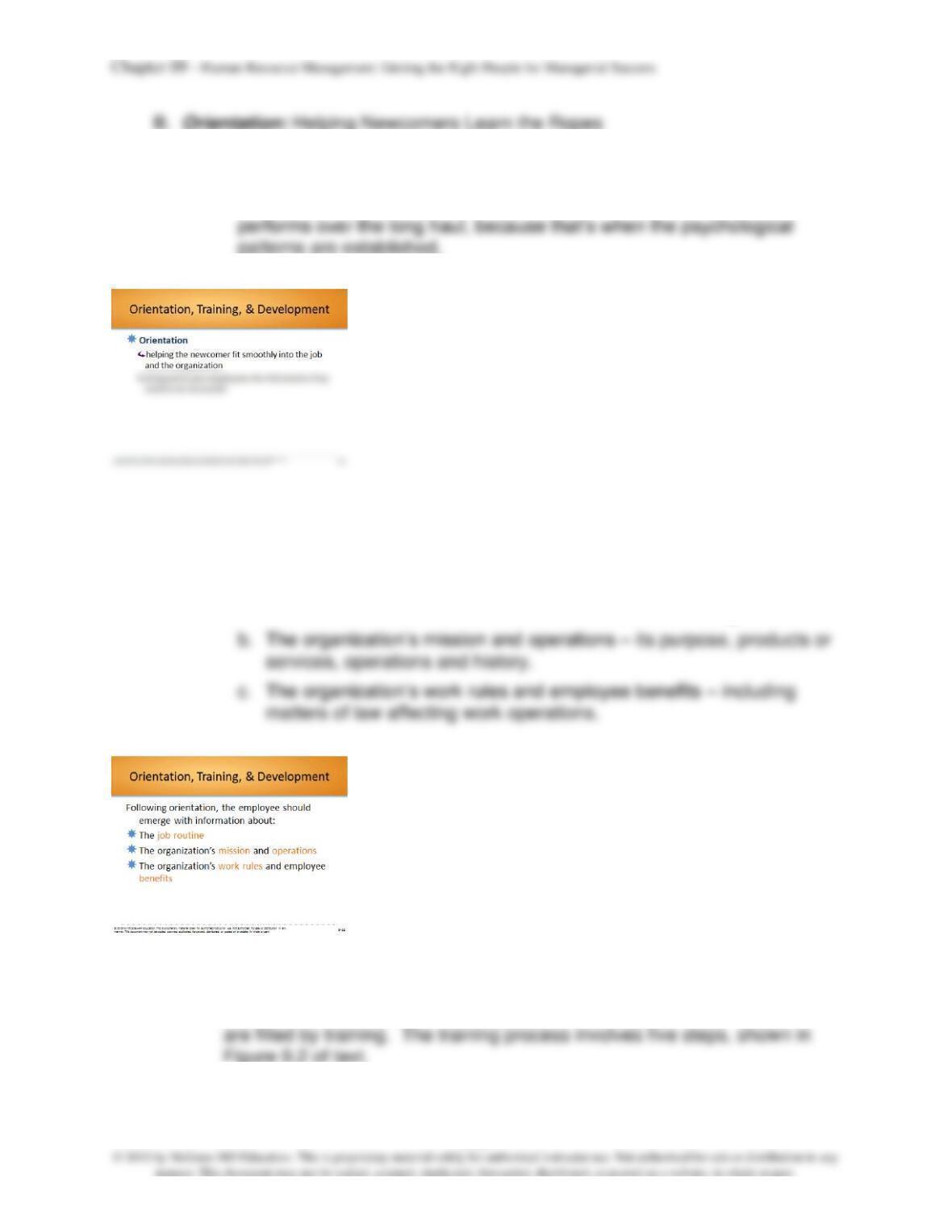
1. Orientation is helping the newcomer fit smoothly into the job and the
organization.
2. The first 6 months on the job can be critical to how an employee
3. Whether formal or informal, the initial socialization period is designed to
give new employees the information they need to be effective. The
employee should emerge with information about:
a. The job routine – what is required in the job, how the work will be
evaluated, and who the immediate coworkers and managers are.
C. Training and Development: Helping People Perform Better
1. For even the best qualified employees, there are gaps in knowledge that
Chapter 09 – Human Resource Management: Getting the Right People for Managerial Success
9-26
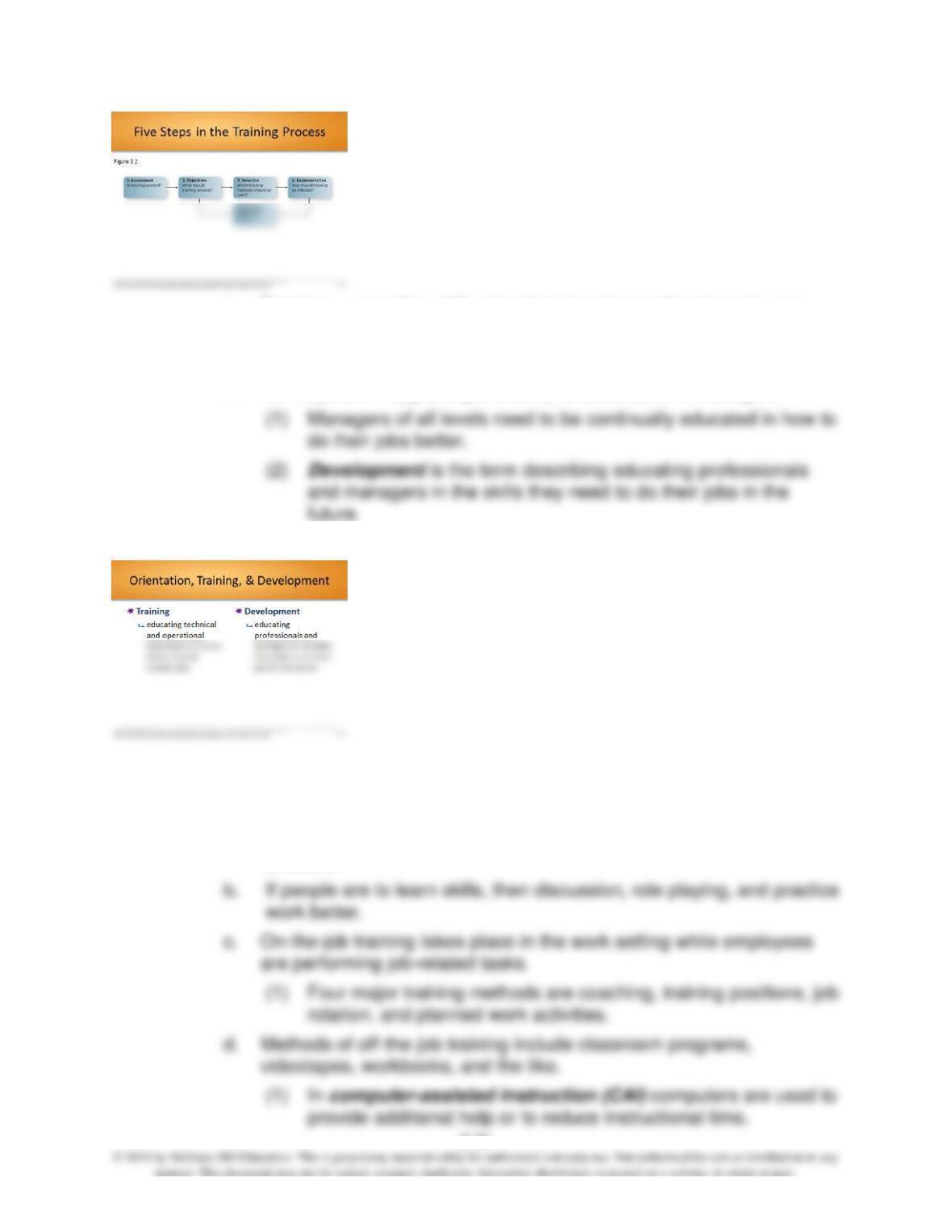
a. Training—upgrading skills of technical and operational employees
(1) Training refers to educating technical and operational
employees in how to better do their current jobs.
b. Development—upgrading skills of professionals and managers
2. Different kinds of training and development methods are used to teach
facts and to teach skills.
a. If people are to learn facts, lectures, videotapes, and workbooks are
effective.
Chapter 09 – Human Resource Management: Getting the Right People for Managerial Success
9-27
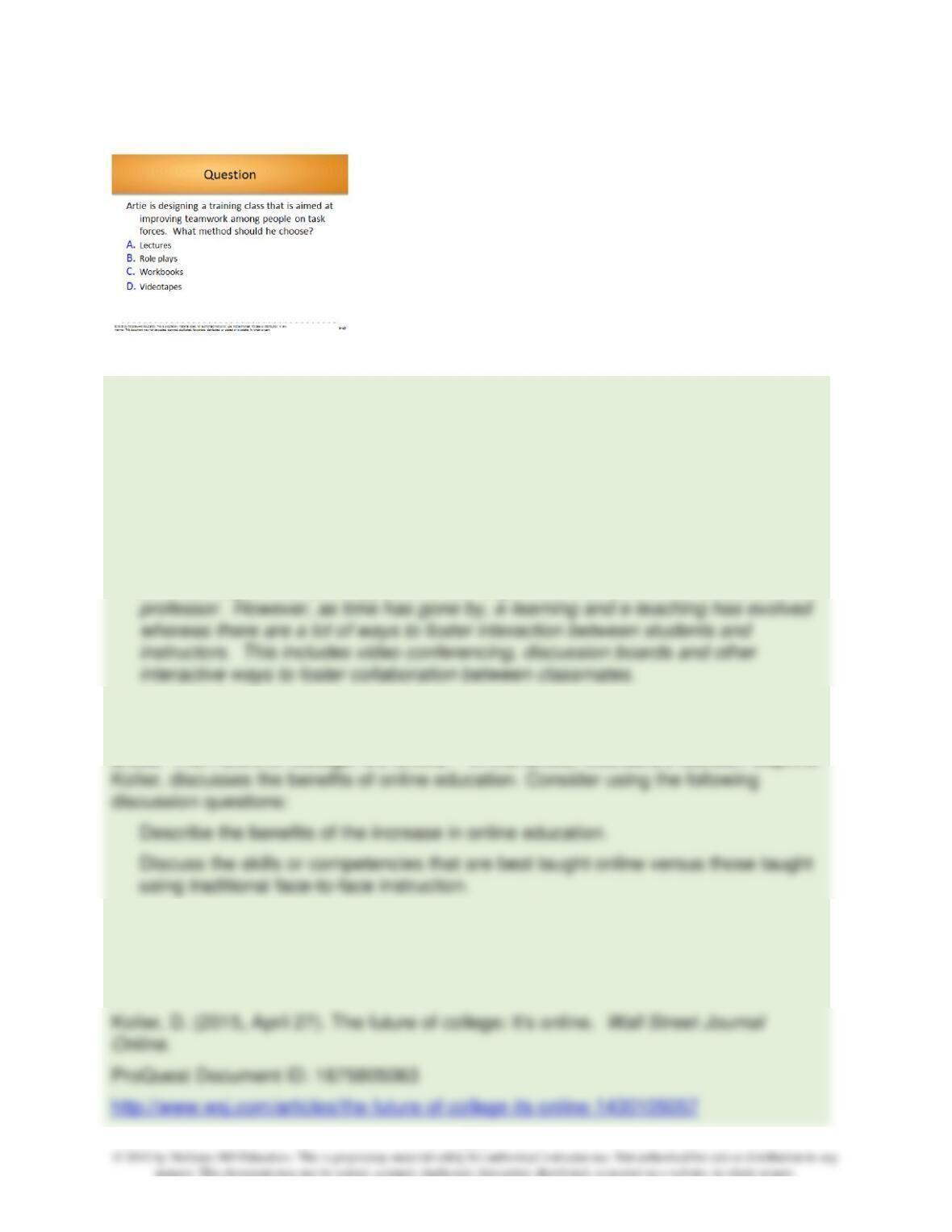
(Correct answer is B)
Interactive Classroom Material:
EXAMPLE: Off-the-Job Training: Getting Ahead through E-Learning (p. 279)
Approximately 30% of training occurs via e-learning and virtual classrooms.
YOUR CALL
Neuroscientists are finding out that the brain is a “social animal” that needs
interaction with others. How do you think this fact relates to e-learning? Do
you think you learn better in a classroom rather than online?
One can argue that some types of e-learning inhibit interaction with others and the
Additional Activities:
One way to build on this Example is to have the students read the Wall Street Journal
article “The Future of College: It’s Online.” In this article, Coursera’s founder, Daphne
How can academic institutions create a competitive advantage in an age where
many universities are giving their content away for free through online open
courses?
Article Citation

Chapter 09 – Human Resource Management: Getting the Right People for Managerial Success
9-28
SELF-ASSESSMENT 9.3 (p. 279)
Is a Career in HR Right for You?
Go to connect.mheducation.com and take Self-Assessment 9.3.
Student Questions:
1. Are you suited for a career in human resources? Which specific aspect of
human resources do you prefer?
Students will respond with HR generalist, compensation professional, HRIS
2. Look at the top two areas of HR for which you tested as being best suited.
Look over the descriptions of these fields and then identify what skills you
need to have to be successful.
3. Even if you do not pursue a career in HR, which skills do you feel you should
continue to develop? Explain.
Section 9.5 discusses performance appraisals. Performance appraisals, or assessing
employee performance and providing them feedback, may be objective or subjective.
9.5 Performance Appraisal (pp. 280-284)
How can I assess employees’ performance more accurately and give
more effective feedback?
Chapter 09 – Human Resource Management: Getting the Right People for Managerial Success
9-29
Possible Topics for Discussion:
• Critique the performance management process at your company (or a previous
one) and discuss ways the process might be improved.
Major Idea Outline:
A. Performance Management in Human Resources
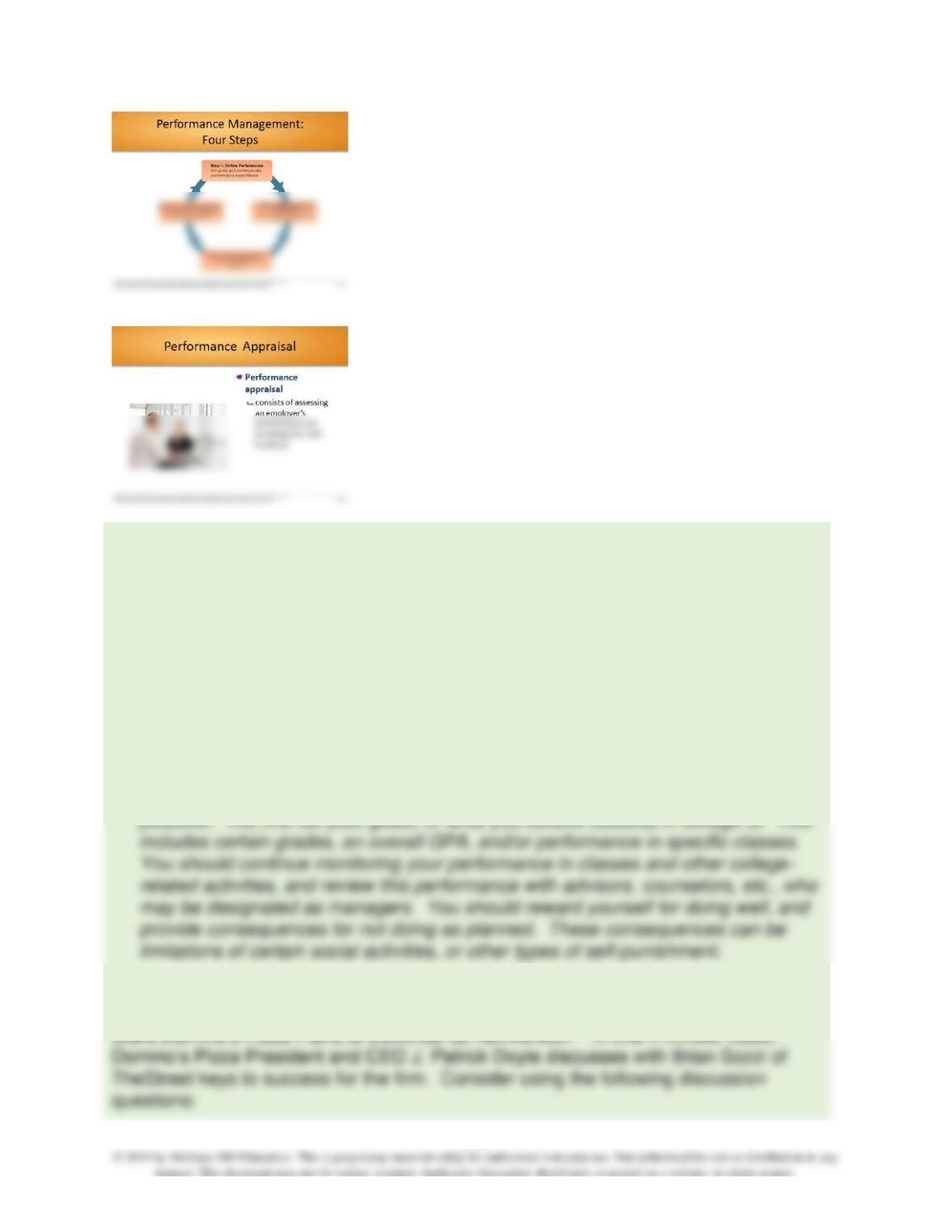
1. Feedback about how you’re doing at work is part of performance
appraisal, which consists of (1) assessing an employee’s performance
and (2) providing him or her with feedback.
Chapter 09 – Human Resource Management: Getting the Right People for Managerial Success
9-30
Interactive Classroom Material:
EXAMPLE: Performance Management: How Domino’s Pizza Built a Billion–
Dollar Business (p. 281)
The founder of Domino’s Pizza, Tom Monaghan, grew the business, which he later
sold for $1 billion, by using performance management.
YOUR CALL
In your current job—being a student—how effective do you think Domino’s
approach to performance management could be in helping you excel at
college? Who would you designate as your “manager,” how often would you
meet, and what kind of goals and action plans would you set?
Getting ahead in college using Domino’s approach to performance management is
Additional Activities:
One way to build on this Example is to have the students watch the video “How Pizza
Chapter 09 – Human Resource Management: Getting the Right People for Managerial Success
9-31
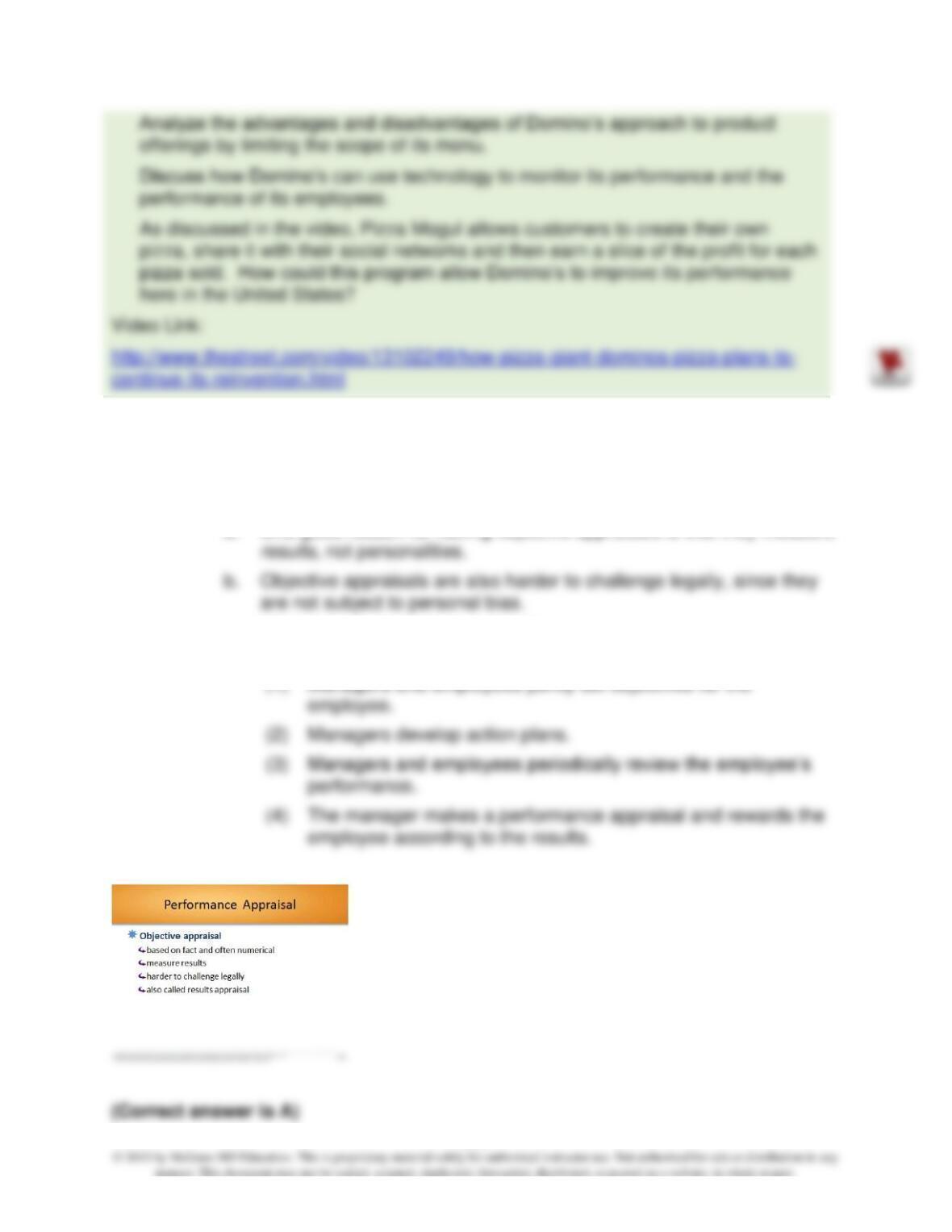
B. Two Kinds of Performance Appraisal: Objective & Subjective
1. Objective appraisals, also called results appraisals, are based on facts
and are often numerical.
a. One good reason for having objective appraisals is that they measure
c. Management by objectives (MBO) is an objective approach used to
encourage employees to produce specific results.

Chapter 09 – Human Resource Management: Getting the Right People for Managerial Success
9-32
2. Subjective appraisals are based on a manager’s perceptions of an
employee’s traits or behaviors.
a. Trait appraisals are ratings of subjective attributes such as “attitude,
“initiative” and “leadership”.
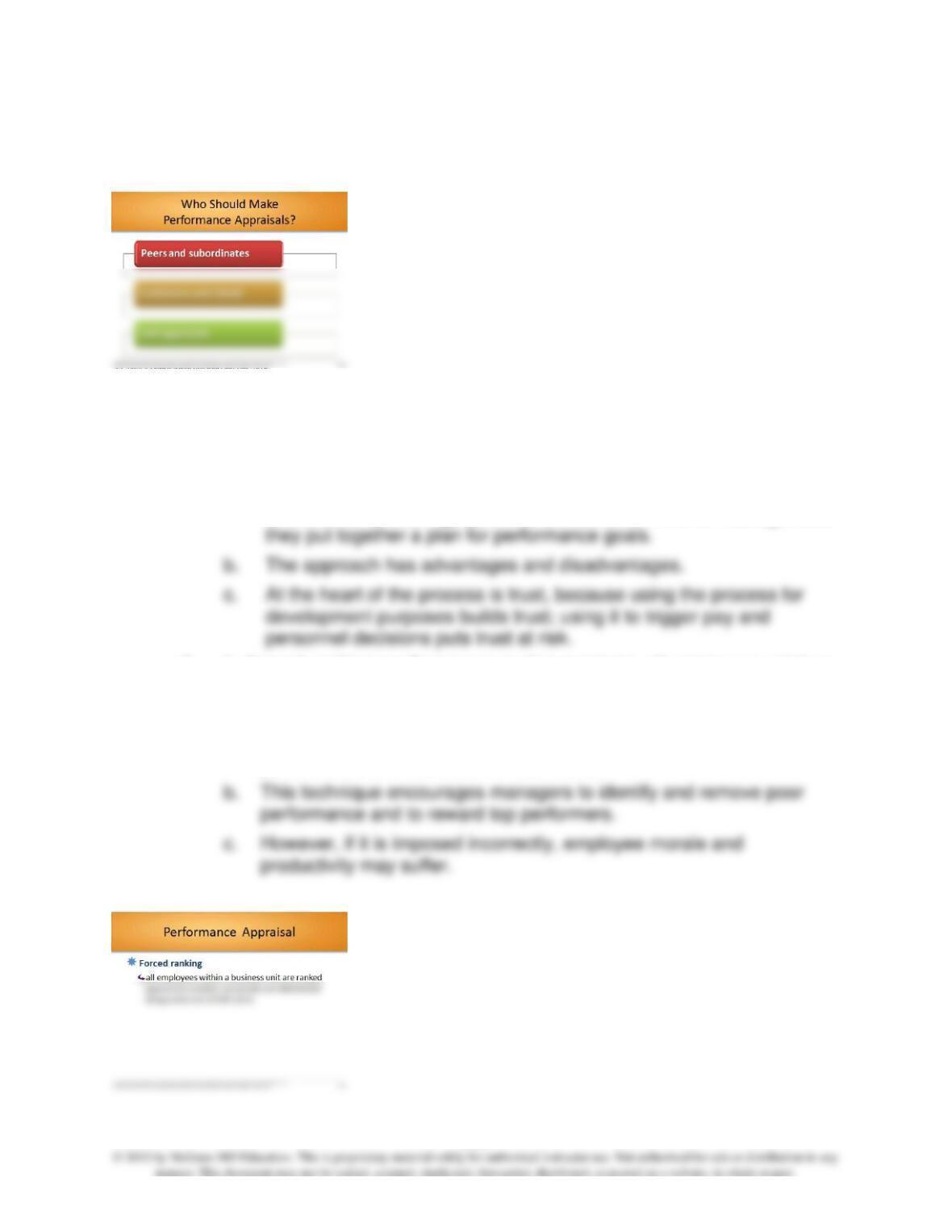
C. Who Should Make Performance Appraisals?
1. Most performance appraisals are done by managers, but to add different
perspectives, appraisal information can be provided by other people
knowledgeable about particular employees.
Chapter 09 – Human Resource Management: Getting the Right People for Managerial Success
9-33
c. Self-appraisals help involve employees in the whole evaluation
process and may make them more receptive to feedback.
2. In the 360-degree assessment, or 360-degree feedback appraisal,
employees are appraised not only by their managerial superiors but also
by peers, subordinates, and sometimes clients.
a. An employee chooses between 6-12 other people to make
evaluations and then goes over the results with his/her manager and
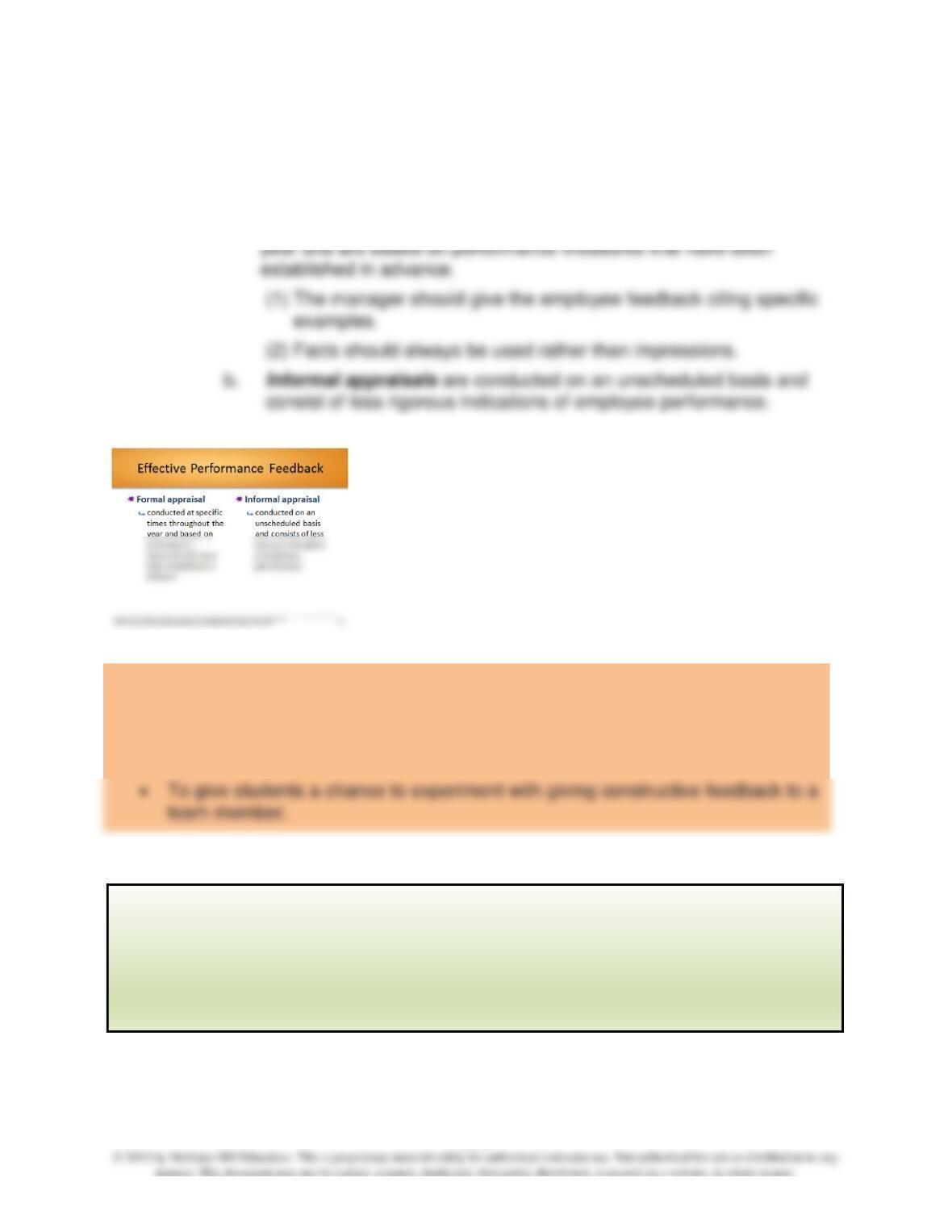
3. In forced ranking performance review systems, all employees within a
business unit are ranked against one another and grades are distributed
along some sort of bell curve.
a. Top performers are rewarded with bonuses and promotions; the worst
performers are rehabilitated or dismissed.
Chapter 09 – Human Resource Management: Getting the Right People for Managerial Success
9-34
D. Effective Performance Feedback
1. The point of performance appraisal is to stimulate better job performance.
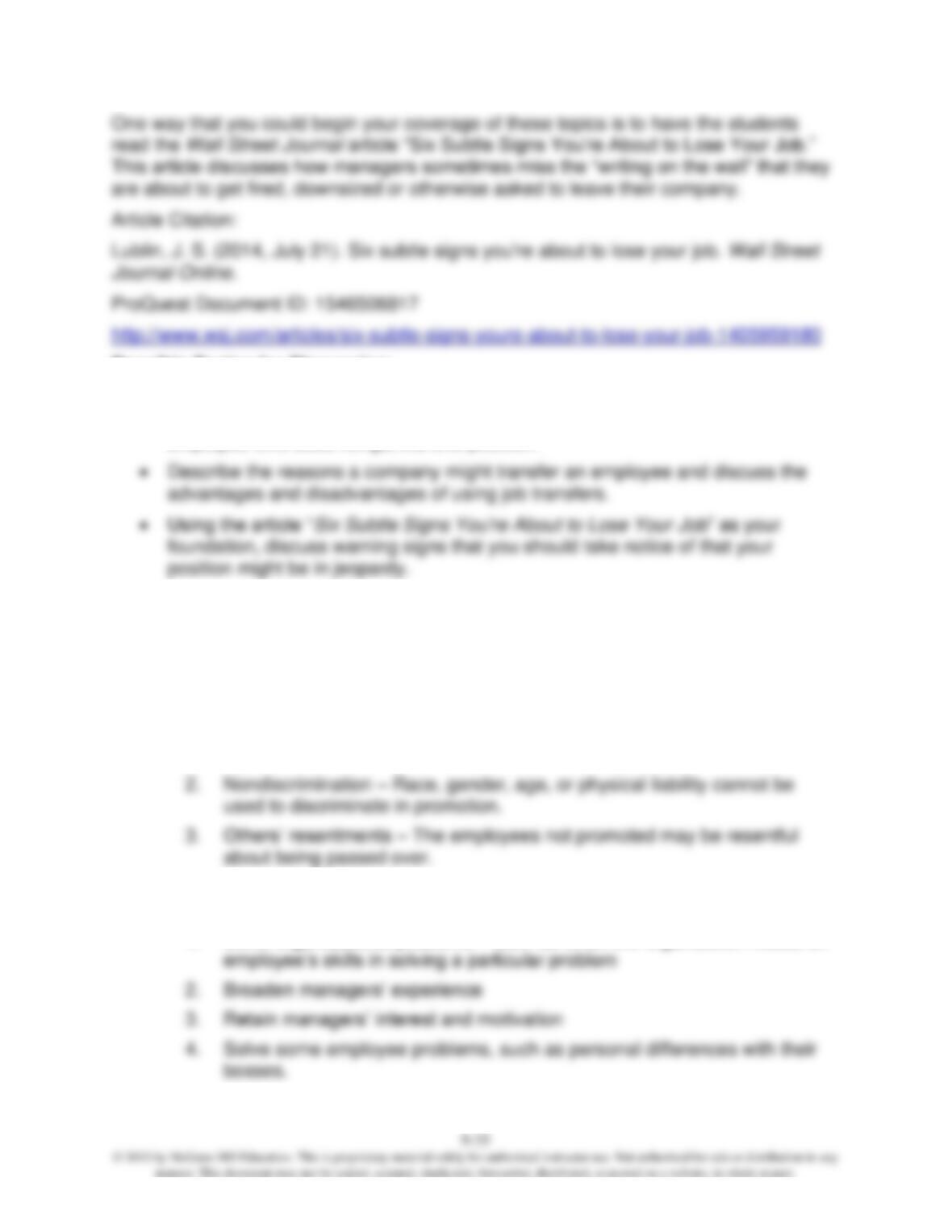
To do this, a manager can use two kinds of appraisals: formal and
informal.
a. Formal appraisals are conducted at specific times throughout the
Group Exercise #3: Providing Constructive Feedback to a Team Member
There is a group exercise available at the end of this manual that provides students
with the chance to experiment with giving constructive feedback to a team member.
Exercise Objective
Section 9.6 discusses managing employee replacement actions. These include
promoting, transferring, demoting, laying off, or firing.
9.6 Managing Promotions, Transfers, Disciplining,
& Dismissals (pp. 285-287)
What are some guidelines for handling promotions, transfers, disciplining,
and dismissals?
Chapter 09 – Human Resource Management: Getting the Right People for Managerial Success
Possible Topics for Discussion:
• Assume two of your employees applied for an open position in your organization
that would represent a promotion for them. How should you deal with the
employee who does not get the one position?
Major Idea Outline:
A. A manager deals with what is called employee replacement whenever an
employee leaves or when promoting, transferring, demoting, laying off, or firing.
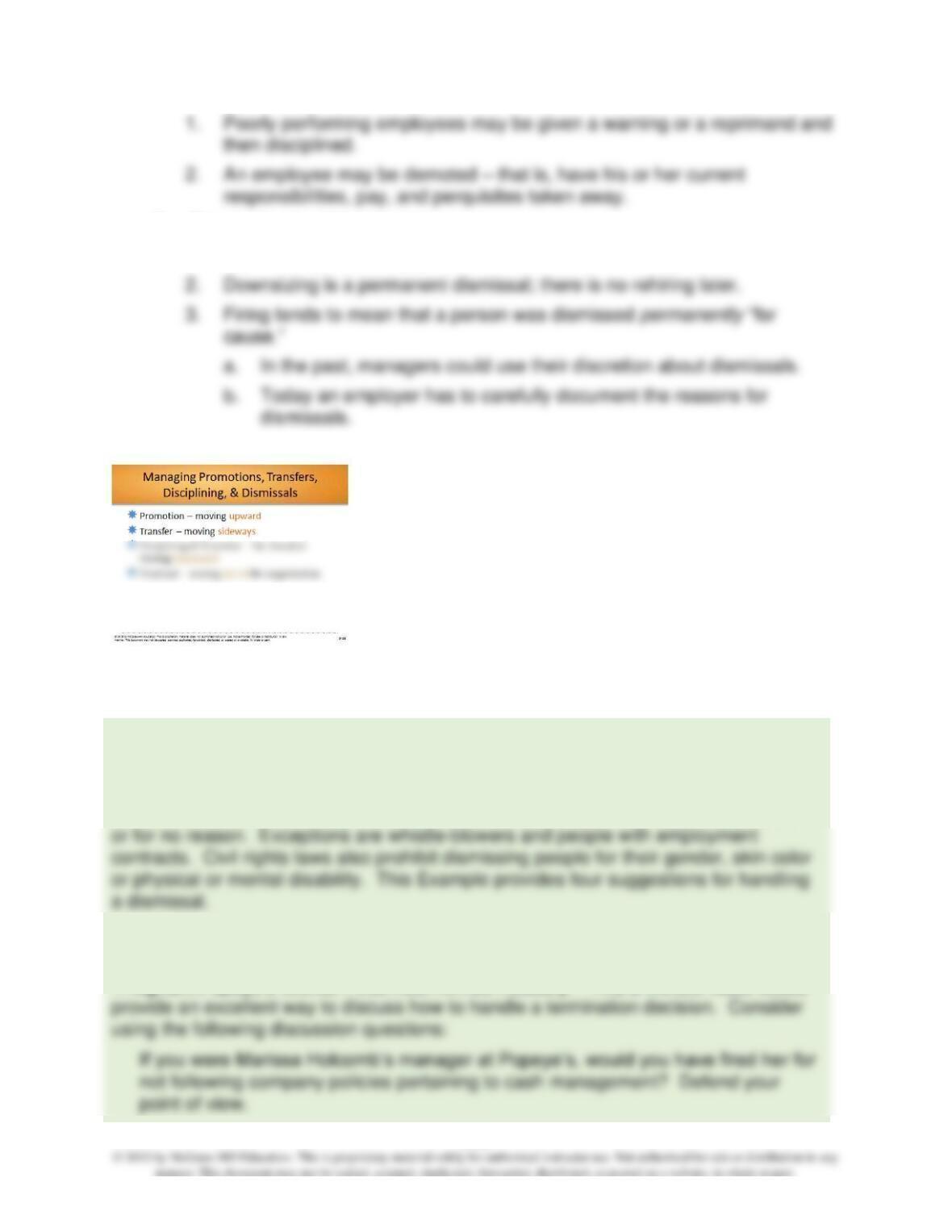
B. Promotion is moving an employee to a higher-level position. Three concerns of
promotion are fairness, nondiscrimination, and others’ resentments.
1. Fairness – It is important that promotion be fair, not for reasons of
nepotism, or cronyism.
C. Transfer is movement of an employee to a different job with similar
responsibility. It may occur for four reasons:
1. Solve organizational problems – such as when the organization needs an
D. Disciplining and Demotion: The Threat of Moving Downward
Chapter 09 – Human Resource Management: Getting the Right People for Managerial Success
9-36
E. Dismissals are of three types:
1. Layoffs suggest that a person has been dismissed temporarily.
Interactive Classroom Material:
EXAMPLE: The Right Way to Handle a Dismissal (p. 287)
“Employment at will” is the governing principle of employment in the great majority of
states, which means that anyone can be dismissed at any time for any reason at all –
Additional Activities:
One way to build on this Example is to have the students watch the CBS News video
“Pregnant Popeye’s Worker Fired After Armed Robbery.” This 2-minute video would
Chapter 09 – Human Resource Management: Getting the Right People for Managerial Success
9-37
Section 9.7 discusses the four areas of human resource law any manager needs to be
aware of. These are labor relations, compensation and benefits, health and safety, and
equal employment opportunity.
One way that you could begin your coverage of these topics is to have the students
Possible Topics for Discussion:
• Discuss best practices for sexual harassment prevention and for investigating
claims of sexual harassment.
• Have you or any of your co-workers been a victim of workplace bullying? If so,
Major Idea Outline:
A. Your organization has to operate within the environment of American law. See
Table 9.3 in the text for important federal laws and regulations.
9.7 The Legal Requirements of Human Resource
Management (pp. 288-293)
To avoid exposure to legal liabilities, what areas of the law do I need to
be aware of?
Chapter 09 – Human Resource Management: Getting the Right People for Managerial Success
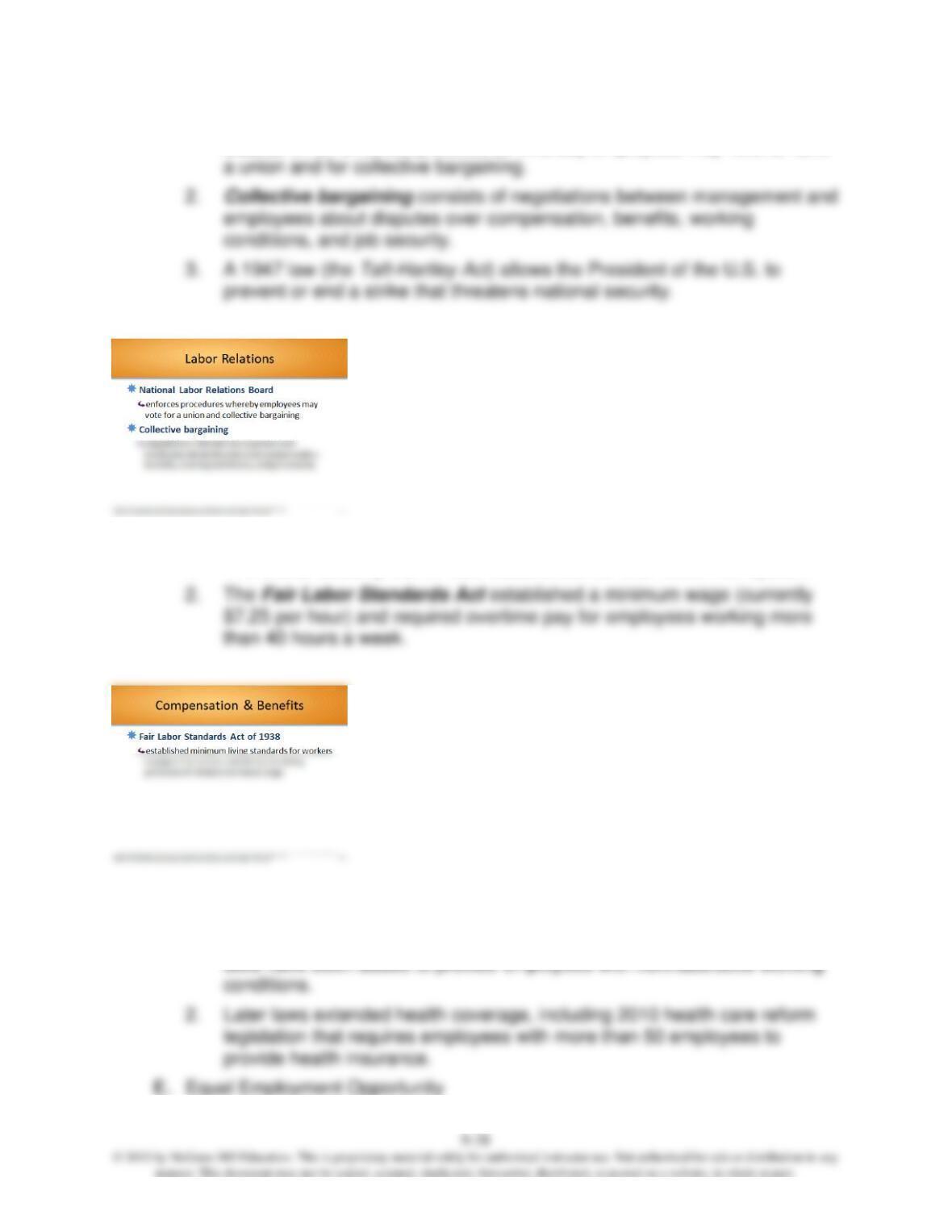
1. Legislation passed in 1935 resulted in the National Labor Relations
Board, which enforces procedures whereby employees may vote to have
C. Compensation and Benefits
1. The Social Security Act in 1935 established the U.S. retirement system.
D. Health and Safety
1. Beginning with the Occupational Safety and Health Act (OSHA) of 1970,
Chapter 09 – Human Resource Management: Getting the Right People for Managerial Success
9-39
1. Title VII of the Civil Rights Act of 1964 began the move to reduce
discrimination in employment based on racial, ethnic, and religious bigotry
and gender stereotypes.
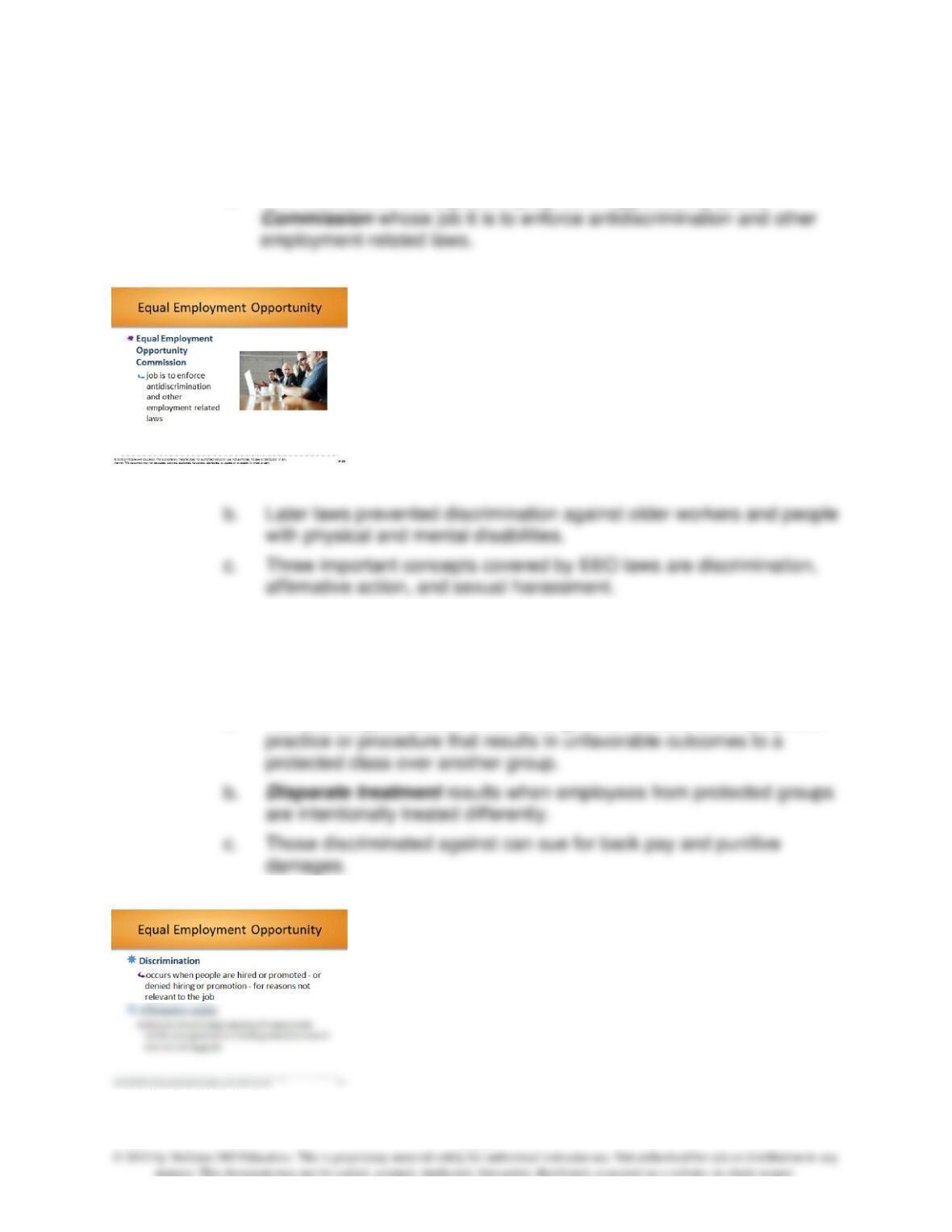
a. This established the Equal Employment Opportunity (EEO)
F. Workplace Discrimination, Affirmative Action, Sexual Harassment, & Bullying
1. Workplace discrimination occurs when people are hired or promoted –
or denied hiring or promotion – for reasons not relevant to the job. There
are two types:
a. Adverse impact occurs when an organization uses an employment
Chapter 09 – Human Resource Management: Getting the Right People for Managerial Success
9-40
2. Affirmative action focuses on achieving equality of opportunity within an
organization.
3. Sexual harassment consists of unwanted sexual attention that creates an
adverse work environment.
a. This includes not only unwanted touching but also obscene gestures,
sex-stereotyped jokes, sexually-oriented posters, and much more.
situation.
d. There are two types of sexual harassment that violate Title VII of the
Civil Rights Act:
(1) Quid pro quo – Hiring, job benefits or opportunities are