Instructor Resource
Rowe, Cases in Leadership 5e
SAGE Publications, Inc., 2019
Case Notes
Case 9.2: The Awethu Project: Values-Driven Decisions for Profit and Social
Impact
Charlene C. Lew wrote this teaching note as an aid to instructors in the classroom use of the
case The Awethu Project: Values-Driven Decisions for Profit and Social Impact, No. 9B17C018.
This teaching note should not be used in any way that would prejudice the future use of the case.
This publication may not be transmitted, photocopied, digitized, or otherwise reproduced in any
Teaching Note
Synopsis
The Awethu Project (Awethu) was a South African-based social enterprise that operated as a
venture capital and investment firm for small, medium, and micro-sized enterprises (SMMEs).
The company was widely acknowledged for its social mission to create jobs and benefit society
while maximizing profit. Yusuf Randera-Rees, the company’s founder and chief executive
Learning Objectives
The case shows the importance of values-driven decision-making and brings to the fore debates
about value clashes in social entrepreneurship. It also enables discussions about the relevance of
shared value for social enterprises and corporations today, and asks how a new partnership can
help overcome business challenges.
Position in Course
This case integrates principles from multiple business disciplines and is therefore best suited for
students in postgraduate and executive courses. It may be used in programs dealing with strategic
decision-making and leadership, as well as organizational behaviour and organizational design.
Relevant Readings
Values-Driven Decision-Making
• Woodward, I. C., & Shaffakat, S. (2014). Understanding values for insightfully aware
leadership. INSEAD Working Papers Collection 2014/46/OBH, 2014. Retrieved April
Instructor Resource
Rowe, Cases in Leadership 5e
SAGE Publications, Inc., 2019
Value Creation Paradigms in Business
• Santos, F. M., Pache, A. -C., & Birkholz, C. (2015). Making hybrids work: Aligning
Shared Value Solutions
• Crane, A., Palazzo, G., Spence, L. J., & Matten, D. (2014). Contesting the value of
‘Creating Shared Value’. California Management Review, 56(2), 130–153.
Additional Material
• As part of their preparation, or during class discussion, students and instructors may
watch a video displaying a short overview of Awethu: “The Awethu Project,” YouTube
Assignment Questions
1. What role do individual and organizational values play in defining a company’s
decisions and strategic focus? In your answer reflect on (a) the influence of personal
2. Should a social enterprise have both a social and profit motive?
Teaching Plan
The case can be taught in a 90-minute time slot. The instructor may choose to do only two of the
four questions, unless more time is available. The following structure and time allocations may
be used:
Activity
Time Allocation
Watch the short video about Awethu
5–7 minutes
Ask students to reflect on the values that underpin their own decisions
15 minutes
Assignment question 1
Values-driven decisions: Divide students into working groups and let
them develop a joint understanding of the answers to assignment
question 1
15-minute
discussion
Each group presents its most salient ideas
10-minute
feedback
Present the theory on values in decision-making
15 minutes
Assignment question 2
Lead a debate on the purpose of business and whether social
enterprises should aim to maximize profit
20 minutes
Discuss different views on value creation, as described in the analysis
below
20 minutes
Assignment questions 3 and 4
Ask groups to act as consultants to Awethu and propose their solutions.
Each group should make a presentation of approximately 10 minutes
20–60 minutes
(dependent on
number of
Instructor Resource
Rowe, Cases in Leadership 5e
SAGE Publications, Inc., 2019
religion, age, and life stage. Applying this knowledge to the two protagonists of the case, we find
the following.
Randera-Rees’ values were likely influenced by his unique background and upbringing, as
described in the case. Other influences include visionary leader Nelson Mandela, and the
opportunities that Randera-Rees had to participate in leadership roles and in formative activities
How Values Determine Behaviour and Strategic Focus in Organizations
Most social enterprises are mission driven. The essence of social entrepreneurship is running a
business aimed at providing solutions to social problems. Contrastingly, the core responsibility
of companies’ leaders/boards is to maximize shareholder value; the way companies create value
is by meeting consumer needs. Clearly, there is a tension between these two views.
As values are displayed in the behaviors and cultures of companies, there may be a view
Instructor Resource
Rowe, Cases in Leadership 5e
SAGE Publications, Inc., 2019
have a mission that incorporates their own financial performance, but also aspects of the
environment, employees, and customers. It is important that the stated missions of companies are
fully aligned to how the organizations are run—including organizational design elements such as
departmental goals, physical design of spaces, performance standards, policies, processes,
5
At this point, the instructor can address the specific contextual factors that enabled Awethu
to add value, including the following:
• The extent of the country’s income inequality
• The missing middle class
Conclusion
Awethu’s leaders had developed specific values through various influences that had become the
principles that guided their strategic decisions. Their values also shaped Awethu’s organizational
values and strategic focus for growth, as well as the company culture. When considering the role
2. Should a social enterprise have both a social and profit motive?
Value Creation Paradigms in Business
The term “value creation paradigm” refers to the theories that people hold about the scope of the
value that business should create; within this lies a question about what the true purpose of
Where Organizations Create Value
Before the instructor can address the different worldviews regarding the purpose of business and
Different Worldviews on the Purpose of Business and Value Creation
There are disparate views of what the purpose of social enterprise should be. Nobel laureate
Muhammad Yunus follows seven principles to what he calls “social business.” (1) The purpose of a
social business is to overcome a difficult problem or problems of society. Yunus maintains that the
Considering Awethu’s future growth plans, it is evident that the company had a strong
profit motive. Yet it also has a very strong social mission—so much so that their business model,
such as investment or entrepreneurial development, did not matter as much to leadership as their
mission to bring about societal change. The methods it used and the spectrum of the solutions
offered were merely vehicles for creating societal impact and profit. There was an
interdependence between Awethu’s social mission and its ability to produce profit. Randera-Rees
Instructor Resource
Rowe, Cases in Leadership 5e
SAGE Publications, Inc., 2019
Once students have an understanding of the different views on what constitutes value
creation in social enterprise, the instructor should pose the same question regarding corporations
(given the potential partnership).
Santos, Pache, and Birkholz discuss a greater realization in business to be “more than”
business—to meet different expectations from society by addressing issues and creating value for
society.
8
These authors hold that it may no longer be a question of trading off between goals of
profitability and value created for owners and societal value creation, but that an integrated
How Different Worldviews Affected the Awethu–SAB Partnership Agreement
If we continue to consider the different worldviews about the purpose of business and the tension
between profit and impact, it becomes clear that alignment of these worldviews and values are
Instructor Resource
Rowe, Cases in Leadership 5e
SAGE Publications, Inc., 2019
critical to the success of partnerships and investment relationships in this case. The case
describes multiple points in the negotiation process where alignment of values had to be secured:
• Not all the corporations with which Awethu had discussions immediately ascribed to
Awethu’s viewpoints.
Conclusion
In considering whether a social enterprise could integrate profit-making with social impact,
students should first understand the value that a company offers. Such value may be monetary or
otherwise. Second, students need to understand that even within modern capitalism, there is a
3. What is the role of shared value in ensuring social impact through corporations?
Shared Value Solutions in the Context of Social Change
At the end of the case, Randera–Rees and LeBlanc wonder how much the Enterprises Supplier
Development Fund signed with SAB (later named The SAB Thrive Fund), will help them (and
others) address the challenges they are facing and create value. The shared value solution for
4. How could the partnership agreement with SAB help Awethu address each of the
challenges that it faces?
Students will realize that one of the benefits of the agreement for Awethu was that it brought
about more capital to manage on a bigger platform with a credible and reputable partner, and a
potential partnership with the fifth-biggest beer brewing company in the world at the time (SAB
Miller).
15
The case highlights three main challenges:
Instructor Resource
Rowe, Cases in Leadership 5e
SAGE Publications, Inc., 2019
• raising capital, and how to scale value creation and impact.
In terms of the socio-political challenges, Awethu’s leaders realized that the fund could not
really help them solve that problem, even if it resulted in Awethu expanding beyond its current
market. They did, however, want to strengthen the voice of business in government
In summary, Awethu saw the potential benefits of the agreement across several levels.
LeBlanc noted:
[The agreement] increases the quantum of assets under management, formalization and
growing of the team, and sophistication (because the stakes are higher and we are more
Instructor Resource
Rowe, Cases in Leadership 5e
SAGE Publications, Inc., 2019
What Happened
Following the signing of the agreement with SAB, Awethu expected to complete approximately
17 transactions with SAB suppliers. These transactions, which formed part of the implementation
plan of The SAB Thrive Fund, were aimed at developing the businesses and entrepreneurial
Instructor Resource
Rowe, Cases in Leadership 5e
SAGE Publications, Inc., 2019
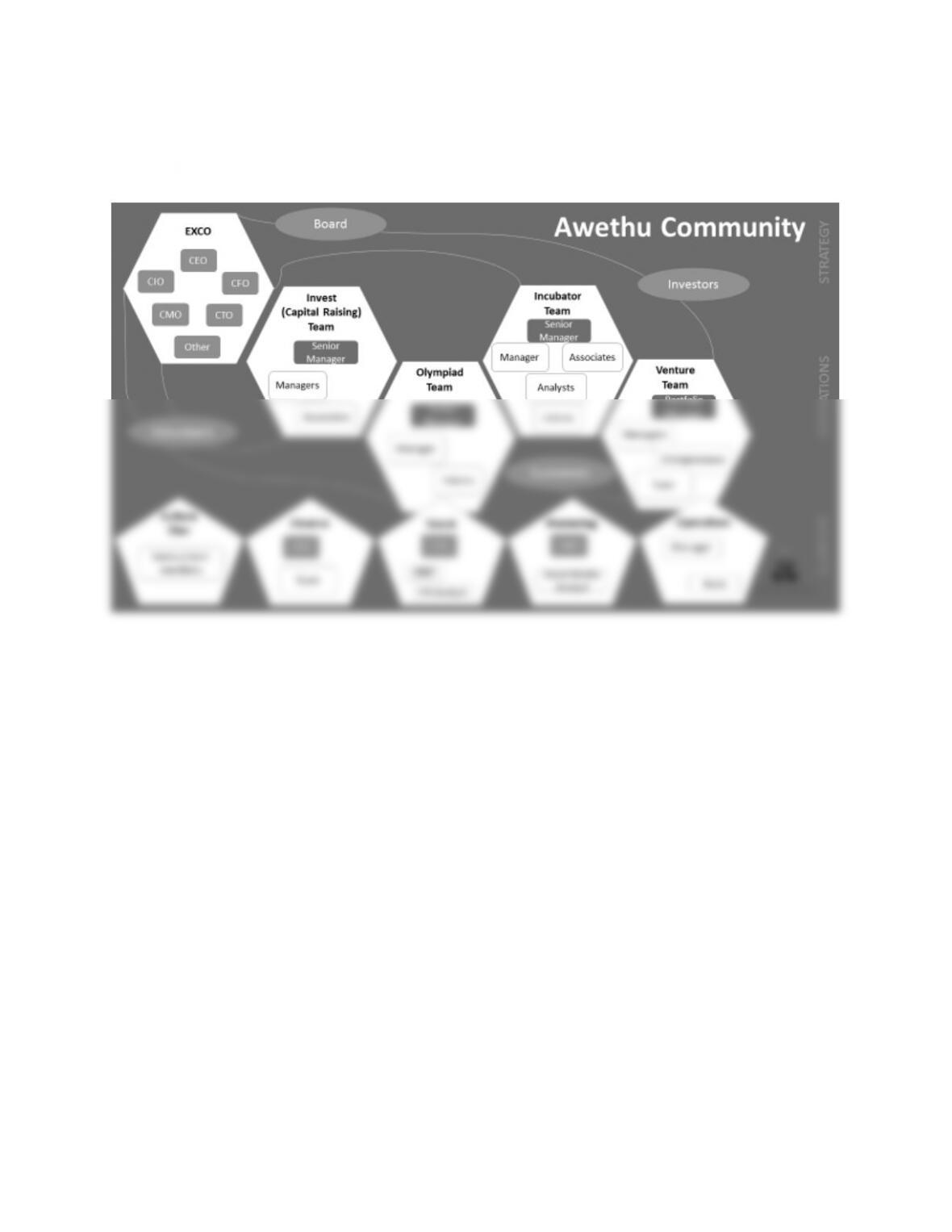
Exhibit Tn-1
Awethu’s Community
Instructor Resource
Rowe, Cases in Leadership 5e
SAGE Publications, Inc., 2019
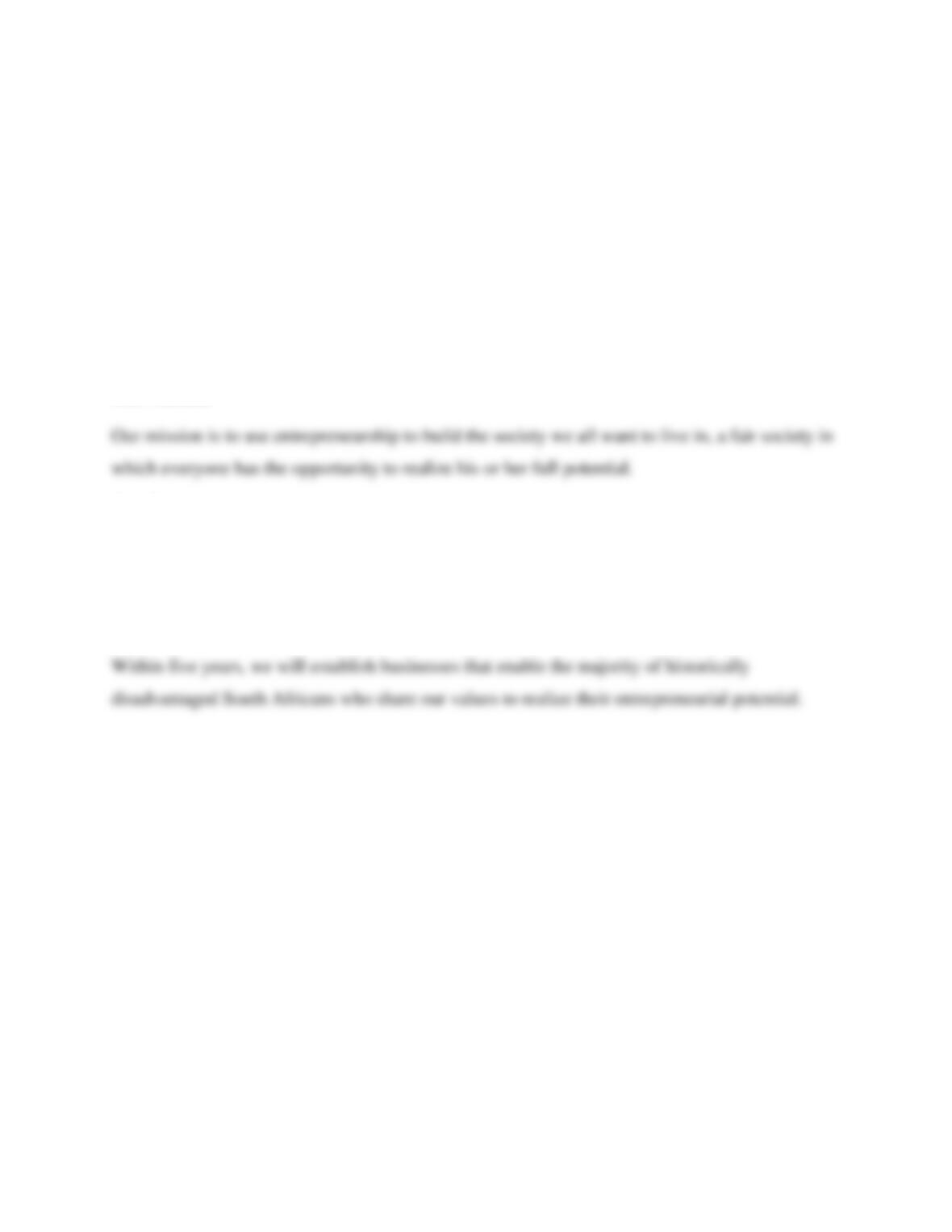
Exhibit Tn-2
Awethu’s Vision, Mission, and Strategy
Who We Are
The Awethu Project has developed a globally acclaimed model for building businesses and
creating sustainable jobs in under-resourced South African communities. We train and assist
entrepreneurs in these communities to start and grow businesses, selecting the most talented to
be part of the high-impact Awethu Incubator.
Our Mission
Our Vision
Within 35 years, we aim to establish businesses through which all urban people in developing
countries who share our values can realize their entrepreneurial potential.
5-Year Strategy