
Chapter 08 – Organization Structure
8-1
8
chapter
Organization Structure
Learning Objectives 2
Key Student Questions 3
Class Roadmap 4
Bottom Line 12
Social Enterprise 14
CHAPTER CONTENTS
Chapter 08 – Organization Structure
8-2
1 Explain how differentiation and integration influence an organiza-
tion’s structure.
2 Summarize how authority operates.
LEARNING OBJECTIVES

Chapter 08 – Organization Structure
8-3
This chapter is such a wealth of information that you may be overrun with student questions as you lec-
ture. Two popular topics for questions include specifics about organizational design, and delegation. For
instance, your students may ask:
1. “What is the most widely used approach to organizational structure in
U.S. businesses and what are the reasons it is used most?”
2. “What is the difference between the board of directors and the chief
executive officers?”
3. “How can a manager overcome his or her fears of delegating?”
4. “What different things can managers do to increase the likelihood that
their associates will follow through with delegated tasks?”
While these questions generally have straightforward answers, they also provide opportunities to examine
some of the complexities of organizational structure. For example:
1. While most mid- to large-size organizations in the U.S. today have a functional structure, the majority
2. The apparent answer to this question is that the CEO is an employee of the organization, while the
board of directors is an outside governing body, whose members are not employees of the organiza-
3. The answer here is that “fear” is often a manager’s sense that what has been delegated will not be
Teaching Tip:
Ask everyone in the class to write down what they think the word “fear” refers to in this question.
Then get students who have been managers to share their answers, followed by students who
have been employees. The employee group is likely to see ‘fear’ as worry about being upstaged
by an employee, while the manager group is likely to see “worry” as concern that the employee
won’t do the job right.
4. Employees will be more likely to follow through on their tasks if they know why they are doing those
KEY STUDENT QUESTIONS
Chapter 08 – Organization Structure
8-4
Management in Action
Leadership and Structural Change at General Motors
For decades now, the story of General Motors has been one of a giant trying to move nimbly. The image
conveyed has not always been pretty. GM’s market share has been sliding since its peak in 1962, and its
LO 1: Explain how differentiation and integration influence an organization’s structure.
A. The Organization Chart
1. The organization chart depicts the positions in the firm and the way they are ar-
ranged
B. Differentiation
1. Differentiation is an aspect of the organization’s internal environment created by job
C. Integration
1. Integration means that these differentiated units are put back together so that work is
coordinated into an overall product.
CLASS ROADMAP
I. FUNDAMENTALS OF ORGANIZING
Chapter 08 – Organization Structure
8-5
E.G.
Use Example 8.1 Integration here
LO 2: Summarize how authority operates.
A. Authority in Organization
1. Corporate governance describes the oversight of the firm by its executive staff and its
board of directors.
LO 3: Define the roles of the board of directors and the chief executive officer
4. Board of directors led by the chair, makes major decisions affecting the organiza-
tion, subject to corporate charter and bylaw provisions.
ferent information and perspectives and to prevent big mistakes.
5. The chief executive officer is personally accountable to the board and to the owners
for the organization’s performance.
a. The CEO usually holds two positions either as the chair of the board or the presi-
E.G.
Use Example 8.2 – Board of directors here
B. Hierarchical Levels
1. Top management
II. THE VERTICAL STRUCTURE
Chapter 08 – Organization Structure
8-6
2. Middle management
a. This is the second broad level.
b. Made up of managers who are in charge of plants or departments.
3. Operational management
a. This is the lowest level of management.
LO 4: Discuss how span of control affects structure and managerial effectiveness.
C. Span of Control
1. Span of control is the number of subordinates who report directly to an executive or
supervisor.
2. Narrow spans build a tall organization with many reporting levels.
E.G.
Use Example 8.3 – Span of control here
LO 5: Explain how to delegate effectively.
D. Delegation
1. Delegation is the assignment of new or additional responsibilities to a subordinate.
(Exhibit 8.3)
Chapter 08 – Organization Structure
4. Authority means that the person has the power and the right to make decisions, gives
E.G.
Use Example 8.4 – Delegation here
LO 6: Distinguish between centralized and decentralized organizations.
E. Decentralization
1. A centralized organization is an organization in which high-level executives make
LO 7: Summarize the ways organizations can be structured.
1. As the task of an organization becomes increasingly complex, the organization inevitably
A. The Functional Organization
III. THE HORIZONTAL STRUCTURE
8-8
1. In a functional organization, jobs are specialized and grouped according to business
functions and the skills they require. (Exhibit 8.4)
B. The Divisional Organization
1. Divisional organization incorporates departmentalization that groups units around
products, customers, or geographic regions. (Exhibit 8.6)
2. Examples of Functional and Divisional Organization (Exhibit 8.7)
3. Product division – all functions that contribute to a given product are organized un-
der one manager.
a. Information needs are managed more easily.
4. Customer and geographical divisions
a. Customer divisions are structured around the customer needs and provide
E.G.
Use Example 8.5 – Functional and divisional organization here
LO 8: Identify the unique challenges of the matrix organization.
C. The Matrix Organization
1. The matrix organization is an organization composed of dual reporting relationships
Management in Action –
Progress Report
Through 2013, Daniel Akerson’s plans for turning around GM included reorganizing the corpo-
ration in to more of a functional structure. By placing more authority in the hands of functional
executives, Akerson hoped to force more collaboration across models and geographic markets.
Chapter 08 – Organization Structure
8-9
Akerson also appointed Mary Barra to head GM’s global product development. Barra stream-
lined that group, eliminating a layer of management, and simplified the choices available for new
designs.
• Review the advantages and drawbacks of functional organizations and geographic divisions.
Which ones may have contributed to the decision to finally address the faulty ignition switch?
A functional organization offers economies of scale, more effective monitoring of the environ-
• What do you think will be the impact of GM’s effort to create a more centralized structure
based on functional groups?
D. The Network Organization
1. The network organization is a collection of independent, mostly single-function
firms that collaborate on a product or service. (Exhibit 8.12)
2. The dynamic network is also called the modular or virtual corporation. It is com-
prised of temporary arrangements among partners that can be assembled and reas-
E.G.
Use Example 8.7 – Network organization here
Multiple Generations at Work
Will Online Networks Replace Traditional Hierarchies?
According to journalist and author, Malcolm Gladwell, the United States is reaching a
Chapter 08 – Organization Structure
8-10
What does this generational shift mean for organizations that use hierarchical structures? They
may want to being shifting their cultures and designing jobs and teams in a way that encour-
LO 9: Describe important integrative mechanisms.
A. Coordination by Standardization
1. Standardization is establishing common rules and procedures that apply uniformly to
everyone.
E.G.
Use Example 8.8 – Standardization here
B. Coordination by Plan
1. Interdependent units are required to meet deadlines and objectives that contribute to a
common goal.
C. Coordination by Mutual Adjustment
1. Involves feedback and discussions to jointly figure out how to approach problems and
D. Coordination and Communication
1. Reducing the need for information
2. Increasing information processing capability
a. Direct contact
IV. ORGANIZATIONAL INTEGRATION
Chapter 08 – Organization Structure
8-11
f. Matrix organizations
3. Managing high information-processing demands (Exhibit 8.13)
1. Organizations are more like a motion picture – they move.
Management in Action –
Onward
Mary Barra is now the CEO of GM. Barra has the daunting task of changing the way managers
and employees behave at GM. She has made it clear that GM’s inward looking culture and slow
responses to safety issues and product defects will no longer be tolerated. She has pledged to
hold people accountable for their actions. Barra refuses to sweep the tragic events of 2014 under
the rug. She wants GM decision makers to remember the pain that the ignition switch problem
(and 10-year delay) caused for victims and the company: “I never want to put this behind us. I
want to put this painful experience permanently in our collective memories.”
• In its effort to improve integration, how is GM addressing the need for communication?
• How might Barra’s efforts at changing the culture at GM increase the chances that the struc-
tural changes will be effective in the long-term?
When an organization’s culture is in line with its hierarchical structure, the chances of long term
• What personal factors are likely to affect GM’s success in achieving greater organizational
integration?
The success of GM’s efforts to improve integration will depend on people’s willingness to work
V. LOOKING AHEAD
Chapter 08 – Organization Structure
8-12
p. 269: Why not eliminate all middle layers to save the most time and money?
This question is intended to spur some thought about the common dislike of “bureaucracy”; answers will
p. 271: Under what conditions might an effort at delegation backfire?
This question previews the following discussion of how to delegate; answers will vary. Possible condi-
p. 273: What makes centralized decision making slower?
The employee who recognizes the need for a decision is often not the employee charge with making that
p. 275: Why might a company centralize its information technology (IT) department?
A common reason is to lower costs through economies of scale. This type of arrangement also contributes
p. 278: Suppose your international company sells scientific equipment to high schools, universities, and
businesses. Would you set up customer divisions or geographic divisions? Why?
p. 281: How might a matrix structure increase speed?
In a matrix, people who work on designing and making products are part of the same group as people who
p. 282: Which functions would you include in a network to improve sustainability?
Answers will vary. Students don’t have enough information to answer definitively for all organizations.
However, they should consider what they have learned so far about business functions and suggest some
BOTTOM LINE

Chapter 08 – Organization Structure
8-13
p. 286: Why does more information tend to improve solutions?
Information is needed to understand the problem, diagnose the problem, identify alternatives, and choose
Chapter 08 – Organization Structure
8-14
Kiva Organizes by Function
1. Why do you think Kiva is using a functional approach to structuring its organi-
zation?
Given the global complexity of Kiva’s operations, the organization hopes to achieve
2. Referring to the eight areas illustrated above, which would be considered staff
activities? Line activities?
Staff activities include people and legal. These areas support the main function of the
SOCIAL ENTERPRISE
Chapter 08 – Organization Structure
8-15
LECTURETTE 8.1: The Managerial Span of Control
THE MANAGERIAL SPAN OF CONTROL PRINCIPLE
1. The managerial span of control refers to the number of subordinates that a given manager can effec-
tively direct. For decades, management thinkers have struggled with the issue of the managerial span
of control because it directly impacts the size and shape of the organizational structure of a business,
and it impacts both the effectiveness and efficiency of the work process.
GRAICUNAS’S THEORY
1. In 1933, A.V. Graicunas published an article, “Relationship in Organization,” in The Bulletin of the
International Management Institute in which he established his theory of the span of managerial con-
2. Graicunas’ research led him to find that the manager’s direct relationships increased in proportion to
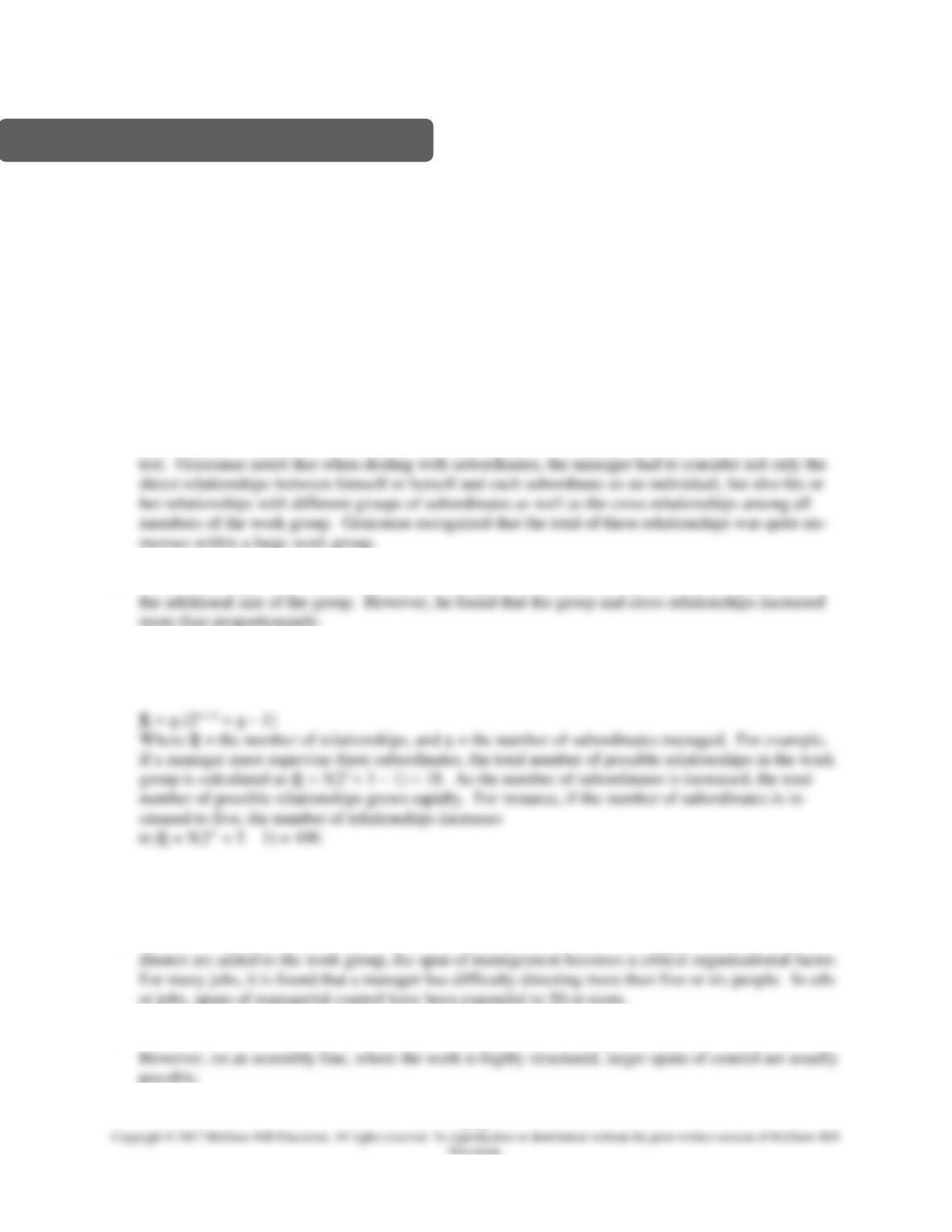
3. The resulting Graicunas Theory calculates the number of possible relationships in a work group from
the formula:
CONSEQUENCES OF THE SPAN OF MANAGEMENT
1. Since the number of relationships with which a manager must deal increases geometrically as subor-
2. Where the work is unstructured, as in a research laboratory, the span of management is quite low.
LECTURETTES
Chapter 08 – Organization Structure
8-16
3. Subordinate relationships are more positive and control is maximized by small or “narrow” spans of
management. However, narrow spans of control cost money in terms of salaries, fringe benefits,
4. On the other hand, wide spans of managerial control often result in overworked and stressed-out
managers, ineffective decision-making, and inefficient operations that tend to go out of control.
EXPANDING THE SIZE OF THE SPAN OF MANAGEMENT
1. Obviously, it is in the best interests of the organization to keep the spans of control as wide as possi-
ble without allowing the process to get out of control. As a result, researchers have established a
number of ways by which organizations may attempt to increase the span of management without ad-
verse effects on the organization. Some of those techniques for increasing the span of control are
listed below:
➢ Design the work so that it features repetitive tasks.
➢ Decrease the complexity of operations.
➢ Design jobs so that less training and expertise is needed.
➢ Reduce the need for the coordination of work functions.
➢ Increase the ability level of the subordinates.
Chapter 08 – Organization Structure
8-17
1. Based on the description of General Motors in this chapter, give some examples of differentia-
tion in that organization. In other words, what specialized tasks have to be performed, and how
is labor divided at General Motors? Also, how does General Motors integrate the work of these
different units? Based on what you have learned in this chapter, would you say General Motors
has an effective structure? Why or why not?
Before Akerson’s arrival, GM’s structure was a divisional structure based on regions (North America,
South America, Europe, and International Operations). Before that, it had a divisional structure based
2. What are some advantages and disadvantages of being in the CEO position?
The advantage of being a CEO is that, from an organizational perspective, it is the position of deci-
sion-making and power. In theory, whatever the CEO says is implemented. It is a position that pro-
3. Would you like to sit on a board of directors? Why or why not? If you did serve on a board,
what kind of organization would you prefer? As a board member, in what kinds of activities do
you think you would most actively engage?
The idea of serving on a board of directors will appeal to some students and not to others. Some will
see it as an opportunity to be involved, on a limited basis, in the direction of an organization, and
DISCUSSION QUESTIONS
Chapter 08 – Organization Structure
4. Interview a member of a board of directors and discuss the member’s perspectives on his or her
role.
Suggest to the students that they ask some of the following questions:
➢ How much time do you devote each month to the board’s activities? Do you think this is suffi-
5. Pick a job you have held and describe it in terms of span of control, delegation, responsibility,
authority, and accountability.
Students who have not held a management position may not relate to the aspects of authority and span
6. Why do you think managers have difficulty delegating? What can be done to overcome these
difficulties?
Ultimately, in any organization, managers are responsible for the activities of those individuals who
What can be done to overcome this? Managers can be trained how to delegate effectively. There are
numerous courses offered on “how to delegate” and “effective delegation for the manager.” From a
7. Consider an organization in which you have worked, draw its organization chart, and describe
it using terms in this chapter. How did you like working there, and why?