Chapter 08 – Skills for Building Personal Credibility and Influencing Others
8-1
Leader
Part 2: Focus on the Leader
Chapter 8: Skills for Building Personal Credibility
and Influencing Others
Chapter 08 – Skills for Building Personal Credibility and Influencing Others
8-2
Overview of Chapter 8 Skills for Building Personal Credibility and
Influencing Others
Overview of Chapter 8: Skills for Building Personal Credibility and Influencing Others
The intent of this chapter of the Instructor’s Manual, as well as the chapters at the conclusion of
Part 1 (chapter 3) and Part 3 (chapter 11) and Part 4 (chapter 16), is to align the IM chapters with
the “Leadership Skills” chapters that appear at the conclusion of major sections of the text.
Chapter 08 – Skills for Building Personal Credibility and Influencing Others
8-3
Chapter 8 Skills for Building Personal Credibility and Influencing Others
Outline
Building Credibility
The two components of credibility
Building expertise
Building trust
Expertise x Trust
Listening
Demonstrate nonverbally that you are listening
Actively interpret the sender’s message
Attend to the sender’s nonverbal behavior
Avoid becoming defensive
Assertiveness
Use “I” statements
Be persistent
Conducting Meetings
Determine whether it is necessary
Effective Stress Management
Monitor your own and your followers’ stress levels
Identify what is causing the stress

Chapter 08 – Skills for Building Personal Credibility and Influencing Others
8-4
Chapter 08 – Skills for Building Personal Credibility and Influencing Others
Problem Solving
Identifying problems or opportunities for improvement
Analyzing the causes
Overview of the Learning Resources for Chapter 8 Skills for Building
Personal Credibility and Influencing Others Outline
Exercise 8-1: Credibility Quiz. This self-assessment provides students with feedback about their
Exercise 8-3: Nonverbal Communication. In this 10-minute interactive exercise, students
Exercise 8-4: One-Way and Two-Way Communication. In this 15-minute exercise, a pair of
students is asked to construct a model, but they can only do so using one-way communication.
Exercise 8-6: Communication Chain Exercise. In this 15-minute exercise, a story is read to one
Exercise 8-7: Role Playing with the Three A’s. This 15-minute exercise asks student groups to
prepare, deliver, and discuss skits involving assertiveness, acquiescence, and aggressiveness.

Chapter 08 – Skills for Building Personal Credibility and Influencing Others
8-6
Exercise 8-8: Meeting Checklist. Students spend 20 minutes applying a checklist and discussing
how well their meetings conform to the best practices of meeting management.

Chapter 08 – Skills for Building Personal Credibility and Influencing Others
8-7
Exercise 8-11: The Water Jar Problem. This 15-minute exercise demonstrates how students can
easily get fixated on a specific problem-solving approach.
Exercise 8-13: Brainstorming. This 20-minute exercise has students practice three rounds of
Exercise 8-14: Usefulness of Items. This 25-minute exercise asks students to develop unusual
uses for common objects, and gets at the synthetic ability component of creativity.

Chapter 08 – Skills for Building Personal Credibility and Influencing Others
8-8
Chapter 8 Skills for Building Personal Credibility and Influencing Others
Outline Exercises & Instructions
Exercise 8-1
Exercise Title: Credibility Quiz
Purpose: To provide students with information about their current level of credibility.
Summary: The best way to do this exercise is to pass out the Credibility Quiz and Scoring Key as a
homework assignment. It will take students about 15 minutes to answer the questions and score the

Chapter 08 – Skills for Building Personal Credibility and Influencing Others
8-9
Credibility Quiz
Name: _______________________________
Chapter 08 – Skills for Building Personal Credibility and Influencing Others
8-10
One important aspect of leadership is credibility. Because credible leaders have relevant knowledge and
are trusted by their followers, followers will have confidence in the goals they set for the team. On the
Use the following scale to respond to the items:
1——————-—2———–———3——————4————-——5
Strongly Disagree Disagree So–So Agree Strongly Agree
1. People see me as a subject matter expert. _____
2. I have a development plan that is reviewed and updated regularly. _____
3. I constantly seek opportunities to broaden my knowledge and skills. _____
Chapter 08 – Skills for Building Personal Credibility and Influencing Others
8-11
Scoring Guide for the Credibility Quiz
Credibility consists of two components, which are expertise and trust. Items 1–7 focus on expertise and
ask respondents about their level of technical, organizational, and industry knowledge and skills. Items 8–
It is important to understand that credibility is not a fixed entity. As people move to new companies or into
new roles they may have to develop new technical and functional knowledge and establish relationships
with key stakeholders. Thus, a person could be highly credible in one situation and lack all credibility in
another.
Scores and interpretive comments are as follows:
Total of Items 1–7= _______ Total Expertise Score
• 28–35 You see yourself as an expert within the organization.
Total of Items 8–14= _______Total Trust Score
• 28–35 You see yourself as having a high level of trust in the
organization.
Chapter 08 – Skills for Building Personal Credibility and Influencing Others
8-12
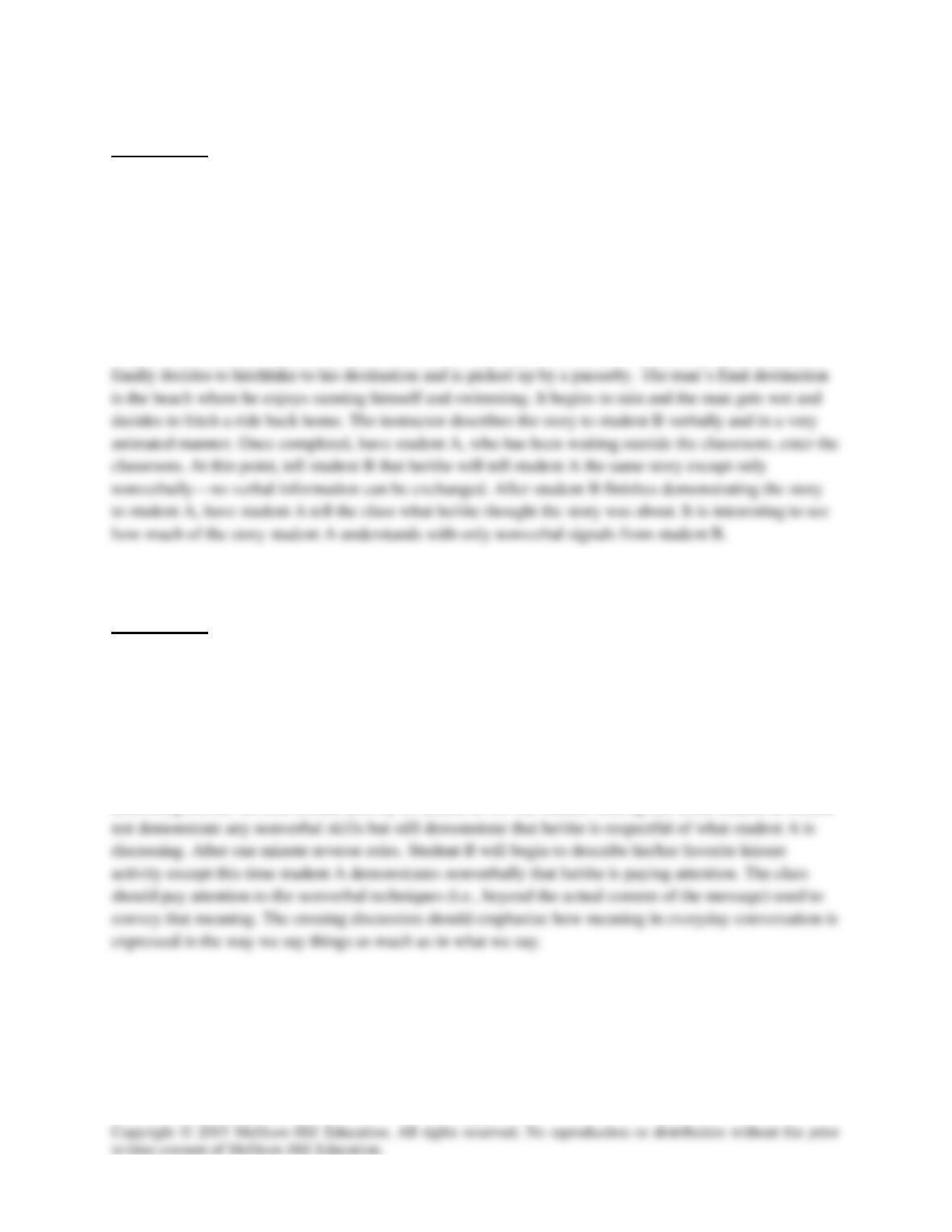
Plotting Credibility Quiz Results
• What will you need to do if you want to build your current level of credibility?
E
x
High
30
25
20

Chapter 08 – Skills for Building Personal Credibility and Influencing Others
Chapter 08 – Skills for Building Personal Credibility and Influencing Others
8-14
Exercise 8-2
Exercise Title: Only Nonverbals
Purpose: To demonstrate how our actions speak louder than words and that we tend to rely on nonverbal
more than verbal communication.
Summary: Pick two students from class and have student A leave the classroom. Tell student B a story.
Devise a story that utilizes many nonverbals. One example of a story could be a person waiting at a bus
stop and the bus never comes. The person becomes very impatient and constantly looks at his watch. He
This exercise will take about 15 minutes to complete.
Exercise 8-3
Exercise Title: Nonverbal Communication
Purpose: To demonstrate how meaning is conveyed nonverbally.
Summary: Select two student volunteers and ask them to think of their favorite leisure activity. Have the
students sit across from each other and in full view for the other classmates. Have student A begin by
describing his/her favorite leisure activity to student B for one minute. During this time, student B should
It will take 10 minutes to complete this exercise.
Chapter 08 – Skills for Building Personal Credibility and Influencing Others
8-15
Exercise 8-4
Exercise Title: One-Way and Two-Way Communication
Purpose: To demonstrate the advantages of two-way communication over one-way communication.
Summary: This is an exercise that is virtually always interesting to observe and provides rich data for
discussion. You will need a set of Tinker-Toys or Legos for this activity.
Before class, build a structure out of Tinker-Toys or Legos of moderate complexity. We have found
structures using 30–40 “sticks”, “wheels”, or “building blocks” of varying sizes and colors work best.
You may choose to make your structure either symmetrical or asymmetrical. It probably should not
represent an actual object (e.g., a car), and it is best if your structure uses a variety of pieces. When you
bring the structure to class, be sure to keep it covered.
The task is for the leader to describe and for the follower to build a structure identical to the one in front
of the leader. The leader should proceed at as rapid a pace as possible, mindful that the task is to direct the
follower to precisely duplicate the model structure. Tell them both from this point on that they may only
communicate with each other according to the following rule. In essence, the follower may not
communicate with the leader in any way whatsoever. This includes not only direct queries or
acknowledgements, but also any other sort of information such as laughs, grunts, moans, sounds with the
pieces, etc. Communication is to be one-way only, from the leader to the follower.
You may stop the exercise either by setting an arbitrary deadline or by waiting for the leader to complete
his or her directions (obviously this must be totally independent of any knowledge about the actual state
Chapter 08 – Skills for Building Personal Credibility and Influencing Others
of the follower’s model). It is often interesting at this point to ask the leader and follower to rate how
confident they are that they successfully completed the task. To avoid the bias caused by hearing the
other’s rating, ask both the leader and the follower to write down their numerical ratings. The following
Discuss the exercise. Here are some issues you may want to address:
a. Were the confidence levels expressed by the leader and follower appropriate? Sometimes the
confidence level of both the leader and follower are higher than the constructed model warrants, and
the confidence level of the leader is usually higher than that of the follower. You may want to discuss
the generalizability of this finding: that one who is communicating to others usually believes he (or
she) is being clear (an analogous situation may be the classroom, where teachers may believe their
description of complicated material is clearer than it seems to students).
d. Did the leader specify a consistent frame of reference (e.g., “Place the blue stick with the wheel at
its end pointing away from you? It should be like the hand of a clock pointing toward twelve
o’clock.”), or did the leader use an ambiguous reference (e.g., “Now put another stick in going in the
opposite direction.”)?
e. How did the follower feel throughout the exercise?