
Chapter 08 – Skills for Building Personal Credibility and Influencing Others
This exercise will take about 15 minutes to complete.
Chapter 08 – Skills for Building Personal Credibility and Influencing Others
8-18
Exercise 8-5
Exercise Title: The Perfect Square
Purpose: To demonstrate the importance of communication and leadership.
Summary: Begin this exercise by asking the group to form a circle, and then have students put on
blindfolds. Once the blindfolds are on, the instructor should give a 50-foot piece of rope to the students.
The instructor should make sure everyone in the group is holding the rope and tell the students they have
20 minutes to form the rope into a perfect square. Instructors should call time after 20 minutes.
This exercise takes 35 minutes to complete.
Alternative set-up: Instructors could also ask the group to form a house or star shape instead of a square.
Exercise 8-6
Exercise Title: Communication Chain Exercise
Purpose: Demonstrate how a message changes as it is passed from one person to another.
Summary: Select about five students for this exercise and have them leave the room. Then pass out
copies of the story on the next page to the rest of the students, asking them to monitor the nature of the
In an ensuing discussion, relate the results to the communication challenge facing leaders and followers.
How do communications from leaders to followers get filtered and changed as they are passed on? What
can help minimize such problems?
Chapter 08 – Skills for Building Personal Credibility and Influencing Others
8-19
Communication Story
The stocky man in the dark brown suit set his shopping bag on the empty shelf beside him and
quickly scanned the rows of books in the mystery section, looking for a new novel about
“Excuse me, but do you carry Deadly Will, the new book by Justin St. Claire?”
That was precisely the title he was looking for, so he paid attention to the answer. It looked like
he would get some help finding his book even without asking for it.
“Yes, we do … at least I think we do. It’s been selling like hot cakes, and we may only have one
or two left. Just a moment, I’ll go check for you.”
“No, you cannot. I’d like you to sell me that book. I was reaching for it when you stepped in
front of me.”
“As I said, I’m sorry, but I didn’t see you reaching for anything. I’ll be happy to make a call in
just a moment and order another copy of this one for you. It would probably be here tomorrow.
But this particular book is sold, unless the person at the counter doesn’t mind waiting another
day herself.”
Chapter 08 – Skills for Building Personal Credibility and Influencing Others
8-20
Exercise 8-7
Exercise Title: Role Playing with the 3 A’s
Purpose: To demonstrate assertive, acquiescent, and aggressive responses.
Summary: Select six students to role play a conflict. A scenario can be selected from current events in
It will take about 15 minutes to prepare, deliver, and discuss the three types of responses in the
skits.
Exercise 8-8
Exercise Title: Meeting Checklist
Purpose: To provide a checklist to help students design and run meetings according to the best practices
of meeting management.
Summary: Instructors should pass out the Meeting Checklist and ask students to use the checklist to rate
It will take students about 10 minutes to complete the Meeting Checklist and another 10 minutes to
discuss their findings in small groups.
Chapter 08 – Skills for Building Personal Credibility and Influencing Others
Meeting Checklist
□ Is or was this meeting really necessary?
□ Are the goals of the meeting clear? In other words, did everyone understand the purpose of the
meeting and what was to be accomplished in the meeting?
□ Is meeting attendance mandatory or optional? What should the attendance policy be?
□ Is an agenda sent out prior to each meeting? It is recommended that your group do this. If so, then who
was responsible for creating the agenda, and when do group members receive it?
□ Are the group’s decisions or actions documented? It is recommended that your group do this. If so,
then who is responsible for this, and is this information disseminated?
Overall, does your group run effective or ineffective meetings? What could your group do to improve its
meetings? How easy do you think it would be to change?
Chapter 08 – Skills for Building Personal Credibility and Influencing Others
8-22
Exercise 8-9
Exercise Title: Relaxation Exercises
Purpose: To describe three techniques for deep mental and physical relaxation, a skill that can
be useful in reducing the symptoms of moderate transient stressors.
Summary: Many students will enjoy and benefit from some time spent in class reviewing and
demonstrating these stress management techniques. Coping well with stress and being perceived
by others as coping well with stress can enhance one’s leadership and followership effectiveness.
Deep Breathing
Slow, deep breathing is a component of virtually every formal relaxation procedure. It is so
elementary and effective, yet so commonly ignored, that it should be addressed separately. Quite
simply, if one is deeply relaxed one will be breathing slowly and deeply; if one is breathing
rapidly and shallowly, then one is not relaxed.
There are several reasons why deep, slow breathing is beneficial. For one thing, oxygen transfer
to the blood occurs most efficiently in the lower lungs. Furthermore, one’s habitual breathing
pattern has been associated with significant parameters of physical and psychological health,
Chapter 08 – Skills for Building Personal Credibility and Influencing Others
8-23
Progressive Muscular Relaxation
Progressive relaxation is a systematic procedure of tensing and then relaxing different muscle
groups. In addition to producing a deeply relaxed state, the regular practice of progressive
shorter and shorter periods of time. After a while, you will be able to relax deeply without going
through the muscle tensing activities at all. The following sequence of muscle groups can serve
as a guide for your progressive relaxation exercise.
HANDS: Clench one fist, then relax it and extend the fingers. Clench the other fist and then relax
it. Finally clench both fists simultaneously and then relax them both.
ARMS: Bend your arms and tense your biceps; then straighten your arms and tense your triceps.
FACE: Wrinkle your forehead, close your eyes tightly, clench your jaw, and press your tongue to
the roof of your mouth.
Chapter 08 – Skills for Building Personal Credibility and Influencing Others
8-24
Calming Words, Phrases, and Images
The words and phrases we say to ourselves, and our mental imagery, have a strong effect on how
we feel. A good way to reduce stress and promote feelings of relaxation is to visualize relaxing
scenes and simultaneously repeat calming “self-talk.” As with any skill, the stress-reducing
potential of these behaviors will improve with practice.
In addition to visualizing a relaxing scene in your mind’s eye, you can repeat phrases like the
following to yourself or recite them into a tape recorder for later listening. In either case, each
phrase should be stated slowly and softly several times with a pause of about ten seconds
between them.
I am calm and relaxed.
My arms are warm and heavy.
Knowing When to Relax
It is as important to know when to relax as to know how to relax. There are times to relax and
times not to. Sometimes lowered arousal level will enhance performance, but at other times
Chapter 08 – Skills for Building Personal Credibility and Influencing Others
8-25
Grossman, P. (1983). Respiration, stress, and cardiovascular function. Psychophysiology, 20,
284-300.
It will take about 10–20 minutes to do each of the sets of exercises described in this section.
Exercise 8-10
Exercise Title: Student Stress Scale
Purpose: To assess stress levels of college-age adults.
Summary: Provide students the Student Stress Scale. Have students complete the scale and add both
columns to determine their overall score. Students who score a 300+ have an extremely high level of
Chapter 08 – Skills for Building Personal Credibility and Influencing Others
8-26
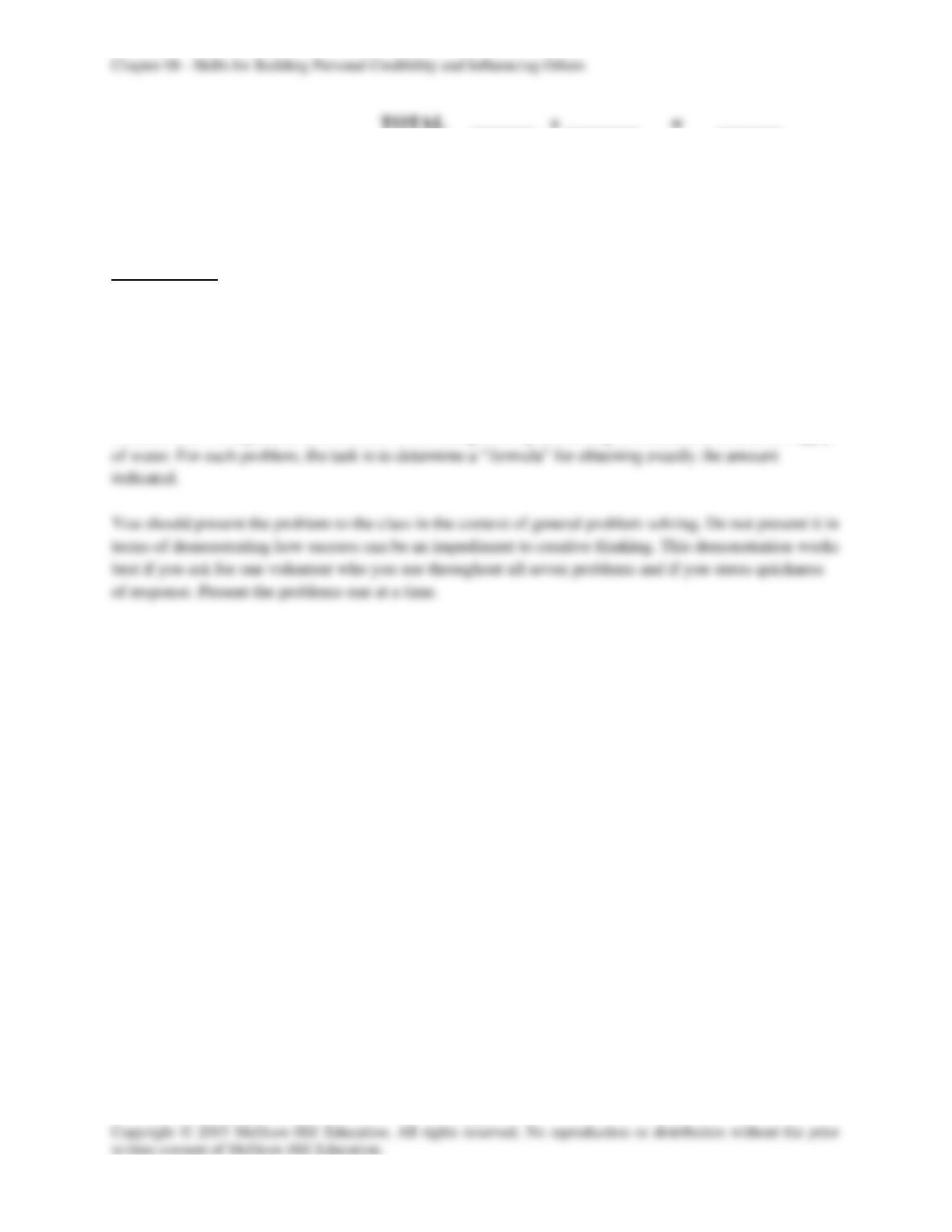
Student Stress Scale
Check the events you have experienced in the past six months or are likely to experience in
the next six months.
PAST FUTURE POINTS
ASSIGNED
1. Death of a close family member ____ ____ 100
2. Death of a close friend ____ ____ 73
3. Divorce between parents ____ ____ 65
4. Jail term ____ ____ 63
11. Sex problems ____ ____ 44
12. Serious argument with close friend ____ ____ 40
13. Change in financial status ____ ____ 39
14. Change of major ____ ____ 39
15. Trouble with parents ____ ____ 39
22. Lower grade than expected ____ ____ 29
23. Change in sleeping habits ____ ____ 29
24. Change in social activities ____ ____ 29
25. Change in eating habits ____ ____ 28
26. Chronic car trouble ____ ____ 26
8-27
Exercise 8-11
Exercise Title: The Water Jar Problem
Purpose: To demonstrate how success can be an impediment to problem solving.
Summary: Present the class with a “thought problem” wherein they have beakers or water jugs of three
different sizes or capacities (the sizes of which change from problem to problem) and an available supply
Chapter 08 – Skills for Building Personal Credibility and Influencing Others
8-28
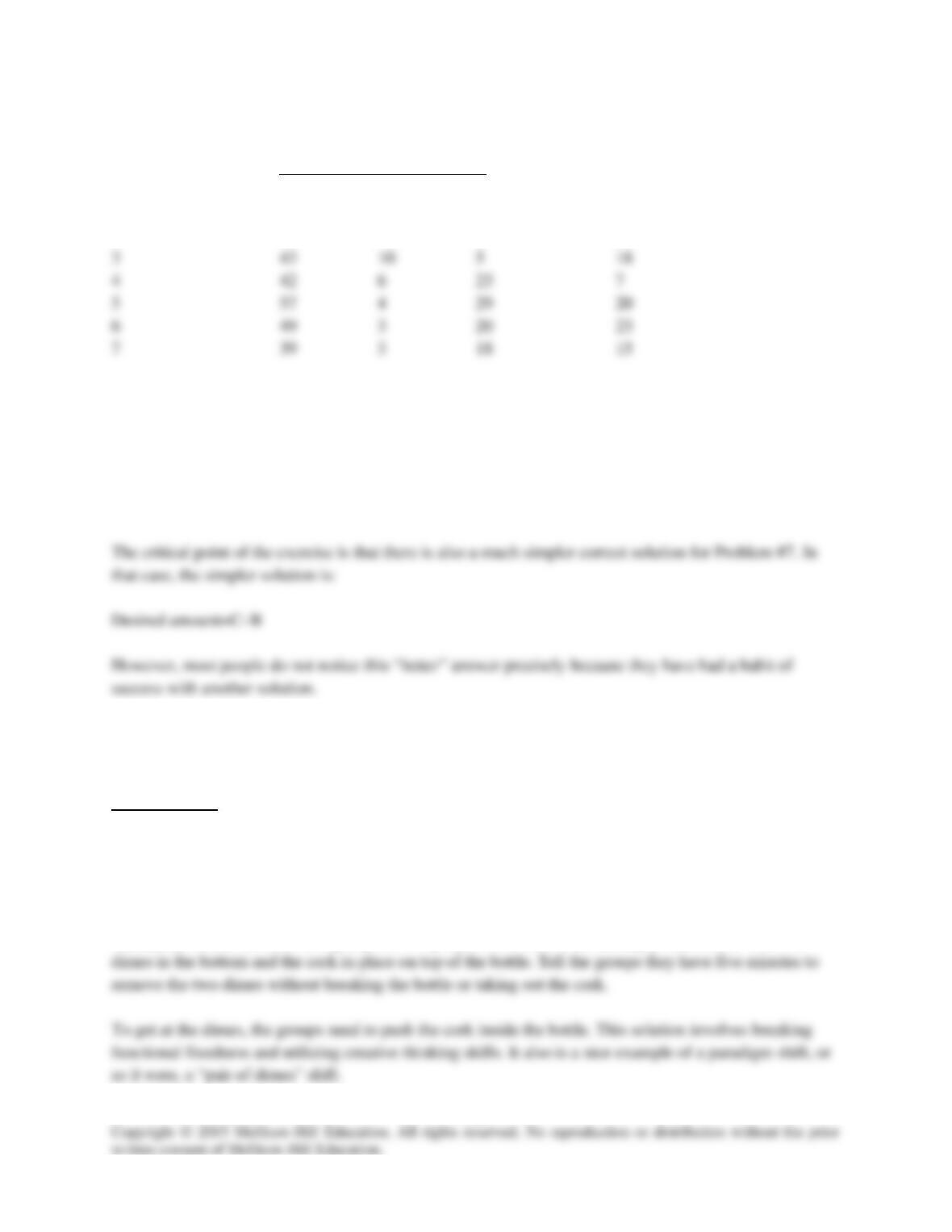
Problem Given jugs of these sizes Measure out this much water
A B C
1 127 3 100 21
2 46 5 22 14
Actually, the same formula is the solution to all the problems:
Desired amount=A–2B–C
It is important the volunteer gets the right answer each time. If necessary, let the class provide assistance.
With each successive problem, that solution should be apparent sooner and sooner.
It will take about 15 minutes to conduct and debrief this exercise.
Exercise 8-12
Exercise Title: Corked
Purpose: To break functional fixedness and improve creative thinking skills.
Summary: Break the class into groups of 4–5 people. Give each class an empty wine bottle with two

Chapter 08 – Skills for Building Personal Credibility and Influencing Others
8-29
Chapter 08 – Skills for Building Personal Credibility and Influencing Others
8-30
Exercise 8-13
Exercise Title: Brainstorming
Purpose: To provide practice in brainstorming and creative thinking skills.
Summary: Go over the rules of brainstorming, and then divide the class into groups of 5–6 people.
Provide each group with markers and flipchart paper, and then tell them they will be doing three short
brainstorming sessions. For session one, give each group one minute to brainstorm a list of famous
people. After the minute is up, they are to review the list and come to consensus on the “wildest” person
Instructors should remind groups of the rules of brainstorming and ask groups whether they ever violated
any of the rules. Instructors should also comment on how the introduction of competition can actually
increase the number of ideas generated.
This exercise takes 20 minutes.
**Note: This exercise is also listed in Part 3 Leadership Skills.**
Exercise 8-14
Exercise Title: Usefulness of Items
Purpose: To demonstrates how familiarity with common objects can become stumbling blocks in
creativity.
Summary: The instructor needs to bring 3 or 4 items to class, and the items should range from the
common to the unusual (items for which few or no students will know the intended purpose). Two great

Chapter 08 – Skills for Building Personal Credibility and Influencing Others
This exercise will take about 25 minutes to complete.
Chapter 08 – Skills for Building Personal Credibility and Influencing Others
Exercise 8-15
Exercise Title: Quick and Creative Exercises
Purpose: To provide quick-paced, fun, and short exercises to challenge students’ creative abilities.
1. A delegation of Martians has just landed in the middle of your hometown. They do not
2. Show students the following letters, one at a time and in the sequence listed. Their challenge is to
spell a word with each new letter presented. The last letter presentation requires students to
rearrange all the letters to come up with a word.
3. Play a game of charades or Pictionary.
4. Provide the following paragraph to students to find the seven mistakes:
There are seven misstakes in this pargraph! If you can find all seven misstakes, you are smarter
then the average person you’re age!
5. Bring in an unopened soda can and challenge the students with “How is it possible for me to
drink out of this can if I don’t open it or puncture it?” Solution: Turn the can upside down and
pour a small amount of water in the depression.
These exercises take 5–10 minutes each.