Kinicki/Williams, Management, 9e: Chapter 8 Organizational Culture, Structure, and Design: Building
Blocks of the Organization
8–i
Chapter 8
Organizational Culture, Structure,
and Design
Building Blocks of the Organization
CHAPTER CONTENTS
Teaching Resource Manual: A Guide to Implementation ii
Overview of the Chapter 8
Classroom Outline 10
Legal/Ethical Challenge Case 43
Group Exercises 52
Uber Continuing Case 59
Kinicki/Williams, Management, 9e: Chapter 8 Organizational Culture, Structure, and Design: Building
Blocks of the Organization
8–ii
TEACHING RESOURCE MANUAL: A GUIDE TO IMPLEMENTATION
The purpose of the Teaching Resource Manual (TRM) is to support you in the delivery of your
chosen curriculum in either a face-to-face or online classroom formats. It also was created to
help you address some of the following challenges in higher education:
• Addressing the inability to measure student comprehension prior to major assignments
such as a midterm or project.
• Overcoming the inability to tailor your lecture to the topics that students find difficult.
You will learn that we created many different teaching resources you can use either before,
during, or after class. Because of the quantity of options, the goal of this implementation guide is
to provide an overview of how you might select the many teaching resources at your disposal.
So What Assets Can I Choose From?
Generally, a typical class session for any course comprises three “touch points:” before, during,
and after class. For a face-to-face course, your class session would normally be the day you
lecture to students. For an online course, the class session would be when you recorded the
Assigning SmartBook 2.0 and Connect® Exercises
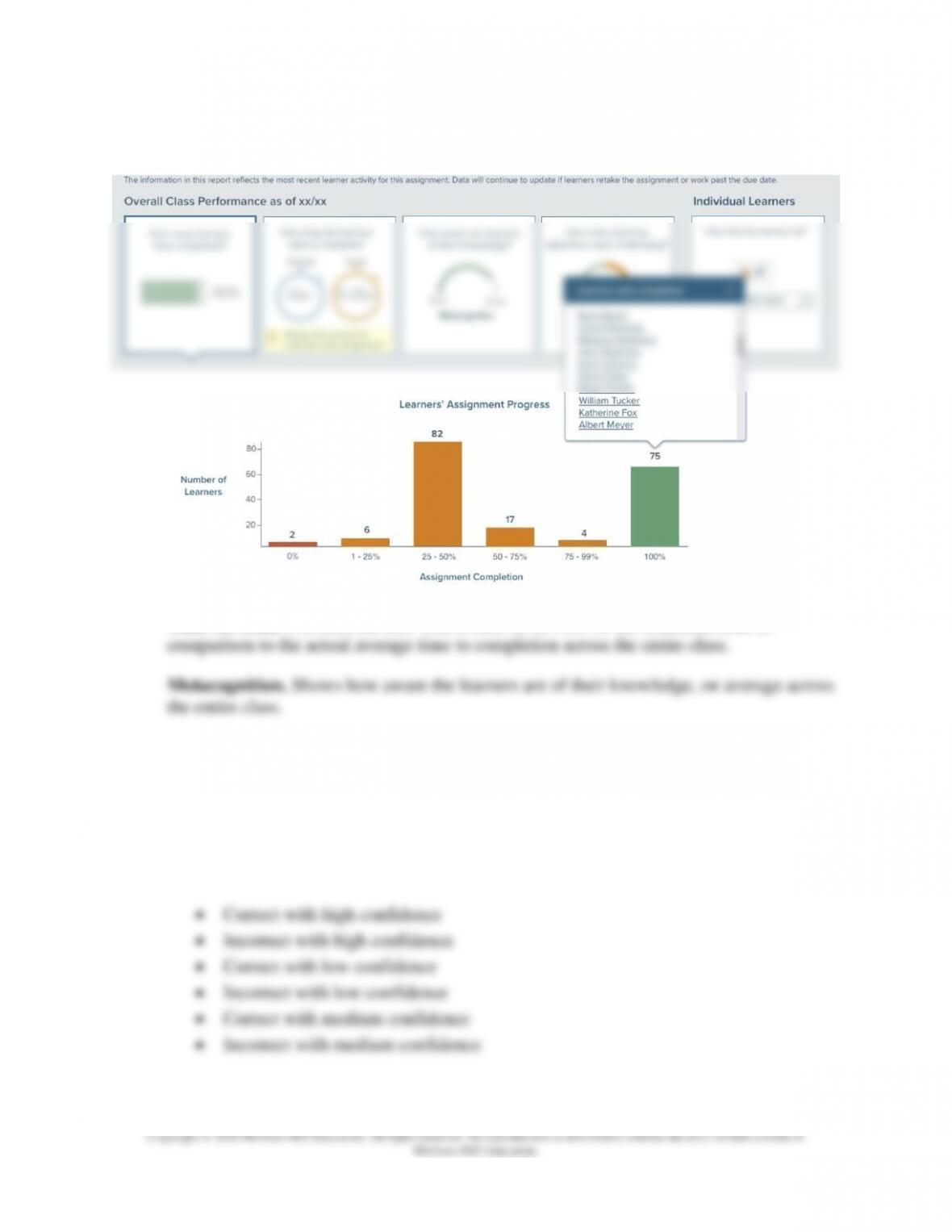
SmartBook 2.0, (In Connect®, click on Performance / Reports / Assignment Results. Here you
can choose SmartBook and choose the assignment you wish to view reports for.) The following
reports are available through SmartBook 2.0:
Kinicki/Williams, Management, 9e: Chapter 8 Organizational Culture, Structure, and Design: Building
Blocks of the Organization
8–iii
Assignment Completion. Shows the total percentage of all learners in the class that have
completed the assignments at this point in time.
Time on Task. Provides the user with a class-level view of the estimated time in
Most Challenging Learning Objectives. Shows the number of challenging Learning
Objectives across the class, in comparison to the total number of Learning Objectives in
the assignment.
Individual Learner Report. System provides all the assignment data available for that
specific student at that point in time, showing a breakdown of all questions answered in
each of the following categories:
Kinicki/Williams, Management, 9e: Chapter 8 Organizational Culture, Structure, and Design: Building
Blocks of the Organization
8–iv
With Connect®, you can build your own course, make changes to the course throughout the
semester, and use auto-grading. Connect® integrates with other Learning Management Systems,
include Blackboard®, Canvas, and D2L. Students can study anytime with the free
ReadAnywhere app, create personalized study plans, and Connect®’s Calendar and Report tools
will help keep them on track.
Connect® gives you a wide array of flexibility in making assignments and creating grading
policies. You may choose to:
• assign as many assignments as appropriate.
Some recommendations include:
• Before selecting the option for one attempt only, select unlimited or multiple attempts on
the first few assignments to allow students a chance to learn and navigate the system.
So When Do I Assign Each Type of Teaching Resource?
Wouldn’t it be wonderful if you could transition from simply assigning readings, lecturing, and
testing to actually adapting your teaching to student needs? By utilizing the teaching resources
Kinicki/Williams, Management, 9e: Chapter 8 Organizational Culture, Structure, and Design: Building
Blocks of the Organization
8–v
Before Class
The learning goals we have for students determines our assignments before, during and after
class. For example, you may want to focus on mastering content, applying content, or using
A reading assignment—typically a chapter from the product in use—is a student’s initial
exposure to course content. Requiring students to complete a SmartBook 2.0 module either prior
to class or an online lecture allows you to gauge their comprehension of the material. Having a
better sense before class of which concepts your students are “getting” and which ones they are
not, allows you to more effectively and efficiently plan your time with them during class. To
ascertain student competency, use the reporting function of SmartBook 2.0, where you can view
general results of their performance.
If your learning objectives include fostering application and integrating the concepts discussed
with real world practice, then Management in Action or legal/ethical challenge cases contained
in the textbook can be assigned so students can think critically and practice applying what they
During Class
The TRM offers a host of additional materials and experiential activities you can use to bring
chapter content to life.
Kinicki/Williams, Management, 9e: Chapter 8 Organizational Culture, Structure, and Design: Building
Blocks of the Organization
8–vi
Copyright © 2020 McGraw-Hill Education. All rights reserved. No reproduction or distribution without the prior written consent of
McGraw-Hill Education.
If your goal is content mastery and you are utilizing SmartBook 2.0, you can plan class activities
and lecture based on results from the general results report and the metacognitive skills report.
This allows for a more tailored class period that enhances student engagement and more
opportunities to resolve gaps in knowledge. We also provide links to online readings that you can
use to supplement the content covered in the textbook. They are useful if you desire to provide
additional material beyond that covered in the text.
If your goal is to create an engaging learning environment filled with student discussion and
interactions, we provide multiple resources. First, each major heading in a chapter contains
suggested discussion starter questions. These open-ended questions are likely to foster student
discussion and engagement. We also provide additional activities (i.e., experiential exercises) for
every Example and Practical Action box.
If your goal is to provide for additional application of material, the TRM breaks down the
textbook Management in Action cases and legal/ethical challenges by providing questions and
ideal responses. Connect® also has multiple-choice questions that can be assigned for the
Management in Action cases. Finally, the TRM has a selection of group exercises that allows
instructors to focus on team learning methods.
After Class
After the face-to-face class session, or online lecture, you can assign Connect® exercises as
homework to further reinforce the material covered in the textbook and lecture. You may also
want to assign an iSeeIt! Animated Video if you notice that students are struggling with a
Kinicki/Williams, Management, 9e: Chapter 8 Organizational Culture, Structure, and Design: Building
Blocks of the Organization
A Special Focus on Career Readiness
The ninth edition has a new strategic focus on career readiness. The authors goal is to provide
you the information and teaching resources needed to develop students’ career readiness
competencies desired by employers. The authors provide you the following information and
resources:
• Chapter 1 introduces the concept of career readiness and identifies the competencies
desired by employers.
Kinicki/Williams, Management, 9e: Chapter 8 Organizational Culture, Structure, and Design: Building
Blocks of the Organization
8–viii
CAREER READINESS-BASED PERSONAL DEVELOPMENT PLAN
This ninth edition of Management: A Practical Introduction includes a new strategic theme
around the concept of career readiness in order to address the employers’ complaints of
graduating students not possessing the needed skills to perform effectively. We deeply care about
this issue and hope that this new feature will assist instructors develop their students’ career
readiness.
We believe that creation of the plan is the desired end result for this course. Working the plan is
expected to happen after your class is over.
It is strongly recommended that you grade students’ plans. This enables you to assess whether
students are on the right track and provides the incentive students need to thoroughly complete
The instructor’s and students’ instructions for drafting a personal development plan are
located in the Chapter 1 TRM.
CAREER
READINESS
Kinicki/Williams, Management, 9e: Chapter 8 Organizational Culture, Structure, and Design: Building
Blocks of the Organization
8–ix
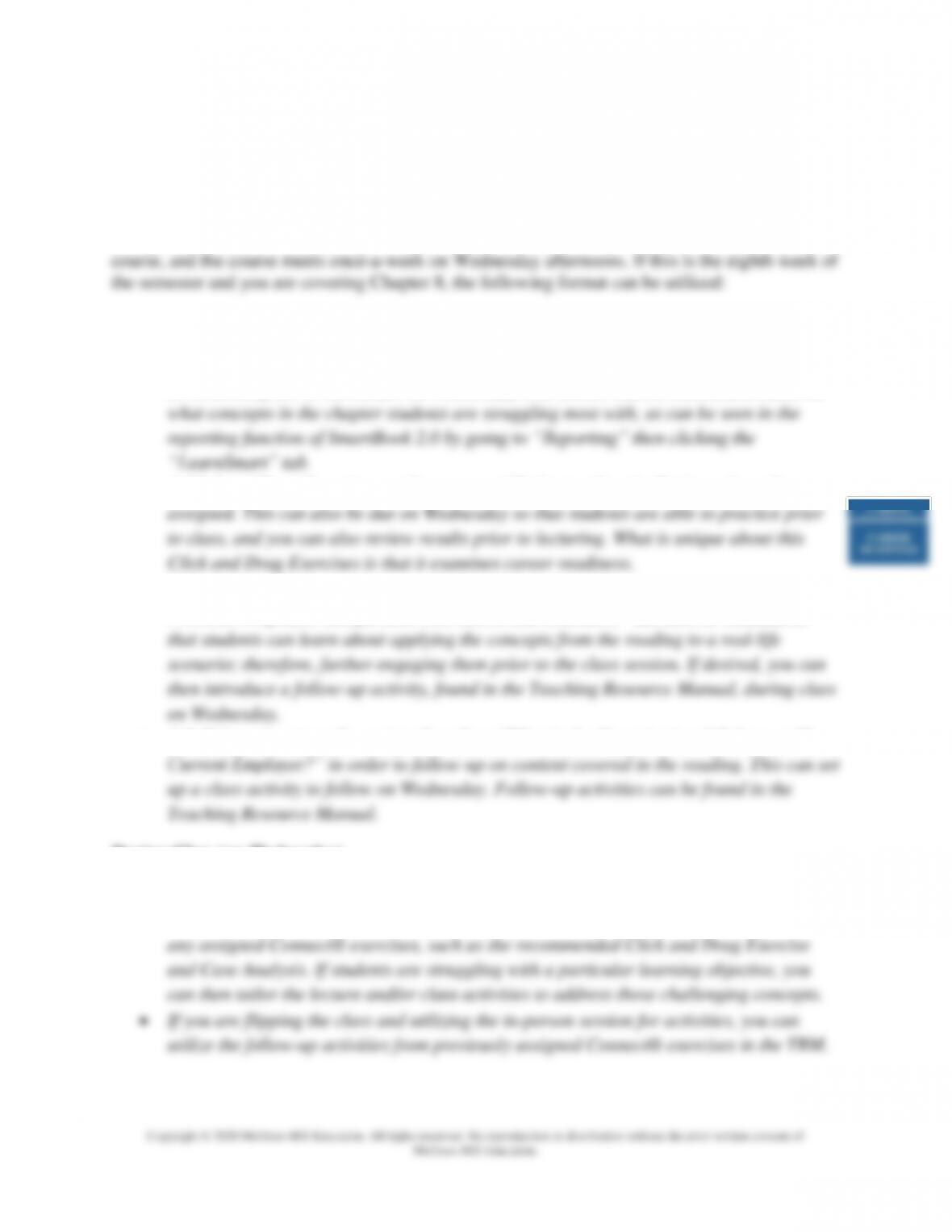
SUGGESTED RESOURCES ACROSS TEACHING TOUCH POINTS MATRIX
Type of Asset
Before-Class/Lecture
During-Class/Lecture
After-Class/Lecture
SmartBook 2.0
Click and Drag Exercises
iSeeIt! Animated Videos
Self-Assessments
Case Analyses
Video Cases
Example and Practical
Action BoxesM
Group Exercises/Career
Group ExercisesM
TRM Discussion StartersM
TRM Follow-up activities for
Case Analyses, Video Cases,
Self-Assessments, and
Example/Practical Action
BoxesM
Quizzes/Tests
Uber Continuing Case
Management in Action
CaseM
Legal/Ethical Challenge
CaseM
Manager’s Hot Seat Videos
Application-Based Activities
CAREER
READINESS
Kinicki/Williams, Management, 9e: Chapter 8 Organizational Culture, Structure, and Design: Building
Blocks of the Organization
Note: The above-mentioned assets are generally assignable and auto-gradable, except for those listed with an M as
those require manual grading. Also, some resources will require a paid subscription.
A Week at a Glance
When creating a syllabus and schedule for students, you can utilize the above-mentioned matrix
as a guide. Let’s use the following example: You teach a face-to-face Principles of Management
Before Class (before Wednesday)
• Assign Chapter 8 in SmartBook 2.0, making it due Tuesday evening so that reporting can
be reviewed prior to the lecture on Wednesday. The lecture can be customized based on
• A Click and Drag Exercises, such as one on “Understanding the Business,” can be
• A Connect® Case Analysis, such as “Management in Action: W.L. Gore’s Culture
Promotes Employee Satisfaction, Innovation, and Retention,” can also be included so
• A Self-Assessment can be assigned, such as “What is the Organizational Culture at My
During Class (on Wednesday)
• You can deliver a short, yet effective, lecture and focus on areas that students are really
struggling with. This can be done by reviewing the reporting from SmartBook 2.0 and
CAREER
Kinicki/Williams, Management, 9e: Chapter 8 Organizational Culture, Structure, and Design: Building
Blocks of the Organization
8–xi
• You can assign a career skill-based Self-Assessment earlier in the week, for example on
• A Manager’s Hot Seat video can be utilized to open up class discussion. Many of these
videos cover frequent, yet controversial topics, and they ask students to describe what
• If time allows, and you would like to dive into real situations, you can discuss an
After Class (after Wednesday)
• You can assign a Connect® exercise, such as the continuing case on Uber, to reinforce
student comprehension of material and to also test application of concepts.
If you are teaching a completely online course asynchronously, then the in-person class above
can be substituted for a recorded online lecture that is customized based on SmartBook 2.0
Kinicki/Williams, Management, 9e: Chapter 8 Organizational Culture, Structure, and Design: Building
Blocks of the Organization
8–1
LEARNING OBJECTIVES
8.1 Describe how managers align vision and strategies with the organization’s culture and
structure.
8.3 Describe the process of culture change in an organization.
8.5 Identify the major elements of an organization.
8.7 Identify the factors that affect the design of an organization’s structure.
Kinicki/Williams, Management, 9e: Chapter 8 Organizational Culture, Structure, and Design: Building
Blocks of the Organization
TEACHING RESOURCES
Section
Title
Resource Type
8.1: Aligning Strategy,
Culture, and Structure
The Leader’s Guide to Corporate
Culture
with Supplemental Activity
Harvard Business Review
article
ONLINE
ARTICLE
Connect® Click and
Connect® Click and
Kinicki/Williams, Management, 9e: Chapter 8 Organizational Culture, Structure, and Design: Building
(4 minutes)
Major Organizational Elements
Connect® Click and
Drag Exercise
The Organizational Socialization
Process
Connect® Click and
Drag Exercise
8.3: The Process of Culture
Change
How Costco’s Obsession with
Culture Drove Success
with Supplemental Activity
Online Blog
Costco Culture
with Supplemental Activity
Assessing Your Preferred Type of
Organizational Culture
with Self-Assessment Activity
Self-Assessment
The Process of Culture Change
Connect® Click and
Drag Exercise
8.4: Organizational
Structure
Google makes alpha bet on new
company structure
with Supplemental Activity
(2 minutes)
8.5: The Major Elements of
an Organization
Is It Time to Tear Up the
Organizational Chart?
with Supplemental Activity
How to Grow Your Business
ONLINE
VIDEO
ONLINE
VIDEO(
ONLINE
ARTICLE

8–4
Whole Foods Boss Calls Himself a
Connect® Video Case
Factors in Creating the Best
Nadella Is Tearing Up the
Assessing Your Organizational
Self-Assessment
Connect® Click and
Group Exercise
ARTICLE
8.6: Basic Types of
Organizational Structures
The Workplace of the Future:
Holacracy
ONLINE
ARTICLE
8–6
8.8: Career Corner:
Managing Your Career
Readiness
Even If Your New Job Is a Bad
with Supplemental Activity
Building the Competency of Self-
Awareness
Career Corner Group
Exercise
Comprehensive Materials
Wells Fargo’s Sales Culture Fails
the Company
Textbook Management in
Action Case
Should Socializing Outside Work
Hours Be Mandatory?
Textbook Legal/Ethical
Challenge Case
Uber Case: Organizational Culture
& Structure
Uber Continuing Case
Organizational Structure: Merging
Corporate Differences
Manager’s Hot Seat
Video
Organizational Culture: Churning
Out a New Culture
Manager’s Hot Seat
Video
Org. Culture: Side effects include
harassment and bullying
Application-Based
Activity
READINESS
CAREER
READINESS
CAN BE
USED
ONLINE

Kinicki/Williams, Management, 9e: Chapter 8 Organizational Culture, Structure, and Design: Building
8–7
Copyright © 2020 McGraw-Hill Education. All rights reserved. No reproduction or distribution without the prior written consent of
McGraw-Hill Education.
Please note Harvard Business Review articles are subscription-based or accessible via hbsp.harvard.edu as
examination copy. Also note that resources like The Wall Street Journal will require a paid subscription.
Kinicki/Williams, Management, 9e: Chapter 8 Organizational Culture, Structure, and Design: Building
Blocks of the Organization
8–8
OVERVIEW OF THE CHAPTER
8.1 Aligning Strategy, Culture, and Structure
Managers must determine organizational culture and structure to implement a particular
8.2 What Kind of Organizational Culture Will You Be Operating In?
Organizational culture appears as three layers: observable artifacts, espoused values,
8.3 The Process of Culture Change
Changing organizational culture involves a process in which members instruct each other
about the organization’s preferred values, beliefs, expectations, and behaviors. There are
8.4 Organizational Structure
For-profit, nonprofit, and mutual-benefit organizations have different purposes for
8–9
8.5 The Major Elements of an Organization
There are seven basic elements or features of an organization. First, there is a common
purpose, which unifies members with an understanding of the organization’s reason for
8.6 Basic Types of Organizational Structures
There are three broad categories of organizational structures: traditional, horizontal, and
designs that open boundaries. Traditional designs include simple structures, which are
8.7 Contingency Design: Factors in Creating the Best Structure
The process of fitting the organization to its environment is called contingency design.
8.8 Career Corner: Managing Your Career Readiness