Chapter 08 – Organizational Culture, Structure, & Design: Building Blocks of the Organization
8-1
8
Chapter
Organizational Culture,
Structure, & Design:
Building Blocks of the Organization
Major Questions the Student Should Be Able to Answer 2
Mapping the Class: Chapter Outline 3
Overview of the Chapter 4
CHAPTER CONTENTS
Chapter 08 – Organizational Culture, Structure, & Design: Building Blocks of the Organization
8-2
8.1 Aligning Strategy, Culture, & Structure
MAJOR QUESTION: Why is it important for managers to align a company’s vision and
strategies with its organizational culture and structure?
8.4 Organizational Structure
MAJOR QUESTION: How are for-profit, nonprofit, and mutual-benefit organizations
structured?
8.5 The Major Elements of an Organization
MAJOR QUESTION: When I join an organization, what seven elements should I look for?
MAJOR QUESTIONS THE STUDENT SHOULD BE ABLE TO ANSWER
Chapter 08 – Organizational Culture, Structure, & Design: Building Blocks of the Organization
8-3
8.1 Aligning Strategy, Culture, & Structure
• What Does It Mean to “Fit”? Anticipating a Job Interview
8.2 What Kind of Organizational Culture Will You Be Operating In?
• Four Types of Organizational Culture: Clan, Adhocracy, Market, & Hierarchy
8.3 The Process of Culture Change
8.4 Organizational Structure
8.5 The Major Elements of an Organization
• Common Elements of Organizations: Four Proposed by Edgar Schein
8.6 Basic Types of Organizational Structures
• Traditional Designs: Simple, Functional, Divisional, & Matrix Structures
8.7 Contingency Design: Factors to Consider in Creating the Best
Structure
• Three Factors to Be Considered in Designing an Organization’s Structure
• The Environment: Mechanistic versus Organic Organizations—the Burns &
MAPPING THE CLASS: CHAPTER OUTLINE
Chapter 08 – Organizational Culture, Structure, & Design: Building Blocks of the Organization
8-4
8.1 Aligning Strategy, Culture, & Structure
Managers must determine organizational culture and structure so as to
8.2 What Kind of Organizational Culture Will You Be Operating In?
8.3 The Process of Culture Change
There are 12 ways a culture becomes established in an organization: formal
8.4 Organizational Structure
8.5 The Major Elements of an Organization
The seven basic elements or features of an organization are: common purpose:
8.6 Basic Types of Organizational Structures
Seven types of organizational structures are simple, functional, divisional,
OVERVIEW OF THE CHAPTER
Chapter 08 – Organizational Culture, Structure, & Design: Building Blocks of the Organization
8-5
8.7 Contingency Design: Factors to Consider in Creating the Best
Structure
Three factors that should be considered when determining the best
Chapter 08 – Organizational Culture, Structure, & Design: Building Blocks of the Organization
8-6
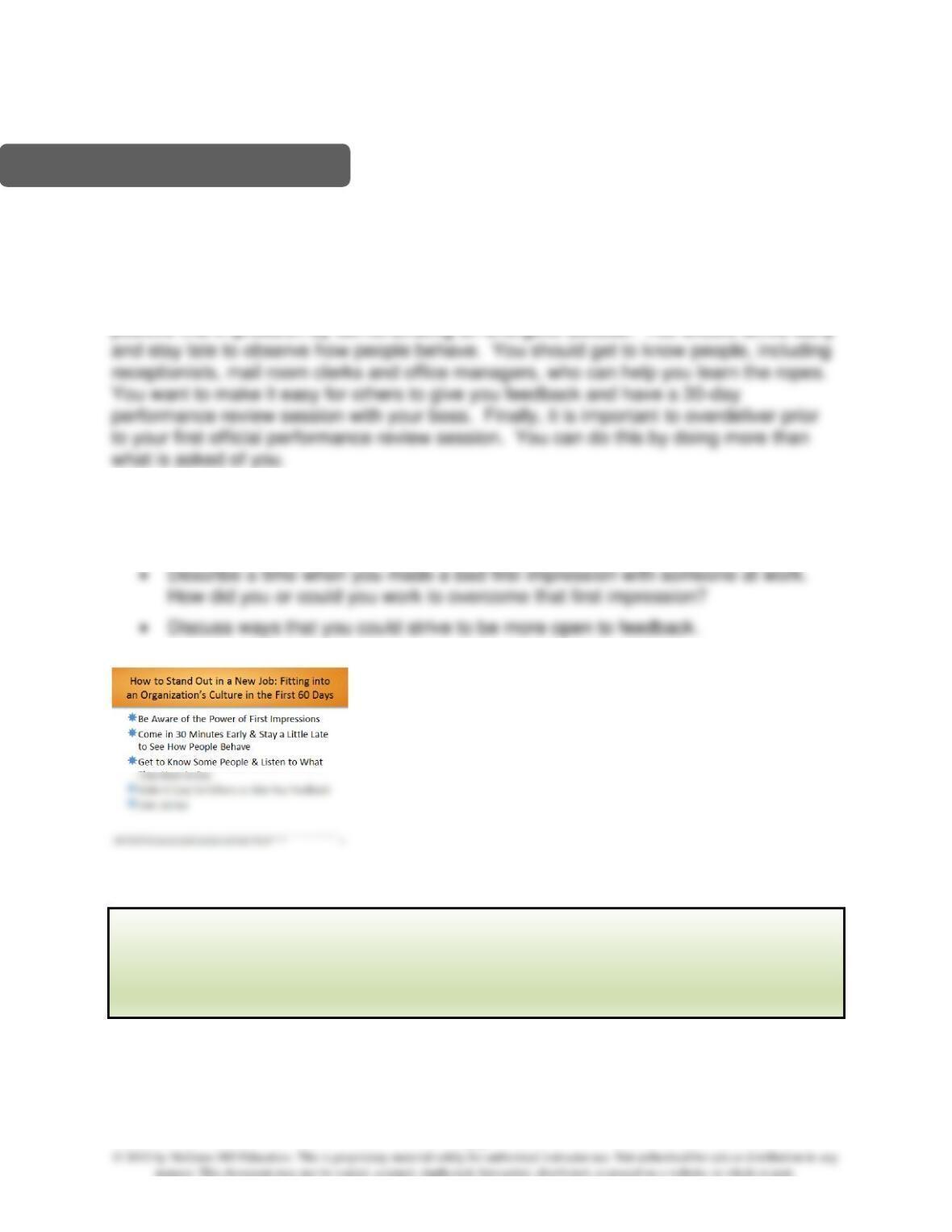
The Manager’s Toolbox: How to Stand Out in a New Job: Fitting into an
Organization’s Culture in the First 60 Days
It is important to stand out when you begin a new job. This toolbox provides advice for
things to do in the first 60 days of new employment. First, you should strive to make a
positive first impression by demonstrating an energetic attitude. You should arrive early
Possible Topics for Discussion:
• How does the foregoing advice square with your past experiences in starting a
new job? Are there things you wish you could have done differently?
Section 8.1 begins the discussion on organizing, the second of the four functions in the
management process. Organizational culture consists of the set of shared, taken-for-
CLASSROOM OUTLINE
8.1 Aligning Strategy, Culture, & Structure (pp. 226-228)
Why is it important for managers to align a company’s vision and
strategies with its organizational culture and structure?
Chapter 08 – Organizational Culture, Structure, & Design: Building Blocks of the Organization
Possible Topics for Discussion:
• Have you ever had a job where you felt like it was not the right “fit?” If so,
describe the factors that contributed to this lack of fit. If not, in what ways was
your current or most recent position the right fit?
Major Idea Outline:
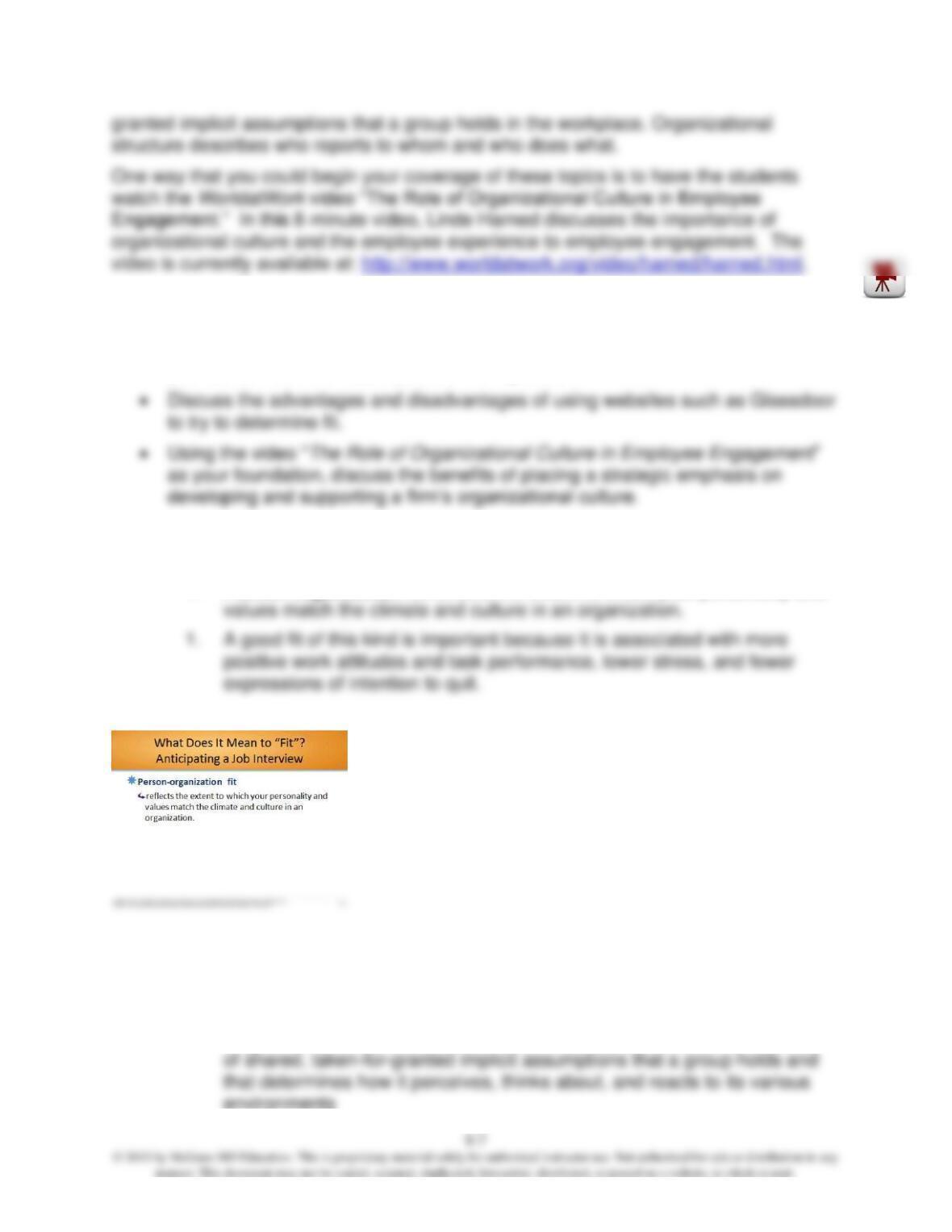
A. What Does It Mean to “Fit”? Anticipating a Job Interview
1. Person-organization fit reflects the extent to which your personality and
B. Organizational Culture: The System of Shared Beliefs and Values
1. To implement a particular strategy, managers must determine the right
kind of (1) organizational culture and (2) organizational structure.
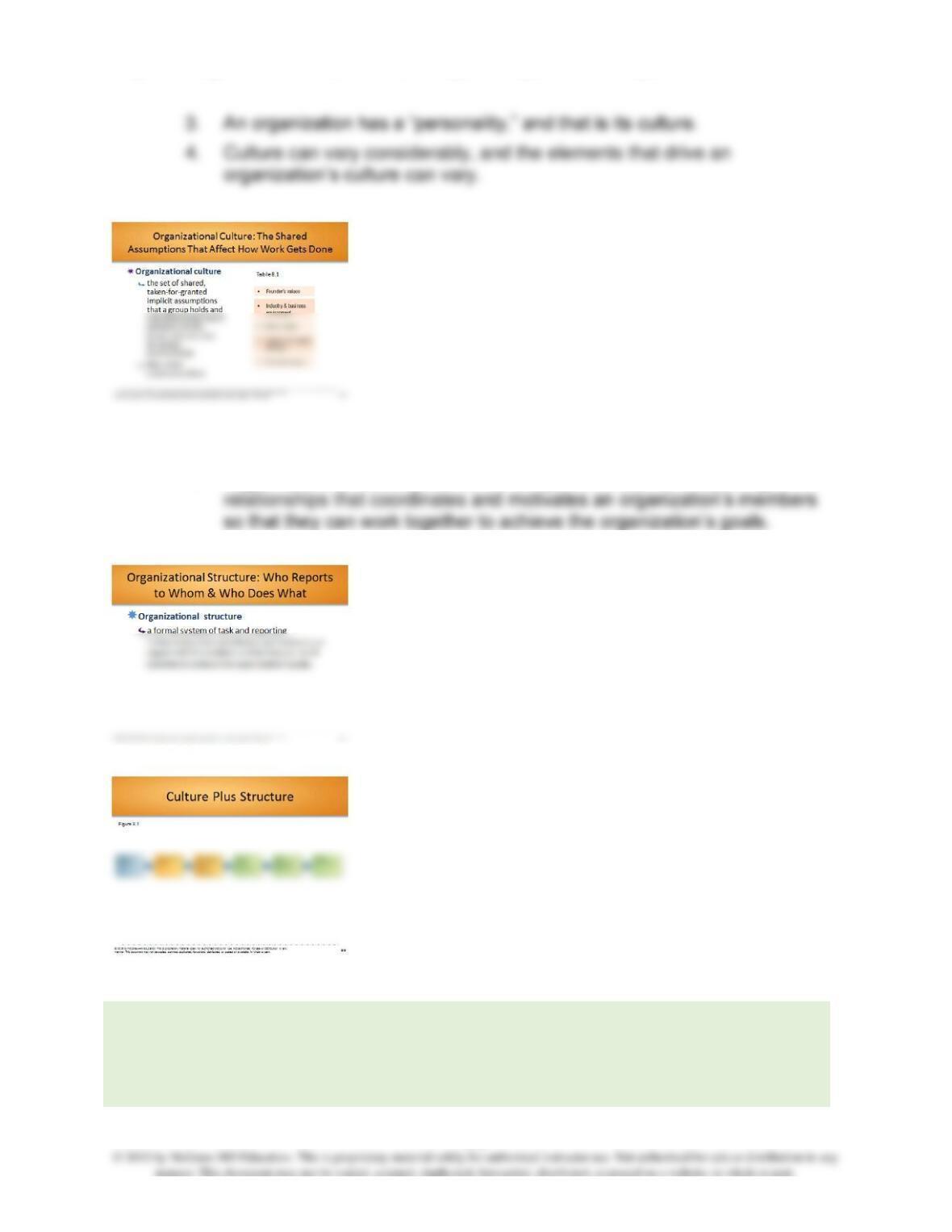
2. Organizational culture, sometimes called corporate culture, is the set
Chapter 08 – Organizational Culture, Structure, & Design: Building Blocks of the Organization
8-8
C. Organizational Structure: Who Reports to Whom and Who Does What
1. Organizational structure is a formal system of task and reporting
Interactive Classroom Material:
EXAMPLE: How Strategy Affects Culture & Culture Affects Structure: EndoStim,
a Medical Device Start-up, Operates Virtually (p. 228)
Nowadays a firm can be completely international. An example is the medical device
Chapter 08 – Organizational Culture, Structure, & Design: Building Blocks of the Organization
start-up EndoStim, nominally based in St. Louis but operating everywhere. The
culture of the company is an adhocracy, which is a risk taking culture that values
flexibility and creativity and that is focused on developing innovative products.
YOUR CALL
Are you comfortable enough to work in a virtual, boundaryless organization?
Which would you favor?
A lot has to do with how comfortable one is getting work done without formal,
structural oversight. Moreover, social interactions are, in many areas, part of an
Additional Activities:
One way to build on this Example is to have the students read the St. Louis Business
Journal article “EndoStim Raises $2.5 Million from Single Investor.” Consider using
Chapter 08 – Organizational Culture, Structure, & Design: Building Blocks of the Organization
8-10
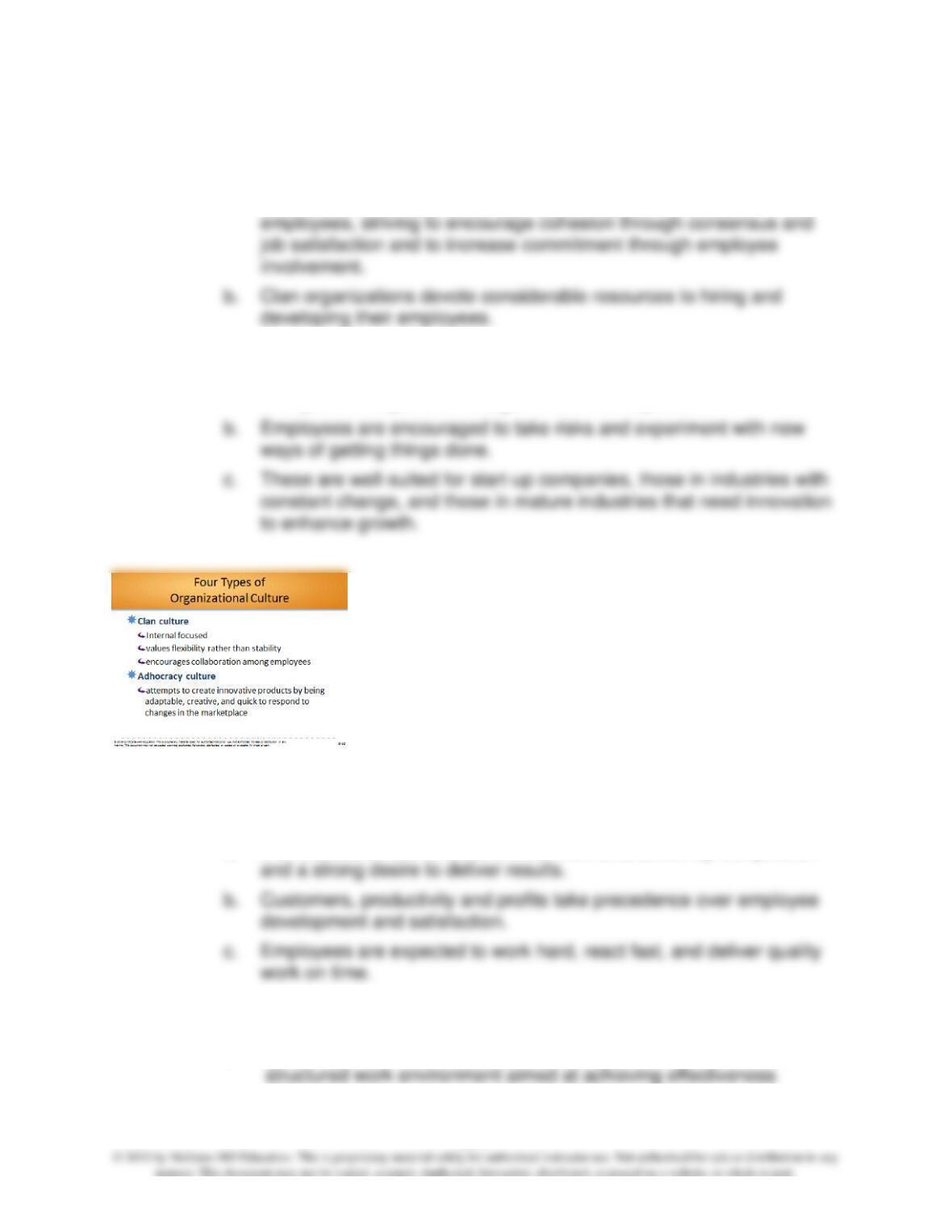
Section 8.2 discusses the four types of organization culture: clan, adhocracy, market,
and hierarchy. Organizational culture appears as three layers: observable artifacts,
espoused values, and basic assumptions. Culture is transmitted to employees in
symbols, stories, heroes, and rites and rituals.
Possible Topics for Discussion:
• Of the four culture types (i.e., clan, adhocracy, hierarchy and market), identify
which one you would find the most motivating and explain why.
Major Idea Outline:
A. Four Types of Organizational Culture: Clan, Adhocracy, Market, & Hierarchy
1. According to one common methodology known as the competing values
8.2 What Kind of Organizational Culture Will You be
Operating In? (pp. 229-234)
How do I find out about an organization’s “social glue,” its normal way of
doing business?
Chapter 08 – Organizational Culture, Structure, & Design: Building Blocks of the Organization
8-11
2. A clan culture has an internal focus and values flexibility rather than
stability and control.
a. Like a family-type organization, it encourages collaboration among
3. An adhocracy culture has an external focus and values flexibility.
a. It attempts to create innovative products by being adaptable, creative,
and quick to respond to changes in the marketplace.
4. A market culture has a strong external focus and values stability and
control.
a. It is focused on the external environment and driven by competition
5. A hierarchy culture has an internal focus and values stability and control
over flexibility.
a. Companies with this kind of culture are apt to have a formalized,
Chapter 08 – Organizational Culture, Structure, & Design: Building Blocks of the Organization
8-12
SELF-ASSESSMENT 8.1 (p. 231)
Assessing Your Preferred Type of Organizational Culture
Go to connect.mheducation.com and take Self-Assessment 8.1.
Student Questions:
1. Do you have a preferred culture type, or is there a combination of types best
suited for you? Are you surprised by the results?
Student responses will differ based on assessment results. Students may be
2. What are three questions you can ask a recruiter to determine if a company
possesses your preferred culture type?
Examples of questions include: How important is innovation for your
3. Have you ever worked in a company that did not possess your preferred
culture type? In what ways did you feel a lack of person-organization fit? Did
lack of fit affect your job satisfaction or desire to continue working at the
company? Explain.
It would be good to know the outcome of students working for organizations
Additional Activities:
You can also consult the Connect Instructors Manual for the post-assessment activity
and corresponding PowerPoint slides used for this Self-Assessment in Connect. In
Chapter 08 – Organizational Culture, Structure, & Design: Building Blocks of the Organization
8-13
Interactive Classroom Material:
EXAMPLE: The Corporate Cultures of Pfizer Pharmaceuticals: The Different
“Personalities” within an Organization (p. 231)
Organizational cultures are nearly as varied as human personalities, and often
YOUR CALL
What cultural types are illustrated in these three examples? Does it make more
sense that a company would have one dominant cultural type or an equal
mixture of clan, adhocracy, market, and hierarchy? Explain your rationale.
Fines – Market culture
Free prescription drugs – Clan culture
Additional Activities:
One way to build on this Example is to have the students read the Bloomberg
Business article “All Eyes on Pfizer as Shareholders Await the Mega-Deal: Real
M&A.” This article profiles the acquisition strategy of Pfizer. Consider using the
following discussion questions:
Discuss the difficulties Pfizer likely faces in managing its organizational culture as
Chapter 08 – Organizational Culture, Structure, & Design: Building Blocks of the Organization
8-14
B. The Three Levels of Organizational Culture
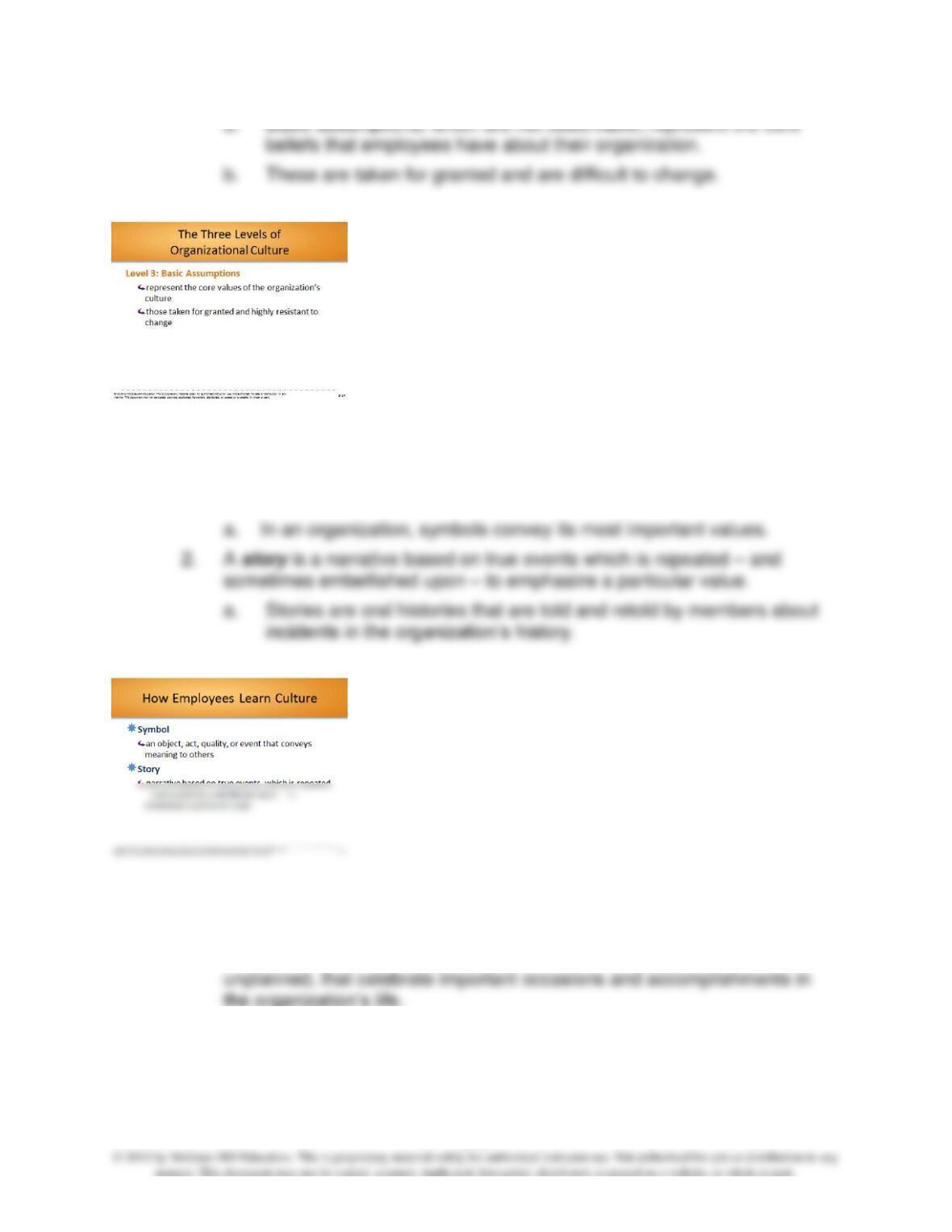
1. Level 1: Observable Artifacts – Physical Manifestations of Culture
a. Most visible level of the organization, expressed in observable
2 Level 2: Espoused Values – Explicitly Stated Values and Norms
a. Espoused values are the explicitly stated values and norms
preferred by an organization. These may be put forth by the firm’s
Chapter 08 – Organizational Culture, Structure, & Design: Building Blocks of the Organization
8-15
C. How Employees Learn Culture: Symbols, Stories, Heroes, Rites and Rituals
1. A symbol is an object, act, quality, or event that conveys meaning to
others.
3. A hero is a person whose accomplishments embody the values of the
organization.
4. Rites and rituals are the activities and ceremonies, planned and
Chapter 08 – Organizational Culture, Structure, & Design: Building Blocks of the Organization
8-16
(Correct answer is D)
D. The Importance of Culture
2. Figure 8.3 shows what organizational benefits are associated with what
organizational cultures.
3. Research on the importance of culture shows that:
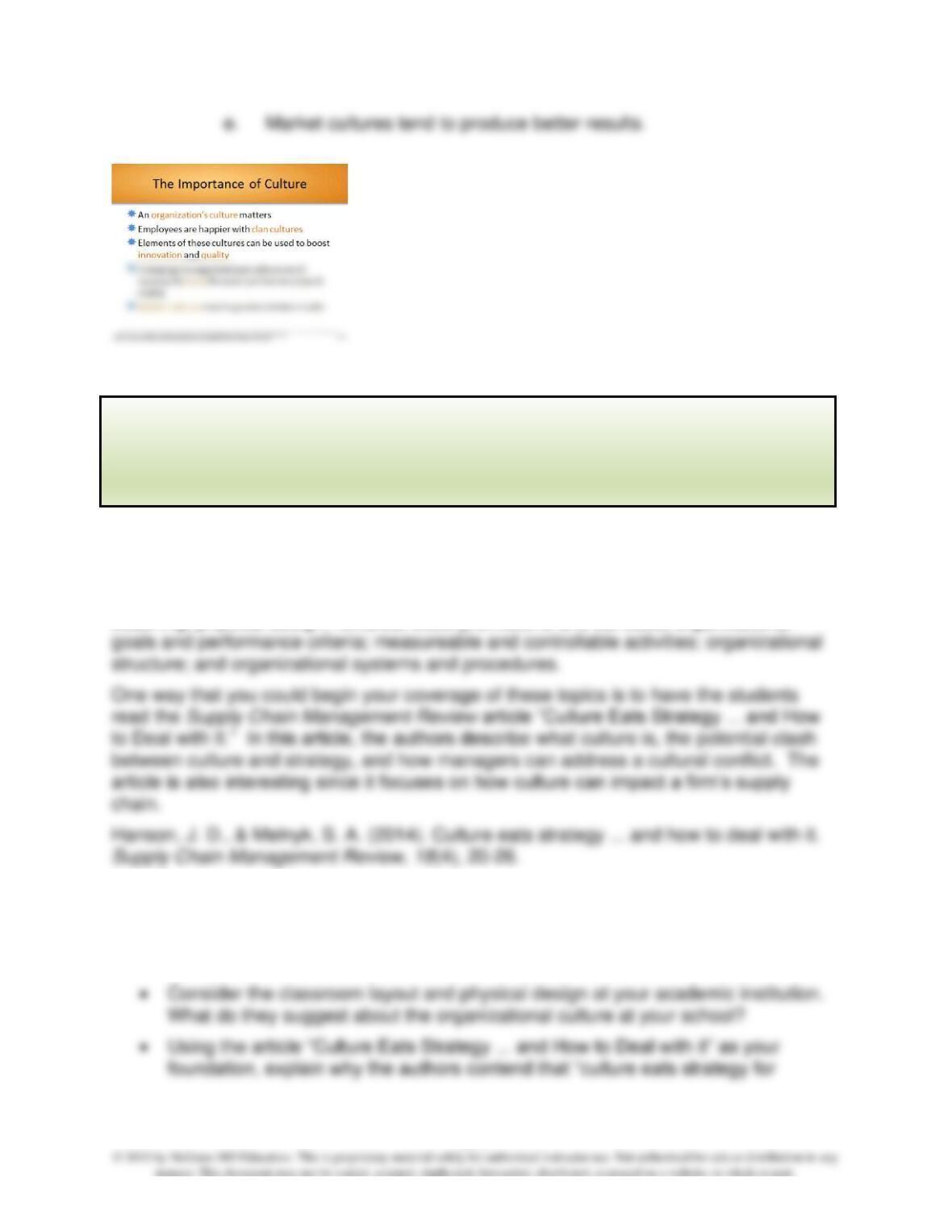
a. An organization’s culture matters.
Chapter 08 – Organizational Culture, Structure, & Design: Building Blocks of the Organization
8-17
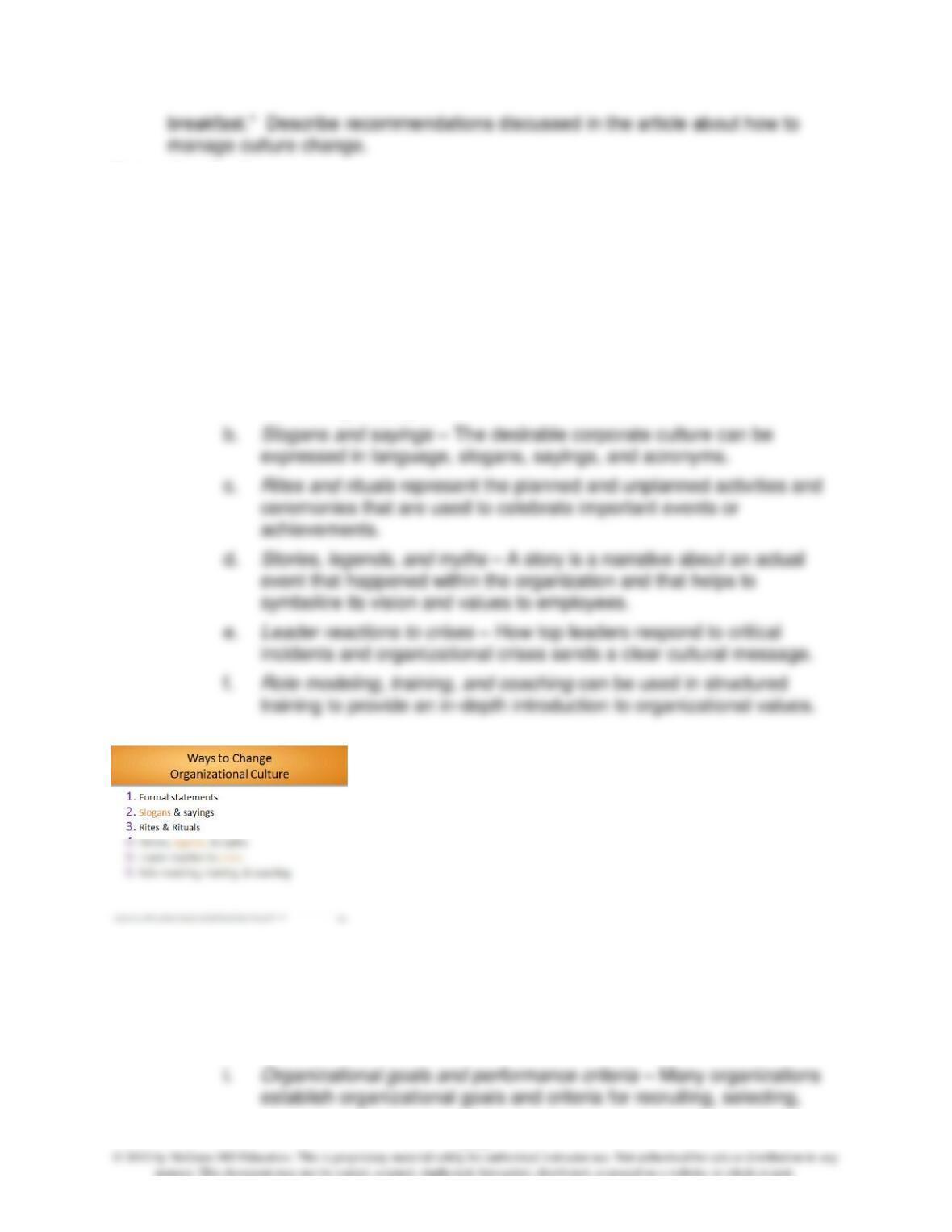
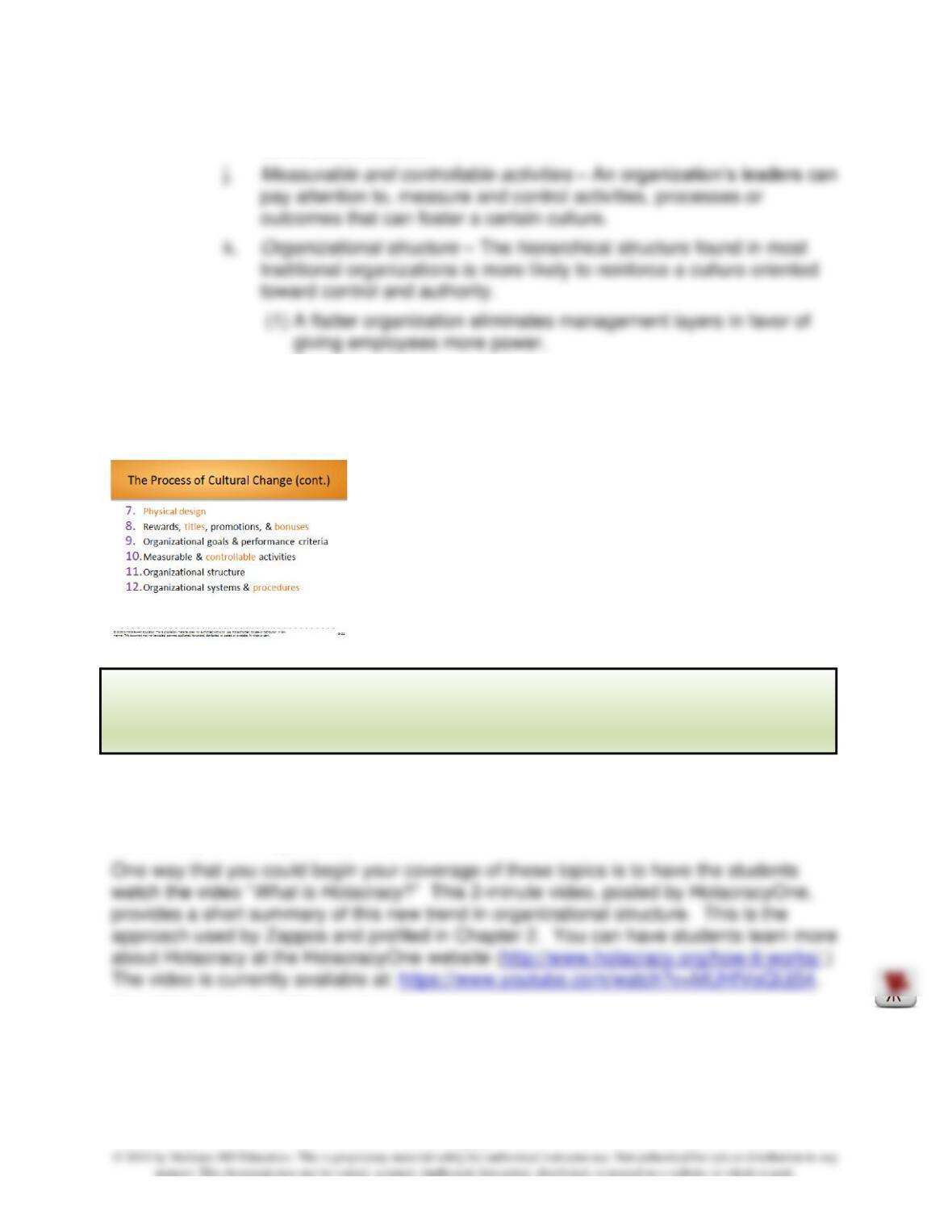
Section 8.3 discusses the 12 ways in which a culture becomes established in an
organization. These include formal statements; slogans and sayings; rites and rituals;
stories, legends and myths; leader reactions to crises; role modeling, training and
coaching; physical design; rewards, titles, promotions and bonuses; organizational
Possible Topics for Discussion:
• Select at least four of the ways to change organizational culture listed in Table
8.2 and provide an example of how each mechanism has been used by your
company (or a previous one) to embed the organizational culture.
8.3 The Process of Culture Change (pp. 235-237)
What can be done to an organization’s culture to increase its economic
performance?
Chapter 08 – Organizational Culture, Structure, & Design: Building Blocks of the Organization
8-18
Major Idea Outline:
A. The Process of Culture Change
1. Changing organizational culture is a teaching process in which
organizational members teach each other about the organization’s
preferred values, beliefs, expectations and behaviors.
2. This process is accomplished by using one or more of the following
mechanisms:
a. Formal statements of organizational philosophy, mission, vision and
values, as well as materials used for recruiting, selecting and
socializing employees.
g. Physical design and office layout can send a strong message about a
firm’s culture.
h. Rewards, titles, promotions, and bonuses are one of the strongest
ways to embed organizational culture.
Chapter 08 – Organizational Culture, Structure, & Design: Building Blocks of the Organization
8-19
developing, promoting, dismissing and retiring people, all of which
reinforce the culture.
l. Organizational systems and procedures – Companies are
increasingly using electronic networks to increase collaboration
among employees along with innovation, quality and efficiency.
Section 8.4 covers the organizational structure of the three types of organizations: for–
profit, nonprofit, and mutual-benefit. The structure may be expressed vertically or
horizontally on an organization chart.
Possible Topics for Discussion:
• Locate the organizational chart for your company or one for which you would like
to work after graduation. Describe what you can learn from this chart about the
firm’s vertical hierarchy of authority and the horizontal specialization of the firm.
8.4 Organizational Structure (pp. 238-240)
How are for-profit, nonprofit, and mutual-benefit organizations structured?
Chapter 08 – Organizational Culture, Structure, & Design: Building Blocks of the Organization
8-20
Major Idea Outline:
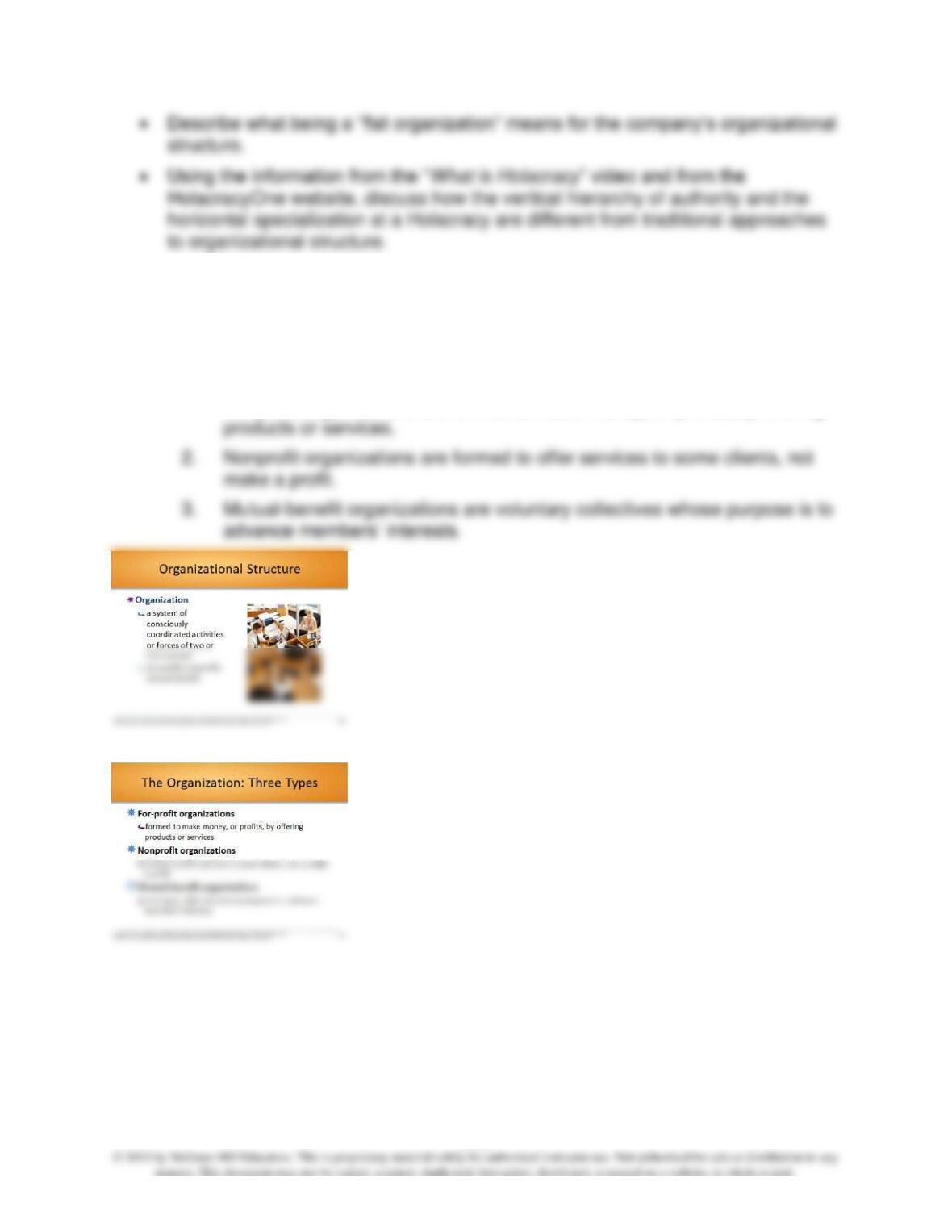
A. An organization is a system of consciously coordinated activities or forces of
two or more people.
B. The three types of organizations are classified according to the different
purposes for which they are formed.
1. For-profit organizations are formed to make money, or profits, by offering