Chapter 8
Long-Term (Capital Investment) Decisions
Concept Questions
1. (LO1—NPV and the cost of capital)
The cost of capital is the average rate of return that a company must pay to its
2. (LO1 and 2—The relationship between IRR and NPV)
3. (LO2—NPV and IRR)
When (1) projects are of the same magnitude, (2) their investment lives are
4. (LO2—IRR)
In using IRR, projects are accepted when IRR is greater than or equal to the
5. (LO3—NPV and profitability index)
The profitability index (PI) is a modification of the NPV technique. It is calculated
6. (LO3—Screening decisions versus preference decisions)
Screening decisions are those relating to whether a proposed project meets a
Solutions Manual
8-2
7. (LO4—The depreciation tax shield)
The depreciation tax shield is the tax savings that a company receives from
8. (LO5—Payback method)
The payback period is the length of time necessary for a long-term project to
Brief Exercises
1. (LO1—NPV: No salvage value or taxes)
Cash Flow Year Present Value
2. (LO2—IRR: Even cash flows)
With revenues increasing by $2,000 per year, dividing the machine cost of
$9,000 by the annual cash flow ($2,000) results in an IRR factor of 4.5.
Chapter 8: Long-Term (Capital Investment) Decisions
3. (LO3–Screening decisions and preference decisions)
a. False
4. (LO4—Depreciation tax shield)
5. (LO5—Payback method with uneven cash flows)
Exercises
6. (LO1—Basic NPV: No salvage value or taxes)
Cash Flow Year Present Value
7. (LO1—Basic NPV with salvage value)
Cash Flow Year Present Value
Initial investment Now $(80,000)
8. (LO1—Basic NPV with salvage value)
Cash Flow Year Present Value
Initial investment Now $(100,000)
Solutions Manual
8-4
9. (LO1—Understanding NPV)
10. (LO1 and 2—NPV)
As estimated, the NPV of the project is $43,000, so the return on the project is
11. (LO1 and 2—NPV and IRR assumptions)
There are two underlying assumptions:
12. (LO2—IRR: Even cash flows)
With revenues increasing by $1,500 per year, dividing the machine cost of
3.333 = DFA5,r r = approx. 15 percent; or, using Excel, we have
Cash Flow Year Value
Initial investment $(5,000)
Chapter 8: Long-Term (Capital Investment) Decisions
13. (LO2—IRR with uneven cash flows)
Because the cash flows are unequal, a financial calculator or Excel must be used
14. (LO2—IRR: Tax effects)
The relevant after-tax cash flows are as follows:
Year Cash Flow
Initial investment Now $(21,000)
15. (LO2 and 4—IRR: Tax effects)
After-tax revenues increase by $1,050 per year [$1,500 × (1 – 30%)].
16. (LO3—Profitability index)
The present value of future cash flows, which is $17,000, is divided by the initial
Solutions Manual
8-6
17. (LO3—Profitability index)
The profitability index of 1.3 equals the present value of cash inflows divided by
the initial investment ($45,385/$35,000). The present value of the cash inflows is
as follows:
18. (LO4—After-tax NPV)
After-Tax
Years Cash Flow Present Value
Cost to purchase Now $(1,000,000.00) $(1,000,000.00)
Annual cost savings 1–10 84,000.00* 589,982.40**
**** $30,000 × 7.0236 = $210,708.00
19. (LO4—The depreciation tax shield)
20. (LO5—Payback method)
Chapter 8: Long-Term (Capital Investment) Decisions
8-7
Problems
21. (LO1, 2, and 3—Preference decisions: NPV versus IRR versus profitability index)
A. Projects P, Q, and R are all acceptable investments because they have
B. Because idle funds cannot be reinvested at a rate greater than the 12 percent
discount rate, Stephens Industries should use NPV and the profitability index
22. (LO1 and 3—NPV and preference decisions)
Project X is preferred because it has the highest NPV.
Net present value of Project X:
Net present value of Project Y:
Solutions Manual
8-8
Net present value of Project Z:
23. (LO1, 2, and 5—NPV versus payback method: Impact of varying cash flow
assumptions)
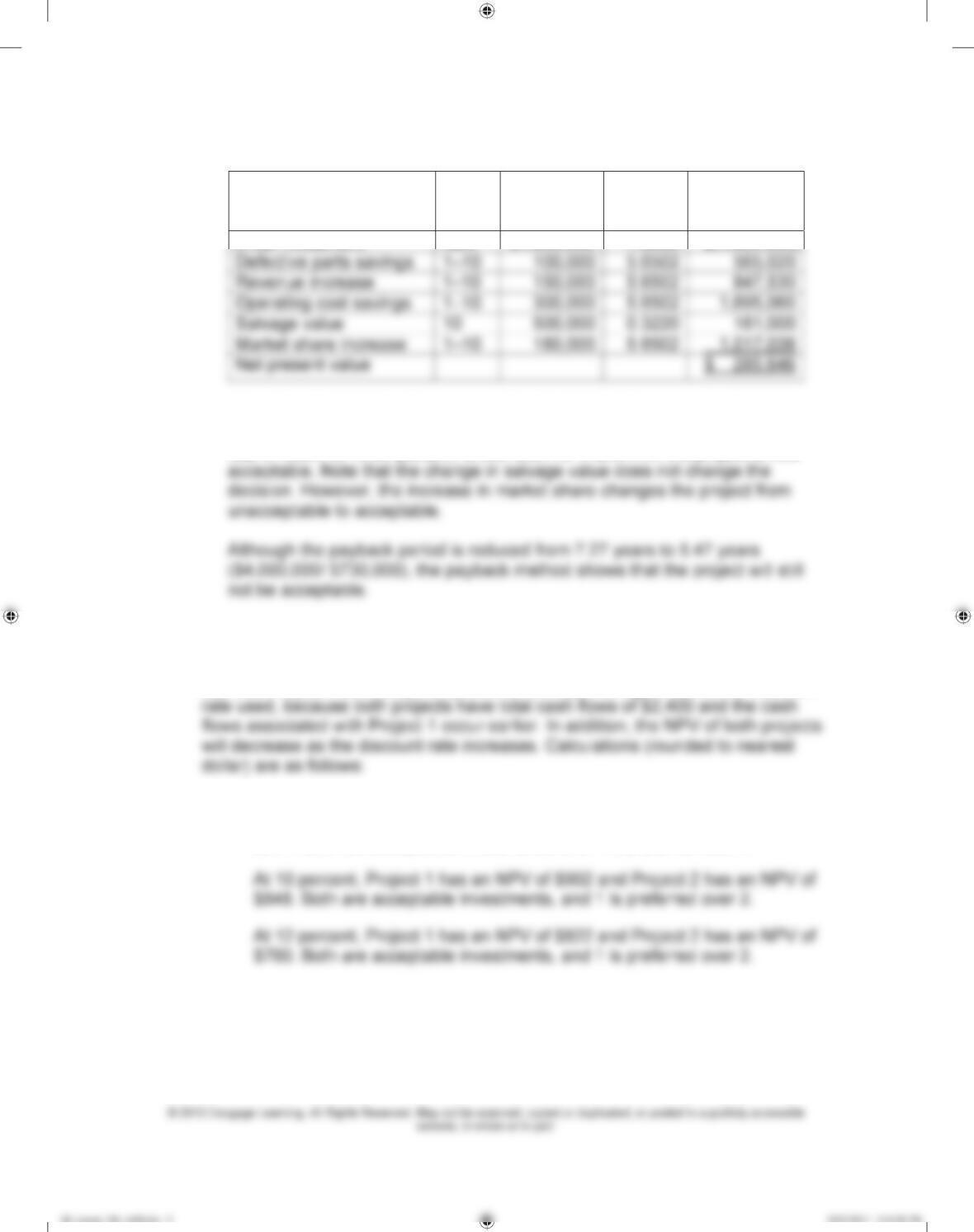
A. The payback period is 7.27 years ($4,000,000/$550,000). With a minimum
payback period of five years, the project will not be acceptable.
B.
Cash Flow
Year
Amount
12
Percent
Factor
Present
Value
Initial investment New $4,000,000 1.0000 $(4,000,000)
Chapter 8: Long-Term (Capital Investment) Decisions
8-9
C.
Cash Flow
Year
Amount
12
Percent
Factor
Present
Value
Initial investment New $4,000,000 1.0000 $(4,000,000)
Using Excel’s NPV function, we see that the NPV of the investment is now
$285,649. Using Excel’s IRR function indicates that the investment’s internal
rate of return is 13.65 percent. Under both NPV and IRR, the project is now
24. (LO1, 3, and 5—NPV versus payback method versus profitability index)
Note to Instructors: Without doing any calculations, students should be able to
see that Project 1 will always be preferred to Project 2 regardless of the discount
A. At 8 percent, Project 1 has an NPV of $987 and Project 2 has an NPV of
$941. Both are acceptable investments, and 1 is preferred over 2.
B. Payback for Project 1 is 1.67 years. Payback for Project 2 is 2.125 years.
Given Alfred’s cautious nature, we would still recommend Project 1.
Solutions Manual
8-10
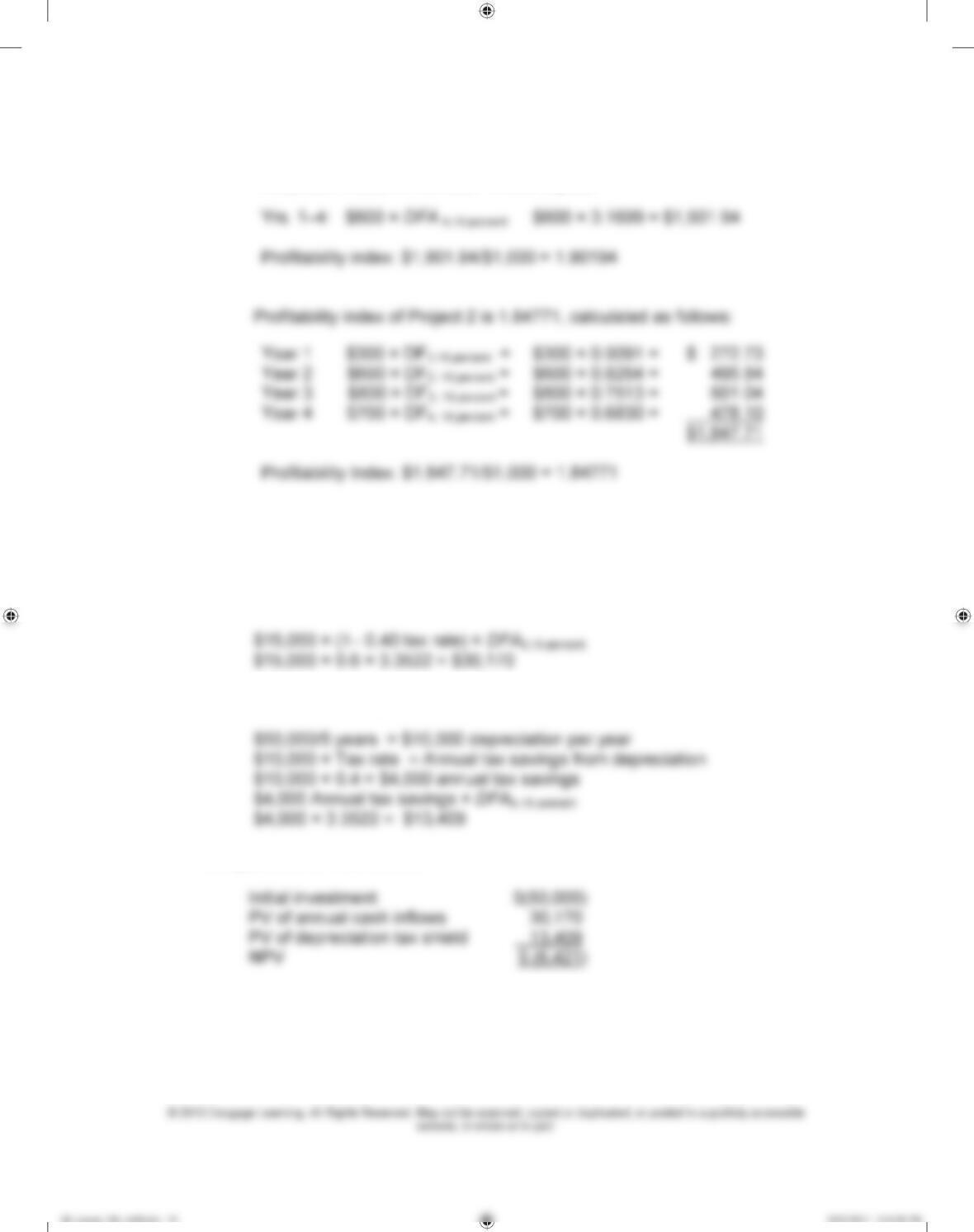
C. Profitability index of Project 1 is 1.90194, calculated as follows:
The present value of the cash inflows equals:
On the basis of the profitability index, Alfred should pursue Project 1.
25. (LO1 and 4—After-tax NPV)
Present value of annual cash inflows:
Present value of the depreciation tax shield:
Compute the NPV as follows:
Since the NPV is below zero, the new computers provide a return less than the
minimum return of 15 percent and should not be purchased.

Chapter 8: Long-Term (Capital Investment) Decisions
8-11
26. (LO3—NPV)
A. The present value of the operating cash outflows for the old machine is
D. Tate Enterprises should keep the old machine. The net cash outflow
associated with keeping the old machine is $15,163 (see solution to
27. (LO1 and 4—After-tax NPV with loss on sale and depreciation tax shield)
A. Assuming straight-line depreciation over four years with no half-year
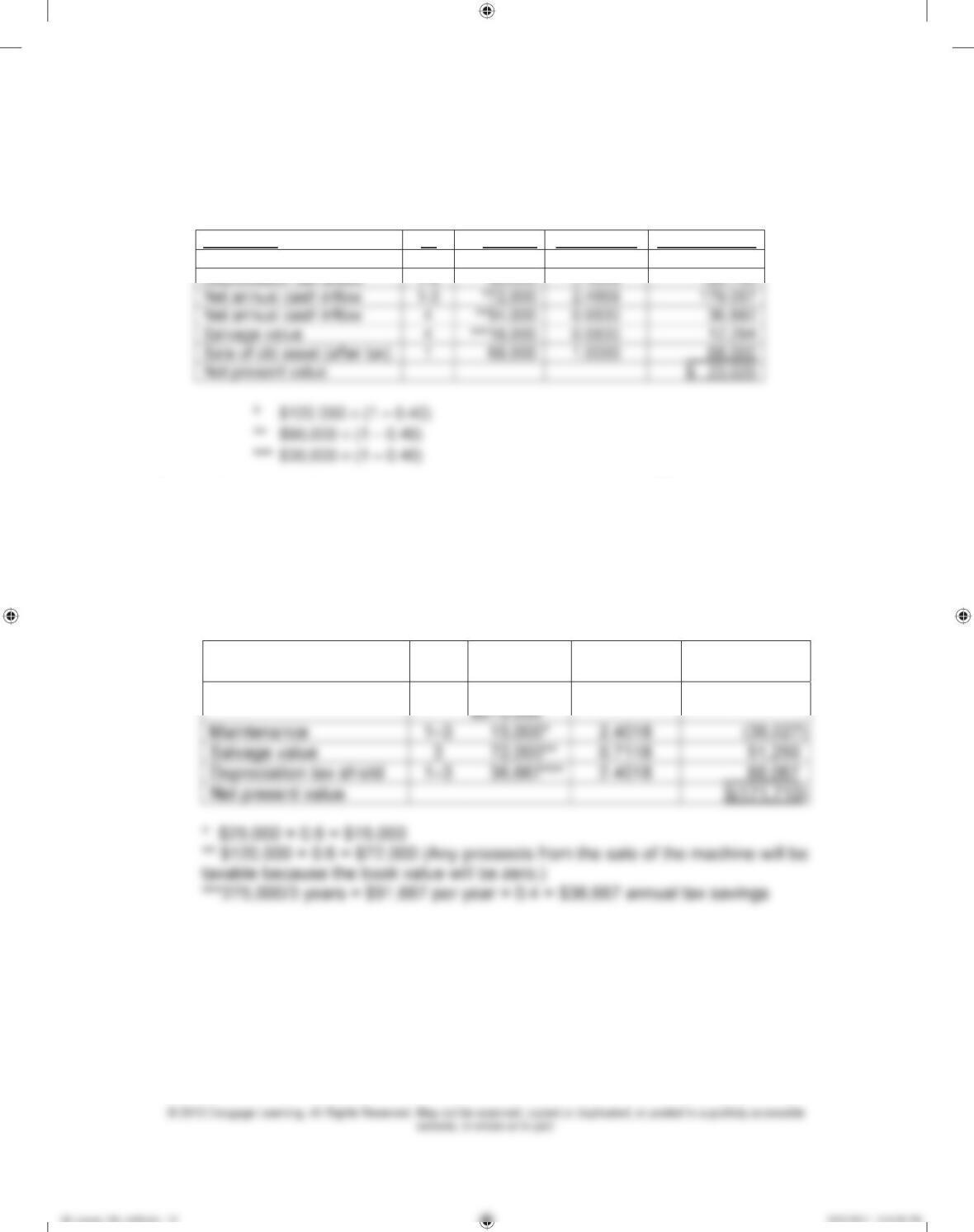
B. The old asset will be sold for $60,000, increasing cash inflows in Year 1 by
a similar amount. However, the sale of the old asset will also result in a
Solutions Manual
8-12
C. The net present value is $23,029. Note that the operating revenues are
not relevant in this problem because they will not change when the new
asset is placed in service.
Cash Flow Yr Amount 10% Factor Present Value
Initial investment New $400,000 1.0000 $(400,000
)
28. (LO1 and 4—Decision focus: Lease-or-buy decision using NPV analysis)
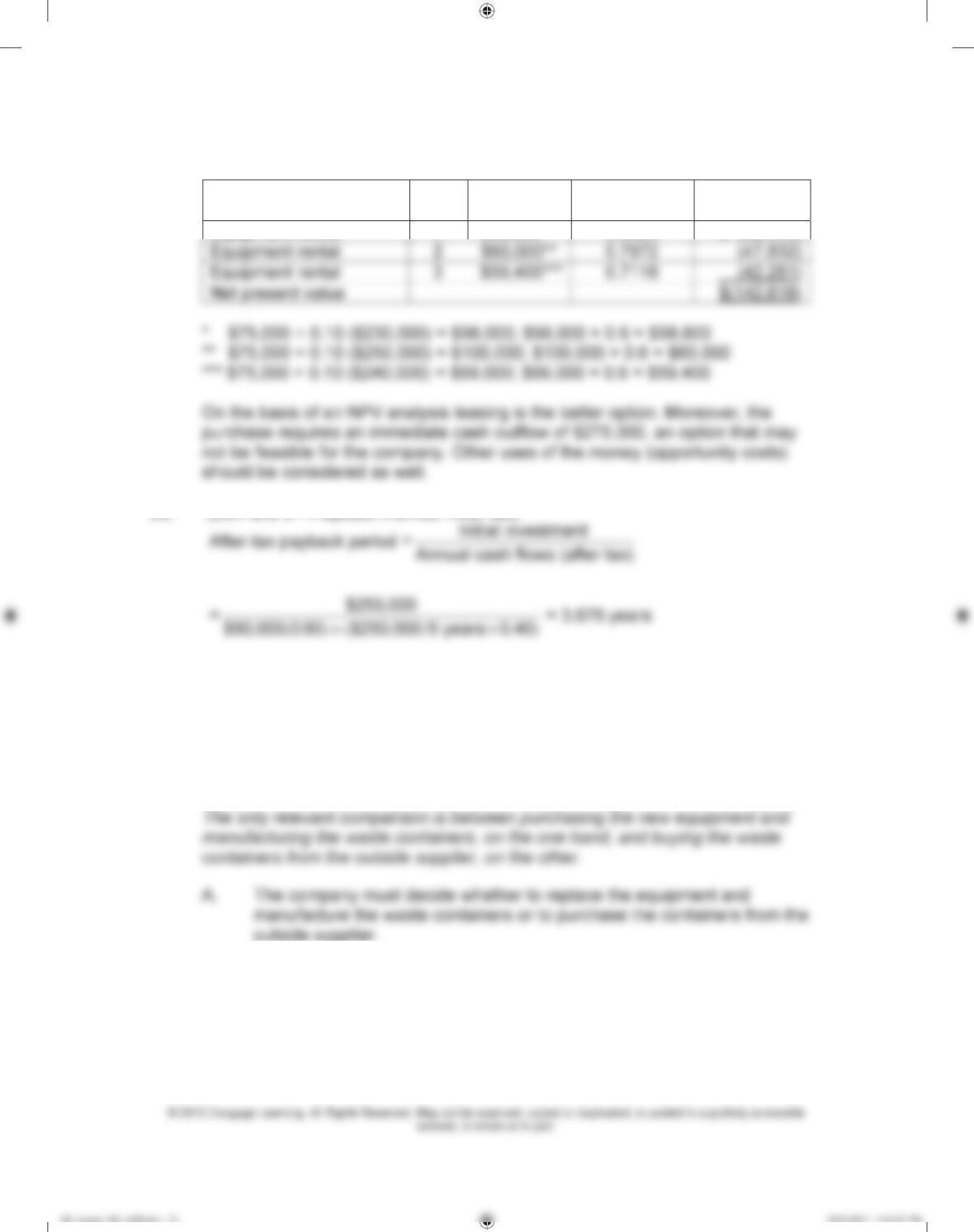
The purchase-or-lease options can be analyzed by focusing on only the
differential costs. In the following analysis, the estimated billings, operating
expenses, and setup expenses are not included because they are the same in
both alternatives.
Purchase option:
Cash Flow
Year
Amount
12 Percent
Factor
Present
Value
Initial investment Now
1.0000 $(275,000)
Chapter 8: Long-Term (Capital Investment) Decisions
8-13
Lease option:
Cash Flow
Year
Amount
12 Percent
Factor
Present
Value
Equipment rental 1 $58,800* 0.8929 $ (52,503)
29. (LO4 and 5—Payback method: After-tax)
Cases
30. (LO1 and 4—Decision focus: Make-or-buy decision with NPV analysis)
Note to instructors and students: It is not necessary to compare the new
equipment with the old equipment, because the old equipment must be replaced.
Solutions Manual
8-14
B. Rather than focus on two separate options (buying the equipment and
manufacturing waste containers versus purchasing the waste containers),
the analysis can be simplified by focusing only on the relevant differential
costs. Buying the new equipment has a positive net present value of
$51,676, so the new equipment should be purchased.
Year
Cost Savings
Tax Rate
After-Tax
Cost Savings
Cash Flow
Year
Amount
12%
Factor
PV
Initial investment Now $945,000 1.0000 $(945,000)
Salvage value of old equip. Now 900* 1.0000 900
Cost savings** 1–2 165,000 1.6901 278,867
Chapter 8: Long-Term (Capital Investment) Decisions
8-15
31. (LO1, 4—Comprehensive NPV)
A. With the revised estimates, the net present value analysis is as follows:
Cash Flow
Year
Amount
12%
Factor PV
Equip. purchasing/Installation Now $4,500,000 1.0000 $(4,500,000)
Increased working capital Now 1,000,000 1.0000 (1,000,000)
Sale of trucks Now 60,000 1.0000 60,000
Equip. repairs (net of taxes) 5 480,000 0.5674 (272,352)
Increased annual operating
B. Thorton has an ethical problem. He has been asked by his supervisor to
falsify his report in order to help preserve the job of the supervisor’s friend.
If he accurately presents the analysis with the expectation of an eight-year
Solutions Manual
8-16
C. One option is for Thorton and Ungerman to examine the projections a third
time, with a special emphasis on the projections of cost savings. If other
D. From a purely quantitative perspective, the new equipment should not be
purchased unless other cost savings or other revenue can be identified.