
8-1
8 PROBABILITY
EXERCISE 8-1
2. F is more likely; 12
37
4. E is more likely; 7
0.9 8
area Y
12. Let yellowY,redR, and greenG. Then
22. There are two red queens. If we let red queenRQ , then 21
()
PRQ since each outcome is
24. Let a sixA and a clubB. Then ()()()()413116nA B nA nB nA B . Since each
26. Let girlG and
b
oyB. Then ( , ),( , ), ( , ), ( , )SGGGBBGBB
where (, )GG means both children are girls, (,)GB means the first child is a girl, the second is a boy, and
28. From Problem 27(C), ( ) 0.26PJ , ( ) 0.14PG , ( ) 0.30PP , ( ) 0.30PS . So,
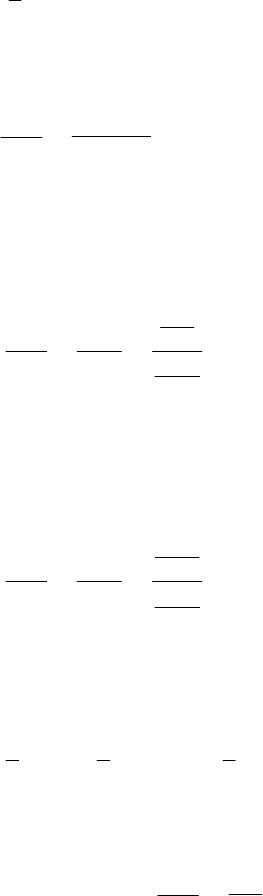
30. Using probabilities given in problem 27(C),
32. (,,),(,,),(,,),(,,),(,,),(,,),(,,),(,,)S GGG GGB GBG GBB BGG BGB BBG BBB
34. The number of four-digit sequences with no digit repeated is 10 4
P . Since the possible opening
combinations are equally likely, the probability of a person guessing the right combination is:
36. Let S = the set of five-card hands. Then n(S) = 52 5
C .
38. S = set of five-card hands; n(S) = 52 5
C.
B = “five non-face cards”; n(B) = 40 5
C
Since the individual hands are equally likely to occur:
40. Let A and B be the two candidates running neck-and-neck and C the third candidate who is receiving half
the support of either A or B according to the polls. An appropriate sample space would be S = {A, B, C}. A
42. n(S) = 66
P = 6! = 720

46. Let C = “Sum is greater than 8” ={(3, 6), (4, 5), (5, 4), (6, 3), (4, 6), (5, 5), (6, 4), (5, 6), (6, 5), (6, 6)}
48. Let D = “Sum is not 2, 4, or 6″, and let E = “Sum is 2, 4, or 6″.
Then P(D) = 1 – P(E).
52. Let G = “Sum is divisible by 4″. Then the possible values for the sum will be 4, 8, 12.
54. Let H = “Sum is 2, 3, or 12.” Then
56. Let I = “Sum is divisible by 2 and 3.” Then it must be divisible by 2 × 3 = 6. The possible values
For Problems 58–62 , the sample space S is given by: S = {(H, H, H), (H, H, T), (H, T, H), (H, T, T)}
The outcomes are equally likely and n(S) = 4.
58. Let A = “2 heads”. Then n(A) = 2 and P(A) = 2
4 = 1
2.
64. Yes, the sample space S = {H, T}. Assuming the coin is fair, we can make the equally likely assumption;

8-4 CHAPTER 8: PROBABILITY
66. S = {0, 1, 2}. For this experiment there are four outcomes, HH, HT, TH, TT, which correspond to 2, 1, 1, 0
(number of heads) respectively. As you can see, 1 corresponds to two outcomes whereas 0 and 2 each
68. S = {R, O, Y} and the seven sectors are of equal areas. Thus, P(R) = 3
70. (A) Yes, but the probability of that happening is very small.
(B) Yes, because we would expect, on the average, 1 double six in 36 rolls. The empirical probability we
assign based on the given experiment is 11
36 .
74. Let B = “Sum is 5”. Then n(B) = 4 and P(B) = 41
16 4
.
78. Let D = “Sum is an even number”. Then n(D) = 8 and P(D) = 81
16 2
.
80. Let A = “face cards “. Then n(A) = 12 and 12 5
12!
5!7!
( ) 0.000305
C
PA C
82. Let B = “6-card hand with exactly two clubs”.
O1: Choose 2 clubs; N1: 13 2
C

EXERCISE 8-1 8-5
C
86. Let D = “7-card hand with exactly 1 king and exactly 2 jacks”.
O1: Choose 1 king; 141 4NC
O
.
88. (A) Answer depends on the results of simulation.
90. (A) Select 400 random integers from the integers 1 through 12.
92. (A) The sample space S is the set of all possible permutations of the 6 brands taken 3 at a time, and
63
()nS P. Thus, the probability of selecting 3 brands and identifying them correctly, with no
1
94. (A) Let A = “3 from A and 1 from B“. Then n(A) = 15 3 20 1
CC and n(S) = 35 4
C. Thus
(B) Let B = “2 from A and 2 from B“. Then n(B) = 15 2 20 2
CC. Thus P(B) = 15 2 20 2
35 4
CC
C
≈ 0.381

8-6 CHAPTER 8: PROBABILITY
98. The total number of ways of selecting an eight-person committee from the 10 senators and 16
representatives is: 26 8 26 8
, i.e., ( )CnSC.
(A) Let A = “An equal number of senators and representatives.” The number of ways to have 4 senators
CC
EXERCISE 8-2
5
512 5
12
4
46 24
5
33
316 3
16 16
AB
AB
14. P(F) = 12
52 = 3
13 since there are 4 suits and each has 3 faces.
18. P(D’ F) = 9
52 since there are 9 faces which are not diamonds.

EXERCISE 8-2 8-7
so
22. P(D’ F’) = 30
52 = 15
26 since there are 39 non-diamond cards of which only 9 are face cards.
So, there are 30 non-diamond and non-face cards.
26. Let E = “number is even”; F = “number is multiple of 7”. Then ()12,()3,( )1nE nF nE F
28. Let E = “the number is less than 10 or greater than 10.” Then ‘E = “the number is 10.” 1
(‘) 25
PE .
30. Let E = “number is a multiple of 3”; F = “number is a multiple of 4”. Since EF , use Theorem 1:
32. Let E = “number is a prime”; F = “number is less than 14”. Since EF , use Theorem 1:
34. Let A be the event that an automobile tire fails in less than 50,000 miles. Then A‘ will be the event that the
36. sum greater than 9) (sum of 10) (sum of 11) (sum of (
12)
PPPP
38. number on first or second die is even) P(first is even) P(second is even) (both are even)
P(
P
40. (A) P(E) = 3
5,
P(E ‘) = 1 – P(E) = 2
(B) P(E) = 1
7, P(E ‘) = 1 – 1
7 = 6
7
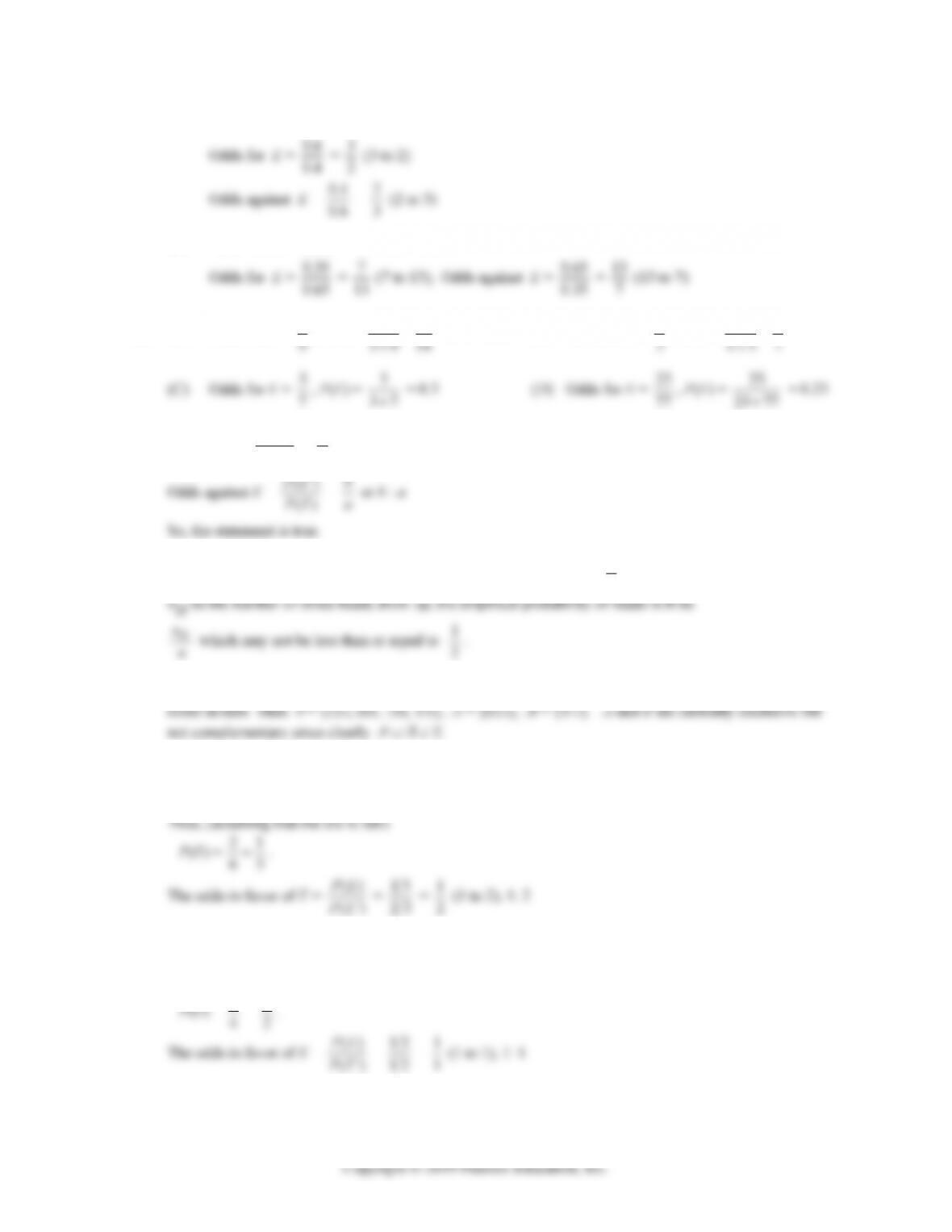
Odds for E = ()
PE

8-8 CHAPTER 8: PROBABILITY
(C) P(E) = 0.6, (‘)PE = 1 – 0.6 = 0.4
(D) P(E) = 0.35, (‘)PE = 1 – 0.35 = 0.65
42. (A) Odds for E = 5
44. Odds for E = ()
()
PE
PE
= a
b and
46. False. The theoretical probability of heads on one flip of a fair coin is 1
2. If we flip this coin n times and let
48. False. Flip a fair coin twice and let E be the event that both flips result in heads and F be the event that both
50. Let E = “a number divisible by 3 in a single roll of a die”.
= {3, 6}
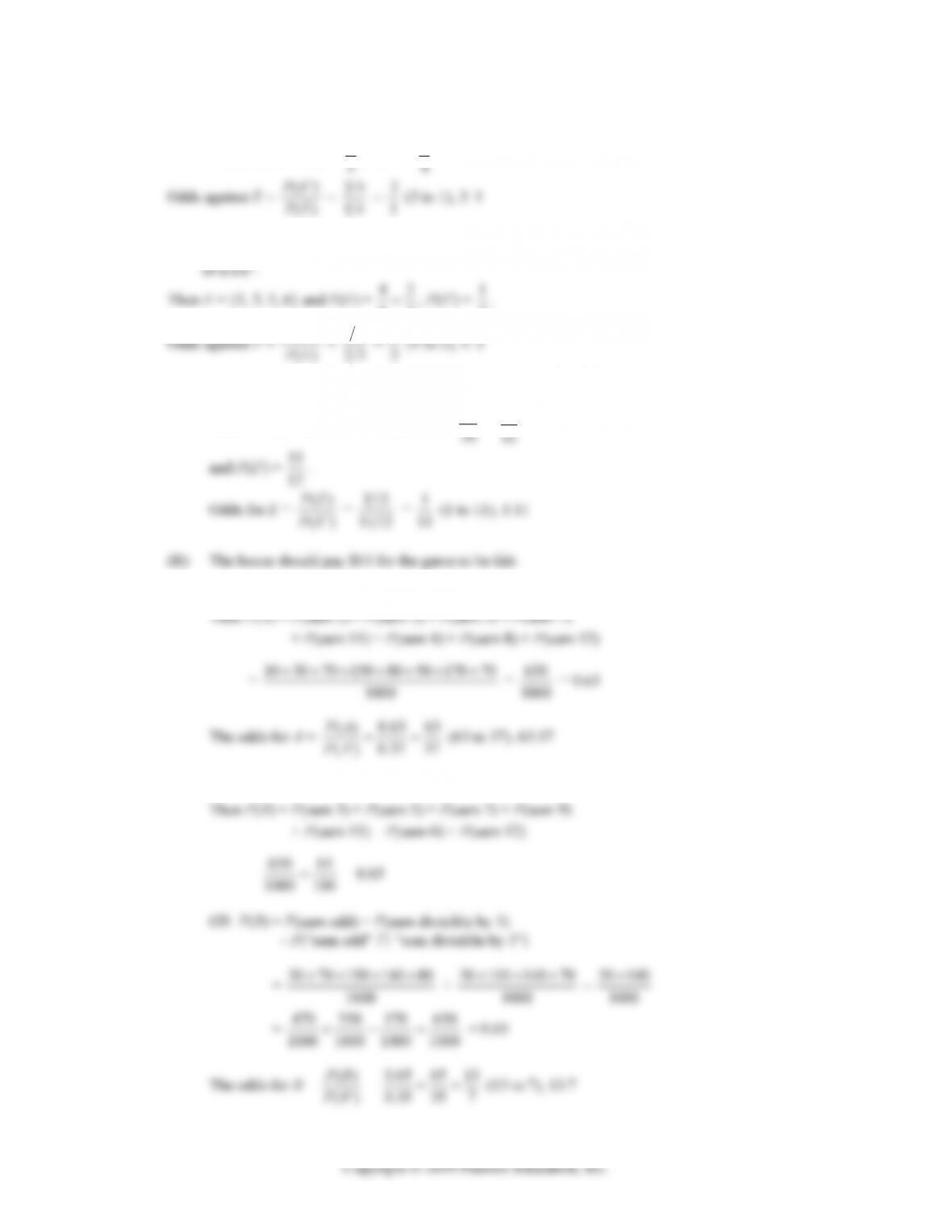
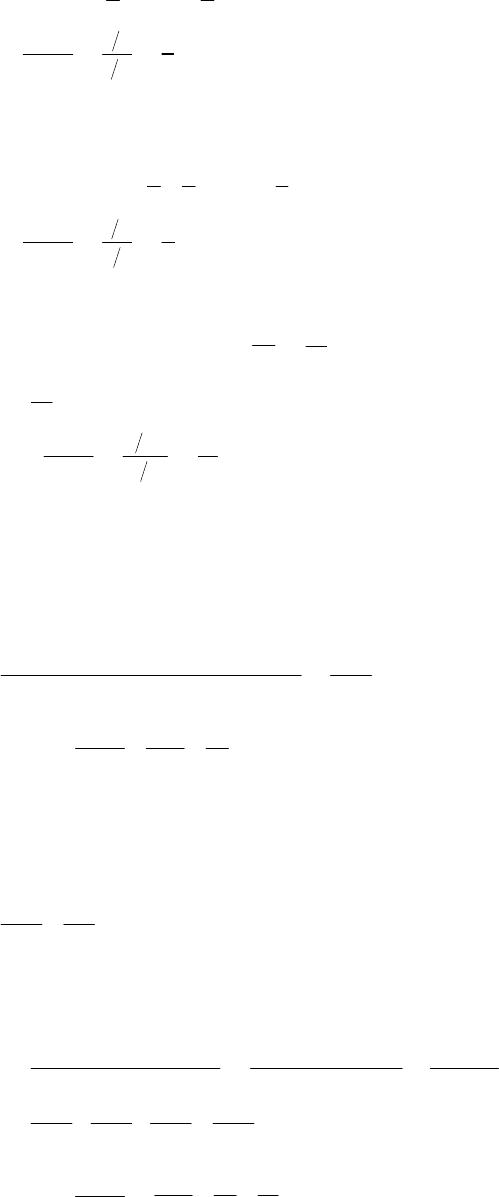
52. Let E = “1 head when a single coin is tossed twice” = {HT, TH}.
Thus, (assuming that the coin is fair or balanced)
EXERCISE 8-2 8-9
54. Let E = “2 heads when a single coin is tossed twice”.
Then E = {HH} and P(E) = 1
56. Let E = “an odd number or a number divisible by 3 in a single roll
63
3.
PE
58. (A) Let E = “a sum of 10 in a single roll of two fair dice”.
Then E = {(4, 6), (5, 5), (6, 4)}, P(E) = 3
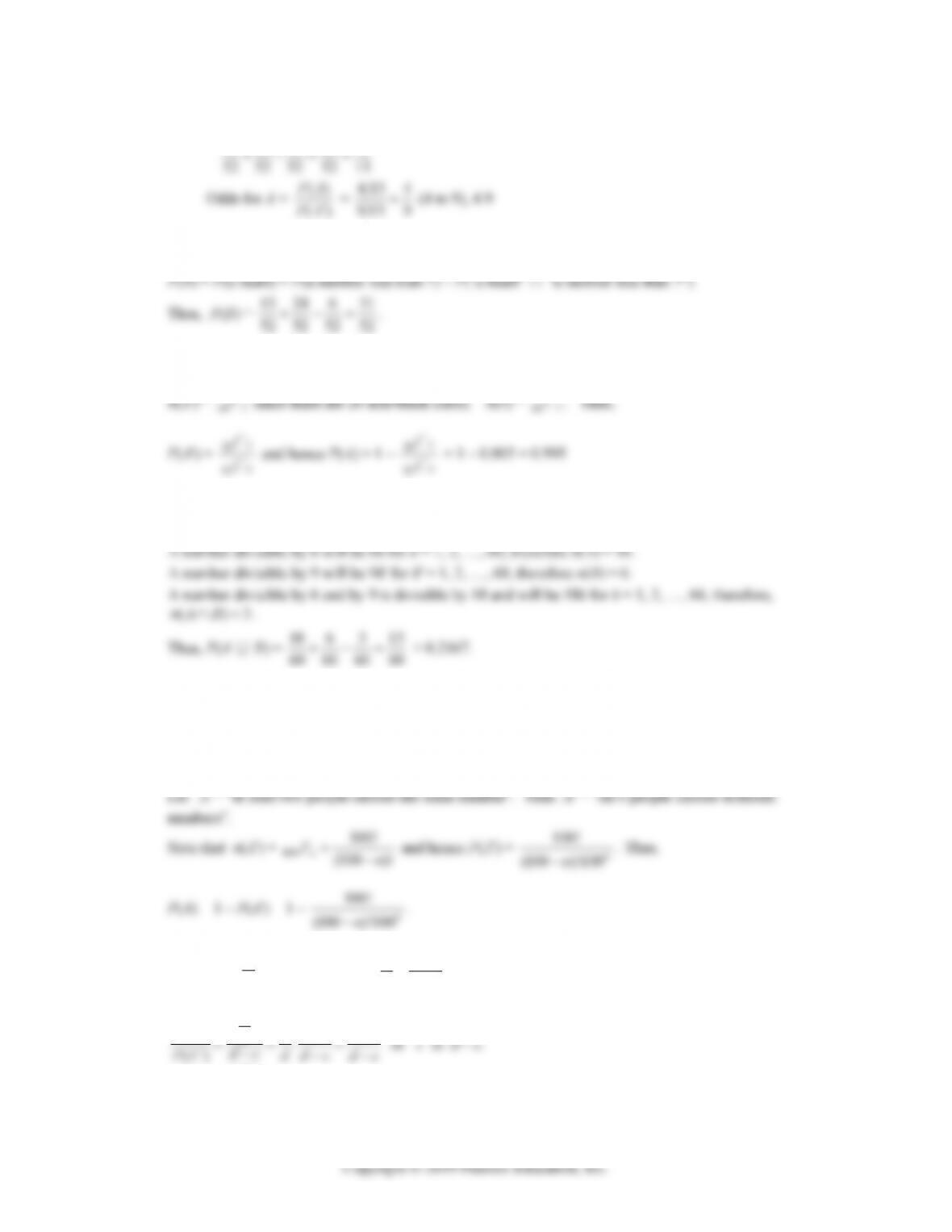
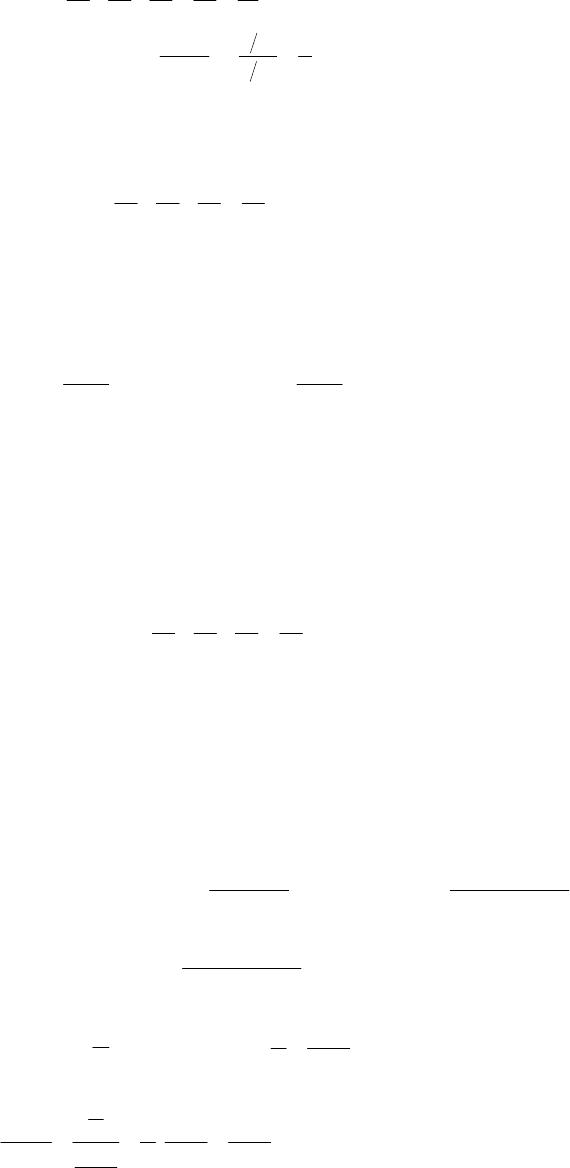
60. (A) Let A = “the sum is a prime number or is exactly divisible by 4”.
(B) Let B = “the sum is an odd number or is exactly divisible by 3″.
8-10 CHAPTER 8: PROBABILITY
62. Let A = “a king or a heart is drawn”. Then P(A) = P(a king) + P(a heart) – P( king of hearts)
64. Let B = “a heart or a number less than 7″. Then
66. Let A = “at least 1 black card in a 7-card hand dealt from a standard 52-card deck”.
Then A‘ = “0 black cards in a 7-card hand dealt from a standard 52-card deck”.
68. Let A = “the selected number is divisible by 6,” B = “the selected number is divisible by 9”.
Then P(A B) = P(A) + P(B) – P(A B)
70. The equation holds if the events A, B, and C are pairwise mutually exclusive.
74. n(S) = 100 100 100
= 100n, because each of the n people is free to choose any of the numbers
between 1 and 100.
76. If () ,
c
PE d
then (‘)1 cdc
PE dd
, and the odds in favor of E are
c
Pcdc
d
d

EXERCISE 8-2 8-11
78. (A) The command selects 50 random integers from 2 through 12. Unlike the sum of a pair of dice, a 2 is
80. (A) Let A = “the selected student owns a car”, and B = “the selected student owns a laptop”.
Then P(A) = 450
82. (A) Let A = “the driver has an accident,” B = “the driver drives more than 15,000 miles per year”.
84. Let A = “1 or more defective found in a sample of 10.” Then A‘ = “no defective found in a sample of 10”.
C
C
86. Let A = “at least one union employee is selected”. Then A‘ = “no union employee is selected”.
Therefore, n(A‘) = 12 4
C, n(S) = 20 4
C, and P(A‘) = 12 4
C
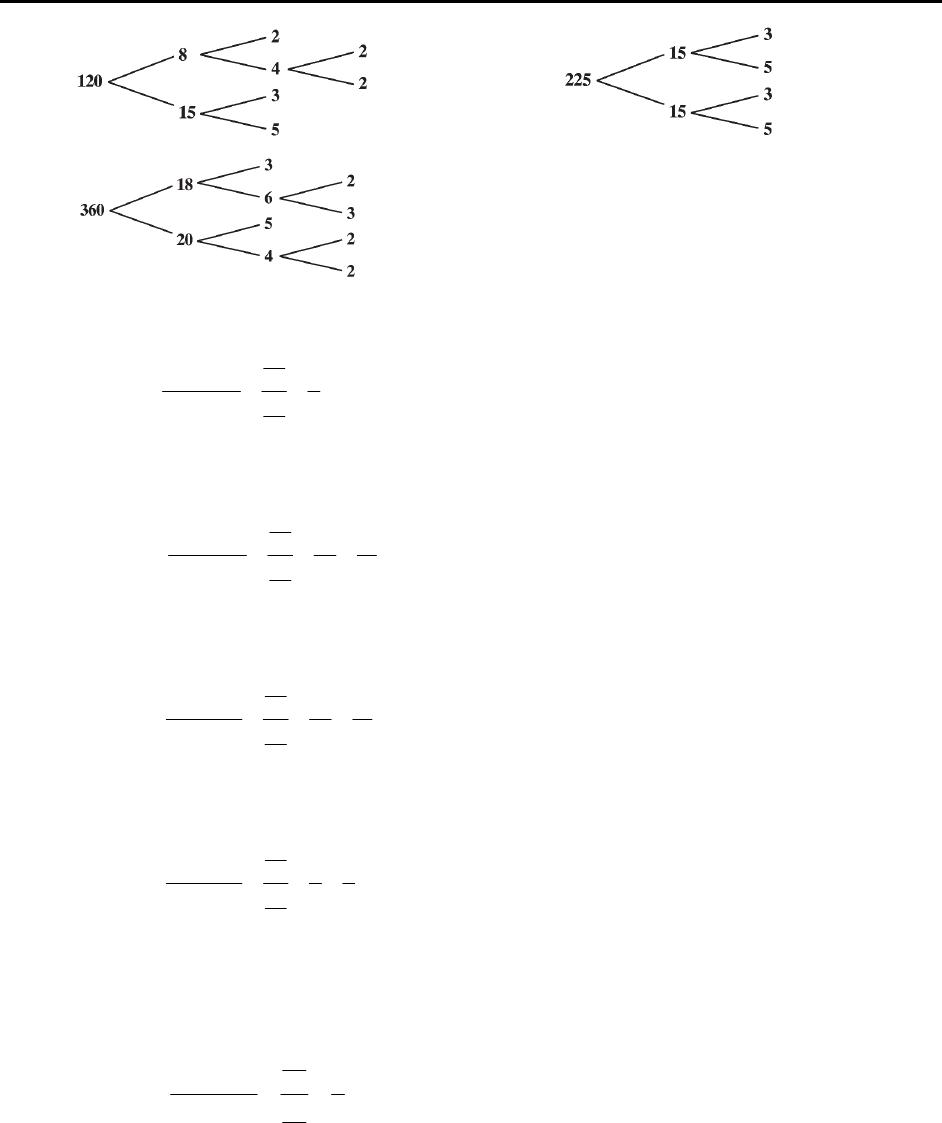
88. Let A = “the resident is a Democrat”, B = “prefers candidate B“, and C = “has no preference”.
(A) P(A B) = P(A) + P(B) – P(A B) = 0.5 + 0.53 – 0.25 = 0.78
The odds for this event = 0.78 0.78 78 39
1 0.78 0.22 22 11
(39 to 11), 39:11.
8-12 CHAPTER 8: PROBABILITY
EXERCISE 8-3
2.
4.
6.
8. R = card is red, F = card is a face card; ( ) 26, ( ) 12, ( ) 6.nR nF nR F
6
10. F = card is a face card, R = card is red; ( ) 26, ( ) 12, ( ) 6.nR nF nR F
6
12. J = card is a jack, R = card is red; () 4, () 26, ( ) 2.nJ nR nJ R
2
14. R = card is red, J = card is a jack; () 4, () 26, ( ) 2.nJ nR nJ R
2
16. T = sum is 10, D = roll is doubles. () 3, ( ) 6, ( ) 1nT nD nT D .
1

EXERCISE 8-3 8-13
18. D = roll is doubles, T = sum is 10. () 6, () 3, ( )1nD nT nT D .
1
20. A = sum is odd, B = at least one six. () 18, () 11, ( ) 6nA nB nA B .
6
22. B = at least one six , A = sum is odd . () 18, () 11, ( ) 6nA nB nA B .
6
24. P(E) = .40 26. P(C E) = .07
28. (0.07
P( | ) 0.175
( ) 0.40
)PC
CE E
E
P
30. )(0.07
(|) 0.35
() 0.2
PE
PE C PC
C
32. )(0.28
(|) 0.40
() 0.7
PE
PE A PA
A
34. P(B|B) = ()
()
PB B
PB
= ()
()
PB
PB = .1
.1 = 1
36. P(A) = 0.70, P(E) = 0.40, P(A E) = 0.28.
38. Dependent. Observe that:
P(E) = 0.40, P(B) = 0.10 and P(E B) = 0.05
40. P(C) = 0.20, ( ) 0.30PF , )(0.06PFC .
44. (A) Since the rolls are independent, probability of getting a 6 on the fifth roll is 1
(B) n(S) = 6·6·6·6·6 = 65 and if A = “same number turns up each time”,

8-14 CHAPTER 8: PROBABILITY
46. Let E = “pointer lands on an odd number”, and F = “pointer lands on a prime number”.
Then P(E) = 0.3 + 0.2 + 0.1 = 0.6 (E = {1, 3, 5}), P(F) = 0.1 + 0.2 + 0.1 = 0.4 (F = {2, 3, 5})
()
PE
0.6 = 1
2.
48. (A) P(N R) = P(N) · P(R|N) = (0.7)(0.4) = 0.28.
50. E1 = {HH, HT}, E3 = {HT, TT}, E4 = {HH, TH}, E1 E3 = {HT}, E3 E4 = .
(A) E1 and E3 are independent (and not mutually exclusive) since
52. Let A = “at least 5 on the first throw”, and B = “at least 5 on the second throw”.
Since the throws are independent , the events A and B are independent. Thus,
54. Let A = “the first selected card is red”, and B = “the second selected card is red”.
Then we are interested in computing P(A B); P(A B) = P(A)·P(B|A)
(A) Without replacement: P(A) = 26
52 = 1
2 since there are 26 red cards in a deck. After the selection of a
(B) With replacement: In this case P(A) = 26
56. We note that n(M) = 13, n(N) = 20 (since the even cards are 2, 4, 6, 8, 10 and there are 4 of each),
n(M N) = 5 (since there are only 5 even diamond cards).
EXERCISE 8-3 8-15
5
58. (A) 2 coins are tossed.
4.
A and B are dependent since P(A B) = 1
4 ≠ P(A) P(B) = 1
4 × 1
2 = 1
8
(B) 3 coins are tossed.
In this case, S = {HHH, HHT, HTH, HTT, THH, THT, TTH, TTT}
60.
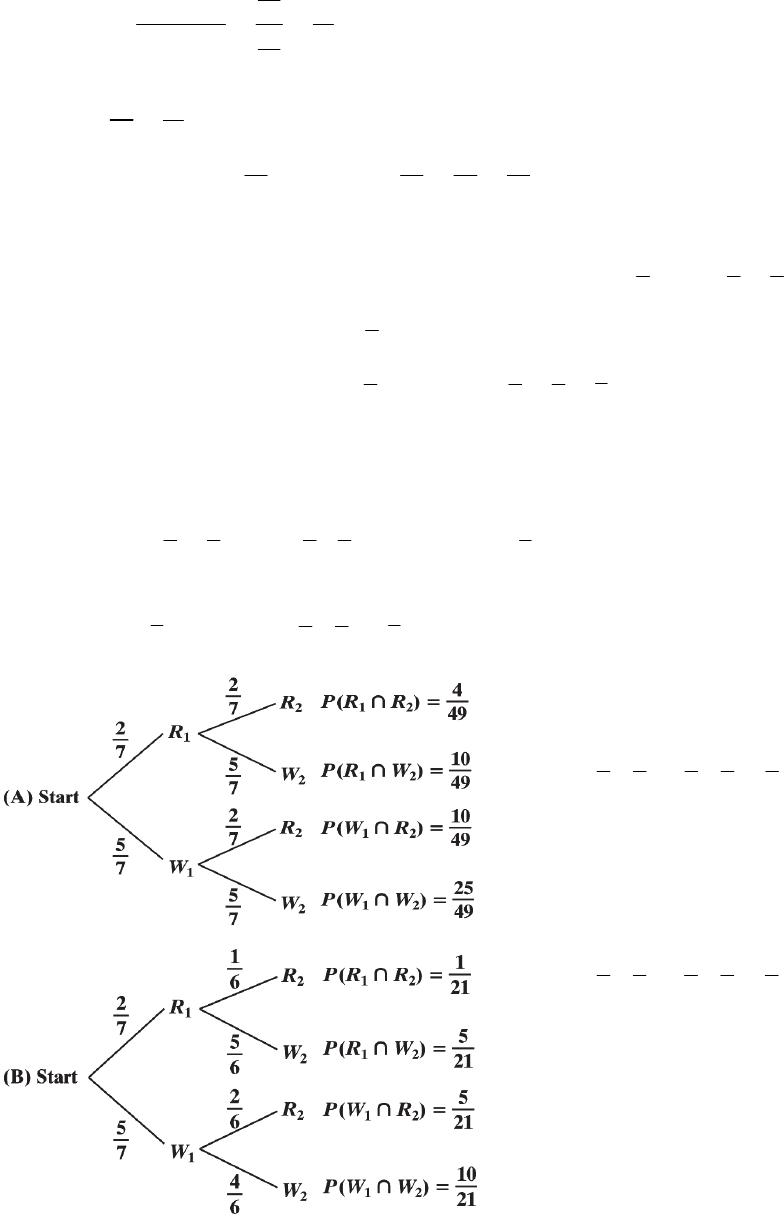
P(R2) = P(R1 R2) + P(W1 R2)
= P(R1)P(R2|R1) + P(W1)P(R2|W1)
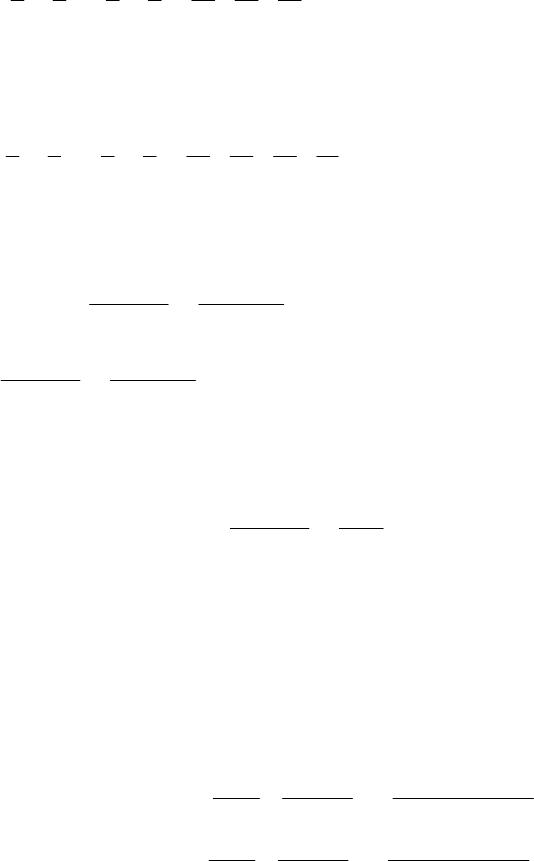
P(R2) = 21 52 2
76 76 7
which is the same as in (A).
8-16 CHAPTER 8: PROBABILITY
62. (A) From Problem 60 part (A) we have: P(both balls have the same color)
(B) From problem 60 part (B) we have: P(both balls have the same color)
64. False. Let P(A) = 0.4, P(B) = 0.3 and P(A B) = 0.12. Then clearly A and B are independent since
P(A B) = P(A)P(B).
66. False. Consider the sample space S = {HH, HT, TH, TT} and the events A = {HH, HT, TH},
68. False. This statement fails whenever () 0PA and () 0PB . If A and B are independent, then
70. True. Observe that:
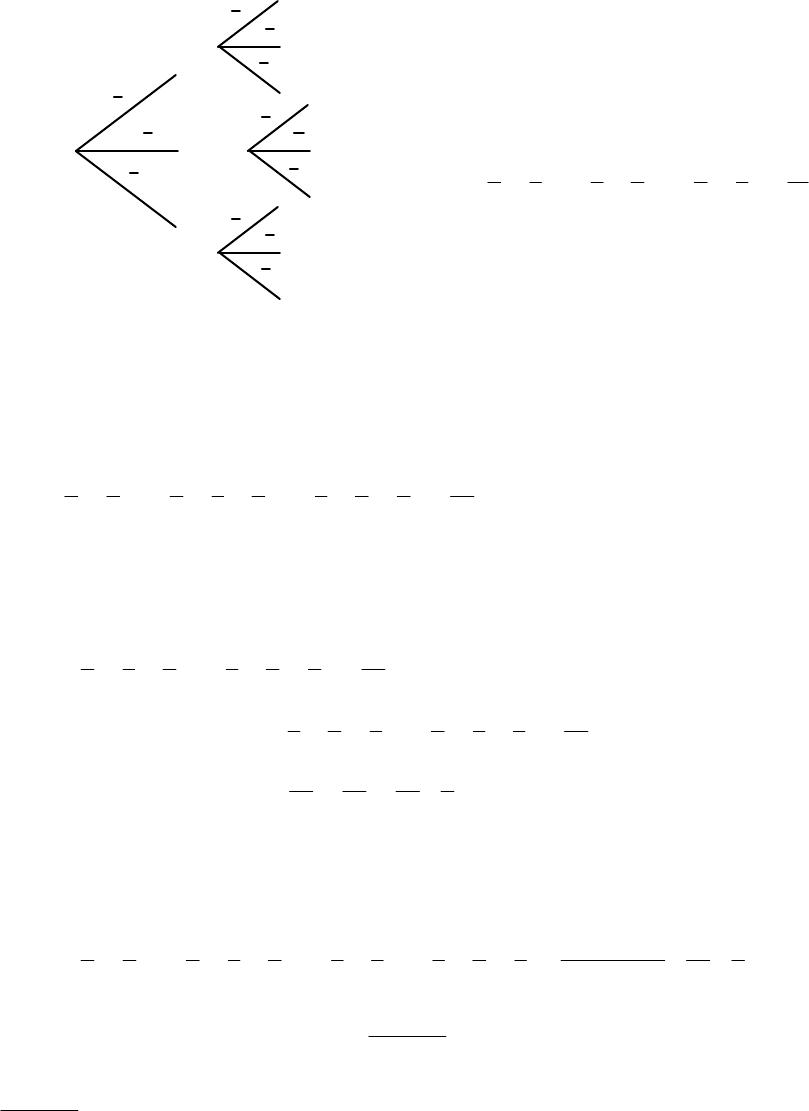
P(W1 R2) = P(W1)P(R2|W1) = 1
nm
= ()( 1)
nm
;
72.
R2
1
83
R1
R2
8
4
2
8
W2
W1
W2
8
3
8
W2
G2
G1
G2
Start
3
9
W1
P(both balls are the same color)
74. (A) P(Ann wins the match) = P(W1 W2) + P(W1 L2 W3) + P(L1 W2 W3),
(B) P( 3 s e t s a r e p l a y e d ) = P(Ann wins in 3 sets) + P( B a r b a r a w i n s i n 3 s e t s ) .
P(Ann wins in 3 sets) = P(W1L2W3) + P(L1W2W3)
(C) P(Ann wins the match) + P(Barbara wins the match)
76. Suppose (|) ().PAB PA Since ()
(|) ,
()
PA B
PAB PB
it follows that
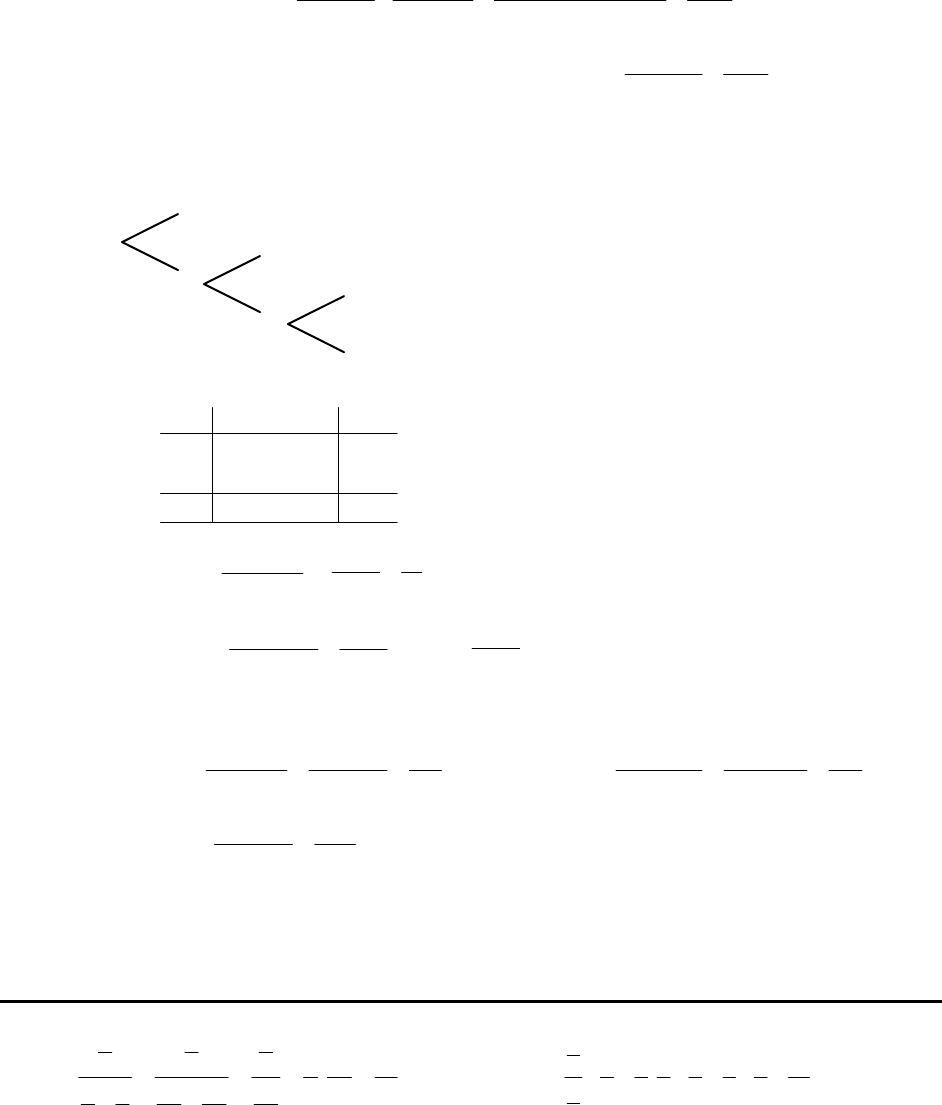
8-18 CHAPTER 8: PROBABILITY
78. Since ‘ (universal set), ( ‘) ( ) ( ‘ )
A
AU BUB AA B AB AB.
82. Let A = “car is produced at plant A,” B = “car has defective emission control devices”.
84.
P1
0.40
P2
0.60
0.80
(A) P(passing on the first or second try)
86. (A) ‘ Totals
0.002 0.024 0.026
FF
C
PC F
88. (A) ()()104
(|) 0.2
() () 520
PC F nC F
PC F PF nF
, (‘)(‘)96
(| ‘) 0.2
(‘) (‘) 480
PC F nC F
PC F PF nF
EXERCISE 8-4
222
228 8
777
2
2 242 8210
7

EXERCISE 8-4 8-19
6.
8. P(N B) = P(N)P(B|N) = (0.4)(0.8) = 0.32
10. P(B) = P(M B) + P(N B) = P(M)P(B|M) + P(N)P(B|N) = (0.6)(0.3) + (0.4)(0.8) = 0.50
14. Referring to the Venn diagram:
35
Using Bayes’ formula:
P(U2|R) = 2
()
PU R
()(| )
PU P R U
16. Referring to the Venn diagram:
25
Using Bayes’ formula:
P(U2|R‘) = 22
1122
( )(‘| )
( )(‘| ) ( )(‘| )
PU P R U
PU P R U PU P R U
60 25
18. Referring to the tree diagram: (‘) (‘)
(| ‘) (‘) ( ‘) ( ‘) ( ‘)
PV C PV C
PV C PC PU C PV C PW C
PU C

8-20 CHAPTER 8: PROBABILITY
PW C
26. 14 23 10 2
()()()()(|)()(|)
35 35 15 3
PD PA D PB D PAPD A PBPD B
28.
() 3
35
(|) 2
PB D
PB D PD
30. From the first tree we have
P(D) = P(A D) + P(B D) + P(C D) = P(A)P(D|A) + P(B)P(D|B) + P(C)P(D|C)
13
()
PD
()
PD =
1
4
3
17
P(B|D‘) = (‘)
(‘)
PD
(‘)
PD =
3
4
= 5
18
13