CHAPTER 8 REVIEW 8-35
The game is not fair. (8-5)
30. S = {(1,1), (2,2), (3,3), (1,2), (2,1), (1,3), (3,1), (2,3), (3,2)}; n(S) = 3·3 = 9
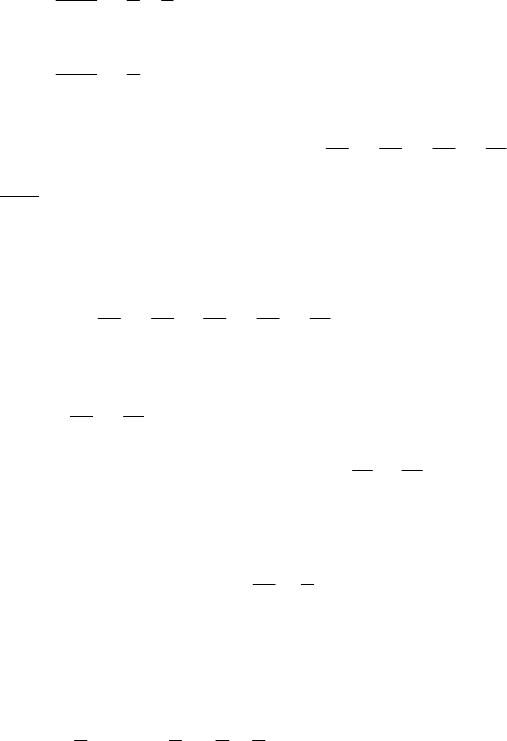
31. (A) P(jack or queen) = P(jack) + P(queen) = 4
(B) P(jack or spade) = P(jack) + P(spade) – P(jack and spade)
(C) P(ace) = 4
52 = 1
13 . Thus,
32. (A) The probability of rolling a 5 is 4
36 = 1
9.
(B) Let x = amount house should pay (and return the $1 bet).
Then, for the game to be fair,
33. Event E1 = 2 heads; f(E1) = 210.
8-36 CHAPTER 8: PROBABILITY
(A) The empirical probabilities for the events above are as follows:
(B) Sample space S = {HH, HT, TH, TT}.
(C) Using part (B), the expected frequencies for each outcome are
as follows:
34. The individual tosses of a coin are independent events (the coin has no memory).
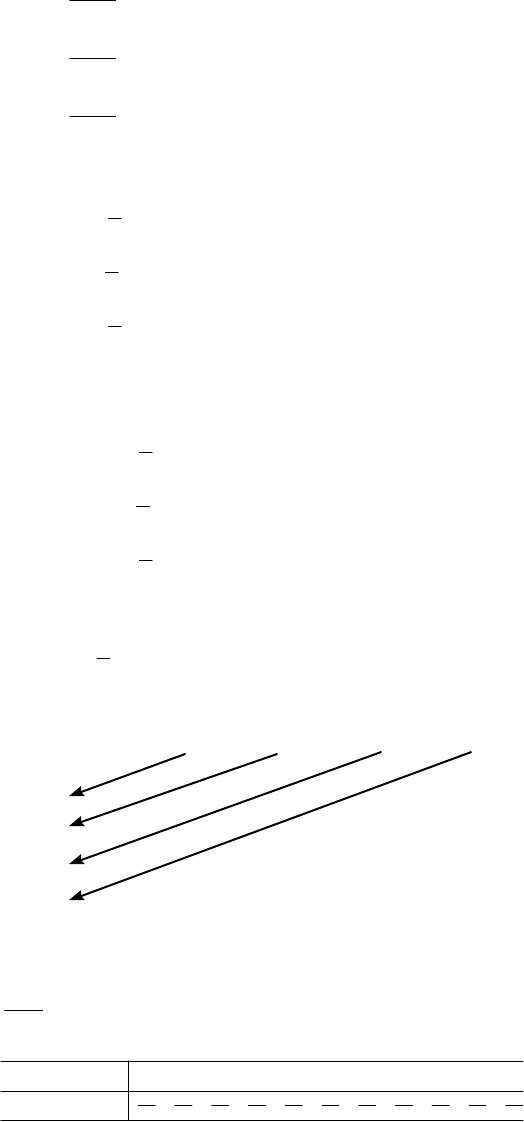
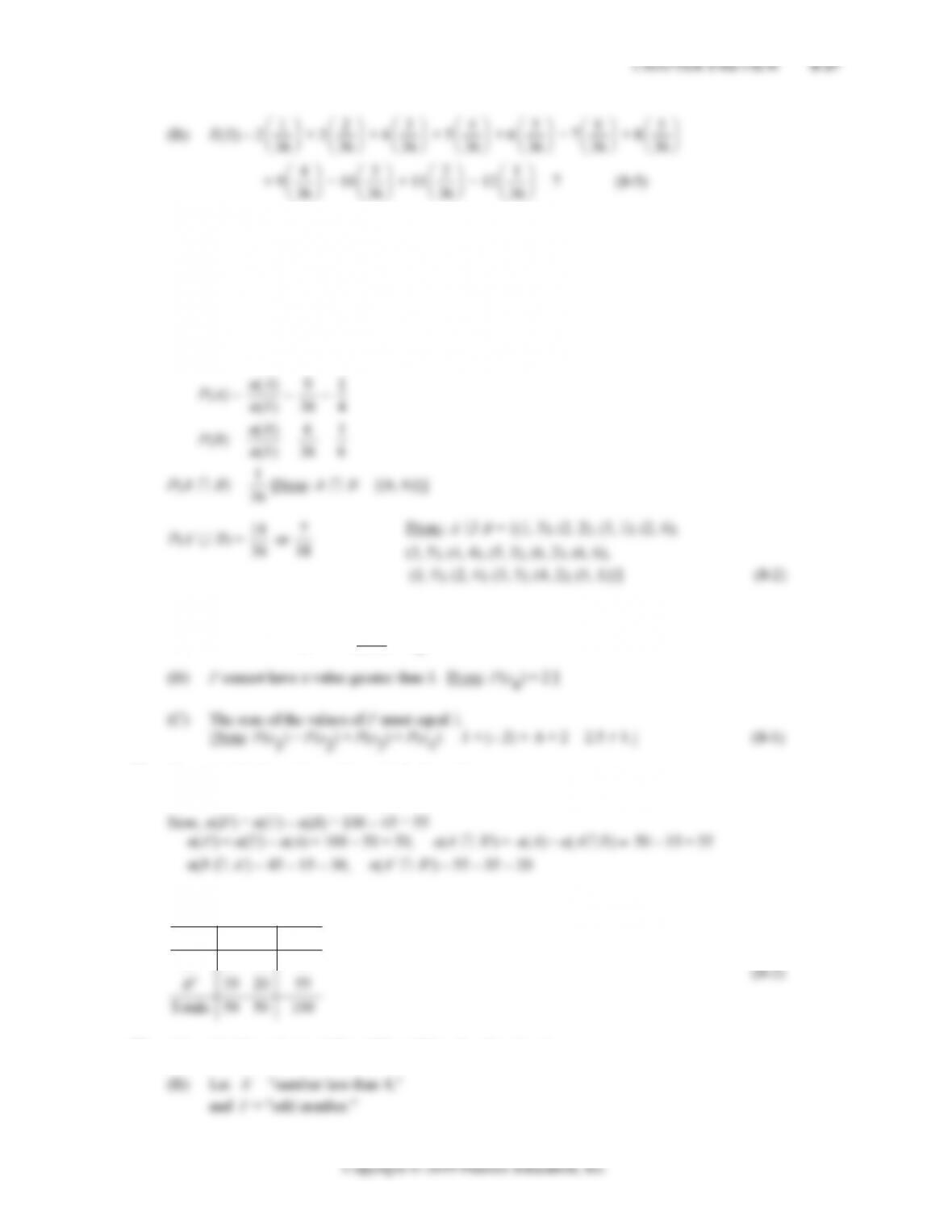
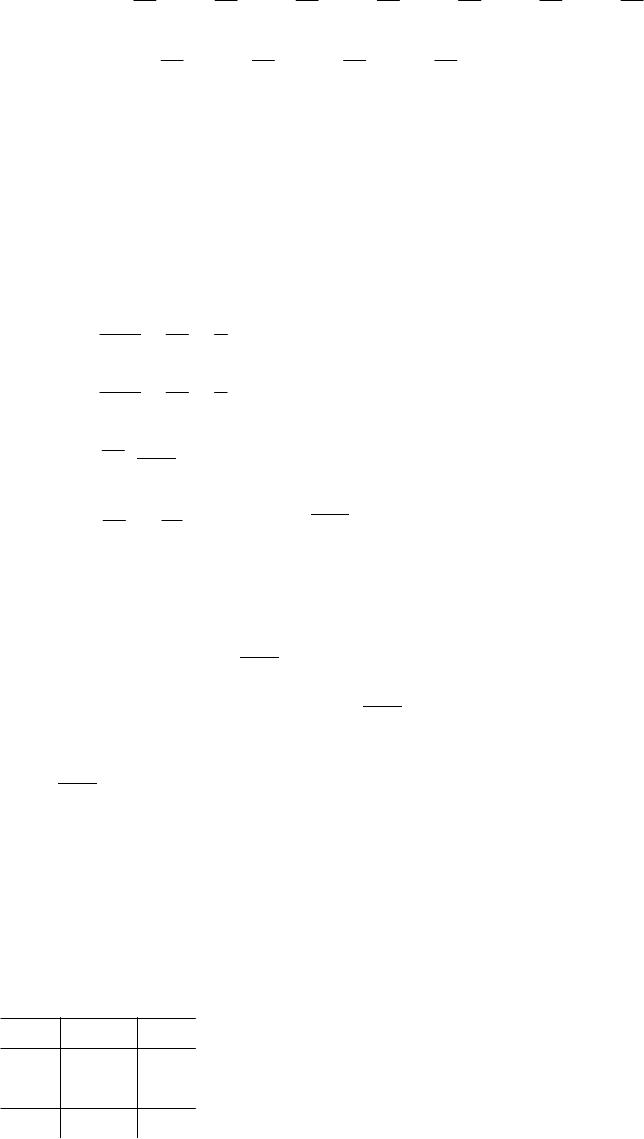
35. (A) The sample space S is given by:
S = {(1,1), (1,2), (1,3), (1,4), (1,5), (1,6),
(2,1), (2,2), (2,3), (2,4), (2,5), (2,6),
36. The event A that corresponds to the sum being divisible by 4 includes sums 4, 8, and 12.
This set is:
A = {(1, 3), (2, 2), (3, 1), (2, 6), (3, 5), (4, 4), (5, 3), (6, 2), (6, 6)}
The event B that corresponds to the sum being divisible by 6 includes sums 6 and 12.
This set is:
B = {(1, 5), (2, 4), (3, 3), (4, 2), (5, 1), (6, 6)}
37. The function P cannot be a probability function because:
(A) P cannot be negative. [Note: P(e2) = –0.2.]
38. Since n(A B) = n(A) + n(B) – n(A B), we have
80 = 50 + 45 – n(A B) which implies n(A B) = 15
Thus,
Totals
15 30 45
AA
B
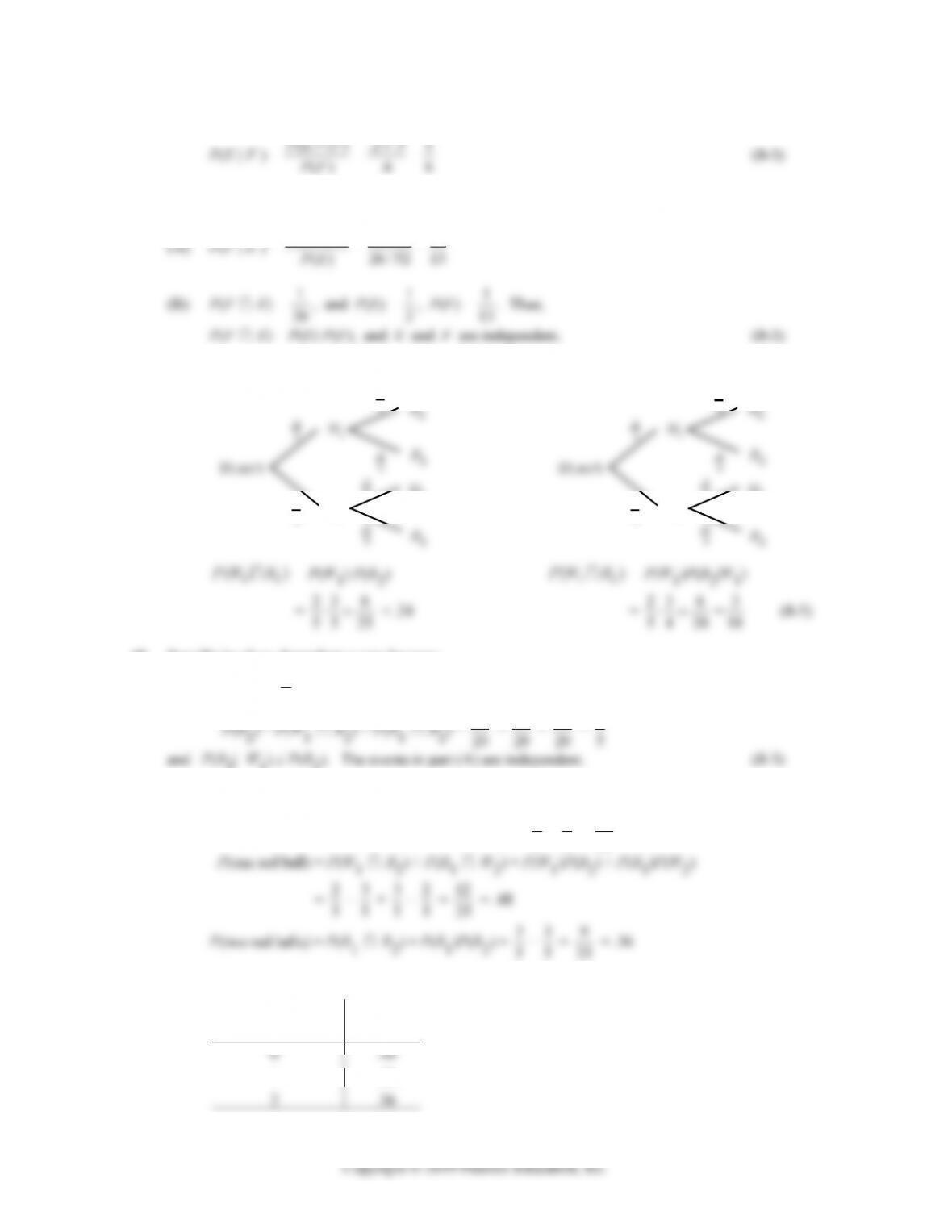
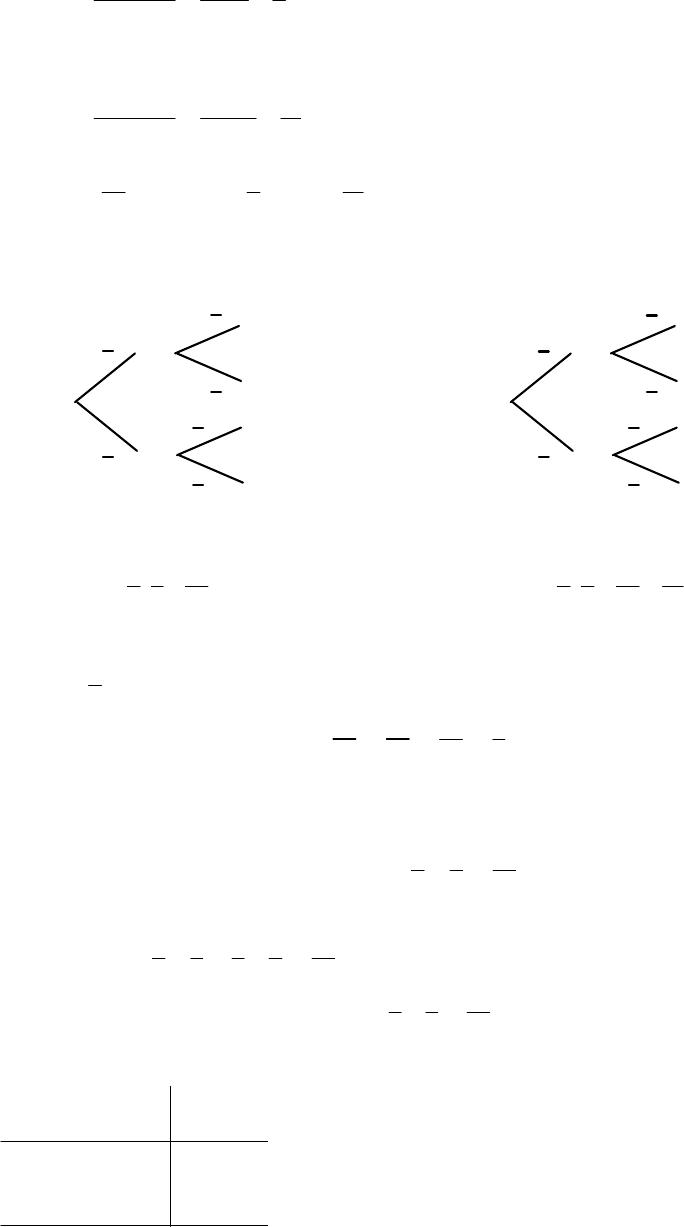
39. (A) P(odd number) = P(1) + P(3) + P(5) = .2 + .3 + .1 = .6
8-38 CHAPTER 8: PROBABILITY
Now, E F = {1, 3}, F = {1, 3, 5}.
40. Let E = “card is red” and F = “card is an ace.” Then F E = “card is a red ace.”
PF E
= 2/52
41. (A) The tree diagram with replacement is:
3
5
R1
W2
2
5
(B) The tree diagram without replacement is:
3
5
R1
W2
1
4
42. Part (B) involves dependent events because
P(R2|W1) = 3
4
43. (A) Using the tree diagram in Problem 41(A), we have:
P(zero red balls) = P(W1 W2) = P(W1)P(W2) = 2
5·2
5= 4
25 = .16
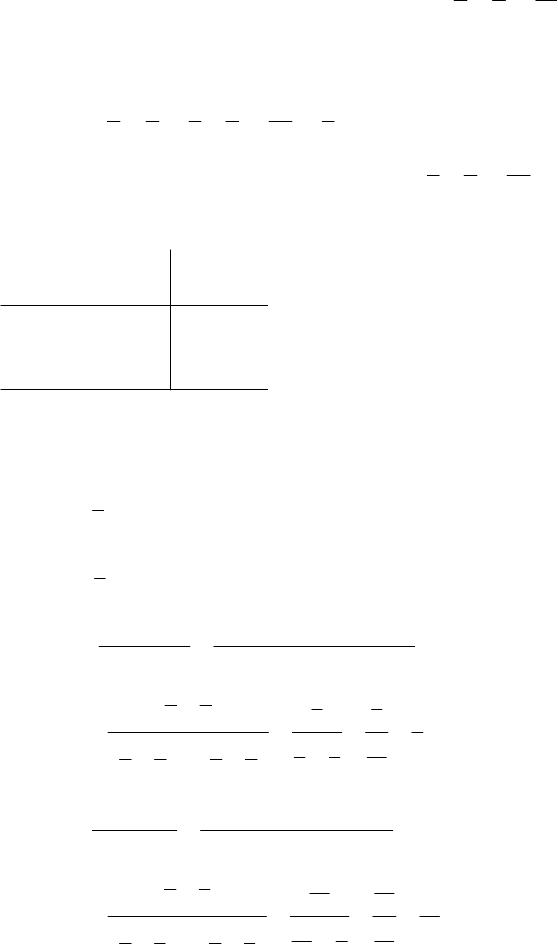
Thus, the probability distribution is:
N
umber of red balls Probability
1.48
ii
xp
CHAPTER 8 REVIEW 8-39
The expected number of red balls is:
(B) Using the tree diagram in Problem 41(B), we have:
P(zero red balls) = P(W1 W2) = P(W1)P(W2|W1) = 2
5 · 1
4 = 1
10 = .1
P(two red balls) = P(R1 R2) = P(R1)P(R2|R1) = 3
5 · 2
4 = 6
20 = .3
Thus, the probability distribution is:
N
umber of red balls Probability
1.6
ii
xp
The expected number of red balls is:
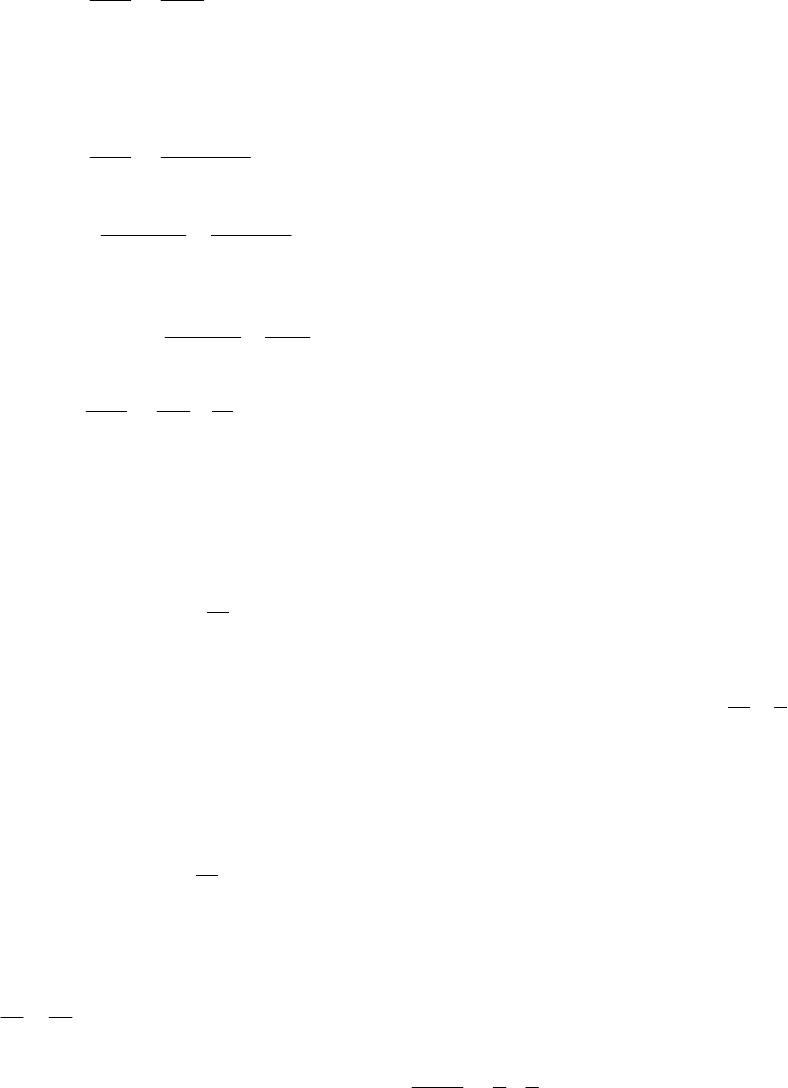
44. (A) 1
3
(| ) 5
PRU {There are 3 red of the 5 balls in urn 1.}
(C) 22
2
12
() ()
(|) () ( ) ( )
PU W PU W
PU W PW PU W PU W
(D) 11
1
12
() ()
(|) () ( ) ( )
PU R PU R
PU R PR PU R PU R
45. No, because P(R|U1) ≠ P(R). (See Problem 44.) (8-3)
8-40 CHAPTER 8: PROBABILITY
46. n(S) = C52,5
(A) Let A be the event “all diamonds.” Then n(A) = C13,5. Thus,
(B) Let B be the event “3 diamonds and 2 spades.” Then
n(B) = C13,3 · C13,2. Thus,
47. n(S) = C10,4 = 10!
4!(10 4)!= 1 0·9·8·7 ·6 !
4·3·2·1·6! = 210
Let A be the event “The married couple is in the group of 4 people.” Then
48. Events S and H are mutually exclusive. Hence, P(S H) = 0, while P(S) ≠ 0 and P(H) ≠ 0.
Therefore,
49. (A) From the plot, P(2) = 8
50 = .16.
(B) The event A = “the minimum of the two numbers is 2″ contains the simple events
50. The empirical probability depends on the results of your simulation.
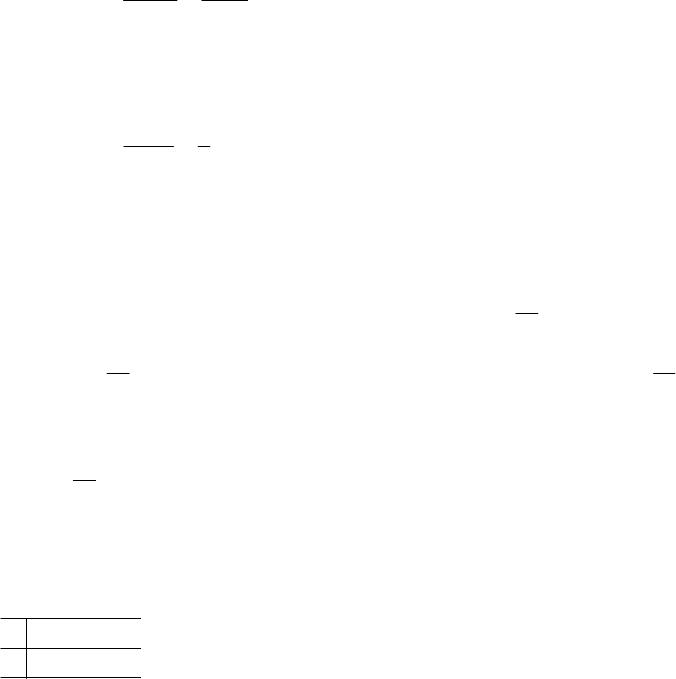
51. False. If P(E) = 1, then P(E’) = 0 and the odds for E = ()
()
PE
PE = 1
0; 1
0 is undefined. (8-2)
CHAPTER 8 REVIEW 8-41
52. True. In general, P(E F) = P(E) + P(F) – P(E F).
54. False. Counterexample: Roll a fair die; S = {1, 2, 3, 4, 5, 6}.
55. True. This is the definition of independent events. (8-3)
57. Let E2 be the event “2 heads.”
(A) From the table, f(E2) = 350. Thus, the approximate empirical probability of obtaining
2 heads is:
(B) S = {HHH, HHT, HTH, HTT, THH, THT, TTH, TTT}
(C) The expected frequency of obtaining 2 heads in 1000 tosses of 3 fair coins is:
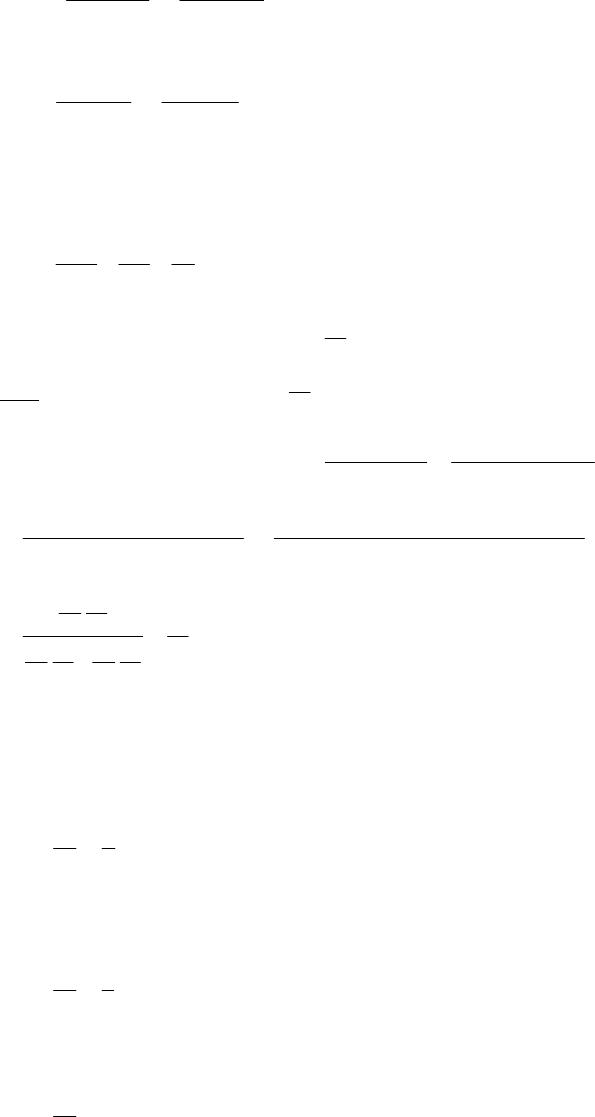
58. On one roll of the dice, the probability of getting a double six is 1
36 and the probability of not getting a
double six is 35
36 . On n independent rolls, the probability of no double sixes is 35 .
36
n
In particular, we conclude that, in 24 rolls of the die,
8-42 CHAPTER 8: PROBABILITY
59. The total number of ways that 3 people can be selected from a group of 10 is:
C10,3 = 10!
60. P(second heart | first heart) = P(H2 | H1) = 12
51 ≈ .235
61. P(first heart | second heart) = P(H1 | H2) = 12
2
()
()
PH H
PH
= 121
2
()( | )
()
PH PH H
PH
= 121
()( | )
PH PH H
()( | )
PH PH H
62. Since each die has 6 faces, there are 6·6 = 36 possible pairs for the two up faces.
P(2) = 9
A sum of 4 corresponds to the pairs (3, 1), (2, 2), (1, 3). There are 1·3 + 2·2 + 3·1 = 10 such pairs.
Thus,
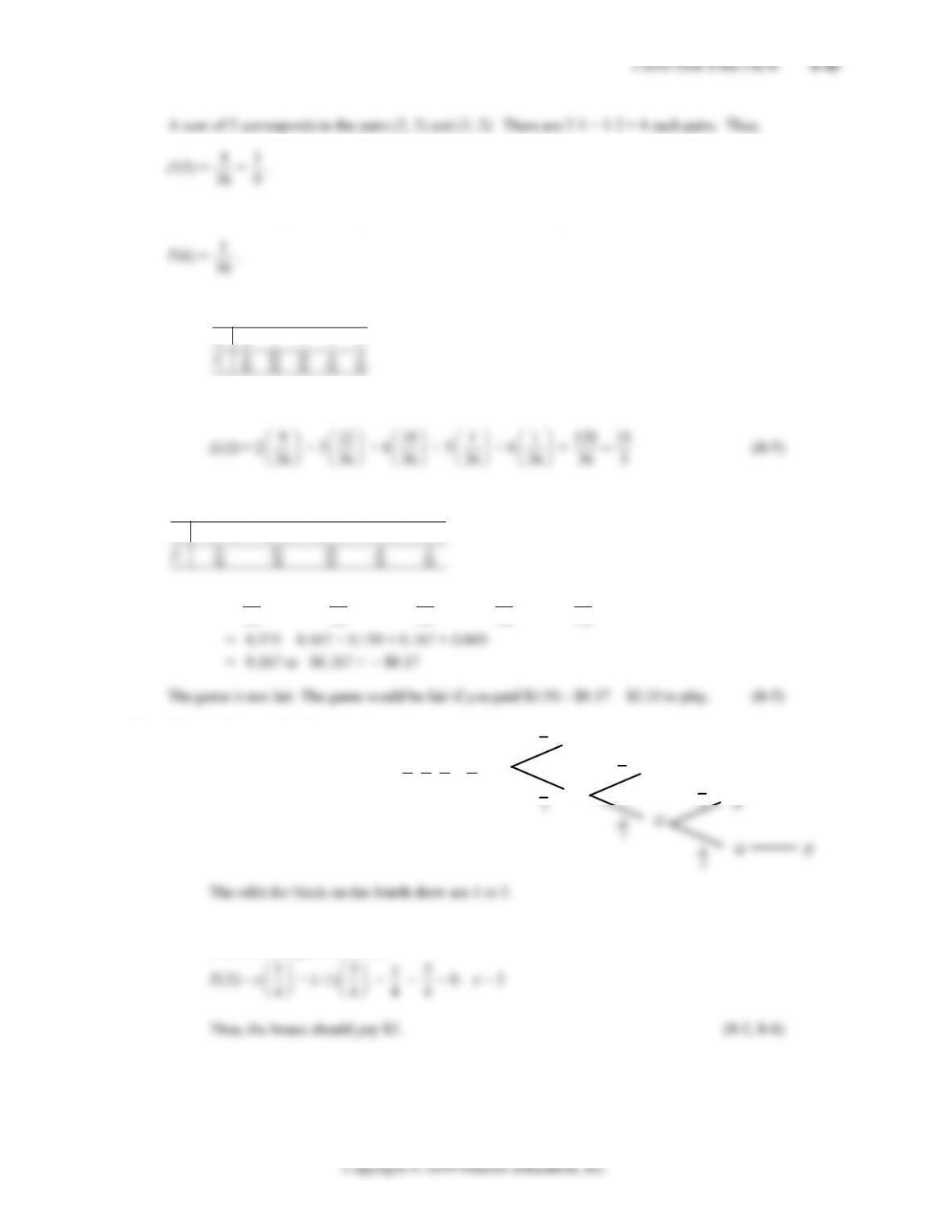
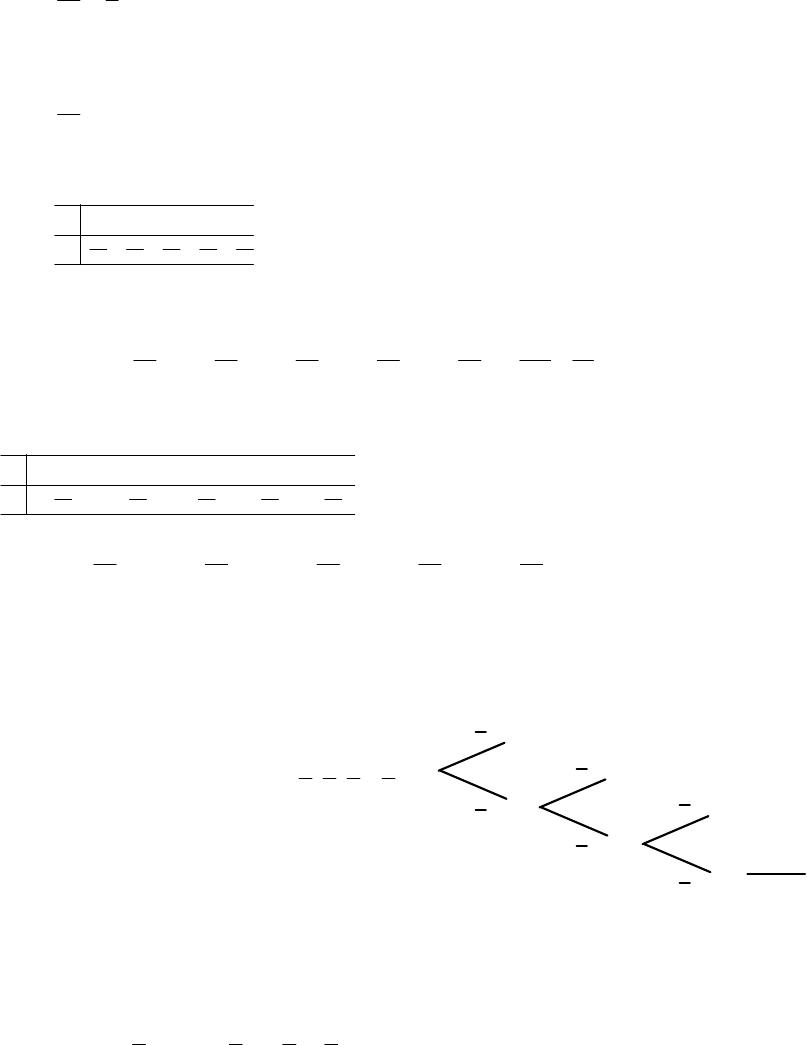
A sum of 6 corresponds to the pair (3, 3) and there is one such pair. Thus,
(A) The probability distribution for X is:
23456
x
(B) The expected value is:
63. The payoff table is:
$1.50 $0.50 $0.50 $1.50 $2.50
i
x
and E(X) = 9
36 (–1.50) + 12
36 (–0.50) + 10
36 (0.50) + 4
36 (1.50) + 1
36 (2.50)
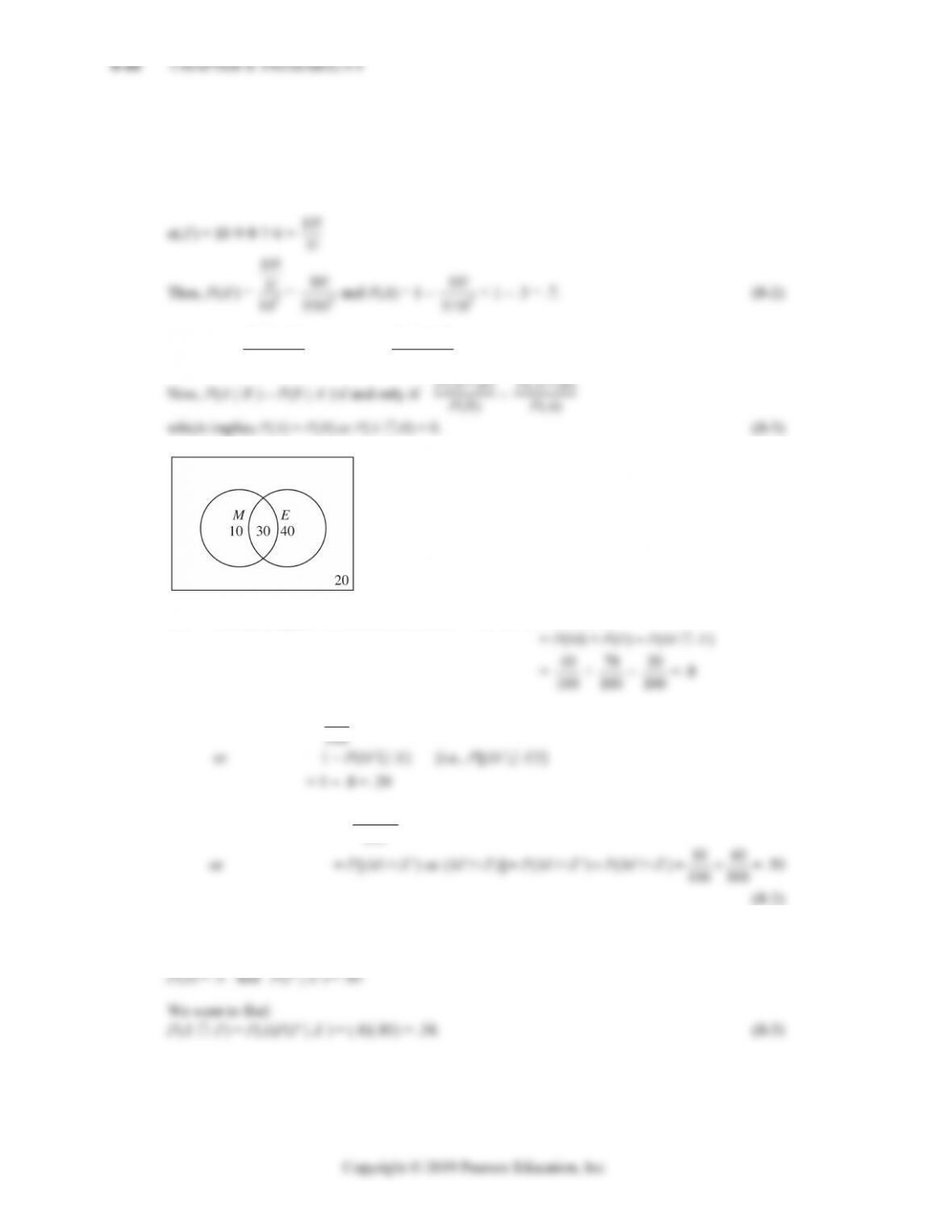
64. The tree diagram for this experiment is:
(A)P(black on the fourth draw) = 321 1
432 4
W
B
1
4
3
B
1
3
1
(B)Let x = amount house should pay (and return the $1 bet).
Then, for the game to be fair:
65. n(S) = 10·10·10·10·10 = 105
Let event A = “at least two people identify the same book.” Then A‘ = “each person identifies a different
book,” and
66. P(A|B) = ()
()
PA B
PB
, P(B|A) = ()
()
PA B
PA
.
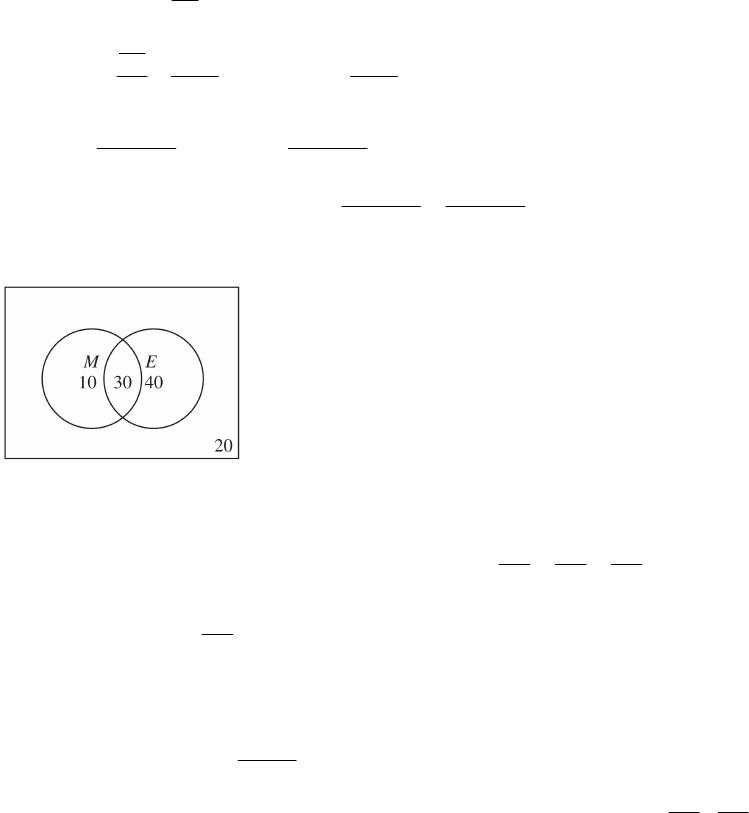
67.
Event M = Reads the morning paper.
Event E = Watches evening news.
(A) P(reads the paper or watches the news) = P(M or E) = P(M E)
(B) P(does neither) = 20 .20 (from the Venn diagram)
(C) P(does exactly one) = 10 40 .50 (from the Venn diagram)
100
68. Let A be the event that a person has seen the advertising and P be the event that the person purchased the
product. Given:
69. (A) P(A) = 290
1,000 = .290
(B) A and B are not independent because
(C) P(C) = 880
1,000 = .880
(D) C and D are mutually exclusive since C D = . C and D are dependent since
70. The payoff table for plan A is:
1
10 million 2 million
.8 .2
i
x
p
71. The payoff table is:
8-46 CHAPTER 8: PROBABILITY
72. n(S) = C12,4 = 12!
4!(12 4)!= 12·11·10·9·8!
4·3·2·1·8! = 495
The number of samples that contain no substandard parts is:
73. n(S) = C12,3 = 12!
3!(12 3)!= 12·11·10·9!
3·2·1·9! = 220
P(0) = 10,3
12,3
C =
220
220 = 120
220 = 12
22
12,3
(A) The probability
74. Let Event NH = individual with normal heart,
Event MH = individual with minor heart problem,
Event SH = individual with severe heart problem,
and Event P = individual passes the cardiogram test.
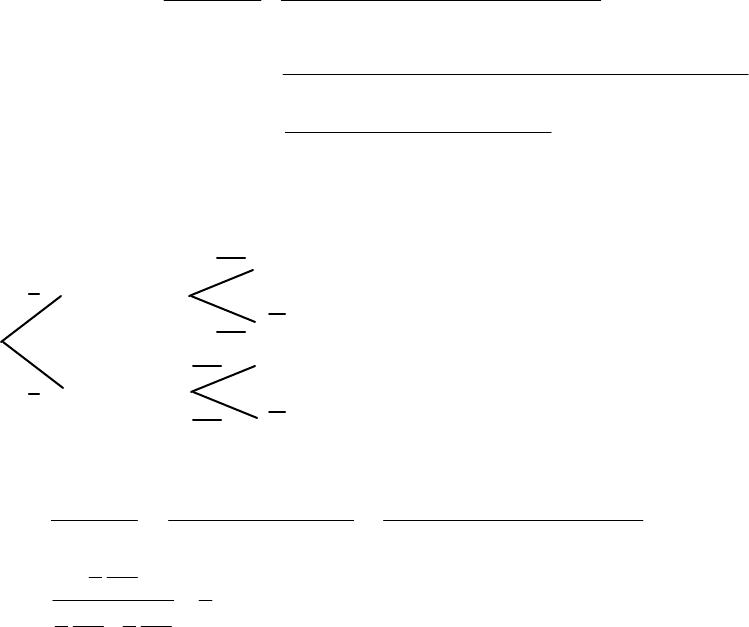
75. The tree diagram for this problem is as follows:
1
C (Colorblind)
6
100
76. According to the empirical probabilities, candidate A should have won the election. Since