1
Instructor’s Manual – OMSC2 – Collier/Evans – C8 Facility and Work Design
Chapter 8 introduces students to four different types of facility layouts – product, process,
cellular, and fixed position – that are used in goods-producing and service-providing
No supplements are needed for this chapter.
One Excel spreadsheet template – Work Measurement –is available in MindTap and illustrated
in a solved problem.
Questions and problems are provided in four categories:
The chapter has three cases:
1. Employee 842 versus The State is the first case study. This case requires students to evaluate
an already completed work measurement study, decide whose case in justified, and discuss
2. The second case, Bank USA: Cash Movement, requires students to setup and balance an
assembly line. Other case questions focus on how many employees are needed and what
3. The integrative case study, Hudson Jewelers, with case assignment questions in all chapters,
requires the student to draw and design a layout for a high-end jewelry store, and critique their
design using concepts from previous chapters.
KEY TERMS
Allowances include time for labor fatigue and personal needs, equipment breakdowns, rest
periods, information delays, and so on. Most allowance factors are in the range of 10 to 20
percent.
Continuous timing involves starting the clock at the beginning of each task and recording the
cumulative time at the completion of each work task.
Cycle time is the interval between successive outputs coming off the assembly line.
Ergonomics is concerned with improving productivity and safety by designing workplaces,
equipment, instruments, computers, workstations, and so on that take into account the
Job enlargement is the horizontal expansion of the job to give the worker more variety
although not necessarily more responsibility.
Job enrichment is vertical expansion of job duties to give the worker more responsibility.
Lack-of-work delay (starving) occurs whenever one stage completes work and no units from
the previous stage are awaiting processing.
3
A product layout is an arrangement based on the sequence of operations that is performed
during the manufacturing of a good or delivery of a service.
REVIEW QUESTIONS
1. What are the objectives of facility and work design? How can it help support strategic
directions?
Facility layout refers to the specific arrangement of physical facilities. The purposes of
layout studies are to minimize delays in materials handling and customer movement,
2. Under what conditions are facility-layout studies conducted?
Facility-layout studies are necessary whenever (1) a new facility is constructed, (2) there is
5 0.35 weeks.
3. What are “flow blocking delay” and “lack of work delay”? What types of designs can help
to reduce these two sources of delay?
Flow-blocking delay occurs when a work center completes a unit but cannot release it
because the in-process storage at the next stage is full. The worker must remain idle until
4. What is an assembly line? Define the “assembly line balancing problem” and explain what
information is needed to solve it.
An assembly line is a product layout dedicated to combining the components of a good or
5. When might you have to rebalance an assembly line?
Assembly lines often need rebalancing when company strategy changes the product mix, or
the volumes of goods produced.
6. Explain the concepts of designing process layouts.
In designing process layouts, we are concerned with the arrangement of departments or
7. What is a “closeness rating” and how can computer analysis support layout decisions?
A layout analyst constructs a preference table that specifies how important it is for two
departments to be close to one another. An example of such “closeness ratings” follows. A
8. Explain how to design product layouts using assembly line balancing.
Assembly-line balancing seeks to achieve the throughput necessary to meet sales
5
1. the set of tasks to be performed and the time required to perform each task;
2. the precedence relations among the tasks—that is, the sequence in which tasks must
The cycle time (CT) must satisfy:
maximum operation time < CT < sum of operation times [8.1]
Cycle time (CT) is related to the output required to be produced in some period of time (R)
by the following equation:
9. What is work measurement? How can it be used to improve organizational performance?
Work measurement is a systematic procedure for the analysis of work and determination of
6
10. Explain the concept of normal time. How can an operations manager verify whether the time
to perform a task is indeed “normal”?
Normal time is the expected time required to perform some work activity at a normal pace,
under normal operating conditions, and using a prescribed method. By a normal pace, we
11. How does standard time differ from normal time? How are standard times used in
operations management?
Standard time is normal time adjusted for allowances. Allowances include time for labor
12. What is time study? Describe the basic procedure for conducting a time study.
Time study is the development of a standard time by observing a task and analyzing it with
the use of a stopwatch. The general approach to time study can be described as follows.
1. Define and evaluate each task and activity.
7
13. Define job design, job enlargement, and job enrichment, and give a non-textbook example
of each.
Job design involves determining the specific job tasks and responsibilities, the work
environment, and the methods by which the tasks will be carried out to meet the goals of
14. Why is safety important?
Safety is one of the most important aspects of workplace design, particularly in today’s
society. To provide safe and healthful working conditions and reduce hazards in the work
environment, the Occupational Safety and Health was passed in 1970. It requires
15. Define ergonomics and give an example of a good or bad experience.
Ergonomics is concerned with improving productivity and safety by designing workplaces,
16. Describe the Ethical Trading Initiative (ETI) and how it fits with sustainability.
8
The Ethical Trading Initiative (ETI) is a leading alliance of companies, trade unions and
nongovernmental organizations that promotes respect for workers’ rights around the
1. Employment is freely chosen.
2. Freedom of association and the right to collective bargaining are respected.
These workplace conditions support social sustainability, as described in Exhibit 1.12.
Companies must keep track of where their products are being made, and of the working
17. What key questions should be asked when designing workplaces?
Key questions that must be addressed at the workstation level include the following:
1. Who will use the workplace? Will the workstation be shared? How much space is
required?
2. How will the work be performed? What tasks are required? How much time does each
task take? How much time is required to set up for the workday or for a particular job?
How might the tasks be grouped into work activities most effectively?
9
18. Describe the human issues related to workplace design.
Two broad objectives must be satisfied in job design. One is to meet the firm’s competitive
priorities—cost, efficiency, flexibility, quality, and so on; the other is to make the job safe,
satisfying, and motivating for the worker. Resolving conflicts between the need for
DISCUSSION QUESTIONS AND EXPERIENTIAL ACTIVITIES
19. What are the advantages and disadvantages of each of the major types of layout patterns?
Provide one example of each type of layout for goods-producing and service-providing
firms.
A product layout is an arrangement based on the sequence of operations that are
performed during the manufacturing of a good or delivery of a service. Product layouts
support a smooth and logical flow where all goods or services move in a continuous path
20. Discuss the type of facility layout that would be most appropriate for:
a. printing books—Product layout
21. Describe the layout of a typical fast-food franchise such as McDonald’s. What type of
layout is it? How does it support productivity? Do different franchises (e.g., Burger King or
Wendy’s) have different types of layouts? Why?
Students should be encouraged to visit these and look closely at the kitchen areas.
McDonald’s is basically a process layout, while others bear closer similarity to product
22. Research and write a short paper illustrating how an organization uses one of the following
types of facility layouts:
• Product layout
• Process layout
11
23. Visit a manufacturer or service organization and critique their facility design. What are the
advantages and disadvantages? How does the layout affect process flows, customer
service, efficiency, and cost? Describe the basic types of materials-handling systems
commonly used in manufacturing.
This activity gives students a chance to see the application of OM. They might uncover
some obvious improvements after examining the facilities in the context of the text
material. One objective of this question is for students to understand the complimentary
24. Many company cafeterias are changing from the traditional cafeteria (process) layout to a
product layout in which food items are arranged into stations (salads, Italian, cold
sandwiches, roast beef and ham, etc.). What types of layouts are these? Discuss the
advantages and disadvantages of each type of layout.
The traditional process layout saves space and food handling requirements to replenish
items. However, it can lengthen the wait times for customers. The product layout allows
25. What type of layout is typically used in a home kitchen? Can you suggest an alternative
layout that might have some different advantages?
A home kitchen is basically a process layout (cooking prep area, stove for cooking, sink for
12
26. How is assembly line efficiency related to unit cost? Explain.
In general, as assembly line efficiency increases, unit cost decreases. That is, assembly line
efficiency is related to a competitive priority—cost. For example, in the in-line skate
27. Do you think the following jobs require standard times? Explain your reasoning.
• Carpet installers
• Software programmers
• Cable T.V. installers
28. What do you think of Cargill Kitchen Solutions’ 20-minute job rotation approach? Would
you want to work in such an environment, or one in which you performed the same tasks
all day. Why?
See the box in titled “Cargill Kitchen Solutions: Innovative Job Design.” Most students will
feel that the approach is a great idea because it provides more interesting work and cross–

13
29. Research and write a short paper (1-page maximum) on the advantages and disadvantages
of virtual teams in today’s digital environment.
One of the major trends in business is a move toward virtual workplaces. In situations
Advantages of a virtual team
• Saves time and travel expenses
• Eliminates moving expenses
• Provides access to experts
Disadvantages of a virtual team
• Lack of physical interaction
• Loss of face-to-face synergies

14
30. What is the role of ergonomics in job design? What factors do you think are the most
important?
Ergonomics is concerned with improving productivity and safety by designing workplaces,
equipment, instruments, computers, workstations, and so on that take into account the
31. List the ergonomic features of your automobile’s interior and discuss any improvements
that you can identify.
Height, width, seat comfort, visibility, headrests, cup holders, space, steering wheel, etc.
32. How might sustainability issues be incorporated into the design of facilities and
workplaces? Provide examples and explain your reasoning.
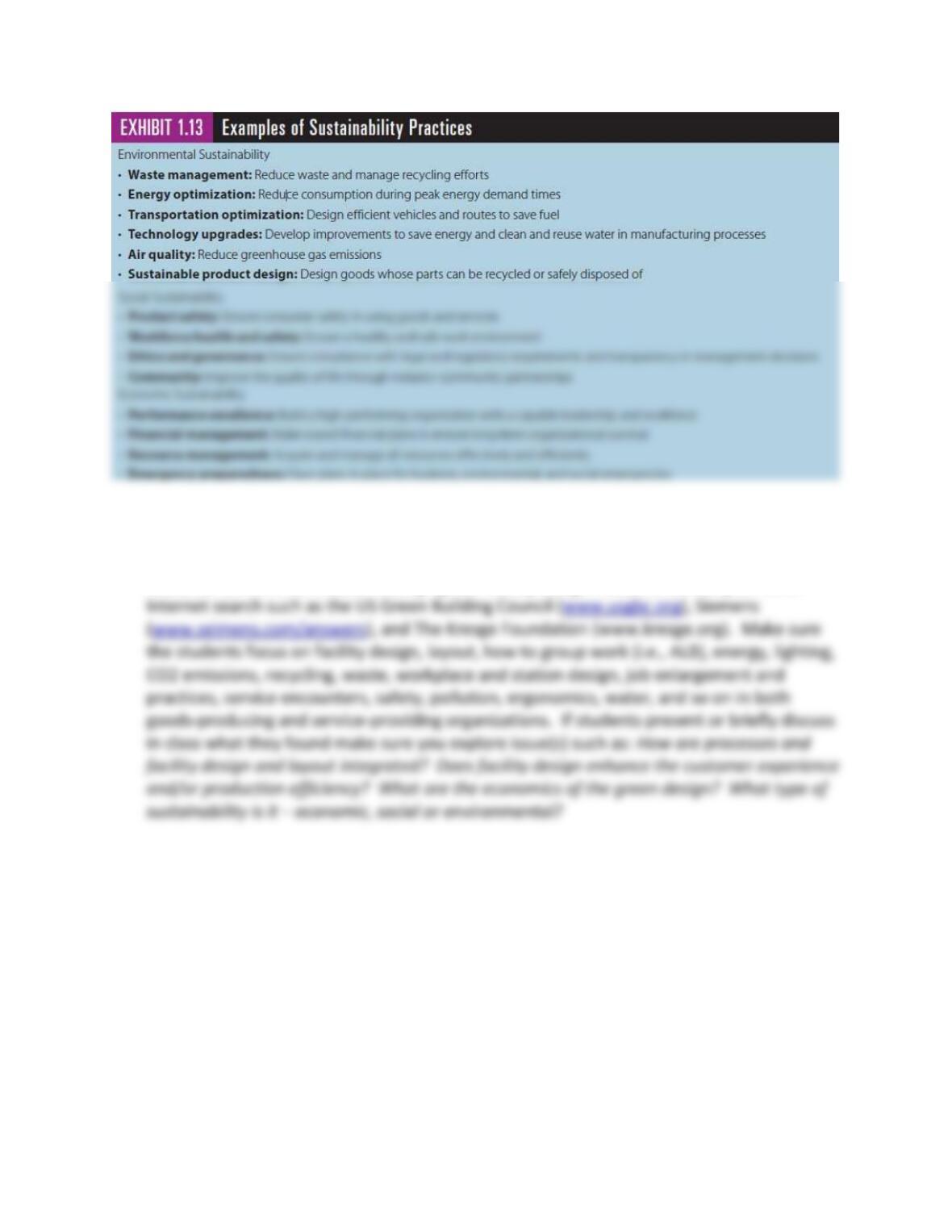
Undergraduate students will focus on what they know about such as restaurants, hotels,
15
33. Research and write a short report (maximum of two typed pages) on green facility design
making sure that you incorporate some of the key topics in this chapter.
Students will have no trouble finding “green facility design” issues and examples via an
COMPUTATIONAL PROBLEMS AND EXERCISES
These exercises require you to apply the formulas and methods described in the chapter. The
problems should be solved manually.
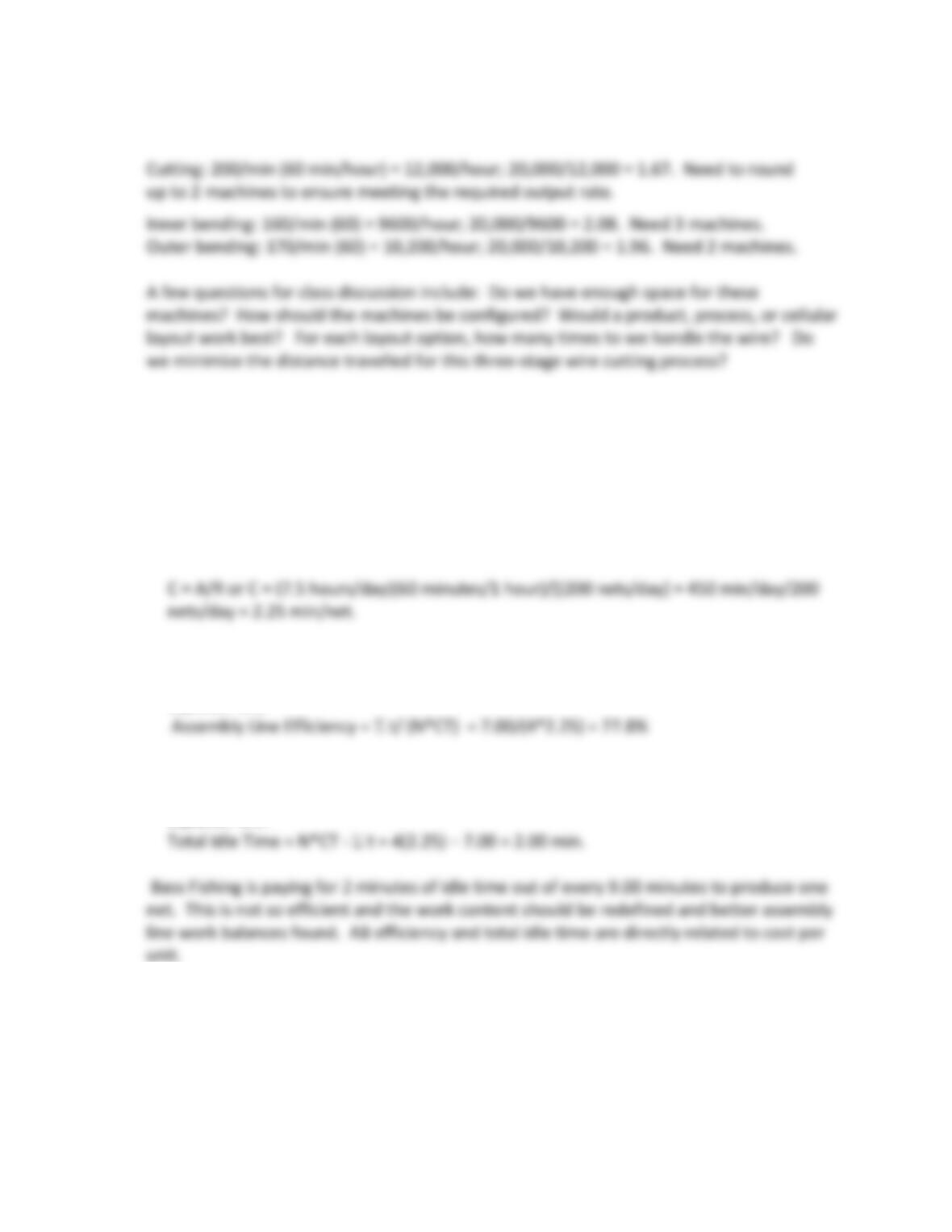
34. Peter’s Paper Clips uses a three-stage production process: cutting wire to prescribed
lengths, inner bending, and outer bending. The cutting process can produce at a rate of
200 pieces per minute; inner bending, 160 pieces per minute; and outer bending, 150
pieces per minute. Determine the hourly capacity of each process stage and the number of
machines needed to meet an output rate of 20,000 units per hour. How does facility layout
impact your numerical analysis and process efficiency? Explain.
16
This question draws upon capacity concepts from chapter 10.
35. Bass Fishing, Inc. assembles fishing nets with aluminum handles in an assembly line using
four workstations. Management wants an output rate of 200 nets per day using a 7.5-hour
workday. The sum of the task times is 7.00 minutes/net.
a. What is the cycle time?
Equation 8.2:
b. What is assembly-line efficiency?
Equation 8.6:
c. What is total idle time?
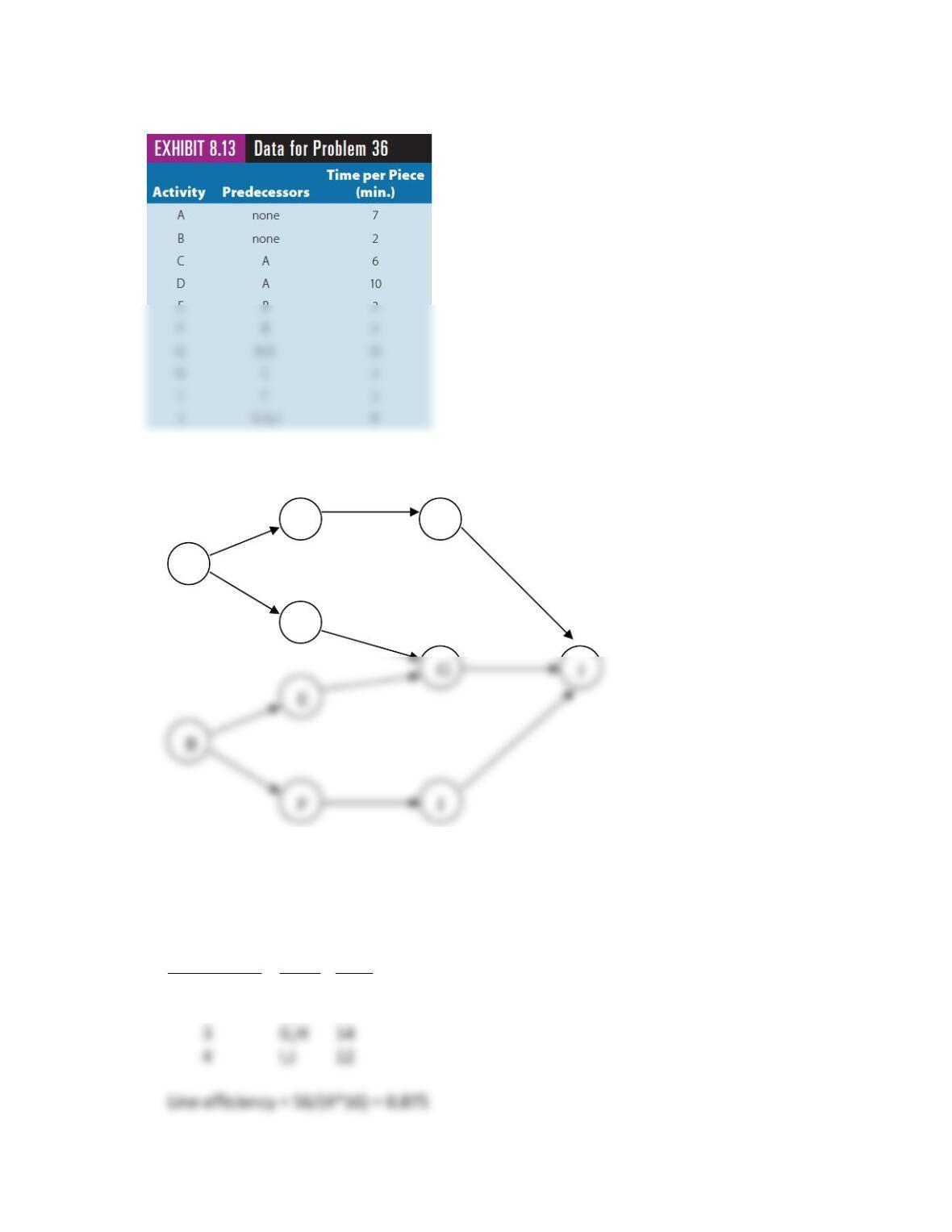
36. Use the activities and precedence relations in Exhibit 8.13 to do the following:
a. Draw a precedence diagram for this assembly line.
b. Balance the assembly line for an eight-hour-shift output of 30 pieces.
c. Determine maximum and minimum cycle times.
17
a. Draw a precedence diagram for this assembly line.
G
J
B
E
F
I
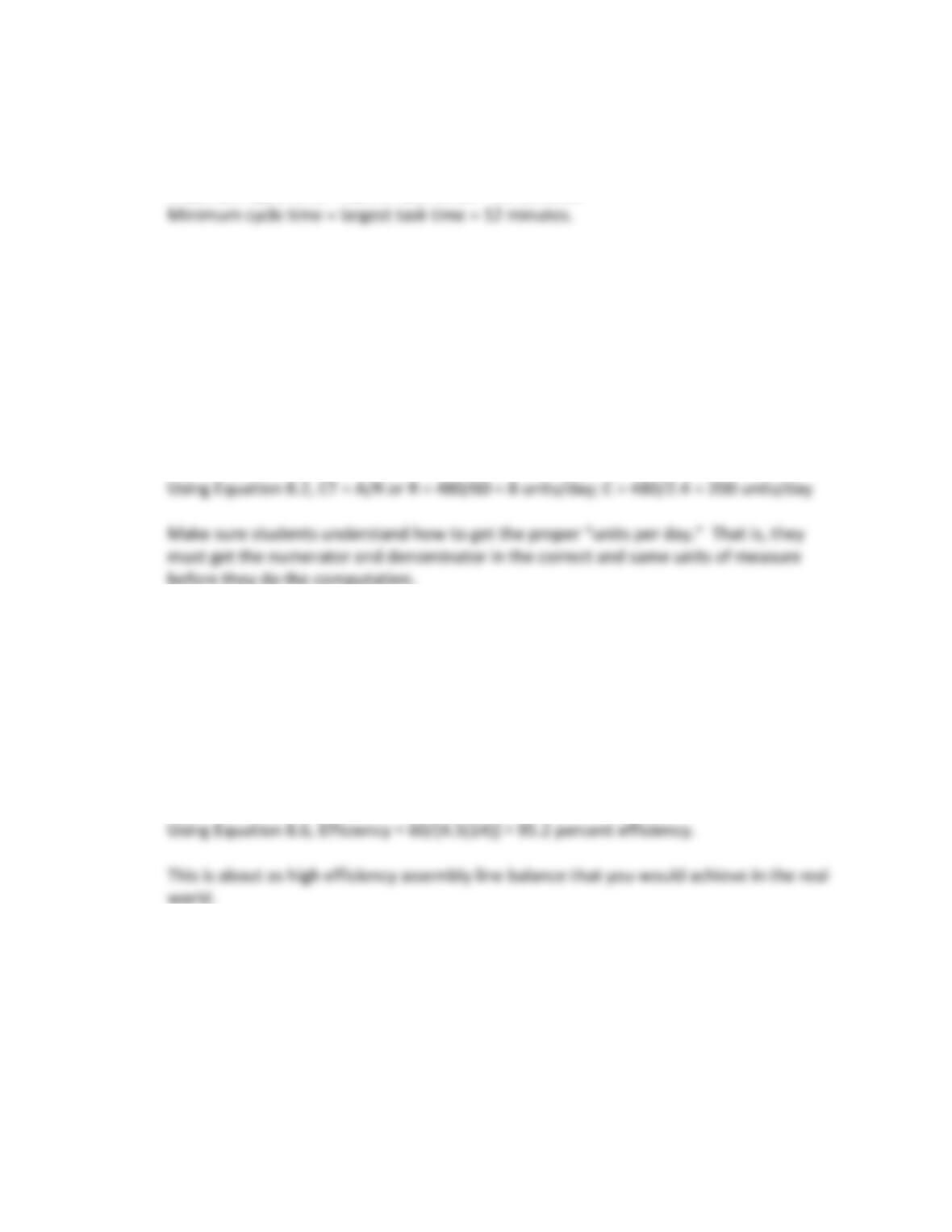
b. Balance the assembly line for an eight-hour-shift output of 30 pieces.
Shift output = 30 pieces, so the cycle time must be 480/30 = 16 minutes. Using largest
task time rule, we get
Workstation Tasks Time
1 A,B,C 15
2 D,E,F 15
A
C
D
H
18
c. Determine maximum and minimum cycle times.
Maximum cycle time = sum of task times = 56 minutes.
37. An assembly line with 30 activities is to be balanced. The total amount of time to complete
all 30 activities is 60 minutes. The longest activity takes 2.4 minutes and the shortest takes
0.3 minutes. The line will operate for 480 minutes per day.
a. What are the maximum and minimum cycle times?
Maximum cycle time = 60 minutes; minimum cycle time = 2.4 minutes.
b. How much daily output will be achieved by each of those cycle times?
38. In problem 37, suppose the line is balanced using 14 workstations and a finished product
can be produced every 4.5 minutes.
a. What is the production rate in units per day?
Using Equation 8.2, CT = A/R or 4.5 = 480/R or R = 106.7 units/day
b. What is the assembly line efficiency?
39. A small assembly line for the assembly of power steering pumps needs to be balanced.
Exhibit 8.14 is the precedence diagram. The cycle time is determined to be 1.5 minutes.
How would the line be balanced by choosing the assignable task having the longest task
time first?