Chapter 08 – Location Planning and Analysis
8-1
CHAPTER 08
LOCATION PLANNING AND ANALYSIS
Teaching Notes
Facility Location refers to the location of a service or manufacturing facility with respect to customers,
suppliers and other existing facilities such that it allows the company to gain a competitive and/or
strategic edge. In making a location decision, both tangible costs such as the cost of operating the
facility, cost of land (if it applies), cost of labor, taxes, utilities and the cost of inbound and outbound
transportation, and intangible costs such as availability of qualified labor, and labor climate must be
Reading: Not So Clear Choices: Should you Export or Manufacture Overseas
1. Advantages of exporting include the following:
a. It is less risky than manufacturing and requires less investment in capital.
d. Political problems and instability in the targeted country does not affect exporting as much
as it affects overseas manufacturing.
e. It is better to export than to manufacture overseas a less mature product requiring design
changes because dealing with significant changes away from the main product
development and engineering teams may be very difficult and costly.
goods manufactured overseas.
2. Advantages of manufacturing overseas include the following:
a. The costs of logistics, transportation, and taxes are lower.
3. The advantages of employing local employees include:
a. The locals can be eyes and ears of a foreign unknown market.
Chapter 08 – Location Planning and Analysis
8-2
d. Local employees have a better understanding of the language, culture, markets, business
practices, and government regulations.
5. Other relevant factors include changes in cost of logistics, changes in tariffs, changes in
technology, obsolescence and timing of entry.
Answers to Discussion and Review Questions
1. Location decisions can have an impact on access to markets, costs (including materials, labor,
2. The fact that similar businesses are widely located underscores the futility of searching for that
“one best” location. On the other hand, however, it doesn’t necessarily follow that little
attention is needed in finding a suitable location. Many organizations that have not been
3. Important community factors include the size of the community, public transportation,
schools, recreational facilities, libraries, restaurants, shopping centers, cultural and
entertainment selections, and so on.
4. Manufacturing and non-manufacturing organizations tend to approach location decisions in a
similar way, but the factors which are important to each tend to differ. While both tend to take
5. Foreign locations may offer lower taxes, access to markets, availability of raw materials,
6. Location rating, or factor rating, is a qualitative technique used to develop an overall
7. The first step is usually to identify any factors which will dominate the decision. Next, if
Chapter 08 – Location Planning and Analysis
8-3
8. Locational breakeven analysis generally assumes the following:
a. Fixed costs are constant for the range of probable output.
9. Recent trends include the location of foreign manufacturing plants in the United States, having
smaller factories located close to markets, choosing nearby suppliers, low-cost labor is
becoming less of a factor in many industries, and advances in information technology make it
less important to have design, engineering, etc. close to the factory.
Taking Stock
1. Due to economies of scale, the centrally located large facility will be more efficient. The
scheduling and coordination between the large facility and suppliers or customers will be
2. Unlike the process design decision, the facility location decision is a macro decision and thus
requires the involvement of top level management. The larger the facility, the higher the level
3. Due to the advancement of data mining and data warehousing, and the related improvements
in computers’ ability to store and exchange data, we can generate much more useful
information to make the facility location decision.
Critical Thinking
1. The company does have some social responsibility. Because the company employs such a
large percentage of the workforce, its leaving is certain to have a major impact on town
businesses. It is likely that unless new sources of employment emerge, some residents may be
2. Trade-offs involved would include:
a. The nature of current and more importantly the forecasted future demand.
Chapter 08 – Location Planning and Analysis
8-4
b. Current demographics and the future expected changes in demographics for this area.
c. The nature and type of competition for this area. We will need to predict what our
competitors will be doing in the short term as well as in the long term.
3.
Options
Pros
Cons
Avoid such locations.
Avoid the problem completely
Miss out on potential business
Locate there and deal with it.
Potential business.
Need to make sure workers
know and abide by the policy,
risk cheating and possible
to service people)
4. Student answers will vary
Memo Writing Exercises
1. The following factors must be considered to make this decision:
a. location of the existing restaurants
2. The following factors must be considered:
a. construction cost of expansion
Chapter 08 – Location Planning and Analysis
8-5
e. capacity of the existing plant after expansion
f. capacity of the plant at the new location
g. cost of manufacturing and operation at both locations
Solutions
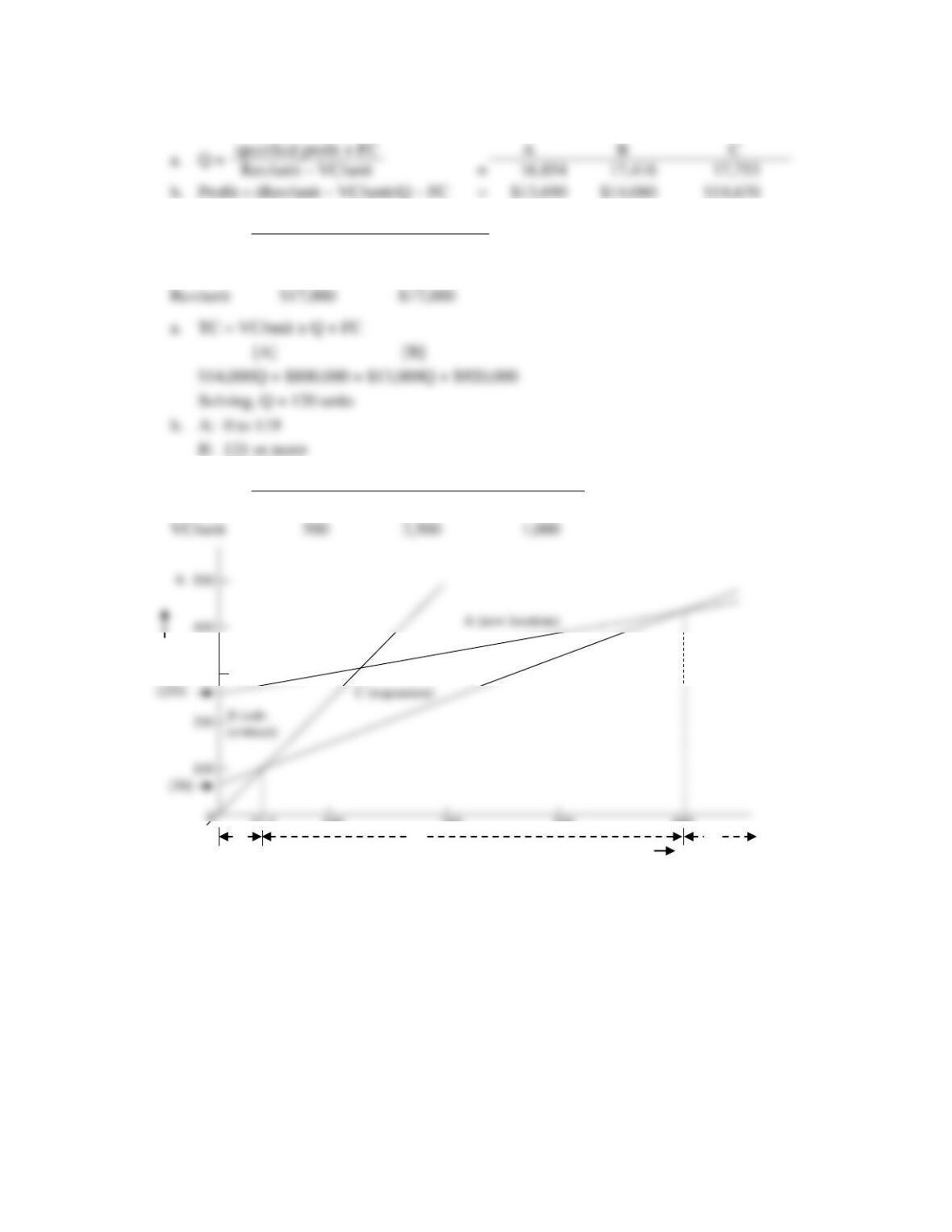
1. Profit = (Rev/unit – VC/unit)Q – FC
2. Location
A
B
C
Chapter 08 – Location Planning and Analysis
8-6
3.
A
B
FC
$800,000
$920,000
VC/unit
$14,000
$13,000
Rev/unit
$17,000
$17,000
TC = VC/unit x Q + FC
Solving, Q = 120 units
b.
A: 0 to 119
B: 121 or more
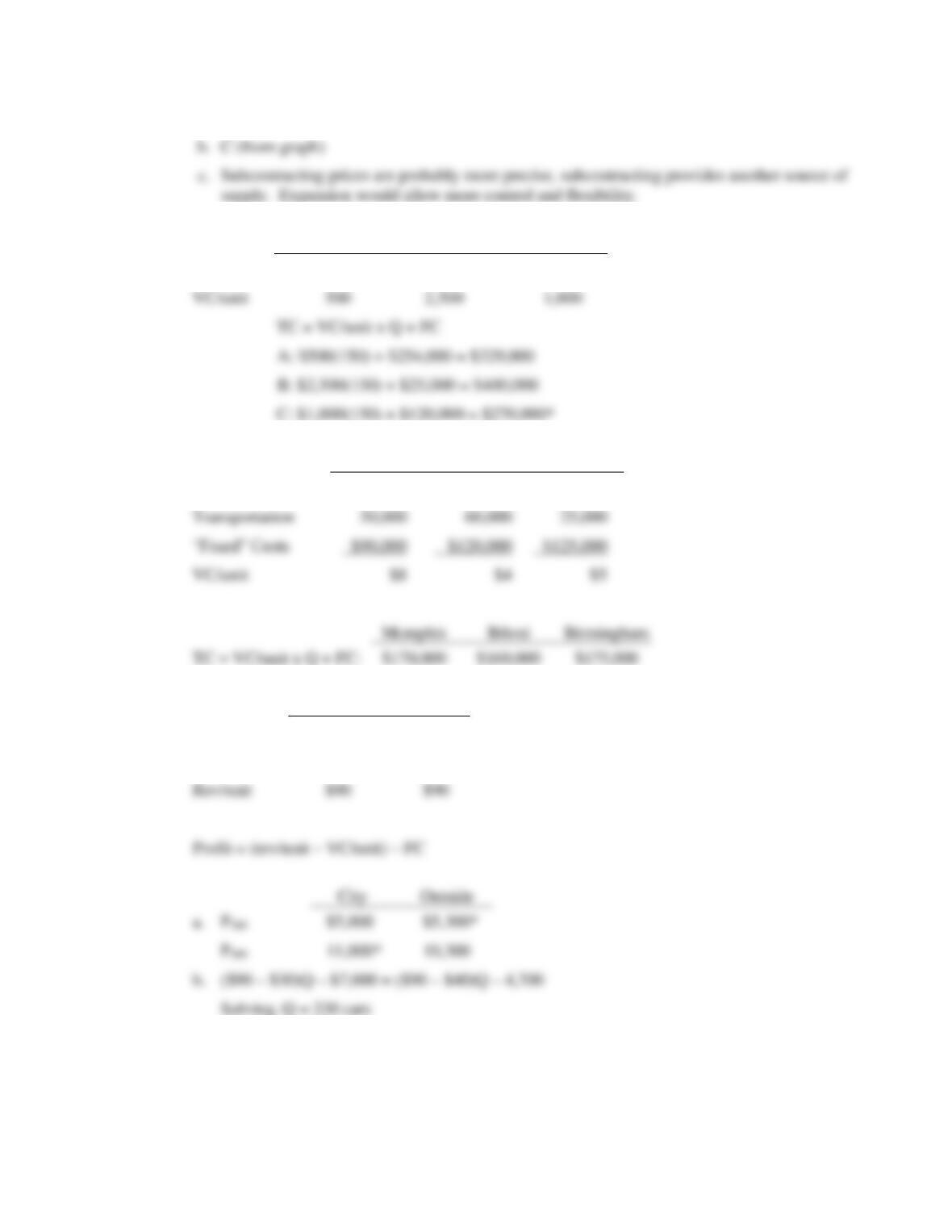
4.
A
B
C
FC/year
$250,000
$50,000
VC/unit
C (expansion)
33.3 100 200 300 400
300
TC
($000)
B
C
A
No. of Boats/yr.
b.
Profit = (Rev/unit – VC/unit)Q – FC
Chapter 08 – Location Planning and Analysis
8-7
5.
A
B
C
FC
$254,000
$25,000
$120,000
VC/unit
TC = VC/unit x Q + FC
A: $500(150) + $254,000 = $329,000
B: $2,500(150) + $25,000 = $400,000
C: $1,000(150) + $120,000 = $270,000*
6.
Memphis
Biloxi
Birmingham
Lease, equipment
$40,000
$60,000
$100,000
Transportation
60,000
$90,000
VC/unit
Birmingham
TC = VC/unit x Q + FC:
$160,000
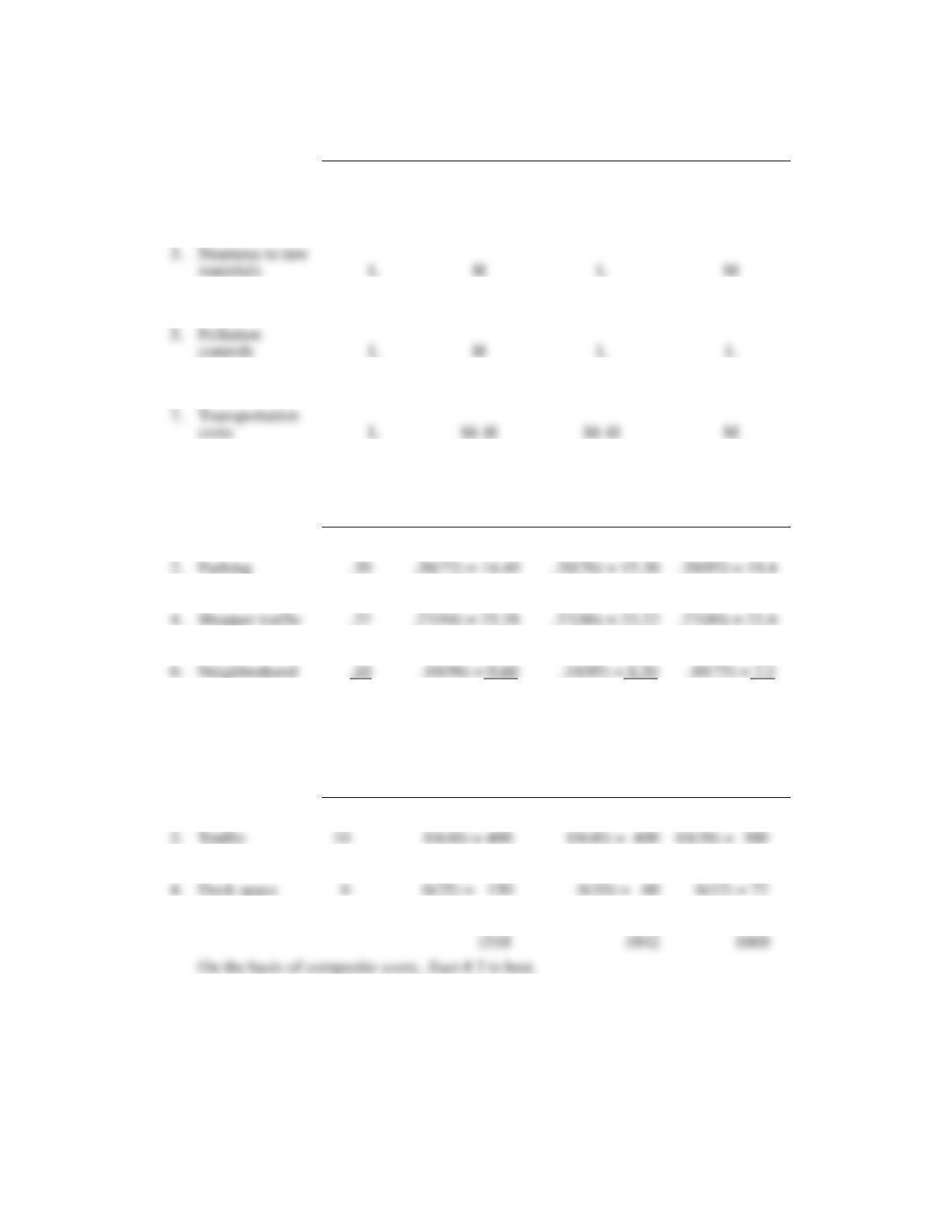
7.
City
Outside
FC/month
$7,000
$4,700
VC/unit
$30
$40
Rev/unit
Profit = (rev/unit – VC/unit) – FC
$5,000
$5,300*
b.
($90 – $30)Q – $7,000 = ($90 – $40)Q – 4,700
Solving, Q = 230 cars
C (from graph)
Chapter 08 – Location Planning and Analysis
8-8
8.
Factor
Local bank
Steel mill
Food warehouse
Public school
1.
Convenience for
customers
H
L
M–H
M–H
2.
Attractiveness of
building
H
L
M
M–H
4.
Large amounts
of power
L
H
L
L
5.
Pollution
controls
L
H
L
L
6.
Labor cost and
availability
L
M
L
L
7.
Transportation
costs
L
M–H
8.
Construction
costs
M
H
M
M–H
9.
Factor
Wt.
A
B
C
1.
Conv. access
.15
.15(80) = 12.00
.15(70) = 10.50
.15(60) = 9.0
3.
Display area
.18
.18(88) = 15.84
.18(90) = 16.20
.18(90) = 16.2
4.
Shopper traffic
.27
.27(94) = 25.38
.27(86) = 23.22
.27(80) = 21.6
5.
Operating costs
.10
.10(98) = 9.80
.10(90) = 9.00
.10(82) = 8.2
1.00
87.02
82.62
80.9
On the basis of composite score, A seems the best.
10.
Factor
Wt.
East #1
East #2
West
1.
Initial Cost
8
8(100) = 800
8(150) = 1200
8(140) =1120
3.
Maintenance
6
6(20) = 120
6(25) = 150
6(18) = 108
4.
Dock space
6
6(25) = 150
6(10) = 60
6(12) = 72
5.
Neighborhood
4
4(12) = 48
4(8) = 32
4(15) = 60
On the basis of composite score, .East # 2 is best.
3.
Nearness to raw
L
H
L
Chapter 08 – Location Planning and Analysis
8-9
Location (a)
Location (b)
11.
Factor
A
B
C
Weight
A
B
C
2.
Community Services
7
6
7
1/9
7/9
6/9
7/9
3.
Real Estate Cost
3
8
7
1/9
3/9
8/9
7/9
4.
Construction Costs
5
6
5
2/9
10/9
12/9
10/9
5.
Cost of Living
4
7
8
1/9
4/9
7/9
8/9
6.
Taxes
5
5
5
1/9
5/9
5/9
4/9
7.
Transportation
6
7
8
1/9
6/9
7/9
8/9
Total
39
44
45
1.0
53/9
55/9
54/9
Each factor has a weight of 1/7.
a.
Composite Scores
39
44
45
7
7
7
B or C is the best and A is least desirable.
c.
Composite Scores
B is the best followed by C and then A.
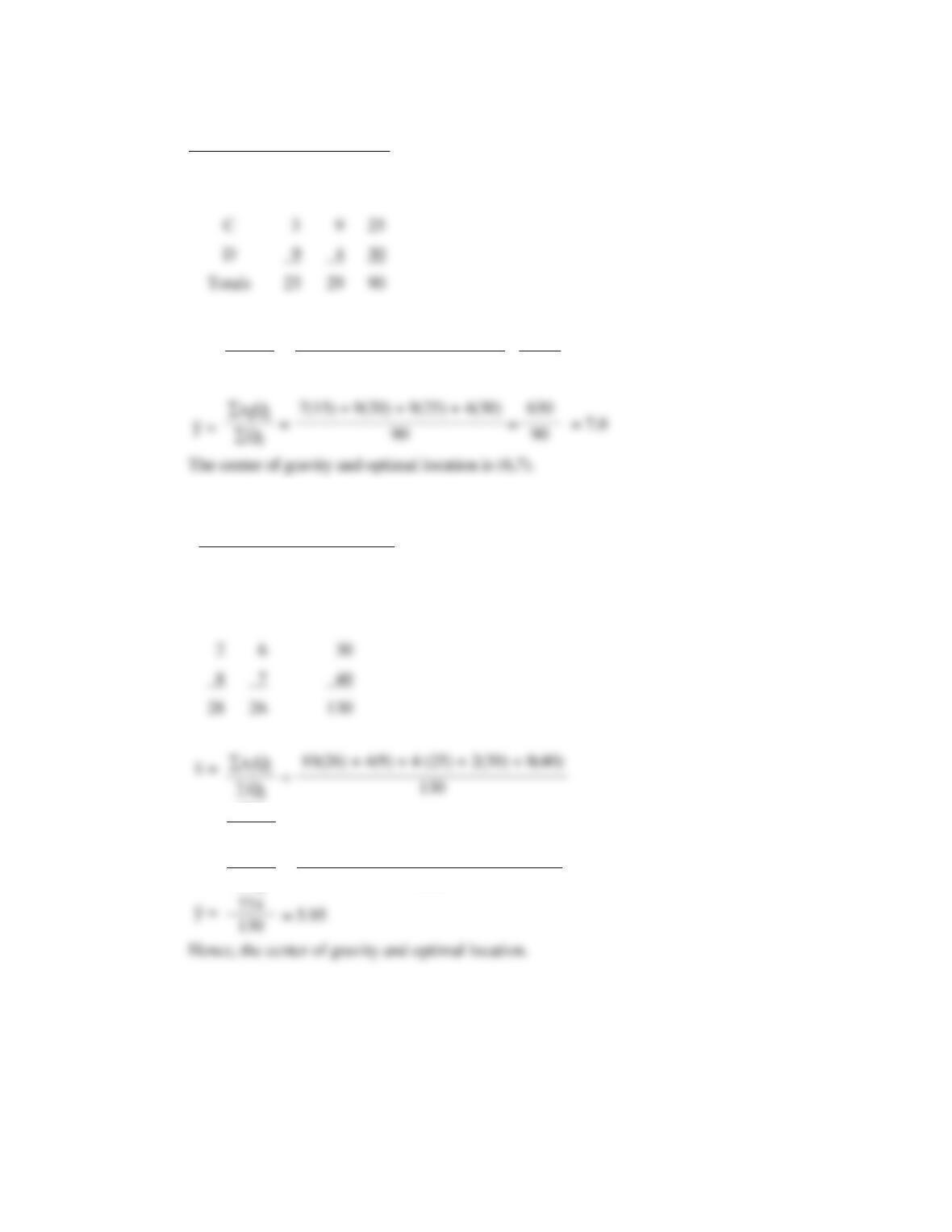
12.
Location
x
y
A
3
7
B
8
2
C
4
6
D
4
1
E
6
Totals
25
1.
Business Services
9
5
5
2/9
18/9
10/9
10/9
Chapter 08 – Location Planning and Analysis
8-10
13.
Location
x
y
0
A
5
7
15
B
6
9
20
−
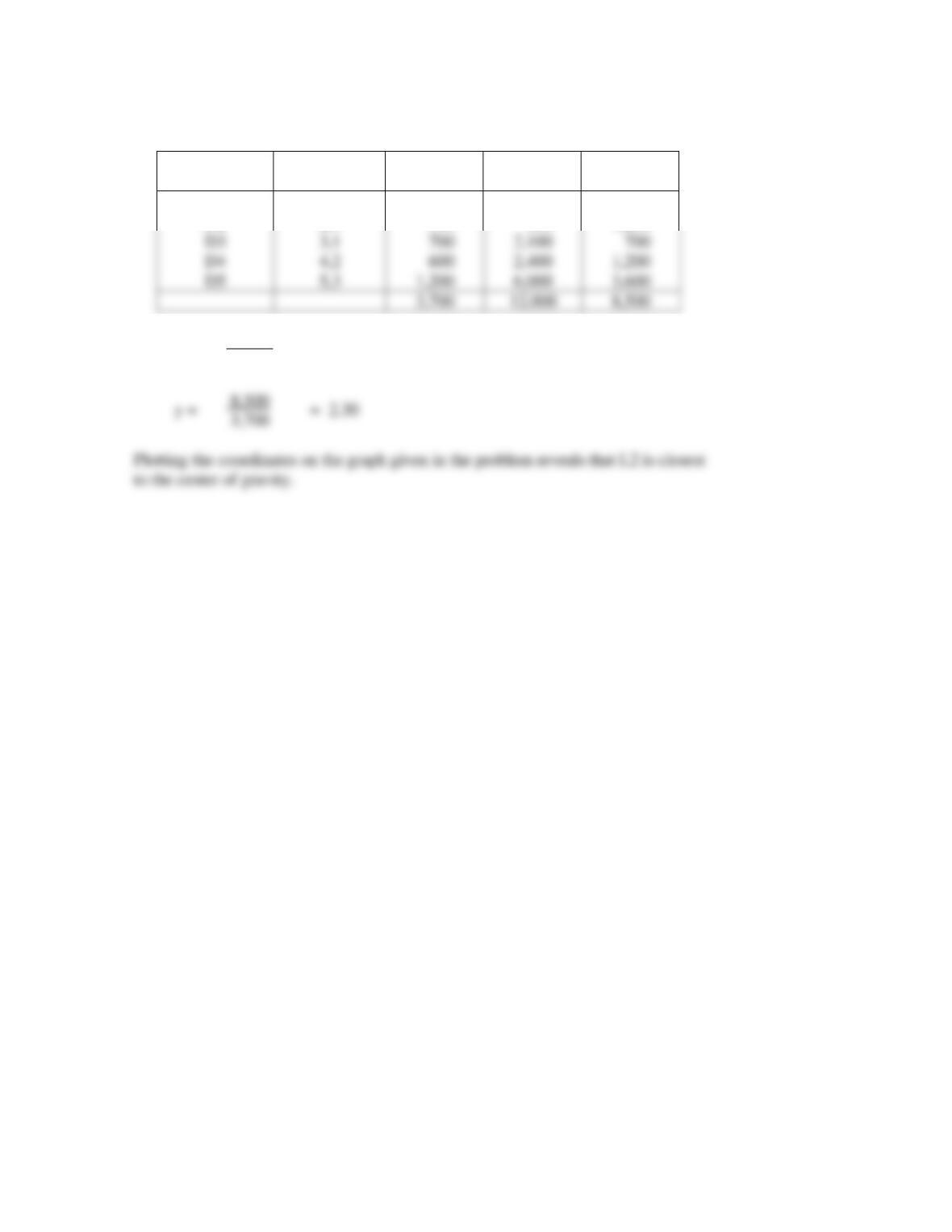
x =
xiQi
=
5(15) + 6(20) + 3(25) + 9(30)
=
540
= 6.0
Qi
90
90
−
xiQi
=
7(15) + 9(20) + 9(25) + 4(30)
=
630
= 7.0
Qi
90
90
14.
Location
Volume in
x
y
Tons Per Day
10
5
26
4
1
9
4
7
25
2
6
30
8
28
−
xiQi
=
Qi
−
x =
776
= 5.97
130
−
y =
yiQi
=
5(26) + 1(9) + 7(25) + 6(30) + 7(40)
Qi
130
−
774
130
C
3
9
25
D
9
30
Totals
23
90
Chapter 08 – Location Planning and Analysis
8-11
15.
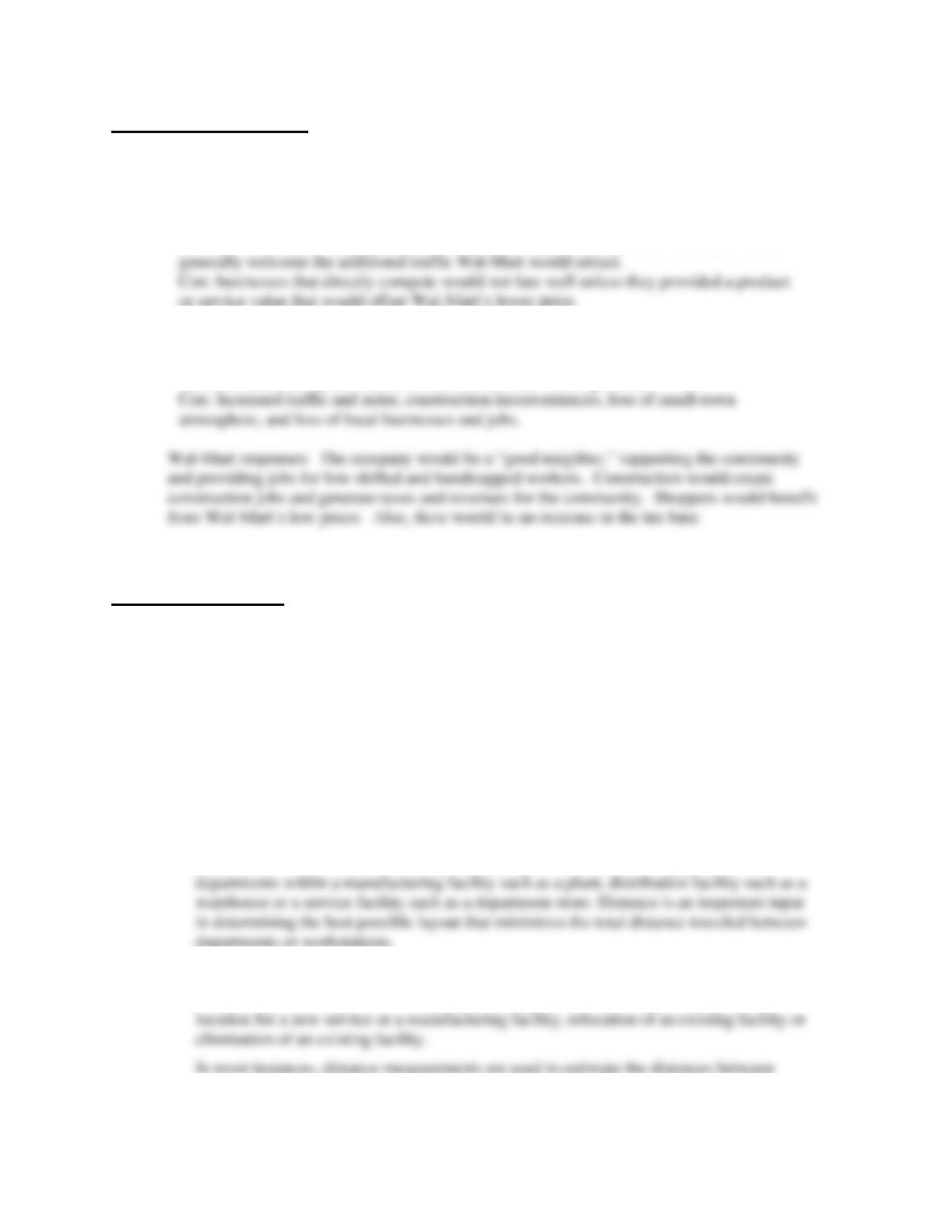
Destination
x, y
Coordinates
Quantity
xQ
yQ
D1
D2
1,2
2,4
900
300
900
600
1,800
1,200
x =
12,000
3,700
= 3.24
y =
8,500
3,700
= 2.30
Chapter 08 – Location Planning and Analysis
8-12
Case: Hello Wal-Mart?
[This is a good case for in-class discussion. Three groups can be formed: one to take the position of
residents, one to take the position of small businesses, and one to take the position of Wal-Mart.]
1. Owners of small businesses.
Pro: restaurants and other businesses that do not compete directly with Wal-Mart would
2. Residents.
Pro: another shopping option, lower prices, and other, non-competing businesses that
would be attracted by the increased traffic Wal-Mart would generate.
Enrichment Module
A. Distance Measurement
B. Center of Gravity Method with Predetermined Sites
C. Factor Scoring Model
D. Emergency Facility Location
A. Distance Measurement
The companies measure distance when making two important decisions:
1. Facility Layout decision:
Distances are estimated/measured in determining the best layout of equipment or
2. Facility Location decision:
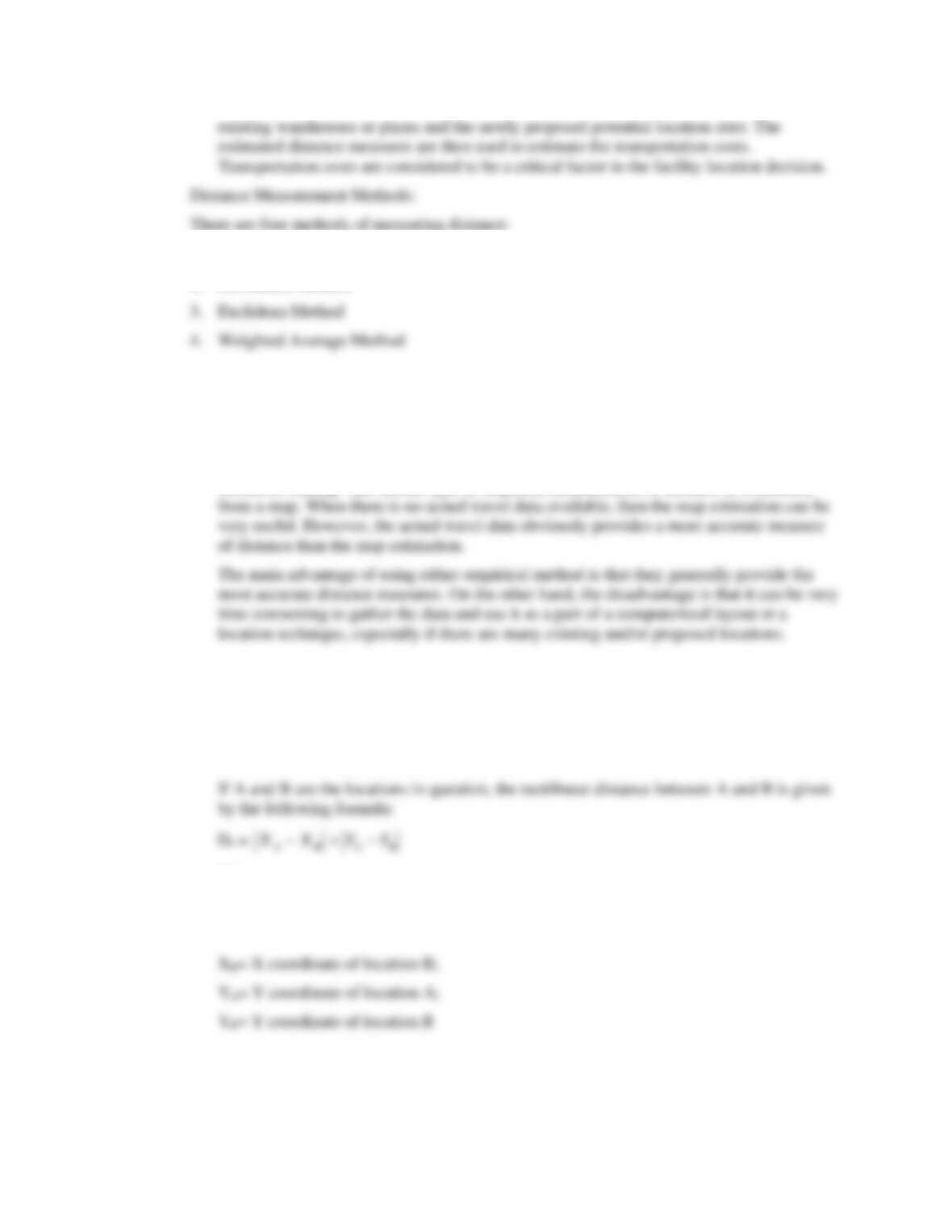
Distance measurement is also a very important input measure in determining the best
Chapter 08 – Location Planning and Analysis
8-13
1. Empirical Method
2. Rectilinear Method
1. Empirical Method:
The empirical method is the most accurate distance measure. Using the empirical method,
distance can be measured in one of two ways. The first type of empirical measurement is
the actual recorded travel distance, where a driver records the distance based on a vehicle
odometer reading. The second type of empirical measurement of distance is estimation
2. Rectilinear Method
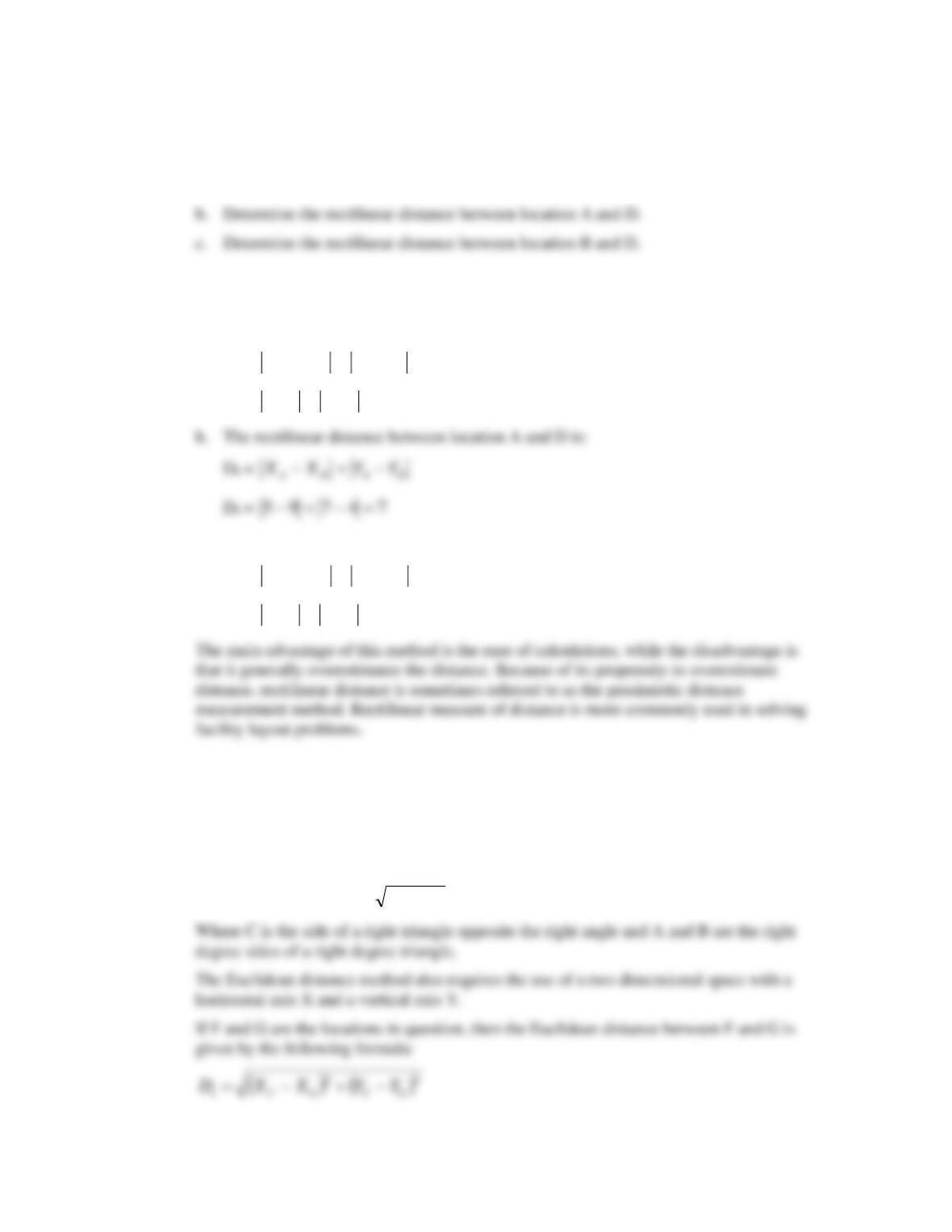
This mathematical method is very easy to compute and lends itself to easy implementation
of computerized layout or location techniques. Rectilinear method requires the use of a
two dimensional space with a horizontal axis X and a vertical axis Y.
Where:
Dr = rectilinear distance measure between location A and location B;
XA= X coordinate of location A;
Example problem—Calculation of the Rectilinear distance:
Chapter 08 – Location Planning and Analysis
8-14
When answering this question, refer to textbook, Chapter 8, Problem 12.
a. Determine the rectilinear distance between location A and B.
Solution to example problem—Measurement of Rectilinear distance:
a. The rectilinear distance between location A and B is:
Dr =
BABA YYXX −+−
Dr =
39765 =−+−
c. The rectilinear distance between location A and D is:
Dr =
DBDB YYXX −+−
Dr =
84996 =−+−
3. Euclidean Method
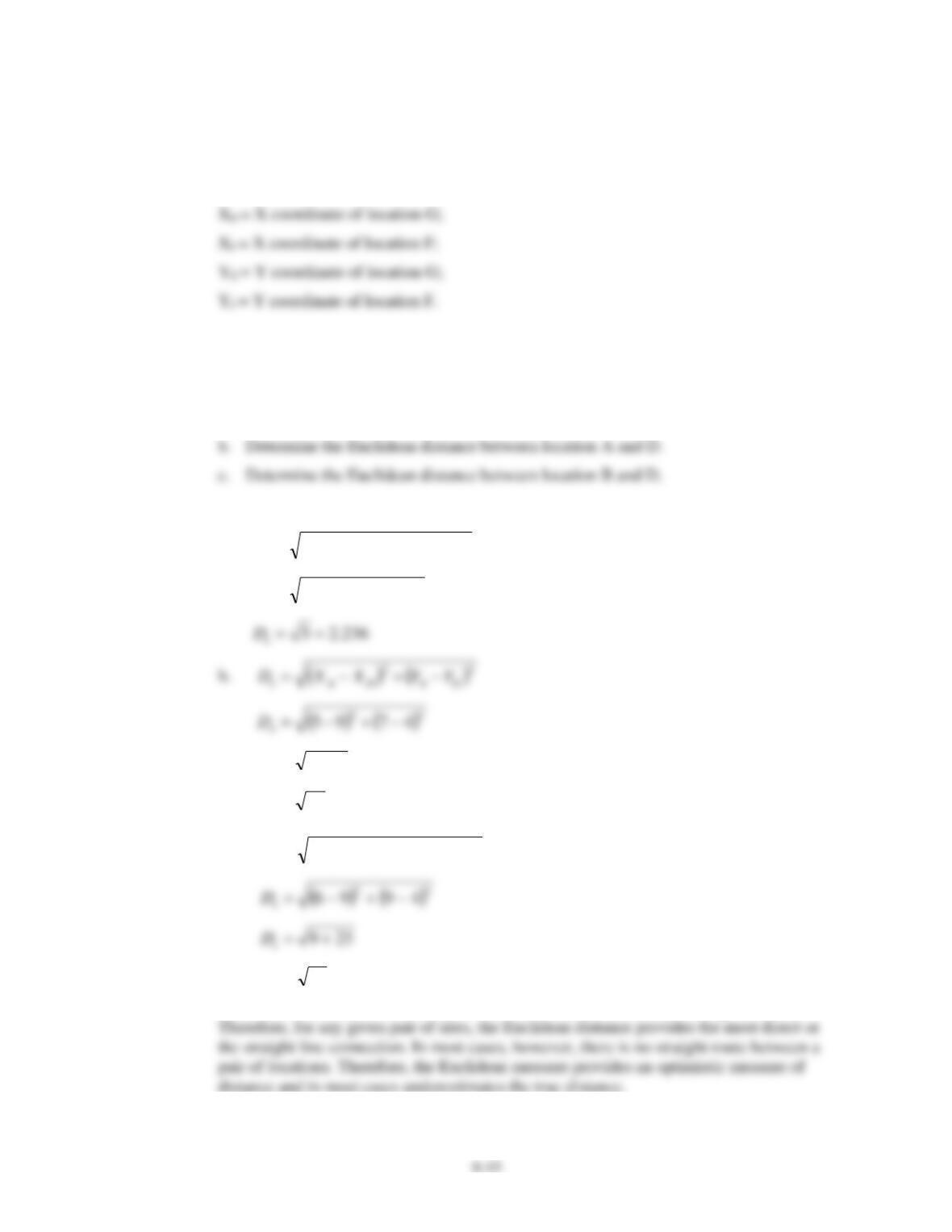
This mathematical method is based on the Pythagorean theorem.
The following formula for the hypotenuse of a right triangle provides us with the
Euclidean distance:
C2 = A2 + B2 or C =
22 BA +
Chapter 08 – Location Planning and Analysis
Where:
De = Euclidean distance measure between location F and location G;
Example problem—Calculation of the Euclidean Distance:
Refer to textbook, Chapter 8, Problem 12.
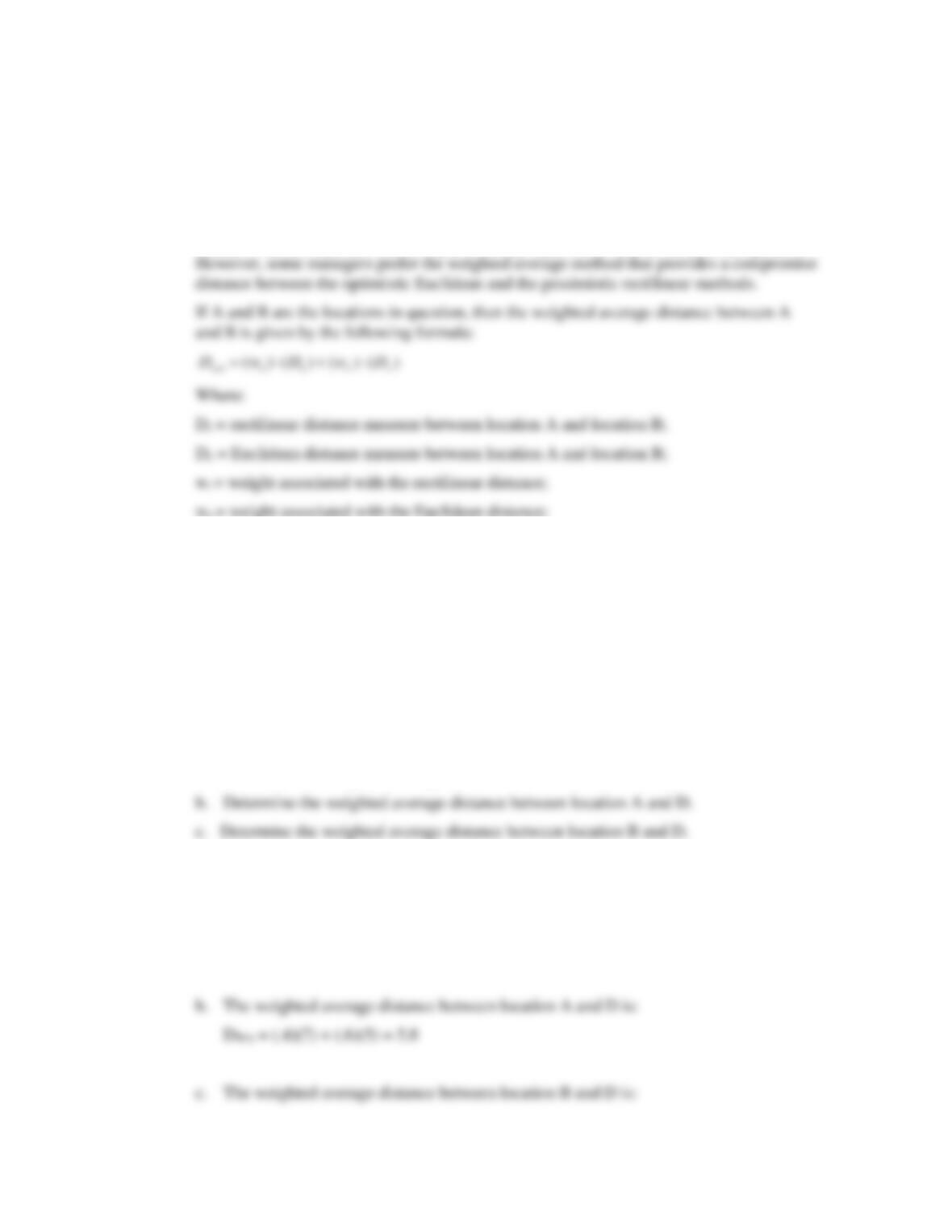
a. Determine the Euclidean distance between location A and B.
Solution to example problem—Calculation of the Euclidean Distance:
a.
c.
The Euclidean distance is the direct or the shortest distance between two given sites.
( ) ( )
( ) ( )
9765 22
22
−+−=
−+−=
e
BABAe
D
YYXXD
525
916
==
+=
e
e
D
D
( ) ( )
831.534
22
==
−+−=
e
DBDBe
D
YYXXD
Chapter 08 – Location Planning and Analysis
8-16
4. Weighted Average Method
As we discussed in the previous sections, the rectilinear method is a conservative,
pessimistic measure of distance, and the Euclidean method is an optimistic measure of
distance. Both Euclidean and Rectilinear measures of distance are frequently the only
standard distance options used as a part of many layout and location software programs.
0
1
i
ii
w
w=
Example problem—Calculation of the Weighted Average Distance:
Refer to textbook, Chapter 8, Problem 12 and the two examples given earlier in this
section. Assume that the pessimistic (rectilinear) weight is 0.4 and the optimistic
(Euclidean) weight is 0.6.
a. Determine the weighted average distance between location A and B.
Solution to example problem—Weighted Average
a. The weighted average distance between location A and B is:
DWA = (.4)(3) + (.6)(2.236) = 2.5416