Chapter 08 – Location Planning and Analysis
8-17
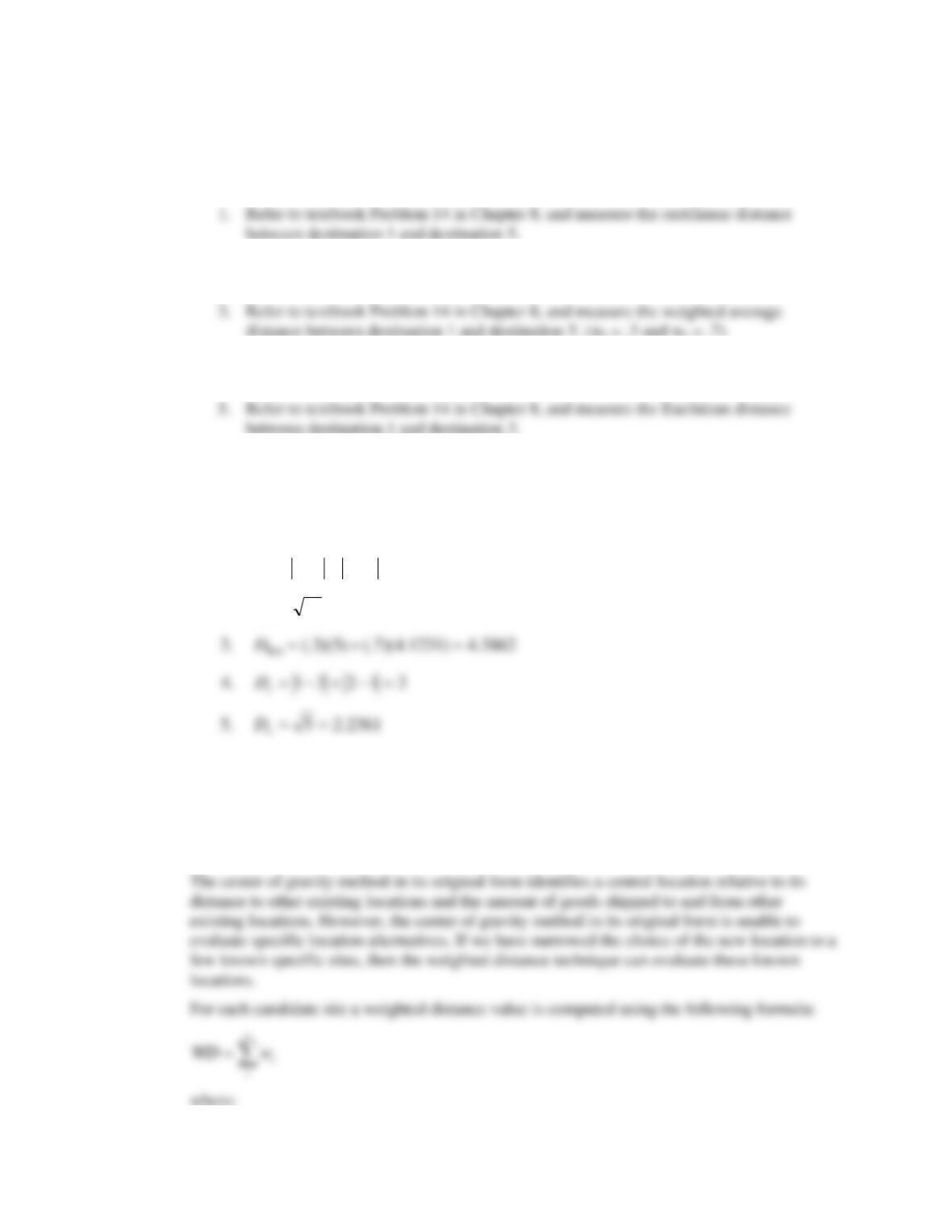
DWA = (.4)(8) + (.6)(5.831) = 6.7
Exercise Problems
2. Refer to textbook Problem 14 in Chapter 8, and measure the Euclidean distance
between destination 1 and destination 5.
4. Refer to textbook Problem 14 in Chapter 8 and measure the rectilinear distance
between destination 1 and destination 3.
6. Refer to textbook Problem 14 in Chapter 8, and measure the weighted average
distance between destination 1 and destination 3. (wr = .5 and we = .5)
Solutions to Exercise Problems
6181.2)2361.2)(5(.)3)(5(..6
1231.417.2
53251.1
=+=
==
=−+−=
WA
e
r
D
D
D
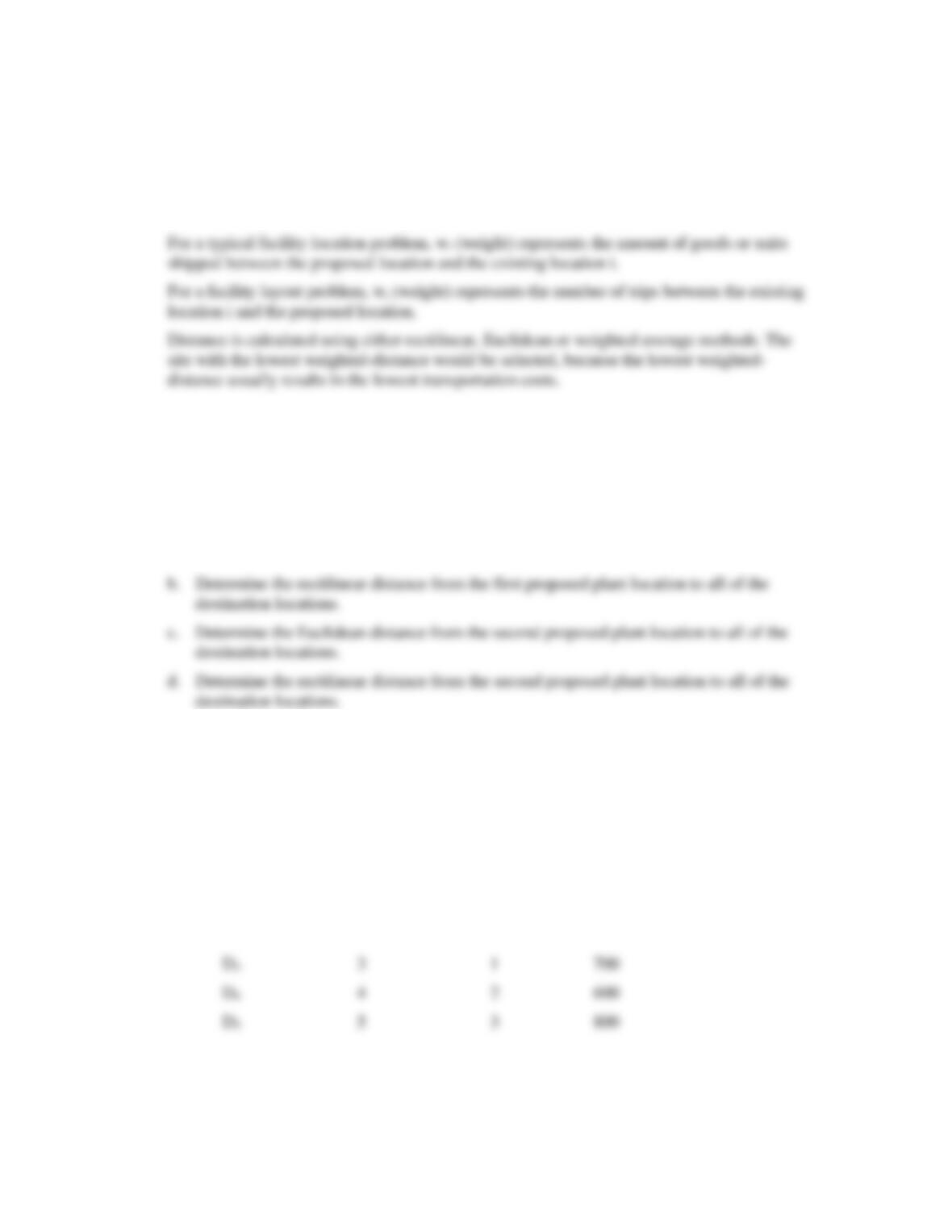
B. Center of gravity method with known alternative locations:
(Weighted distance technique)
Chapter 08 – Location Planning and Analysis
8-18
WD = weighted distance value for a given site
wi = weight associated with existing location i
Di = the distance between existing site i and the proposed location
Problem 1
Based on the destination locations and quantities given in textbook problem 14, the companies
are considering two locations for a new plant. The coordinates of the first plant location are:
(x = 2, y = 3) and the coordinates of the second location are: (x = 4, y = 3).
a. Determine the Euclidean distance from the first proposed plant location to all of the
destination locations.
e. Determine the weighted distance value for the first and second proposed plant locations
based on Euclidean distance and decide where the new plant should be located.
f. Determine the weighted distance value for the first and second proposed plant locations
based on rectilinear distance and decide where the new plant should be located.
Solution to Problem 1
Destination
X coordinate
Y coordinate
Q
D1
1
2
900
D2
2
4
300
D3
3
1
700
D4
4
2
600
D5
5
3
800
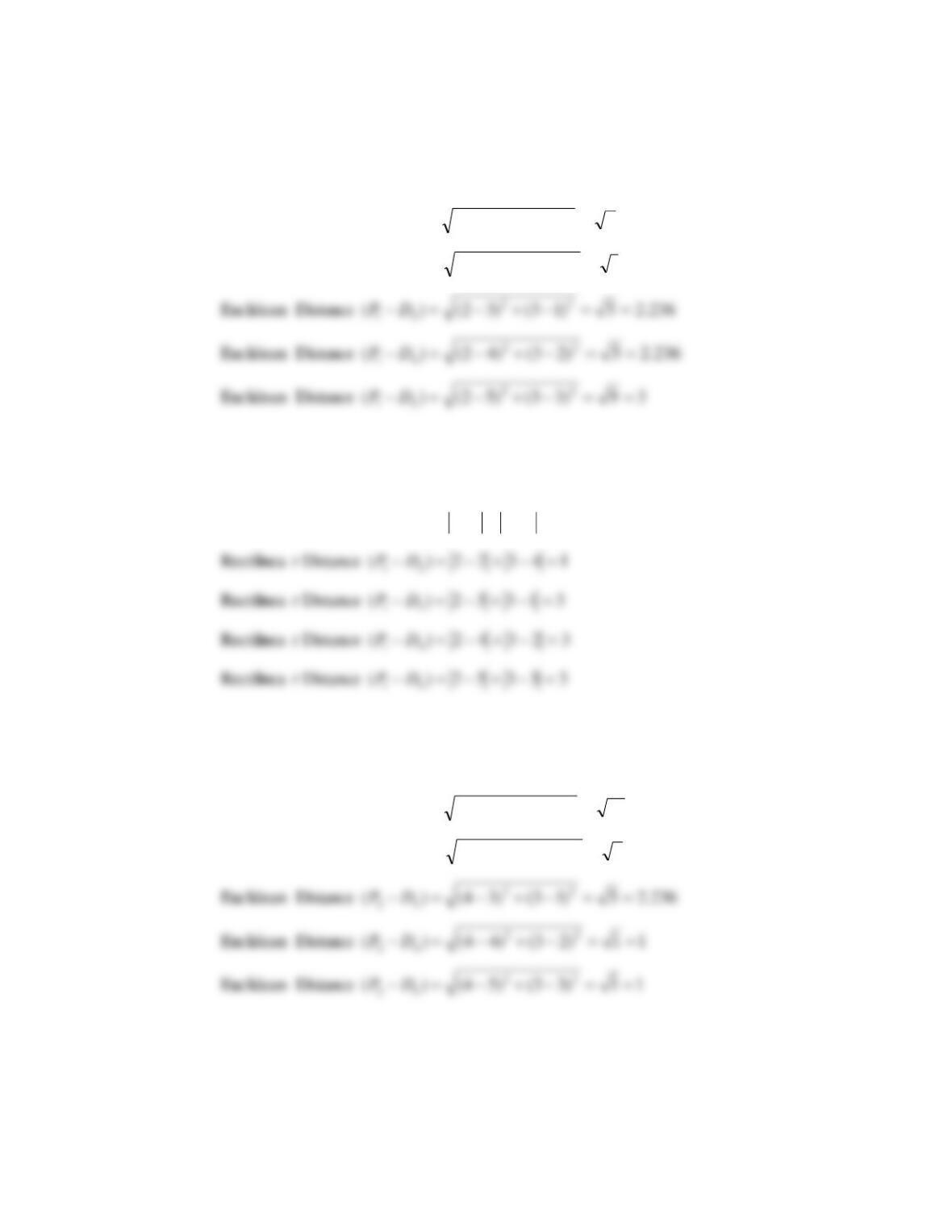
a. Plant Site 1—Euclidean Distance
Chapter 08 – Location Planning and Analysis
8-19
From Plant Site 1 (P1) to Destination j (Dj)
11)43()22()( DistanceEuclidean
4142.12)23()12()( DistanceEuclidean
22
21
22
11
==−+−=−
==−+−=−
DP
DP
b. Plant Site 1—Rectilinear Distance
From Plant Site 1 (P1) to Destination j (Dj)
22312)( Distancer Rectilinea
11
=−+−=−
DP
c. Plant Site 2—Euclidean Distance
From Plant Site 2 (P2) to Destination j (Dj)
236.25)43()24()( DistanceEuclidean
162.310)23()14()( DistanceEuclidean
22
22
22
12
==−+−=−
==−+−=−
DP
DP
Chapter 08 – Location Planning and Analysis
8-20
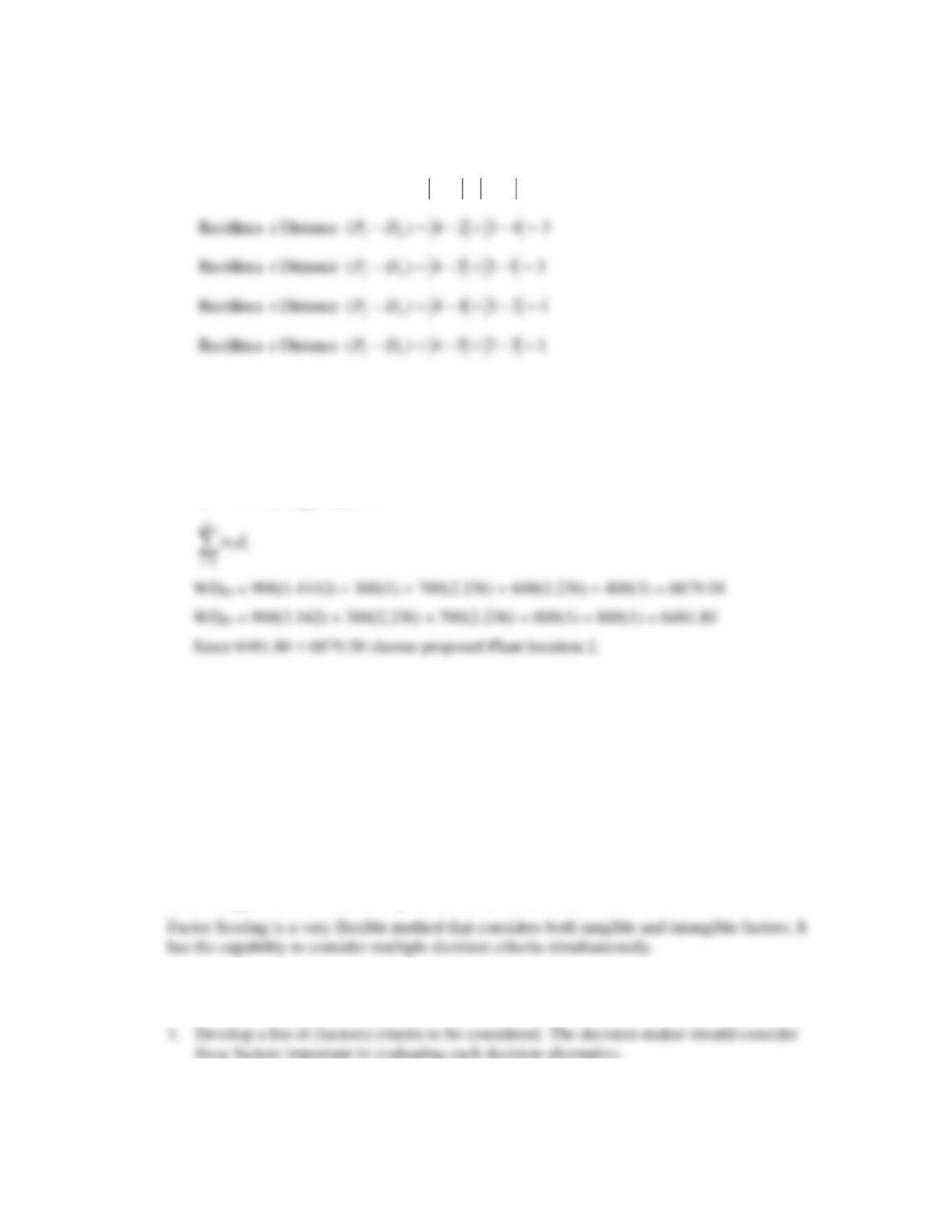
d. Plant Site 2—Rectilinear Distance
From Plant Site 2 (P2) to Destination j (Dj)
42314)( Distancer Rectilinea
12
=−+−=−
DP
e. Weighted Distance Values Based on Euclidean Distances
P1 = Plant 1
P2 = Plant 2
K = # of existing locations
f. Weighted distance values based on rectilinear distances
WDP1 = 900(2) + 300(1) + 700(3) + 600(3) + 800(3) = 8400
WDP2 = 900(4) + 300(3) + 700(3) + 600(1) + 800(1) = 8300
Since 8300 < 8400 choose proposed Plant location 2.
C. Factor Scoring Model
This simplistic selection procedure has many areas of application. The two most common
areas of application are: 1) Facility Location; 2) Product Selection.
The Steps of the Factor Scoring Model
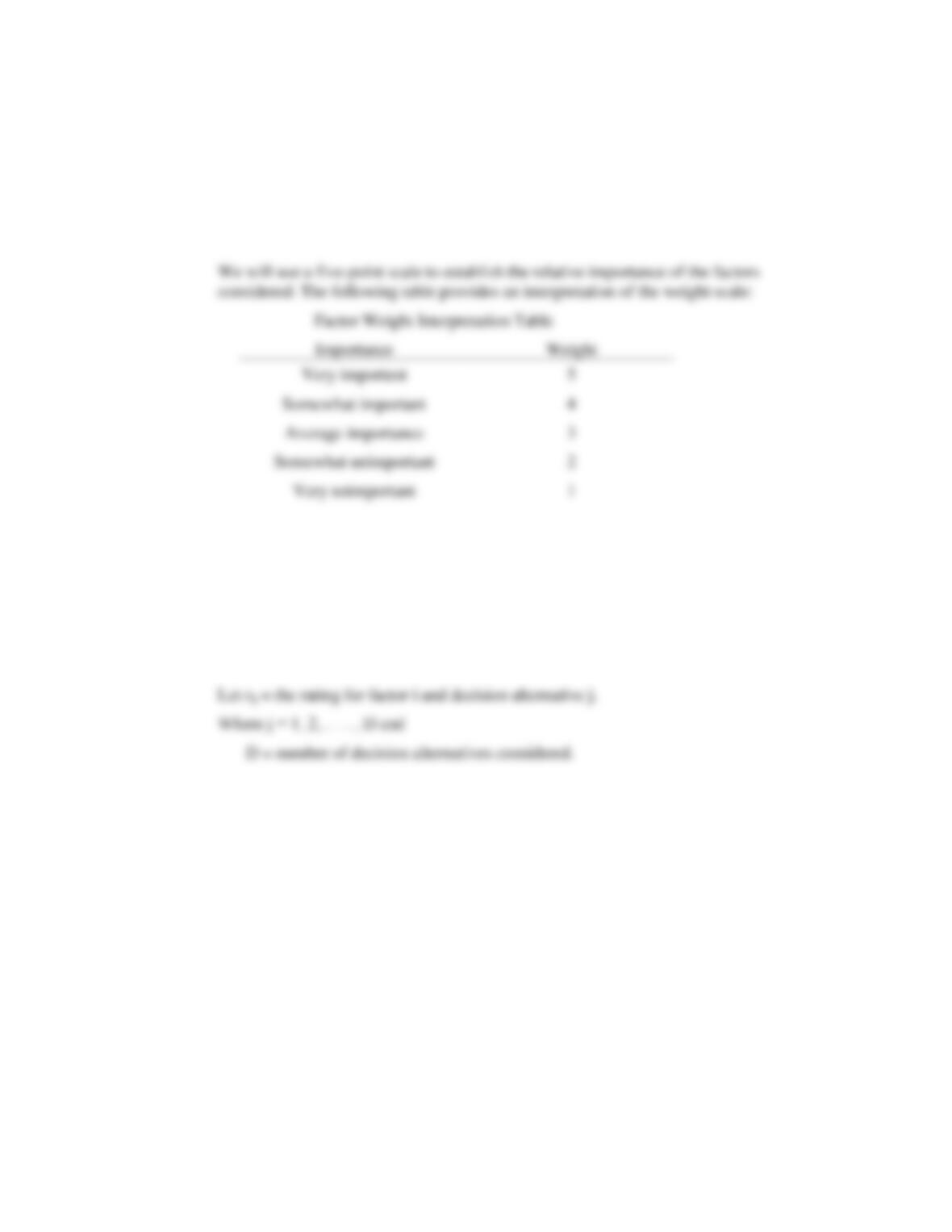
2. Assign a weight to each factor that describes the factor’s relative importance.
Chapter 08 – Location Planning and Analysis
8-21
Let wi = the weight for factor i, where i = 1, 2, ….., F
F = the number of factors considered.
The higher the weight the more important the criterion.
For example, if a factor has a weight of 4, it is somewhat more important than the average
factor.
If a factor has a weight of 1, relative to the other factors being considered, the factor in
question is very unimportant.
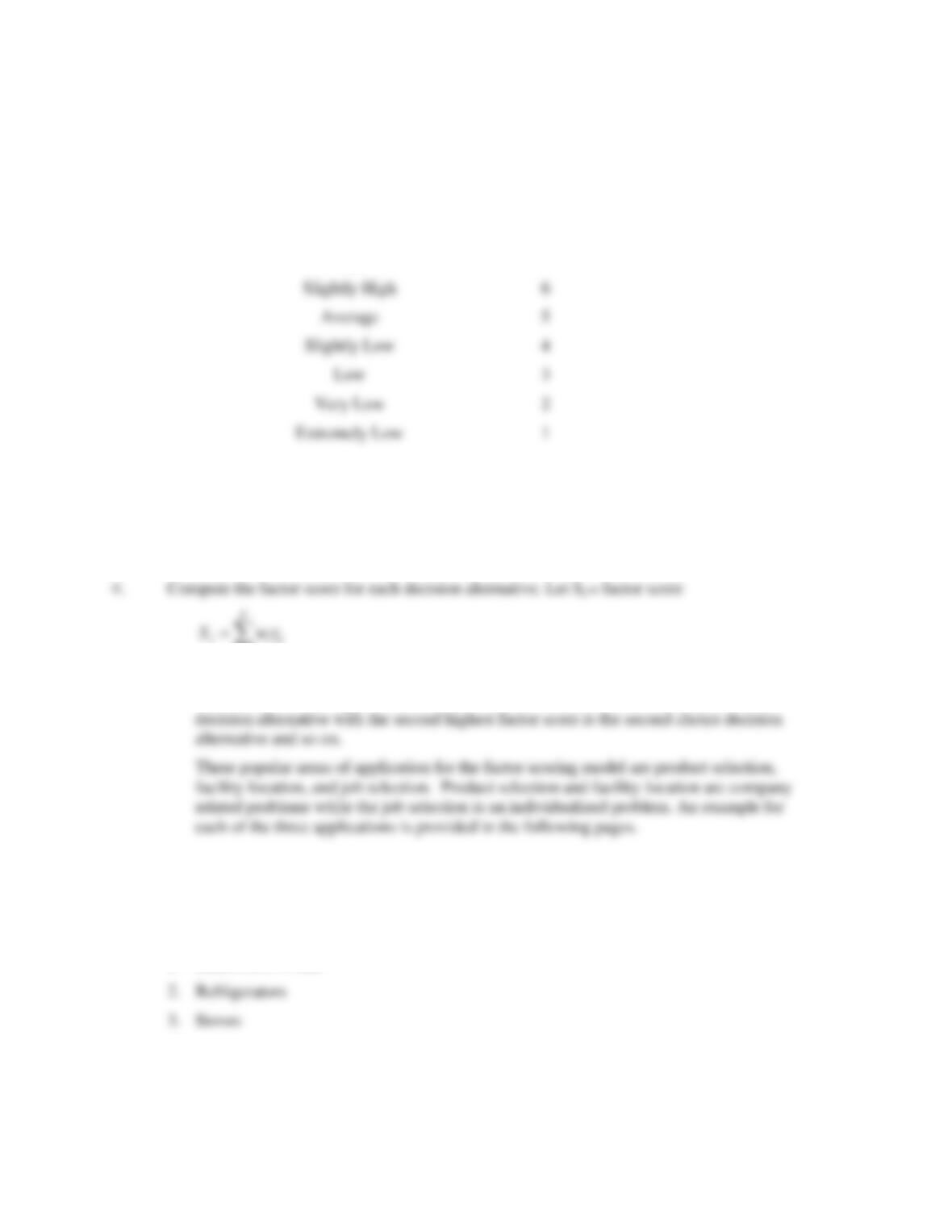
3. Determine a list of decision alternatives. Let dj = decision alternative j and assign a rating
for each factor/decision alternative combination.
Chapter 08 – Location Planning and Analysis
8-22
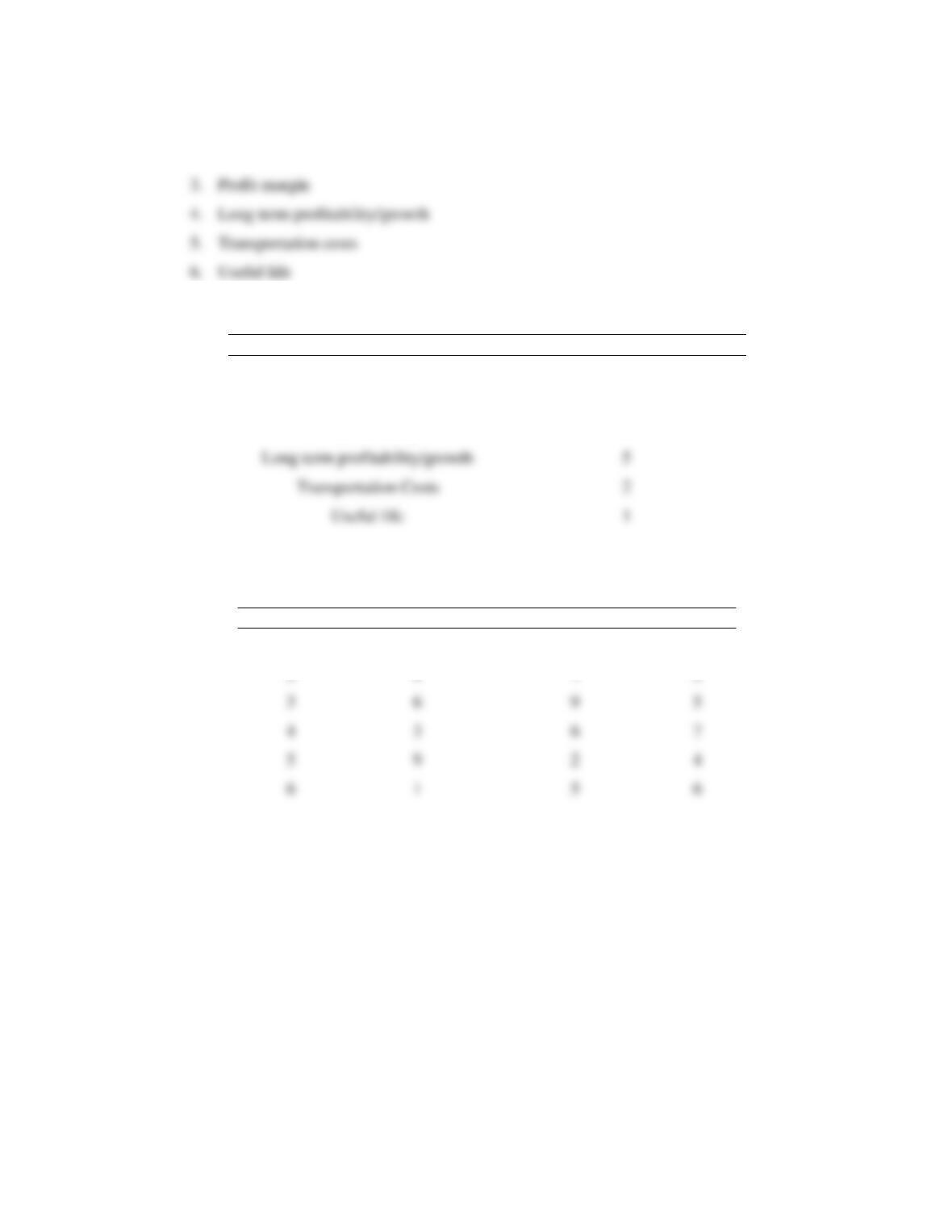
For the purposes of rating each decision alternative/factor combination, we use the following 9-point
scale.
Level of Satisfaction
Rating
Extremely High
9
Very high
8
High
7
For example, a score of 7 for a given decision alternative would indicate that the decision-
maker (manager) rates this decision alternative (location) high with respect to a given
factor (availability of qualified labor).
i
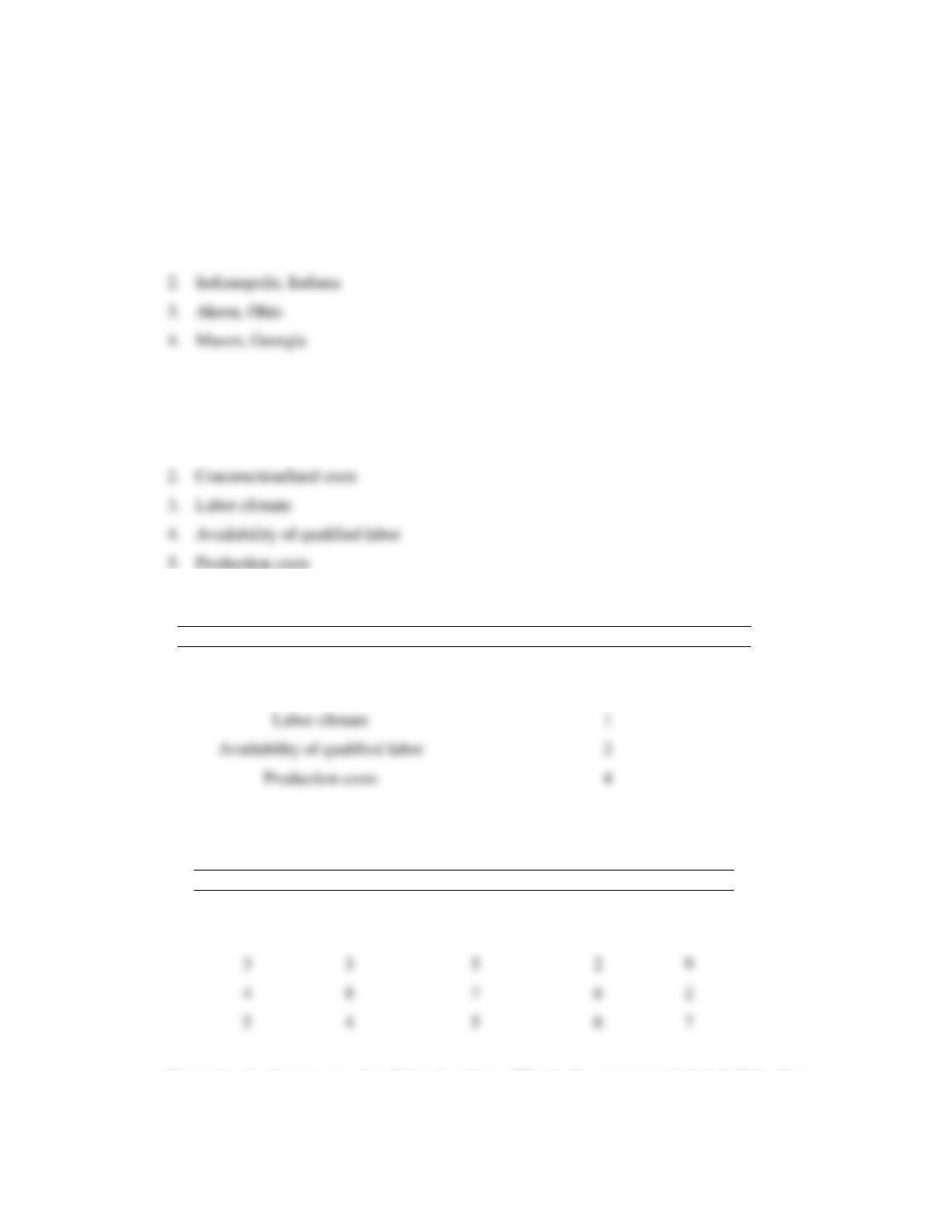
5. Sequence the decision alternatives from the highest score to the lowest score. The decision
alternative with the highest factor score is the recommended decision alternative. The
PRODUCT SELECTION EXAMPLE
An appliance manufacturing company is considering expanding its product line. It has
sufficient capital to introduce only one of the three following products:
1. Microwave Ovens
The management thinks that the following decision criteria should be used in selecting the
product:
1. Manufacturing capability/cost
6
5
4
2
1
Chapter 08 – Location Planning and Analysis
8-23
2. Market demand
The company has determined the following weights for the decision criteria:
FACTORS
CRITERIA
WEIGHT
Manufacturing capability/cost
4
Market demand
5
Unit profit margin
3
Long term profitability/growth
5
Transportation Costs
2
1
The decision factor ratings for each criteria are given in the following table:
DECISION FACTOR RATINGS
FACTOR
MICROWAVE
REFRIGERATOR
STOVE
1
4
3
8
2
8
4
2
3
6
9
5
4
3
6
7
5
9
2
4
6
1
5
6
Based on the information provided, determine the factor scores for all three products. What is
the best choice for the appliance manufacturing company? What is the second best choice?
Chapter 08 – Location Planning and Analysis
8-24
FACILITY LOCATION EXAMPLE
Due to a significant sustained increase in demand, the ITM fastener manufacturing company
has decided to build a new plant. After an initial study, it has narrowed its choices to four
locations:
1. Albany, New York
ITM also identified the following as being important factors in terms of the facility location
decision:
1. Transportation costs
On a five-point scale, the company has determined the following weights for these factors:
FACTOR WEIGHTS
FACTORS
WEIGHTS
Transportation costs
5
Construction/land costs
3
1
Availability of qualified labor
2
4
The decision factor ratings for each criteria is given in the following table:
DECISION FACTOR RATINGS
FACTORS
ALBANY
INDIANAPOLIS
AKRON
MASON
1
3
8
6
1
2
5
4
7
8
3
3
5
2
9
4
8
7
6
2
5
4
5
6
7
Determine the factor scores for all four locations. What is the recommended site? If the first
site is not available, what is the second choice?
Chapter 08 – Location Planning and Analysis
8-25
JOB SELECTION EXAMPLE
Assume that you are a senior student majoring in marketing. You have been involved in the
job search process for the last few months. At this time you have three job offers from three
different firms. Your potential job titles and locations of the jobs are presented below:
1. Pharmaceutical Sales—Chicago
The salaries of the jobs are as follows:
1. Chicago $37,000
The following table provides additional information about each job and company:
COMPANY/JOB CHARACTERISTICS
CHARACTERISTIC
CHICAGO
ST. LOUIS
SAN DIEGO
Culture
Formal
Mix
Informal
Job Security
High
Medium
Low
Medium
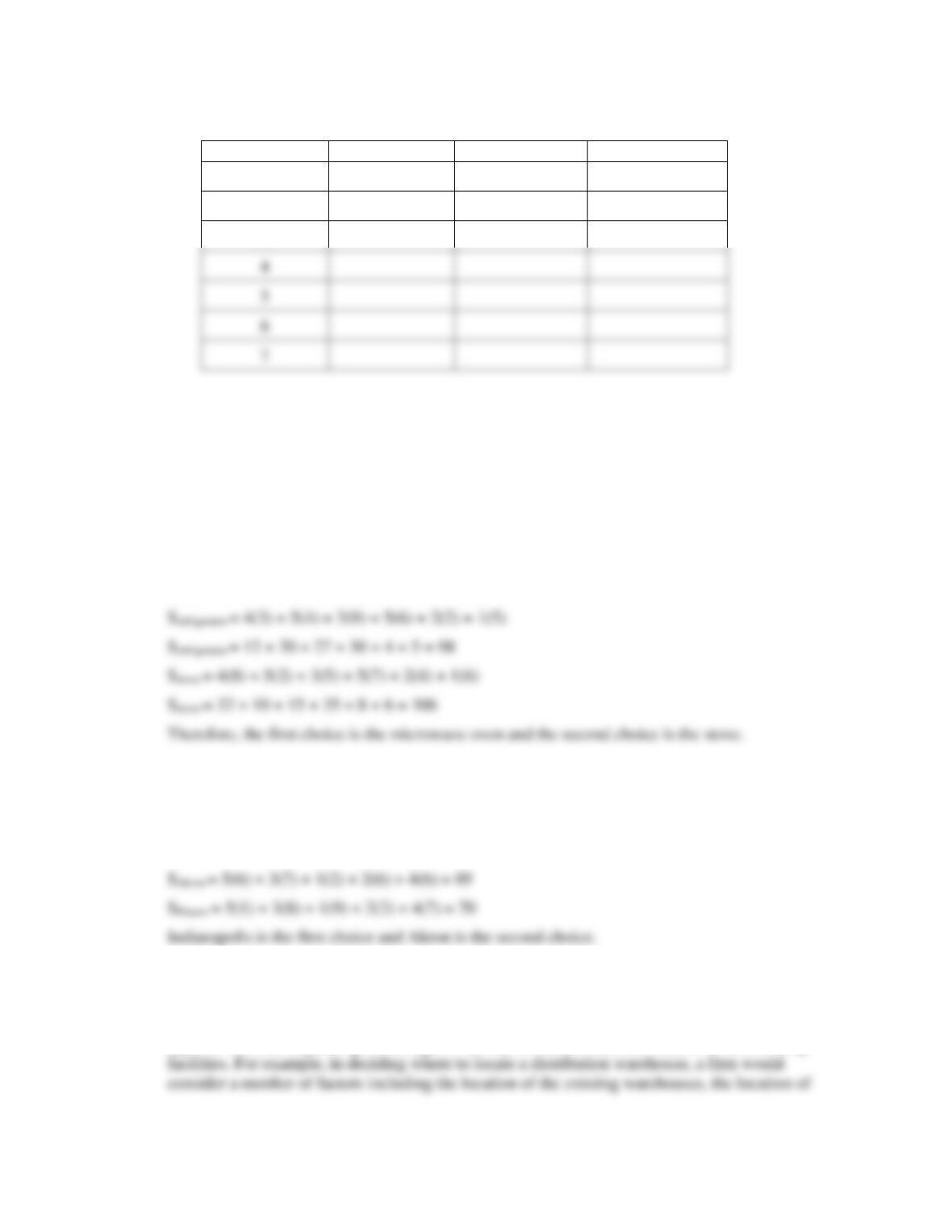
a. Determine the weights for all the listed factors (5 being very important and 1 being very
unimportant) and rate the importance of the factors from one to five.
FACTOR #
FACTORS
WEIGHT
1
Salary and Benefits
2
Type of Job
3
Location: Social/Cultural
4
5
6
7
Opportunities for Advancement
b. Complete the following table indicating your decision factor ratings for each criteria.
Chapter 08 – Location Planning and Analysis
8-26
FACTORS
CHICAGO
ST. LOUIS
SAN DIEGO
1
2
3
c. Determine the factor score for each location.
d. Based on your answer to part C, indicate the best choice and the second best choice.
Solutions to Example Problems
SOLUTION TO PRODUCT SELECTION PROBLEM
Smicro = 4(4) + 5(8) + 3(6) + 5(3) + 2(9) + 1(1)
Smicro = 16 + 40 + 18 + 15 + 18 + 1 = 108
SOLUTION TO FACILITY LOCATION PROBLEM
SAlbany = 5(3) + 3(5) + 1(3) + 2(8) + 4(4) = 65
SIndianapolis = 5(8) + 3(4) + 1(5) + 2(7) + 4(5) = 91
D. EMERGENCY FACILITY LOCATION
The factors considered in deciding where to locate a facility differ drastically among different
types of facilities depending on the type of facility considered and the location of the existing
4
5
6
7
Chapter 08 – Location Planning and Analysis
8-27
the manufacturing facilities that would supply the warehouse and the location of existing
stores that the warehouse would supply. On the other hand, if we were deciding the location
of a new restaurant franchise, we would consider the location of existing restaurants, both
competitive eateries as well as other branches of the franchise. We would also consider the
population of the surrounding communities and more importantly the forecasted demand from
each community.
The emergency facility objectives (methods) can be categorized as follows:
1. Minimization of maximum response time
In minimizing the maximum response time, we are concerned about the worst-case scenario
response. In minimizing the average response time, the chosen location will be the site with
the lowest average response time, even though the worst-case response may not be desirable.
These first two objectives may be acceptable, if the need or the demand for emergency
In order to utilize any of the above methods, we must first determine the feasible sites that
require emergency service, then we must decide on the proposed sites that can be used to
locate the emergency facility. Finally, the response time between each site needs to be
represented as a network with nodes and arcs where each node represents a community or
location while each arc represents the estimated response time between two locations.
Minimization of maximum response time:
After determining the maximum response time from each proposed location, we simply
choose the location with the smallest of the maximum response times.
Chapter 08 – Location Planning and Analysis
8-28
Minimization of weighted average response time:
First, we determine the weighted-average response time using the following formula:
locations proposed of numberl
servedlocations of numberk
=
=
:Let
Problem 1
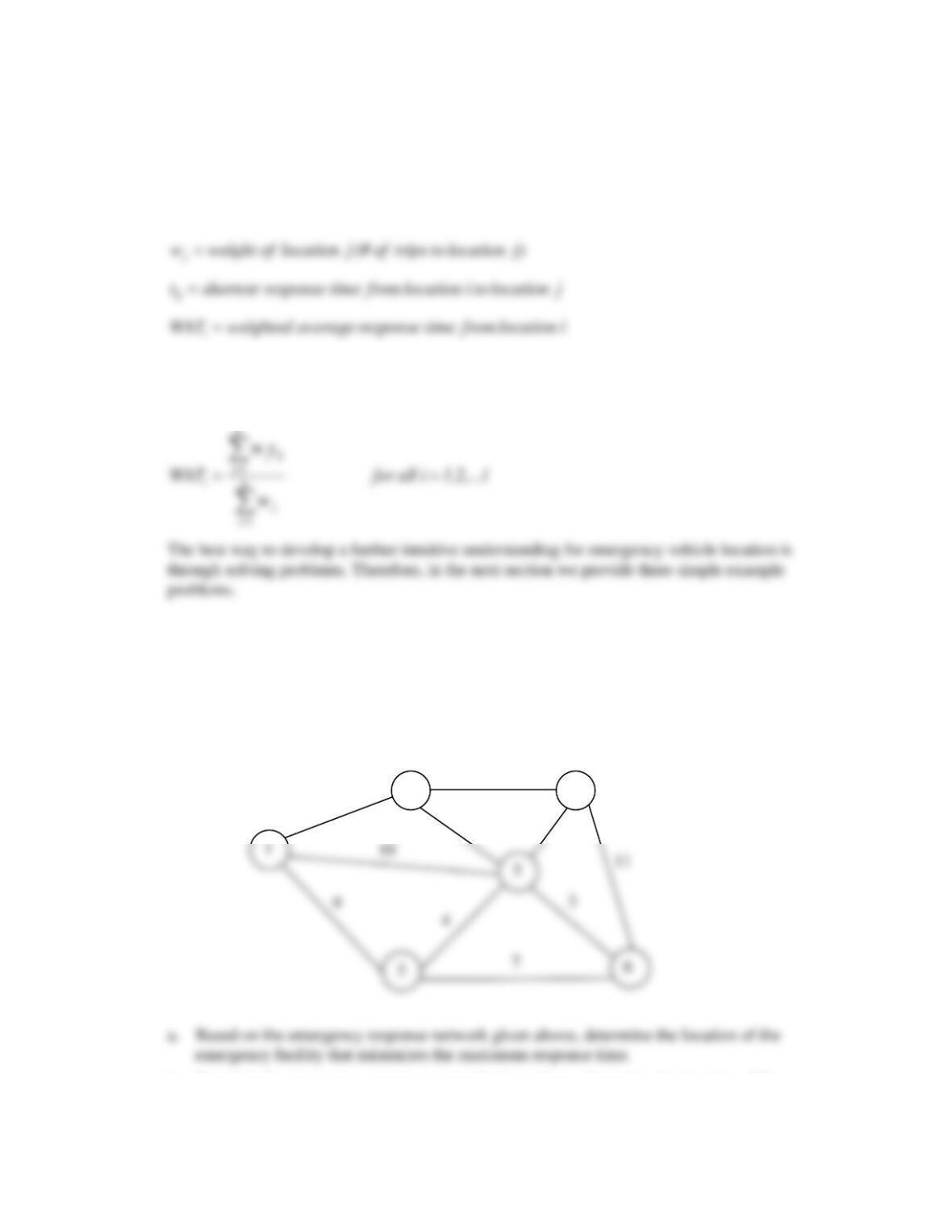
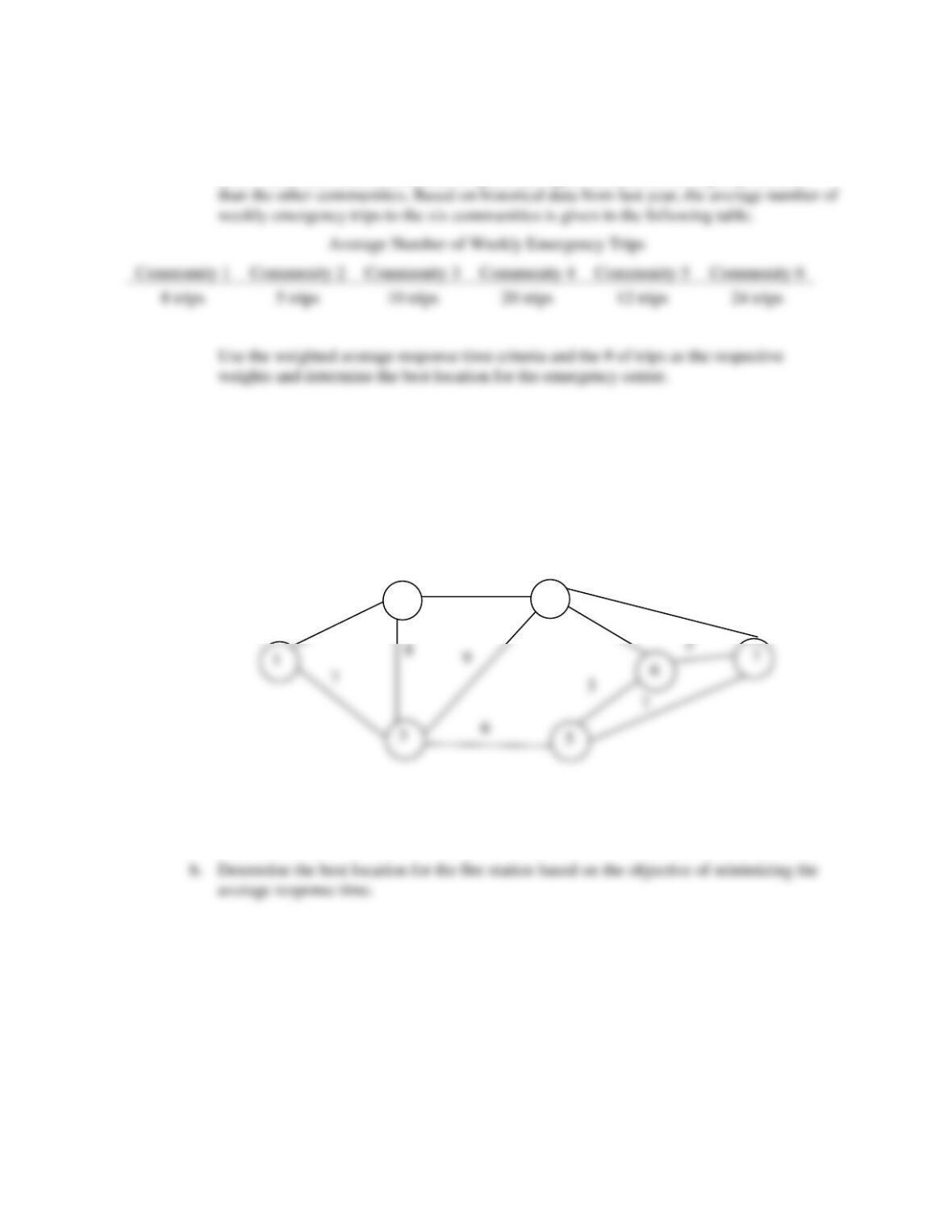
The local hospital in northeast Ohio has just received approval from its executive board to
build a new emergency facility. The facility will serve six communities in northeast Ohio. The
response times in minutes are given in the network figure below.
Network Diagram 1
6
3
1
11
3
10
9
7
4
b. Based on the emergency response network given above, determine the location of the
emergency facility that minimizes the average response time.
2
4
8
7
6
5
Chapter 08 – Location Planning and Analysis
8-29
c. Assume that the community 4 is a retirement community and community 6 is a high crime
area. Therefore, these communities experience higher demand for emergency vehicles
Problem 2
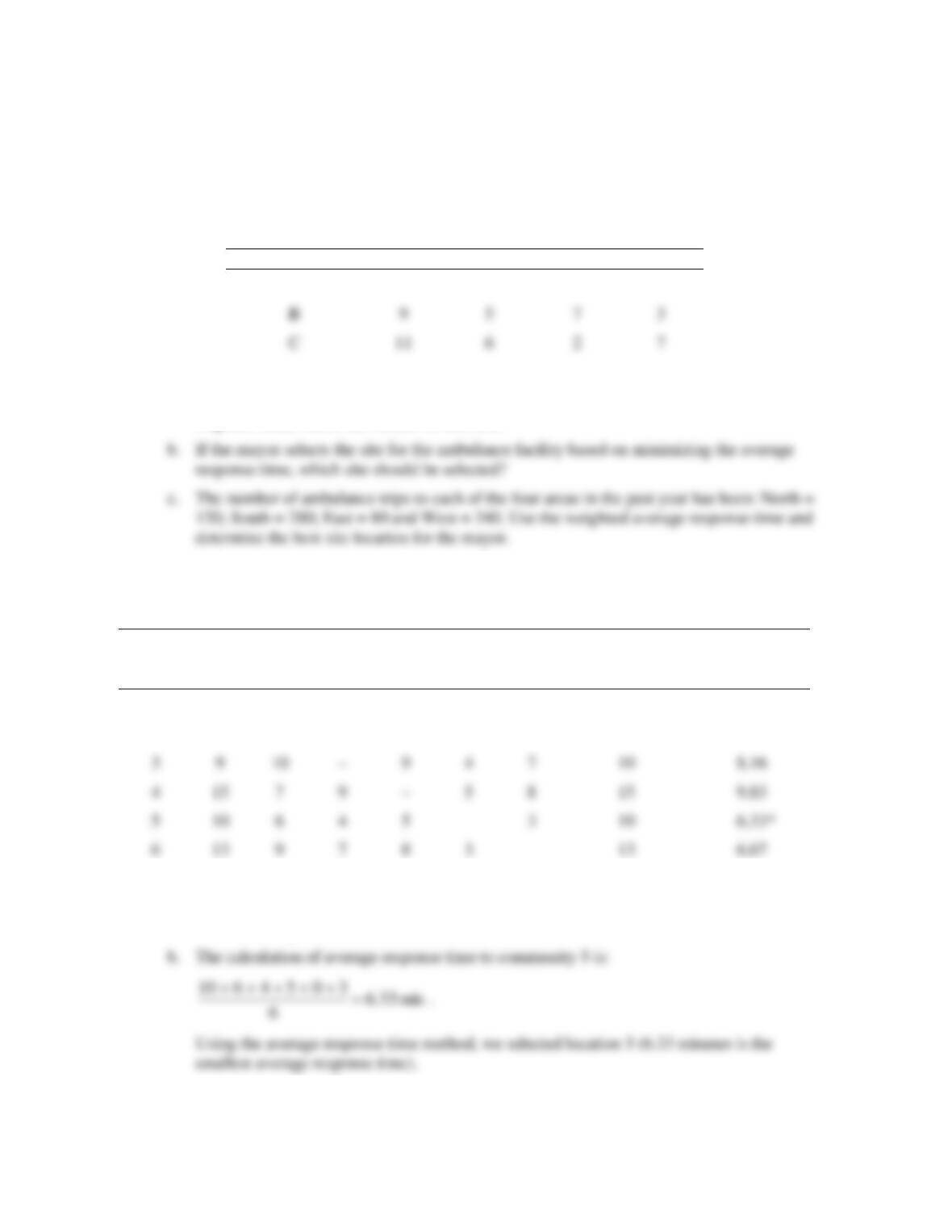
The city of Hampton is in the process of making a decision on where to locate a fire
department that will serve the entire city. The city is divided into seven communities. The
network of cities with fire truck response times is given in the following figure.
Network Diagram 2
7
6
7
5
3
8
7
1
2
a. Determine the best location for the fire station based on the objective of minimizing the
maximum response time.
6
2
5
4
10
4
Chapter 08 – Location Planning and Analysis
8-30
Problem 3
The mayor of a small town is planning to select one of three sites as the location for its
ambulance facility. The town consultant has determined the following response times from
each of the proposed locations to the four main areas of the town that must be served (North,
South, East and West).
Area Served
Proposed Site
North
South
East
West
A
4
8
10
6
a. If the mayor selects the site for the ambulance facility based on minimizing the maximum
response time, which site should be selected?
Solution to Problem 1
Shortest Response Time Matrix
To
From
1
2
3
4
5
6
Longest
Response Time
Average
Response
Time
1
–
8
9
15
10
13
15
9.16
2
8
–
10
7
6
9
10
8.33
3
10
9
4
7
10
8.16
4
7
9
–
5
8
15
9.83
5
6
4
5
–
3
10
6.33*
6
9
7
8
3
13
6.67
a. Using the longest response time criteria, we can choose community 2, 3, or 5 (minimum
maximum response time of 10 minutes).
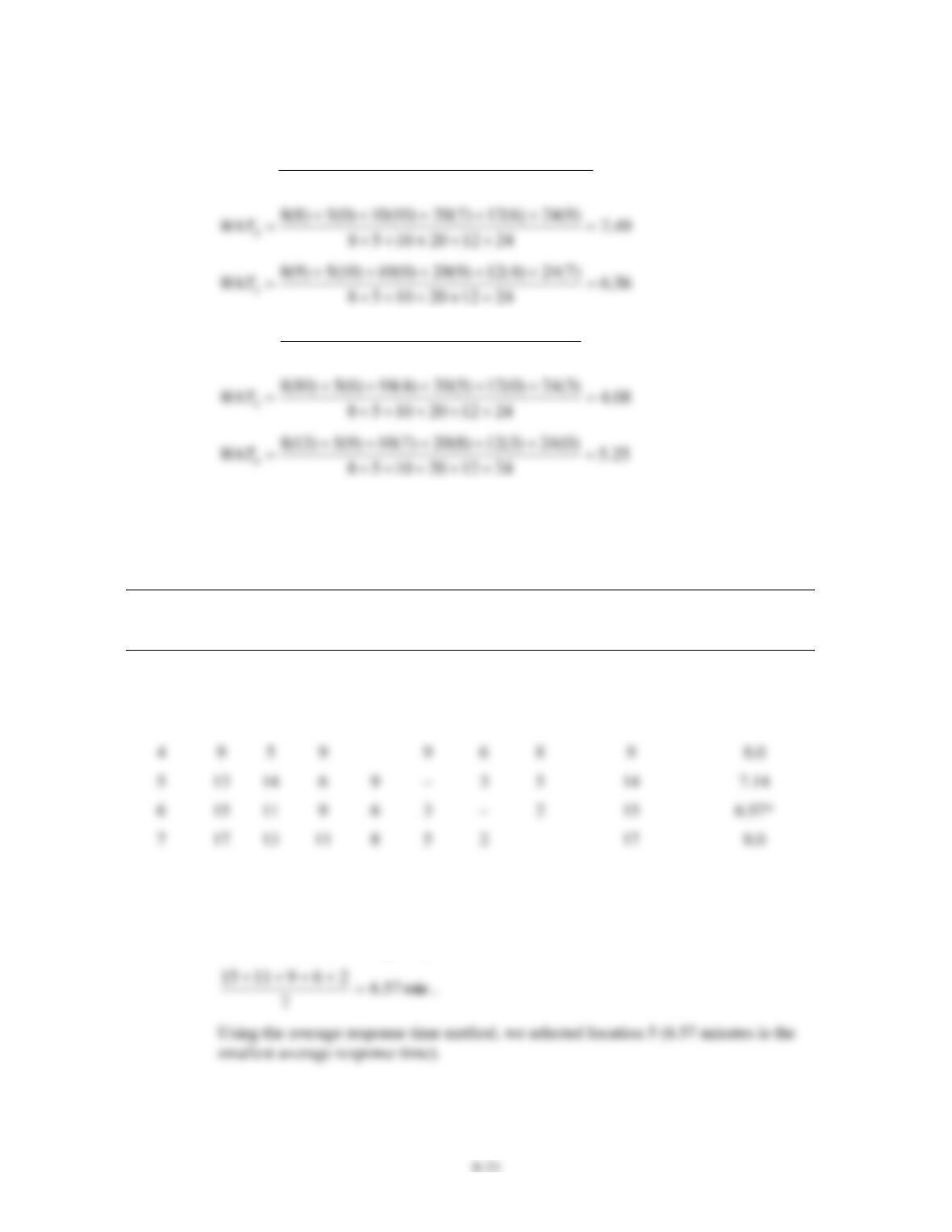
c.
Chapter 08 – Location Planning and Analysis
29.6
2412201058
)8(24)5(12)0(20)9(10)7(5)15(8
91.10
2412201058
)13(24)10(12)15(20)9(10)8(5)0(8
4
1
=
+++++
+++++
=
=
+++++
+++++
=
WAT
WAT
Select location 5 because it has the lowest weighted average response time (4.08 minutes).
Solution to Problem 2
Shortest Response Time Matrix
To
From
1
2
3
4
5
6
7
Longest
Response Time
Average
Response
Time
1
–
4
7
9
13
15
17
17
9.29
2
4
–
8
5
14
11
13
14
7.86
3
7
8
–
9
6
9
11
11
7.14
4
9
5
9
–
9
6
8
5
6
9
3
5
14
7.14
6
9
6
3
2
15
7
11
8
5
2
17
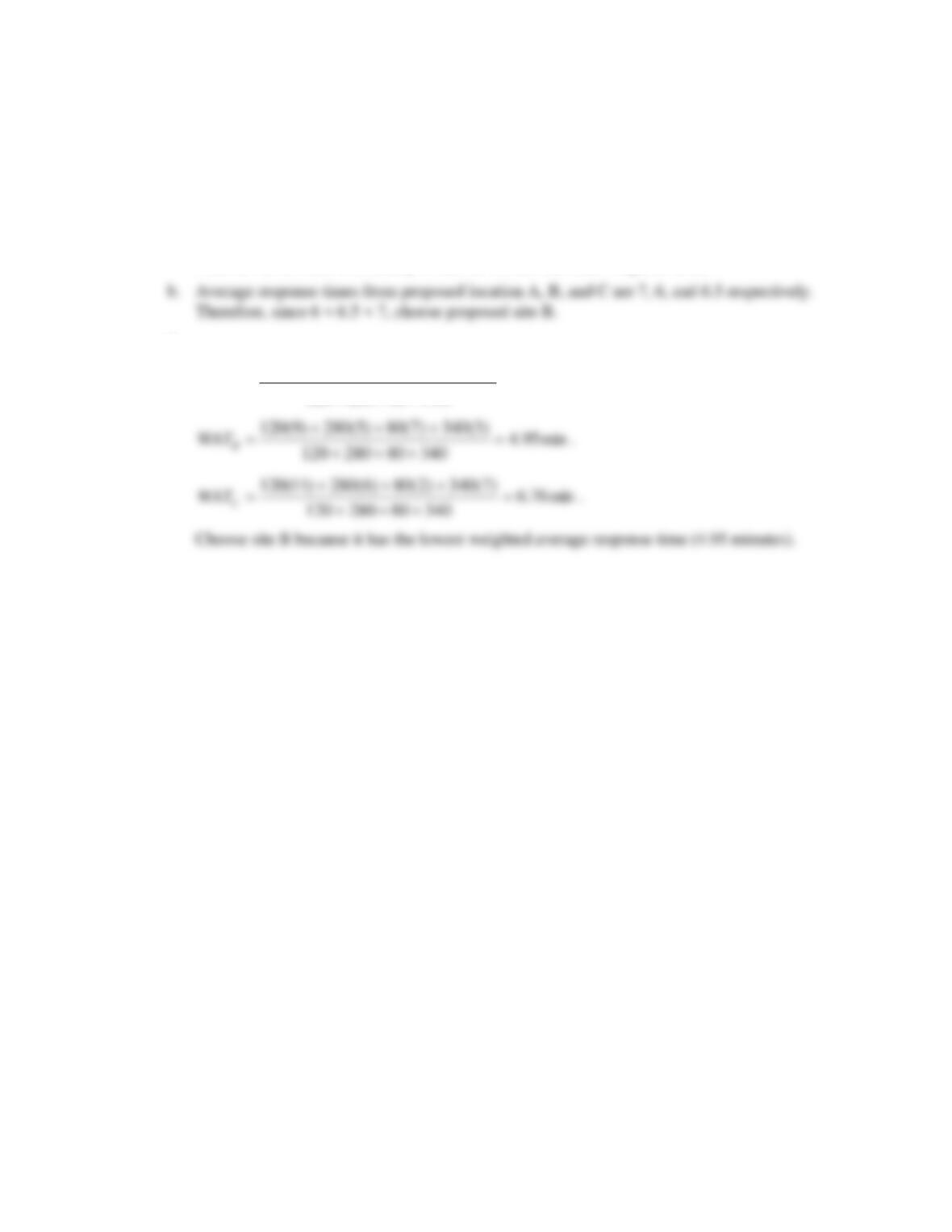
a. Using the longest response time criteria, we choose location 4 because the minimum
longest response time is 9 minutes.
b. The calculation of average response time to location 5 is:
Chapter 08 – Location Planning and Analysis
8-32
Solution to Problem 3
a. Maximum response time from location A, B, and C are 10, 9, and 11 respectively.
Choose site B, since community B has the lowest maximum response time.
c.
.min787.6
34080280120
)6(340)10(80)8(280)4(120
=
+++
+++
=
A
WAT