Chapter 8
Controlling
DISCUSSION QUESTIONS
8-1. Q: Provide two additional examples of (a) feedback, (b) screening (concurrent), and (c) feed-
forward control. In each example identify the four steps of the control process.
A: (a) Examples of feedback suggested by students include: computer programming
(program, test run, correct errors), automobile cruise control, management by objectives, and
8-2. Q: Which, in your opinion, are the most important characteristics of an effective control
system? Justify your choices. What other important characteristic(s) might one add?
8-3. Q: Hytek Corporation ended 2008 with cash of $50,000, accounts receivable of $100,000, and
inventory of $300,000. Property, plant, and equipment were valued at their original cost of
$470,000, less accumulated depreciation of $170,000. Current liabilities other than income
taxes owed (see below) were $120,000 and long term debt was $250,000. Stockholders’
equity consisted of (i) $90,000 common stock investment and (ii) accumulated retained
earnings, which had totaled $130,000 at the end of 1994. Net sales for 1995 were $900,000.
Expenses included $500,000 cost of goods sold, $50,000 allowance for depreciation, $85,000
selling expense, and $65,000 G&A expense. Interest income and expense were $5000 and
$25,000, respectively, and income taxes for the year (unpaid at year’s end) were $80,000.
Dividends of $20,000 had been declared but not paid at year’s end. Prepare an income
statement and a balance sheet reflecting these figures.
8-4. Q: Hytek Corporation ended 2012 with cash of $50,000, accounts receivable of $100,000, and
inventory of $300,000. Property, plant, and equipment were valued at their original cost of
$470,000, less accumulated depreciation of $170,000. Current liabilities other than income
taxes owed (see below) were $120,000 and long term debt was $250,000. Stockholders’
equity consisted of (i) $90,000 common stock investment and (ii) accumulated retained
earnings, which had totaled $130,000 at the end of 1994. Net sales for 2012 were $900,000.
Expenses included $500,000 cost of goods sold, $50,000 allowance for depreciation, $85,000
selling expense, and $65,000 G&A expense. Interest income and expense were $5000 and
$25,000, respectively, and income taxes for the year (unpaid at year’s end) were $80,000.
Dividends of $20,000 had been declared but not paid at year’s end. Prepare an income
statement and a balance sheet reflecting these figures.
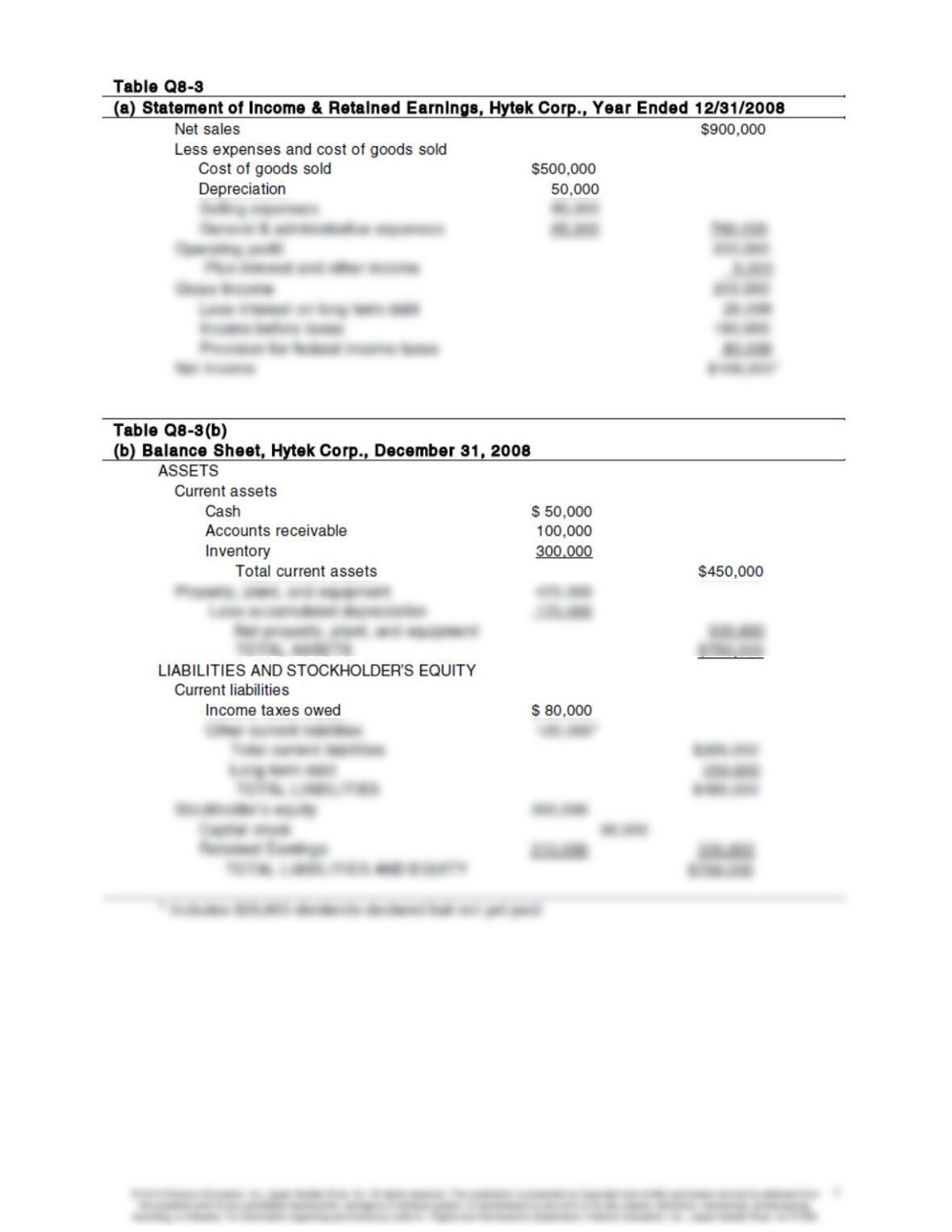
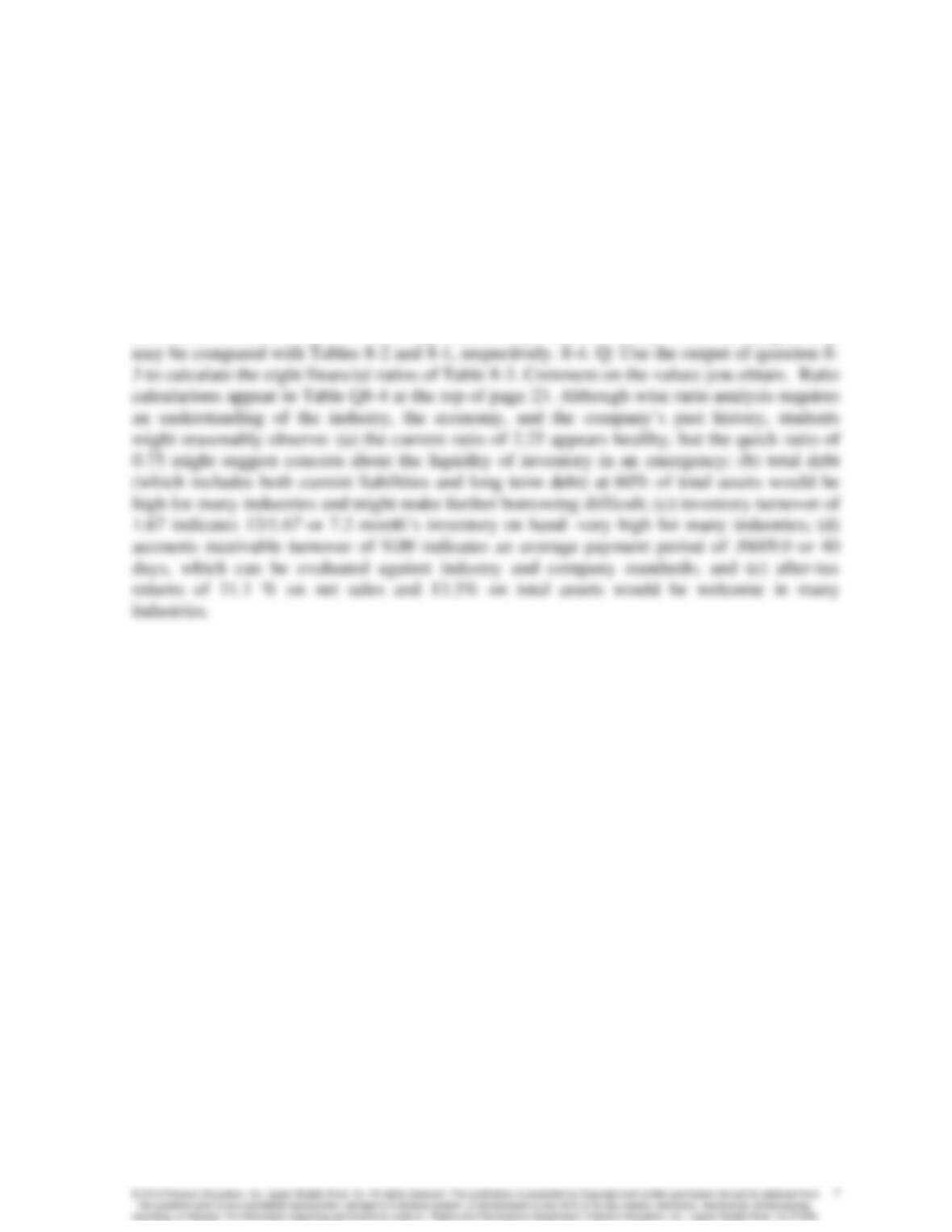
A: Correct answers follow as Tables Q8-3(a) and Q8-3(b) at the top of the next page. They
8-5. Q. Excelsior Corporation reported the following status (in thousands of dollars) as of
December 31, 2008: accounts payable of $150; accounts receivable of $250; cash of $150;
inventory of $200; long term debt of $260; net plant and equipment of $500; notes payable
during 1996 of $250; and stockholders’ equity of $440. (a) Prepare a balance sheet as of
12/31/08, and (b) calculate as many financial ratios as you can with the information provided.
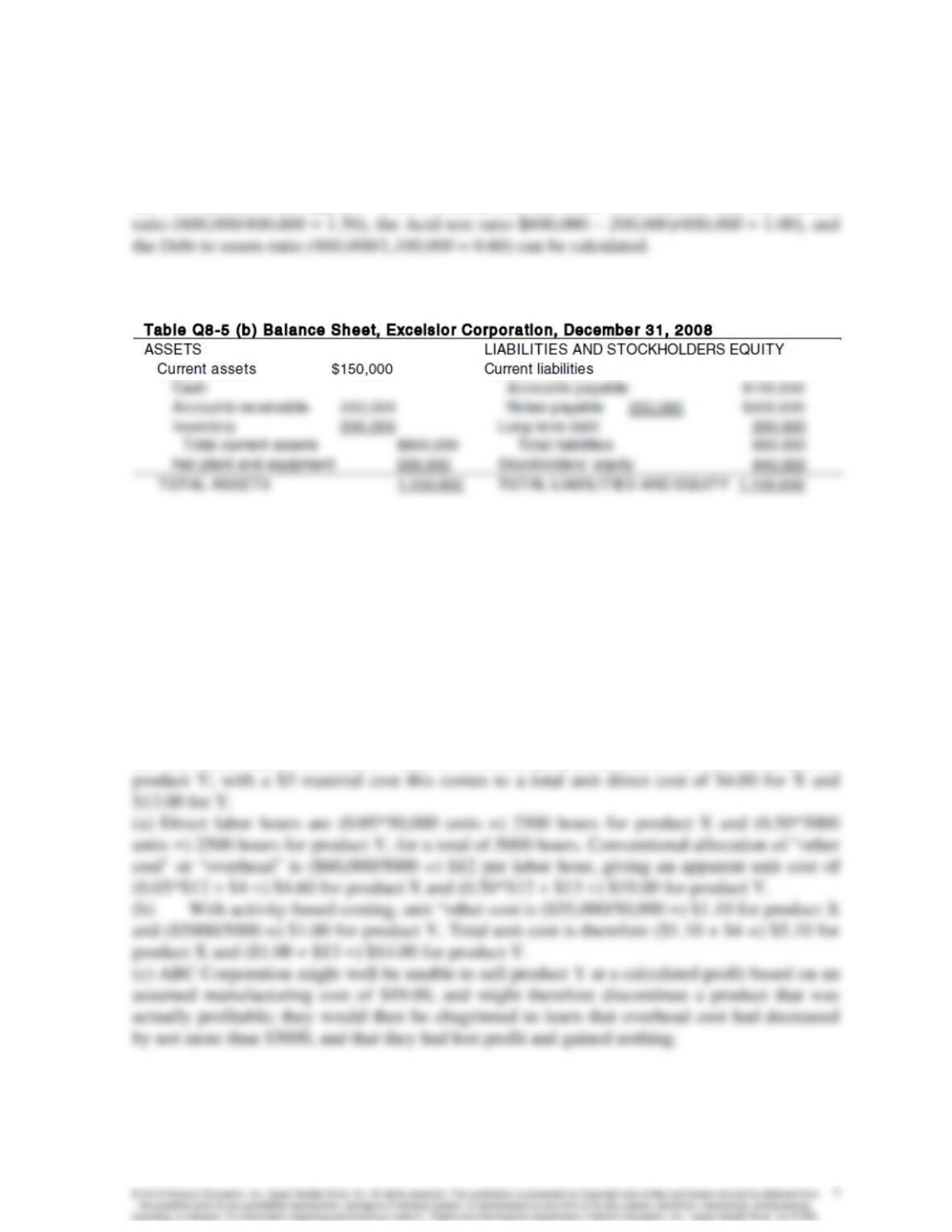
A: The balance sheet appears below. Without balance sheet information, only the Current
8-6. Q: ABC Corporation produces 50,000 units of Product X and 5000 units of product Y at a
direct materials cost of $3 per unit. Product X requires 3 minutes and product Y 30 minutes
direct labor per unit (at $20 per hour). Other costs (tooling, setup, and equipment depreciation
and maintenance) for this period amount to $60,000. (a) If these “other costs” are allocated on
the basis of direct labor hours, what is the apparent unit cost of each product? (b) Production
of product X is highly automated to reduce direct labor cost; it is responsible for $55,000 of
this “other cost,” and product Y only $5000. Using activity-based costing, what do the unit
costs now become? (c) What difference might this make in ABC Corporation’s actions?
A: Unit direct labor cost is (0.05*$20 =) $1.00 for product X and (0.50*$20 =) $10.00 for