Chapter 8: Global Management
161
Chapter 8: Global Management
Pedagogy Map
This chapter begins with the learning outcome summaries and terms covered in the chapter, followed by a
set of lesson plans for you to use to deliver the content in Chapter 8.
• Lesson Plan for Lecture (for large sections)
• Lesson Plan for Group Work (for smaller classes)
• Assignments with Teaching Tips and Solutions
What Would You Do Case Assignment – Groupon
Self-Assessment – Are You Nation-Minded or World-Minded?
Management Decision – Cultural Backlash in India
Highlighted Assignments
Key Points
What Would You Do?
Groupon has grown rapidly, but there are few barriers to
entry to its market, and it faces stiff competition as it expands
to global markets.
Students are asked to deliberate on how a company should
deal with cultural backlash as it expands to global markets.
Management Team Decision
Can social entrepreneurship work in the fast-food industry?
Practice Being a Manager
Students consider the cultural variety in their hometown.
and newlywed, as she explores it on her own and tries to
make sense of what she sees.
Reel to Real Video Assignment –
Management Workplace
Holden is a US-based company but has manufacturing
facilities in China. For any company that sources materials
and labor overseas, shipping is a vital concern.
Supplemental Resources
Where to Find Them
Course Pre-Assessment
IRCD
Course Post-Assessment
IRCD
Chapter 8: Global Management
162
Learning Objectives
1 Discuss the impact of global business and the trade rules and agreements that govern it.
Today, there are more than 77,175 multinational corporations worldwide; just 3.1 percent are based in the
United States. Global business affects the United States in two ways: through direct foreign investment in
2 Explain why companies choose to standardize or adapt their business procedures.
Global business requires a balance between global consistency and local adaptation. Global consistency
means using the same rules, guidelines, policies, and procedures in each location. Managers at company
3 Explain the different ways that companies can organize to do business globally.
The phase model of globalization says that as companies move from a domestic to a global orientation,
4 Explain how to find a favorable business climate.
The first step in deciding where to take your company global is finding an attractive business climate. Be
sure to look for a growing market where consumers have strong purchasing power and foreign
Chapter 8: Global Management
163
5 Discuss the importance of identifying and adapting to cultural differences.
National culture is the set of shared values and beliefs that affects the perceptions, decisions, and behavior
of the people from a particular country. The first step in dealing with culture is to recognize meaningful
6 Explain how to successfully prepare workers for international assignments.
Many expatriates return prematurely from international assignments because of poor performance.
However, this is much less likely to happen if employees receive language and cross-cultural training,
Terms
Asia-Pacific Economic Cooperation (APEC)
Association of Southeast Asian Nations
(ASEAN)
Central America Free Trade Agreement
(CAFTA-DR)
cooperative contract
Maastricht Treaty of Europe
multinational corporation
national culture
nontariff barriers
North American Free Trade Agreement
(NAFTA)
Lesson Plan for Lecture
Pre-Class Prep for You:
Pre-Class Prep for Your Students:
• Review chapter and determine what points to
• Bring book.

Chapter 8: Global Management
164
cover.
• Bring PPT slides.
Warm Up
Begin Chapter 8 by asking your students the following series of questions:
• “Without looking, which of you knows (or is confident that you know) where
Content
Delivery
Lecture slides: Make note of where you stop so you can pick up at the next class
meeting. Slides have teaching notes on them to help you as you lecture.
Topics
PowerPoint Slides
Activities
What is Global Business
1 Global Business,
Trade Rules, and
Trade Agreements
1.1 The Impact of
Barriers, and Trade
Agreements
1: Global Management
2. What Would You Do?
3: What Is Global
Business?
4: What Is Global
10: World Trade
Organization
11: Maastricht Treaty of
Europe
12: NAFTA
13: CAFTA-DR
14: UNASUR
How to Go Global
3 Forms for Global
Business
3.1 Exporting
3.2 Cooperative
Contracts
18: How to Go Global?
19: Consistency or
20: Forms for Global
Business
21: Exporting
22: Cooperative
Contracts
23: Licensing
An issue around which to
spark discussion is the

Chapter 8: Global Management
165
Where to Go Global
4 Finding the Best
Business Climates
4.1 Growing Markets
4.2 Choosing a
30: Where to Go Global?
31: Finding the Best
Business Climate
32: Growing Markets
33: Office /
Manufacturing. Location
If you have an electronic
classroom, consider doing a
free geography game
offered by Sheppard’s
software at
sheppardssoftware.com
5 Becoming Aware of
38: National Culture
Outerwear
6 Preparing for an
International
42: Preparing for an
International Assignment
43: Language and Cross-
Adjust lecture to include the activities in the right column. *Some activities should be
done before introducing the concept, some after.
Special
Items
Spark a debate among your students by asking them to respond to the following
statement:
“If given a choice, Americans will buy American-made goods rather than foreign-
made goods.”
Conclusion
Possible assignments:
Lesson Plan for Group Work
Pre-Class Prep for You:
Pre-Class Prep for Students:
• Review material to cover and modify the
lesson plan to meet your needs.
• Set up the classroom so that small groups of
4-5 students can sit together.
• Bring book.
Warm Up
Begin Chapter 8 by asking your students the following questions:
• “Without looking, which of you knows (or is confident that you know) where
Content
Delivery
The first section of the chapter has a lot of content that you can use to spark debate
among students. For this reason, you may want to hold off lecturing on “Global
Business, Trade Rule, and Trade Agreements” until after you do the group activity
“World Trade and You.”
Lecture on What Is Global Business (Section 1).
Break for the following group activity:
“World Trade and You”
Divide the class into small groups of 3 to 5 students. Before beginning the activity,
ask students if anyone can describe the function of the WTO. Ask if anyone can
If you didn’t lecture on Section 1 prior to the activity, do so now.
Segue into next section by asking students “So if we postulate that global business is
good for consumers and companies alike, what’s the best way to go global? Perhaps
Chapter 8: Global Management
167
Break for the following activity:
“Around the World”
If you have an electronic classroom, consider doing a geography game at
Introduce the sections on culture by asking if any of your students have ever lived,
worked, or studied abroad and where. If they have, ask them what they considered the
biggest difference between the host culture and the student’s culture of origin.
Conclusion
and
Assignments:
1. To follow up on the discussion of where and how to go global, assign students to
Remind students about any upcoming events.
Assignment with Teaching Tips and Solutions
Case Assignment – What Would You Do?
[insert WWYD text]
What Really Happened? Solution
GROUPON
In the opening case, you learned that Groupon, the “daily deal” coupon company had grown from 400
subscribers and 30 daily deals in 30 cities in December 2008 to 35 million subscribers and 900 daily deals
in 550 markets today, thus getting to $1 billion in sales faster than any other company. Local companies
Chapter 8: Global Management
168
As Groupon goes global, should it adapt its business to different cultures? Or, is it likely to find that the
daily deals that are successful in the U.S. will be popular throughout the world? Also, since humor is a
key part of its advertising approach, should Groupon continue to rely on its 70 Chicago-based comedy
writers to write copy for ads in China, Chile, and Germany?
National culture is the set of shared values and beliefs that affects the perceptions, decisions, and
behavior of the people from a particular country. The first step in dealing with culture is to recognize
So, given that it just offers daily deals, can Groupon have a standard set of products or should they be
different in each market and culture? Not surprisingly, Groupon has found that people in different
countries and cultures don’t respond to the same offers. For example in India, the most popular daily
Finally, in a nod to the importance of culture, especially with humor, which can differ tremendously
across cultures, Groupon now realizes that its 70 Chicago-based ad writers, some of whom have comedy
Similarly, who should make key decisions, managers at headquarters or managers in each country?
Likewise, should Groupon continue to use its large Chicago-based sales force to build and retain
business with merchants, and In short, should Groupon run its business the same way all around the
world?
One of the key issues in global business is determining whether the way you run your business in one
country is the right way to run that business in another. In other words, how can you strike the right
If companies focus too much on local adaptation, they run the risk of losing the cost efficiencies and
productivity that result from using standardized rules and procedures throughout the world. However, if
companies lean too much toward global consistency, they run the risk of their business being poorly
suited to particular countries’ markets, cultures, and employees (i.e., a lack of local adaptation).
Chapter 8: Global Management
169
Groupon has discovered that, in part, it must adapt is business at it does business around the world.
While the web side of its business works most places, that is, using email and text, web sites, and
In other ways, however, Groupon is balancing consistency with local adaptation. While it has local
managers (see more below) to run its businesses in 42 different countries, it brings all of them to Chicago
Another part of balancing consistency with local adaptation, at least for now, is maintaining a large call
center in Chicago. Unlike Facebook and Google, which hire software engineers to automate their web
sites, Groupon relies on call center-based sales force in Chicago to sell and maintain relationships with
client companies. Every time it opens in a new city, its sales force is charged with identifying and then
approaching businesses who could be interested in using Groupon to provide discounts to customers. The
question is whether it makes sense for Groupon to have similar call centers in the other regions or
countries in which it now does business?
Joe Harrow, who manages Groupon’s Chicago call center, says that Groupon will have call centers in
How should Groupon expand internationally? Should it license its web services to businesses in each
area, form a strategic alliance with key foreign business partners (it rejected Google’s $6 billion offer in
the U.S.), or should it completely own and control each Groupon business throughout the world?
Determining how to organize your company for successful entry into foreign markets is a key
decision in going global. When companies produce products in their home countries and sell those
As explained in the chapter, each of these methods of “going global” has specific advantages and
disadvantages. Moreover, a common method of going global is to use the phase model of international
Chapter 8: Global Management
170
The challenge for Groupon is that just 3 years after its startup, it may be the fastest growing startup
company of all time, but it also faces the most quickly established set of global competitors ever
Backed with several hundred million dollars in funding, Groupon used an approach in which it
combined strategic alliances and wholly-owned affiliates. In short, just as Google offered a $6 billion buy
out to Groupon, Groupon has offered to buy the market leaders that it has identified in 50 different
countries.
Groupon board member Kevin Efrusy says, “To see people copy you is difficult to adjust to. But
Groupon immediately looked at it as an opportunity. You could pick the best that’s out there and save a
lot of time.” “The strategy,” he says, is to find the best local teams. Then give them the tools they need
Groupon repeated this acquisition strategy, buying similar companies in Chile, Russia, Japan, China and
other locations. One year, after deciding to go global, Groupon is in 42 different countries.
Subscribers Who Get Daily Emails for Discounts at Local Businesses,” Wall Street Journal, 17 May 2010, B4; K.
Patel, “Groupon Primes Itself to Become Next Zappos,” Advertising Age, 28 February, 2011, 4; B. Saporito, “The
Groupon Clipper,” Time, 21 February 2011, 50–52; B. Stone & D. MacMillan, “Groupon‘s $6 Billion Snub,”
Bloomberg Businessweek, 13 December 2010, 6–7; B. Stone & D. MacMillan, “Are Four Words Worth $25
Billion?” Bloomberg Businessweek, 21 March 2011, 70–75; R. Underwood, “Groupon versus the World,” Inc.,
October 2010, 116-118; B. Weiss, “The Weekend Interview with Andrew Mason: Groupon’s $6 Billion Gambler,”
Wall Street Journal, 18 December 2010, A15.
Chapter 8: Global Management
171
Self-Assessment
WORLDMINDEDNESS
In-Class Use
Have students open their books to page 312 of the text and give them 5 to 7 minutes to complete the
inventory. Use the Self-Assessment PowerPoint slides and have students raise their hands as you read off
Scoring
Steps 1-2: Interpreting Worldmindedness Scores
People who are flexible, adaptable, open to other cultures, and have good relationship skills are more
successful on international assignments. In a sense, we could say that these people have greater
“worldmindedness.” Individuals who are strong in worldmindedness look at problems as problems of
humanity rather than American problems, or Japanese problems, or Spanish problems. In contrast, people
Worldmindedness is related to gender (females have higher scores), to family income (students from
high income families have lower scores), foreign language ability (fluency in additional languages means
higher scores), and college major (business majors have lower scores than other majors, and finance and
accounting majors have lower scores than marketing and management majors). Worldmindedness may
not be related to international travel (except for longer-term residency in a country) or age.
This survey is based on research presented in R. W. Boatler, “Study Abroad: Impact on Student
Students will want to know how their worldmindedness scores compare with their classmates and
with other college students. I typically have students report their scores and create a distribution on the
board for everyone to see how they compare with their classmates. The following data collected from
college students provide another point of comparison.
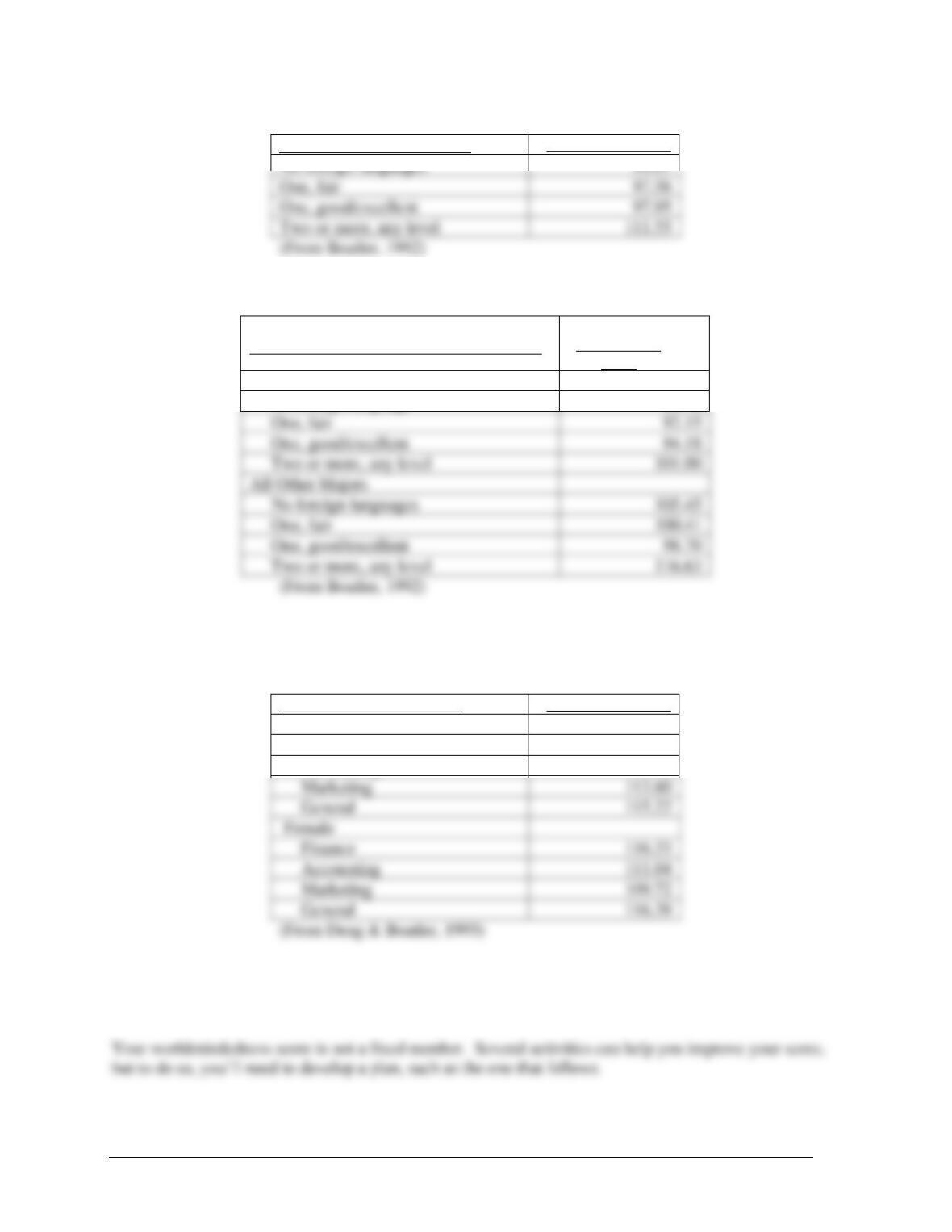
Worldmindedness by Major
Average WM Score
Arts and Sciences
104.65
Business
Fine Arts
100.58
Undecided
Chapter 8: Global Management
172
Except for undecided majors, Business majors have the lowest worldmindedness
scores.
Worldmindedness by Major
Average WM Score
Speaking more languages leads to increased worldmindedness.
Worldmindedness by Language and Major
Average WM
Score
Business Majors
No foreign language
88.76
One, fair
92.15
One, good/excellent
94.18
Two or more, any level
All Other Majors
No foreign languages
One, fair
One, good/excellent
98.70
Two or more, any level
Business majors who speak no foreign languages have the lowest worldmindedness scores,
whereas other majors who speak two or more languages have the highest worldmindedness
scores. Whatever major, speaking another language increases worldmindedness.
WM by Major and Gender
Average WM Score
Male
Finance
105.35
Accounting
93.78
Marketing
113.80
General
Female
Finance
Accounting
111.04
Marketing
109.72
General
Male finance and accounting majors have the lowest worldmindedness scores. Female finance and
general majors have the highest worldmindedness scores. Except marketing majors, females have higher
worldmindedness scores than males.
Step 3: Develop a plan to increase your global managerial potential.
No foreign languages
99.07
One, fair
97.56
One, good/excellent
97.95
Two or more, any level

Chapter 8: Global Management
173
People don’t change from being nationminded to worldminded overnight. Below you’ll find the outlines
of a plan to increase your worldmindedness. You need to fill in the details to make it work. This plan is
based on foreign languages, living overseas, global news and television, and your openness to the
different cultural experiences available right where you live!
3B. Living overseas. Develop a plan to study overseas. List the facts for two different overseas study
would participate, and any other important details.
3C. Global news and television. Another way to increase your worldmindedness is to increase the
diversity of your news sources. Most Americans get their news from local TV and radio or from the major
networks, ABC, NBC, and CBS. Luckily, you don’t have to leave the country to gain access to foreign
3D. Local cultural experiences. Many American students wrongly assume that they have to travel
overseas to gain exposure to foreign cultures. Fortunately, many American cities and universities are rich
Management Decision
CULTURAL BACKLASH IN INDIA
Purpose
A company that is looking to do business overseas must cannot ignore cultural differences if it is to be
Setting It Up
You can introduce this case to students by creating a table that shows the various cultural differences
between the U.S. and a foreign country, ideally one that has been the site of much foreign investment
such as China, India, Brazil, or Russia. You can then ask students how a company should deal with these
differences in order to find success.
Questions
1. How would you, as the manager of this company, deal with the risk associated with doing
business in countries that feel threatened by American culture?
Students are likely to respond in one of two ways – either the company must learn how to do deal
Chapter 8: Global Management
174
2. How might your company use an alliance with local companies to adapt to local concerns about
American culture?
Companies that look to do business overseas often choose strategic alliances, most commonly in
the form of joint ventures. The advantage of joint ventures is that a domestic company combines
Management Team Decision
A DIFFERENT WAY TO GO GLOBAL
Questions
1. What are the advantages of social entrepreneurship as a way to approach doing business in
developing economies outside the United States? What are the disadvantages?
Social entrepreneurship presents both advantages and disadvantages to organizations. First, the
advantages. By showing that they care about social issues, organizations build customer loyalty by
showing that they care about the same social issues that the customer cares about. Additionally, this