1
C H A P T E R 8
SALES, LICENSING, AND E-COMMERCE
INTRODUCTION
Virtually all commercial enterprises are the purchase or sale of goods. While most international
sales are governed by the Convention on Contracts for the International Sale of Goods, sales of
goods in the United States are governed by Article 2 of the Uniform Commercial Code (UCC).
Many provisions of the UCC, however, can be changed through express agreement. When the
UCC is silent on a subject, common-law contract provisions described in Chapter 7 usually
apply. The chapter also discusses the laws of e-commerce.
I. ARTICLE 2 OF THE UCC.
A. What Types of Contracts Are Covered by UCC Article 2?
1. Sale of Goods. The UCC only applies to contracts for the sale of goods.
Goods is defined as all things (including specially manufactured goods)
which are movable at the time of identification to the contract sale.”
II. SOFTWARE LICENSES. Does Article 2 apply to software, even if is bundled with a
good?
A. Rationale for Licensing Software. A sales agreement generally imposes no
obligation other than purchase price at sale. Software license, however, generally
B. Law Applicable to Software Licenses. Most cases indicate that software is a
“good” so Article 2 applies.
BAGLEY, MANAGERS AND THE LEGAL ENVIRONMENT 7TH ED—INSTRUCTOR’S MANUAL
2
III. CONTRACT FORMATION. Under the UCC, a contract is enforceable if parties intend to
be bound, though terms are left open for later agreement. If a dispute arises over a
missing term, the court may use UCC “gap–fillers.”
A. Offer. The term is not defined by the UCC.
B. Acceptance. The UCC does not define acceptance, but acceptance may contain
1. Battle of the Forms. The UCC effectively abolishes the mirror-image rule.
Unlike common law, additional or different terms does not necessarily
create a counteroffer.
(a) Definite Response. A definite and timely assent to an offer
constitutes an acceptance. The crucial inquiry is whether the
parties intended to close a deal.
on which the parties agree in writing.
(d) Acceptance with Additional Terms. If either party is not a
merchant, additional terms are construed as proposals and do not
become part of the contract. If all parties are merchants, additional
provisions become part of the contract, unless:
(i) The offer expressly limits acceptance to the terms in the
CHAPTER 8 SALES, LICENSING, AND E-COMMERCE
3
(e) Acceptance with Different Terms. Different terms neither defeat
acceptance nor impede formation of a contract. There are
CASE 8.1 Richardson v. Union Carbine Industrial Gases, Inc.
790 A.2d 962 (N.J. Super. 2002). Richardson, an
employee at Hoeganaes, was injured at work by a
furnace explosion. Richardson sued, among others,
2. Software Licenses and Online Purchase Agreements.
(a) Shrink-Wrap License: license terms on the outside of the box of
software.
C. Consideration. An offer signed by a merchant that indicates the offer will be kept
open is a firm offer and is not revocable for lack of consideration.
IV. STATUTE OF FRAUDS of the UCC provides that a contract for the sale of goods for at
least $500 is unenforceable unless it is at least partly in writing: (1) there must be some
BAGLEY, MANAGERS AND THE LEGAL ENVIRONMENT 7TH ED—INSTRUCTOR’S MANUAL
4
A. “Some Writing.” In a UCC contract, the writing need only detail the quantity of
goods to be sold to make an enforceable contract unless:
1. The goods were specially manufactured for the buyer and not suitable for
resale to others in the ordinary course of the seller’s business;
B. Signature. The writing must be signed by the party against whom enforcement is
sought, unless the sale is between merchants, and:
1. A confirmation of the contract has been received;
V. ELECTRONIC CONTRACTS: THE UNIFORM ELECTRONIC TRANSACTION ACT AND
THE E-SIGN ACT.
A. Uniform Electronic Transactions Act. The UETA sets forth four basic rules
regarding contracts entered into by parties that agree to conduct business
electronically:
1. A record or signature may not be denied legal effect or enforceability
solely because it is in electronic form.
B. E-SIGN Act. “Fills in the gaps” with UETA.
CHAPTER 8 SALES, LICENSING, AND E-COMMERCE
C. Exclusions. Use of electronic signatures is voluntary. Both UETA and the E-
VI. DUTY OF GOOD FAITH UNDER THE UCC. The UCC imposes an obligation of good
faith in contract performance and enforcement.
VII. WARRANTIES. The UCC’s warranty provisions note attributes of goods under: express
warranty, implied warranty of merchantability, and implied warranty of fitness for a
particular purpose.
A. Express Warranty. An express warranty is an explicit guarantee by the seller that
the goods will have certain qualities. Buyers must rely on the seller’s
declarations, mere puffing is not a warranty.
CASE 8.2 MacNeil Automotive Products, Ltd. v. Cannon Automotive, Ltd.,
B. Implied Warranty of Merchantability guarantees that goods are reasonably fit for
the general purpose for which they are sold, properly packaged and labeled. The
C. Implied Warranty of Fitness for a Particular Purpose guarantees that the goods are
fit for the particular purpose the seller recommended and applies to merchants and
non-merchants alike.
1. Elements. The warranty is implied only if four elements are present: The
buyer had a particular purpose for the goods; The seller knew or had
BAGLEY, MANAGERS AND THE LEGAL ENVIRONMENT 7TH ED—INSTRUCTOR’S MANUAL
6
2. Disproving Reliance. To prove that the buyer did not rely on the seller’s
D. Disclaiming Warranties and Limiting Liability.
1. Avoiding Responsibility. The seller can avoid responsibility for the quality
of the goods under any of these warranties by: not making any express
2. To Recover for Breach of Warranty. To recover for breach of warranty, a
buyer must prove that: the seller made an express or implied warranty; that
E. Strict Product Liability versus Breach of Warranty. More fully discussed in
Chapter 10, when products injure those out of privity, strict liability may be more
effective.
VIII. MAGNUSON-MOSS WARRANTY ACT (MMWA) protects consumers against deception
in warranties.
IX. RIGHT TO REJECT NONCONFORMING GOODS. A buyer has the right to reject
nonconforming goods. The rejection must be made within a reasonable time after the
goods are delivered.
CASE 8.3 Midwest Hatchery & Poultry Farms, Inc. v. Doorenbos Poultry, Inc., 783
N.W.2d 56 (Iowa App. 2010). Midwest agreed to sell Doorenbos 112,000
CHAPTER 8 SALES, LICENSING, AND E-COMMERCE
7
X. ALLOCATION OF RISK OF LOSS. In the absence of an agreement, the UCC places the
risk of loss on the party controlling the goods at the time loss occurs.
A. Goods Shipped by Carrier. When goods are shipped by carrier, the risk of loss
passes to the buyer under one of two conditions:
1. At the time the goods are properly delivered to the carrier, if the contract
B. Goods Held by Independent Warehouse. The risk of loss passes to the buyer
when the buyer receives the document entitling it to pick up the goods.
C. All Other Cases. If goods are neither shipped by carrier nor held by an
independent warehouse, the allocation of the risk of loss in transit depends on
XI. UNCONSCIONABILITY. If a contract is so unfair as to “shock the conscience” of the
court, a judge may negate the offending terms or the entire contract. Under common law
unconscionability can be either procedural or substantive.
XII. COMMERCIAL IMPRACTICABILITY UNDER THE UCC. Under the UCC a failure to
perform is not a breach if performance is made impractical by an event unforeseen by the
contract. A party seeking discharge must show three things:
BAGLEY, MANAGERS AND THE LEGAL ENVIRONMENT 7TH ED—INSTRUCTOR’S MANUAL
B. Unforeseen Contingency. A seller seeking discharge must prove that the
contingency that prevents performance was both unforeseen and unforeseeable;
and
XIII. DAMAGES. The UCC tries to put the non-breaching party in the same position it would
have been in if the contract had been performed. This is usually done through award of
monetary damages.
A. Seller’s Remedies.
1. Buyer Breach. The measure of damages is the difference between the
B. Buyer’s Remedies.
1. Seller Breach. If a seller breaches, the buyer may cancel the contract and
2. Buyer’s Remedies. If buyer elects to cover it must do so in good faith and
in a reasonable time period. If buyer elects damages, the measure of
3. Specific Performance. If the promised goods are unique, then a court may
order the seller to deliver them for monetary compensation will not be
adequate to remedy the loss suffered by the buyer.
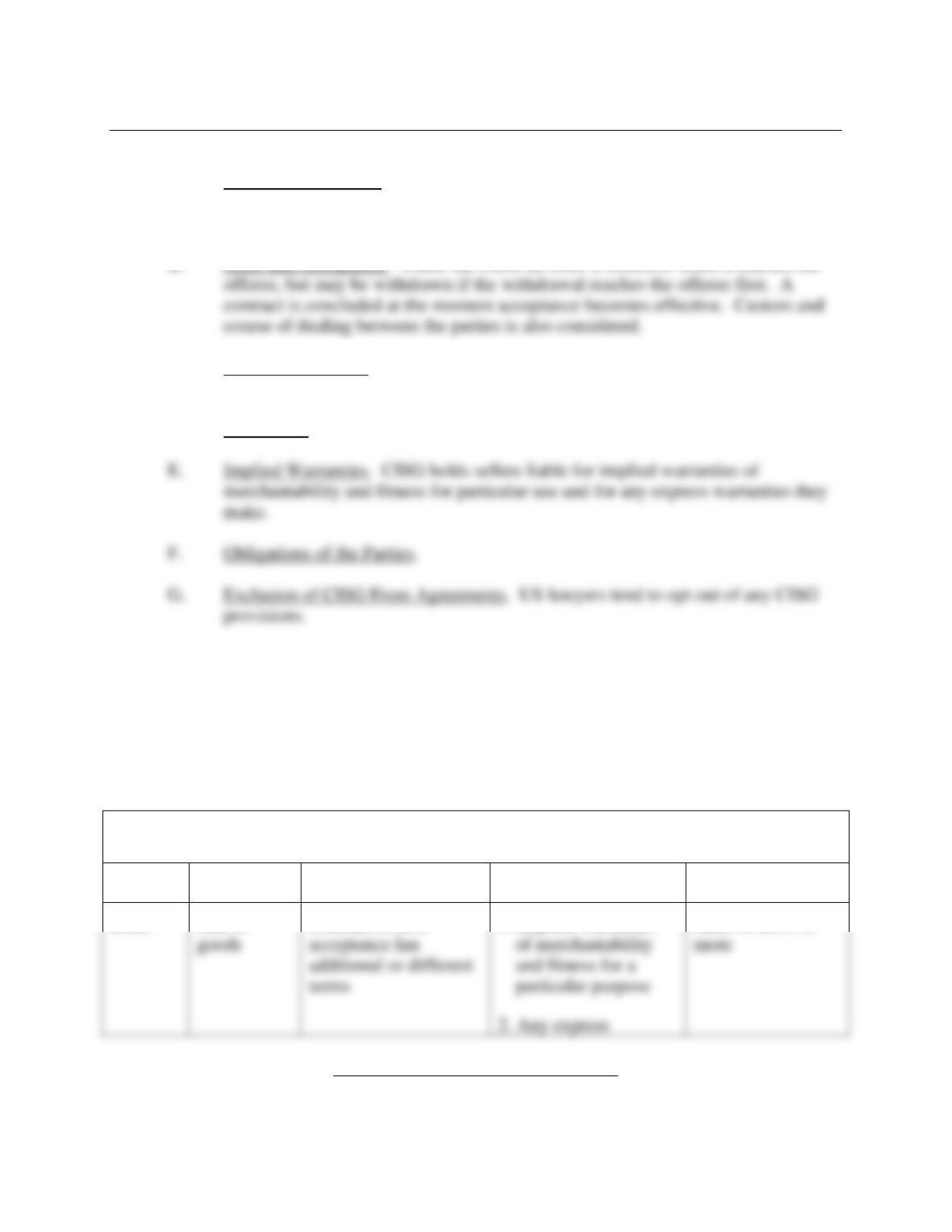
XIV. GLOBAL VIEW: THE CONVENTION ON CONTRACTS FOR THE INTERNATIONAL SALE
OF GOODS. The international sale of goods is outside of the scope of UCC Article 2.
CHAPTER 8 SALES, LICENSING, AND E-COMMERCE
9
A. Scope of Convention. CISG applies to oral and written sales contracts between
parties within signatory countries. CISG does not apply to goods for personal
use, stocks, negotiable instruments, money, or ships and other marine vessels.
B. Offer and Acceptance. Under the CISG an offer is effective when it reaches the
C. Battle of the Forms. Under CISG, a reply that contains additional terms or other
modifications is a rejection of the offer and constitutes a counteroffer.
D. Good Faith. CISG promotes “the observance of good faith in international trade.”
IN BRIEF
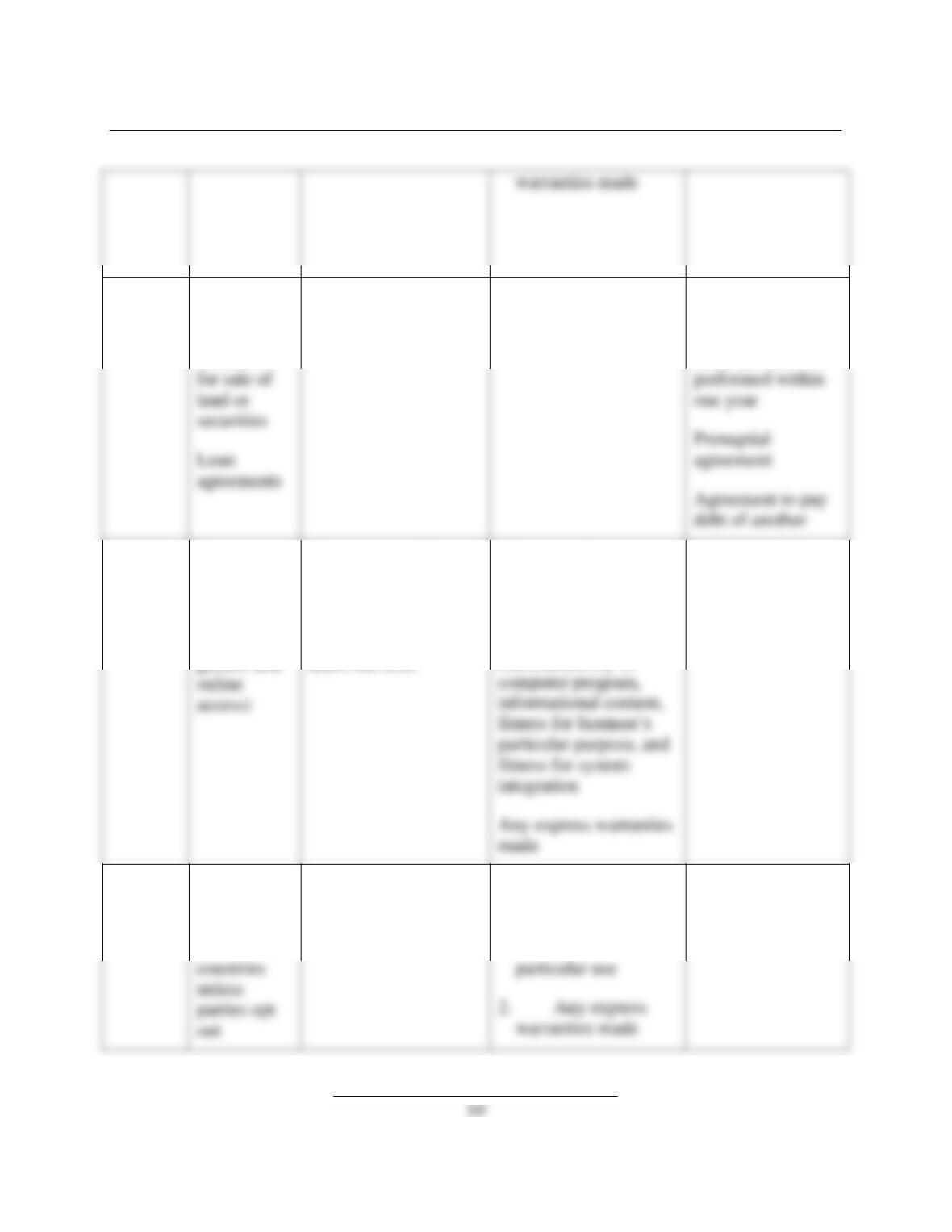
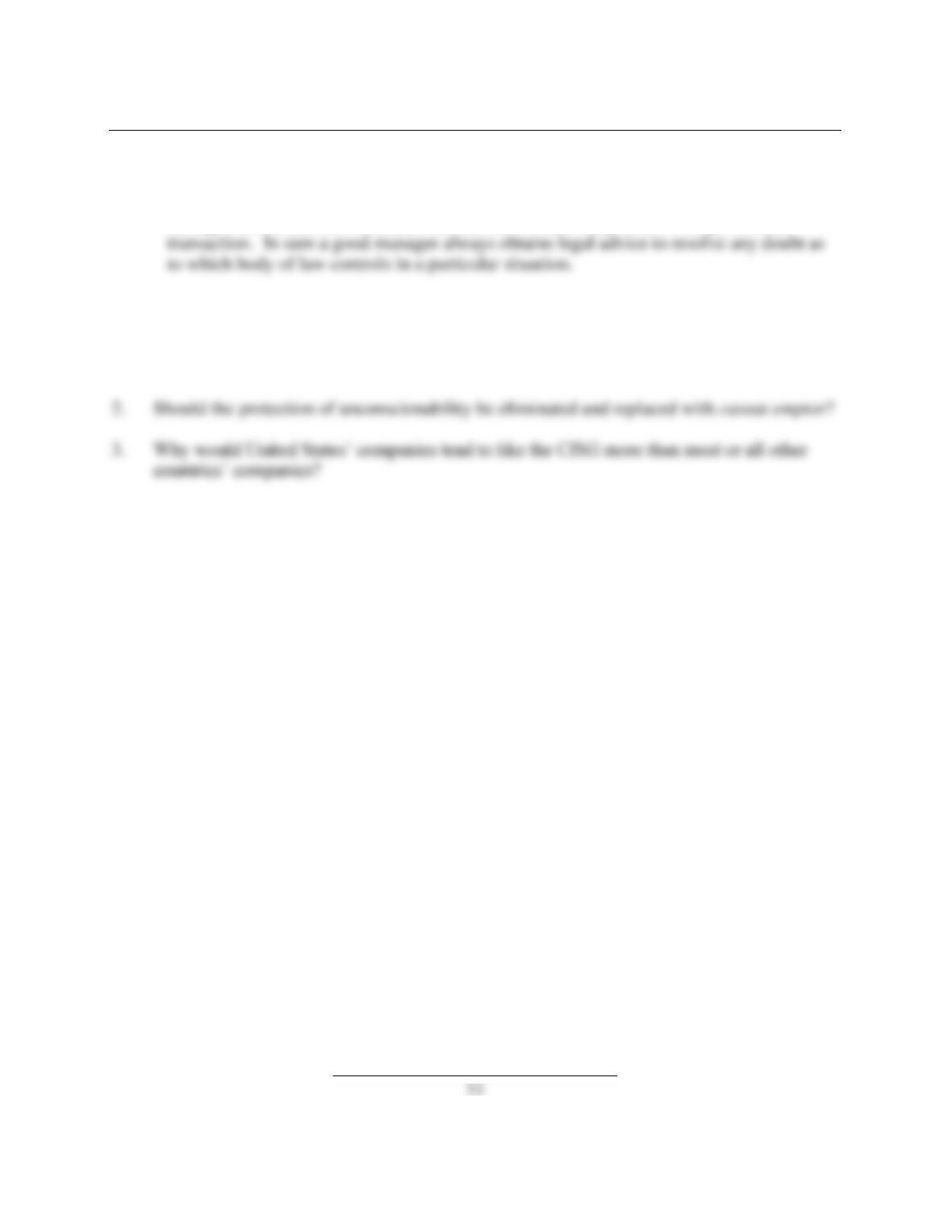
COMPARISON OF UCC, COMMON LAW, UCITA, AND CISG
Scope
Battle of the Forms
Warranties
Statute of Frauds
UCC
Sale of
Contract even if
1. Implied warranties
Sales of $500 or
BAGLEY, MANAGERS AND THE LEGAL ENVIRONMENT 7TH ED—INSTRUCTOR’S MANUAL
Commo
n Law
Provision of
services
Contracts
Mirror-image rule
Any express warranties
made
Transfer of real
estate
Contract can’t be
UCITA
Computer
information
(including
software,
computer
Contract even if
acceptance has
additional or different
terms, unless
acceptance materially
Warranty of
noninterference and
non-infringement
Implied warranties of
merchantability of
Contracts for
$5,000 or more
CISG
Sale of
goods by
merchants
in different
In practice, mirror-
image rule
1. Implied
warranties of
merchantability and
fitness for a
None
CHAPTER 8 SALES, LICENSING, AND E-COMMERCE
XV. THE RESPONSIBLE MANAGER: Operating under Varying Legal Regimes. Any
manager who enters into contracts should know which body of law will govern the
RESPONSIBLE MANAGER: TEACHING SUGGESTIONS
1. Will e-mail and the Internet make the Statute of Frauds obsolete?