Chapter 08 – Control, Change, and Entrepreneurship
8-19
Lecturer Enhancer 8.1
ANTICIPATING THE NEED TO CHANGE
Major shifts in the competitive landscape may seem to appear overnight, but in reality, they usually
Radical Change: Radical change occurs when an industry’s core assets and core activities are both
threatened with obsolescence. Under this scenario, the knowledge and brand capital built up in the
industry erode, as do customer and supplier relationships. During the 1980s and 1990s, an estimated 19%
of U.S. industries went through some stage of radical change. A good example is the travel business. The
core activities and core assets of travel agencies came under fire as the airlines implemented systems to
value, if they are used in new ways. Management’s challenge, therefore, is to find new and sometimes
unconventional ways to preserve valuable assets and extract value from core resources while
simultaneously restructuring key relationships. In the music industry, for instance, recording companies
are beginning to sell their services a la carte to aspiring musicians rather than making huge investments in
the artists upfront and incurring all the costs of artist development. The customer and the activities have
LECTURE ENHANCERS
Chapter 08 – Control, Change, and Entrepreneurship
8-20
Creative Change: In industries on a creative change trajectory, relationships with customers and suppliers
are generally stable, but assets turn over constantly. The film production industry is a good example.
p. 86.
Lecturer Enhancer 8.2
USING THE EXIT INTERVIEW AS A CONTROL SYSTEM
Feedback on problems is the only way to prevent them from recurring. One often-overlooked way of
getting this feedback from employees is through the exit interview. Interviews with employees who
voluntarily leave the organization serve a dual purpose. For the employee, exit interviews are a chance to
say many things they haven’t been able to say before. For employers, the interviews can be an excellent
source of information. Many companies, however, do not conduct exit interviews or conduct them
ineffectively.
“What did you like most about working here?” This helps gain insight into how the employee perceives
the corporate culture. At AT&T one of the answers most frequently heard is that they appreciated the
benefits package. When exiting employees mention this, it reaffirms to the company that the investment
in benefits is paying off.
“What do you feel good about having accomplished?” This helps determine what responsibilities gave
the employee a sense of accomplishment.
“If you were in charge here, what would you change?” This question is used to give the employee a
chance to figuratively change the work environment. Prepare for a candid answer.
“What best helped you achieve your goals?” This is where managers find out which employee-support
Chapter 08 – Control, Change, and Entrepreneurship
8-21
“What did you dislike about the work environment here?” An exit interview survey at a Boston hospital
showed that twenty percent said they had problems with the work schedule and 15 percent said they
disliked their direct supervisor. This information encouraged hospital administrators to implement
schedule alternatives and management training for supervisors.
Lecturer Enhancer 8.3
THE CONTROL EXPERIMENTS
In Search for Excellence, the Peters and Waterman study of America’s excellent corporations, recounted
an experiment conducted by an industrial psychologist. The subjects were given some difficult puzzles to
solve and some rather dull proofreading to do. While they attempted these chores, a raucous audiotape
consisting of one person speaking Spanish, two people speaking Armenian, a mimeograph machine
running, a chattering typewriter, and street noise ran in the background. Half the subjects were given a
In the follow-up book, A Passion for Excellence, another experiment is described, this one at Edison, New
Jersey, site of a Ford Motor assembly plant. They had begun an experiment that parallels the one in the
lab. Every person on the line in the huge facility was given access to a button that he or she could push to
shut down the line—quite a gutsy move on the part of the plant manager. The results that follow occurred
during the first 10 months of the experiment.
To begin with, Edison, New Jersey, is not like an industrial psychology lab. People did push their buttons
at Edison. To be precise, they shut the facility down 30 times the first day and about 10 times a day
thereafter. The good news is that after the first day the average shutdown lasted only about 10 seconds—
just enough time to make a quality adjustment, a tweak, a twist, a turn, and to tighten up a nut or bolt.
DISCUSSION
1. What is the relationship between organizing and controlling?
MANAGEMENT IN ACTION
Chapter 08 – Control, Change, and Entrepreneurship
8-22
The text defines controlling as the process whereby managers monitor and regulate how efficiently and
effectively an organization and its members are performing the activities necessary to achieve
organizational goals.
In order to control the organization, managers must monitor and evaluate whether their organization’s
strategy and structure (which was developed during the organizing function) are working as they
intended, how they could be improved, and how they might be changed if they are not working.
2. How do output control and behavior control differ?
3. Why is it important for managers to involve subordinates in the control process?
4. What kind of controls would you expect to find most used in (a) a hospital, (b) the Navy, (c) a city
police force? Why?
Chapter 08 – Control, Change, and Entrepreneurship
8-23
The Navy primarily uses behavior and culture control systems. The behavior of enlisted personnel is
constantly monitored and they are expected to follow a plethora of rules, including the way that they
5. What is organizational culture, and how does it affect the way employees behave?
Organizational culture is the shared set of beliefs, expectations, values, norms, and work routines that
influences how members of an organization relate to one another and work together to achieve
organizational goals. An organizational culture can be adaptive or inert.
ACTION
6. Ask a manager to list the main performance measures that he or she uses to evaluate how well the
organization is achieving its goals.
(Note to Instructors: The following are some examples of performance measures)
7. Interview some employees of an organization, and ask them about the organization’s values, norms,
socialization practices, ceremonies and rites, and special language and stories. Referring to this
information, describe the organization’s culture.
Chapter 08 – Control, Change, and Entrepreneurship
Depending on the responses the students receive, they could describe the organization culture considering
the formality or informality of the organization, the openness to innovation, the style of control (whether
bureaucratic, clan, or any other), and whether the culture seems to be adaptive or inert.
AACSB: Ethics
Understanding Controlling
(Note to Instructors: Students’ answers may vary depending on the organization chosen.)
1. At what levels does control take place in this organization?
2. Which output performance standards (such as financial measures and organizational goals) do
managers use most often to evaluate performance at each level?
3. Does the organization have a management by objectives system in place? If it does, describe it. If it
does not, speculate about why not.
1. Specific goals and objectives are established at each level of the organization.
3. Periodic reviews are made of progress toward meeting goals.
BUILDING MANAGEMENT SKILLS
8-25
4. How important is behavior control in this organization? For example, how much of managers’ time is
spent directly supervising employees? How formalized is the organization? Do employees receive a book
of rules to instruct them about how to perform their jobs?
5. What kind of culture does the organization have? What are the values and norms? What effect does the
organizational culture have on the way employees behave or treat customers?
6. Based on this analysis, do you think there is a fit between the organization’s control systems and its
culture? What is the nature of this fit? How could it be improved?
Chapter 08 – Control, Change, and Entrepreneurship
8-26
1. Either by yourself or in a group, think about the ethical implications of organizations’ monitoring and
collecting information about their employees. What kind of information is it ethical to collect or unethical
to collect? Why? Should managers and organizations inform subordinates they are collecting such
information?
2. Similarly, some organizational cultures seem to develop norms and values that cause their members to
behave in unethical ways. When and why does a strong norm that encourages high performance become
one that can cause people to act unethically? How can organizations prevent their values and norms from
becoming “too strong”?
MANAGING ETHICALLY
Chapter 08 – Control, Change, and Entrepreneurship
8-27
How Best to Control the Sales Force?
1. Design a control system that you think will best motivate salespeople to achieve these goals.
A control system that would motivate salespeople to achieve set goals may include:
2. Determining how many cold calls they should conduct or the number of new customers they should
contact during a specific period.
4. Preparing brief summaries of the results of these contacts to be submitted regularly to their supervisor.
2. What relative importance do you put on (a) output control, (b) behavior control, and (c) organizational
culture in this design?
AACSB: Analytic
1. What kind of output controls will best facilitate positive interactions both within the teams and among
the teams?
2. What kind of behavior controls will best facilitate positive interactions both within the teams and
among the teams?
SMALL GROUP BREAKOUT EXERCISE
BE THE MANAGER
Chapter 08 – Control, Change, and Entrepreneurship
8-28
Copyright © 2017 McGraw-Hill Education. All rights reserved. No reproduction or distribution without the prior written consent of McGraw-Hill
Education.
With the MBO approach, everyone has knowledge of what is going on, what is expected of the teams and
of individuals, and managers and employees buy into their goals because they are part of the decision
process.
3. How would you go about helping managers develop a culture to promote high team performance?
AACSB: Analytic
Case Synopsis: Behind Ginni Rometty’s Plan to Reboot IBM
The Wall Street Journal Case in the News
Chapter 08 – Control, Change, and Entrepreneurship
8-29
Questions
1. How would you describe Rometty’s approach to output control? Provide several examples to
support your view.
2. How would you describe Rometty’s approach to behavior control? Provide several examples
to support your view.
3. What factors should IBM’s CEO and other senior managers take into consideration as they
shift the focus of the organization going forward? What type of organizational changes do you
think could be implemented as part of the plan?

Chapter 08 – Control, Change, and Entrepreneurship
8-30
Copyright © 2017 McGraw-Hill Education. All rights reserved. No reproduction or distribution without the prior written consent of McGraw-Hill
Education.
control. It seems that this type of control does not fit well with a company that uses many
researchers and computer experts. Instead, IBM should consider a shift to more cultural
controls, which involves instilling a constructive pattern of behavior in employees.
AACSB: Analytic
• Change: More Pain than Gain?
SUPPLEMENTAL FEATURES
MANAGER’S HOT SEAT (MHS)
Chapter 08 – Control, Change, and Entrepreneurship
8-31
These Instructor’s PowerPoint slides can be used to supplement the lecture material.
INSTRUCTOR’S
POWERPOINT SLIDE 1
Chapter Title
INSTRUCTOR’S
POWERPOINT SLIDE 2
Learning Objectives
INSTRUCTOR’S
POWERPOINT SLIDE 3
Learning Objectives
INSTRUCTOR’S
POWERPOINT SLIDE 4
What is Organizational
Control?
INSTRUCTOR’S
POWERPOINT SLIDE 5
Control Systems and IT
INSTRUCTOR’S
POWERPOINT SLIDE 6
Control Systems
POWERPOINT SLIDE 7
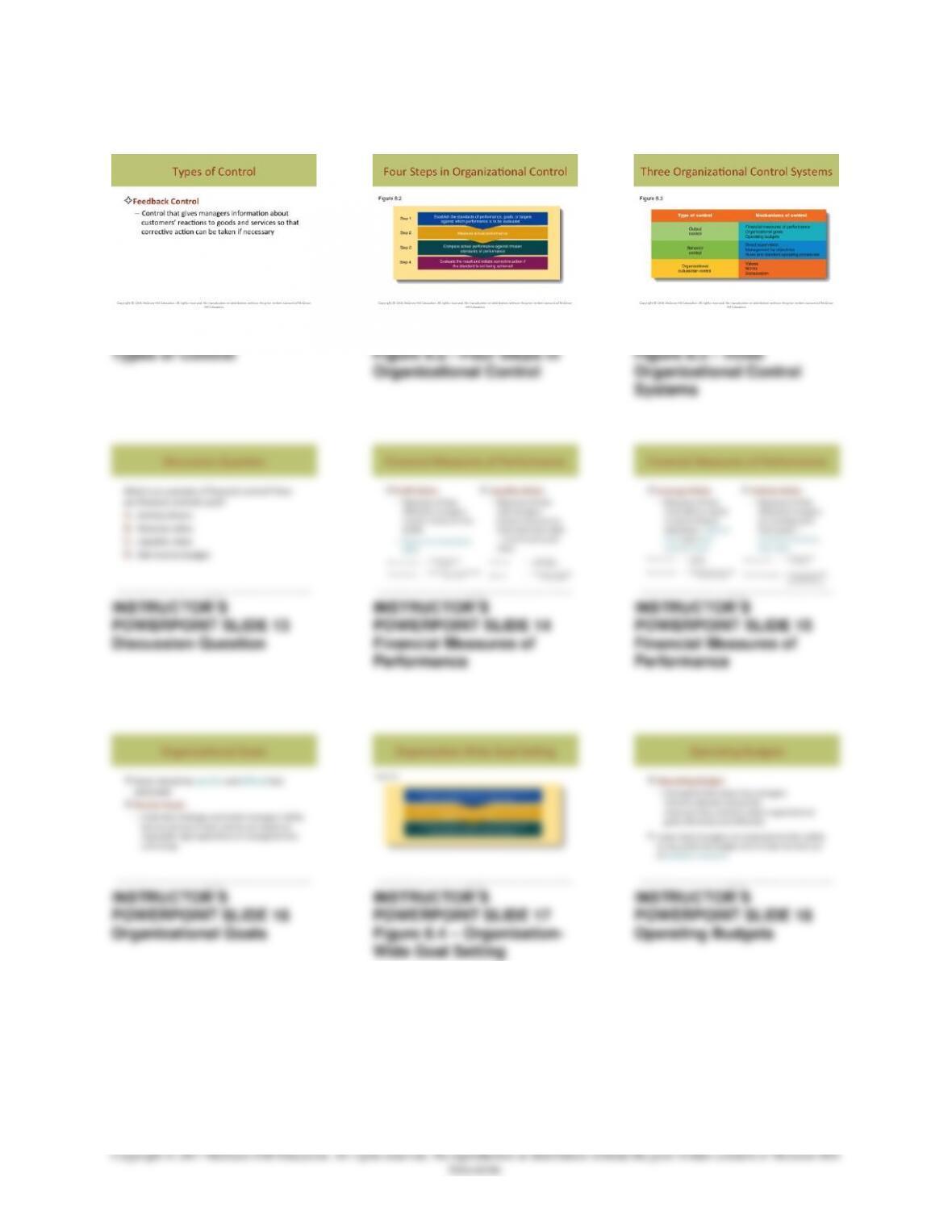
Figure 8.1 – Three Types of
POWERPOINT SLIDE 8
Question?
POWERPOINT SLIDE 9
Types of Control
INSTRUCTOR’S POWERPOINT SLIDES
Chapter 08 – Control, Change, and Entrepreneurship
8-32
INSTRUCTOR’S
POWERPOINT SLIDE 10
INSTRUCTOR’S
POWERPOINT SLIDE 11
INSTRUCTOR’S
POWERPOINT SLIDE 12
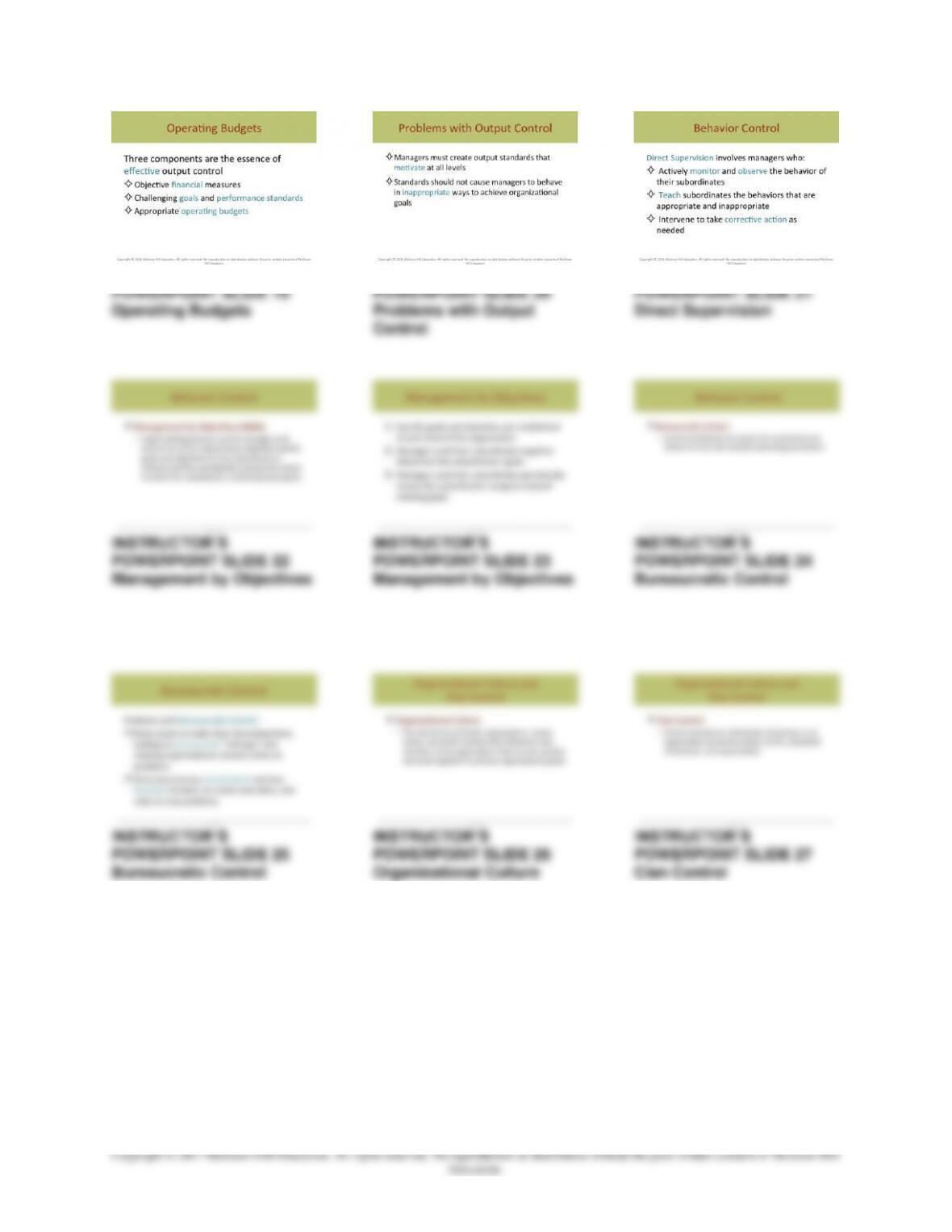
Wide Goal Setting
Chapter 08 – Control, Change, and Entrepreneurship
8-33
INSTRUCTOR’S
INSTRUCTOR’S
INSTRUCTOR’S

Chapter 08 – Control, Change, and Entrepreneurship
8-34
INSTRUCTOR’S
POWERPOINT SLIDE 28
Adaptive vs. Inert Culture
INSTRUCTOR’S
POWERPOINT SLIDE 29
Figure 8.5 – Organizational
Control and Change
INSTRUCTOR’S
POWERPOINT SLIDE 30
Organizational Change
INSTRUCTOR’S
POWERPOINT SLIDE 31
Figure 8.6 – Four Steps in
the Organizational Change
Process
INSTRUCTOR’S
POWERPOINT SLIDE 32
Organizational Learning
INSTRUCTOR’S
POWERPOINT SLIDE 33
Top-Down Change
INSTRUCTOR’S
POWERPOINT SLIDE 34
Bottom-Up Change
INSTRUCTOR’S
POWERPOINT SLIDE 35
Question?
INSTRUCTOR’S
POWERPOINT SLIDE 36
Benchmarking

Chapter 08 – Control, Change, and Entrepreneurship
INSTRUCTOR’S
POWERPOINT SLIDE 37
INSTRUCTOR’S
POWERPOINT SLIDE 38
INSTRUCTOR’S
POWERPOINT SLIDE 39