Chapter 08 – Organizational Culture, Structure, & Design: Building Blocks of the Organization
8-21
(Correct answer is B)
C. An organization chart is a box-and-lines illustration showing the formal lines of
authority and the organization’s official positions or work specializations.
1. Two kinds of information that organization charts reveal about
2. The vertical hierarchy (who reports to whom) is the chain of command.
a. A formal vertical hierarchy also shows the official communication
Chapter 08 – Organizational Culture, Structure, & Design: Building Blocks of the Organization
8-22
Interactive Classroom Material:
PRACTICAL ACTION: Transition Problems on Your Way Up: How to Avoid the
Pitfalls (p. 240)
You may not always get training and support as you move up the management
YOUR CALL
How would you try to manage the perceptions not only of subordinates but of
your peers?
There are other suggestions for managing the perceptions of one’s peers. It is
Additional Activities:
One way that you could build on this Practical Action is to have the students read the
Entrepreneur online article “8 Tips to Help First-Time Managers Thrive.” This article
complements the material in the Practical Action and gives first-time managers more
issues to ponder. Consider using the following discussion questions:
Discuss how understanding organizational culture and organizational structure can
help you to be a better first-time manager.
Section 8.5 discusses the seven basic elements or features of an organization. These
include common purpose; coordinated effort; division of labor; hierarchy of authority;
8.5 The Major Elements of an Organization (pp. 241-244)
When I join an organization, what seven elements should I look for?
Chapter 08 – Organizational Culture, Structure, & Design: Building Blocks of the Organization
8-23
Possible Topics for Discussion:
• Describe the span of control at your company or a previous one. Is this the
appropriate span for this company? Defend your point of view.
Major Idea Outline:
A. Common Elements of Organization: Four Proposed by Edgar Schein
1. Common purpose: the means for unifying members
2. Coordinated effort: working together for common purpose
a. The common purpose is realized through coordinated effort, the
3. Division of labor: work specialization for greater efficiency
a. Division of labor, also known as work specialization, is the
Chapter 08 – Organizational Culture, Structure, & Design: Building Blocks of the Organization
4. Hierarchy of authority: the chain of command
a. The hierarchy of authority, or chain of command, is a control
mechanism for making sure the right people do the right things at the
right time.
b. Authority is most effective when arranged in a hierarchy.
B. Common Elements of Organizations: Three More That Most Authorities Agree
On
1. The span of control, or span of management, refers to the number of
people reporting directly to a given manager. There are two kinds.
a. A narrow span of control means a manager has a limited number of
people reporting.
(1) An organization is said to be tall when there are many levels
with narrow spans of control.
Chapter 08 – Organizational Culture, Structure, & Design: Building Blocks of the Organization
8-25
2. Authority, responsibility, and delegation: line versus staff.
a. With authority go accountability, responsibility, and the ability to
delegate one’s authority.
b. Authority refers to the rights inherent in a managerial position to
make decisions, give orders, and utilize resources.
d. With more authority comes more responsibility, the obligation you
have to perform the tasks assigned to you.
(1) If managers are given too much authority and not enough
responsibility, they may become abusive to subordinates and
Chapter 08 – Organizational Culture, Structure, & Design: Building Blocks of the Organization
8-26
Interactive Classroom Material:
PRACTICAL ACTION: When Should You Delegate & When Not? How Managers
Get More Done (p. 243)
How do you decide when to delegate and when not to? Here are some guidelines: 1)
YOUR CALL
Are any of these reasons why you might not be very good at delegating? What
are some others?
These are common reasons why managers do not delegate. Another reason may
Additional Activities:
One way that you could build on this Practical Action is to have the students complete
the “How Well Do You Delegate?” self–assessment at the MindTools’ website. The
assessment contains 12 items and it provides insight into what and when to delegate,
how to delegate, and to whom to delegate. Consider using the following discussion
questions:
Chapter 08 – Organizational Culture, Structure, & Design: Building Blocks of the Organization
3. The organization chart distinguishes between two positions, line and staff.
a. Line managers (indicated on the chart by a solid line) have authority
4. Centralization versus decentralization of authority
a. With centralized authority, important decisions are made by higher-
level managers.
(1) Nearly all organizations have at least some authority
b. With decentralized authority, important decisions are made by
middle-level and supervisory-level managers.
(1) Power is delegated throughout the organization.
Chapter 08 – Organizational Culture, Structure, & Design: Building Blocks of the Organization
8-28
Section 8.6 describes the seven types of organizational structures, which are simple,
functional, divisional, matrix, team-based, network, and modular. One way that you
could begin your coverage of these topics is to have the students read the Harvard
Business Review article “Customer–Centric Org Charts Aren’t Right for Every
Company.” This article discusses the advantages and disadvantages of organizational
Possible Topics for Discussion:
• How can a firm decide what type of organizational structure is best suited for its
strategic needs?
Major Idea Outline:
A. Organizational design is concerned with designing the optimal structures of
accountability and responsibility that an organization uses to execute its
strategies.
B. Traditional Designs: Simple, Functional, Division and Matrix
8.6 Basic Types of Organizational Structures (pp. 245-251)
How would one describe the seven organizational structures?
Chapter 08 – Organizational Culture, Structure, & Design: Building Blocks of the Organization
8-29
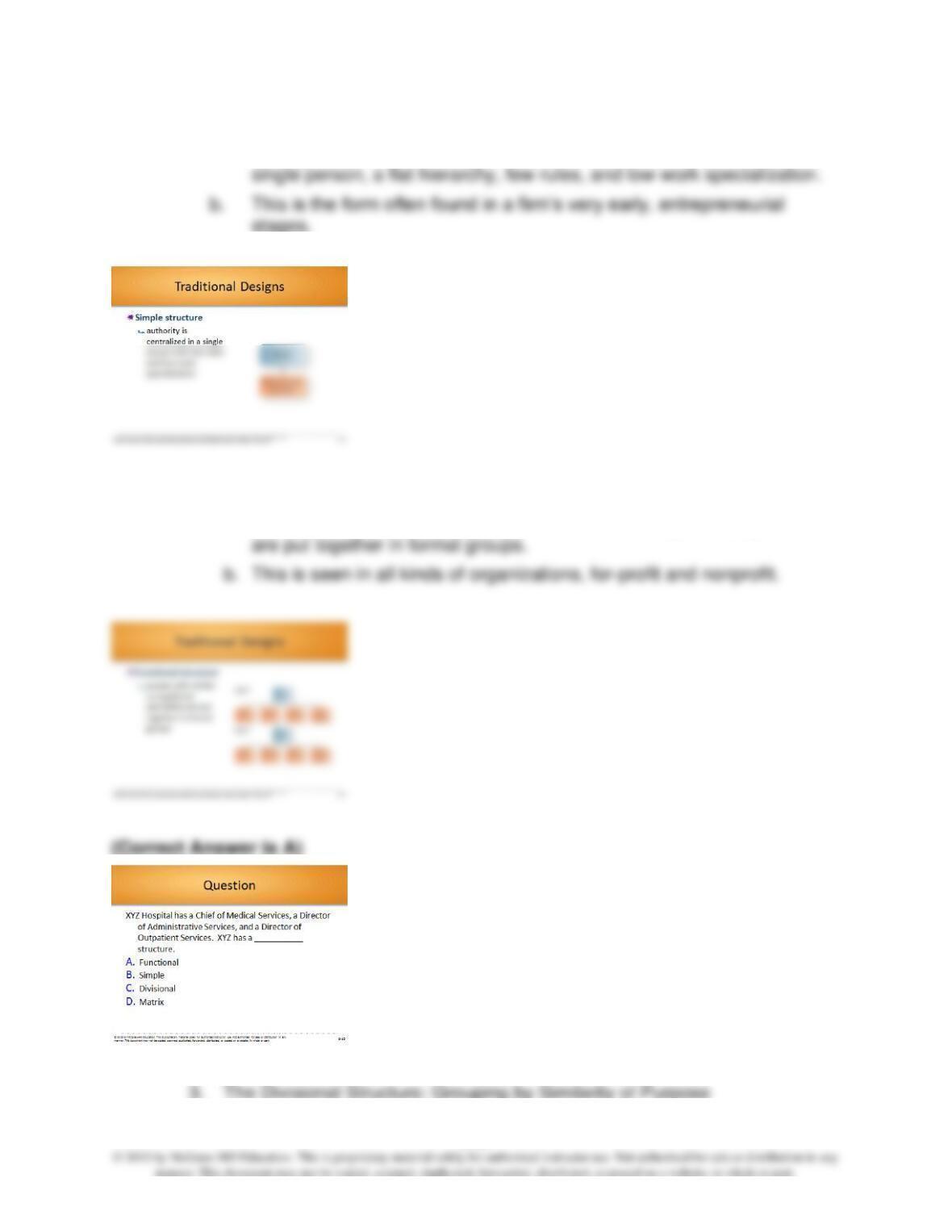
1. The Simple Structure: For the Small Firm
a. An organization with a simple structure has authority centralized in a
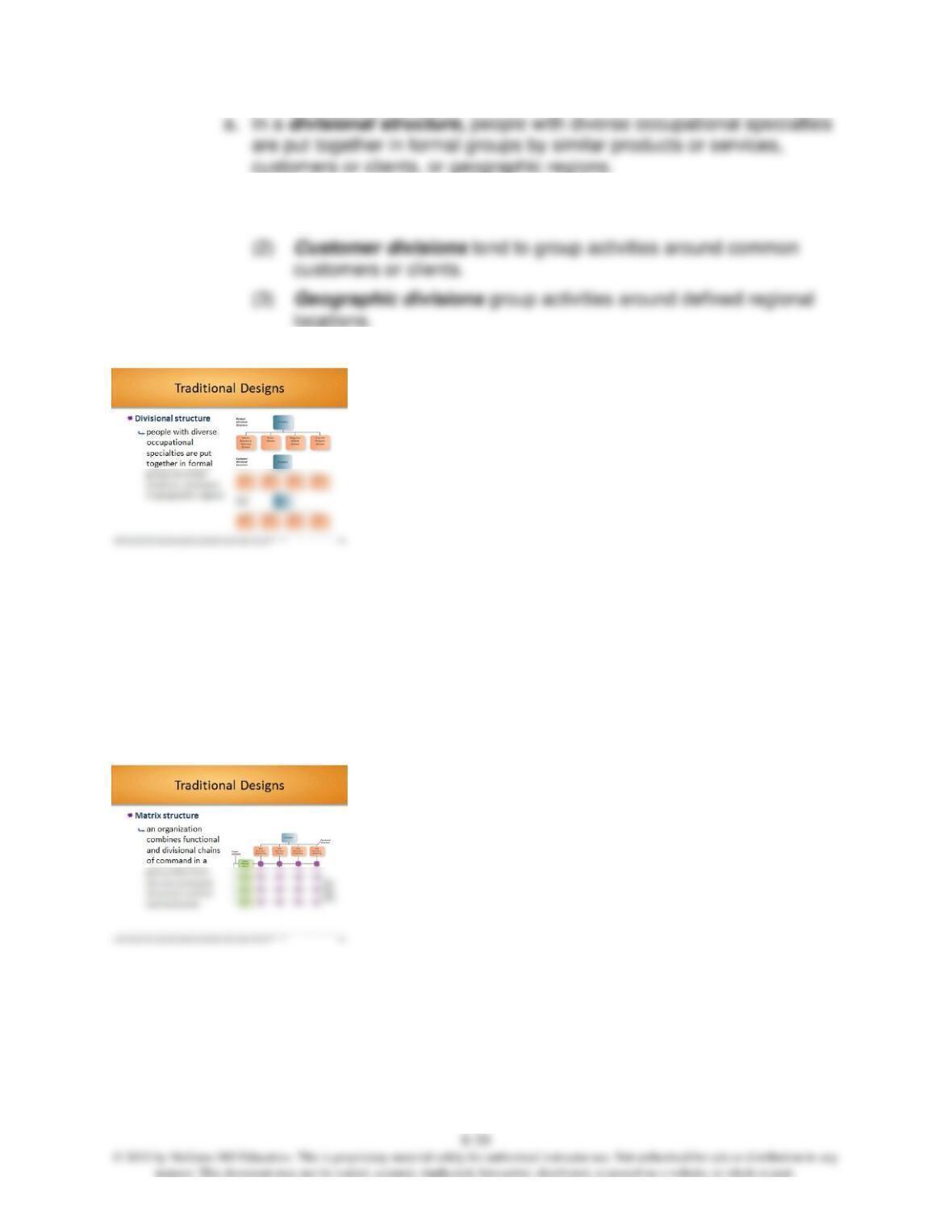
2. The Functional Structure: Grouping by Similar Work Specialties
a. In a functional structure, people with similar occupational specialties
Chapter 08 – Organizational Culture, Structure, & Design: Building Blocks of the Organization
(1) Product divisions group activities around similar products or
services.
locations.
4. In a matrix structure, an organization combines functional and divisional
chains of command in a grid so that there are two command structures –
vertical and horizontal.
a. The functional structure usually doesn’t change, but the divisional
structure may vary.
b. The reporting arrangement is both horizontal and vertical.
C. The Horizontal Design: Eliminating Functional Barriers to Solve Problems
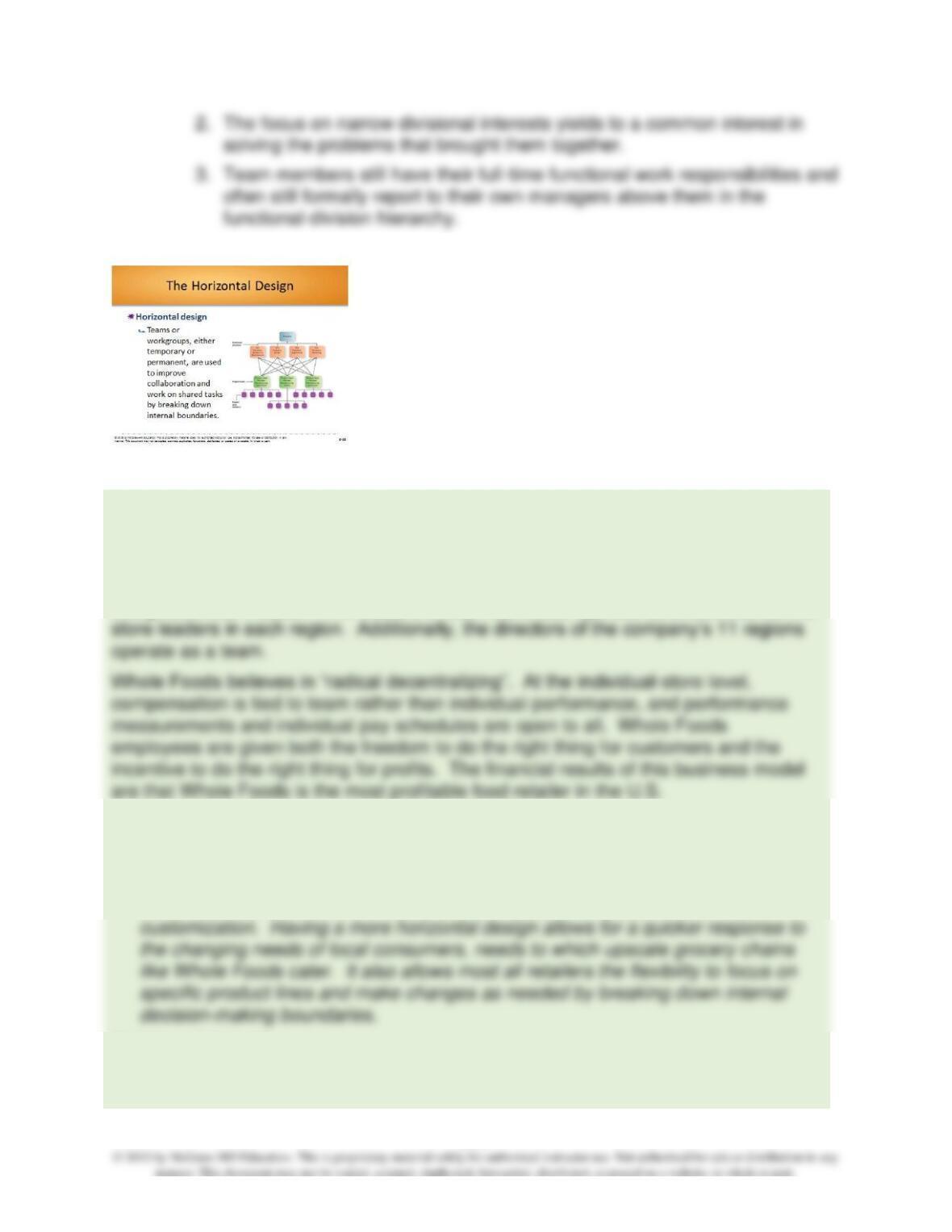
1. In a horizontal design, teams or workgroups, either temporary or
permanent, are used to improve collaboration and work on shared tasks
by breaking down internal boundaries.
Chapter 08 – Organizational Culture, Structure, & Design: Building Blocks of the Organization
8-31
Interactive Classroom Material:
EXAMPLE: Use of a Horizontal Design: Whole Foods Market (pp. 248–249)
One of Whole Foods’ core operating principles is that all work is teamwork. Thus,
each store is organized into roughly eight self-managed teams, each with a
designated team leader. The leaders in each store also operate as a team, as do the
YOUR CALL
Why do you think a horizontal design would be better in a retail business such
as groceries?
Retail businesses often have many different subunits of products and local
Additional Activities:
One way to build on this Example is to have the students watch the CNBC video
“Creativity in Culture of Whole Foods.” In this 9-minute video, Whole Foods co-CEO
Chapter 08 – Organizational Culture, Structure, & Design: Building Blocks of the Organization
8-32
D. Designs That Open Boundaries between Organizations: Hollow, Modular &
Virtual Structures
1. The opposite of a bureaucracy, a boundaryless organization is a fluid,
highly adaptive organization whose members, linked by information
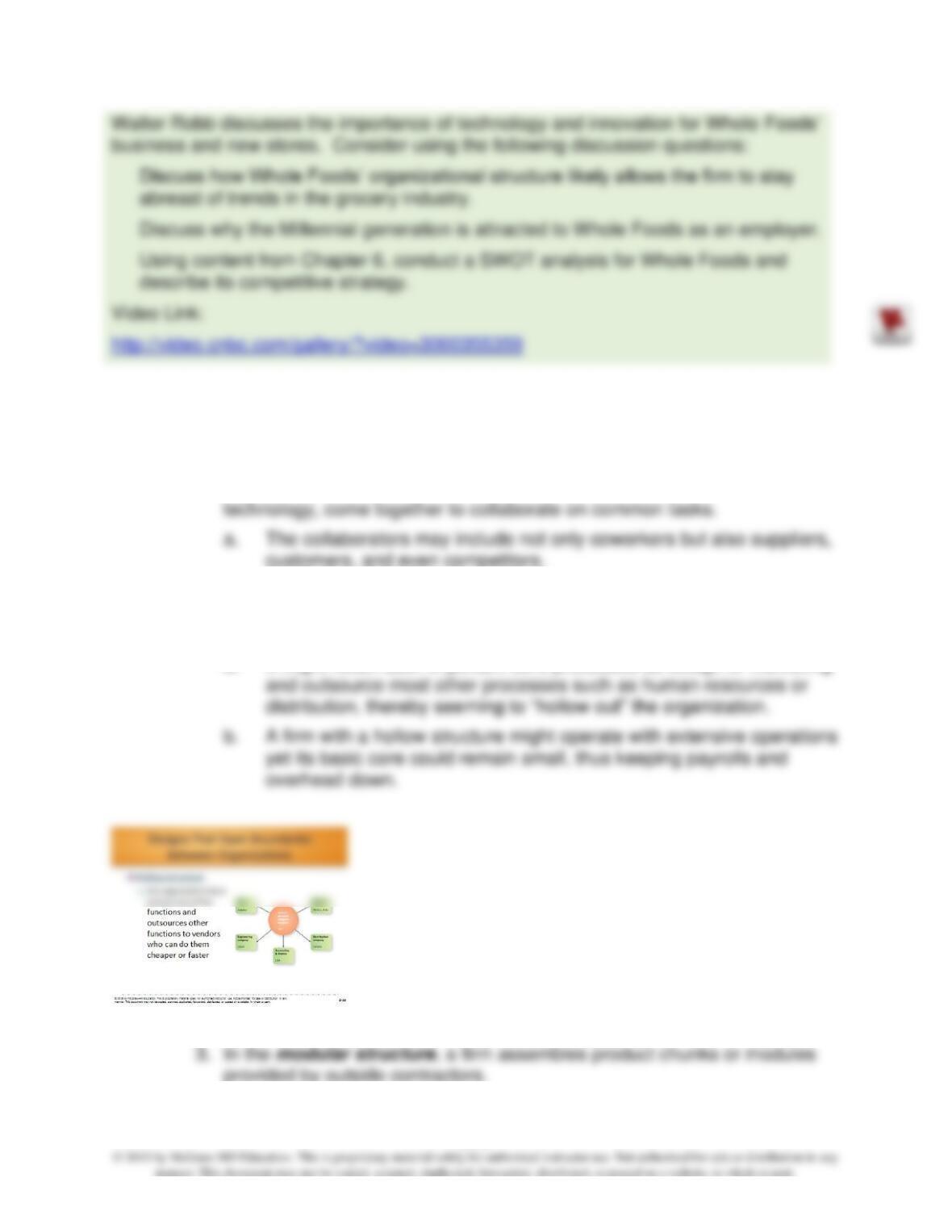
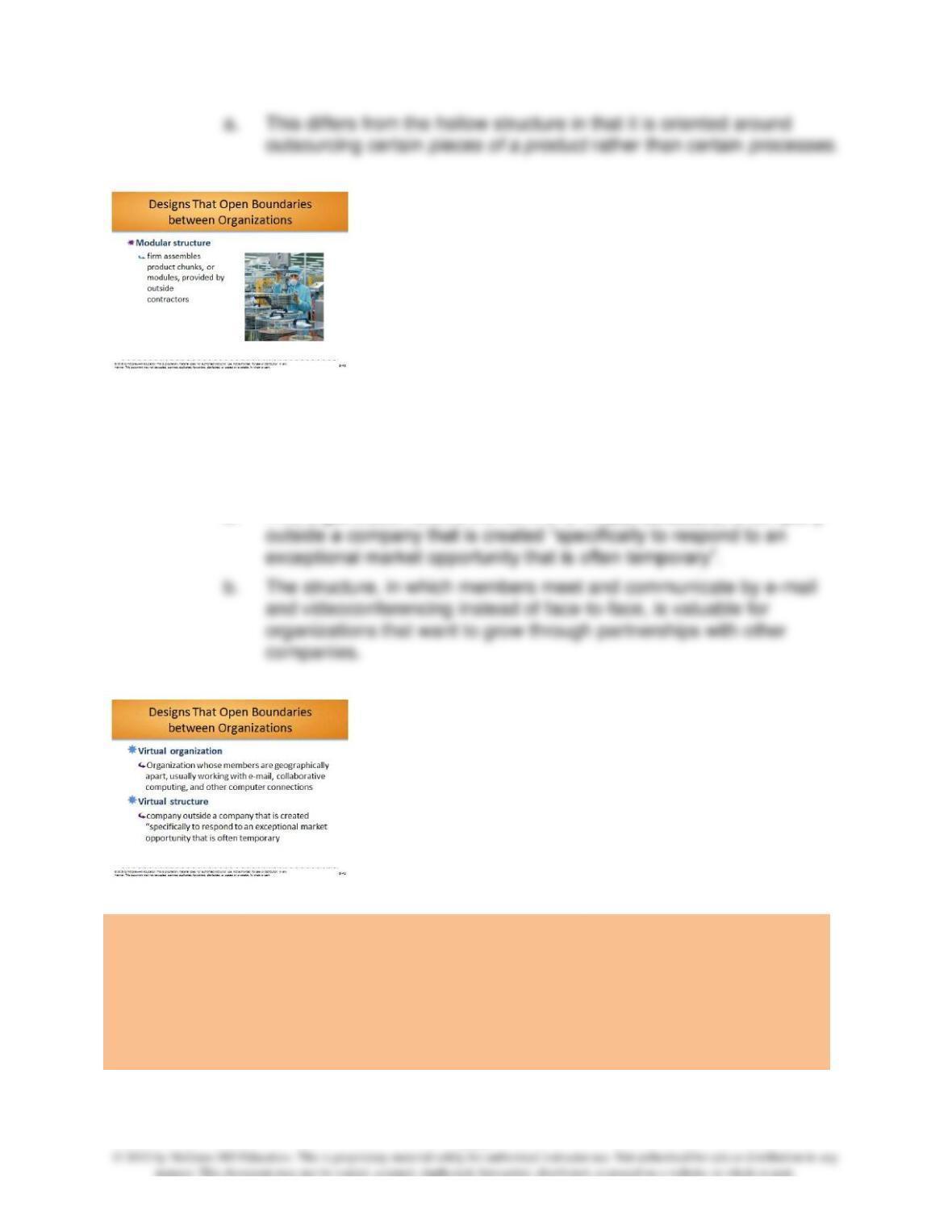
2. In the hollow structure, often called the network structure, the
organization has a central core of key functions and outsources other
functions to vendors who can do them cheaper or faster.
a. It might retain such important core processes as design or marketing
Chapter 08 – Organizational Culture, Structure, & Design: Building Blocks of the Organization
8-33
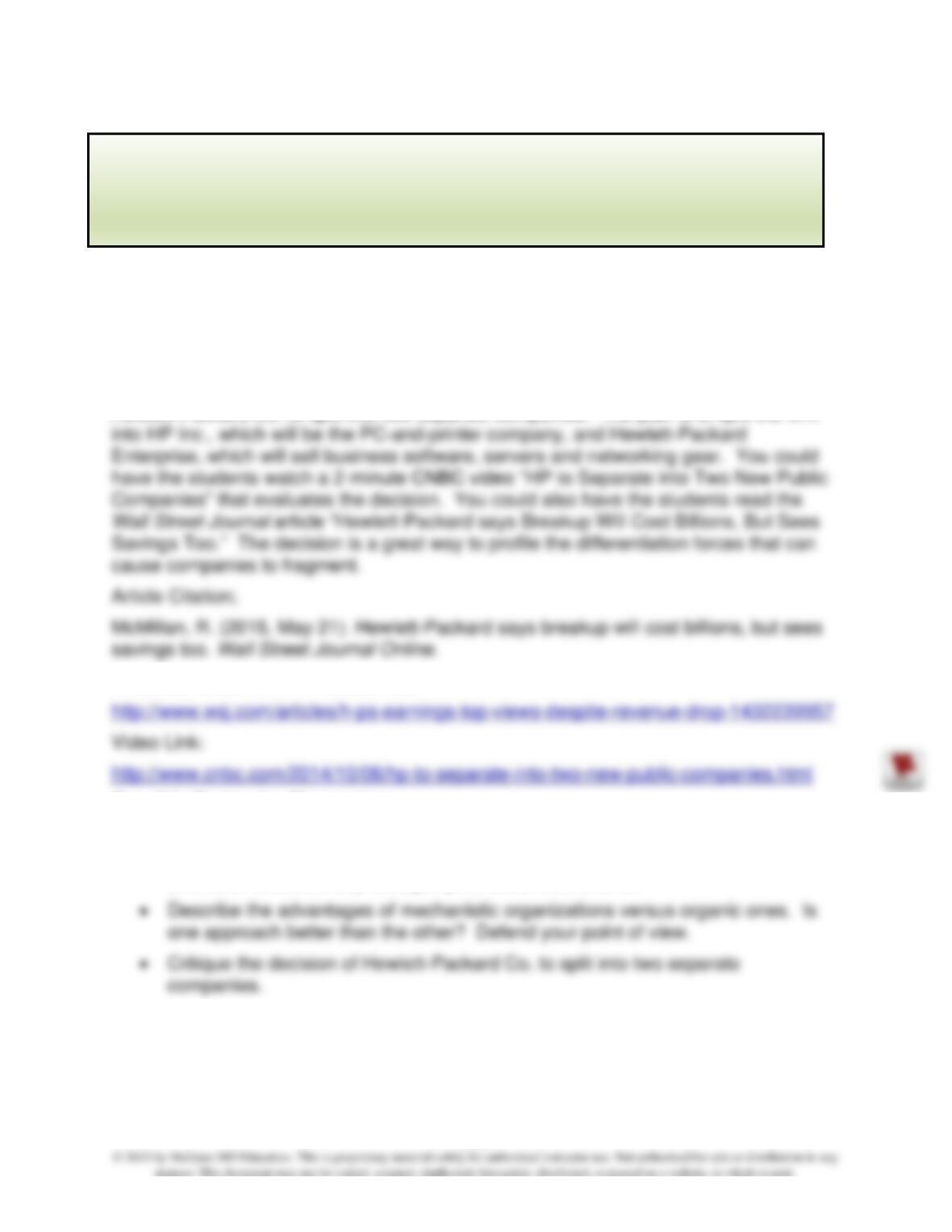
4. A virtual organization is an organization whose members are
geographically apart, usually working with e-mail, collaborative computing,
and other computer connections, while often appearing to customers and
others to be a single, unified organization with a real physical location.
a. This organization allows the form of a virtual structure, a company
Group Exercise #1: Designing an Organization
There is a group exercise available at the end of this manual that allows students to
experiment with designing an organization.
Exercise Objective
• To experiment with designing and operating an organization.
Chapter 08 – Organizational Culture, Structure, & Design: Building Blocks of the Organization
8-34
Section 8.7 discusses the three factors that should be considered when determining the
best organizational structure. This includes whether an organization’s environment is
mechanistic or organic, whether its environment stresses differentiation or integration,
and how its strategy can affect its structure.
One way that you could begin your coverage of these topics is to profile the decision of
Hewlett-Packard Co. to split into two separate companies. The plan is to split the firm
ProQuest Document ID: 1682257823
Possible Topics for Discussion:
• For either your current company or a previous one, evaluate the extent to which
you believe there is an effective linking between the firm’s strategy, culture, and
structure. Describe any changes you would recommend.
Major Idea Outline:
A. Three Factors to Be Considered in Designing an Organization’s Structure
1. The process of fitting the organization to its environment is called
contingency design.
8.7 Contingency Design: Factors in Creating the Best
Structure (pp. 252-254)
What factors affect the design of an organization’s structure?
Chapter 08 – Organizational Culture, Structure, & Design: Building Blocks of the Organization
8-35
2. Managers taking a contingency approach must consider the following
factors in designing the best kind of structure for their particular
B. The Environment: Mechanistic versus Organic Organizations – The Burns &
Stalker Model
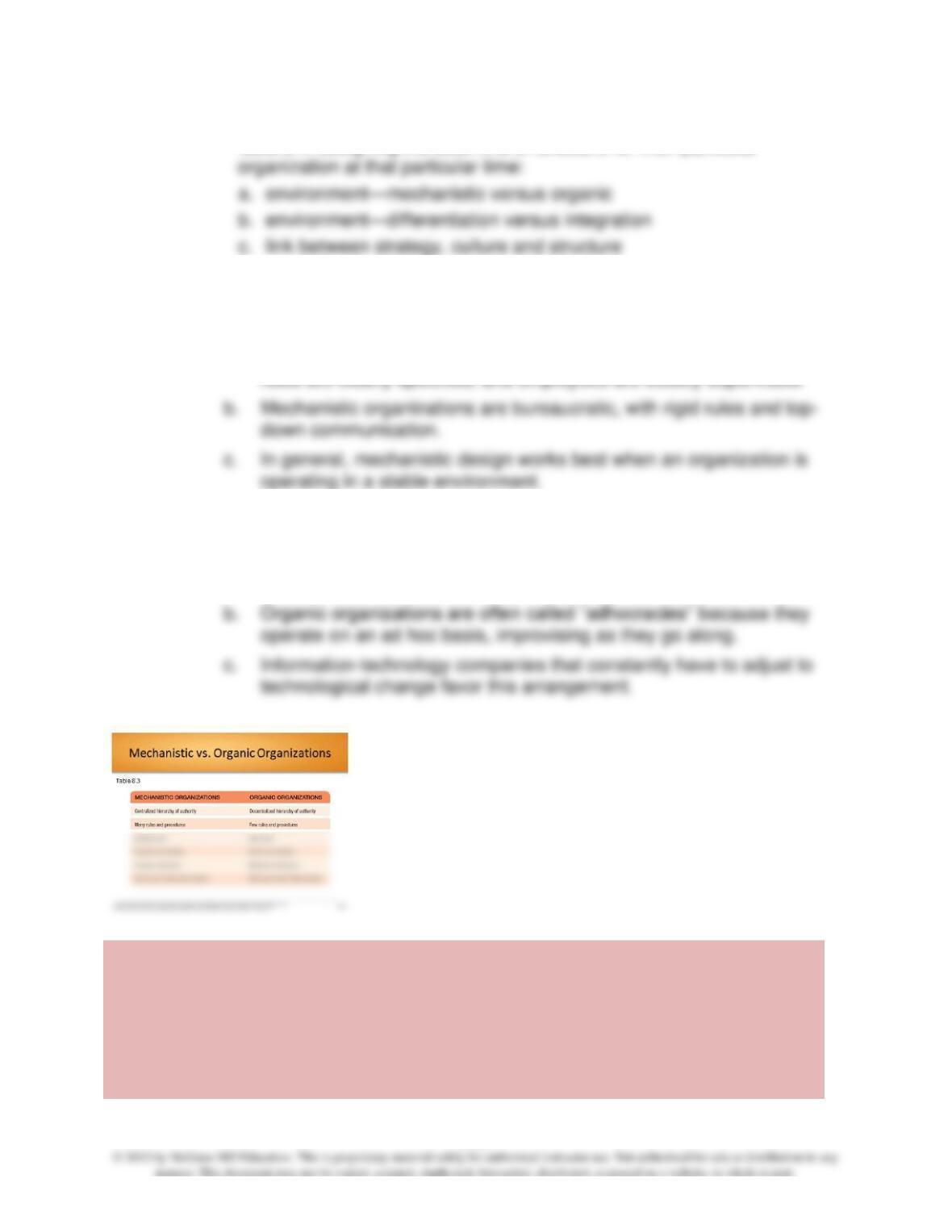
1. Mechanistic organizations: when rigidity and uniformity work best.
a. In a mechanistic organization, authority is centralized, tasks and
2. Organic organizations: when looseness and flexibility work best.
a. In an organic organization, authority is decentralized, there are
fewer rules and procedures, and networks of employees are
encouraged to cooperate and respond quickly to unexpected tasks.
SELF-ASSESSMENT 8.2 (p. 254)
Assessing Your Organizational Structure Preference
Go to connect.mheducation.com and take Self-Assessment 8.2.
Student Questions:
1. Do you prefer a more mechanistic or organic structure? What do you think is
Chapter 08 – Organizational Culture, Structure, & Design: Building Blocks of the Organization
8-36
the cause for this preference?
Student responses will differ based on assessment results. Students who are
2. If you were interviewing for a job, what questions might you ask to determine if
the company is more mechanistic or organic?
Some questions that can be asked include: Is your organization more oriented
Additional Activities:
You can also consult the Connect Instructors Manual for the post-assessment activity
and corresponding PowerPoint slides used for this Self-Assessment in Connect. In
C. The Environment: Differentiation vs. Integration: The Lawrence/Lorsch Model
1. Instead of a mechanistic-organic dimension, Paul Lawrence and Jay
Lorsch proposed a differentiation-integration dimension, forces that impel
the parts of an organization to move apart or to come together.
a. The stability of the environment confronting the parts of the
organization determines the degree of differentiation or integration
Chapter 08 – Organizational Culture, Structure, & Design: Building Blocks of the Organization
(1) In a highly integrated organization, specialists work together to
achieve a common goal.
D. The Link Between Strategy, Culture and Structure
1. A company’s organizational culture and organizational structure should
be aligned with its vision and strategies.
Group Exercise: #2: Establishing Organizational Culture and Structure
There is a group exercise available at the end of this manual that allows students to
learn more about organizational culture and structure.
Exercise Objectives