Exhibit TN-1
Suggested Activities and Timing for an 80-minute Class
Total
Minutes
Content
5
5
Clip on production process showing both founders: “Clip Veja,”
http://www.youtube.com/watch?v=KzFpLLJc47E&feature=related
10
5
Take a vote on Hold (stay the course) versus Fold (acquisition or
partnership): Ask students for a show of hands of those who would “Hold”
(that is, stay the course) and those who would “Fold” (that is, form a
partnership with either Timberland or another fashion firm).”Ask a few
students the main motivation for their recommendation. As the discussion
unfolds, list the key arguments on two sides of the board, grouping them
into specific categories (see Board Plan A in Exhibit TN-2).
20
10
1. Is Veja more or less successful than other brands in the ethical
fashion movement? Explain your criteria.
The class will likely be split between conventional entrepreneurs and social
entrepreneurs on the issue of margin versus mission. Record key themes (see
Board Plan B in Exhibit TN-2).
30
10
2. In which key ways does Veja’s business model differ from that of
conventional fashion industry firms? What role do those differences
play in terms of partnership and acquisition?
Contrast the two business models (see Board Plan C in Exhibit TN-2). The
instructor should keep the business model for Veja on the right-hand side to
make it easier to record the social adjacencies later.
Recommendation: First, work with two students (one for the Veja model,
one for the conventional fashion model) to outline the two models. Then,
instead applied some conventional practices to support growth. If
discussion stalls, relate the Louis Vuitton anecdote: US$4,900 for the first
made-in-Africa “charm” may not deliver the same social impact as the
acquired venture originally intended.
Transition question: What trade-offs do the founders face? Are those
trade-offs likely to be acceptable to the founders? Why, or why not?
Note: The Ivey Publishing DVD includes a section on business models.
40
10
3. How did the founders build the brand? Did they use any magic
ingredients, or was it business as usual?
Draw out the moral underpinning of the venture, which are still visible in
the founders’ view of the venture “as a work in progress” that still has
many limitations. The founders’ focus on the limitations can help them to
find ways to differentiate the brand (by intention and action). Explore under
which circumstances Veja’s approach may “rub off” on its customers, i.e.,
help to bestow uniquely eco-friendly identities on their loyal sneaker
buyers.
50
10
4. How did Veja’s founders choose brand, product and process
extensions?
The founders use social adjacencies. That is, they make decisions that help
to reduce social injustice or mitigate environmental damage; they seek
partners that will enable them to execute on this mission, and then
reconfigure their business model to make it work (the videos on cotton or
leather works well to illustrate this point).
The Ivey Publishing video clip also has a section on art, which can be
shown to illustrate the more complex point of aesthetics.
80
5
Key Takeaways
• Social ventures—emphasize the ability to balance economic, social
and environmental/ecological drivers of competitive advantage by
devising business models that explicitly account for tensions and
synergies among these three dimensions.
• Social movements—social movements are complementary to market
forces; markets are efficient but not sufficient. The markets of the
future depend on changes in consumers’ tastes and companies that
challenge the status quo to cultivate a taste for pro-ecological and
pro-social consumption.
• Social adjacencies—strategic adjacencies deal with business model
extensions that move one step away from the core (by changing one
key element in the business model). Social adjacencies leverage a
pro-social or pro-ecological opportunity that is one step away from
the mission of the venture—for example, Veja’s expansion into
vegetable-tanned leather was an extension of its social mission to
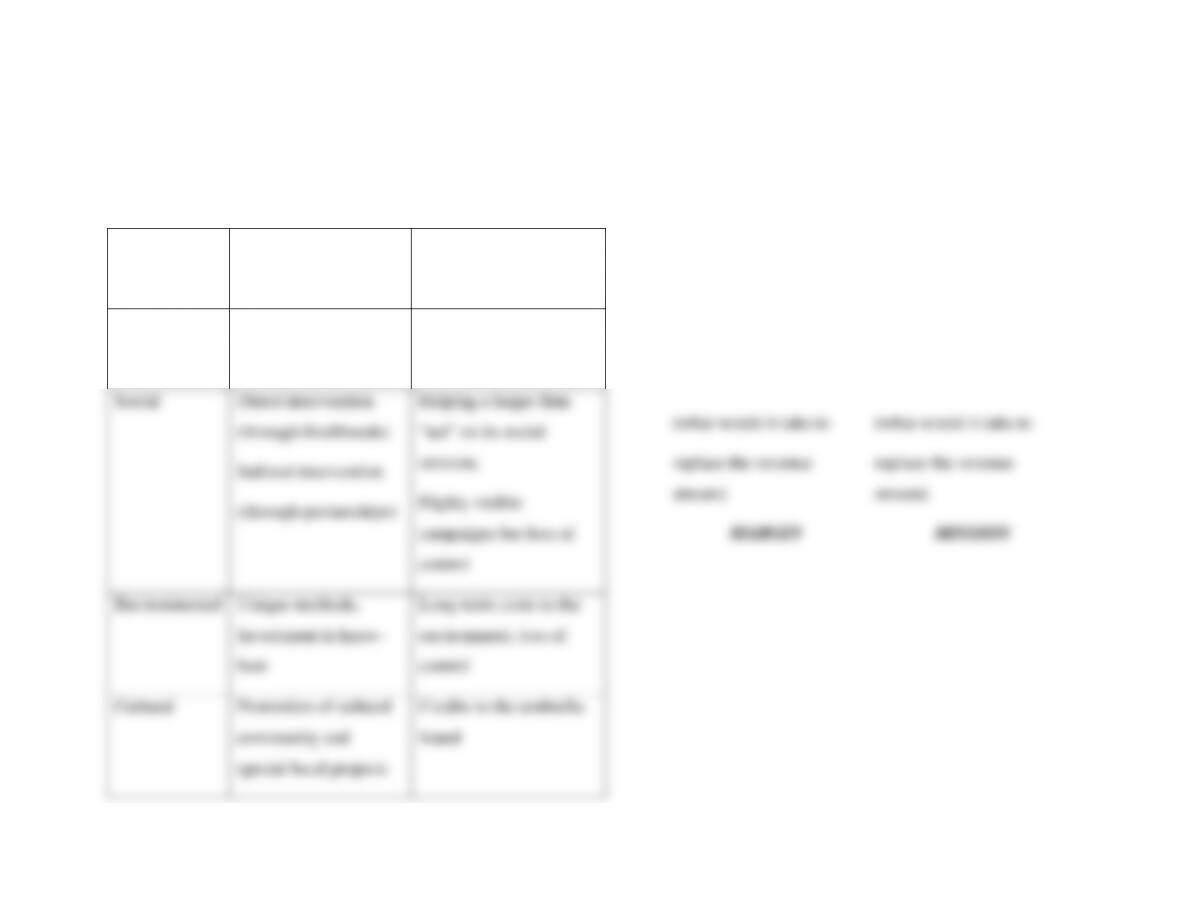
Exhibit TN-2
Board Plan for 80-Minute Class
A: DECISION
HOLD
(stay the course)
FOLD
(partnership)
Economic
Steady growth,
distinctiveness
New Markets
Recognition, appeal
Social
Direct intervention
(through livelihoods)
Indirect intervention
(through partnerships)
Helping a larger firm
“act” on its social
mission,
Highly visible
control
how
control
Cultural
Promotion of cultural
Credits to the umbrella
B: VALUATION
Valuation
20 million……………………………………1 billion
(what would it take to
replace the revenue
stream)
(what would it take to
replace the revenue
stream)

C: BUSINESS MODELS
D: SOCIAL ADJACENCIES
(create economic value only by increasing social
value)
CONVENTIONAL
Long supply chains
Low margins for suppliers
High gross margin, high
advertising
ETHICAL
Minimal, integrated supply chains
High margins for suppliers (×2–×7)
High net profit (zero advertising)
Art projects
Partnerships (farmers, cooperatives)
R&D in traditional/local methods
Note: The same board plan can be used for a double-class in the first stage. The second stage compares the Veja business model with
Oliberte’s business model (outlined in Exhibit TN–3) to develop a deeper understanding of how Veja’s decision may influence eco–
fashion followers and competitors.

Exhibit TN-3
Interview with Oliberté Footwear Founder Tal Dehtiar
Headquarted in Canada, Oliberté Footwear (Oliberté) has launched the first international
footwear company to work exclusively in Africa. Oliberté’s designs for men’s and women’s
shoes are inspired by urban-casual styling. In spring 2010, the company began selling its shoes
both online and in select stores in Canada and the United States. Oliberté’s founder and
president, Tal Dehtiar, has already been recognized with the International Youth Foundation’s
Social Entrepreneur of the Year Award and has been nominated for the YMCA Peace Award, for
Interviewer: What’s so special about your shoes?
Interviewer: Leather is often seen as not very ecofriendly. Why do you choose to use it?
Interviewer: What about the rubber that you use for your shoes?
Interviewer: What’s your vision with Oliberté?


Instructor Resource
Rowe, Cases in Leadership 5e
SAGE Publications, Inc., 2019
Exhibit TN-4
Websites for Ethical Fashion
1. On this webpage you can learn more about the CSR program of fashion store Hennes &
2. On this webpage you can learn more about the CSR program of Nike:
3. On this webpage you can learn more about the CSR program of Marks & Spencer:
4. MADE BY is a shadowlabel for fair and organic produced clothing labels. Their track&trace
system shows you excatly the route that your garment has travelled from cotton farmer to the
5. Organic Exchange works together with MADE BY on track&trace systems which increases
6. Eco Fashion World is a comprehensive news portal on all things eco fashion such as events,
7. Kuyichi is the eco pioneering Dutch casual and jeans brand that has been an inspiration for
8. Art.23 is the fashion brand of French NGO Alter Mundi, founded as a way to commercialize
9. Eco Fashion World also offers a guide with over 200 ethical fashion brands and links to their
10. Dutch ethical designer Rianne de Witte started her pioneering work in the nineties:
11. In the United States, Linda Loudermilk was the first to launch eco luxury with a Hollywood

12. Founded by U2 lead singer Bono and his wife Ali Hewson, Edun is an eco-casual brand:
13. This shoe brand is an innovative example of a venture set up by a campaigning organization
14. Nahui Ollin is the successful company that creates bags and accessories from candy wraps:
15. G = 9.8 is the French lingerie brand that creates pieces out of pinetree fiber: www.g98.fr
16. This blog narrates the collaboration between UK top designer Vivienne Westwood and the
Swiss bottle company SIGG with the message to save water:
17. Earth Pledge is a NYC based non-profit organization that has initiated the first green fashion
18. This blog is a response to an article on sustainable fashion in the Financial Times:
19. Topmodel and green ambassador Summer Rayne Oakes has initiated several projects
20. A successful eco fashion store with two outlets in the Netherlands is Nukuhiva:
21. A green department store with ethically produced fashion, furniture and body care products
22. Equa Boutique was the first boutique that only offered sustainable fashion in London:

25. The world’s oldest and biggest ethical fashion trade show has just been acquired by the
26. This article reports on the London eco fashion event Esthetica in February 2010:
27. This article reports on the New York City green fashion weeks in February 2010:
28. This article gives an overview of several eco fashion events around the world in
29. This online store was one of the first selling only eco fashion design. It was set up by a
30. Founded in New York City in 2005, Nimli was one of the first eco fashion online retailers in
31. Another successful online eco fashion retailer, based in the United States, is Ascension:
32. This website gives information and aims to stimulate the teaching of CSR issues in fashion
33. The Amsterdam Fashion Institute is one of the schools in the Netherlands that actively
34. In the United Kingdom, the London College of Fashion is an innovator in sustainable fashion
35. This BBC article reports on a campaign launched by the UK government to tackle the
36. The Ethical Fashion Forum is the UK body for ethical fashion that brings together