Instructor Resource
Rowe, Cases in Leadership 5e
SAGE Publications, Inc., 2019
Case Notes
Case 8.2: St. John the Compassionate Mission: Organizational Culture and
Leadership
Colleen Sharen wrote this teaching note as an aid to instructors in the classroom use of the case
St. John the Compassionate Mission: Organizational Culture and Leadership, No. 9B14C001.
This teaching note should not be used in any way that would prejudice the future use of the case.
This publication may not be transmitted, photocopied, digitized or otherwise reproduced in any
form or by any means without the permission of the copyright holder. Reproduction of this
Teaching Note
Case Synopsis
In late May 2013, Father Roberto Ubertino, the founder and executive director of the St. John the
Compassionate Mission (SJCM or the Mission), a faith-based social service organization located
in Toronto, Ontario, Canada, sat down to plan for his next board retreat scheduled to occur in
Case Objectives and Use
This case examines servant leadership in a challenging context: in an organization that is trying
to simultaneously plan for leadership succession, maintain an organizational culture and deal
with a number of strategic choices. The case illustrates the messiness of organizational decision-
making.
Intended for the upper year undergraduate or introductory graduate level, this case may
be taught in leadership or organizational behavior courses. Upon successful completion of this
case, students should be able to:
Linkage to Concepts and Theories
Servant leadership inverts the Western model of leadership by placing the leader in the role of
service to followers. Based on the work of Robert Greenleaf,
1
servant leadership proposes that an
effective leader supports and empowers his or her followers, enabling them to develop their
Instructor Resource
Rowe, Cases in Leadership 5e
SAGE Publications, Inc., 2019
Recommended Student Reading
• Gothard, S., & Austin, M. J. (2013). Leadership succession planning: Implications for
non-profit human service organizations. Administration in Social Work, 37(3), 272–285.
Faculty Resources on Servant Leadership
• van Dierendonck, D., & Patterson, K. (eds.) (2010). Servant leadership: Developments in
theory and research. New York: Palgrave.
Research Methods
The data in this case was gathered using field interviews with one board member, the director of
operations, the director of community, two program managers and several community members,
Instructor Resource
Rowe, Cases in Leadership 5e
SAGE Publications, Inc., 2019
Suggested Teaching Plan
This case can be used in a 75-minute class.
Activity
Resources
Time
Problem identification
Maintaining organizational culture during leaders
transitions.
5 min
Discuss servant leadership
and its strengths and
weaknesses
Using Exhibit TN-1, draw out aspects of servant
leadership.
15 min
Discuss servant leadership
culture
Using Exhibit TN-2, discuss the development of a servant
leader culture. How is culture created?
15 min
Identify the internal and
external pressures on SJCM
Discuss socialization and internal and external
environmental changes that might be forcing change.
5 min
Develop a plan to maintain
and foster SL culture at
SJCM.
Modeling of beliefs, values and assumptions; examining
embedding mechanisms (see Exhibit TN-3).
30 min
Summary—key concepts
5 min
Discussion Questions
1. Describe Father Roberto’s approach to leadership. How does this approach fit with
the concept of servant leadership?
2. Compare servant leadership to other leadership approaches.
Instructor Resource
Rowe, Cases in Leadership 5e
SAGE Publications, Inc., 2019
Analysis
1. Describe Father Roberto’s approach to leadership. How does this approach fit with the
concept of servant leadership?
The instructor may use Exhibit TN-1 as a framework to discuss Father Roberto’s leadership
behaviors and fit with the concept of servant leadership. Most students will conclude that Father
2. Compare servant leadership to other leadership approaches.
Servant leadership is the only leadership approach that puts the follower in primacy over the
leader, placing a greater emphasis on morality, community, stewardship and spirituality (see
Exhibit TN-1).
3. How are the characteristics of servant leadership displayed throughout the
organizational culture of the Mission? How are they valued and practiced by the Mission
community—by the leadership team, the paid staff, volunteers and members of the general
community?
The instructor may wish to review the dimensions of servant leadership with students and assess
the fit between SJCM and servant leadership. See Exhibit TN-4 for an analysis of each
dimension.
4. What are the internal and external pressures on the organization that are influencing the
organizational culture of SJCM?
Internally, growth has created significant organizational pressure on resources, including Father
Roberto, the staff, the volunteer group and funding. The heritage of the Mission as a small
5. As the board, design a process to manage the leadership succession at SJCM.
Students may choose to use any number of succession planning models available. (See the
Gothard and Austin article listed in Recommended Student Readings above.) Generally, these
models use some form of the following steps:
8. Creation of communication plan
Students should provide a detailed plan, providing some of the activities required to accomplish
the recommendation and the sequence and timing of these activities, as well as identifying
6. As the board, design a plan to maintain and foster the organizational culture of SJCM
during the upcoming leadership transition.
The first task in designing a plan to maintain and foster the organizational culture is to articulate
the Mission’s cultural values, beliefs and assumptions about the best way to operate. Better
7. What are the strengths and weaknesses of servant leadership? Evaluate the effectiveness
of servant leadership in other types of organizations, for example, in the for-profit,
government and education sectors.
Some students will likely find the prescriptive approach of servant leadership appealing. Others,
however, may be uncomfortable with the idea of service and being a servant, as it connotes lack
of power and influence or subordination to others. Many feminist scholars reject servant
There are three preconditions to servant leadership.
5
First, organizational context and
culture may limit the ability of the leader to effectively use servant leadership. Better students
might question whether a leader can aspire to be a servant leader in an organizational culture that
adopts a more traditional or hierarchical model of leadership. In other words, is the leader
separate from the culture?

Epilogue
In July 2013, the board and leadership council began the process of identifying the Mission’s
culture, values and beliefs, as well as evaluating the leadership competencies needed by the next
executive director. They believe that the succession process will likely take up to three years, as
the community wrestles with organization and community needs and balances them with the
resources and capacity of the Mission.
Instructor Resource
Rowe, Cases in Leadership 5e
SAGE Publications, Inc., 2019
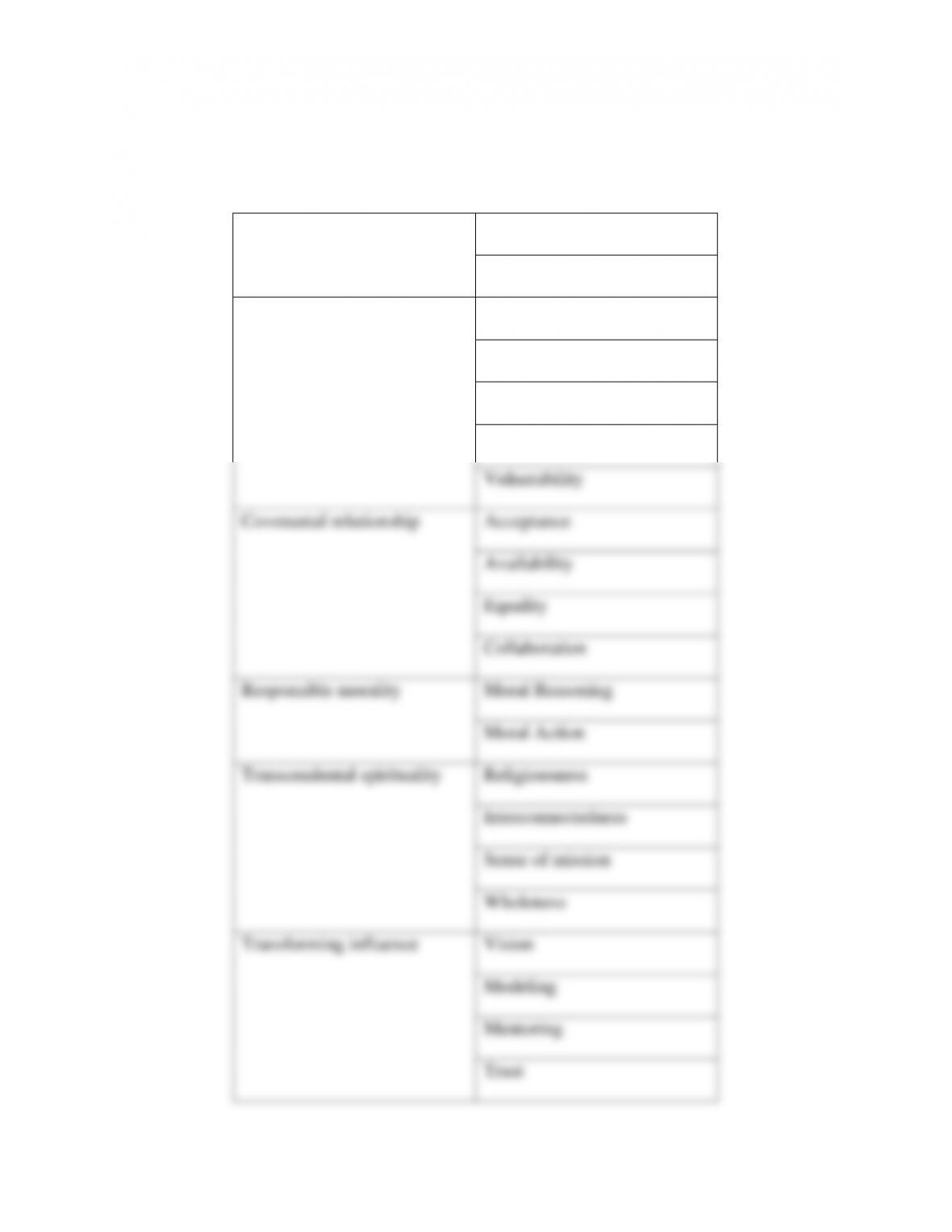
Exhibit TN-1
Dimensions of Servant Leadership—Theoretical Framework
Voluntary subordination
Being a servant
Acts of service
Authentic self
Humility
Integrity
Accountability
Security
Vulnerability
Covenantal relationship
Acceptance
Availability
Equality
Collaboration
Responsible morality
Moral Reasoning
Moral Action
Transcendental spirituality
Religiousness
Interconnectedness
Sense of mission
Wholeness
Transforming influence
Vision
Modeling
Mentoring
Trust

Instructor Resource
Rowe, Cases in Leadership 5e
SAGE Publications, Inc., 2019
Empowerment
Source: Sendjaya, S., Sarros, J. C., & Santora, J. C. (2008). Defining and measuring servant
leadership behaviour in organizations. Journal of Management Studies, 45(2), 409.
Instructor Resource
Rowe, Cases in Leadership 5e
SAGE Publications, Inc., 2019
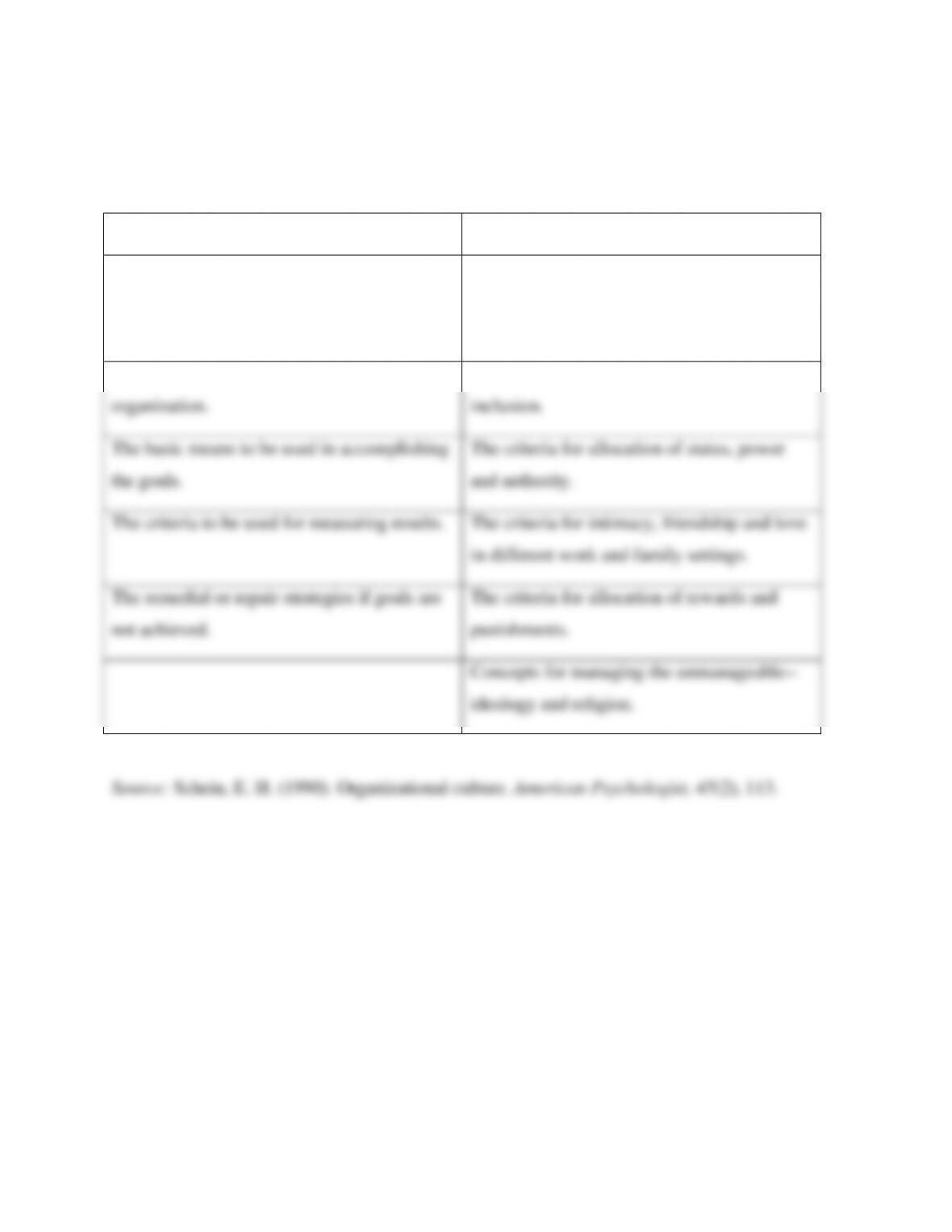
Exhibit TN-2
Culture Development Tasks Facing All Groups
External Adaptation Tasks
Internal Integration Tasks
The core mission, functions and primary
tasks of the organization vis-á-vis its
environments.
The common language and conceptual
system to be used, including basic concepts
of time and space.
The specific goals to be pursued by the
organization.
The group boundaries and criteria for
inclusion.
The basic means to be used in accomplishing
the goals.
The criteria for allocation of status, power
and authority.
The criteria to be used for measuring results.
The criteria for intimacy, friendship and love
in different work and family settings.
The remedial or repair strategies if goals are
not achieved.
The criteria for allocation of rewards and
punishments.
Concepts for managing the unmanageable—
ideology and religion.
Instructor Resource
Rowe, Cases in Leadership 5e
SAGE Publications, Inc., 2019
Exhibit TN-3
How Leaders Embed Culture
Primary Mechanisms
Secondary Mechanisms
What leaders pay attention to, measure and
control
Organizational design and structure
How leaders react to critical incidents and
crises
Organizational systems and procedures
Deliberate role modeling and coaching
Design of physical space, facades and
buildings
Criteria for the allocation of rewards and
status
Stories, legends, myths and symbols
Criteria for recruitment, selection, promotion,
retirement and excommunication
Formal statements of organizational
philosophy, creeds and charters
Source: Schein, E. H. (1990). Organizational culture. American Psychologist, 45(2), 115.
Instructor Resource
Rowe, Cases in Leadership 5e
SAGE Publications, Inc., 2019
Exhibit TN-4
Analysis of SJCM Servant Leadership using Sendjaya, Sorros and Santora Dimensions of
Servant Leadership
Voluntary
subordination
Being a servant
Sobornost, i.e., giving up self-interest for that of the group;
learning from the poor; stewardship of a community
Acts of service
Helpers and helped interchangeable
Authentic self
Humility
Learning from the poor; learning from each other in discussion
Integrity
Accountability
Sobor: staff leadership council decisions taken by the leader in
consultation with the council; reporting to the board
Security
Building and leading a stable organization
Vulnerability
Being open to new experiences and risk-taking created the
need to be comfortable with vulnerability, accepting
weaknesses
Covenantal
relationship
Acceptance
Availability
Shared meals, decision-making process
Equality
All people, initiatives and activities equal; no “Kurtz”
personalities
Collaboration
Each person brings gifts; decision-making process; sobornost
Responsible
morality
Moral
Reasoning
Founded on Orthodox Christian values
Moral Action
Identifying need in the community and acting on it
Transcendent
al spirituality
Religiousness
Parish, daily prayer service, prayer before meals, icons in the
building; the belief that God will look after the money
Inter-
Nature of community; helpers and helped interchangeable;
Instructor Resource
Rowe, Cases in Leadership 5e
SAGE Publications, Inc., 2019
connectedness
daily coffee, communal meals
Sense of mission
Helping people see the value in themselves; move to
Scarborough
Wholeness
Belonging to a community; seeing value in self through
connection with others; lack of outcomes measurement
Transforming
influence
Vision
A belief in the transformational power of community; in the
entrepreneurial spirit; move to Scarborough; founding of
bakery
Modeling
Communal meals, advisory board
Mentoring
Advisory board as leadership incubator
Trust
Joanna and the breakfast program—handing her the keys
Empowerment
E.g., Joanna starting the breakfast program; the way in which
initiatives are identified; advisory board
Instructor Resource
Rowe, Cases in Leadership 5e
SAGE Publications, Inc., 2019
Exhibit TN-5
Mechanisms Used to Embed Culture at SJCM
Primary Mechanisms
Secondary Mechanisms
What leaders pay attention to, measure and
control
• rejected as inconsistent with holistic
approach
Organizational design and structure
• informal, organic, evolutionary; “just do
it”
• sobor—leadership council; board;
advisory council
How leaders react to critical incidents and
crises
• role model; e.g., picnic in park when out of
funds
Organizational systems and procedures
• informal, use mutual adjustment to
manage
Deliberate role modeling and coaching
• prayer and reflection
• openness to risk, failure, discussion,
collaboration
• entrepreneurial, risk-taking
Design of physical space, facades and
buildings
• chapel inside the building
• icons throughout the space
• community room design
Criteria for the allocation of rewards and status
• not material in this case
Stories, legends, myths and symbols
• stories of founding (opening without
heat or light), trust (Joanna), critical
incidents (kite-flying in the park, being
homeless for a year), innovation (the
bakery)
• sacrament of coffee
• communal meals
Instructor Resource