Chapter 07 – Individual & Group Decision Making: How Managers Make Things Happen
7-21
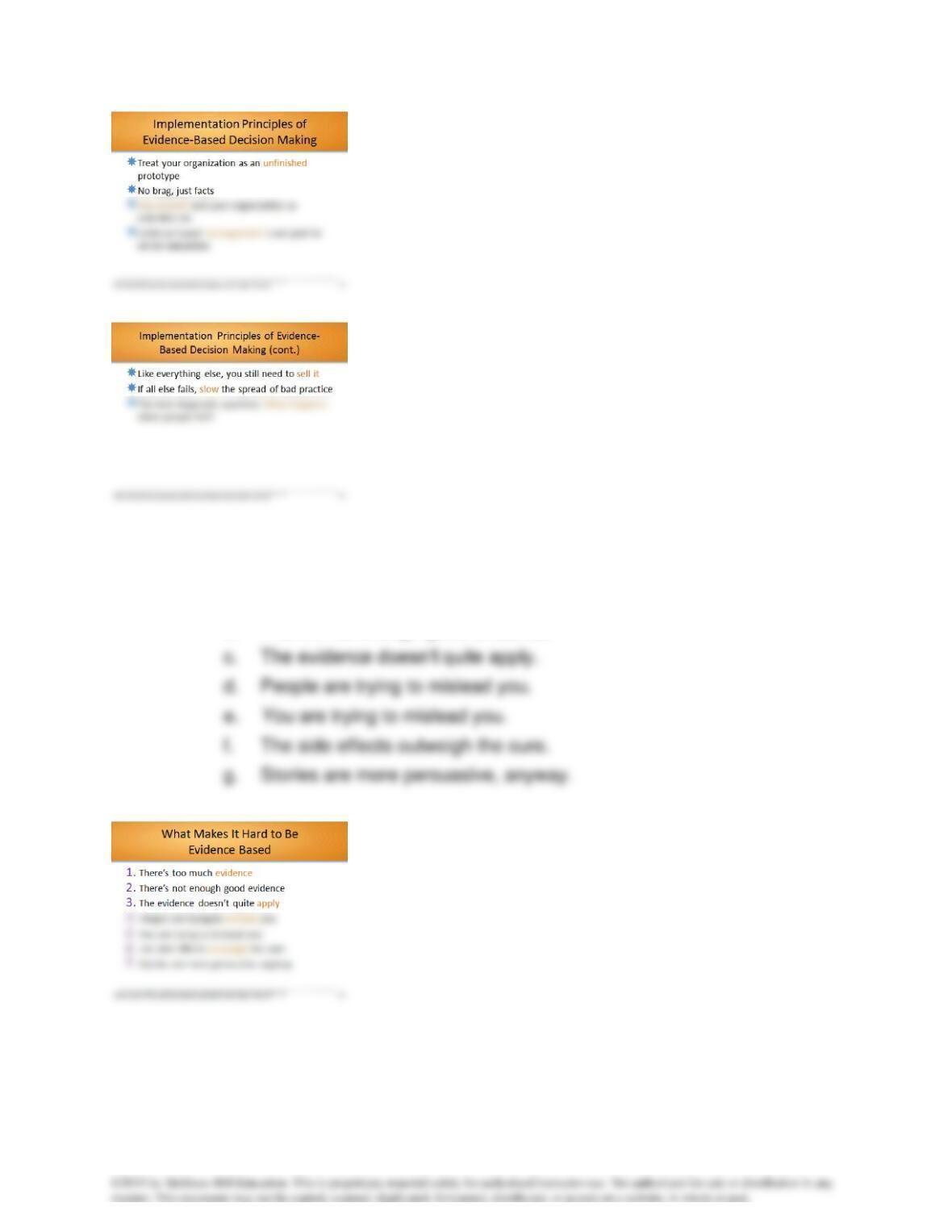
3. What makes it hard to be evidence based – It is hard to bring the best
evidence to bear on your decisions. Among the reasons:
a. There’s too much evidence.
b. There’s not enough good evidence.
Chapter 07 – Individual & Group Decision Making: How Managers Make Things Happen
7-22
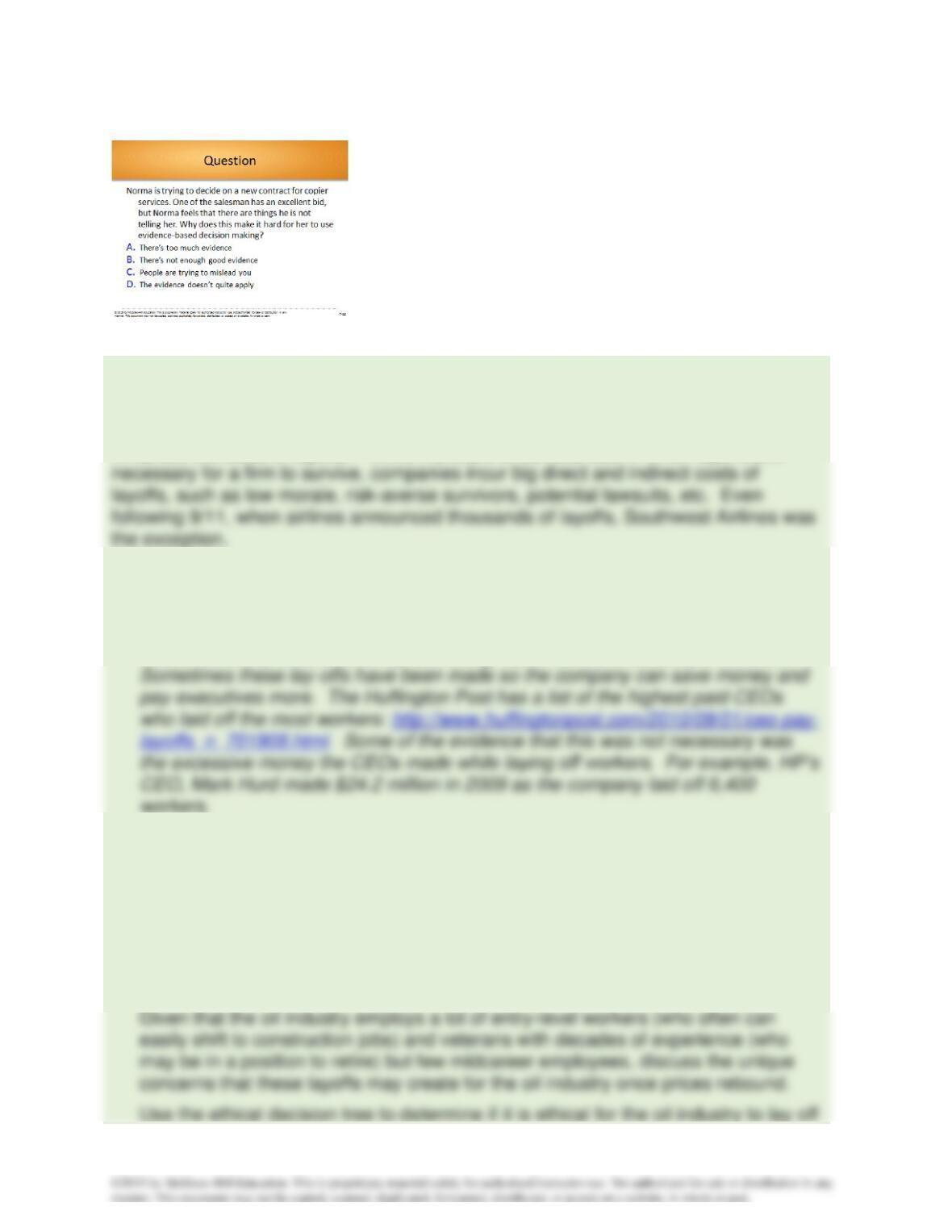
(Correct answer is C)
Interactive Classroom Material:
EXAMPLE: Evidence-Based Decision Making: “If People Are Your Most
Important Assets, Why Would You Get Rid of Them?” (p. 203)
What are the costs of layoffs? While there are circumstances in which layoffs are
YOUR CALL
Can you think of any instances of people being laid off unnecessarily? What is
your evidence that it was not necessary?
There are many instances of lay-offs being made without financial provocation.
Additional Activities:
One way to build on this Example is to have the students watch the CBS News video
“Texas Braces for Massive Layoffs Amid Oil Slump.” This 2-minute profiles the spike
in layoffs as a result of lower oil prices in the spring of 2015. Consider using the
following discussion questions:
How can oil industry firms use evidence-based decision making to determine if
layoffs are a good decision?
Chapter 07 – Individual & Group Decision Making: How Managers Make Things Happen
7-23
B. In Praise of Analytics
1. The purest application of evidence-based management is the use of
analytics.
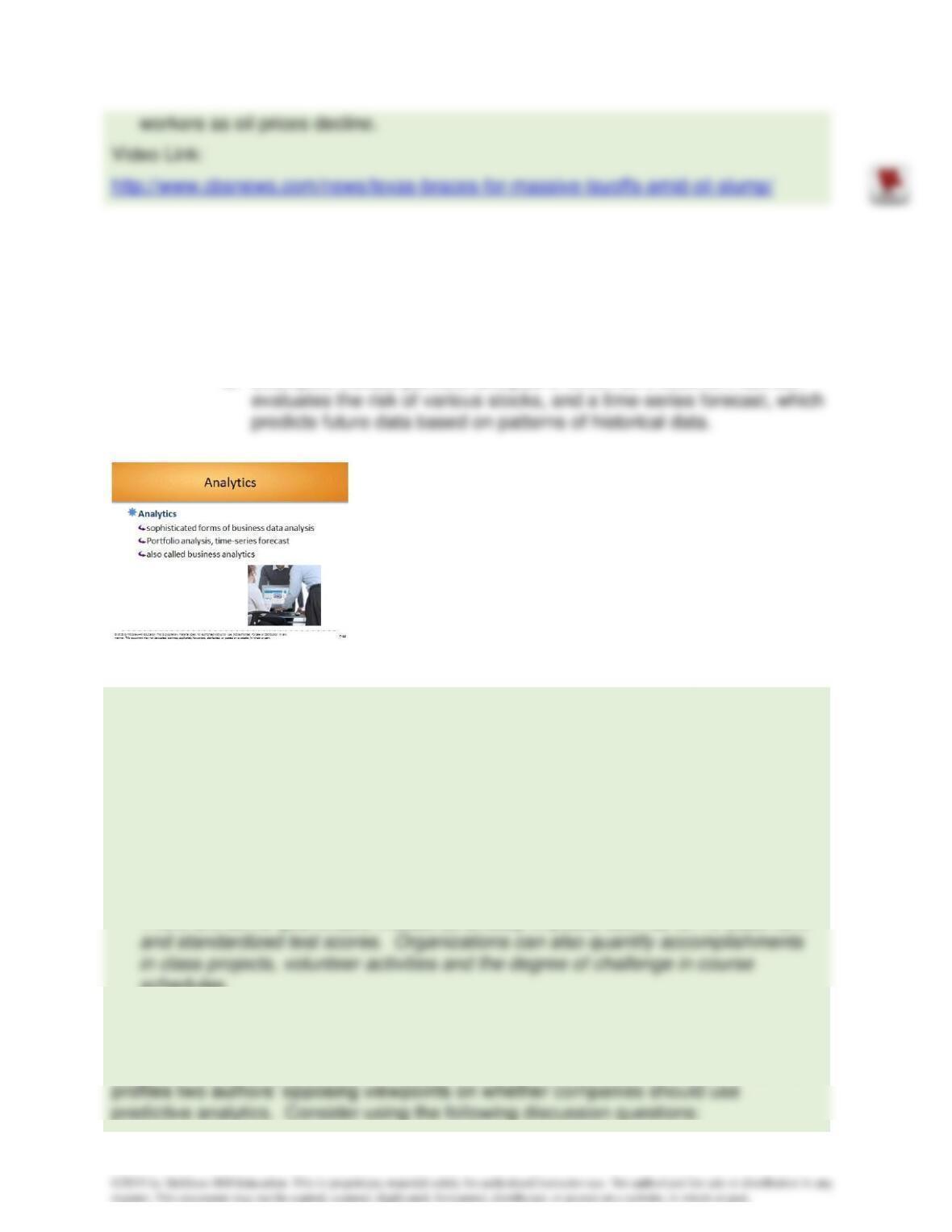
2. Analytics, or business analytics, is the term used for sophisticated
forms of business data analysis.
a. Examples include portfolio analysis in which an investment advisor
Interactive Classroom Material:
EXAMPLE: Analytics in Athletics: The Personal “Moneyball” Coach (p. 204)
Some pro basketball players have personal trainers and chefs, and now some even
have their own personal statistician. The use of analytics in the NBA and NFL has
increased as teams try and find better indicators of player success.
YOUR CALL
What other, more quantifiable measures might be used instead when hiring new
college graduates?
There are some quantifiable measures already in place, such as GPA, class rank
schedules.
Additional Activities:
One way to build on this Example is to have the students read the HR Magazine
article “Should Companies Have Free Rein to Use Predictive Analytics?” The article
Chapter 07 – Individual & Group Decision Making: How Managers Make Things Happen
Summarize the reasons why Karl-Heinz Oehler contends that companies should
use analytics to support HR decisions.
Summarize the reasons why Salvatore Falletta contends that companies should
not use analytics to make employee hiring decisions.
Assume you are the HR manager for your company. What recommendations
would you make about to what extent your firm should rely on analytics in
employee hiring decisions?
ProQuest Document ID: 1684996494
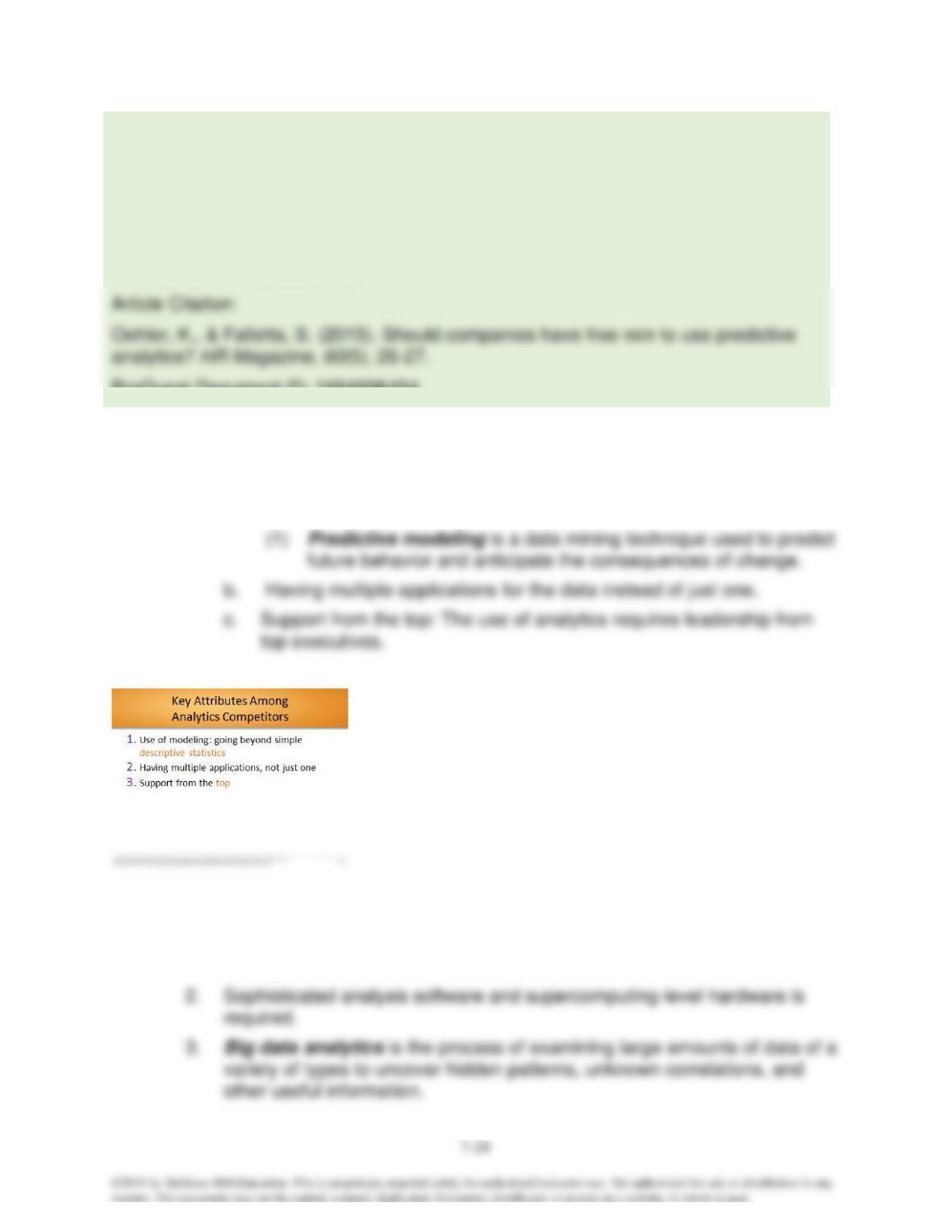
3. Some research finds three key attributes among analytics competitors:
a. Use of modeling: going beyond simple descriptive statistics and using
data mining and predictive modeling.
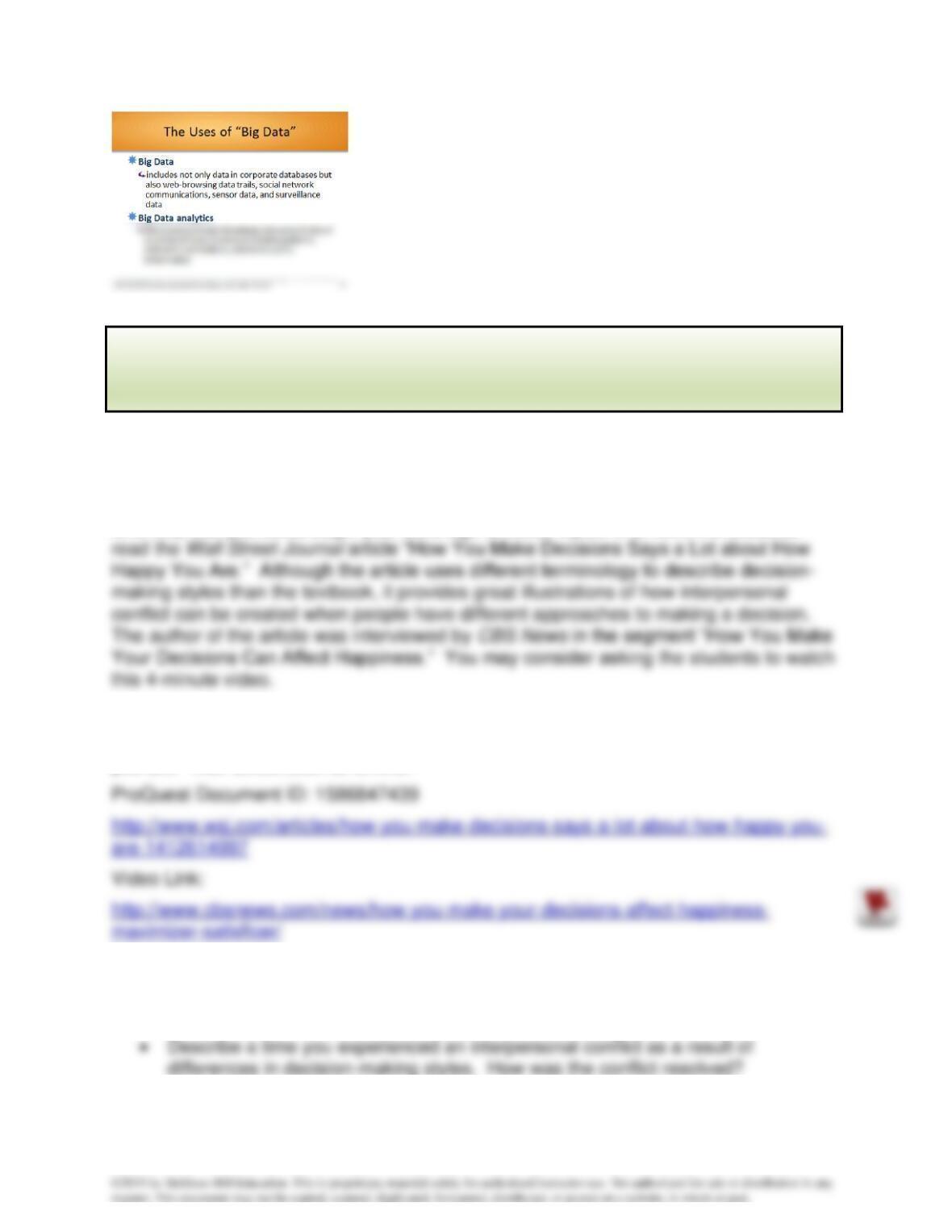
C. The Uses of “Big Data”
1. Big data are stores of data so vast that conventional database
management systems cannot handle them.
Chapter 07 – Individual & Group Decision Making: How Managers Make Things Happen
7-25
Section 7.4 discusses the four general decision making styles of directive, analytical,
conceptual or behavioral. One’s decision-making style reflects how he or she perceives
and responds to information.
One way that you could begin your coverage of these topics is to have the students
Article Citation:
Bernstein, E. (2014, October 6). How you make decisions says a lot about how happy
you are. Wall Street Journal Online.
Possible Topics for Discussion:
• When making a decision, do you like to weigh every option even if it takes a long
time, or do you often think ‘good enough’ is good enough?
7.4 Four General Decision-Making Styles (pp. 206-208)
How do I decide to decide?
Chapter 07 – Individual & Group Decision Making: How Managers Make Things Happen
7-26
Major Idea Outline:
A. A decision-making style reflects the combination of how an individual
perceives and responds to information.
B. One model of decision-making styles bases it on two dimensions:
1. Value orientation – the extent to which a person focuses on either task and
3. Combining the two dimensions creates 4 styles of decision making.
a. Directive
(1) They have low tolerance for ambiguity and are oriented toward task
and technical concerns.
(2) They can also be autocratic and focus on the short run.
b. Analytical

Chapter 07 – Individual & Group Decision Making: How Managers Make Things Happen
7-27
c. Conceptual
(1) They have a high tolerance for ambiguity and focus on the
people/social aspects of a work situation.
d. Behavioral
(1) They work well with others, are supportive and receptive to
suggestions.
4. Which style do you have?
a. Very few people have only one dominant decision-making style.
Chapter 07 – Individual & Group Decision Making: How Managers Make Things Happen
7-28
b. There is not a best decision-making style that applies to all situations.
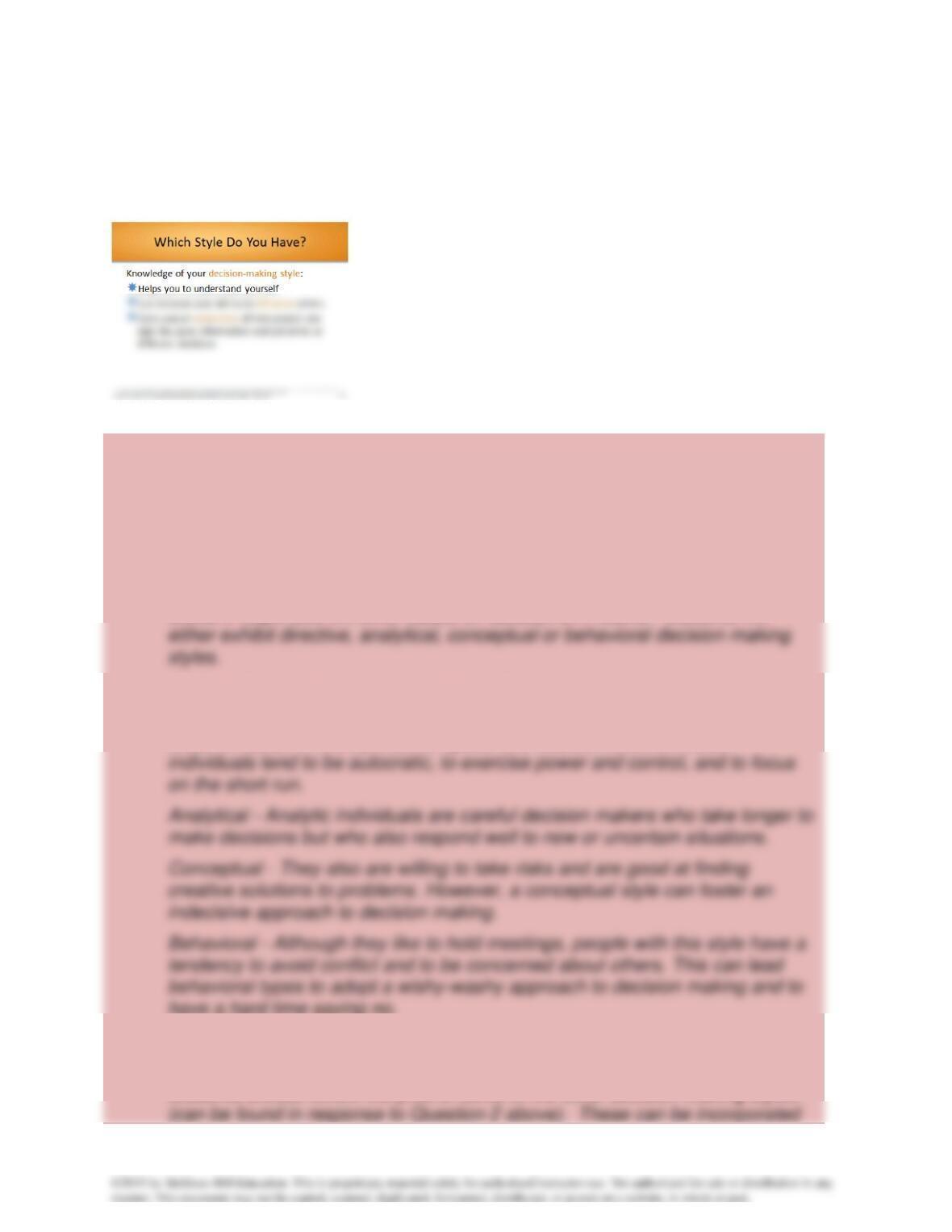
c. You can use knowledge of styles to understand yourself, influence
others and deal with conflict.
SELF-ASSESSMENT 7.3 (p. 208)
What Is Your Decision-Making Style?
Go to connect.mheducation.com and take Self-Assessment 7.3.
Student Questions:
1. What is your dominant decision-making style?
Student responses will differ based on assessment results. Students will
2. What are the pros and cons of your style?
Directive – People with this style are action oriented and decisive and like to
focus on facts. In their pursuit of speed and results, however, these
have a hard time saying no.
3. Based on your results, what are some things you can do to incorporate
aspects of your less dominant styles into your decision making? Explain.
Students should review the pros of some of the other decision-making styles
Chapter 07 – Individual & Group Decision Making: How Managers Make Things Happen
7-29
Additional Activities:
You can also consult the Connect Instructors Manual for the post-assessment activity
and corresponding PowerPoint slides used for this Self-Assessment in Connect. In
Group Exercise #3: Your Preferred Decision-Making Style
There is a group exercise available at the end of this manual that provides students
with an opportunity to further explore their decision-making style.
Exercise Objectives
• To assess your knowledge of decision making.
Section 7.5 discusses the four ineffective and three effective reactions to a decision. It
also expands on the nine common decision-making biases of which managers should
be aware.
One way that you could begin your coverage of these topics is to have the students
Possible Topics for Discussion:
• Describe a time when you displayed an ineffective reaction when faced with a
challenge. How should you have handled the situation differently?
7.5 How to Overcome Barriers to Decision Making
(pp. 209-213)
Trying to be rational isn’t always easy. What are the barriers?
Chapter 07 – Individual & Group Decision Making: How Managers Make Things Happen
Major Idea Outline:
A. People have an “immune system” of the mind, which blunts bad feelings and
smoothes out euphoric ones—this can help make it easier for you to make
difficult decisions.
B. How Do Individuals Respond to a Decision Situation?—Ineffective and
Effective Responses
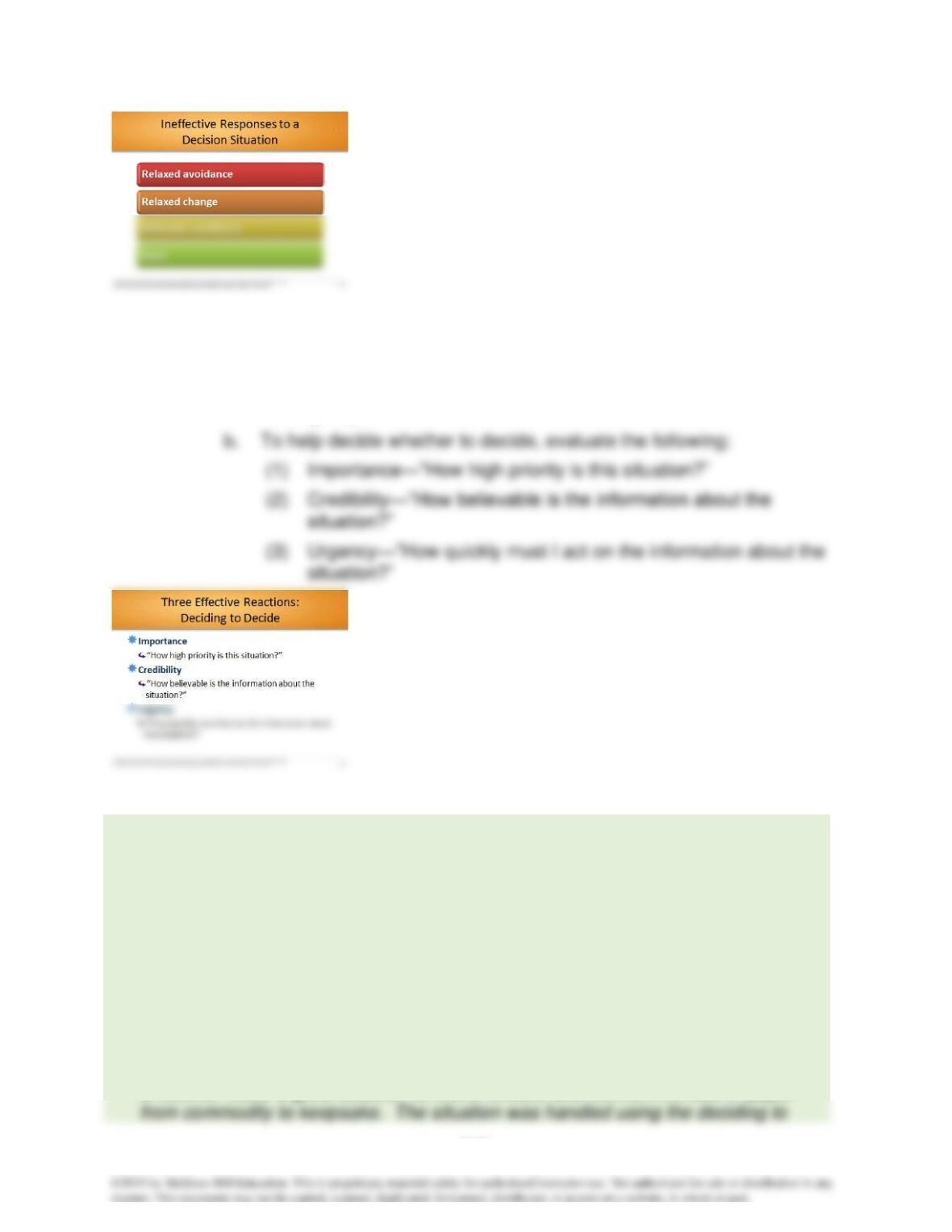
1. When confronted with a challenge, there are four ineffective reactions and
three effective ones.
2. Four ineffective reactions:
a. Relaxed avoidance – “There’s no point in doing anything; nothing
bad’s going to happen.”
b. Relaxed change – “Why not just take the easiest way out?”
(1) A manager realizes that complete inaction will have negative
c. Defensive avoidance – “There’s no reason for me to explore other
solution alternatives.”
(1) A manager can’t find a good solution and follows by
d. Panic – “This is so stressful, I’ve got to do something—anything—to
get rid of the problem.”
(1) A manager is so frantic to get rid of the problem that he or she
Chapter 07 – Individual & Group Decision Making: How Managers Make Things Happen
7-31
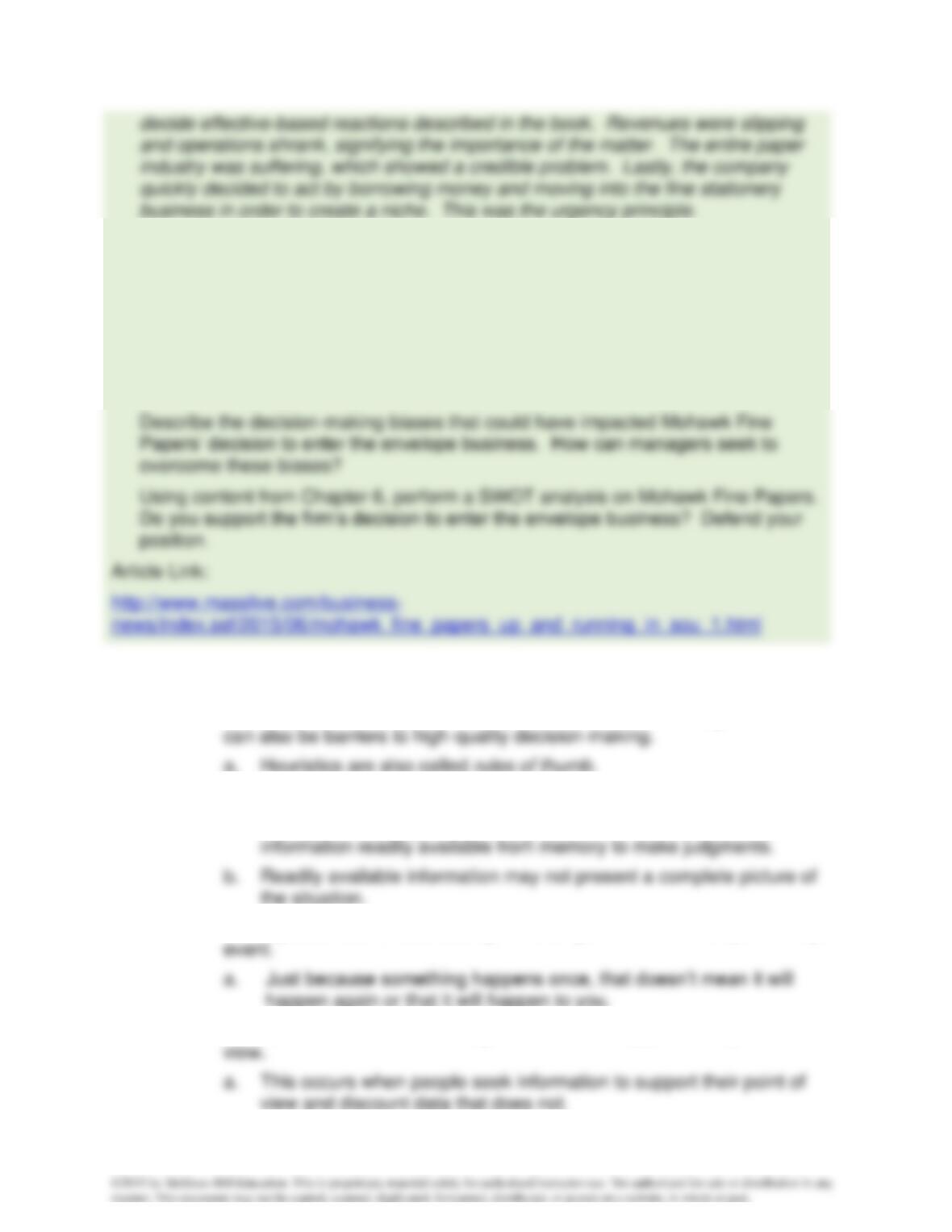
3. Three effective reactions: deciding to decide.
a. In deciding to decide, a manager agrees that he or she must decide
what to do about a problem or opportunity and take effective decision-
making steps.
Interactive Classroom Material:
EXAMPLE: Deciding to Decide: How Should a Paper Maker Reinvent Itself? (p.
211)
In 2000, the paper industry was at its height, with 94 million tons of paper and paper–
based packaging being produced. Then the computer revolution and the vogue
phrase “the paperless office” really began to be felt, and the demand for paper
plummeted.
YOUR CALL
With this knowledge in hindsight, how would you have handled O’Connor’s
initial decisions about finding a new direction for the company?
O’Connor made a good decision to move forward and reinvent the use of paper
Chapter 07 – Individual & Group Decision Making: How Managers Make Things Happen
7-32
Additional Activities:
One way to build on this Example is to have the students read the MassLive article
“Mohawk Fine Papers Up and Running Making Envelopes in South Hadley.” This
article profiles the firm’s continued expansion into new products to offset the decline
of paper sales. Consider using the following discussion questions:
Discuss the factors that likely impacted Mohawk Fine Papers’ “decision to decide”
about entering the envelope industry.
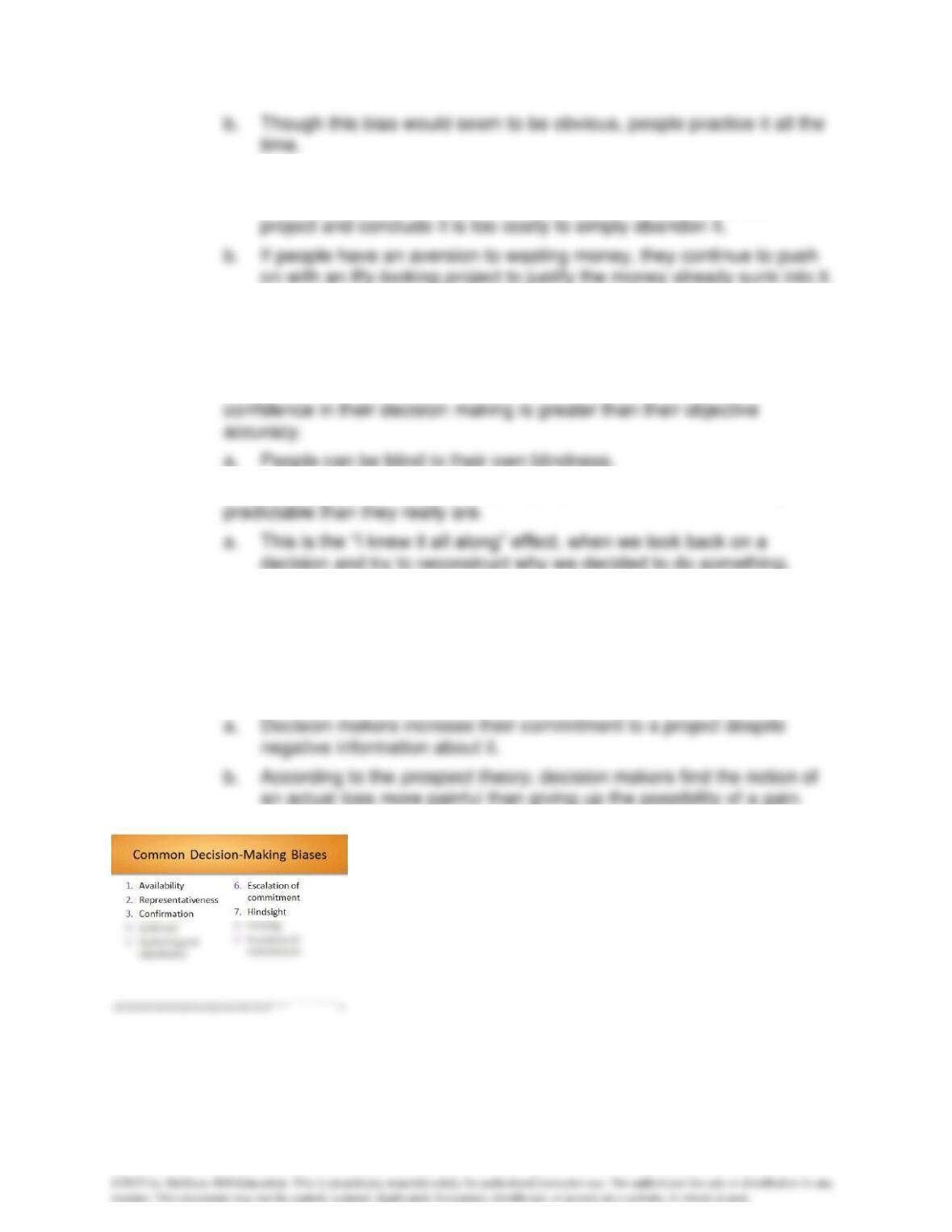
C. Nine Common Decision-Making Biases: Rules of Thumb or “Heuristics”
1. Heuristics are strategies that simplify the process of making decisions but
2. The availability bias: using only the information available.
a. Managers tend to give more weight to more recent behavior and use
3. The representativeness bias: generalizing from a small sample or single
4. The confirmation bias: seeking information to support one’s point of
Chapter 07 – Individual & Group Decision Making: How Managers Make Things Happen
7-33
5. The sunk cost bias: money already spent seems to justify continuing.
a. This occurs when managers add up all the money already spent on a
6. The anchoring and adjustment bias: the tendency to make decisions
based on an initial figure.
a. The bias is that the initial figure may be irrelevant to market realities.
7. The overconfidence bias: the bias in which people’s subjective
8. The hindsight bias: the tendency of people to view events as being more
9. The framing bias – the tendency to be influenced by the way a situation
or problem is presented.
a. How a problem is framed may lead us to consider certain solutions.
10. The escalation of commitment bias – feeling overly invested in a
decision.
Chapter 07 – Individual & Group Decision Making: How Managers Make Things Happen
7-34
Section 7.6 discusses the five potential advantages and four potential disadvantages of
group decision making. There are a number of characteristics of groups that a manager
should be aware of as group problem-solving techniques.
One way that you could begin your coverage of these topics is to have the students
Possible Topics for Discussion:
• Describe situations where individual decision making probably works better than
group decision making.
Major Idea Outline:
A. Research suggests that the best individual, acting alone, can make a better
decision than a group. However, groups make better decisions than most
individuals acting alone.
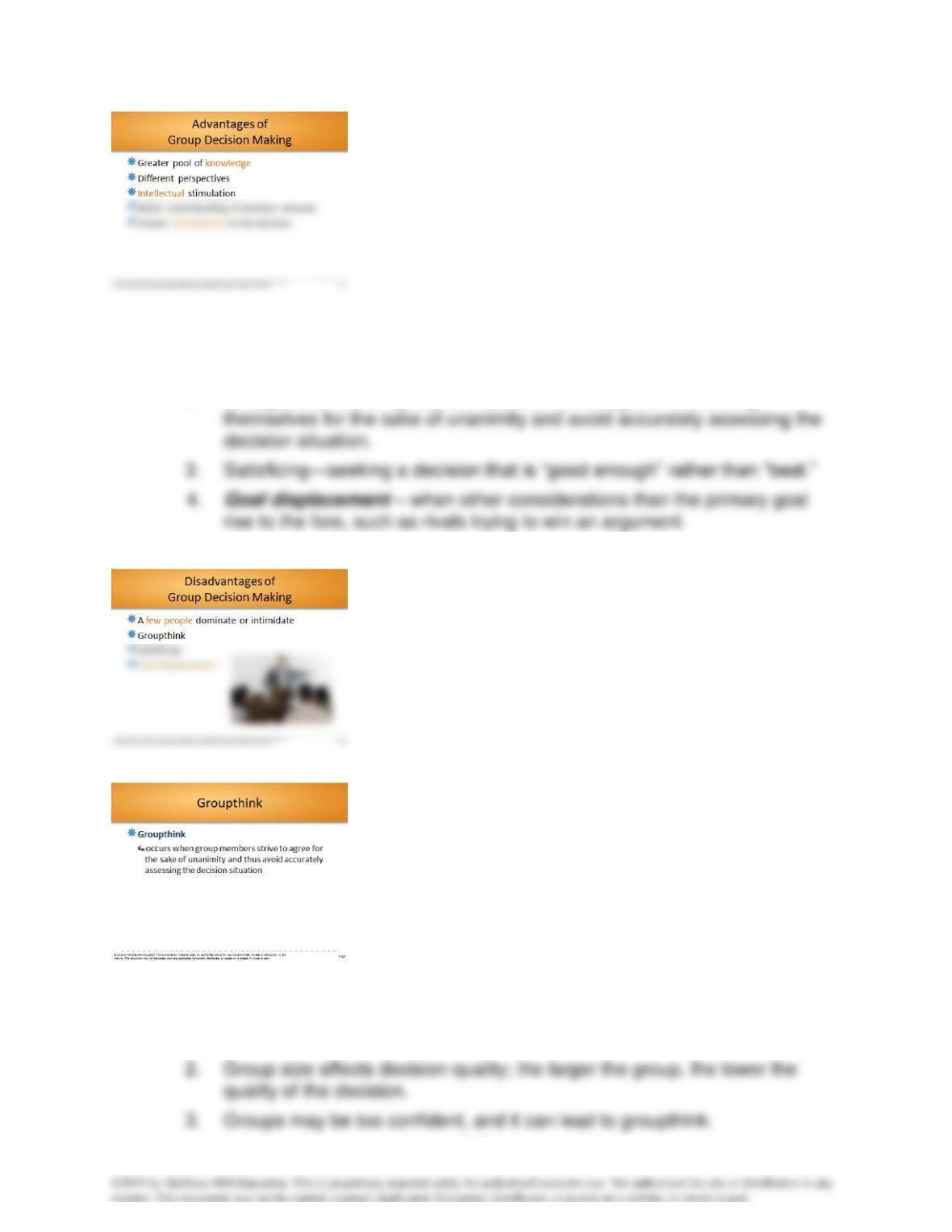
B. Advantages of group decision making:
1. Greater pool of knowledge.
2. Different perspectives.
7.6 Group Decision Making: How to Work with Others
(pp. 214-218)
How do I work with others to make things happen?
Chapter 07 – Individual & Group Decision Making: How Managers Make Things Happen
7-35
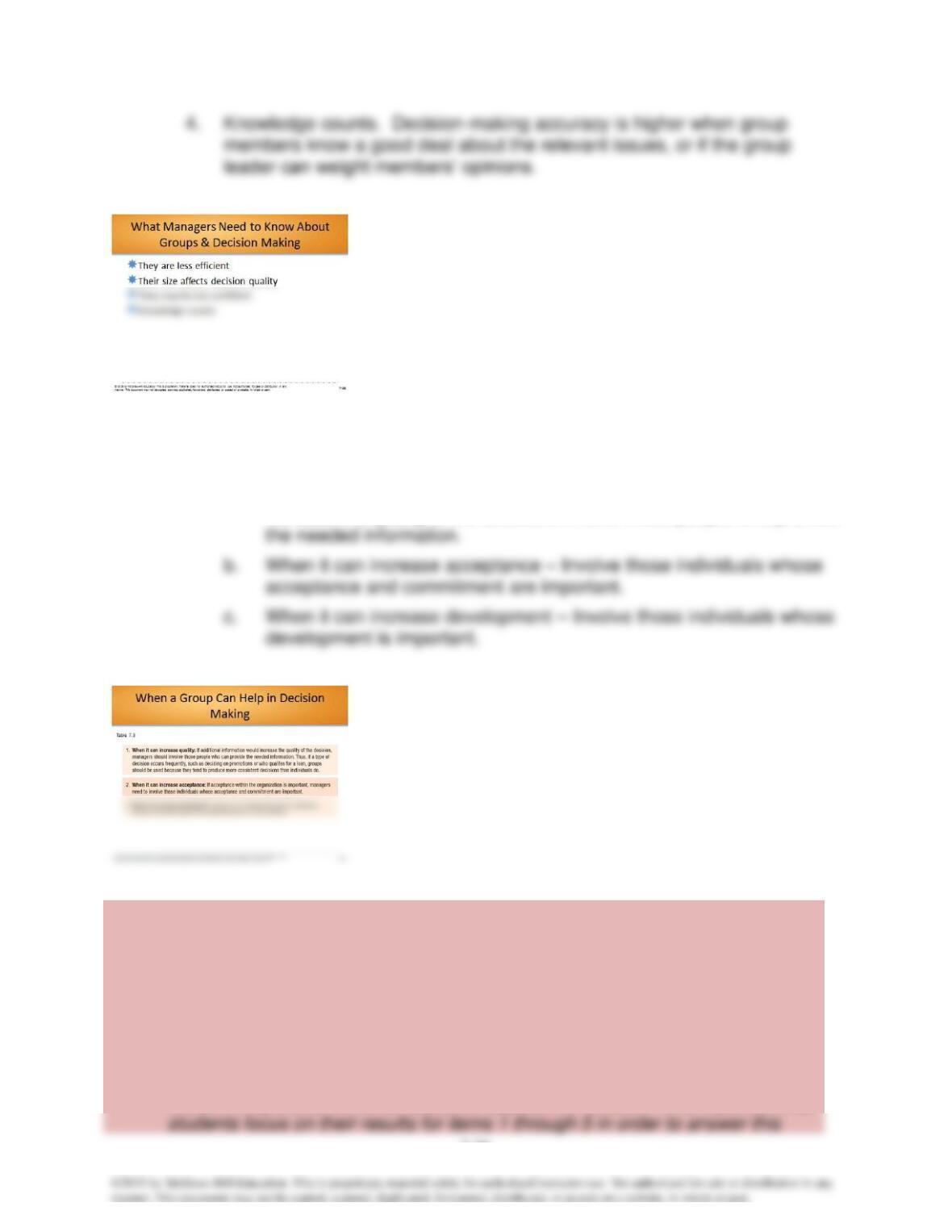
C. Disadvantages of group decision making:
1. A few people dominate or intimidate the group.
2. Groupthink – when group members strive for agreement among
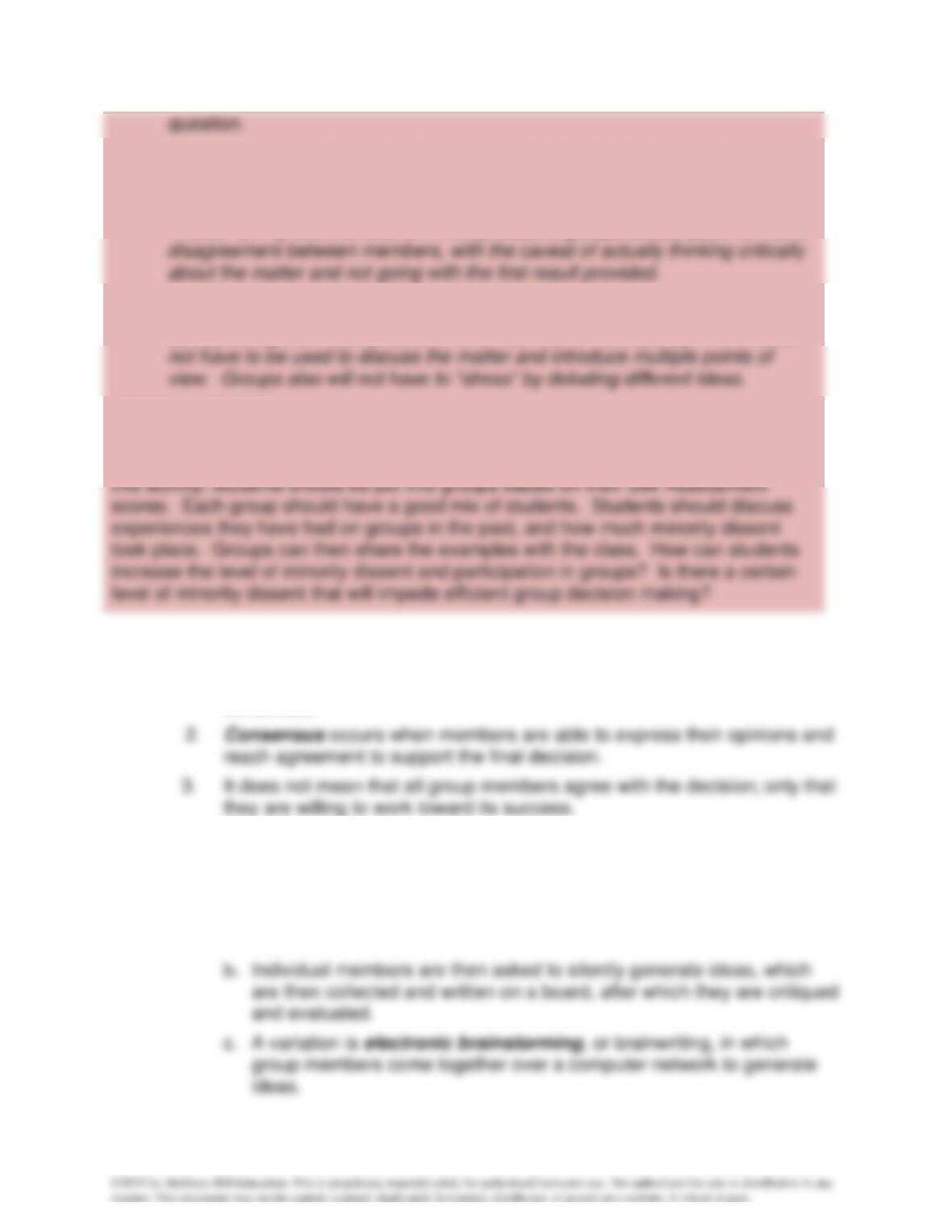
C. What Managers Need to Know about Groups and Decision Making
1. They are less efficient. Groups take longer to make decisions.
Chapter 07 – Individual & Group Decision Making: How Managers Make Things Happen
7-36
5. Managers should also consider using certain guidelines in using groups in
decision making:
a. When it can increase quality – If additional information would
increase the quality of the decision, involve those people who provide
SELF-ASSESSMENT 7.4 (p. 216)
Assessing Participation in Group Decision Making
Go to connect.mheducation.com and take Self-Assessment 7.4.
Student Questions:
1. What is the level of minority dissent in the group, and to what extent are you
satisfied with being a member of this group?
Student responses will differ based on assessment results. It is important that
Chapter 07 – Individual & Group Decision Making: How Managers Make Things Happen
7-37
2. Use the three lowest items that measure minority dissent to answer the
following question: What can you do to increase the level of minority dissent in
this group?
In order to improve the level of minority dissent, groups should allow for more
3. Why do you think many groups muzzle the level of minority dissent?
By bypassing the minority, decisions can be made more quickly. Time does
Additional Activities:
You can also consult the Connect Instructors Manual for the post-assessment activity
and corresponding PowerPoint slides used for this Self-Assessment in Connect. In
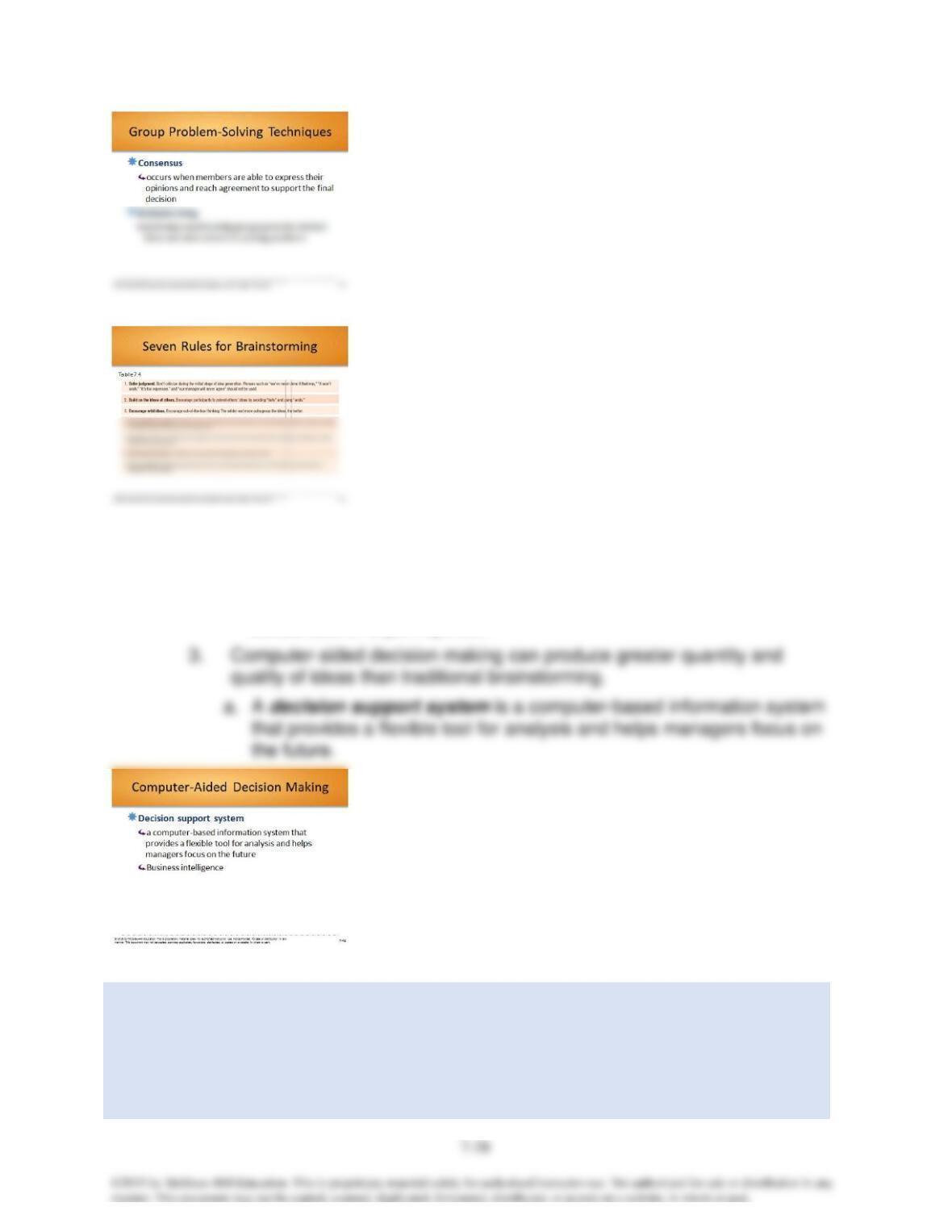
D. Group Problem-Solving Techniques: Reaching for Consensus
1. Using groups to make decisions generally requires that they reach a
consensus.
E. More Group Problem-Solving Techniques
1. Brainstorming is a technique used to help groups generate multiple ideas
and alternatives for solving problems.
a. The technique consists of having members of a group meet and review
a problem to be solved.
Chapter 07 – Individual & Group Decision Making: How Managers Make Things Happen
2. The Delphi Technique is a group process that uses physically dispersed
experts who fill out questionnaires to anonymously generate ideas.
a. The judgments are combined and in effect averaged to achieve a
consensus of expert opinion.
Interactive Classroom Material:
PRACTICAL ACTION: How Exceptional Managers Make Decisions (p. 218)
When should you make a decision and when should you delay? Are there guidelines
for making tough choices? Management consultant Odette Pollar suggests some
ways to make decision making easier:
Chapter 07 – Individual & Group Decision Making: How Managers Make Things Happen
7-39
1. Decide in a timely fashion.
YOUR CALL
What have you found aids you in making decisions?
Student responses will differ here based on past experiences. Some students
Additional Activities:
One way that you could build on this Practical Action is to have the students watch
the Harvard Business Review video “How to Make Better Decisions.” In this 10–
minute video, John Beshears and Francesca Gino of Harvard Business School
Describe how you could test a proposed solution to determine whether it will
accomplish its objectives and discuss why this is an important step in the decision-
making process.
Group Exercise #4: Stranded in the Desert: An Exercise in Decision-Making
There is a group exercise available at the end of this manual that allows students to
Exercise Objective
• To determine the effectiveness of individual versus group decision making.
Chapter 07 – Individual & Group Decision Making: How Managers Make Things Happen
7-40
7.1 How do people know when they’re being logical or illogical?
Being logical or not all depends on rationality. The four steps in making a
7.2 What guidelines can I follow to be sure that decisions I make are not just
lawful but ethical?
One should follow the ethical decision tree to make decisions that are not just
lawful, but also ethical. The following questions should be asked:
7.3 How can I improve my decision making using evidence-based management
and business analytics?
Evidence-based management has seven implementation principles that you
should follow to improve your decision making: 1) Treat your organization as an
multiple applications, and support from top management.
7.4 How do I decide to decide?
“Deciding to decide” starts with choosing a decision-making style. A decision-
CHALLENGE: MAJOR QUESTIONS