Kinicki/Williams, Management, 9e: Chapter 7 Individual and Group Decision Making: How Managers
Make Things Happen
7-i
Chapter 7
Individual and Group Decision Making:
How Managers Make Things Happen
CHAPTER CONTENTS
Teaching Resource Manual: A Guide to Implementation ii
Overview of the Chapter 7
Classroom Outline 8
Legal/Ethical Challenge Case 41
Group Exercises 53
Uber Continuing Case 67
Manager’s Hot Seat Videos 69
Application-Based Activity 71
Kinicki/Williams, Management, 9e: Chapter 7 Individual and Group Decision Making: How Managers
Make Things Happen
7-ii
TEACHING RESOURCE MANUAL: A GUIDE TO IMPLEMENTATION
The purpose of the Teaching Resource Manual (TRM) is to support you in the delivery of your
chosen curriculum in either a face-to-face or online classroom formats. It also was created to
help you address some of the following challenges in higher education:
• Addressing the inability to measure student comprehension prior to major assignments
such as a midterm or project.
You will learn that we created many different teaching resources you can use either before,
So What Assets Can I Choose From?
Generally, a typical class session for any course comprises three “touch points:” before, during,
and after class. For a face-to-face course, your class session would normally be the day you
lecture to students. For an online course, the class session would be when you recorded the
Assigning SmartBook 2.0 and Connect® Exercises
SmartBook 2.0, (In Connect®, click on Performance / Reports / Assignment Results. Here you
can choose SmartBook and choose the assignment you wish to view reports for.) The following
reports are available through SmartBook 2.0:
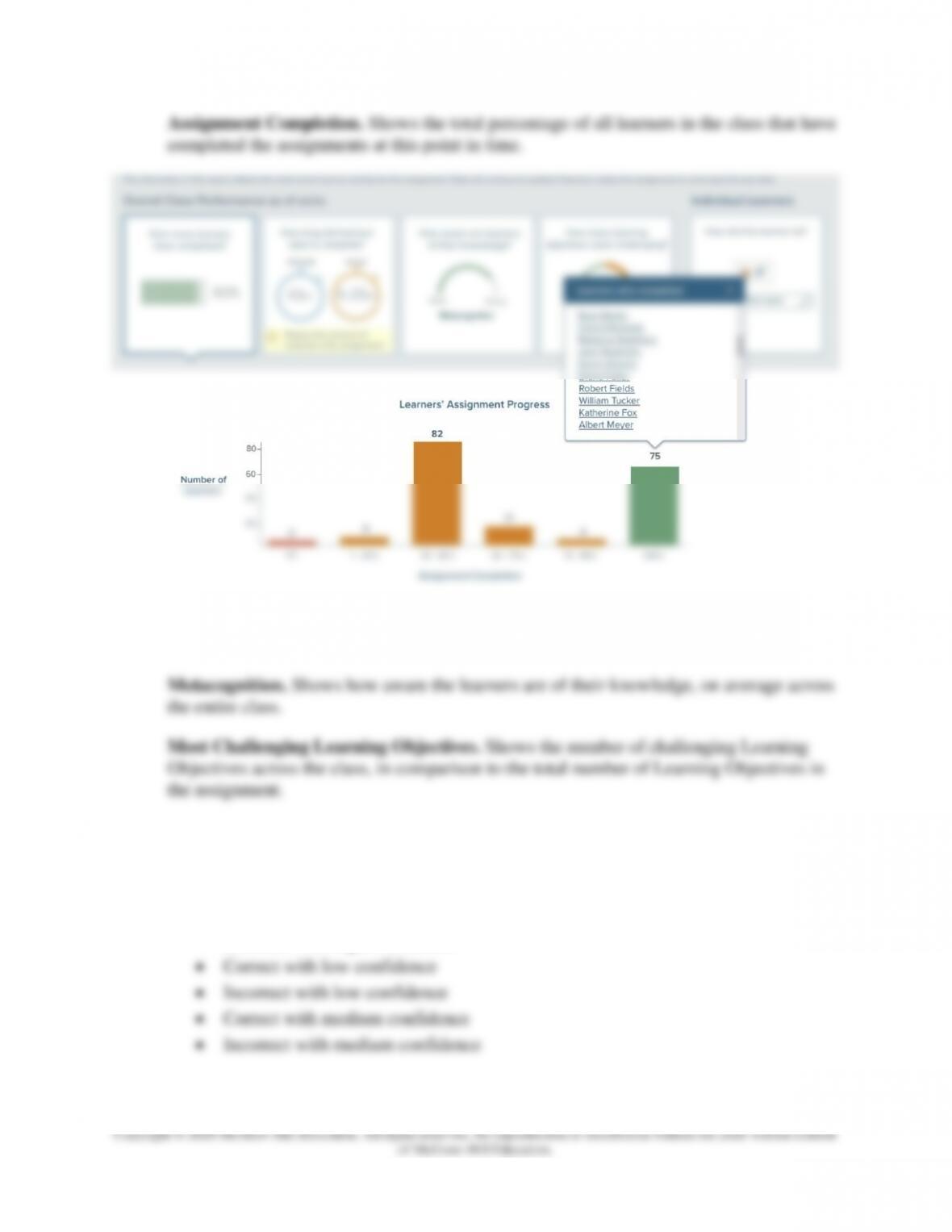
Instructor Dashboard. Click on one of the tiles from Assignment Completion, Time on
Task, Metacognition, Most Challenging Learning Objectives, and Individual Learners.
Kinicki/Williams, Management, 9e: Chapter 7 Individual and Group Decision Making: How Managers
Make Things Happen
7-iii
Copyright © 2020 McGraw-Hill Education. All rights reserved. No reproduction or distribution without the prior written consent
of McGraw-Hill Education.
Assignment Completion. Shows the total percentage of all learners in the class that have
completed the assignments at this point in time.
Time on Task. Provides the user with a class-level view of the estimated time in
comparison to the actual average time to completion across the entire class.
Individual Learner Report. System provides all the assignment data available for that
specific student at that point in time, showing a breakdown of all questions answered in
each of the following categories:
• Correct with high confidence
• Incorrect with high confidence
Kinicki/Williams, Management, 9e: Chapter 7 Individual and Group Decision Making: How Managers
Make Things Happen
7-iv
With Connect®, you can build your own course, make changes to the course throughout the
semester, and use auto-grading. Connect® integrates with other Learning Management Systems,
include Blackboard®, Canvas, and D2L. Students can study anytime with the free
ReadAnywhere app, create personalized study plans, and the Connect® Calendar and Report
tools will help keep them on track.
Connect® gives you a wide array of flexibility in making assignments and creating grading
policies. You may choose to:
• assign as many assignments as appropriate.
Some recommendations include:
• Before selecting the option for one attempt only, select unlimited or multiple attempts on
the first few assignments to allow students a chance to learn and navigate the system.
So When Do I Assign Each Type of Teaching Resource?
7-v
Copyright © 2020 McGraw-Hill Education. All rights reserved. No reproduction or distribution without the prior written consent
of McGraw-Hill Education.
you can now tailor your classrooms to pinpoint and address critical challenges, thereby creating
the greatest impact and assisting students develop higher-order thinking skills.
The following recommendations pertain to these mentioned touch points, with an additional
matrix that follows.
Before Class
The learning goals we have for students determines our assignments before, during and after
class. For example, you may want to focus on mastering content, applying content, or using
content to solve problems. Alternatively, you may want to achieve all three goals.
Finally, you can use iSeeIt Animated Videos to emphasize content we have found difficult for
students to understand. These animated videos were developed to further unpack in brief, yet
effective, fashion the course topics that most commonly challenge students. Each animated video
is accompanied by auto-graded multiple-choice questions that can be assigned to confirm student
comprehension.
Kinicki/Williams, Management, 9e: Chapter 7 Individual and Group Decision Making: How Managers
Make Things Happen
7-vi
During Class
If your goal is to provide for additional application of material, the TRM breaks down the
textbook Management in Action cases and Legal/Ethical Challenges by providing questions and
ideal responses. Connect® also has multiple-choice questions that can be assigned for the
Management in Action Cases. Finally, the TRM has a selection of group exercises that allows
instructors to focus on team learning methods.
After Class
After the face-to-face class session, or online lecture, you can assign Connect® exercises as
homework to further reinforce the material covered in the textbook and lecture. You may also
want to assign an iSeeIt! Animated Video if you notice that students are struggling with a
particular topic, even after class. Students can also be assigned the continuing case for each
Kinicki/Williams, Management, 9e: Chapter 7 Individual and Group Decision Making: How Managers
Make Things Happen
There are both theory-based questions that have right and wrong answers, and there are also
branching questions that allow students to make ideal, sub-ideal, and incorrect decisions based
on the theory they’ve learned. A student’s particular path in the activity will depend on the
decisions made on the branching questions. Application-Based Activities should be utilized after
a student has had at least one pass at the chapter content as they do not introduce new material.
Rather, they encourage students to apply, analyze, and evaluate material they already understand.
A Special Focus on Career Readiness
The ninth edition has a new strategic focus on career readiness. The authors’ goal is to provide
you the information and teaching resources needed to develop students’ career readiness
competencies desired by employers. The authors provide you the following information and
resources:
• Chapter 1, Section 1.7, introduces the concept of career readiness and identifies the
competencies desired by employers.
• Career Corner sections in each chapter link chapter content to career readiness
competencies.
Kinicki/Williams, Management, 9e: Chapter 7 Individual and Group Decision Making: How Managers
Make Things Happen
7-viii
CAREER READINESS-BASED PERSONAL DEVELOPMENT PLAN
This ninth edition of Management: A Practical Introduction includes a new strategic theme
around the concept of career readiness in order to address the employers’ complaints of
graduating students not possessing the needed skills to perform effectively. We deeply care about
this issue and hope that this new feature will assist instructors develop their students’ career
readiness.
Asking students to create a career readiness development plan is one straightforward way to
guide your students toward higher career readiness. Angelo Kinicki has been doing this for years
with his students and wants to provide you the guidance to do the same.
The instructor’s and students’ instructions for drafting a personal development plan are
located in the Chapter 1 TRM.
CAREER
READINESS
Kinicki/Williams, Management, 9e: Chapter 7 Individual and Group Decision Making: How Managers
Make Things Happen
7-ix
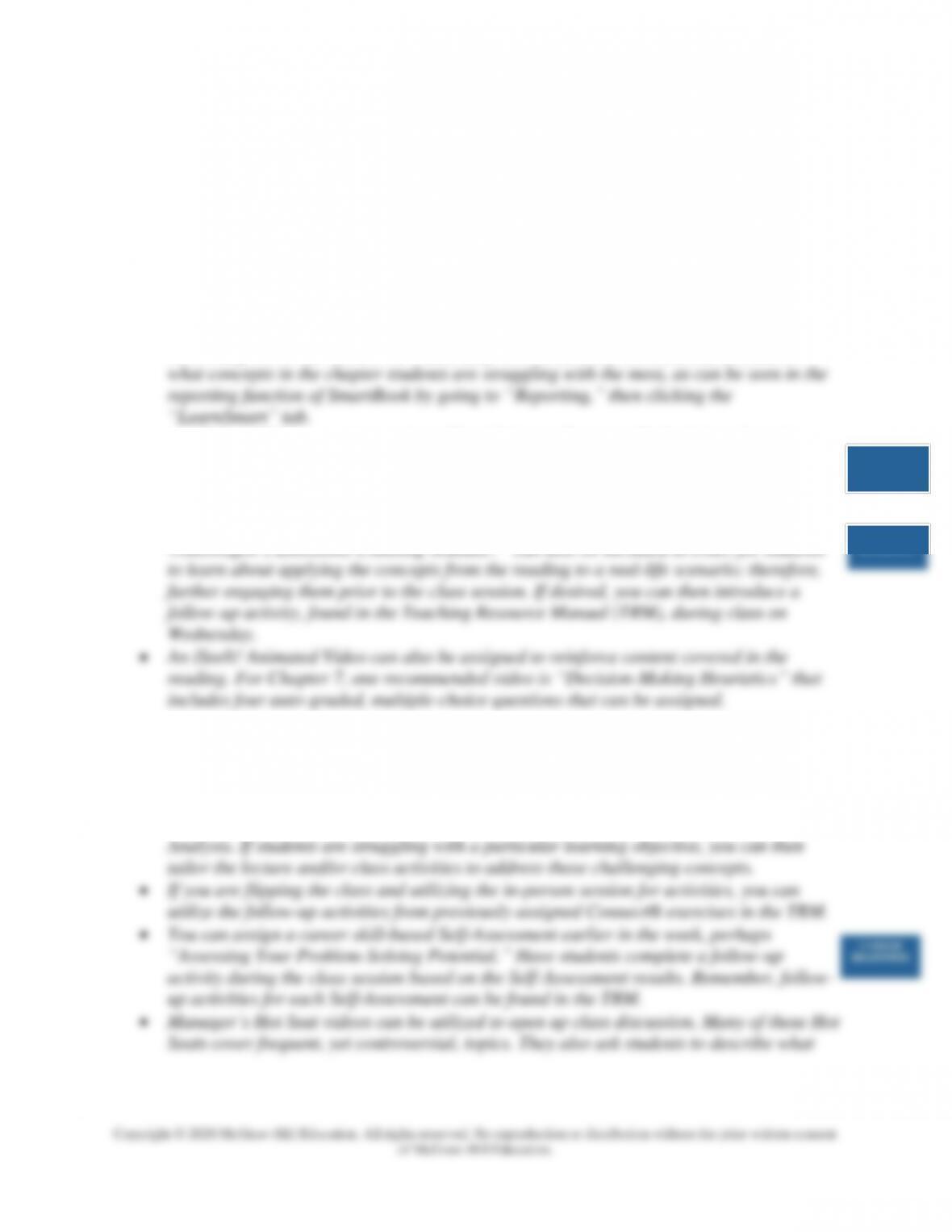
Note: The above-mentioned assets are generally assignable and auto-gradable, except for those listed with an M as those require manual grading.
Please note that some resources will require a paid subscription.
SUGGESTED RESOURCES ACROSS TEACHING TOUCH POINTS MATRIX
Type of Asset
Before-Class/Lecture
During-Class/Lecture
After-Class/Lecture
SmartBook 2.0
Click and Drag Exercises
iSeeIt! Animated Videos
Self-Assessments
Case Analyses
Video Cases
Example and Practical
Action BoxesM
Group Exercises/Career
Group ExercisesM
TRM Discussion StartersM
TRM Follow-up activities
for Case Analyses, Video
Cases, Self-Assessments,
and Example/Practical
Action BoxesM
Quizzes/Tests
Uber Continuing Case
Management in Action
CaseM
Legal/Ethical Challenge
CaseM
Manager’s Hot Seat Videos
Application-Based
Activities
CAREER
READINESS
CAREER
READINESS
CAREER
READINESS
Kinicki/Williams, Management, 9e: Chapter 7 Individual and Group Decision Making: How Managers
Make Things Happen
7-x
A Week at a Glance
When creating a syllabus and schedule for students, you can utilize the above-mentioned matrix
as a guide. Let’s use the following example: You teach a face-to-face Principles of Management
course, and the course meets once-a-week on Wednesday afternoons. If this is the seventh week
of the semester and you are covering Chapter 7 on decision making, the following format can be
utilized:
Before Class (before Wednesday)
• Assign Chapter 7 in SmartBook, making it due Tuesday evening so that reporting can be
reviewed prior to the lecture on Wednesday. The lecture can be customized based on
• A Click and Drag exercise, such as “Establishing a Decision Methodology,” can be
assigned. This can also be due on Wednesday so that students are able to practice prior
to class, and you can also review results prior to lecturing. This Click and Drag exercise
supports career readiness competencies.
• A Connect® case analysis, such as “How Did Decision Making Contribute to
Volkswagen’s Emissions Cheating Scandal?” can also be included in order for students
During Class (on Wednesday)
• You can deliver a short, yet effective, lecture and focus on areas that students are really
struggling with. This can be done by reviewing the reporting from SmartBook and any
assigned Connect® exercises, such as the recommended Click and Drag and Case
CAREER
READINESS
CAREER
READINESS
Kinicki/Williams, Management, 9e: Chapter 7 Individual and Group Decision Making: How Managers
Make Things Happen
7-xi
Copyright © 2020 McGraw-Hill Education. All rights reserved. No reproduction or distribution without the prior written consent
of McGraw-Hill Education.
their decision-making process would be in those situations. Often, students will
recommend conflicting approaches to solving the issues in the videos; therefore, there is
more class engagement. For Chapter 7, one recommended Manager’s Hot Seat is
“Decision Making—A Hurricane of a Choice.”
• If time allows, and you would like to dive into real situations, you can discuss an
Example Box from the text titled, “The Power of Intuition.” There is an additional in-
class activity in the TRM related to the Example Box.
After Class (after Wednesday)
• You can assign a Connect® exercise, such as the Continuing Case on Uber, to reinforce
student comprehension of material and to also test application of concepts.
If you are teaching a completely online course asynchronously, then the in-person class above
can be substituted for a recorded online lecture that is customized based on SmartBook reporting.

Kinicki/Williams, Management, 9e: Chapter 7 Individual and Group Decision Making: How Managers
Make Things Happen
7-1
LEARNING OBJECTIVES
7.1 Compare rational and nonrational decision making.
7.3 Describe how evidence-based management and business analytics contribute to decision
making.
7.5 Identify barriers to rational decision making and ways to overcome them.
7.7 Describe how to develop the career readiness competencies of critical thinking/problem
solving and decision making.
Kinicki/Williams, Management, 9e: Chapter 7 Individual and Group Decision Making: How Managers
Make Things Happen
TEACHING RESOURCES
Section
Title
Resource Type
7.1: Two Kinds of Decision
Making: Rational &
Nonrational
After 25,000 Stores in 78
ONLINE
Kinicki/Williams, Management, 9e: Chapter 7 Individual and Group Decision Making: How Managers
with Supplemental Activity
Workforce
with Supplemental Activity
with Supplemental Activity
Connect® Click and
Drag
Connect® Video Case
7.4: Four General Decision-
Trying to Solve an “Electric”
Problem in Managerial Planning
with Supplemental Activity
Group Exercise
7.2: Making Ethical
Decisions
Follow Dubious Orders or Speak
Up
with Supplemental Activity
Harvard Business Review
Case Study
Ethical Decision Making
Group Exercise
7.3: Evidence-Based
Decision Making &
Analytics
Trust the Algorithm or Your Gut?
with Supplemental Activity
Harvard Business Review
Case Study
CAN BE
USED
ONLINE
ONLINE
ARTICLE
ONLINE
ARTICLE
Kinicki/Williams, Management, 9e: Chapter 7 Individual and Group Decision Making: How Managers
Make Things Happen
7-4
The Right and Wrong Way to
Manage Up at the Office
with Supplemental Activity
What Is Your Decision-Making
Style?
with Self-Assessment Activity
Self-Assessment
Decision-Making Styles
Connect® Click and
Drag
Your Preferred Decision-Making
Style
Group Exercise
7.5: Decision-Making Biases
and the Use of Artificial
Intelligence
The Explainer: Hidden Traps in
Decision-Making
with Supplemental Activity
(2-minutes)
Decision-Making Biases
Connect® Click and
Drag
Applications and Downsides of
Artificial Intelligence
Connect® Click and
Drag
How Did Decision Making
Contribute to Volkswagen’s
Emissions Cheating Scandal?
Connect® Case Analysis
7.6: Group Decision
Making: How to Work with
Others
How Can Groups Make Good
Decisions?
with Supplemental Activity
(9 minutes)
CAREER
ONLINE
ARTICLE
ONLINE
VIDEO
ONLINE
VIDEO
Kinicki/Williams, Management, 9e: Chapter 7 Individual and Group Decision Making: How Managers
Make Things Happen
Advantages and Disadvantages of
Group Decision Making
Connect® Click and
Drag
Assessing Groupthink
with Self-Assessment Activity
Self-Assessment
Assessing Participation in Group
Decision Making
with Supplemental Activity
Self-Assessment
Rules for Brainstorming
Connect® Click and
Drag
Contrasting Devil’s Advocacy and
the Dialectic Approach
Connect® Click and
Drag
Stranded in the Desert: An
Exercise in Decision-Making
Group Exercise
7.7: Career Corner:
Managing Your Career
Readiness
3 Lessons on Decision Making
from a Poker Champion
with Supplemental Activity
(3 minutes)
Establishing a Decision
Methodology
Connect® Click and
Drag
Establishing a Decision
Methodology
Career Corner Group
Exercise
Creating Sets of Ready-Made
Solutions
Career Corner Group
Exercise
CAREER
READINESS
ONLINE
VIDEO
Comprehensive Materials
New York’s Subway System Is
Crumbling
Textbook Management in
Action
Kinicki/Williams, Management, 9e: Chapter 7 Individual and Group Decision Making: How Managers
Make Things Happen
7-6
It’s All about a Peacock
Textbook Legal/Ethical
Challenge
Uber Case: Decision Making
Uber Continuing Case
Decision Making: A Hurricane of
a Choice
Manager’s Hot Seat
Video
Decision Making: A Bridge over
Troubled Water
Application-Based
Activity
Please note Harvard Business Review articles are subscription-based or accessible via hbsp.harvard.edu as
examination copy. Also note that resources like The Wall Street Journal will require a paid subscription.
CAN BE
USED
ONLINE
Kinicki/Williams, Management, 9e: Chapter 7 Individual and Group Decision Making: How Managers
Make Things Happen
7-7
OVERVIEW OF THE CHAPTER
7.1 Two Kinds of Decision Making: Rational and Nonrational
Decision making, the process of identifying and choosing alternative courses of action,
7.2 Making Ethical Decisions
A graph known as a decision tree can help one make ethical decisions.
7.3 Evidence-Based Decision Making & Analytics
Evidence-based decision making, which depends on an “attitude of wisdom,” rests on
7.4 Four General Decision-Making Styles
7.5 How to Overcome Barriers to Decision Making
7.6 Group Decision Making: How to Work with Others
7.7 Career Corner: Managing Your Career Readiness
Kinicki/Williams, Management, 9e: Chapter 7 Individual and Group Decision Making: How Managers
Make Things Happen
CLASSROOM OUTLINE
Manage U: How to Make Good Decisions
Decision making is a critical skill for managers to develop. There are some general guidelines
managers should apply to any formal or informal decision-making process. First, it is important
to keep your mind open to new perspectives and ideas. You need to be ready to take in all valid
Possible Topics for Discussion:
▪ How able are you to make the tough decisions effective managers have to make?
▪ What other kinds of decision-making tools do you think would be helpful to you?