Solutions for Chapter 7: Questions and Problems
CHAPTER 7
ASSET PRICING MODELS: CAPM and APT
Answers to Questions
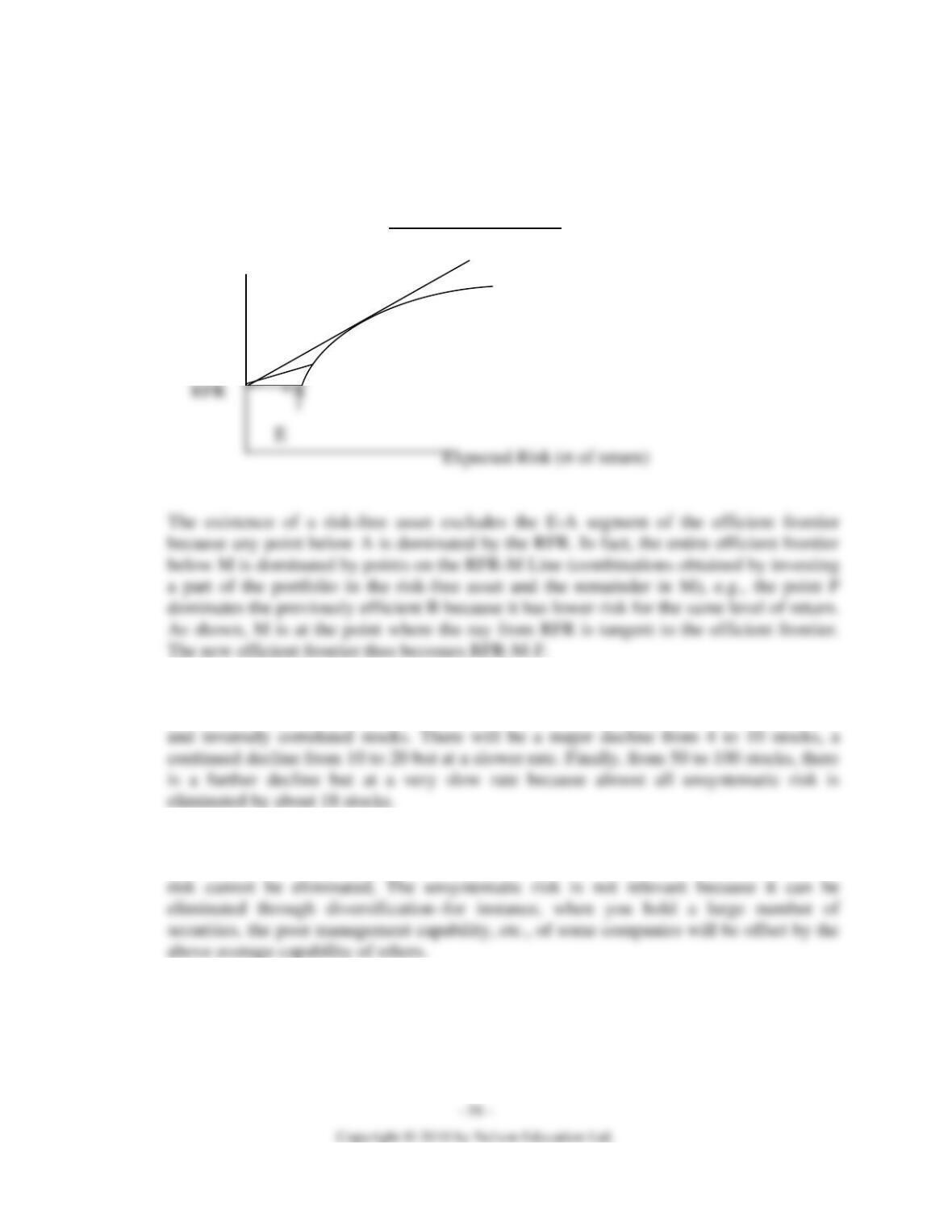
1. Expected Rate
of Return * F
M *
P *
* B
2. Standard deviation would be expected to decrease with an increase in stocks in the
portfolio because an increase in number will increase the probability of having more low
3. In a capital asset pricing model (CAPM) world the relevant risk variable is the security’s
systematic risk – its covariance of return with all other risky assets in the market. This
4. Similarities: they both measure the relationship between risk and expected return.
Differences: First, the CML measures risk by the standard deviation (i.e., total risk) of the
investment while the SML explicitly considers only the systematic component of an
investment’s volatility. Second, as a consequence of the first point, the CML can only be
Solutions for Chapter 7: Questions and Problems
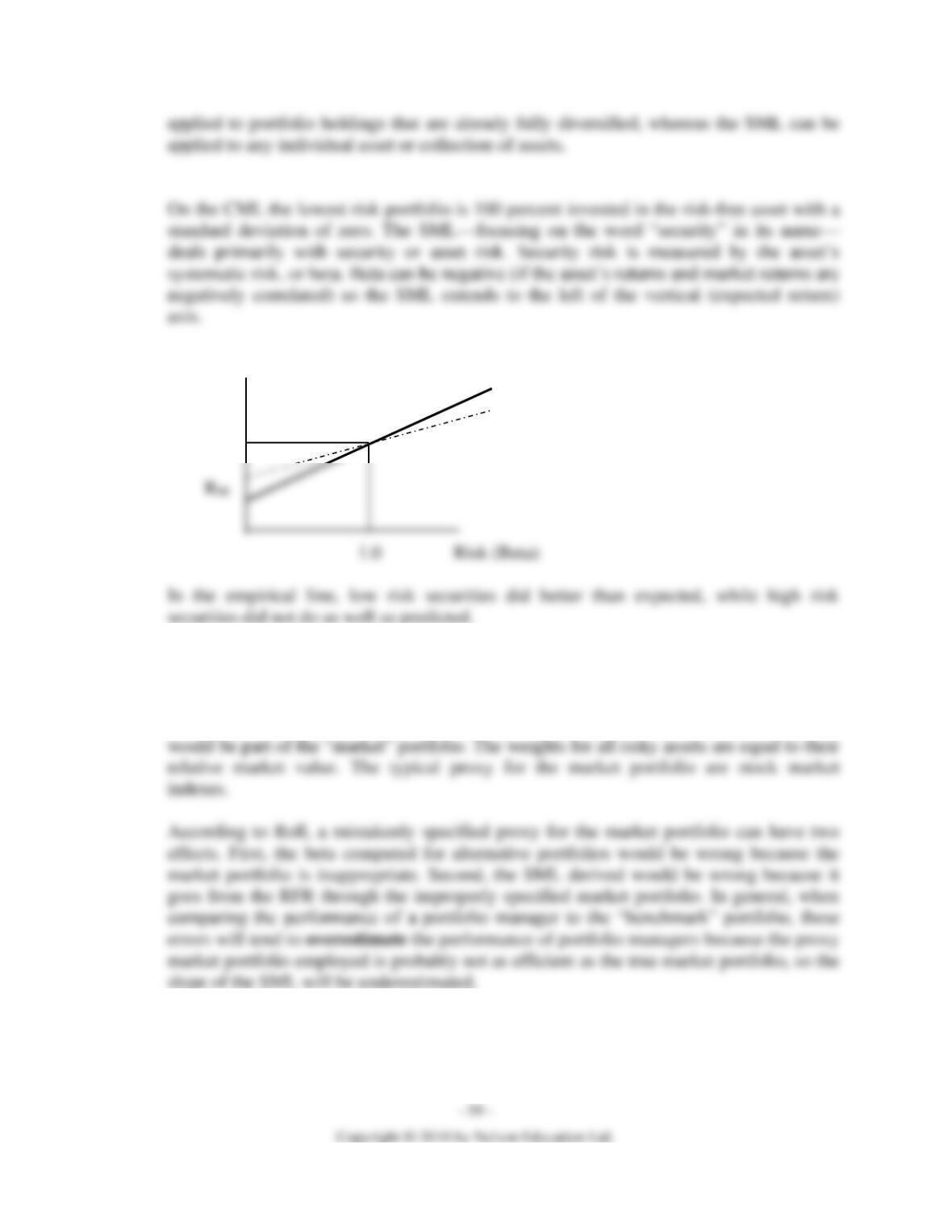
5. E(R) Theoretical SML
Empirical SML
RFR
6. The “market” portfolio contains all risky assets available. If a risky asset, be it an obscure
bond or rare stamp, was not included in the market portfolio, then there would be no
demand for this asset and, consequently, its price would fall. Notably, the price decline
would continue to the point where the return would make the asset desirable such that it
7. Studies of the efficient markets hypothesis suggest that additional factors affecting
estimates of expected returns include firm size, the price-earnings ratio, and financial
Solutions for Chapter 7: Questions and Problems
8. A market factor of 1.2 means the mutual fund is 1.2 times as sensitive as the market
portfolio, all other factors held equal. The SMB (“small minus big”) factor is the return of
a portfolio of small capitalization stocks minus the return to a portfolio of large
Solutions for Chapter 7: Questions and Problems
– 61 –
CHAPTER 7
Answers to Problems
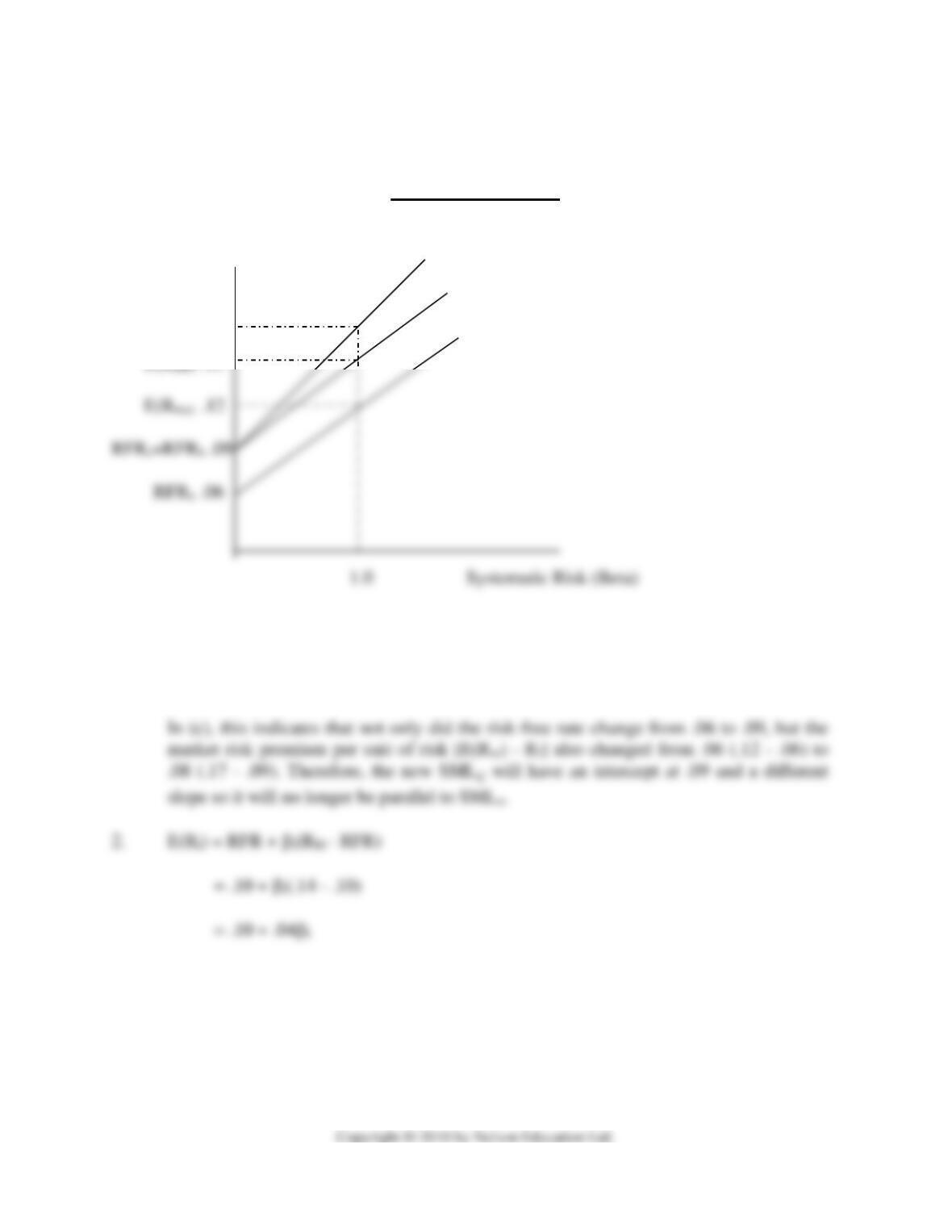
1. Rate of SMLc
Return
SMLb
E(Rmc) .17
SMLa
E(Rmb) .15
In (b), a change in risk-free rate, with other things being equal, would result in a new
SMLb, which would intercept with the vertical axis at the new risk-free rate (.09) and
would be parallel in the original SMLa.
Solutions for Chapter 7: Questions and Problems
– 62 –
.
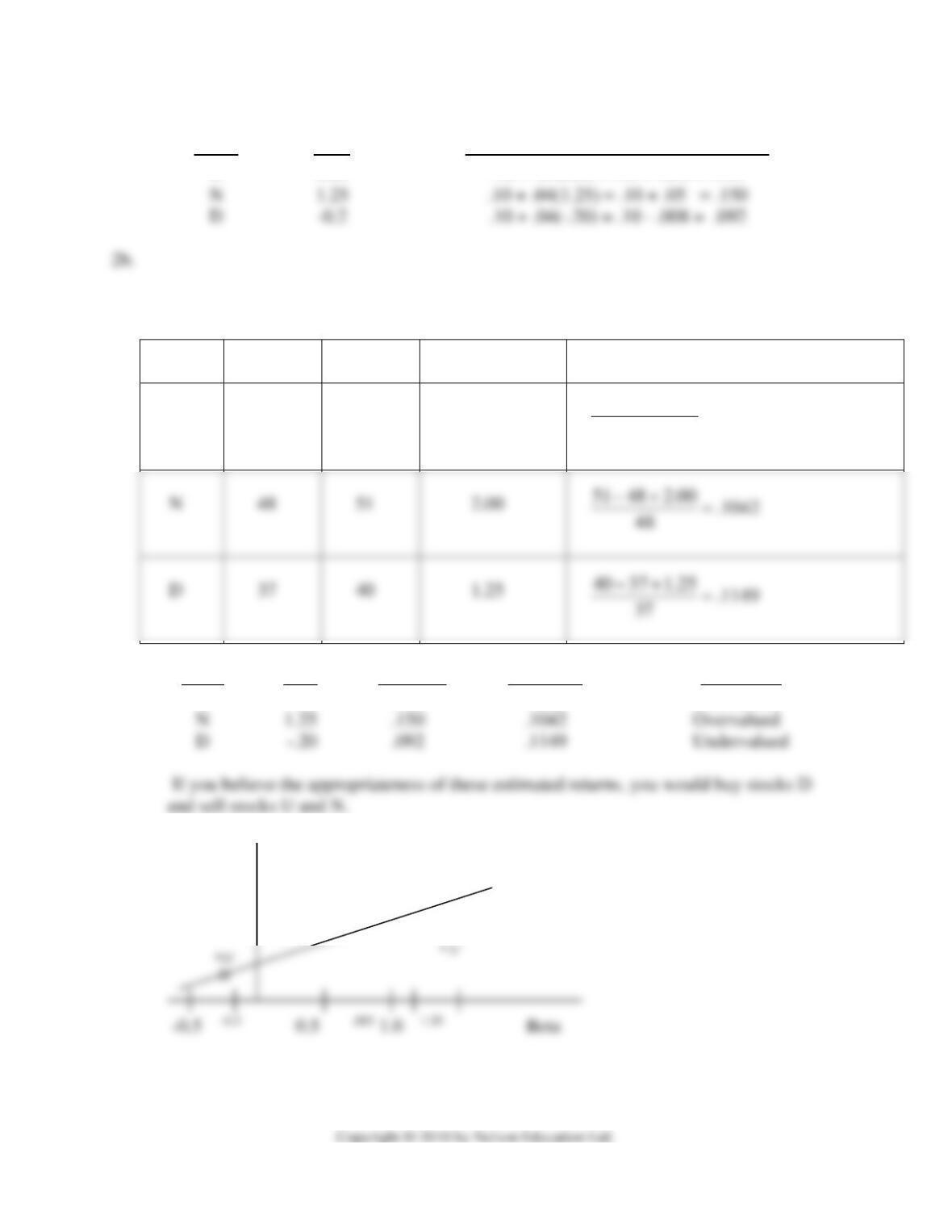
Stock
Beta
(Required Return) E(Ri) = .10 + .04i
U
0.85
.10 + .04(.85) = .10 + .034 = .134
N
1.25
D
Stock
Current
Price
Expected
Price
Expected
Dividend
Estimated Return
U
22
24
0.75
48
51
2.00
37
40
1.25
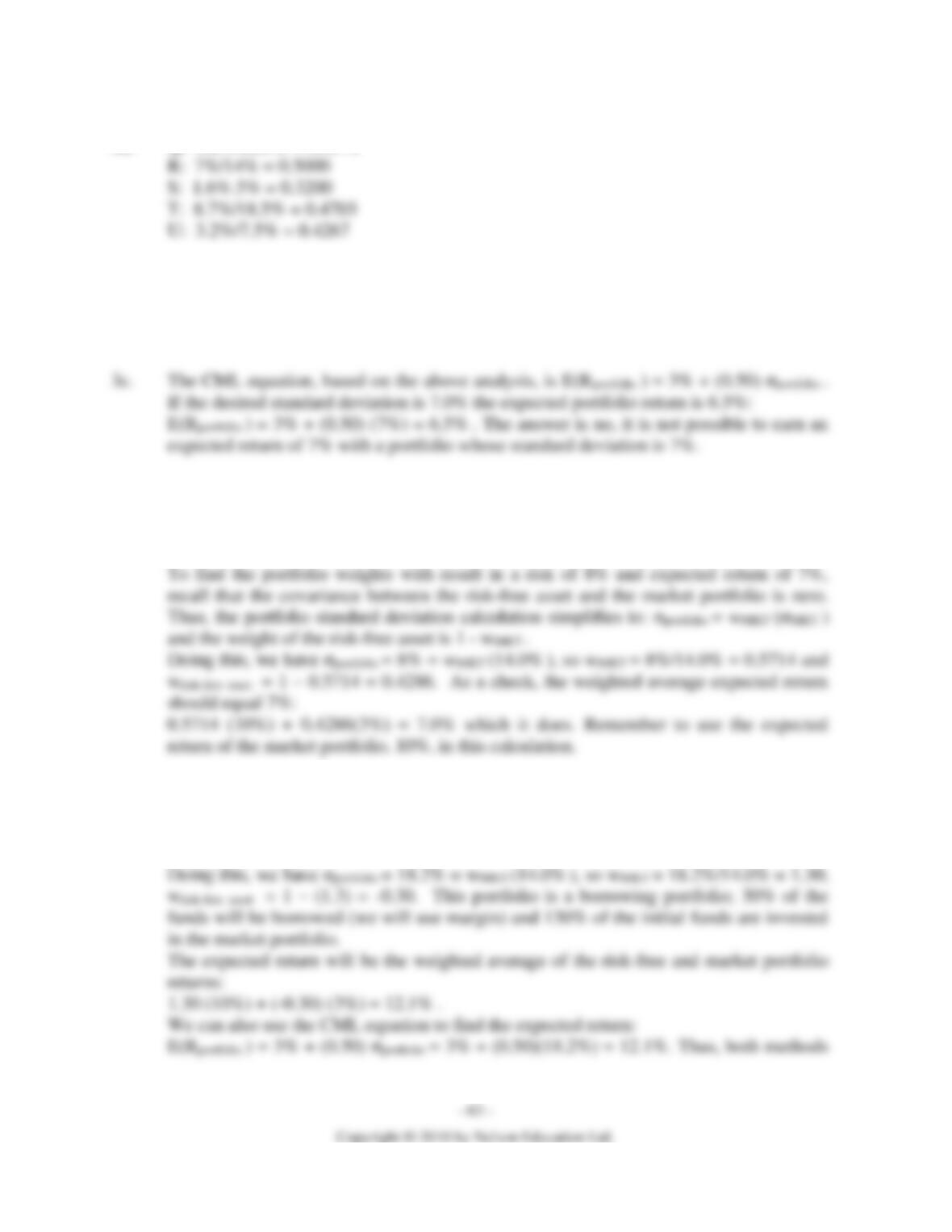
Stock Beta Required Estimated Evaluation
U .85 .134 .1250 Overvalued
E(R)
N
14% U
*U’
1250.
22
75.02224 =
+−
Solutions for Chapter 7: Questions and Problems
3a. Q: 4.8%/10.5% = 0.4571
3b. The CML slope, [E(RMKT ) – RFR ]/ σMKT , is the ratio of risk premium per unit of risk.
Portfolio R has the highest ratio, 0.5000, of these five portfolios so it is most likely the
market portfolio. Thus, the slope of the CML is 0.5; its intercept is 3%, the risk-free
rate.
3d. Using the CML equation, we set the expected portfolio return equal to 7% and solve for
the standard deviation:
E(Rportfolio ) = 7% = 3% + (0.50) σportfolio ➔ 4% = (0.50) σportfolio ➔ σ = 4%/0.50 = 8%.
Thus, 8% is the standard deviation consistent with an expected return of 7%.
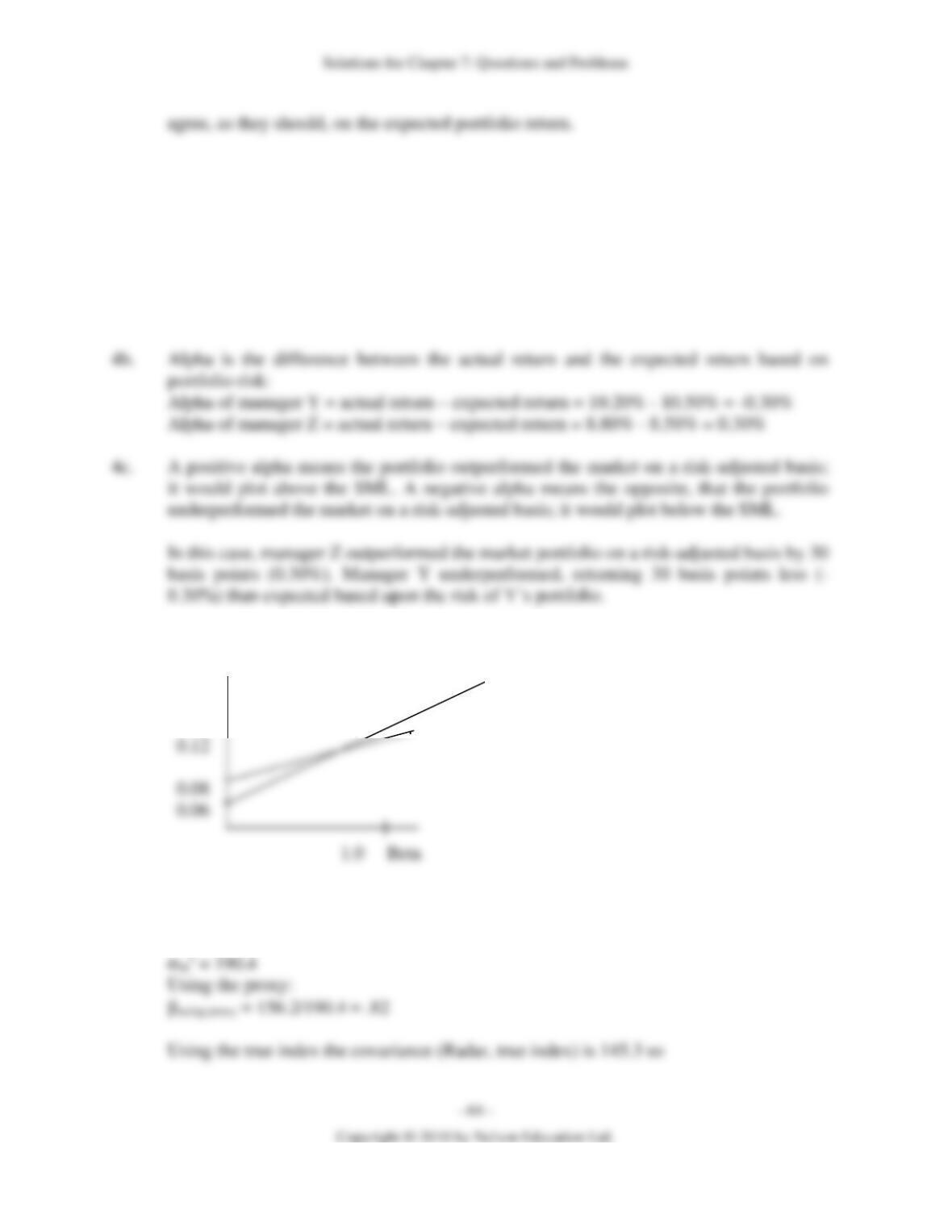
3e. To find the portfolio weights with result in a risk of 18.2%, recall that the covariance
between the risk-free asset and the market portfolio is zero. Thus, the portfolio standard
deviation calculation simplifies to: σportfolio = wMKT (σMKT ) and the weight of the risk-
free asset is 1 – wMKT .
4. With a risk premium of 5% and risk-free rate of 4.5%, the security market line is:
E(return) = 4.5% + (5%)β. Information about the level of diversification of the
portfolios is not given, nor is information about the market portfolio. But a portfolio’s
beta is the weighted average of the betas of the securities held in the portfolio so the
SML can be used to evaluate managers Y and Z.
4a. Expected return (Y) = 4.5% + (5%)β = 4.5% + (5%)(1.20) = 10.50%.
Expected return (Z) = 4.5% + (5%)β = 4.5% + (5%)(0.80) = 8.50%.
5. (a) R
0.15
5 (b). = Cov i,m/(m)2
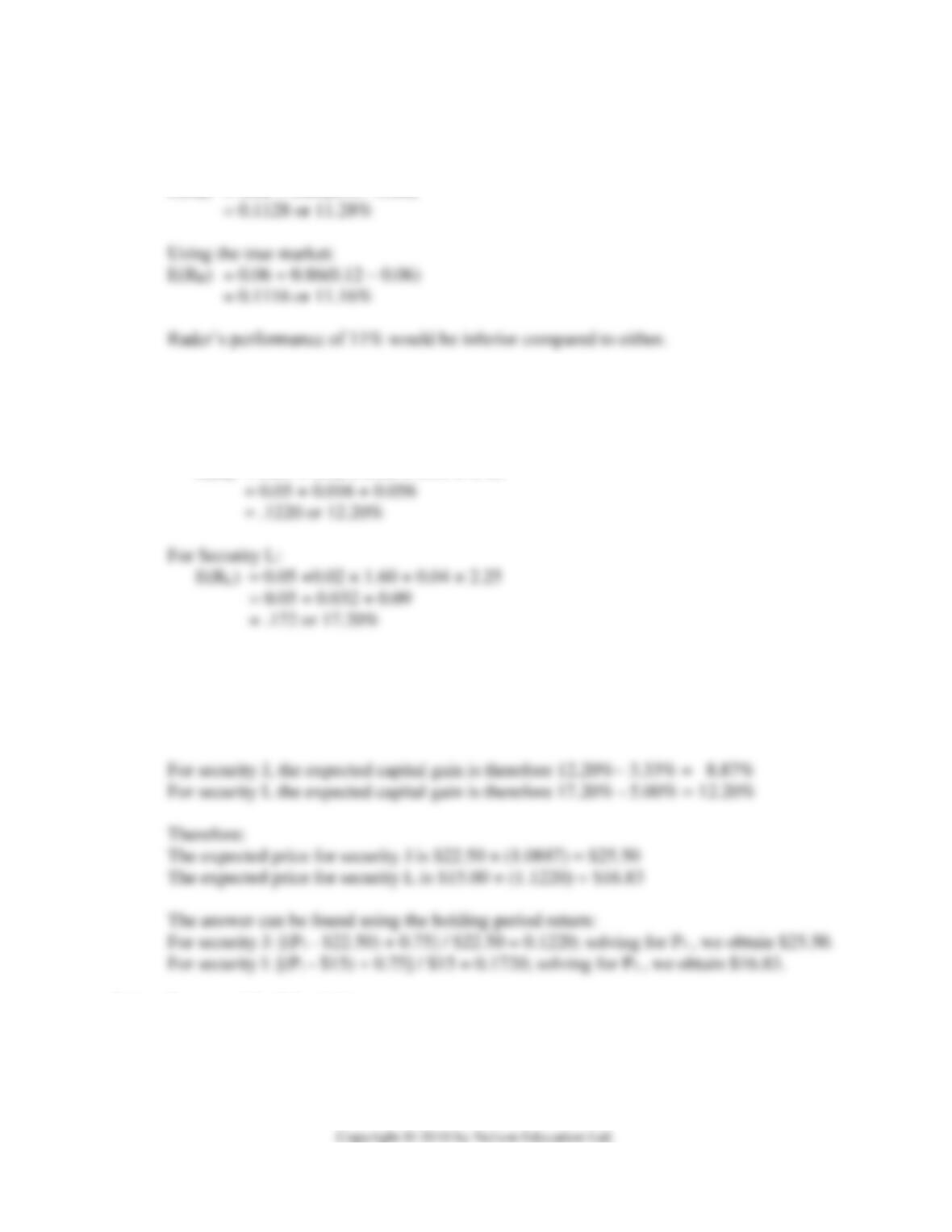
From a spreadsheet program, we find for Radar Tire and the Proxy,
Cov i,m = 156.2.4
Solutions for Chapter 7: Questions and Problems
– 65 –
using true = 145.3/168 = .86
5(c). Using the proxy:
E(RR) = 0.08 + 0.82(0.12 – 0.08)
6
6(a). In general for the APT, E(Rq) = 0 + 1bq1 + 2bq2
For security J:
E(RJ) = 0.05 + 0.02 × 0.80 + 0.04 × 1.40
6(b). Total return = dividend yield + capital gain yield
For security J, the dividend yield is $0.75/$22.50 = 0.033 or 3.33%
For security L, the dividend yield is $0.75/$15.00 = 0.05 or 5%
7(a). RQRS = 4.5 +7.5 × 1.24
= 4.5 + 9.3
= 13.8%

Solutions for Chapter 7: Questions and Problems
– 66 –
7(b). RQRS = 4.5 + 7.5 × 1.24 + (-0.3) × (-0.42) + 0.6 × 0.00
= 4.5 + 9.30 + 0.126 +0.00
= 13.926%
7(c). Assuming that the factor loadings are significant the three factor model should be more
useful to the extent that the non-market factors pick up movements in returns not
captured by the market return. To be practical, however, the differences in the expected
returns are small.
7(d). Because the factor loadings on MACRO2 are zero for two of the stocks, it appears that

Solutions for Chapter 7: Questions and Problems
– 67 –
8(b). Because neither stock pays a dividend, the total return is all due to price appreciation.
Therefore for stock D:
P0x(1.131) = $55
8(c). From part (a), the risk premium for factor 1 was 2.5%. The new risk factor is thus 2.5% +
0.25%, or 2.75%. The new expected returns are:
8(d). D: PD0(1 + 0.134) = $55
PD0 = $55/1.134
PD0 = $48.50