7-1
Management Information Systems, 13E, Global Edition
Laudon & Laudon
Lecture Notes by Barbara J. Ellestad
Chapter 7 Telecommunications, the Internet and
Wireless Technology
Anytime, anywhere, anyway, is the mantra of many computer users. Improved
telecommunications technologies, the process of electronically communicating
7.1 Telecommunications and Networking in Today’s
Business World
This section shows you how these networks are actually constructed and discusses the
various elements involved in connecting all these computers. Knowing how it all works
can give you insight into the changes that have taken place and an idea of what the future
holds. You can also get ideas about how you can take advantage of the future now!
Networking and Communication Trends
For the most part, all of us have grown up with separate service providers and networks
for our land-based telephones, cellular phones, and computers. We’ve been used to the
7-2
What Is a Computer Network?
Before we go much further, let’s make sure you understand how computer networks are
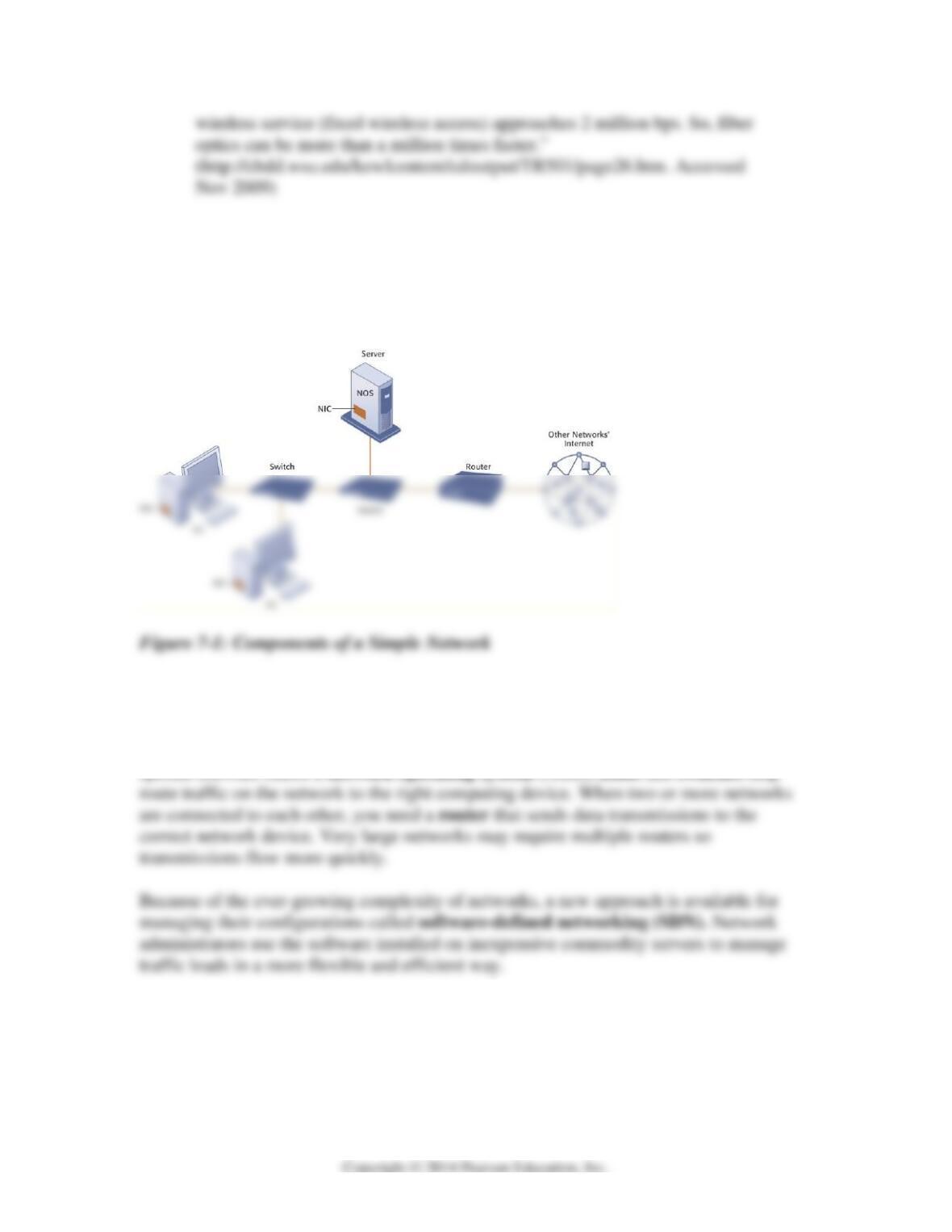
configured. Figure 7-1 shows a simple network structure.
What you should keep in mind is that you can continually add components to this kind of
network and expand it exponentially. You can take a simple desktop computer and by
way of a Network Interface Card (NIC), incorporate it into an existing network. To share
network resources such as printers, and to route communications on a LAN, you require
special software called a network operating system (NOS). Hubs and switches help
Networks in Large Companies
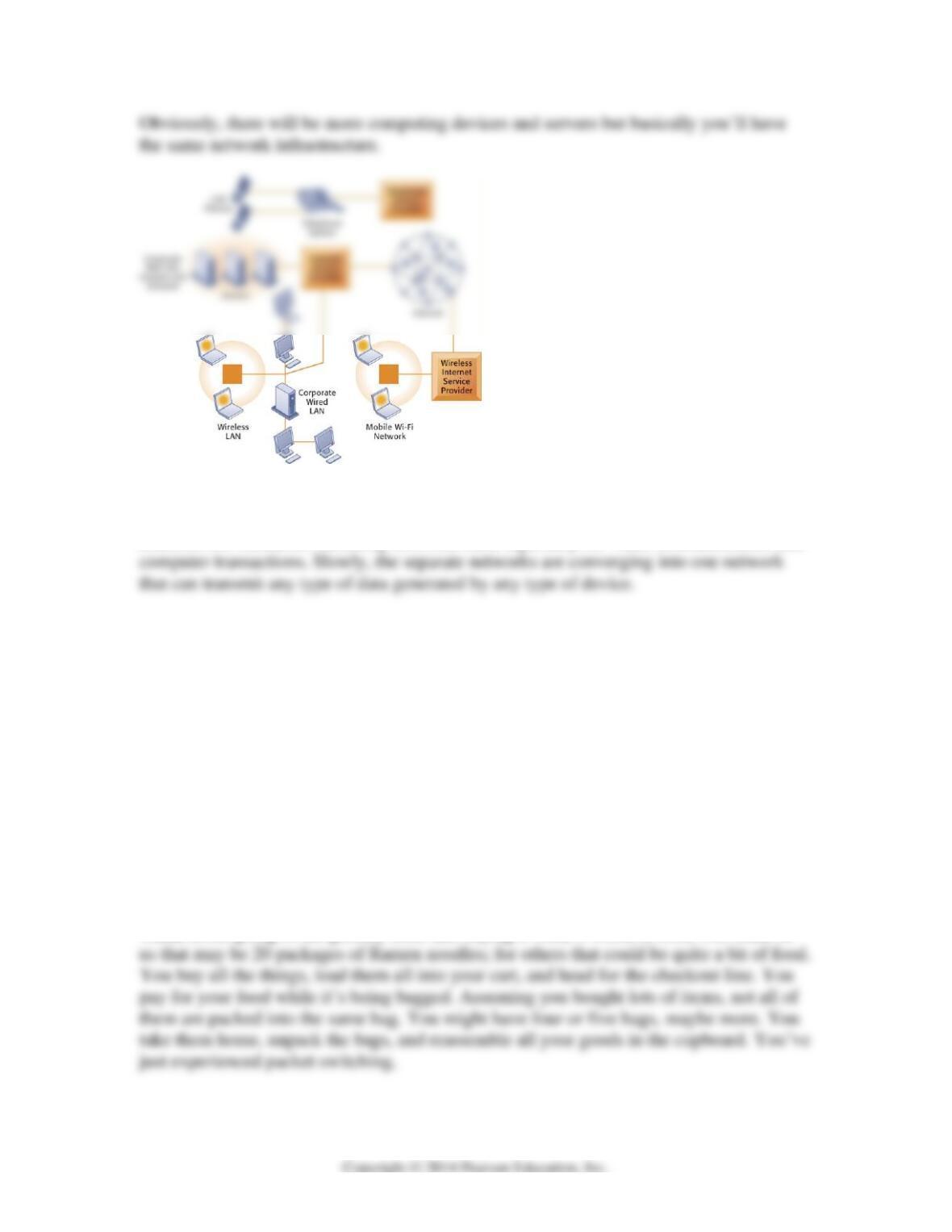
Compare Figure 7-1 above that diagrams a simple computer network to Figure 7-2 below
that diagrams a corporate network infrastructure. You’ll see that the network you might
use in a large company isn’t all that different from what you might use in your home.
7-3
Figure 7-2: Corporate Network Infrastructure
Most corporations, large or small, will use a combination of public and private
transmission mediums, including networks built separately for voice communication and
Key Digital Networking Technologies
Let’s look at three key technologies necessary for network computing.
Client/Server Computing
The client/server network facilitates computing on all kinds of networks including the
Internet. Instead of one huge mainframe with individual nodes, smaller computers called
servers connect to many clients. This type of network is ideal for companies that are
continually expanding their networks or replacing hardware components.
Packet Switching
Think about going to the grocery store and buying a week’s worth of food. For some of

7-4
Packet switching is a method of breaking large blocks of data into smaller chunks and
routing them in the most economical way through whichever communication channel is
available.
TCP/IP and Connectivity
How does your Internet Service Provider manage to send your email to the right place?
We’re talking millions and millions of people sending email and using the World Wide
Web every day. How do you keep from getting Mary’s email intended for Billy in
Atlanta? Notice that each computer user connected to a network has a separate, individual
Companies can create Web-based interfaces for different databases for data input/output
and accessing information without actually combining the data physically in one huge
computer. They do so by using TCP/IP models. With these protocols, they can reduce
the disruption to the organization and decrease the overall costs of adding to their
network.
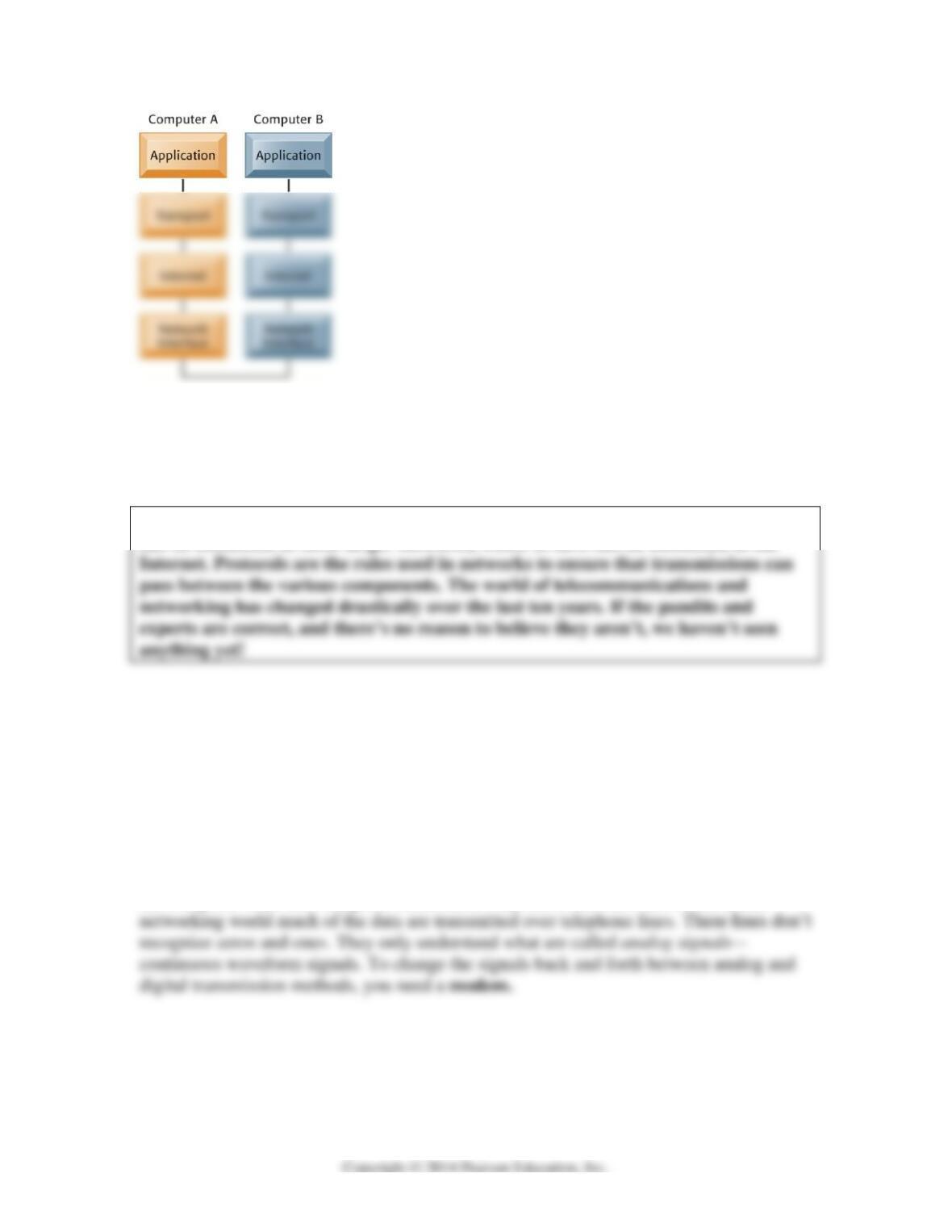
This diagram shows you how TCP/IP works.
7-5
Figure 7-4: The Transmission Control Protocol TCP/IP Reference Model
The most important benefit of the TCP/IP model is that it allows two computers to
communicate even if they are based on different hardware and software platforms.
Bottom Line: All computer networks are basically the same. Many small networks
can be connected to form larger networks, which in turn can be connected to the
7.2 Communications Networks
It’s likely that as a company grows, so will its networking needs and capabilities.
Signals: Digital vs. Analog
Everything going into a computer system must be transformed into the digital signals of
the computer. That is, a computer understands only zeros and ones. However, in the

7-6
Types of Networks
There are many different types of networks that organizations can use to connect their
employees, managers, customers, suppliers, and business partners. It’s important that the
right one is used.
Local Area Networks
The local area network (LAN) is probably the most common network setup. You can
have as few as two computers or as many as you can possibly wire together in the local
Metropolitan and Wide Area Networks
A wide area network (WAN) is basically the same thing as a LAN, only for a broader
geographic setting. This network is not limited by space and distance, and WANs use a
Transmission Media and Transmission Speed
Some experts call us a wired nation. If you consider all the methods we use to
communicate, we should be referred to as a wireless nation. Our paging systems and
cellular telephones use microwave and satellite technologies to transmit our voice and
7-7
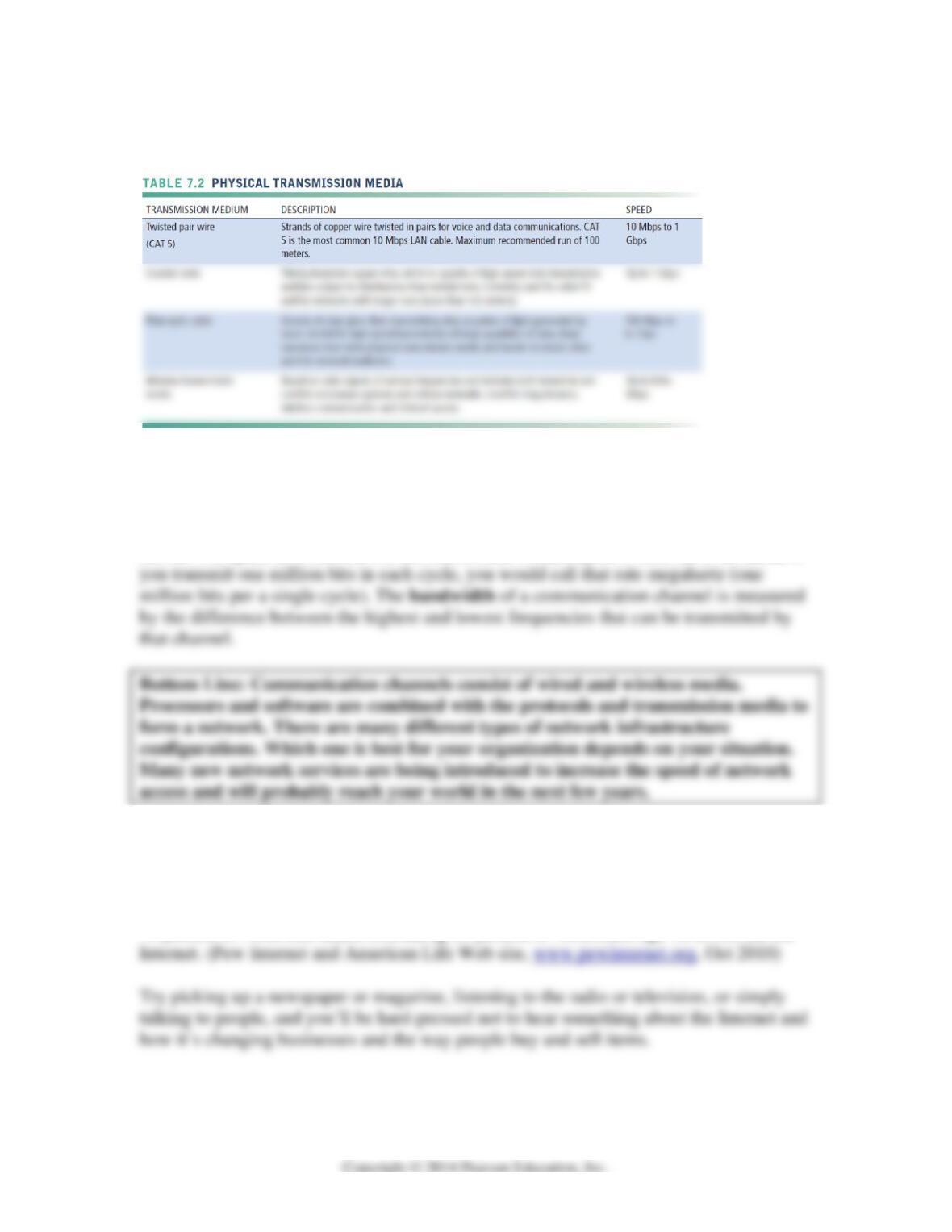
Table 7-2 provides a description and speed of each type of transmission medium you may
use when communicating from one point to another.
Bandwidth: Transmission Speed
When you transmit the latest information from a Web site to your personal computer, the
speed at which it moves across all the transmission media is measured in bits per second
(BPS). The speed at which the bits are transmitted in each cycle is referred to as hertz. If
7.3 The Global Internet
The latest research numbers from the Pew Internet and American Life Web site show that
79 percent of American adults (including 95 percent of Americans age 18 to 29) use the
7-8
What Is the Internet?
The Internet was developed in 1969 for the U.S. military and eventually spread to
universities and civilian researchers. Because of its open structure, interest in its use
Small businesses and individuals connect to the Internet through Internet Service
Providers (ISP) such as Earthlink or CoxMedia. In many areas the ISP is a small local
company connected to a larger network. With recent mergers in the entertainment and
Internet industries, some cable TV companies like TimeWarner may serve as the ISP for
home users.
Larger organizations, such as universities and corporations, can afford a T1 line, which
supports extremely high rates of data transmission. These lines are capable of carrying
voice and data transmissions over 24 channels, which make them ideal for larger
networks. Because they are expensive, it’s not something you’d install in your home.
7-9
Internet Addressing and Architecture
Every address used on the Internet whether it’s an email address or a Web site address is
nothing more than a series of numbers called an Internet Protocol address or IP for
The Domain Name System
The Domain Name System was devised because it’s much easier for people to read
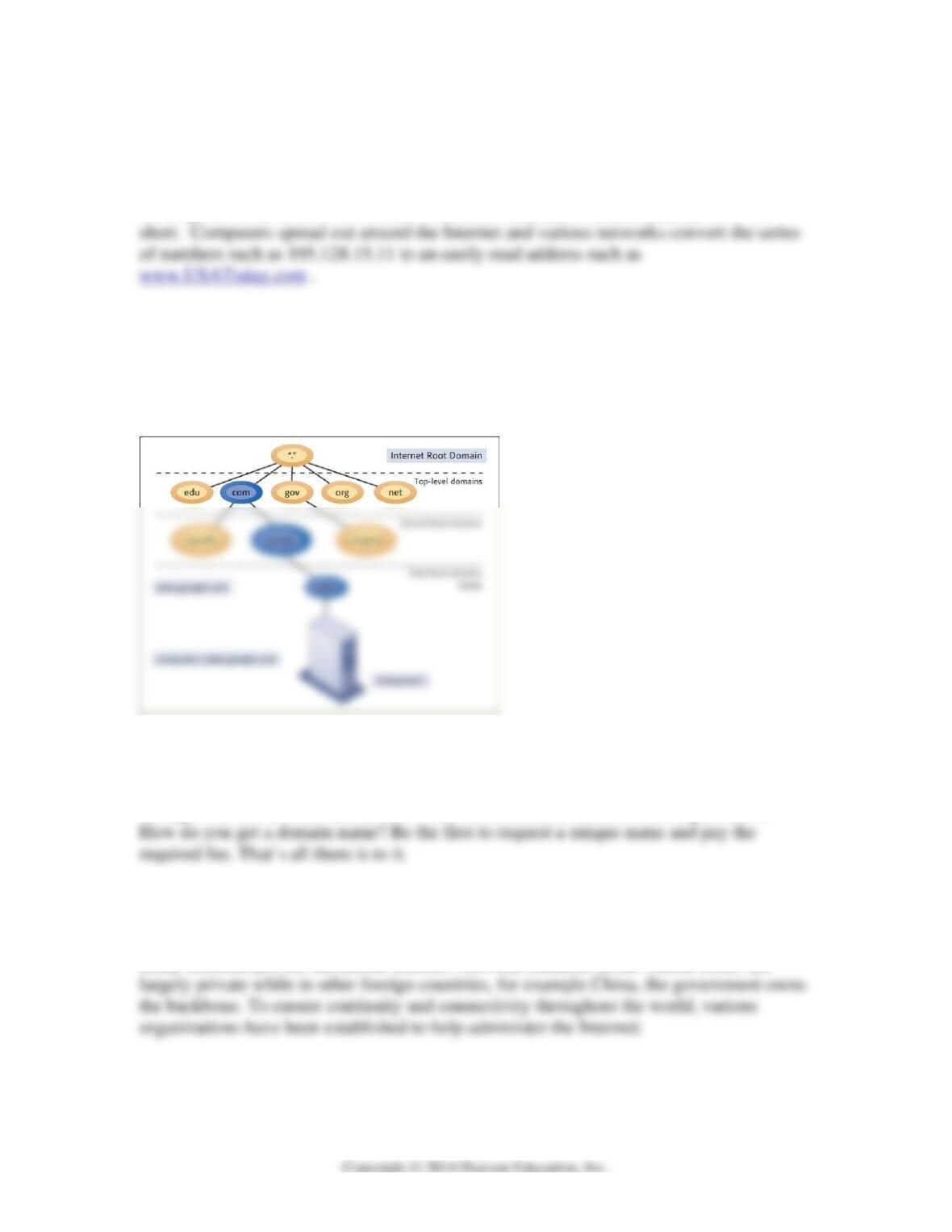
letters and words than to work with series of numbers. The DNS uses a hierarchical
breakdown of addresses as Figure 7-6 shows.
Figure 7-6: The Domain Name System.
Domain names used in email addresses and Web site addresses are easily obtained
through several services such as www.networksolutions.com and www.register.com.
Internet Architecture and Governance
Even though no one owns the Internet as a whole, parts of it are owned and controlled by
many different private and public entities. Network channels in the United States are
• Internet Architecture Board: Defines the overall structure of the Internet
7-10
Just remember, no one owns it. And, it’s not free.
Interactive Session: Organizations: The Battle over Net Neutrality (see page 292 of
the text) introduces arguments for charging Internet users based on the amount of
transmission capacity they use. There are some very good points made for both
proponents and opponents.
Not only is bandwidth saturation becoming a problem on Internet connections and other
network connections, but now the problem is spreading to mobile phone networks as
evidenced by the article below lamenting AT&T’s difficulties with its iPhone users.
AT&T wants its iPhone users to use less wireless data, and it may consider
new pricing models to curb users’ data usage as it tries to keep up with
“We’re going to try to focus on making sure we give incentives to those
small percentages to either reduce or modify their usage so they don’t
crowd out the other customers in those same cell sites,” said de la Vega
according to a transcript of the conference. “And you’ll see us address that
more in detail.”
AT&T has been struggling to keep up with demand for wireless-data
usage on its network. The iPhone, launched more than two years ago, has
revolutionized mobile Web usage. The device, which was built more for

7-11
The Future Internet: IPv6 and Internet2
As the Internet and other networks continue to proliferate, it’s becoming very difficult to
work with the limited number of IP addresses available in the old system. Therefore new
If experts’ predictions are correct about the increasing usage and reliance on the Internet,
and there’s no reason to believe they aren’t, we need to improve and change the current
configuration to meet future demand. The Internet2 project may help. The Next
Generation Internet project has similar goals of advancing the use of the Internet in ways
that will enhance our lives. Here’s how the Internet2 Web site (www.internet2.com)
compares the two projects:
“Internet2 is a collaborative effort by more than 180 U.S. universities,
working with partners in industry and government, to develop advanced
Internet technologies and applications to support the research and
Internet Services and Communication Tools
With the recent introduction of new communication and information appliances, such as
smart phones, PDAs, cell phones, and mobile data networks, organizations have found it
necessary to upgrade their networks to incorporate these new technologies.
7-12
Internet Services
We keep complaining about information overload, yet we crave more. The Internet
Companies are using chat and instant messaging as a viable alternative to email.
Use one of the search engines or directly access a popular portal page such as
Interactive Session: Management: Monitoring Employees on Networks: Unethical
or Good Business? (see page 296 of the text) discusses both sides of a very sticky
situation between employers and employees. It points out the need for every
company to have corporate policies regarding employee use of email and the
Internet.
Voice over IP
Internet telephony services like Skype.com have vastly improved over the last few years
and are now becoming a popular way for a growing number of people to communicate

7-13
“Internet and computer technology have already changed the way people
live, work and communicate. VoIP (Voice over Internet Protocol) is one
of the converged technologies behind this communication revolution.
Looking forward, we believe Internet Telephony innovations are far
beyond what we can imagine now. Let’s utilize those technology advances
and enjoy the feature-rich, low cost and evolutionary communication
tools.”
“VoIP on WiMax will make the latest 3G technologies obsolete before
they are completely installed. The reason is because 3G cell phone
technology is capable of 2Mbs while WiFi is at 11Mbs in bursts and
WiMax will be even greater therefore 3G is not needed as VoIP over
WiMax is going to provide more data, faster speeds and greater numbers
of users.
WiFi and WiMax may actually solve the goals of conquering the digital
The important thing to remember with all this new technology is that nothing is standing
still. The telecommunications and computer industries are working at breakneck speed to
Unified Communications
You use email. Then you switch to the telephone. Then you move to electronic
conferencing. On to instant messaging. Each of these has a separate channel and separate