Hitt 13e Case Teaching Notes
Case 7: Illinois Tool Works: Retooling for Continued Growth and Profitability
Case Synopsis
Illinois Tool Works (ITW) was founded in 1912 to manufacture and sell metal-cutting tools. A
supplier for the U.S. government during WWI, the company continued to grow its reputation as
a leader in engineering, which is why the company was represented on the War Production
Board during WWII. ITW became a publicly traded company on the New York Stock Exchange in
the mid-1960s, and it has continued to grow, primarily through a tremendous number of
acquisitions.
Until 2012, ITW practiced an extreme form of decentralization. In fact, whenever a business
unit’s revenues topped $50 million, it would be split off into two units. ITW’s top-level
executives recognized that the company sacrificed some economies of scale with this structure,
but they believed it made each unit more focused and competitive. It also created
opportunities for young, smart employees to advance rapidly to unit-level leadership positions
and beyond. Many of ITW’s small business units were the result of acquisition. The firm
typically looked for fairly small, undervalued companies, acquired them, and then often let
them function largely intact except for adopting the 80/20 management principle.
Learning Objectives
• Describe different levels of diversification achieved using different corporate-level
strategies. (Chapter 6)
• Discuss the incentives and resources that encourage diversification. (Chapter 6)
• Describe motives that can encourage managers to over diversify a firm. (Chapter 6)
• Describe the relationship between strategy and structure. (Chapter 11)
• Discuss the different functional structures used to implement business-level strategies.
(Chapter 11)
• Explain the use of three versions of the multidivisional (M-form) structure to implement
different diversification strategies. (Chapter 11)
• Define strategic leadership and describe top-level managers’ importance. (Chapter 12)
Strategic Issues and Suggested Discussion Questions & Answers
1. In its first 100 years, what type of diversification strategy did ITW use, and how has it
changed since 2012? Do you think managers were encouraged to over diversify?
Explain your answer.
For just about 100 years, top-level executives at ITW claimed that they did not place a high
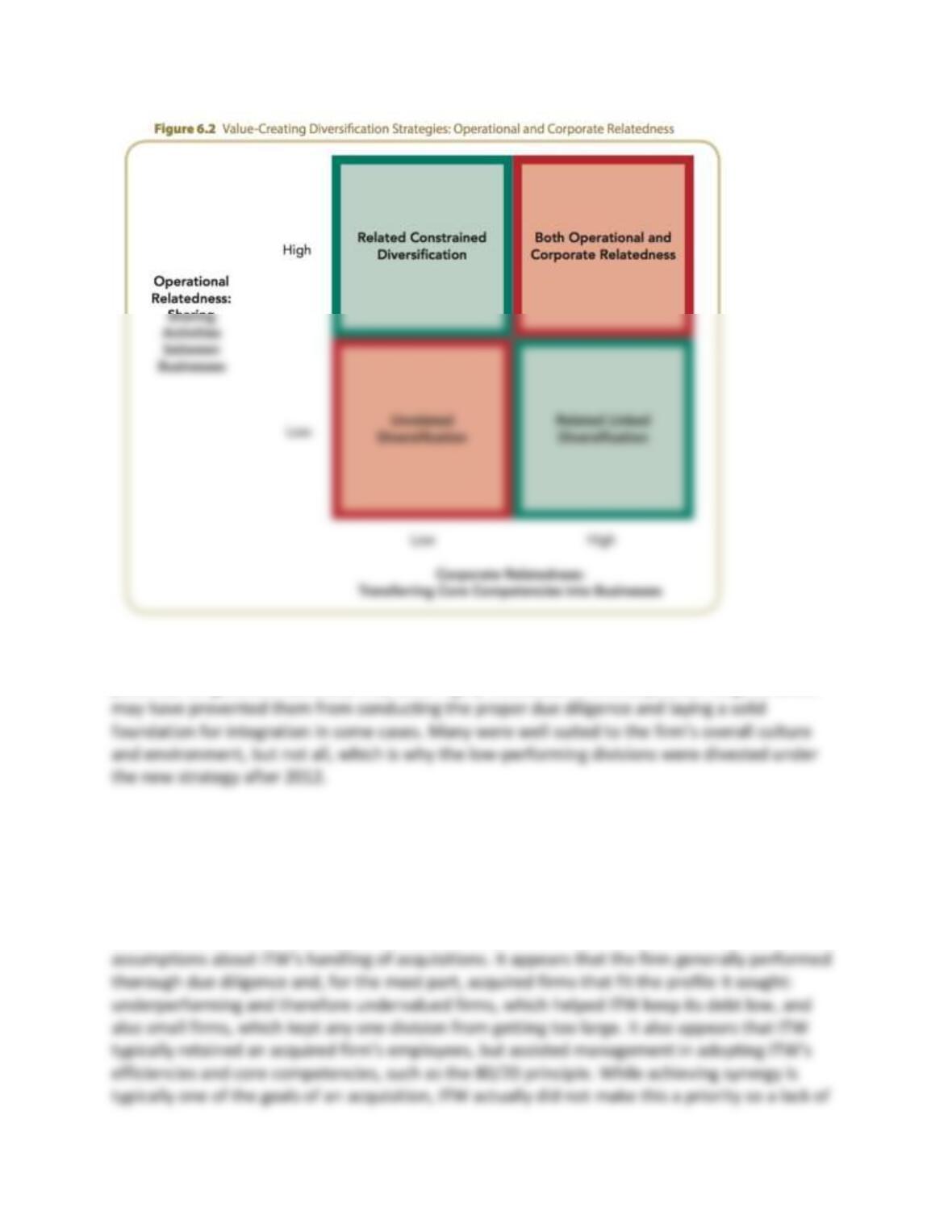
In hindsight, managers probably were encouraged to over diversify to some extent. With the
potential for generous bonuses, they were highly motivated to find acquisition targets, which
2. ITW has a long history of acquiring dozens of smaller companies. How do you think the
firm was able to successfully assimilate so many acquired firms? Now that ITW is
scaling back and only intends to acquire larger firms, do you expect the organization
to enjoy the same success?
Since the case offers relatively few details, the students will have to make some deductions and
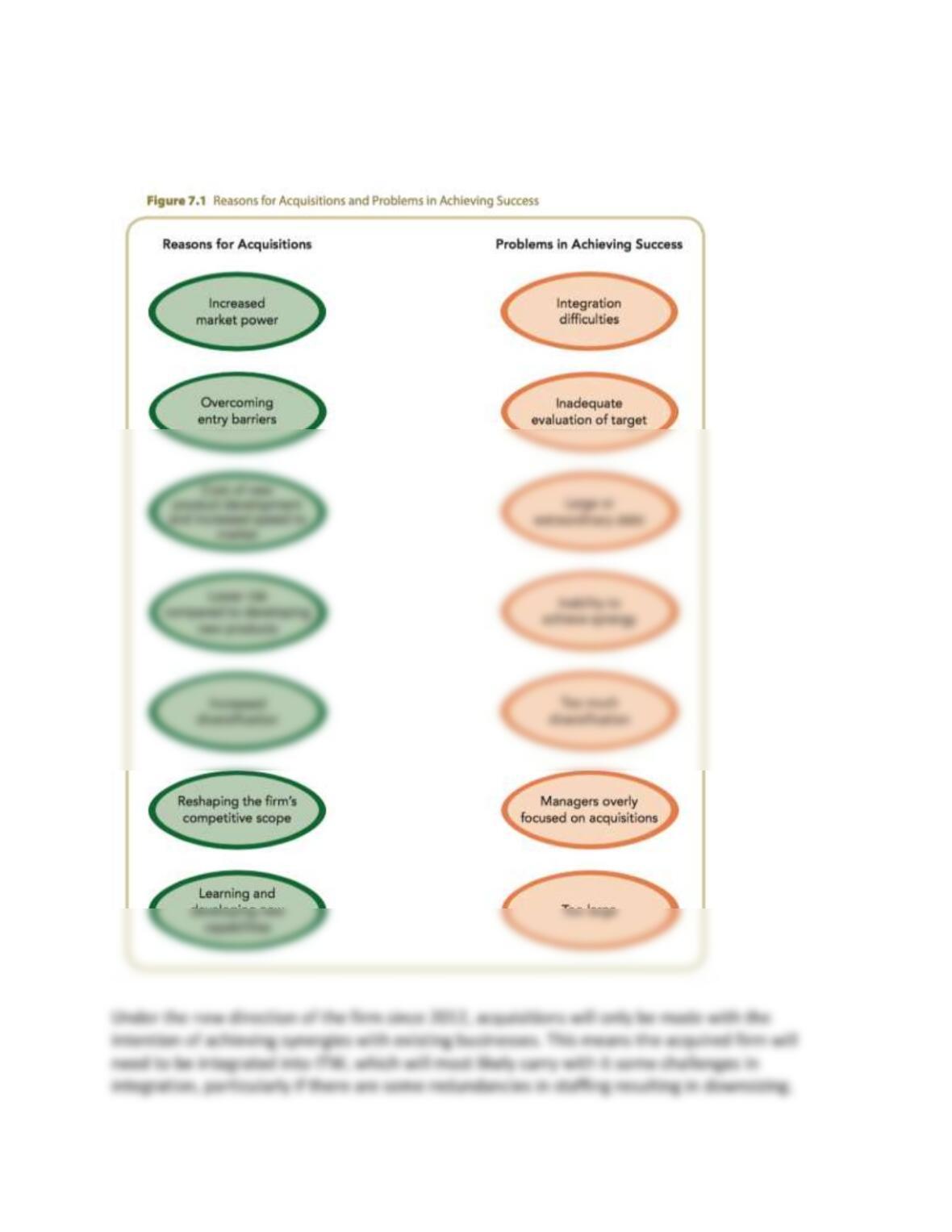
synergy was not an obstacle. If anything, the firm encouraged newly acquired firms to continue
to function as independent divisions under the ITW umbrella (Figure 7.1).
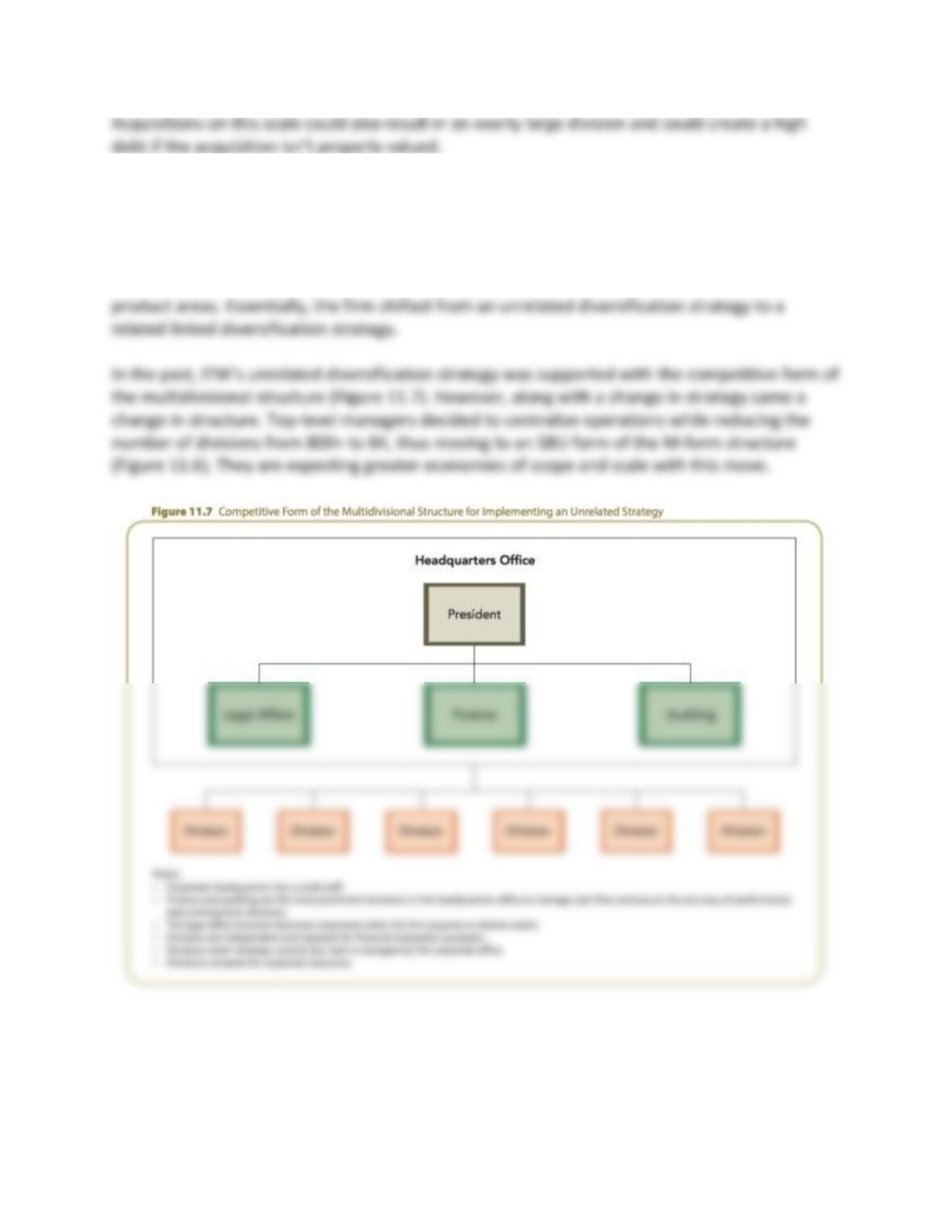
3. If the firm’s diversification strategy has changed since 2012, does that mean its
structure has changed as well? Explain your answer.
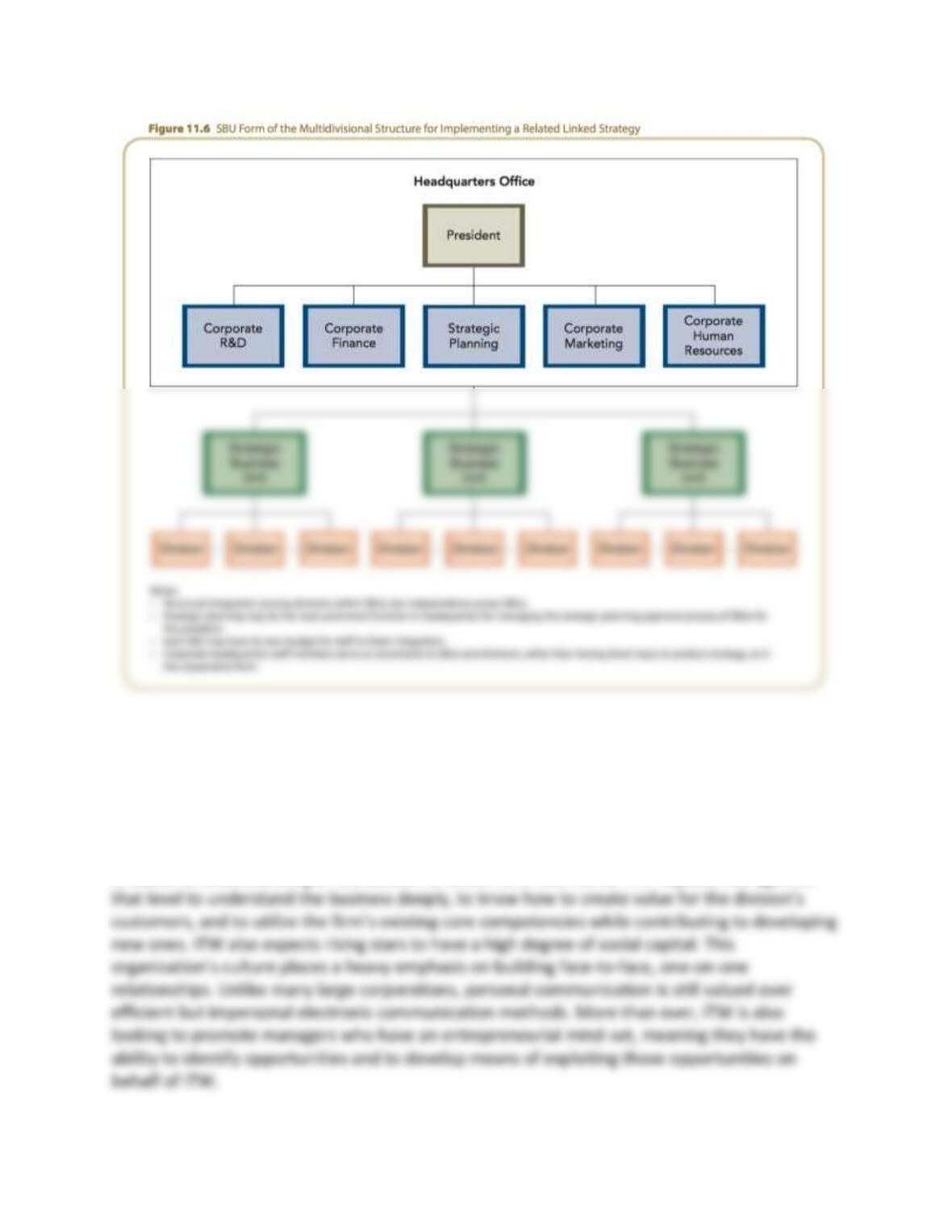
In 2012, the CEO and the board decided to significantly cut back on growth through
diversification and also established that moving forward ITW would focus on seven core
4. ITW places a lot of faith in its employees by promoting from within. The CEOs have all
risen through the ranks, and ITW is able to attract young talent by promising rapid
promotions to leadership positions within individual divisions and SBUs. What type of
manager is most likely to get promoted, and why?
First and foremost, a low-level manager who wants to climb the ladder of success must develop
a masterful understanding of the division in which he or she works. ITW expects managers at
5. Historically, ITW has relied on acquisitions to gain access to innovations, but today the
firm is turning inward, expecting innovations to come from existing divisions. What
needs to happen with ITW’s culture and management style to facilitate internal
innovation?
ITW needs to place a new emphasis on corporate venturing, either through autonomous or
induced strategic behavior. Given the firm’s history of customer-backed innovations that were
Additional Resources
Reuters’s company profile gives in-depth background on ITW’s current financials, leadership,
valuation, news, and more:
Joe Cahill, writing for Crain’s Chicago Business, posted this update on ITW’s strategy in October
2018:
To celebrate its 100th anniversary (2012), ITW produced this video offering an insider’s look at
its corporate culture: