Chapter 07 – e-Business Systems
7-1
7 e-Business Systems
CHAPTER OVERVIEW
Chapter 7: e-Business Systems describes how information systems integrate and support enterprisewide business
processes, as well as the business functions of marketing, manufacturing, human resource management, accounting,
and finance.
LEARNING OBJECTIVES
After reading and studying this chapter, you should be able to:
1. Identify the following cross-functional enterprise systems, and give examples of how they can provide
significant business value to a company:
a. Enterprise application integration
SUMMARY
• Cross-Functional Enterprise Systems. Major e-business applications and their interrelationships are summarized
in the enterprise application architecture of Figure 7.2 . These applications are integrated cross-functional enterprise
• Transaction Processing Systems. Online transaction processing systems play a vital role in business. Transaction
processing involves the basic activities of (1) data entry, (2) transaction processing, (3) database maintenance, (4)
• Functional Business Systems. Functional business information systems support the business functions of

Chapter 07 – e-Business Systems
7-2
• Marketing. Marketing information systems support traditional and e-commerce processes and management of the
marketing function. Major types of marketing information systems include interactive marketing at e-commerce
• Manufacturing. Computer-based manufacturing information systems help a company achieve computer–
integrated manufacturing (CIM), and thus simplify, automate, and integrate many of the activities needed to quickly
• Human Resource Management. Human resource information systems support human resource management in
organizations. They include information systems for staffing the organization, training and development, and
compensation administration. HRM Web sites on the Internet or corporate intranets have become important tools for
providing HR services to present and prospective employees.
• Accounting and Finance. Accounting information systems record, report, and analyze business transactions and

Chapter 07 – e-Business Systems
KEY TERMS AND CONCEPTS
1. Accounting Information Systems (295):
2. Accounts payable (295):
A type of transaction processing based accounting system focused on managing payments to vendors.
3. Accounts receivable (295):
A type of transaction processing based accounting system focused on managing payments owed by customers.
4. Batch Processing (280):
5. Computer-Aided Manufacturing (292):
6. Computer-Integrated Manufacturing (291):
An overall concept that stresses that the goals of computer use in factory automation should be to simplify,
automate, and integrate production processes and other aspects of manufacturing.
7. Cross-Functional Enterprise Systems (272):
8. E-Business (272):
9. Enterprise Application Architecture (272):
With an enterprise application architecture, businesses use the Internet and other networks for e-commerce,
10. Enterprise Application Integration (276):
Companies use enterprise application integration to connect their major e-business applications. EAI software
11. Enterprise Collaboration Systems (281):

Chapter 07 – e-Business Systems
12. Financial Management Systems (296):
13. Functional Business Systems (284):
14. General ledger (295):
A type of transaction processing based accounting system serving as the primary record for all of an
organization’s transactions.
15. Human Resource Information Systems (292):
16. Interactive Marketing (284):
17. Inventory control (295):
A type of transaction processing based accounting system responsible for managing an organization’s inventory
as products are ordered, received (or produced) and sold.
18. Machine Control (292):
The technology of controlling machine tools by computers.
19. Manufacturing Execution Systems (292):
MES are performance monitoring information systems for factory floor operations. They monitor, track, and
20. Manufacturing Information Systems (290):
Manufacturing information systems support the planning, control, and execution of manufacturing processes.
21. Marketing Information Systems (284):
23. Online HRM systems (292)
24. Online Transaction Processing Systems (279):
A real-time system that captures and process transactions online via the Web.

Chapter 07 – e-Business Systems
7-5
25. Order processing (295):
26. Payroll (295):
A type of transaction processing based accounting system focused on managing payments to employees and
related taxes.
27. Process Control (292):
The use of a computer to control an ongoing physical process such as petrochemical production.
29. Sales Force Automation (289):
30. Targeted Marketing (288):
31. Transaction Processing Cycle (280):
Chapter 07 – e-Business Systems
7-6
ANSWERS TO REVIEW QUIZ
Q.
A.
Key Term
Q.
A.
Key Term
1
8
E-business
17
1
Accounting information systems
2
7
Cross-functional enterprise systems
18
22
Online accounting systems
10
6
Computer-integrated manufacturing
26
19
Manufacturing execution systems
11
5
Computer-aided manufacturing
27
30
Targeted marketing
12
11
Enterprise collaboration systems
28
31
Transaction processing cycle
13
27
Process control
29
4
Batch processing
14
18
Machine control
30
28
Real-time processing
15
15
Human resource information systems
31
Online transaction processing system
16
23
Online HRM systems
3
13
Functional business systems
19
25
Order processing
4
9
Enterprise application architecture
20
17
Inventory control
5
10
Enterprise application integration
21
3
Accounts receivable
6
21
Marketing information systems
22
2
Accounts payable
7
16
Interactive marketing
23
26
Payroll
8
Sales force automation
24
14
General ledger
9
20
Manufacturing information systems
25
12
Financial management systems
Chapter 07 – e-Business Systems
7-7
ANSWERS TO DISCUSSION QUESTIONS
1. Refer to the Real World Case on enterprise architecture in the chapter. What are the advantages of a
centralized enterprise architecture? What are the advantages of a decentralized approach that leaves these
decisions to the operating units? How do you balance both? Discuss. (Case 1)
Centralization advantages
• Less administrative, hardware, software, and data redundancy
2. Why is there a trend toward cross-functional integrated enterprise systems in business?
3. Which of the 13 tools for accounting information systems summarized in Figure 7.18 do you feel are
essential for any business to have today? Which of them do you feel are optional, depending on the type of
business or other factor? Explain.
The author does make the distinction between essential and non–essential. Some of these items on the optional
list have more functional substitutes on the “essential” list, for example “paging” and “voice mail”.
Essential:
• Electronic mail
Chapter 07 – e-Business Systems
4. What other solutions could there be for the problem of information systems incompatibility in business
besides EAI systems?
Alternatives to an EAI system, which comprises middleware between disparate business function-oriented
5. What are the most important HR applications a company should offer to its employees via a Web-based
system? Why?
Important HR applications
• Policy references
6. How could sales force automation affect salesperson productivity, marketing management, and
competitive advantage?
Salesperson productivity:
• Puts product and contract information at a salesperson’s fingertips
7. How can Internet technologies be involved in improving a process in one of the functions of business?
Choose one example and evaluate its business value.
Students may pick from any number of examples within this chapter. Answers should consider improvements
in data capture costs, data quality, cycle-time reductions, and increased information availability. A simple
Chapter 07 – e-Business Systems
7-9
8. Refer to the Real World Case on Nationwide Insurance in the chapter. Senior management was emphatic
about maintaining a 24-month deadline at all cost. Should the scope of the project be adapted to reflect a
deadline, or should deadlines reflect the scope of a project? Discuss.
Both
Obviously a deadline should reflect a project’s scope. A project takes as long as it takes, and its scope dictates
9. What are several e-business applications that you might recommend to a small company to help it survive
and succeed in challenging economic times? Why?
Recommendations:
• Web publishing – to create current web presence
10. Refer to the example on virtual worlds in the chapter. How do enterprise collaboration systems
contribute to bottom-line profits for a business?
Contributions
• Cheaper than telephone and travel
Chapter 07 – e-Business Systems
7-10
ANSWERS TO ANALYSIS EXERCISES
1. Hybrid Application Service Providers
oriented tools with AIM, AOL’s free consumer product.
AOL no longer offers this service. Consider identifying the top three cloud computing providers and their
offerings.
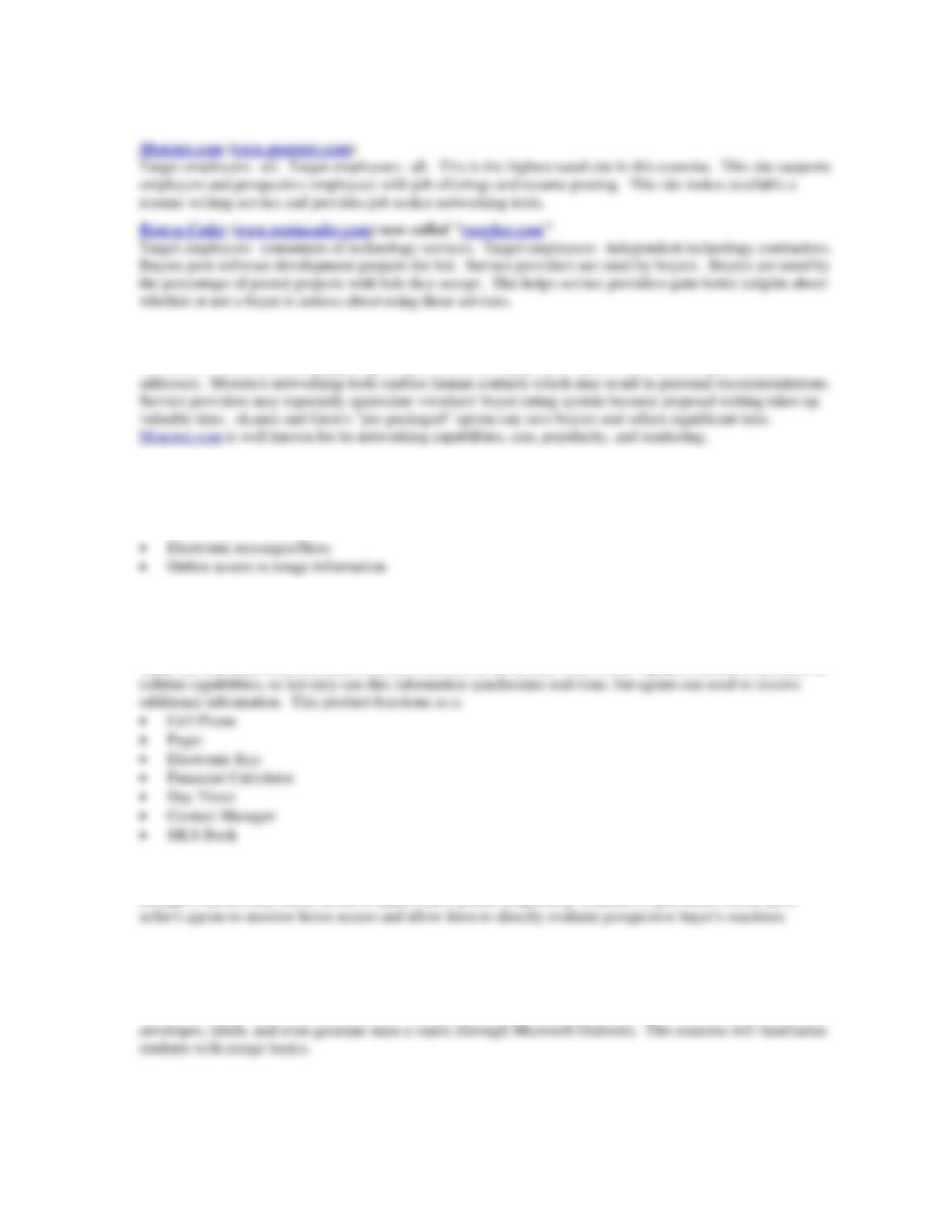
and beta features for Yahoo and Google. Place “Feature,” “Google,” and “Yahoo” as column headers. List
individual features under “Feature” in the left–hand column. Place the symbol “•” in the cell if it’s a current
feature for each competitor and the symbol “0” in the cell if it’s a beta feature. Leave the cell blank if it isn’t
available at all. Give the table a professional appearance.
This is a practical, product comparison exercise. Students will also gain experience formatting tables and
2. In Search of Talent
Solutions:
a. Prepare a review for each job site listed above. Include target employers, target employees, and notable
Web site features.
All sites provide buyer and seller information.
Chapter 07 – e-Business Systems
7-11
b. Which site did you find most useful? Why?
Job seekers find it frustrating applying for jobs and receiving generic rejects with “do not reply” e-mail
3. Integrating Data Capture
a. Use a search engine to look up the Supra iBox. Describe the product’s capabilities.
• Secure lockbox access
b. Use a search engine to look up Sprint and the Supra iBox. How has Sprint taken GE’s product one step
further?
Rather than using a special infrared key, agents can use their PDA’s infrared capability to open the lock box.
They will still need to synchronize with GE’s service, or the device won’t work. Sprint’s PDA also has built in
c. Describe the next-generation product you might sell Rosemary once keyless locks become commonplace.
Perhaps a motion and sound sensitive audio/video system temporarily installed in each home would allow
4. Word’s Mail Merge
Solutions:
This is a very powerful tool. Through its “mail merge” feature, Microsoft Word can create customized letters,
Chapter 07 – e-Business Systems
7-12
a. Download and save “partners.xls” from the MIS 10e OLC.
b. Use Microsoft Word’s mail merge feature to generate name tags sorted by last name and then first name.
Use a suitable name tag template, and format the name tag as illustrated below. Be sure to include first name,
last name, industry, and region. Turn in either the first two pages of the merged names or the merged file,
depending on your professor’s preference.
See Data Solutions Disk for a sample merge template and merged document. Students may have difficulty with
ANSWERS TO REAL WORLD CASES
RWC 1: Toyota Europe, Campbell Soup Company, Sony Pictures, and W.W. Grainger
Case Study Questions
1. What does the position of enterprise architect entail? What qualifications or experiences would you think
a good enterprise architect should have? Support your answer with examples from the case.
Enterprise Architect Job Description
• Connect computing systems
Chapter 07 – e-Business Systems
7-13
2. Consider the different companies mentioned in the case and their experiences with enterprise
architecture. Does this approach seem to work better in certain types of companies or industries than in
others? Why or why not?
Yes
The industries represented in the case varied significantly except in one regard: each business was large with
3. What is the value derived from companies with mature enterprise architectures? Can you see any
disadvantages? Discuss.
Value
• Shared knowledge
Real World Activities
1. Service oriented architecture (SOA) is a recent approach to systems development and implementation
that has much in common (and some differences, as well) with enterprise architecture. Go online and
research the similarities and differences. Prepare a report to summarize your work.
Search terms
SOA ERP
Analysis
2. Have you considered a career as an enterprise architect? What bundle of courses would you put together
to design a major or a track in enterprise architecture? Break into small groups with your classmates to
outline the major areas that should be covered.
Course of study
• BS/MS in computer science

Chapter 07 – e-Business Systems
RWC 2: Nationwide Insurance
Case Study Questions
1. The project that Nationwide undertook was quite clearly a success. What made this possible? Discuss
three different practices that helped Nationwide pull this off. Use examples from the case where necessary.
Success factors
• Top management commitment
2. The case notes that Nationwide had in mind a simple goal, but faced a difficult challenge. Why was this so
difficult?
Difficulties
• Integrating 14 general ledgers
3. What is the business value derived from the successful completion of this project? What can executives at
Nationwide do now that could not before? Provide some examples.
Business value
• Financial portfolio risk management
Real World Activities
1. Technologies and systems involved in financial reporting have received a great deal of attention in the
last few years due to renewed regulatory focus on the integrity and reliability of financial information. Go
online and research how companies are deploying technology to deal with these issues. Prepare a report to
summarize your findings.
Chapter 07 – e-Business Systems
7-15
2. A number of political and cultural issues were involved in the implementation of the “one source of the
truth” approach at Nationwide. Can these obstacles be overcome simply by mandating compliance from top
management? What else should companies do to help ease these transitions? Break into small groups with
your classmates and brainstorm some possible actions.
No
Mandates alone can not work. Implementers need authority, resources, expertise, and accountability as well as
top management commitment to the change. Without each of these, implementers could face overwhelming
passive resistance.
RWC 3: Cisco Systems
Case Study Questions
1. What are the main business benefits of the collaboration technologies described in the case? How do these go
beyond saving on corporate travel? Provide several specific examples.
Benefits:
• productivity growth
2. Michelle Damrow of Polycom notes Cisco is betting on a proprietary standard for its TelePresence
product, while competitors are going with interoperability. Do you agree with Cisco’s strategy? Why or why
not? Defend your answer.
Disagree. Cisco‘s approach may give users a higher quality image, but open standards tend to spur more
3. Think about the I-Zone wiki described in the case, Cisco’s forum for new business ideas, and its seeming
success in that regard. Why do you think that is the case? Do these technologies foster creativity, provide an
opportunity to communicate already existing ideas, or both? Defend your answer.
Both. By placing creative people in the same workspace, they can build on each other’s ideas. They can also
Chapter 07 – e-Business Systems
Real World Activities
1. Go online and search the Internet for commercial offerings that compete with Cisco’s TelePresence
products, such as those noted in the case. Prepare a report comparing and contrasting their features and
specifications, and justify your selection. Would it matter whether the purchasing company was large or
small?
Competitors
• TelePresence
2
• Polycom
3
2. Put yourself in the place of a newly hired Cisco employee. How comfortable would you feel working on a
team distributed across the globe, using the technologies described in the case? What would be the major
challenges you would face? Break into small groups with your classmates to discuss these issues, and explore
the reasons behind any conflicting viewpoints.
Comfort:
Technology tools aren’t always obvious regarding their location, purpose, or relative importance. As a new hire,
I would ask for a roadmap to the various tools, training to use them, and mentoring regarding etiquette.
Challenges:
• learning how to use the tools
Chapter 07 – e-Business Systems
7-17
RWC 4: OHSU, Sony, Novartis, and Others: Strategic Information Systems – It’s HR’s Turn
Case Study Questions
1. What are some of the business benefits of the technologies described in the case? Provide several
examples beyond the mere automation of transaction-oriented processes.
Business benefits:
• Identify high performing employees
2. Do you think the business value of these strategic HRM applications depends on the type of business a
company is in, for instance, consulting, manufacturing, or professional services? Why or why not? Explain.
No. But the nature of the benefits from these systems may differ by type of organization. For example,
3. What are some of the challenges and obstacles in developing and implementing HRM systems? Are these
unique to this type of systems? What strategies would you recommend for companies to meet those
challenges? Provide several specific recommendations.
Challenges:
• Organizational inertia
Chapter 07 – e-Business Systems
Real World Activities
1. The case refers to a view of employees as “assets, to be acquired, cultivated, and deployed strategically—
not unlike product inventory or IT systems.” It also mentions these systems allow managers to evaluate and
promote people on objective criteria. Do you believe extensive adoption of these technologies may lead to a
depersonalization of the employment relationship? Why or why not? Break into small groups to discuss these
2. What are some of the HR trends that seem to be operating behind this renewed emphasis on strategic
applications of technology to this functional area? What new developments have recently arisen in this
domain? Search the Internet for innovative applications of IT in HRM and write a report to summarize your
findings.
Trends:
HR outsourcing is one trend. HR managers wanting to stay relevant to their organization must find ways to