Kinicki/Williams, Management, 9e: Chapter 7 Individual and Group Decision Making: How Managers
Make Things Happen
7-50
SELF-ASSESSMENT 7.3 CAREER READINESS
What Is Your Decision-Making Style?
This survey is designed to assess students’ decision-making style.
STUDENT QUESTIONS
1. What is your dominant decision-making style?
2. What are the pros and cons of your style?
3. What might you say to a recruiter during a job interview to demonstrate your awareness
regarding your decision-making style?
SUPPLEMENTAL ACTIVITY
Students should be put into groups in order to review this scenario:
Jerry is a manager at FTG Corporation. Jerry likes to gather all the information he possibly can
CAREER
READINESS
Kinicki/Williams, Management, 9e: Chapter 7 Individual and Group Decision Making: How Managers
Make Things Happen
7-51
Which decision-making style is “best” and why?
SELF-ASSESSMENT 7.4
Assessing Groupthink
The following survey was designed to assess groupthink.
STUDENT QUESTIONS
1. Where does the team stand on the three aspects of groupthink?
2. Based on your survey scores, what would you do differently to reduce groupthink in the group
you evaluated? Be specific.
SUPPLEMENTAL ACTIVITY
The following questions can be asked of students during class discussion as a supplemental
activity:
Have students ever been in a situation that involved groupthink?
If so, what was the result?
How can groupthink create challenges for organizations?
How would students overcome groupthink?
Kinicki/Williams, Management, 9e: Chapter 7 Individual and Group Decision Making: How Managers
Make Things Happen
7-52
SELF-ASSESSMENT 7.5
Assessing Participation in Group Decision Making
The following survey measures minority dissent, participation in group decision making, and
satisfaction with a group.
STUDENT QUESTIONS
1. What is the level of minority dissent in the group, and to what extent are you satisfied with
being a member of this group?
2. Use the three lowest items that measure minority dissent to answer the following question:
What can you do to increase the level of minority dissent in this group?
3. Why do you think many groups muzzle the level of minority dissent?
SUPPLEMENTAL ACTIVITY
Students should be put into groups based on their Self-Assessment scores. Each group should
have a good mix of students.
Students should discuss experiences they have had on groups in the past, and how much minority
dissent took place. Some questions:
Did minority dissent assist the group?
If there was no minority dissent, did it have a detrimental effect on the group?
Groups can then share the examples with the class.
How can students increase the level of minority dissent and participation in groups? Is there a
certain level of minority dissent that will impede efficient group decision making?
Kinicki/Williams, Management, 9e: Chapter 7 Individual and Group Decision Making: How Managers
Make Things Happen
7-53
GROUP EXERCISES
GROUP EXERCISE #1: TRYING TO SOLVE AN “ELECTRIC” PROBLEM IN
MANAGERIAL PLANNING
Objectives
● To assess a specific problem where planning is required.
Introduction
Increasingly problems are being solved by groups of people, each with a different stake in the
outcome. However, for a company to achieve its goals successfully, these problems must be
solved without alienating members of the group.
Scenario
The company, a large processing center operating in a highly bureaucratic fashion, was
experiencing challenging problems in a major division of its operations. Fifteen months earlier,
when an electrical storm caused loss of power in one company building, five of the seven
members of the night-shift service staff reported strange sensations emanating from their
Instructions
The class should divide into groups of seven people each. Within each group, each person should
assume one of the roles described below. Take turns discussing the case from each of the seven
Roles: The Perspectives of the Positions Involved
7-54
1. Senior management. “We don’t need this problem. We have to restore normal levels of
control and efficiency, based on measured results.”
2. The ergonomists. “There are some routine ergonomic problems that can be improved
3. Labor leaders. “This mess has got to be cleared up. The health and safety features are
4. The politicians. “We don’t want more media coverage on this one and more charges of
5. The service staff. “We’re working with a poor system. We don’t want the strain and stress.
6. The human resources people. “The problem rests with the stressful nature of the work
Questions for Discussion
1. How did your group resolve the situation? Explain.
2. To what extent did your decision-making process represent a rational or nonrational
approach? Explain.
3. How difficult do you think it is it for people to see each other’s perspectives when
solving problems? Explain.
4. How would you manage people who are in conflict about a situation such as the one
presented above? Describe.
Kinicki/Williams, Management, 9e: Chapter 7 Individual and Group Decision Making: How Managers
Make Things Happen
7-55
GROUP EXERCISE #2: ETHICAL DECISION MAKING
Objectives
● To look at the stages in practical decision making.
● To gain practice in ethical decision making.
Introduction
In this chapter you learned there are four stages in making practical decisions. The third stage
Instructions
Break into groups of five or six people and read the following case. As a group, discuss the
The Case
For large cellular service providers, maintaining their own customer service call center can be
very expensive. Many have found they can save money by outsourcing their customer service
calls to outside companies.
TELECOMPROS is one such company. It specializes in cellphone customer service, saving
large cellular companies money by eliminating overhead costs associated with building a call
Kinicki/Williams, Management, 9e: Chapter 7 Individual and Group Decision Making: How Managers
Make Things Happen
customer service reps they had contracted for was not enough. They renegotiated with upper
management at TELECOMPROS and hired additional customer service reps.
TELECOMPROS managers were pleased because they were now receiving more money from
Cell2U for the extra employees, and Cell2U was happy because the call center volume was no
longer overwhelmed and its customers were happy with the attentive customer service.
Questions for Discussion
1. Was the decision made by TELECOMPROS an ethical one? Why or why not?
2. What stages in the practical decision-making process did TELECOMPROS managers
skip? Describe and explain.
Tips for online classes:
Online classes: Students can be placed in online groups and the case can be posted to a
CAN BE
Kinicki/Williams, Management, 9e: Chapter 7 Individual and Group Decision Making: How Managers
Make Things Happen
7-57
GROUP EXERCISE #3: YOUR PREFERRED DECISION-MAKING STYLE
Objectives
● To assess your knowledge of decision making.
Introduction
The goal of this exercise is to consider the pros and cons of different decision-making styles.
Although there is no generic “best style,” the different styles can lead to conflict and
disagreement when people solve problems in a group setting.
Instructions
2. Break into groups by decision-making style.
4. Brainstorm strengths and weaknesses of your decision-making style.
6. Break into mixed groups.
7. Using previous class discussion and the Decision-Making Styles Matrix below, brainstorm in
8. Share your observations with the class.
Questions for Discussion
1. What are the strengths and weaknesses of your decision-making style?
2. How might you interact with someone with a style different from yours?
3. Do you identify with any of the other decision-making styles? Which one(s)?
Kinicki/Williams, Management, 9e: Chapter 7 Individual and Group Decision Making: How Managers
Make Things Happen
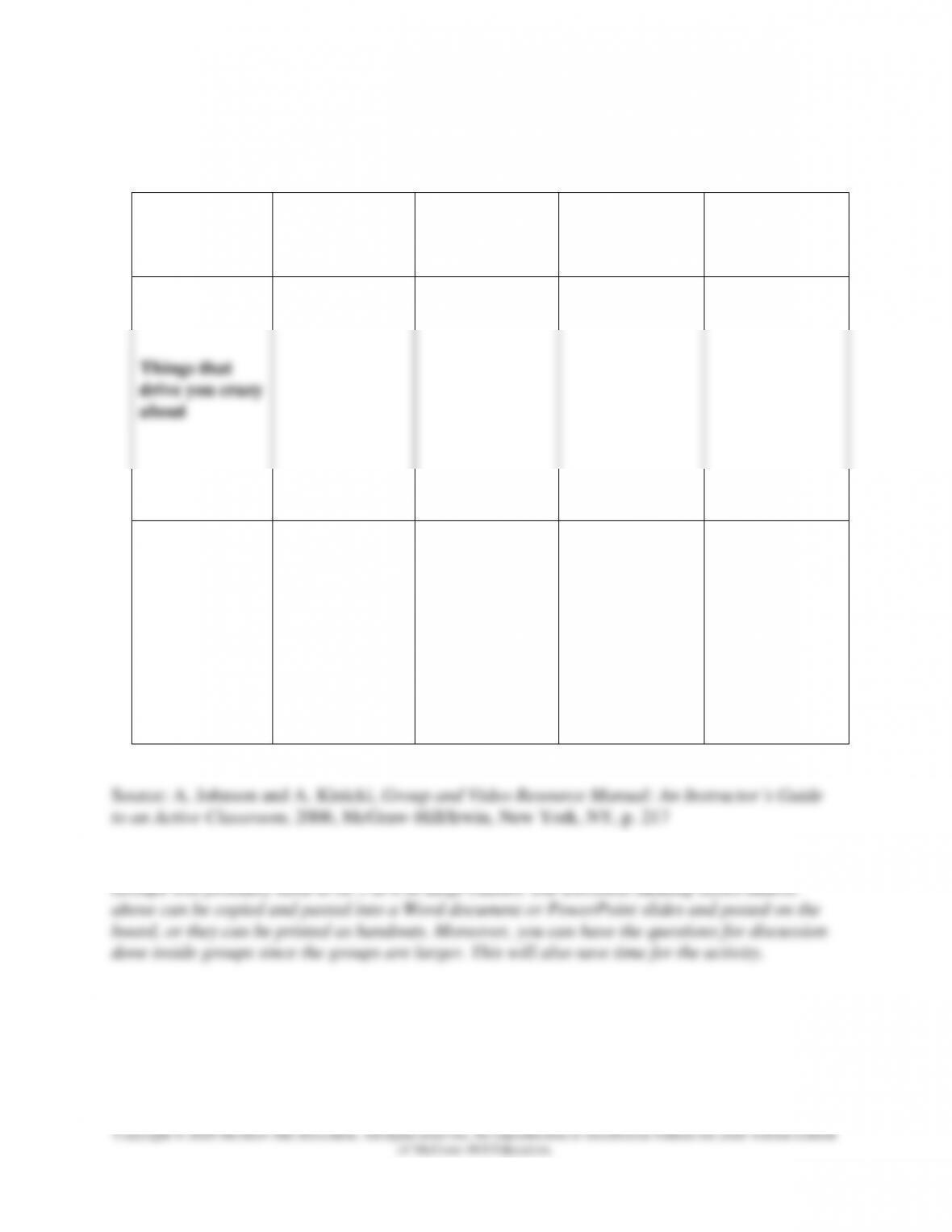
Decision-Making Styles Matrix
Directive
Decision
Makers
Analytical
Decision
Makers
Conceptual
Decision
Makers
Behavioral
Decision
Makers
Things that
drive you crazy
about
Things you
admire about
Tips for large in-person classes:
Kinicki/Williams, Management, 9e: Chapter 7 Individual and Group Decision Making: How Managers
Make Things Happen
7-59
GROUP EXERCISE #4: STRANDED IN THE DESERT: AN EXERCISE IN DECISION
MAKING
Objectives
● To determine the effectiveness of individual versus group decision making.
Introduction
Instructions
1. Give a brief lecture on group decision making. Distribute a copy of the “Stranded in the
Desert” scenario and the “Pack Item Ranking Sheet.”
3. Break students into groups of five and review the following rules:
● Present your position, listening carefully and weighing others’ positions.
4. Groups have 10 minutes to reach a consensus on each pack item’s importance to survival.
5. Using the “Pack Item Ranking Sheet,” each group member then computes the difference
between his or her ranking of each item and the group ranking. Individuals record this
number in the column marked “influence.” This number represents the extent the individual
influenced his or her group to his or her way of thinking. The lower the number, the more
7-60
6. Reconvene as a class for discussion. Record the list of pack items on the
blackboard/whiteboard, flipchart, or overhead. Ask each group for its ranking for each of the
items.
Questions for Discussion
1. Which items did the class rank as most important?
2. How many of you were frustrated by your influence attempts? What did you learn about
influencing others?
3. Based on the influence scores, did your group make an effective decision?
4. Which group members had the most influence on your group’s decisions? Why?
5. Give the students the following research information:
● Groups were often less effective than individuals.
● Groups were more confident about their judgments than individuals.
6. Were these research results reflected in your group’s decision making?
Stranded in the Desert
You and your four friends decide it would be fun to spend a nice spring weekend hiking in the
Sonoran Desert. Excitement is high as all five of you squeeze into your Jeep and head for the
wilderness. As you drive, you enjoy looking for wildlife and trying to identify types of cacti.
Several hours have gone by when the road suddenly ends. A recent storm washed it away and
Kinicki/Williams, Management, 9e: Chapter 7 Individual and Group Decision Making: How Managers
Make Things Happen
considering it’s almost nighttime and you don’t have any sleeping bags or blankets. One of your
friends gathers the scattered gear and lays it out in front of you. You have:
● A flashlight
● A Swiss Army knife
Pack Item Ranking Sheet
Instructions:
2. As a group, rank the remaining pack items from 10 (most important to survival) to 1
Return.