
Chapter 07 – Individual & Group Decision Making: How Managers Make Things Happen
7-1
7
Chapter
Individual & Group
Decision Making
How Managers Make Things Happen
Major Questions the Student Should Be Able to Answer 2
Mapping the Class: Chapter Outline 3
Overview of the Chapter 4
Classroom Outline 5
CHAPTER CONTENTS
Chapter 07 – Individual & Group Decision Making: How Managers Make Things Happen
7-2
7.1 Two Kinds of Decision Making: Rational and Nonrational
MAJOR QUESTION: How do people know when they’re being logical or
illogical?
7.4 Four General Decision-Making Styles
MAJOR QUESTION: How do I decide to decide?
7.5 How to Overcome Barriers to Decision Making
MAJOR QUESTION: Trying to be rational isn’t always easy. What are the
barriers?
MAJOR QUESTIONS THE STUDENT SHOULD BE ABLE TO ANSWER
Chapter 07 – Individual & Group Decision Making: How Managers Make Things Happen
7-3
7.1 Two Kinds of Decision Making: Rational and Nonrational
• Decision Making in the Real World
• Rational Decision Making: Managers Should Make Logical & Optimal
Decisions
• Stage 1: Identify the Problem or Opportunity—Determining the Actual
versus the Desirable
7.2 Making Ethical Decisions
7.3 Evidence-Based Decision Making and Analytics
• Evidence-Based Decision Making
7.4 Four General Decision-Making Styles
• Value Orientation & Tolerance for Ambiguity
• 1. The Directive Style: Action-Oriented Decision Makers Who Focus on
Facts
7.5 How to Overcome Barriers to Decision Making
• Decision Making & Expectations about Happiness
• How Do Individuals Respond to a Decision Situation? Ineffective &
7.6 Group Decision Making: How to Work with Others
• Advantages & Disadvantages of Group Decision Making
MAPPING THE CLASS: CHAPTER OUTLINE
Chapter 07 – Individual & Group Decision Making: How Managers Make Things Happen
7-4
7.1 Two Kinds of Decision Making: Rational and Nonrational
Decision making, the process of identifying and choosing alternative
courses of action, may be rational, but often it is nonrational. Four steps
7.2 Making Ethical Decisions
Businesses have a dismal record of ethics. Many companies now have
7.3 Evidence-Based Decision Making and Analytics
Evidence-based decision making brings rationality to the decision-
making process. This section describes seven principles for implementing
7.4 Four General Decision-Making Styles
7.5 How to Overcome Barriers to Decision Making
Responses to a decision situation may take the form of four ineffective
7.6 Group Decision Making: How to Work with Others
Group decision making has five potential advantages and four potential
OVERVIEW OF THE CHAPTER
Chapter 07 – Individual & Group Decision Making: How Managers Make Things Happen
7-5
The Manager’s Toolbox: How Exceptional Managers Check to See If Their
Decisions Might Be Biased
An important part of a manager’s job is making decisions, but there are a variety of
biases that can cause you to make the wrong decision. You can fall victim to the
Possible Topics for Discussion:
• Facing the hard facts about what works and what doesn’t, how able do you think
you are to make the tough decisions that effective managers have to make? Can
you describe an instance in which you were badly wrong about something or
someone?
• Do you believe these biases are more likely to occur with individual decision
Section 7.1 discusses four steps in the rational decision making process: (1) identify the
problem or opportunity, (2) think up alternative solutions, (3) evaluate alternatives and
select a solution, and (4) implement and evaluate the solution chosen. There is also a
CLASSROOM OUTLINE
7.1 Two Kinds of Decision Making:
Rational & Nonrational (pp. 190-198)
How do people know when they’re being logical or illogical?
Chapter 07 – Individual & Group Decision Making: How Managers Make Things Happen
7-6
describes the firm’s decision to reformulate Saran Wrap over environmental concerns,
knowing that the reformulation was likely to negatively impact the product’s sales.
Article Citation:
Johnson, F. (2015). SC Johnson’s CEO on doing the right thing, even when it hurts
business. Harvard Business Review, 93(4), 33-36.
Product #: R1504A-PDF-ENG
Possible Topics for Discussion:
• Discuss why it can be so hard to be purely rational in the decision-making
Major Idea Outline:
A. Decision Making Defined
1. A decision is a choice made from among available alternatives.
Interactive Classroom Material:
EXAMPLE: How Can Being the Best Affect Your Decision Making? (p. 190)
Kodak was one of the biggest companies of all time, but had to make some tough
decisions on innovation. Afraid to cannibalize its existing business—selling film—
YOUR CALL
Is being in first place the most dangerous place for decision makers? Do you
Chapter 07 – Individual & Group Decision Making: How Managers Make Things Happen
7-7
think some of today’s hot companies—Apple, Google, FedEx, or Costco—on
Fortune’s Most Admired list could experience what happened to Kodak?
Being in first place is always a difficult position because you have to maintain your
lead instead of pushing ahead of your competitors. Keeping a lead, just like in a
Additional Activities:
One way to build on this Example is to have the students watch the New York Times
video “After the Kodak Moment.” This 6-minute video provides a poignant look at
Kodak since its decline. Consider using the following discussion questions:
How should Kodak have applied the steps in rational decision making to address
the decline in film sales?
B. Decision Making in the Real World.
1. Psychologist Daniel Kahneman describes two kinds of thinking, which he
labels System 1 and System 2.
2. With the curse of knowledge, we may be less and less able to see things
from an outsider’s perspective as our knowledge and expertise grow and
hence we are often apt to make irrational decisions.
C. Rational Decision Making: Managers Should Make Logical & Optimal Decisions
1. The rational model of decision making, also called the classical model,
7-8
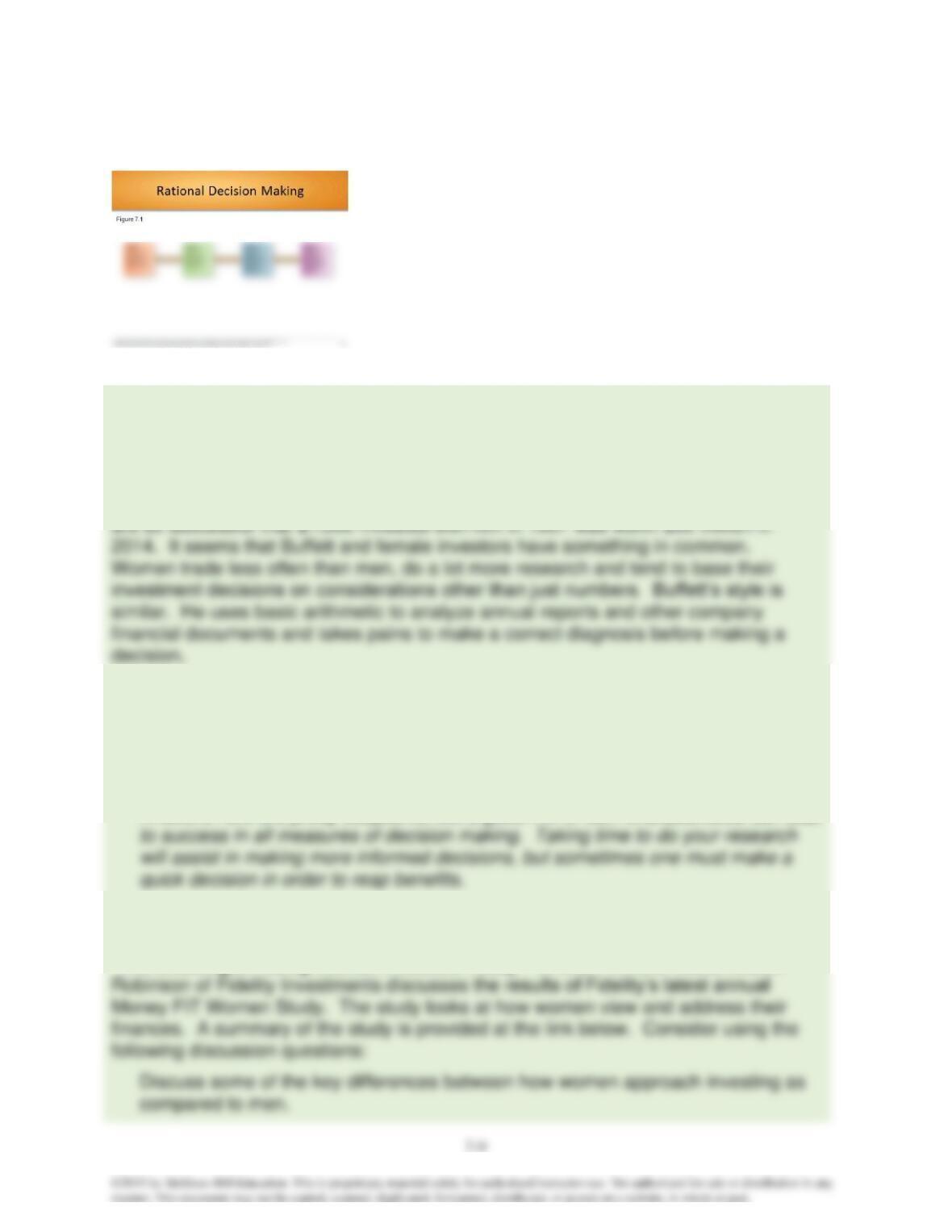
2. There are four stages associated with rational decision making.
a. Stage 1: Identify the problem or opportunity
(1) Problems are difficulties that inhibit the achievement of goals.
b. Stage 2: Think up alternative solutions – both the obvious and the
creative.
(1) After you’ve identified the problem or opportunity and diagnosed
its causes, you need to come up with alternative solutions.
c. Stage 3: Evaluate alternatives and select a solution – ethics,
feasibility, and effectiveness.
(1) Is it ethical? If it isn’t ethical, you shouldn’t give it a second look.
d. Stage 4: Implement and evaluate the solution chosen.
(1) With some decisions, implementation is usually straightforward.
(2) With other decisions, the implementation can be quite difficult.
Chapter 07 – Individual & Group Decision Making: How Managers Make Things Happen
iv. Start over.
Interactive Classroom Material:
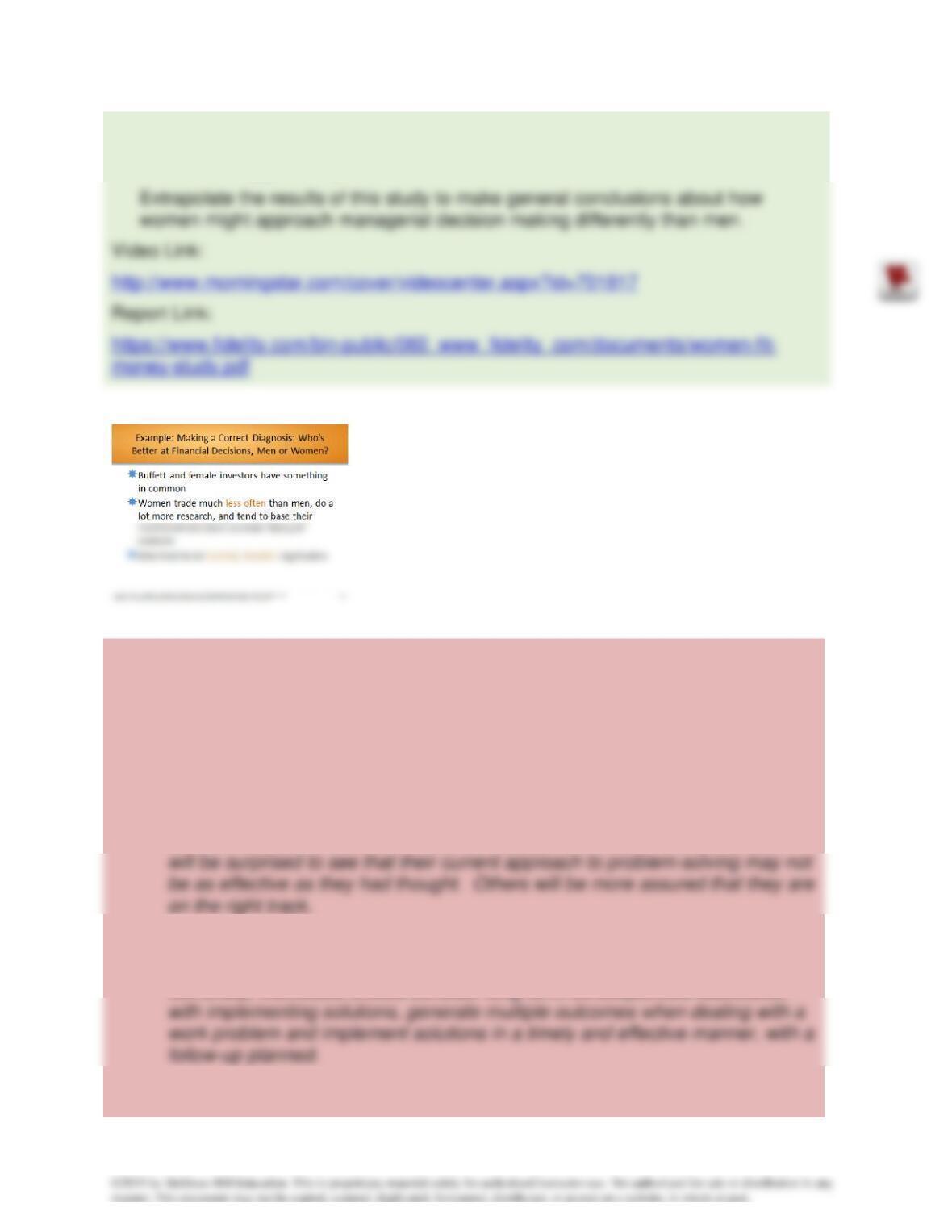
EXAMPLE: Making a Correct Diagnosis: Who’s Better at Financial Decisions,
Men or Women? (p. 192)
Warren Buffett is the renowned billionaire investor known as the “Oracle of Omaha”
who heads the financial juggernaut Berkshire Hathaway. His investment decisions
YOUR CALL
When preparing to make important decisions—especially financial decisions—
do you spend a lot of time trying to make a correct diagnosis, doing deep
research (as women investors are said to do), or do you chase “hot” tips and
make snap judgments (as men reportedly do)?
Answers here are pretty subjective, but a good mix of both characteristics can lead
Additional Activities:
One way to build on this Example is to have the students watch the Morningstar video
“The Challenges Facing Women Investors Today.” In this 7-minute video, Kristen
Chapter 07 – Individual & Group Decision Making: How Managers Make Things Happen
7-10
Assume you are an investment manager at Fidelity. How could you use the
results of this study to help attract more female clients and/or get female clients to
invest more aggressively?
SELF-ASSESSMENT 7.1 (p. 193)
Assessing Your Problem-Solving Potential
Go to connect.mheducation.com and take Self-Assessment 7.1.
Student Questions:
1. What is the status of your problem-solving skills? Are you surprised by the
results?
Student responses will differ based on assessment results. Many students
2. Based on identifying the four lowest scored items on the assessment, what
can you do to improve your problem-solving skills? Explain.
Generally, individuals should consider long-term consequences associated
3. Reflect on a recent decision you made that did not turn out to your
satisfaction. Now, consider what you learned about the rational model and
Chapter 07 – Individual & Group Decision Making: How Managers Make Things Happen
7-11
your problem-solving skills and think through the decision for a second time.
What would you do differently based on these considerations?
Students should implement actual steps from the rational model and apply
Additional Activities:
You can also consult the Connect Instructors Manual for the post-assessment activity
and corresponding PowerPoint slides used for this Self-Assessment in Connect. In
Interactive Classroom Material:
EXAMPLE: Faulty Implementation: Customer Service Is Often “Just Talk” (pp.
193-194)
One study found that only 6% of shoppers who experienced a problem with a retailer
contacted the company. However, 31% went on to tell friends, family, and colleagues
what had happened. Indeed, if 100 people have a bad experience, a retailer stands
to lose between 32 and 36 current or potential customers, according to the study.
YOUR CALL
What do you think the self-serve trend means for customer service?
Self-serve means that customer service may slowly become nonexistent, or
Additional Activities:
One way to build on this Example is to have the students watch the ABC News
202/20 segment “How Ex-Customer Service Reps Say They Dealt with Unruly
Customers.” This 7-minute video profiles the decline of customer service, from the

Chapter 07 – Individual & Group Decision Making: How Managers Make Things Happen
7-12
Interactive Classroom Material:
EXAMPLE: Evaluation: The Boeing 787 Dreamliner, a Bet-the-Company
Decision (pp. 194-195)
When Boeing was losing business to its European rival Airbus, the company was
wracked by scandals involving Pentagon contracts, and rising fuel costs were
dramatically impacting the commercial airline industry. Boeing management made a
bold decision: It would build a new medium-sized commercial jet, the 787 Dreamliner.
First planned for a summer 2007 launch, the date was revised for 2008. Then the
YOUR CALL
How would you evaluate Boeing’s decisions? Do you think despite all the effort
on the 787-8 that the Dash Nine could cause Boeing to fail to break even on the
787-8, with airlines switching their orders to the newer aircraft? Was this a
risky bet-the-company decision?
Boeing is attempting to correct many of the issues with the 787-8 with the 787-9
Additional Activities:
One way to build on this Example is to have the students read the Wall Street Journal
article “With Plates Full, Boeing and Airbus Plot Next Moves.” The article profiles
some of the strategic decisions being made by the rival firms. Consider using the
following discussion questions:
Chapter 07 – Individual & Group Decision Making: How Managers Make Things Happen
7-13
impacted the 787 Dreamliner project.
Using the material from Chapter 6, perform a Porter’s Five Forces analysis on the
commercial jetliner industry. What are the key factors impacting the attractiveness
of this industry?
D. What’s Wrong with the Rational Model?
1. The rational model is prescriptive, describing how managers ought to make
decisions, not how managers actually make decisions.
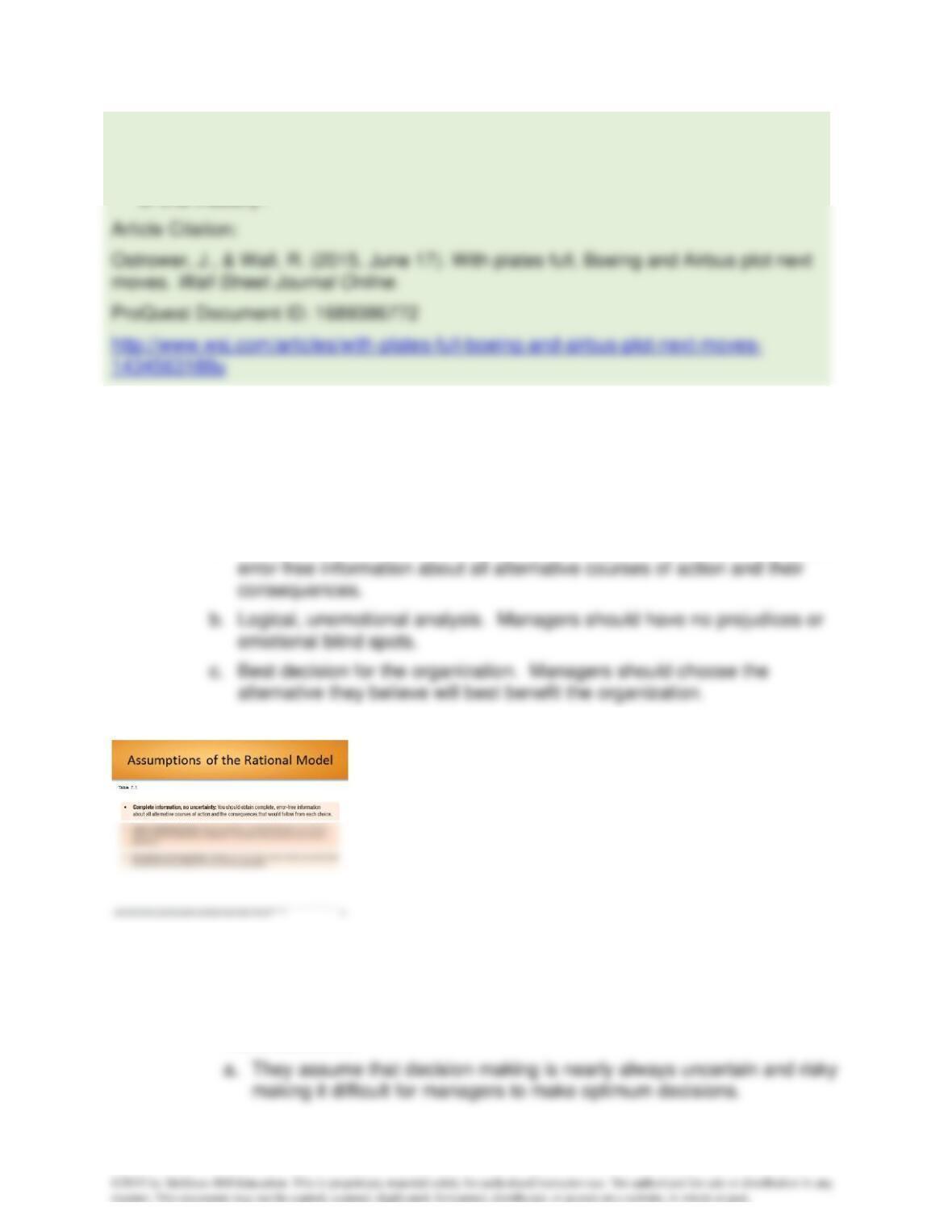
2. The rational model makes three unrealistic assumptions:
a. Complete information, no uncertainty. Managers should have complete,
E. Nonrational Decision Making: Managers Find It Difficult to Make Optimum
Decisions
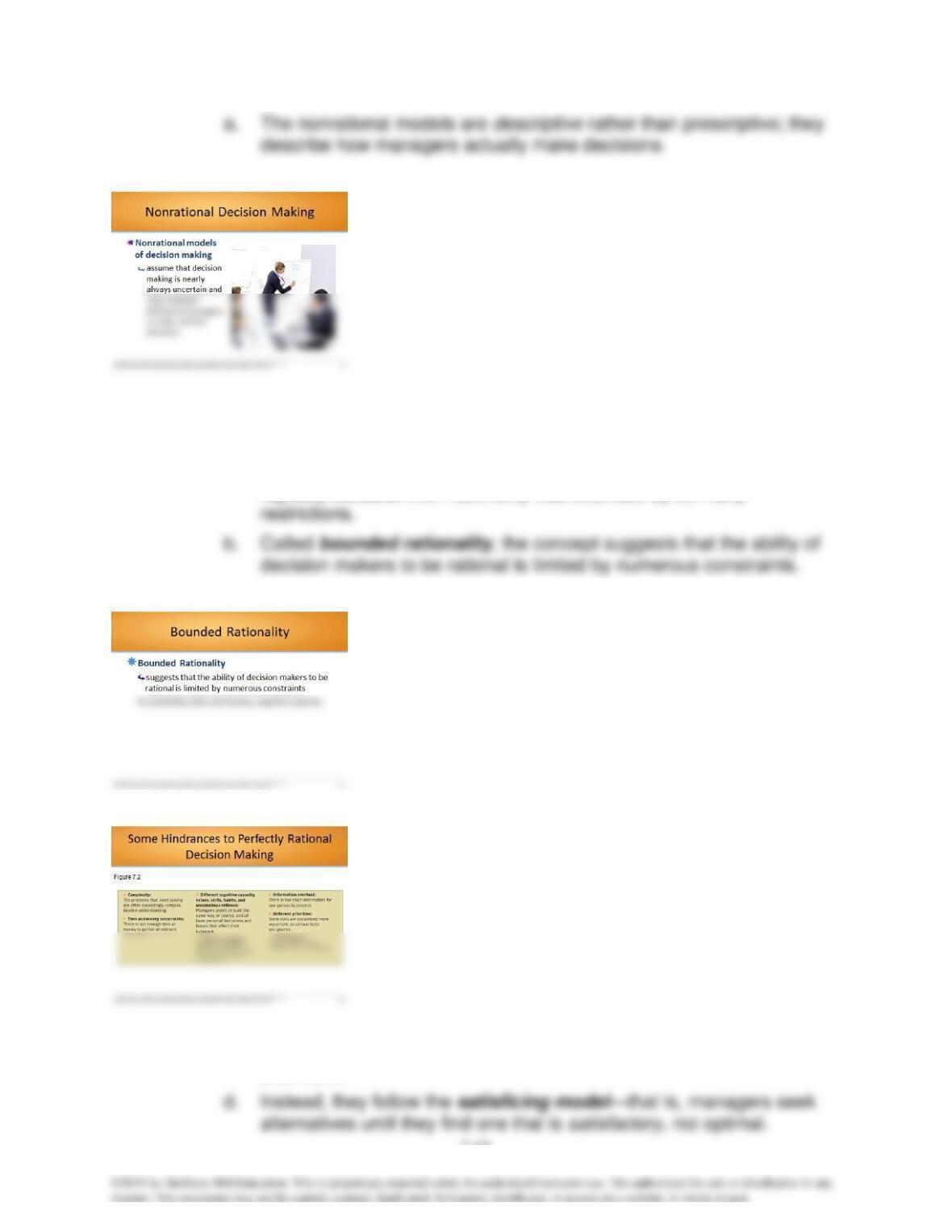
1. Nonrational models of decision making explain how managers do
make decisions.
Chapter 07 – Individual & Group Decision Making: How Managers Make Things Happen
7-14
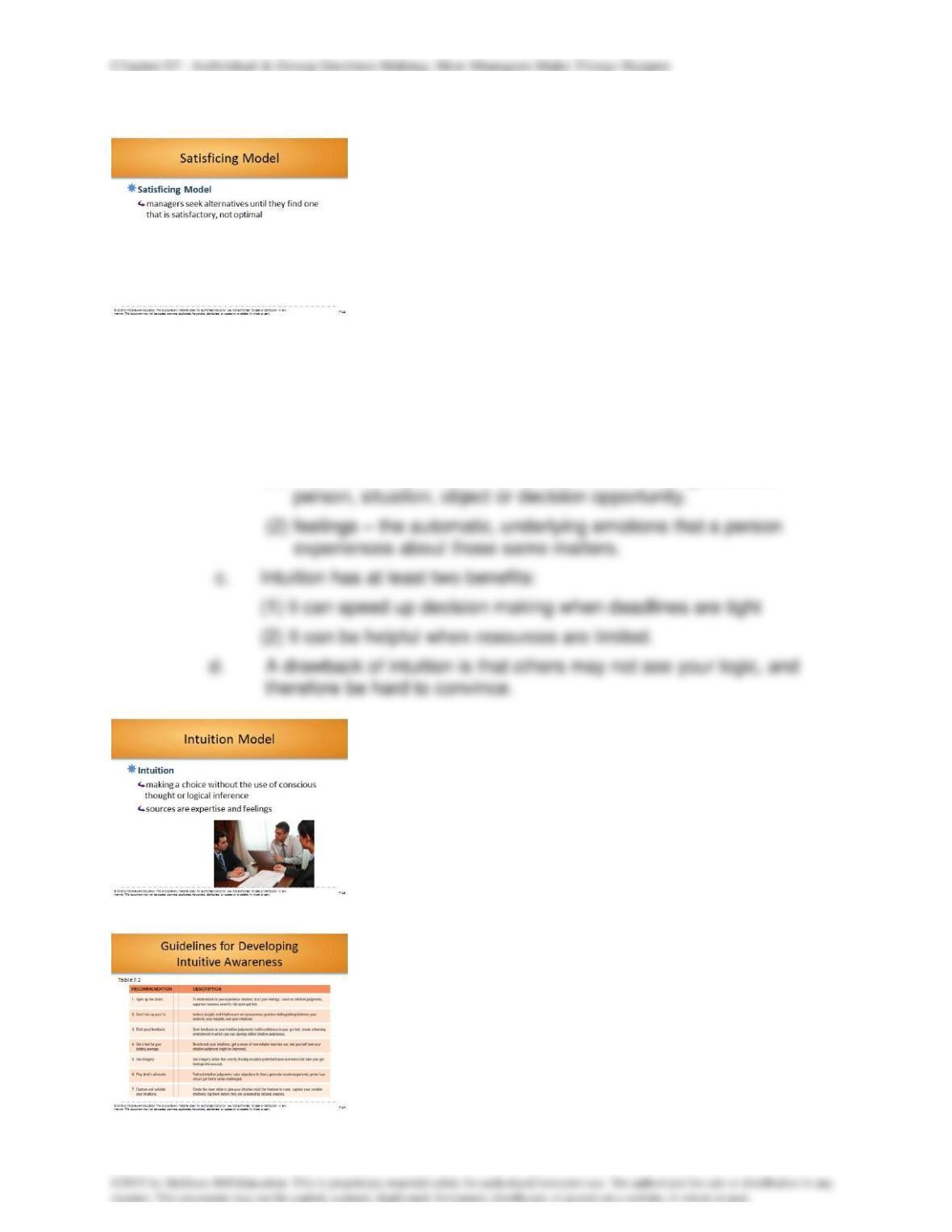
2. Bounded rationality and the satisficing model: “satisfactory is good
enough.”
a. Herbert Simon’s research found that managers could not act truly
logically because their rationality was bounded by so many
c. As a result, managers don’t make an exhaustive search for the best
alternative.
7-15
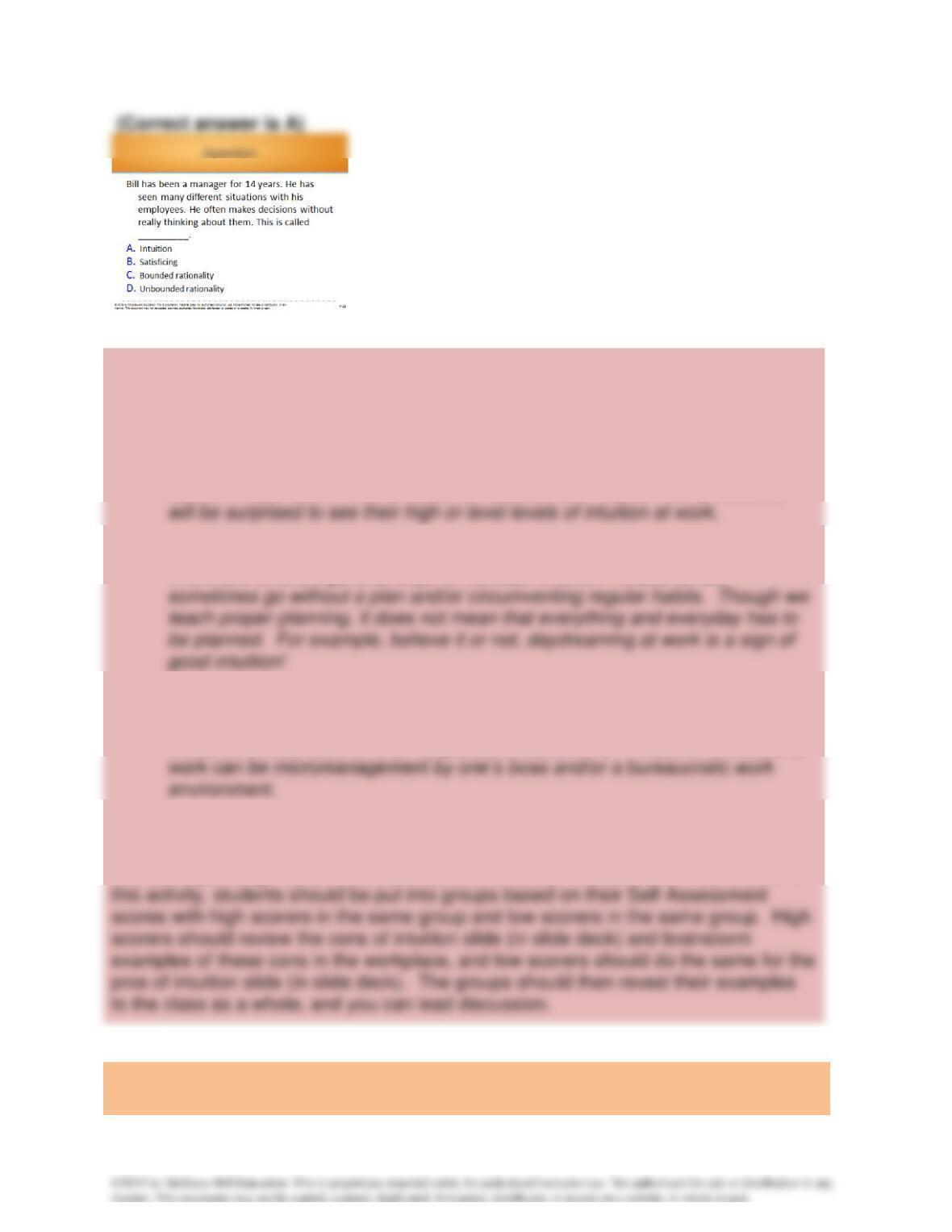
3. The Intuition Model: “It just feels right”
a. Going with your gut, or intuition, is making a choice without the use of
conscious thought or logical interference.
b. Sources of intuition are:
(1) expertise – a person’s explicit and tacit knowledge about a
Chapter 07 – Individual & Group Decision Making: How Managers Make Things Happen
7-16
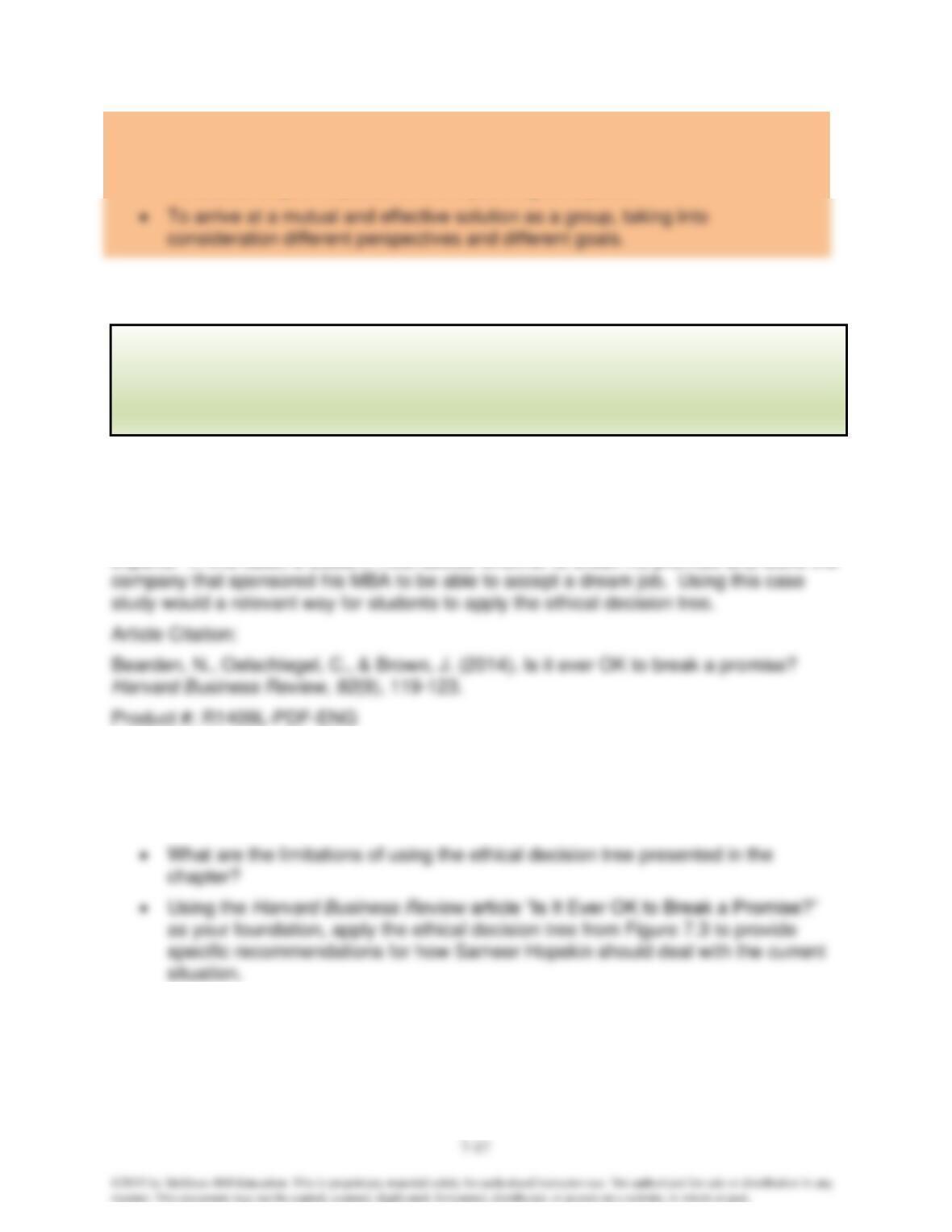
Assessing Your Level of Intuition
Go to connect.mheducation.com and take Self-Assessment 7.2.
Student Questions:
1. Are you intuitive at work? Did the results surprise you?
Student responses will differ based on assessment results. Many students
2. What can you do to increase the amount of intuition you use at work?
There are different general ways to increase intuition. Students can
3. What factors are inhibiting your use of intuition? What if anything can be done
to eliminate these hindrances?
Students should build on their response to Question 2. Possible inhibitions at
Additional Activities:
You can also consult the Connect Instructors Manual for the post-assessment activity
and corresponding PowerPoint slides used for this Self-Assessment in Connect. In
Group Exercise #1: Trying to Solve an “Electric” Problem in Managerial Planning
There is a group exercise available at the end of this manual that allows students
Chapter 07 – Individual & Group Decision Making: How Managers Make Things Happen
apply what they have learned about planning and problem-solving.
Exercise Objectives
• To assess a specific problem where planning is required.
Section 7.2 discusses a decision tree, which can help one make ethical decisions. One
way that you could begin your coverage of these topics is to have the students read the
Harvard Business Review article “Is It Ever OK to Break a Promise?” This article is a
HBR Case Study and includes a fictional case and case commentary by industry
experts. In this case, a student must decide whether to break his promise and leave the
Possible Topics for Discussion:
• Think of a time when you were not sure if a course of action you were
considering was ethical or not. How could you have applied the ethical decision
tree in Figure 7.3 to help you make a decision?
Major Idea Outline:
A. The Dismal Record of Business Ethics
1. Recent high-profile scandals have spurred interest in ethical decision
making.
7.2 Making Ethical Decisions (pp. 199-200)
What guidelines can I follow to be sure that decisions I make are not just
lawful but ethical?
Chapter 07 – Individual & Group Decision Making: How Managers Make Things Happen
7-18
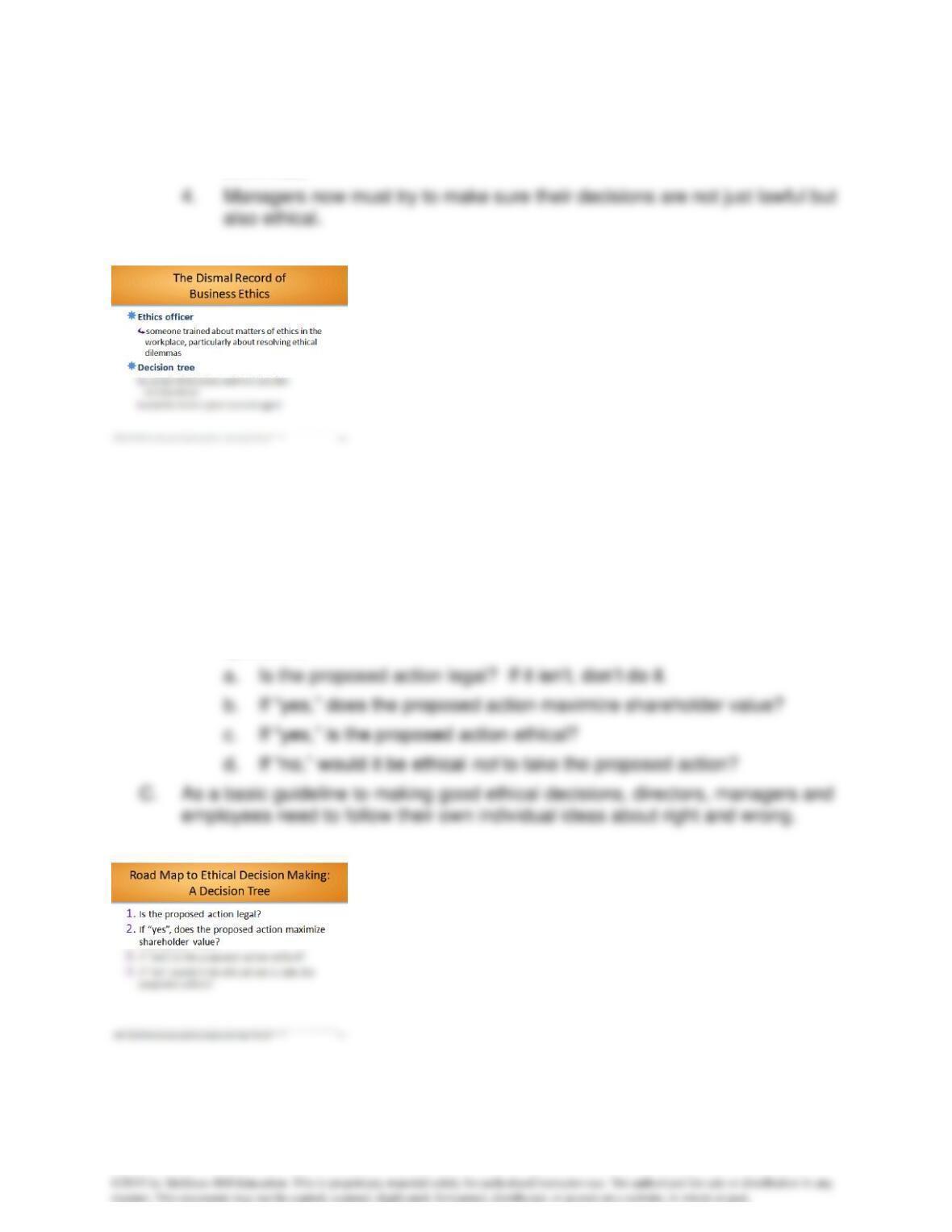
3. Many companies now have an ethics officer, someone trained about
matters of ethics in the workplace, particularly about resolving ethical
dilemmas.
B. Road Map to Ethical Decision Making: A Decision Tree
1. Businesses continually try to balance the pressure to maximize
shareholder value while acting ethically.
2. A decision tree is a graph of decisions and their possible consequences;
it is used to create a plan to reach a goal.
3. When confronted with a decision, a manager should ask the following
questions:
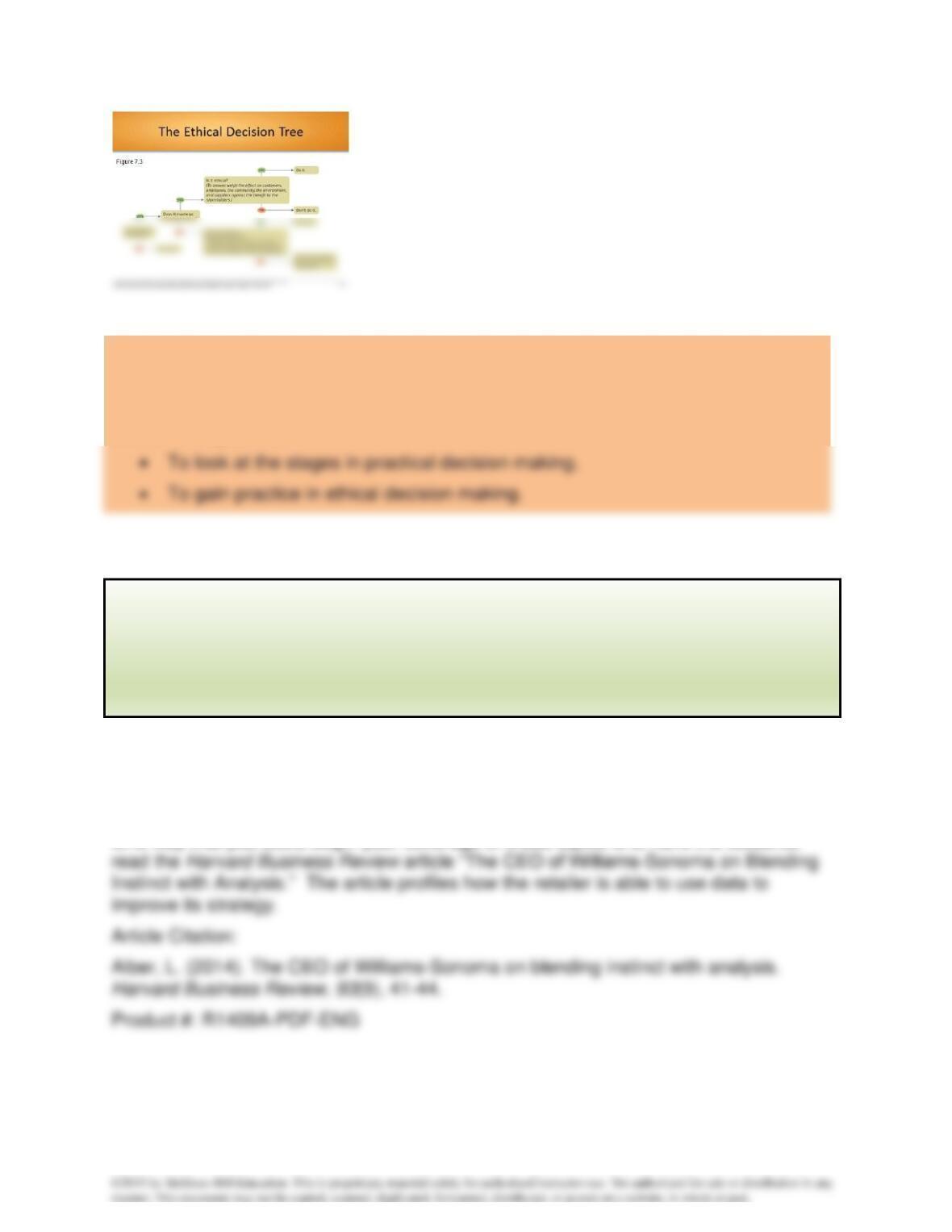
Chapter 07 – Individual & Group Decision Making: How Managers Make Things Happen
7-19
Group Exercise #2: Ethical Decision Making
There is a group exercise available at the end of this manual that allows students to
gain practice in ethical decision making.
Exercise Objectives
Section 7.3 discusses the seven principles for implementing evidence-based decision
making. Overall, it is sometimes difficult to bring this approach to bear on one’s
decision making. Lastly, there is a discussion on analytics and its three key attributes.
One way that you could begin your coverage of these topics is to have the students
7.3 Evidence-Based Decision Making & Analytics (pp. 201-
205)
How can I improve my decision making using evidence-based
management and business analytics?
Chapter 07 – Individual & Group Decision Making: How Managers Make Things Happen
Possible Topics for Discussion:
• Describe industries or products that will undergo dramatic transformation as our
ability to capture and process data improves.
Major Idea Outline:
A. Evidence-Based Decision Making
2. Seven implementation principles help companies that are committed to
doing what it takes to profit from evidence-based management, as follows:
a. Treat your organization as an unfinished prototype – Don’t be
(1) This causes them to downplay risks and continue on the same
paths despite evidence that things are not working.
(1) You need to grab management’s attention by using vivid stories to
sell preferred practices based on solid if unexciting evidence.
f. If all else fails, slow the spread of bad practices – It may be necessary
for you to practice so-called “evidence-based misbehavior.”
g. The best diagnostic question: what happens when people fail? –
When something goes wrong, you need to:
(1) Face the hard facts.