Design for Quality and Product Excellence 1
CHAPTER 7
Design for Quality and Product Excellence
Teaching Notes
The precise manner in which a person or team approaches product design, solving problems to
achieve product excellence, or developing product reliability is not as critical as doing it in a
systematic fashion.
Key objectives for this chapter should include:
• To explore the typical structured product development process consisting of idea
generation, preliminary concept development, product/process development, full-scale
production, product introduction, and market evaluation.
• To learn that concurrent, or simultaneous, engineering is an effective approach for
managing the product development process by using multi-functional teams to help
remove organizational barriers between departments and therefore reduce product
development time. Design reviews help to facility product development by stimulating
discussion, raising questions, and generating new ideas
• To introduce the concept of Design for Six Sigma (DFSS) consisting of a set of tools and
methodologies used in the product development process to ensure that goods and services
meet customer needs and achieve performance objectives, and that the processes used to
make and deliver them achieve Six Sigma capability. DFSS consists of four principal
activities of: Concept development, Design development, Design optimization, and
Design verification. These activities are often incorporated into a variation of the
DMAIC process, known as DMADV, which stands for Define, Measure, Analyze,
Design, and Verify.
• To define concept development as the process of applying scientific, engineering, and
business knowledge to produce a basic functional design that meets both customer needs
and manufacturing or service delivery requirements. This involves developing creative
ideas, evaluating them, and selecting the best concept.
• To appreciate the concepts of innovation and creativity. Innovation involves the
adoption of an idea, process, technology, product, or business model that is either new or
new to its proposed application. Creativity is seeing things in new or novel ways. Many
creativity tools are designed to help change the context in which one views a problem or
opportunity, thereby leading to fresh perspectives.
• To explore Quality Function Deployment (QFD) — a planning process to guide the
design, manufacturing, and marketing of goods by integrating the voice of the customer
throughout the organization. A set of matrices, often called the House of Quality, is used
to relate the voice of the customer to a product’s technical requirements, component
requirements, process control plans, and manufacturing operations.
Design for Quality and Product Excellence 2
• To investigate manufacturing specifications, consisting of nominal dimensions and
tolerances. Nominal refers to the ideal dimension or the target value that manufacturing
seeks to meet; tolerance is the permissible variation, recognizing the difficulty of
meeting a target consistently.
• Tolerance design involves determining the permissible variation in a dimension. A
scientific approach to tolerance design uses the Taguchi loss function. Taguchi assumes
that losses can be approximated by a quadratic function so that larger deviations from
target correspond to increasingly larger losses. For the case in which a specific target
value, T, is determined to produce the optimum performance, and in which quality
deteriorates as the actual value moves away from the target on either side (called
“nominal is best”), the loss function is represented by L(x) = k(x – T)2.
• To study the dimensions of reliability—the ability of a product to perform as expected
over time. Formally, reliability is defined as the probability that a product, piece of
equipment, or system performs its intended function for a stated period of time under
specified operating conditions. In practice, the number of failures per unit time
determines reliability during the duration under consideration (called the failure rate),
look at functional failure at the start of product life (The early failure period is
sometimes called the infant mortality period), reliability failure after some period of
use.
• To understand why reliability is often modeled using an exponential probability
distribution and use the reliability function, specifying the probability of survival, which
is: R(T) = 1 – e–T.
• To explore systems composed of individual components with known reliabilities,
configured in series, in parallel, or in some mixed combination, and how it ties into
various aspects of design, including optimization, tolerance design, and design
verification.
• To learn that design optimization includes setting proper tolerances to ensure maximum
product performance and making designs robust; a scientific approach to tolerance
design uses the Taguchi loss function. Techniques for design verification include
formal reliability evaluation, using techniques such as accelerated life testing and burn-
in.
• To examine the characteristics of Design Failure Mode And Effects Analysis
(DFMEA) — a methodology to identify all the ways in which a failure can occur, to
estimate the effect and seriousness of the failure, and to recommend corrective design
actions.
• Fault Tree Analysis (FTA), sometimes called cause and effect tree analysis, is a
method to describe combinations of conditions or events that can lead to a failure. In
effect, it is a way to drill down and identify causes associated with failures and is a good
complement to DFMEA.
• To investigate good product design, which anticipates issues related to cost,
manufacturability, and quality. Improvements in cost and quality often result from
simplifying designs, and employing techniques such as design for manufacturability
(DFM) – the process of designing a product for efficient production at the highest level
of quality.
Design for Quality and Product Excellence 3
• To study social responsibilities in the design process including product safety and
environmental concerns, which have made Design for Environment (DfE) and design
for disassembly important features of products, because they permit easy removal of
components for recycling or repair, eliminate other environmental hazards, and makes
repair more affordable.
• To explore Design for Excellence (DFX), an emerging concept that includes many
design-related initiatives such as concurrent engineering, design for manufacturability
design for assembly, design for environment and other “design for” approaches. DFX
objectives include higher functional performance, physical performance, user
friendliness, reliability and durability, maintainability and serviceability, safety,
compatibility and upgradeability, environmental friendliness, and psychological
characteristics.
• To introduce concept engineering (CE) — a focused process for discovering customer
requirements and using them to select superior product or service concepts that meet
those requirements.
• To appreciate that the purpose of a design review is to stimulate discussion, raise
questions, and generate new ideas and solutions to help designers anticipate problems
before they occur.
• To understand techniques for design verification including formal reliability evaluation.
These include accelerated life testing, which involves overstressing components to
reduce the time to failure and find weaknesses; and burn-in, or component stress testing,
which involves exposing integrated circuits to elevated temperatures in order to force
latent defects to occur.
• To appreciate that Six Sigma performance depends on reliable measurement systems.
Common types of measuring instruments used in manufacturing today fall into two
categories: “low–technology” and “high-technology.” Low-technology instruments are
primarily manual devices that have been available for many years; high-technology
describes those that depend on modern electronics, microprocessors, lasers, or advanced
optics.
ANSWERS TO QUALITY IN PRACTICE FEATURES
Testing Audio Components at Shure, Inc.
1. Describe how the definition of reliability presented in this chapter applies to the
performance tests described here. Do these tests measure inherent reliability or achieved
reliability?
The general definition of reliability as: the probability that a product, piece of equipment, or
system performs its intended function for a stated period of time under specified operating
conditions, is thoroughly tested by Shure. Tests are tailored to various market segments,
according to the type of use (or abuse) the equipment is likely to incur. For the consumer market,
Shure uses the cartridge drop and scrape test, which is particularly important to test for, in the
light of how “scratch” DJ’s use the equipment. For presentation and installation audio systems,
they use the microphone drop test and perspiration test. For mobile communications, the two
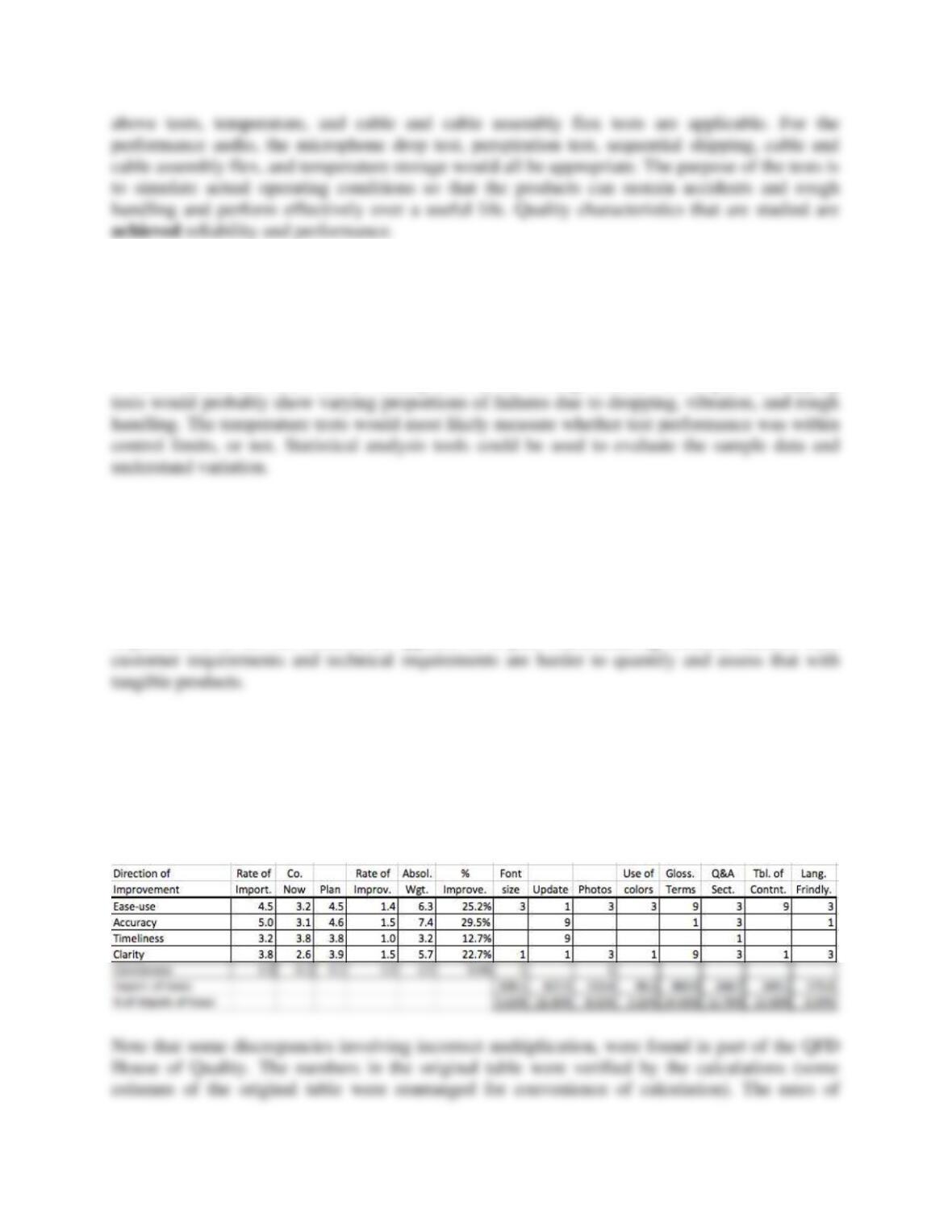
Design for Quality and Product Excellence 4
2. For the examples of product testing provided in this case, discuss what quality/reliability
measurements might be taken and how the data might be analyzed.
For the microphone drop test, the measures are probably measures of sound and response levels,
within an acceptable range. The cable and cable assembly flex test might measure the percentage
of cables tested that failed due to rocking motions or twisting motions. The sequential shipping
Applying QFD in a Managed Care Organization
1. Although this example of QFD involved the design of tangible items, why is it more
difficult to implement in a service context as opposed to a pure manufacturing context?
Although this example of QFD involved the design of a tangible items, it is more difficult to
implement in a service context, as opposed to a pure manufacturing context, because both
2. Verify the calculations in the Importance of the Hows row and Percentage of Importance
of the Hows row by showing the detailed calculationsused to arrive at these figures.
The detailed calculations in the Importance of the hows row and Percentage of importance of the
hows row used to arrive at these figures are shown and verified on the spreadsheet QIP-Managed
Care Solution in the instructor materials.

Design for Quality and Product Excellence 5
3. What lessons can be learned and applied to other service organizations that seek to
design or redesign their products and services?
The lessons that can be learned and applied to other service organizations that seek to design or
redesign their products and services include the facts that QFD provides for a systematic
approach to linking the “voice of the customer” to operational requirements. By doing so,
ANSWERS TO REVIEW QUESTIONS
1. Describe the steps of the product design and development process.
Product design and development consists of six steps:
• Idea Generation. New or redesigned product ideas should incorporate customer needs and
expectations.
• Preliminary Concept Development. In this phase, new ideas are studied for feasibility.
• Product/Process Development. If an idea survives the concept stage, the actual design
process begins by evaluating design alternatives and determining engineering specifications for
2. Discuss the importance of and impediments to reducing the time for product
development.
Competitive pressures are forcing companies to reduce time to market, which means that the
time for product development is also squeezed. The problems incurred in speeding up the
process are well known. If done too hastily, the result will be the need to revise or scrap the
design, cost increases or project over-runs, difficulty in manufacturing the product, early product
Design for Quality and Product Excellence 6
3. What is concurrent engineering? What benefits does it have?
Concurrent engineering is a process in which all major functions involved with bringing a
product to market are continuously involved with product development from conception through
sales. Such an approach not only helps achieve trouble-free introduction of products and
services, but also results in improved quality, lower costs, and shorter product development
return on assets.
4. What is Design for Six Sigma (DFSS)? Explain the four basic elements of DFSS and the
various tools and methodologies that comprise this body of knowledge.
Design for Six Sigma (DFSS) uses a set of tools and methodologies in the product development
process to ensure that goods and services will meet customer needs and achieve performance
objectives, and that the processes used to make and deliver them achieve Six Sigma capability.
DFSS consists of four principal activities:
• Concept development, in which product functionality is determined based upon customer
requirements, technological capabilities, and economic realities;
5. Explain concept development and innovation. Describe the importance of innovation and
creativity in concept development.
Concept development is the process of applying scientific, engineering, and business knowledge
to produce a basic functional design that meets both customer needs and manufacturing or
service delivery requirements. Developing new concepts requires innovation and creativity.
Innovation involves the adoption of an idea, process, technology, product, or business model that
is either new or new to its proposed application. The outcome of innovation is a discontinuous or
breakthrough change and results in new and unique goods and services that delight customers
and create competitive advantage.
Innovations can be classified as:
Design for Quality and Product Excellence 7
1. An entirely new category of product; for example the iPod
2. First of its type on the market in a product category already in existence; for example, the
DVD player.
6. What is the purpose of detailed design?
Conceptual designs must be translated into measurable technical requirements and, subsequently,
into detailed design specifications. Detailed design focuses on establishing technical
7. Explain the concept and the principal benefits of QFD.
QFD benefits companies through improved communication and teamwork between all
constituencies in the production process, such as between marketing and design, between design
and manufacturing, and between purchasing and suppliers. Product objectives are better
understood and interpreted during the production process. Use of QFD determines the causes of
8. Outline the process of building the House of Quality. What departments and functions
within the company should be involved in each step of the process?
In the QFD development process, a set of matrices is used to relate the voice of the customer to a
product’s technical requirements, component requirements, process control plans, and
manufacturing operations. The first matrix, called the House of Quality, provides the basis for
the QFD concept.
Design for Quality and Product Excellence 8
Building the House of Quality consists of six basic steps:
1. Identify customer requirements.
2. Identify technical requirements.
The first House of Quality in the QFD process provides marketing with an important tool to
understand customer needs and gives top management strategic direction. Three other “houses of
quality” are used to deploy the voice of the customer to (in a manufacturing setting) component
parts characteristics, process plans, and quality control. The second house applies to subsystems
and components. At this stage, target values representing the best values for fit, function, and
9. Explain and give an example of nominal specifications and tolerances in both
manufacturing and service.
Manufacturing specifications consist of nominal dimensions and tolerances. Nominal refers to
the ideal dimension or the target value that manufacturing seeks to meet; tolerance is the
permissible variation, recognizing the difficulty of meeting a target consistently. Traditionally,
tolerances are set by convention rather than scientifically. A designer might use the tolerances
specified on previous designs or base a design decision on judgment from past experience.
10. Explain the Taguchi loss function and how it is used in process and tolerance design.

Design for Quality and Product Excellence 9
The Taguchi loss function is a useful concept for process design. Taguchi suggests that there is
not strict cut-off point that divides good quality from poor quality. Rather, he assumed that losses
can be approximated by a quadratic function so that larger deviations from target correspond to
11. Define reliability. Explain the definition thoroughly.
Reliability is the probability that a product, piece of equipment, or system performs its intended
function for a stated period of time under specified operating conditions. There are four key
components of this definition, including probability, time, performance, and operating conditions.
12. What is the difference between a functional failure and a reliability failure?
A functional failure is one incurred at the start of the product‘s life due to defective materials,
components, or work on the product. A reliability failure is one that is incurred after some period of
13. What is the difference between inherent reliability and achieved reliability?
Reliability engineers distinguish between inherent reliability, which is the predicted reliability
determined by the design of the product or process, and the achieved reliability, which is the
14. What is the definition of failure rate? How is it measured?
Failure rate is defined as the number of failures per unit of time during a specified time period
15. Explain the product life characteristics curve and its implications for reliability and
quality control.
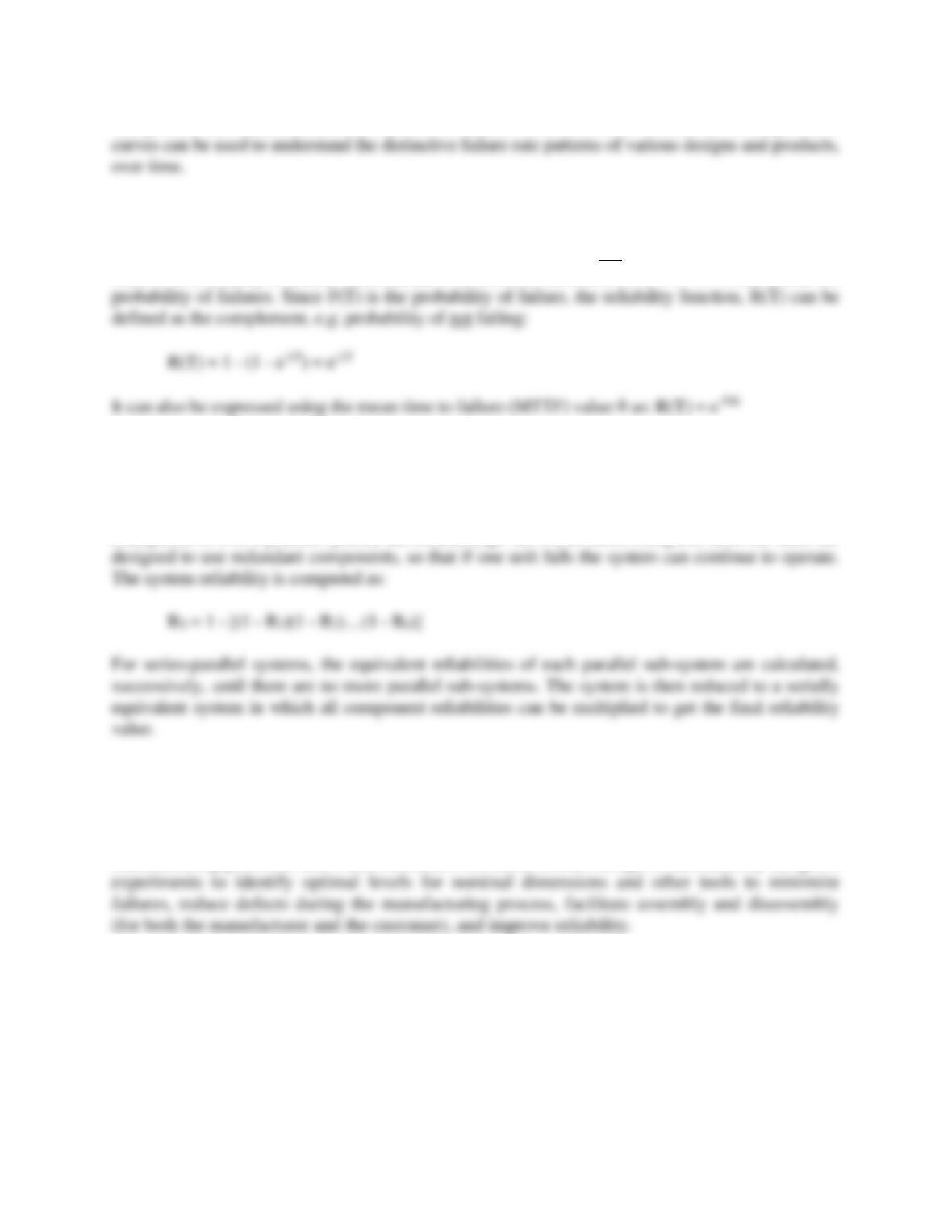
Design for Quality and Product Excellence 10
The product life characteristics curve, is the so-called “bath-tub curve” because of its shape. Such
16. What is a reliability function? Explain how to determine it.
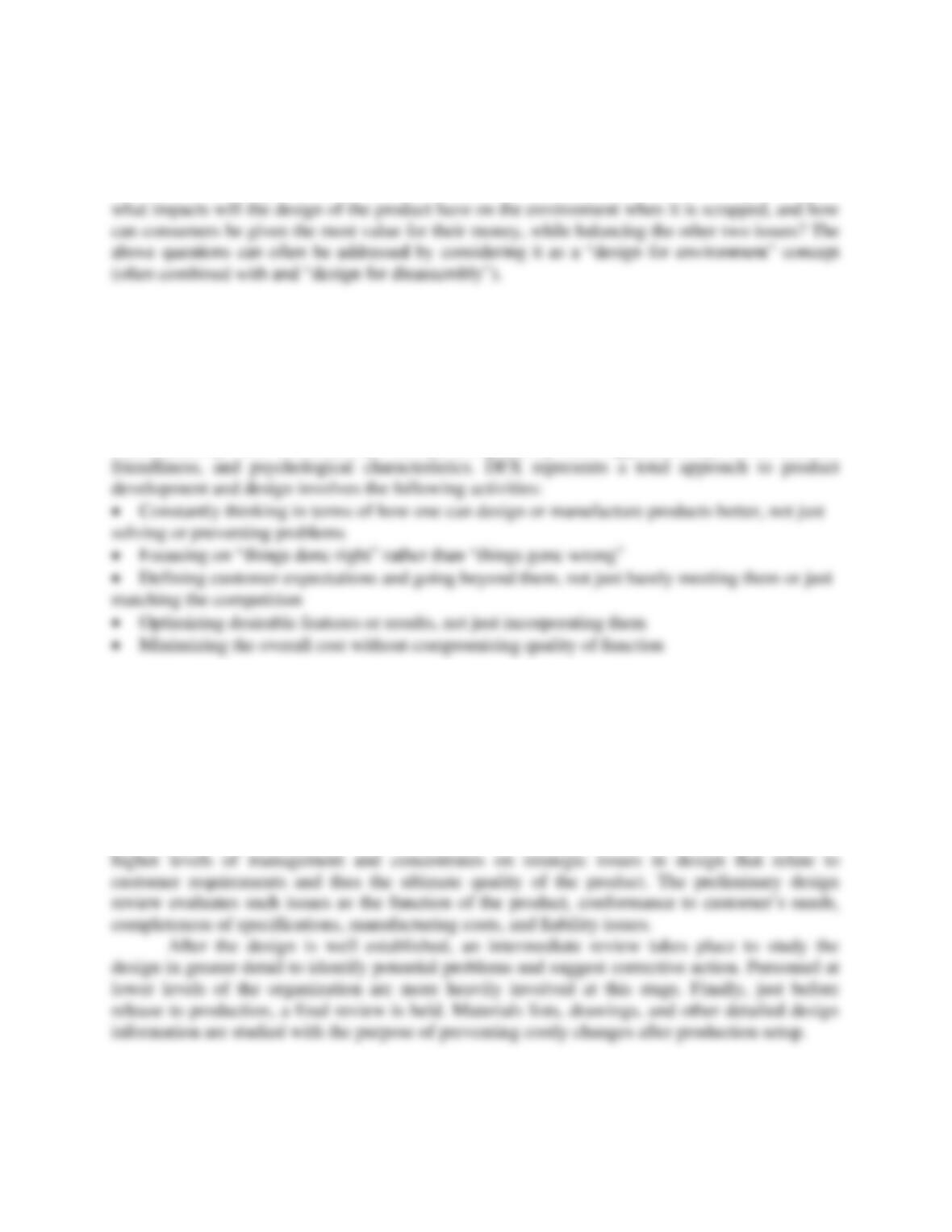
The reliability function represents the probability that an item will not fail within a certain period of
time, T. It is directly related to the cumulative distribution function: F(T) = 1 – e–T, that yields the
17. Explain how to compute the reliability of series, parallel, and series-parallel systems.
The reliability of series, parallel, and series parallel is relatively easy to compute, given the
reliability of components in each system. For a series system, RS = R1R2…Rn. Thus, reliabilities are
multiplicative. For a parallel system, the relationships are a little more complex, since the units are
18. What is robust design? Explain why it is important for both consumers and
manufacturers.
Robust design refers to designing goods and services that are insensitive to variation in
manufacturing processes and when consumers use them. Robust design is facilitated by design of
19. What is design failure mode and effects analysis (DFMEA)? Provide a simple example
illustrating the concept.
The purpose of Design Failure Mode and Effects Analysis (DFMEA) is to identify all the ways
in which a failure can occur, to estimate the effect and seriousness of the failure, and to
recommend corrective design actions. A DFMEA usually consists of specifying the following
information for each design element or function: Failure modes; effect of the failure on the

Design for Quality and Product Excellence 11
20.What is fault tree analysis? How does it differ from DFMEA?
Fault Tree Analysis (FTA), sometimes called cause and effect tree analysis, is a method to
describe combinations of conditions or events that can lead to a failure. In effect, it is a way to
21. How can product design affect manufacturability? Explain the concept and importance
of design for manufacturability.
Product design can have a major impact on manufacturability. If careful thought and planning is
not done by the designer (or design team), the end product can end up being difficult or
impossible to build due to placement of components, methods for attachments, tolerances that
22. Summarize the key design practices for high quality in manufacturing and assembly.
Key design practices for high quality in manufacturing and assembly include: 1) analyze all design
requirements to assess proper dimensions and tolerances, 2) determine process 3) identify and
23. Discuss environmental responsibility issues relating to product design facing businesses
today.
Social responsibilities in the design process include safety and environmental concerns, which
have made Design for Environment (DFE) and Design for Disassembly important features of
products. Legal and environmental issues are becoming critical in designing products and services,
Design for Quality and Product Excellence 12
against liability lawsuits. These would include records on prototype development, testing, and
inspection results.
Environmental issues involve questions of whether environmentally friendly designs (those
that minimize damage to the environment in manufacture and product use) are being developed,
24. Describe the basic approach to design for excellence.
Design for Excellence (DFX) is an emerging concept that includes many design-related
initiatives such as concurrent engineering, design for manufacturability design for assembly,
design for environment and other “design for” approaches. DFX objectives include higher
functional performance, physical performance, user friendliness, reliability and durability,
maintainability and serviceability, safety, compatibility and upgradeability, environmental
25. Explain the purpose of design reviews and how they facilitate product development.
The purpose of a design review is to stimulate discussion, raise questions, and generate new
ideas and solutions to help designers anticipate problems before they occur. To facilitate product
development, a design review is generally conducted in three major stages of the product
development process: preliminary, intermediate, and final. The preliminary design review
establishes early communication between marketing, engineering, manufacturing, and
purchasing personnel and provides better coordination of their activities. It usually involves
26. Describe different forms of product testing.

Design for Quality and Product Excellence 13
Methods of product testing for reliability include: life testing, accelerated life testing, environmental
testing and vibration and shock testing. In life and accelerated life testing the product is tested until
SOLUTIONS TO PROBLEMS
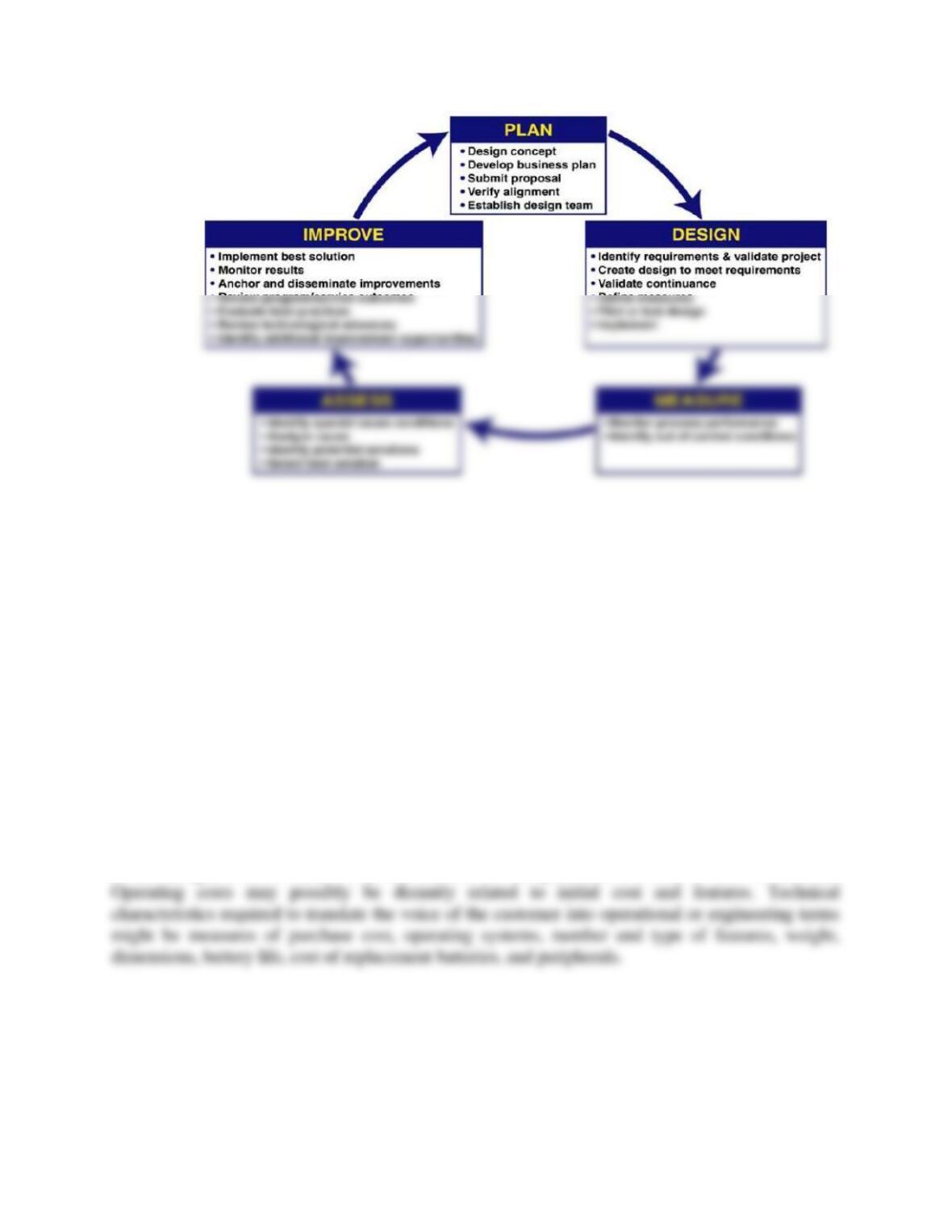
1. A hospital developed a design process consisting of the following steps: Plan, Design,
Measure, Assess, and Improve. Below is a list of specific activities that comprise these five
steps in random order. Place the activities in the most appropriate order within the correct
step of the design process.
Pilot or test design
Submit proposal
Define measures to assess design performance
Implement design
Identify potential solutions to reduce out of control conditions
Develop business plan
Disseminate improvements throughout the organization
Monitor process performance
Select the best solution to improve control
Identify out of control conditions
Propose new concept
Create design to meet requirements
Identify new improvement opportunities
Monitor the new process design
Implement the best solution to improve control
Verify proposal alignment with strategic objectives
Establish design team
Identify causes of out of control conditions
Analyze causes
Identify and validate customer requirements
Identify and evaluate best practices
Although the terms might vary slightly, the following model captures the stages of the design
process for the hospital:
Design for Quality and Product Excellence 14
2. Newfonia, Inc., is working on a design for a new smart phone. Marketing staff conducted
extensive surveys and focus groups with potential customers to determine the
characteristics that the customers want and expect in a smart phone. Newfonia’s studies
have identified the most important customer expectations as
• Initial cost
• Reliability
• Ease of use
• Features
• Operating cost
• Compactness
Develop a set of technical requirements to incorporate into the design of a House of Quality
relationship matrix to assess how well your requirements address these expectations.
Refine your design as necessary, based upon the initial assessment.
Analysis of customer responses for Newfonia’s proposed smart phone indicates the likelihood of
several strong relationships between customer requirements and associated technical requirements
of the design, such as value vs. price; features vs. compactness; and ease of use vs. features.
3. Newfonia, Inc. (Problem 2), faces three major competitors in this market: Oldphonia,
Simphonia, and Colliefonia. It found that potential consumers placed the highest
importance on reliability (measured by such things as freedom from operating system
crashes and battery life), followed by compactness (weight/bulkiness), followed by
flexibility (features, ease of use, and types of program modules available). The operating
cost was only occasionally noted as an important attribute in the surveys. Studies of their
Design for Quality and Product Excellence 15
products yielded the information shown in the table in the C07 Problem Data workbook.
Results of the consumer panel ratings for these competitors are also shown in that
spreadsheet. Using this information, modify and extend your House of Quality from
Problem 2 and develop a deployment plan for the new smartphone. On what attributes
should the company focus its marketing efforts?
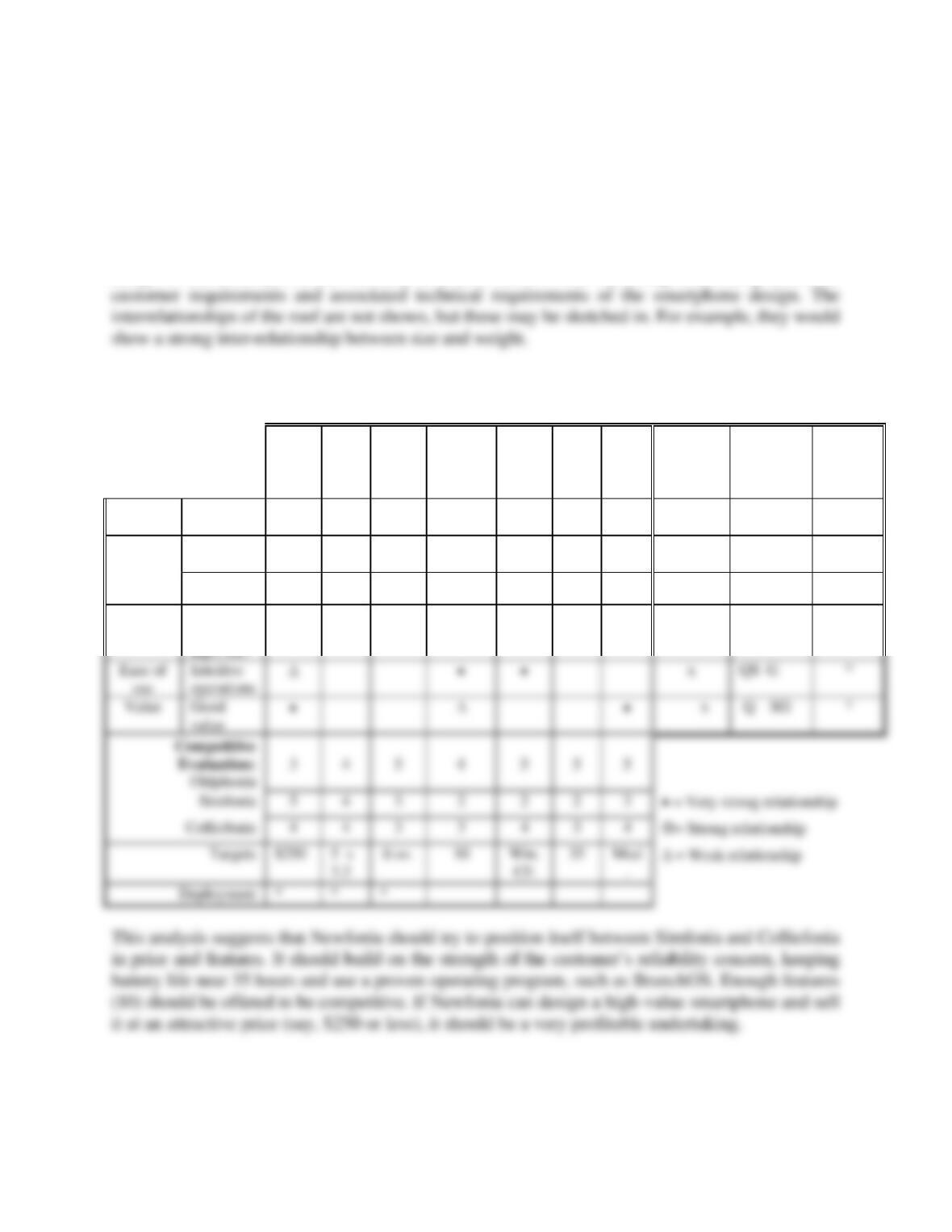
With the new data given for Newfonia’s potential customers, a partial House of Quality for the
design of the smart phone can be built, as shown below. Note the strong relationships between
PARTIAL HOUSE OF QUALITY MATRIX
FOR NEWPHONIA’S SMARTPHONE CASE
Cost
Size
(in.)
Wt.
(oz.)
Featr.
(num.)
Opr.P
rog.
Bat.
Life
Opr.
Cost
Importan
ce
12 3 45
Compet
Eval.
12 3 45
Selling
Pts.
1 2 3 4
5
Reliable
Keeps
operating
•
x
G S H
*
Compact
Fits
pocket
•
x
GSH
Not heavy
•
x
S G Q
Features
Intuitive
QS G
Value
Good
Q SG
*
Calendar,
contact
•
x
G S H
*
4. Georgio’s Giant Gyros conducted consumer surveys and focus groups concerning a new
giant gyro sandwich design, and the facility to sell it, and identified the most important
customer expectations (not in any order of priority) as

Design for Quality and Product Excellence 16
• Tasty, attractive, moderately healthy food
• Speedy service
• An easy-to-read menu board
• Accurate order filling
• Perceived value
Develop only a set of technical requirements to incorporate into the design of the product
and its delivery. Use a House of Quality relationship matrix to assess how well your
requirements address these expectations. Include some technical dimensions that may be
used to measure tasty, attractive, and “healthy” food; speedy service, acceptable menu
boards, order accuracy, or perceived value. Refine your design as necessary based upon the
initial assessment.
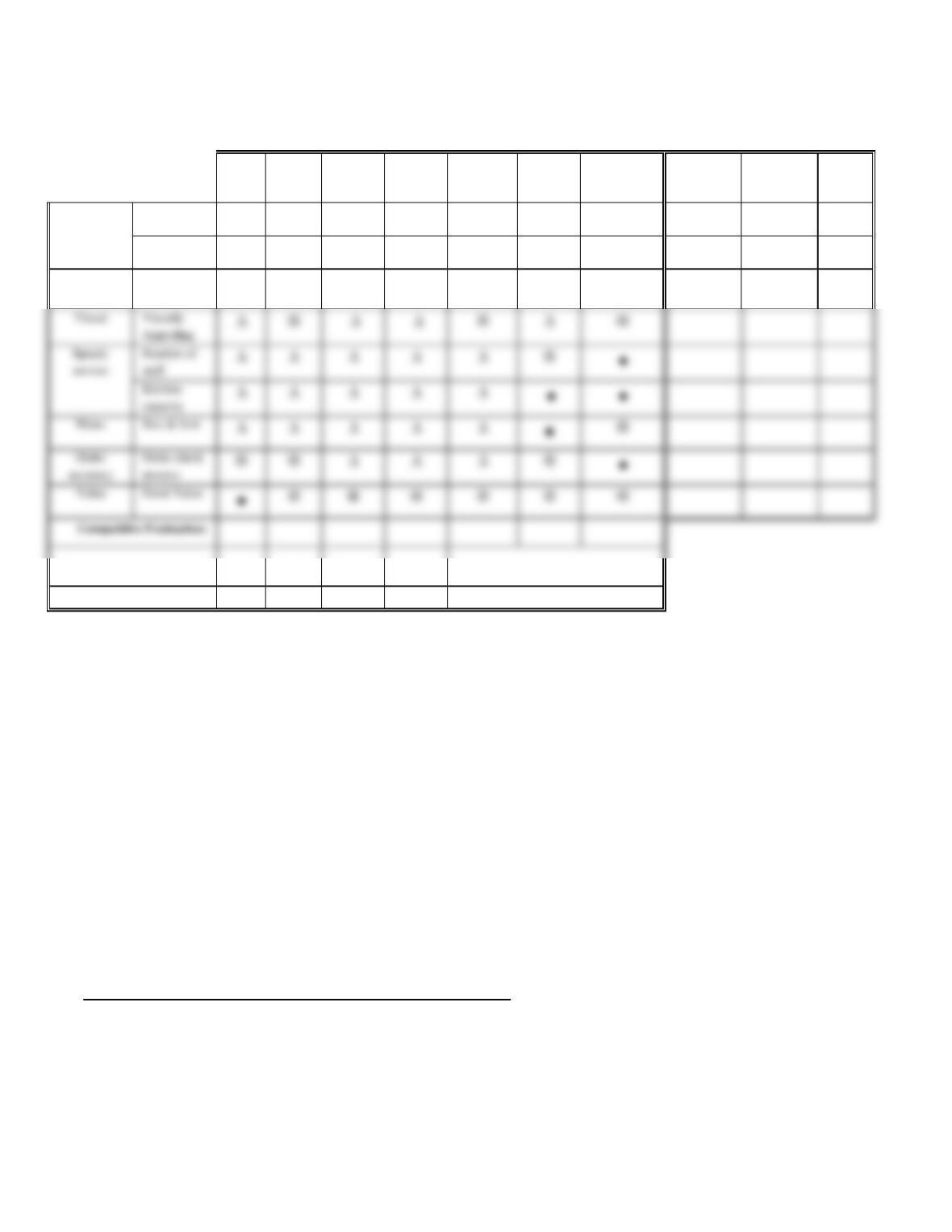
Analysis of customer responses for Georgio’s Giant Gyros indicates that there are likely to be
several strong relationships between customer requirements and associated technical requirements
of the product and delivery system that Georgio designs (for example, a giant gyro product). Some
Design for Quality and Product Excellence 17
PARTIAL HOUSE OF QUALITY MATRIX
FOR GEORGIO’S GIANT GYROS
Price
Size
Calories
Sodium
% t-Fat
Facility
layout
Work
procedures
Importance
1 2 3 4 5
Competitive
Evaluation
1 2 3 4 5
Selling
Points
Taste
Moistness
•
Flavor
•
Health
Nutritious
•
•
•
• = Very strong relationship
= Strong relationship
= Weak relationship
5. Georgio’s Giant Gyros (Problem 4) acquired some additional information about product
characteristics. It found that consumers placed the highest importance on taste appeal
(especially flavor) and order accuracy, followed by healthy food (measured by sodium content
and calories), value, and service. The menu board was only casually noted as one of the least
important attributes in the surveys. Georgio faces three major competitors in this market:
Mario’s, Gyroking, and Antonio’s. Studies of their products yielded the information provided
in the C07 Problem Data workbook. Results of the consumer panel ratings for each of these
competitors can also be found there (a 1–5 scale, with 5 being the best). Using this information,
modify and extend your House of Quality from Problem 4 and develop a deployment plan for
a new gyro. Assume that a separate study will be made on the physical facilities and design of
service delivery. On what attributes should the company focus its marketing efforts?
See the Excel file Problem 7.5 in the instructor materials.
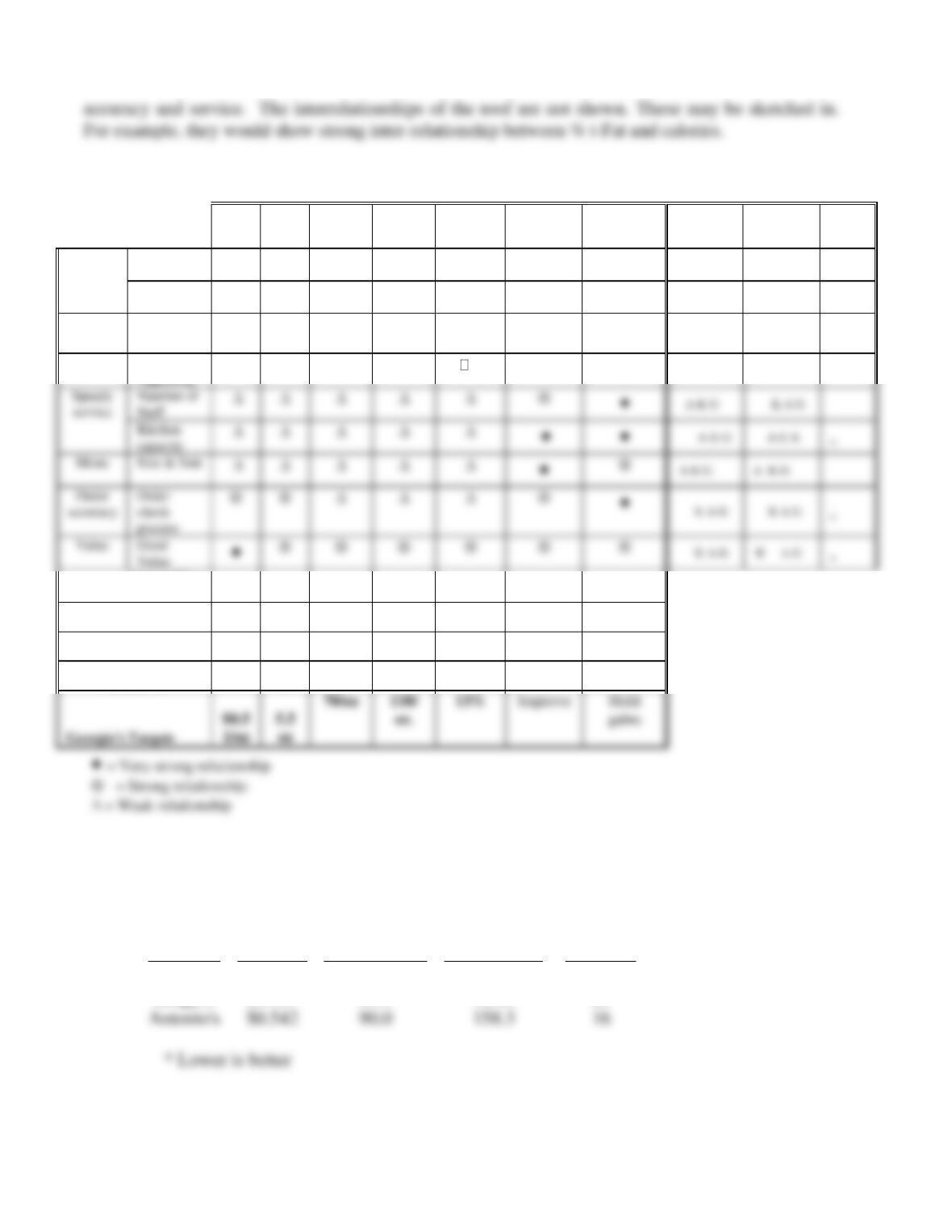
With the new data given, a partial House of Quality for the design of the gyros can be built; an
example is shown below. Note that the relationships between customer requirements (flavor, health,
value) and associated technical requirements (% fat, calories, sodium, price) of the gyro design are
strong. Note also that the focus here is on design of the product, not the service aspects of order
Size & font
Good Value
Design for Quality and Product Excellence 18
PARTIAL HOUSE OF QUALITY MATRIX
FOR GEORGIO’S GIANT GYROS
Price
Size
Calories
Sodium
% t-Fat
Facility
layout
Work
procedures
Importance
1 2 3 4 5
Compet.
Eval.
1 2 3 4 5
Selling
Points
Taste
Moistness
•
A G K
G A K
Flavor
•
A K G
G K A
Health
Nutritious
•
•
•
A K G
K AG
*
Visual
Number of
A K G
Kitchen
Good
Visually
A K G
AG K
Competitive
Evaluation:
Georgio’s
5
3
5
3
5
4
5
Gyroking
3
5
4
5
2
3
4
Antonio’s
4
4
3
3
4
5
3
The Importance and Competitive Evaluation of customer requirements can be read from the
survey results in the data tables in spreadsheet Prob07-05.xlsx that are provided, and placed under
their respective columns. Technical requirements must be placed on a more equal basis, which would
best be shown as units/ounce, except for the percent fat value. These are shown below.
Company
Price/Oz.
Calories/Oz.*
Sodium/Oz.*
Fat (%) *
Georgio’s
$0.545
80.0
159.1
13
Kingyro
$0.567
85.3
124.0
23
Antonio’s
$0.542
90.0
158.3
16

Design for Quality and Product Excellence 19
Thus, we can see from the competitive evaluation of technical characteristics and Georgio’s targets, that
if Georgio’s is already low in price per ounce, as well as calories, and percent fat, its new product is
leaner and healthier, as well as being cost effective. This analysis suggests that Georgio’s might
consider increasing its size and flavor, which may indirectly affect its visual appeal, as well. However,
Georgio has not targeted the size for an increase. At the same time, it should build on the strength of the
6. A blueprint specification for the thickness of a refrigerator part at Cool Food, Inc. is 0.06 ±
0.04 centimeters (cm). It costs $45 to scrap a part that is outside the specifications. Determine
the Taguchi loss function for this situation.
See the Excel file Problem 7.6 in the instructor materials.
The Taguchi Loss Function for refrigerator part is: L(x) = k (x – T)2
$45 = k (0.04)2
The Taguchi Loss Function template may be used for these calculations.
7. A team was formed to study the refrigerator part at Cool Food, Inc. described in Problem 6.
While continuing to work to find the root cause of scrap, they found a way to reduce the scrap
cost to $35 per part.
a. Determine the Taguchi loss function for this situation.
b. What is the loss for a part having a thickness of 0.075?
See the Excel file Problem 7.7 in the instructor materials.
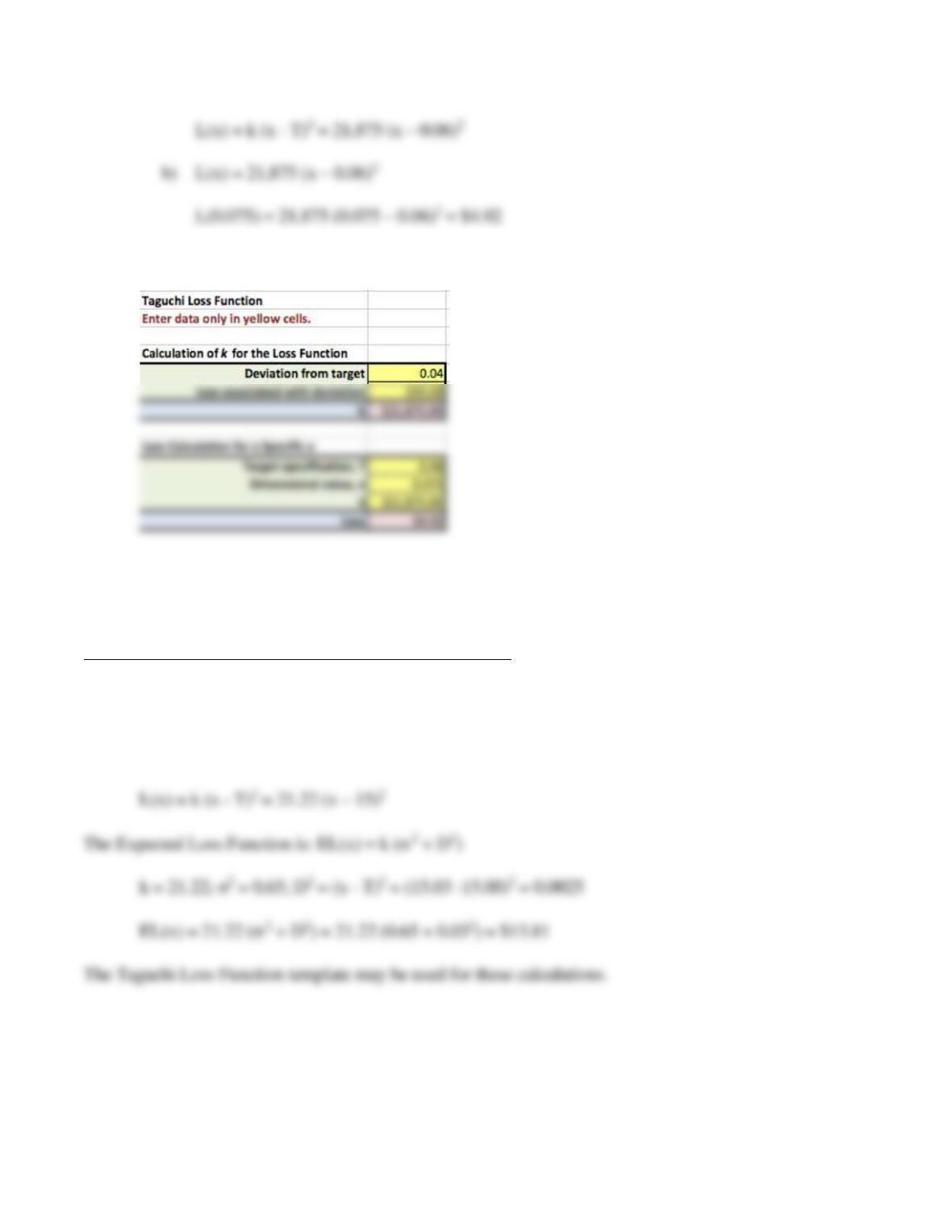
The Taguchi Loss Function is: L(x) = k (x – T)2
a) $35 = k (0.04)2
k = 21,875
Design for Quality and Product Excellence 20
The Taguchi Loss Function template may be used for these calculations.
8. A specification for the length of an auto part at Adams Metal Fabricating is 15.0 ± 1.75
centimeters (cm) It costs $65 to scrap a part. Determine the Taguchi function. Then, determine
the expected loss if the process mean is found to be 15.03 cm with a variance of 0.65 cm2.
See the Excel file Problem 7.8 in the instructor materials.
The Taguchi Loss Function is: L(x) = k (x – T)2
$65 = k (1.75)2
k= 21.22