Markov Processes
Optimal Solution:
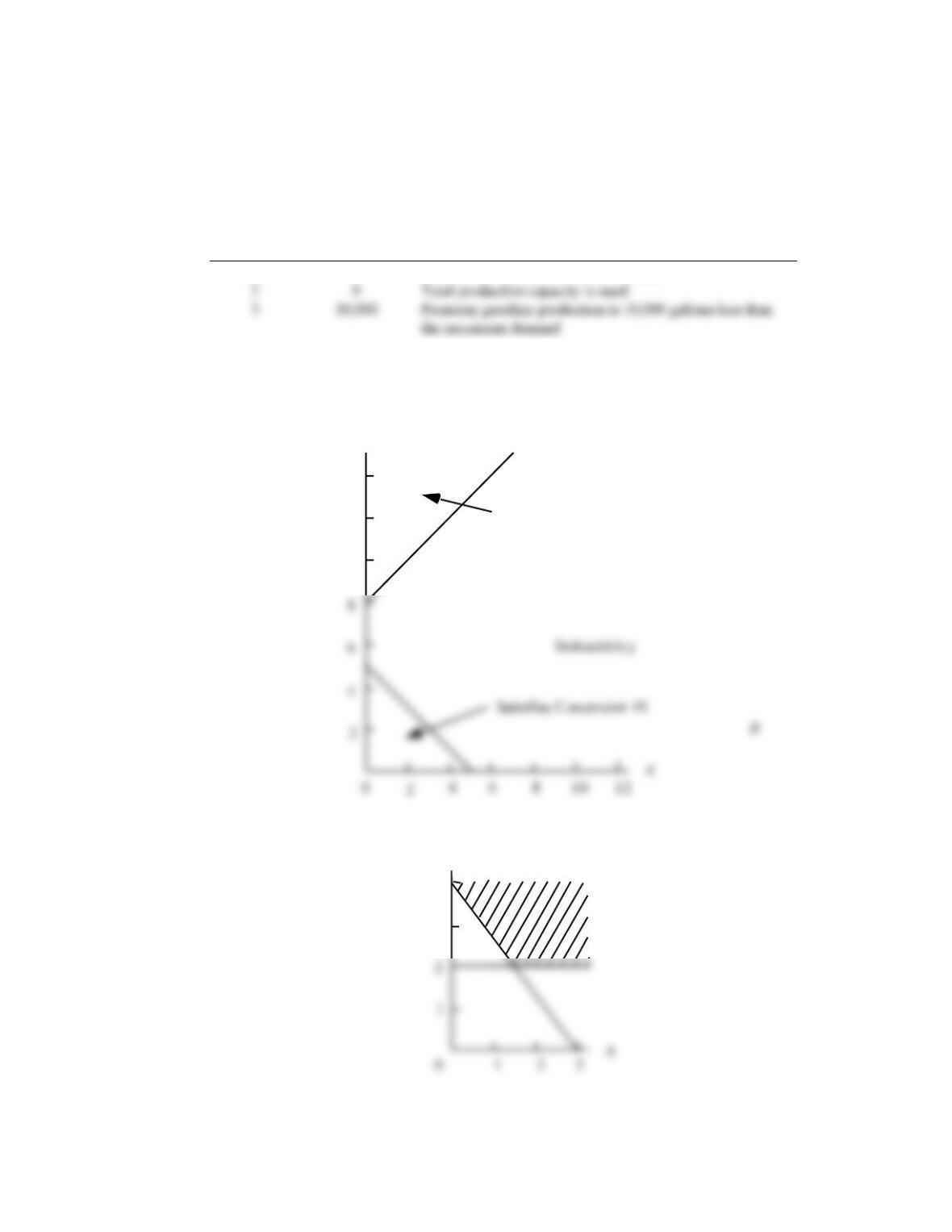
40,000 gallons of regular gasoline
10,000 gallons of premium gasoline
Total profit contribution = $17,000
c.
Constraint
Value of Slack
Variable
Interpretation
1
0
All available grade A crude oil is used
2
0
Total production capacity is used
the maximum demand
d. Grade A crude oil and production capacity are the binding constraints.
42.
x2
A
10
12
14
Satisfies Const raint #2
43.
2
A
3
4
x
2
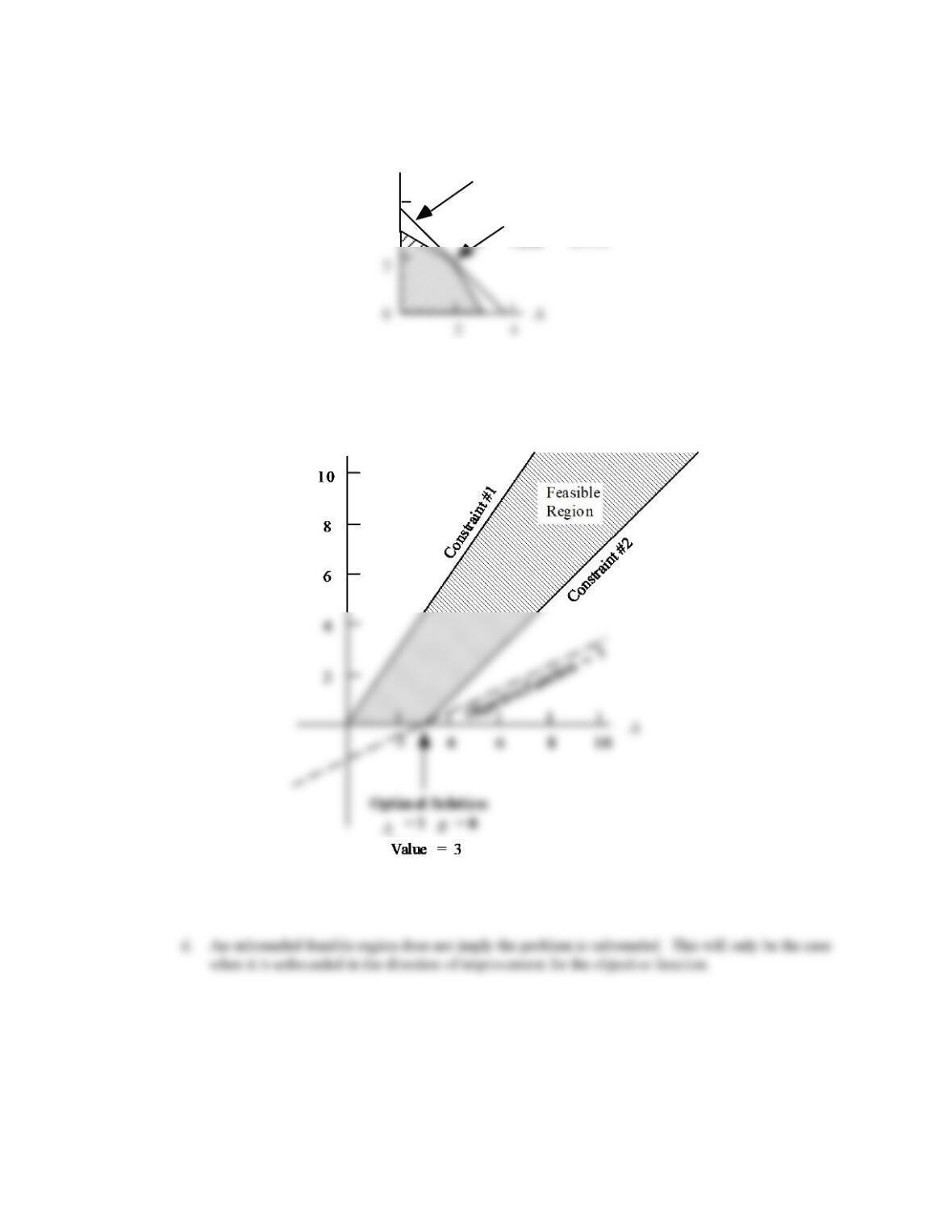
Unbounded
B
B
Chapter 17
44. a.
4
Opt imal So lut ion
(30/16, 30/16)
Object ive Funct ion
x2
A
b. New optimal solution is A = 0, B = 3, value = 6.
45. a.
b. Feasible region is unbounded.
c. Optimal Solution: A = 3, B = 0, z = 3.
B
B
A
A
B
Markov Processes
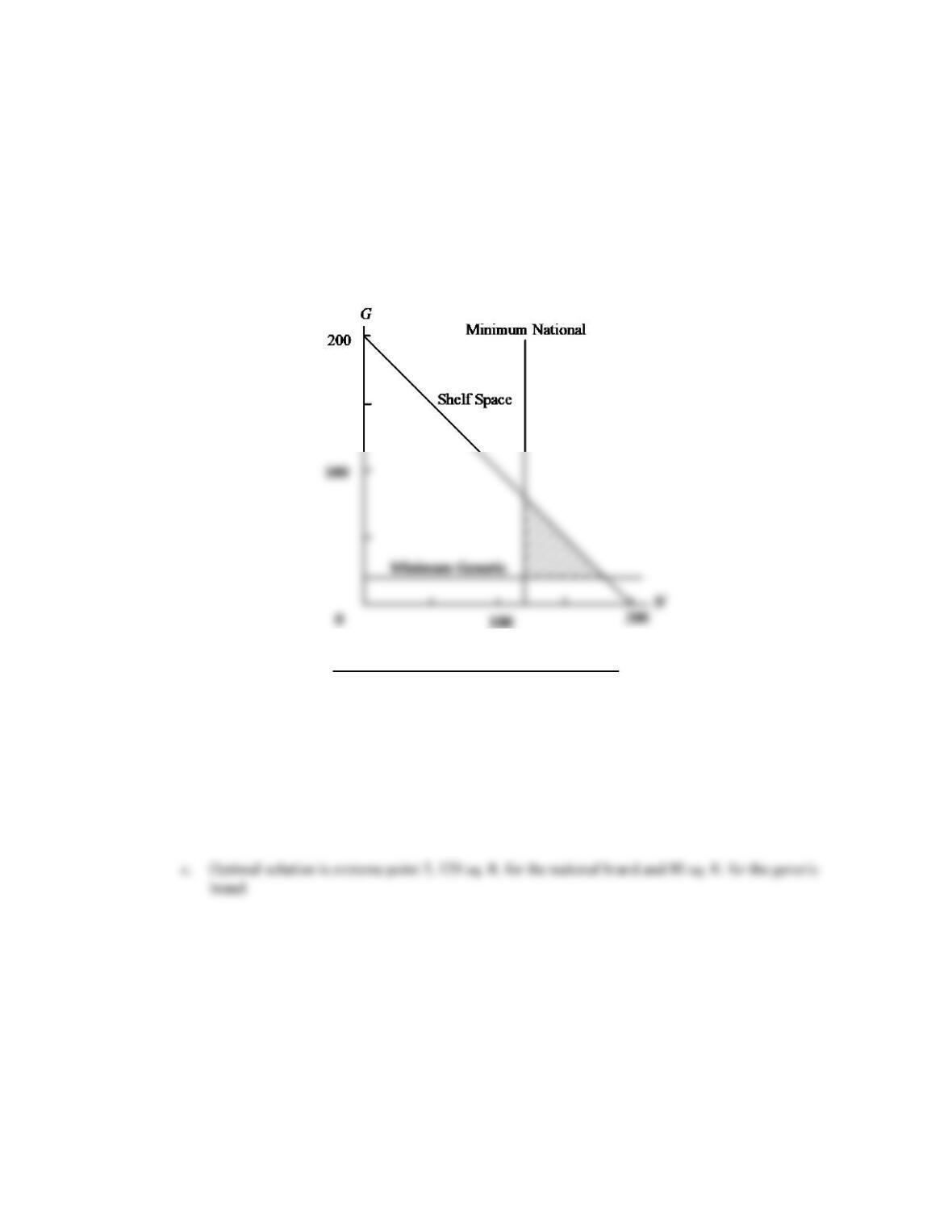
46. Let N = number of sq. ft. for national brands
G = number of sq. ft. for generic brands
Problem Constraints:
N
+
G
200
Space available
N
120
National brands
G
20
Generic
Extreme Point
N
G
1
120
20
2
180
20
3
120
80
a. Optimal solution is extreme point 2; 180 sq. ft. for the national brand and 20 sq. ft. for the generic
brand.
b. Alternative optimal solutions. Any point on the line segment joining extreme point 2 and extreme
point 3 is optimal.
Chapter 17
47.
600
400
x2
300
500
Processing Time
A
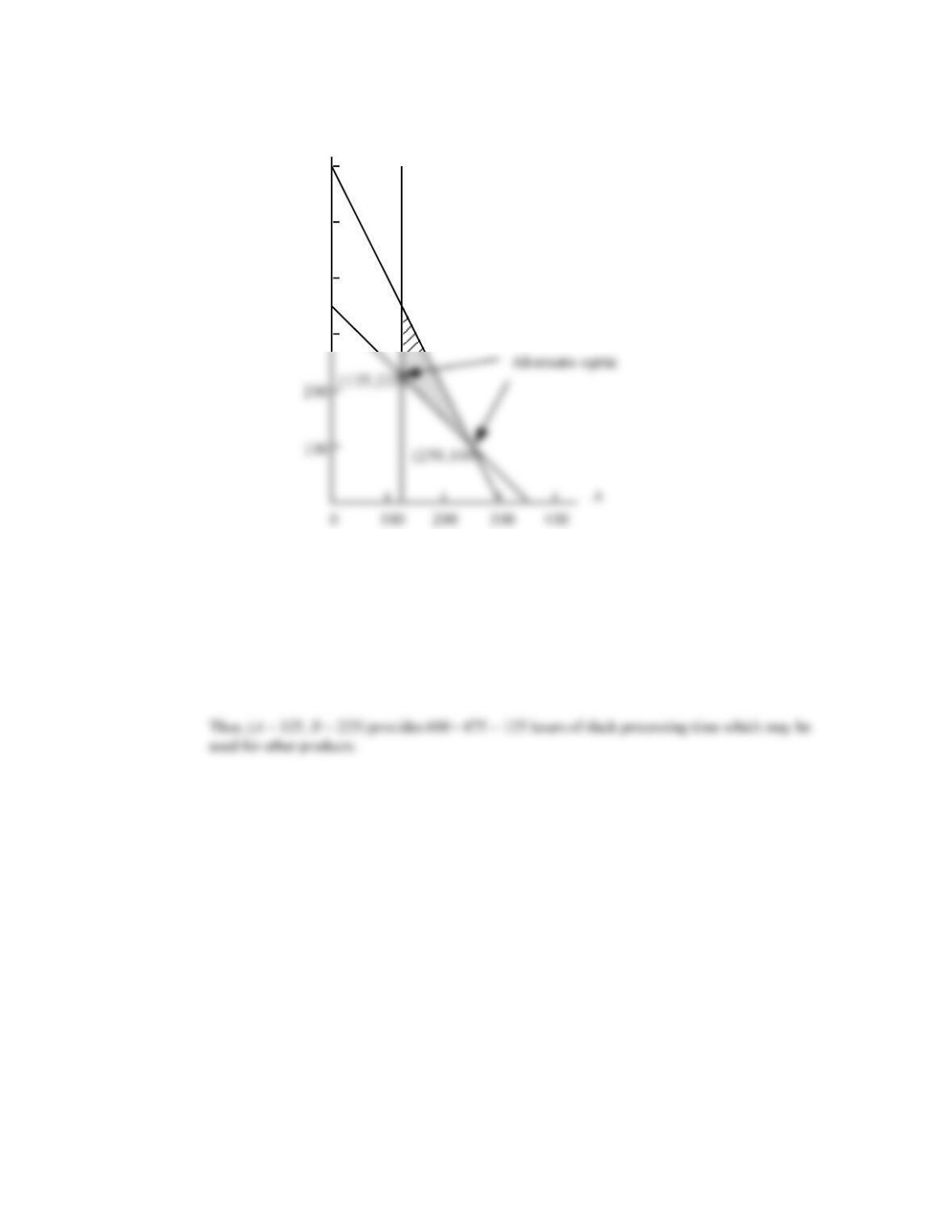
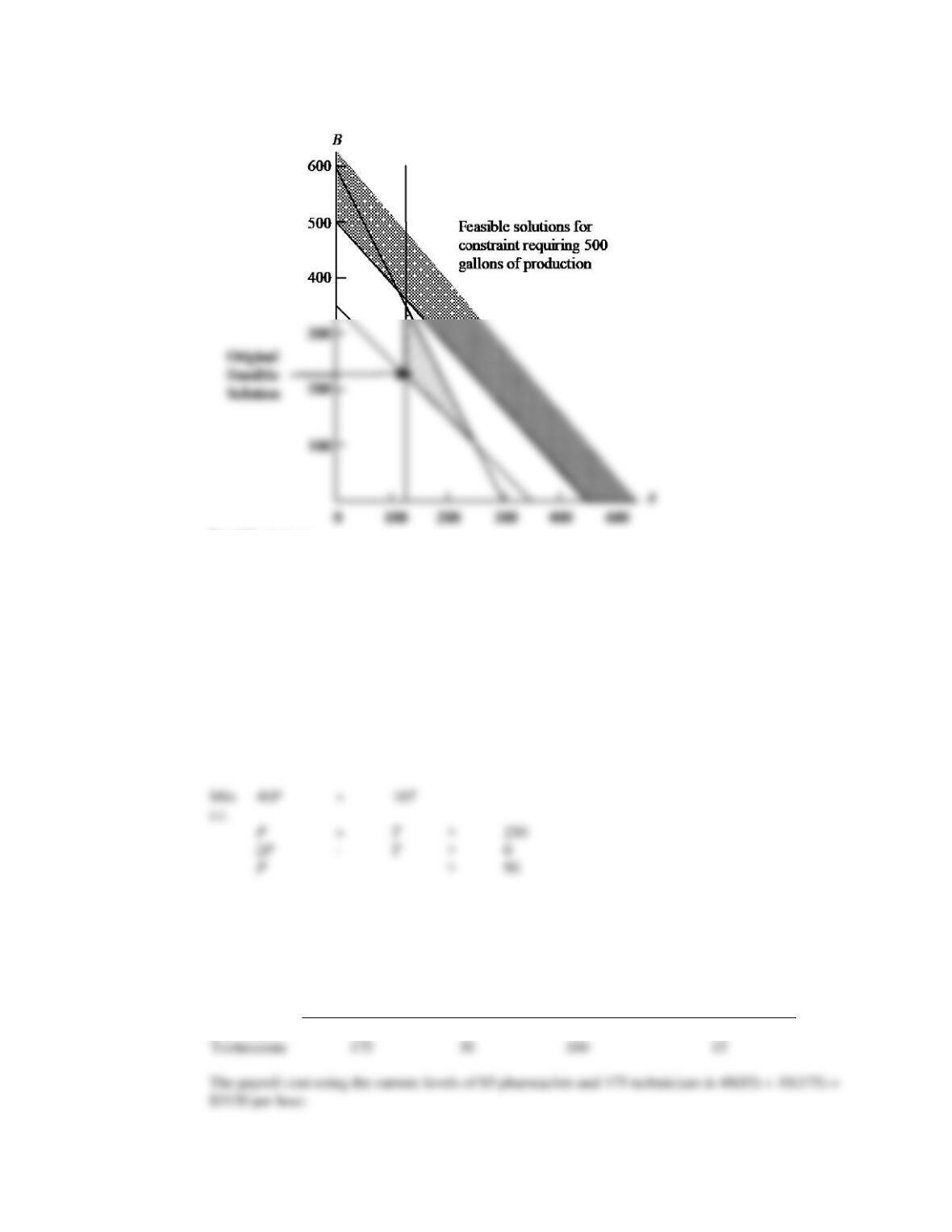
Alternative optimal solutions exist at extreme points (A = 125, B = 225) and (A = 250, B = 100).
Cost = 3(125) + 3(225) = 1050
or
Cost = 3(250) + 3(100) = 1050
The solution (A = 250, B = 100) uses all available processing time. However, the solution
(A = 125, B = 225) uses only 2(125) + 1(225) = 475 hours.
B
Markov Processes
48.
Possible Actions:
i. Reduce total production to A = 125, B = 350 on 475 gallons.
ii. Make solution A = 125, B = 375 which would require 2(125) + 1(375) = 625 hours of processing
time. This would involve 25 hours of overtime or extra processing time.
iii. Reduce minimum A production to 100, making A = 100, B = 400 the desired solution.
49. a. Let P = number of full-time equivalent pharmacists
T = number of full-time equivalent physicians
The linear programming model for this problem is:
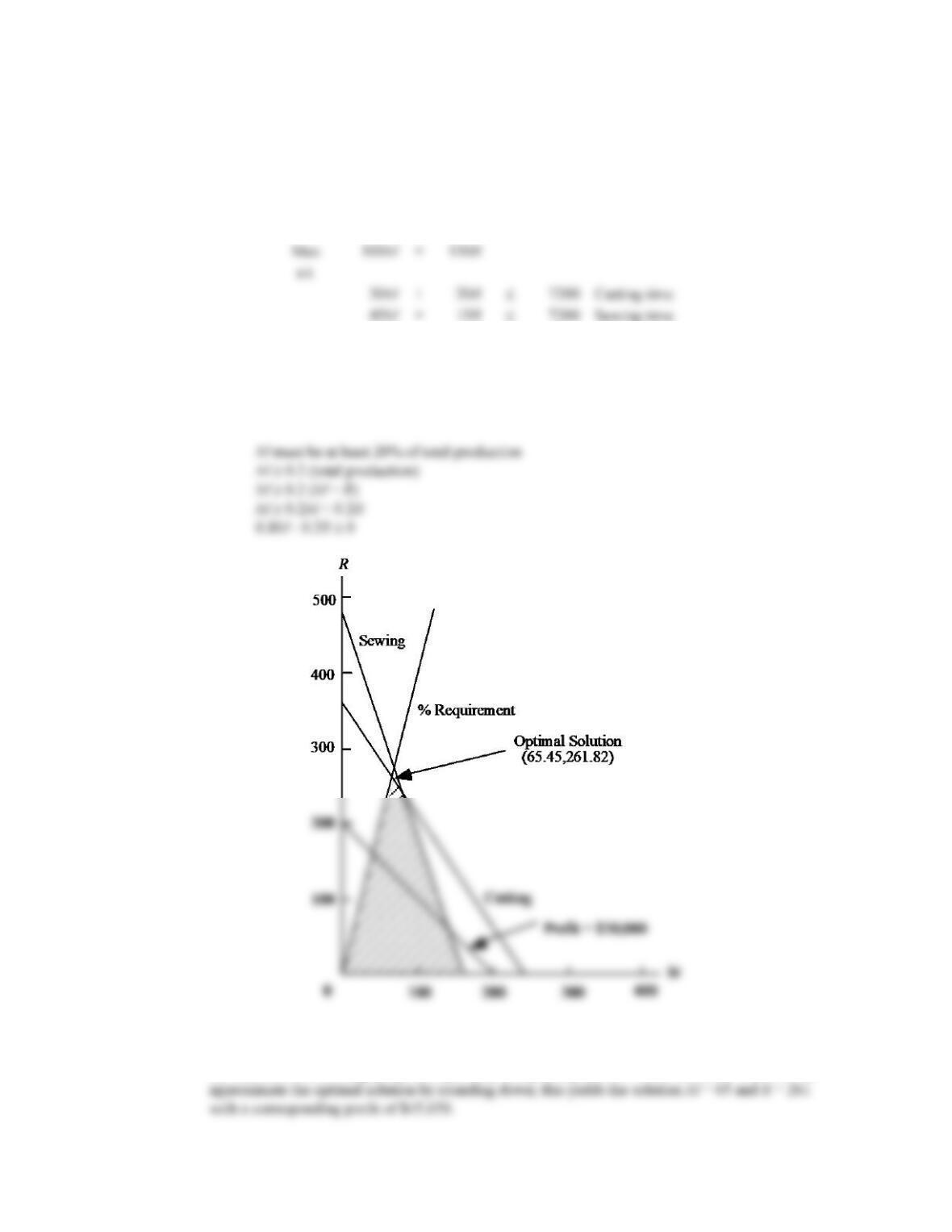
Using Excel to solve this problem, the optimal solution requires 90 full-time equivalent pharmacists
and 160 full-time equivalent technicians. The total cost is $5200 per hour.
b.
Current Levels
Attrition
Optimal Values
New Hires Required
Pharmacists
85
10
90
15
Technicians
30
15
Chapter 17
The payroll cost using the optimal solution in part (a) is $5200 per hour.
Thus, the payroll cost will go up by $50
50. Let M = number of Mount Everest Parkas
R = number of Rocky Mountain Parkas
0.8M
–
0.2R
0 % requirement
Note: Students often have difficulty formulating constraints such as the % requirement constraint.
We encourage our students to proceed in a systematic step-by-step fashion when formulating these
types of constraints. For example:
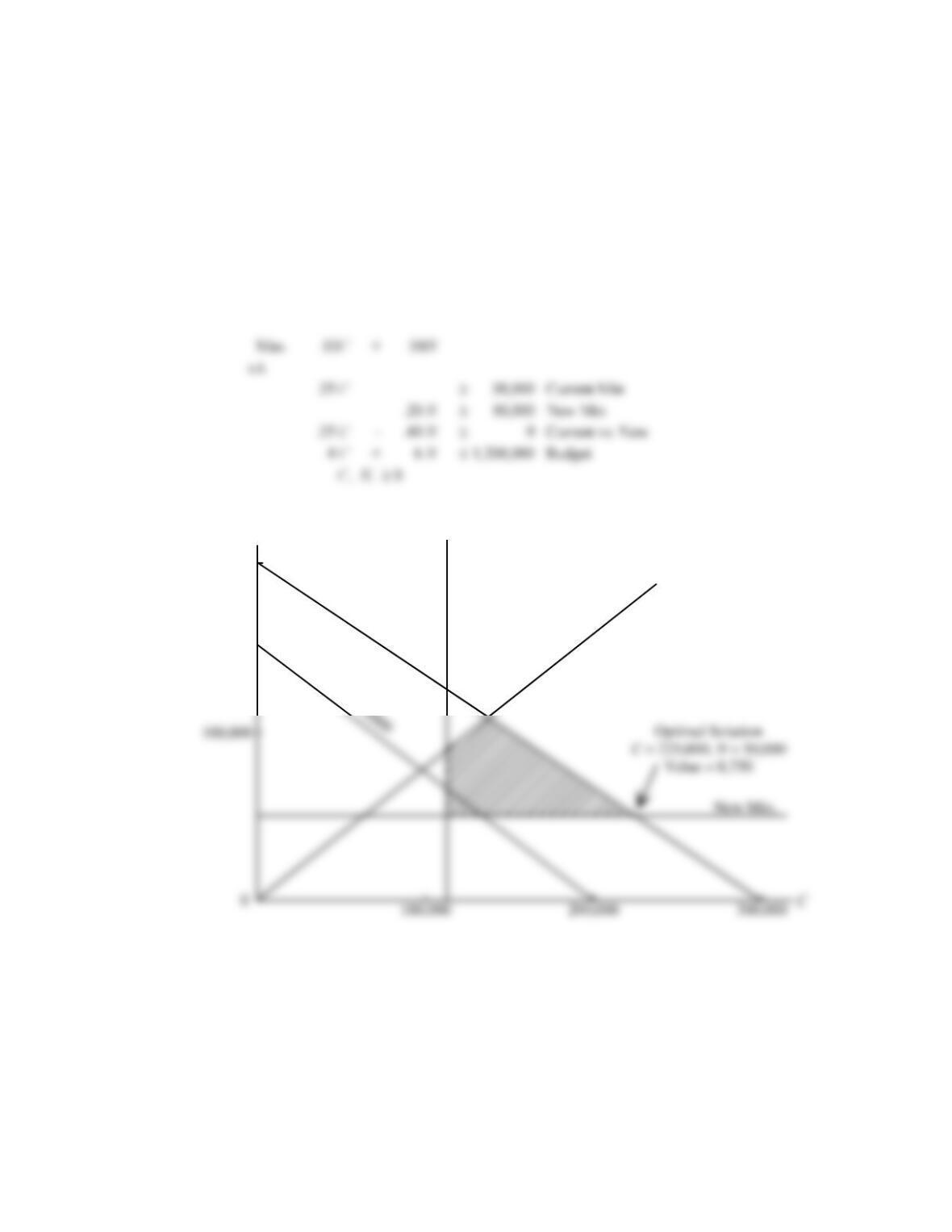
The optimal solution is M = 65.45 and R = 261.82; the value of this solution is z = 100(65.45) +
150(261.82) = $45,818. If we think of this situation as an on-going continuous production process,
the fractional values simply represent partially completed products. If this is not the case, we can
Markov Processes
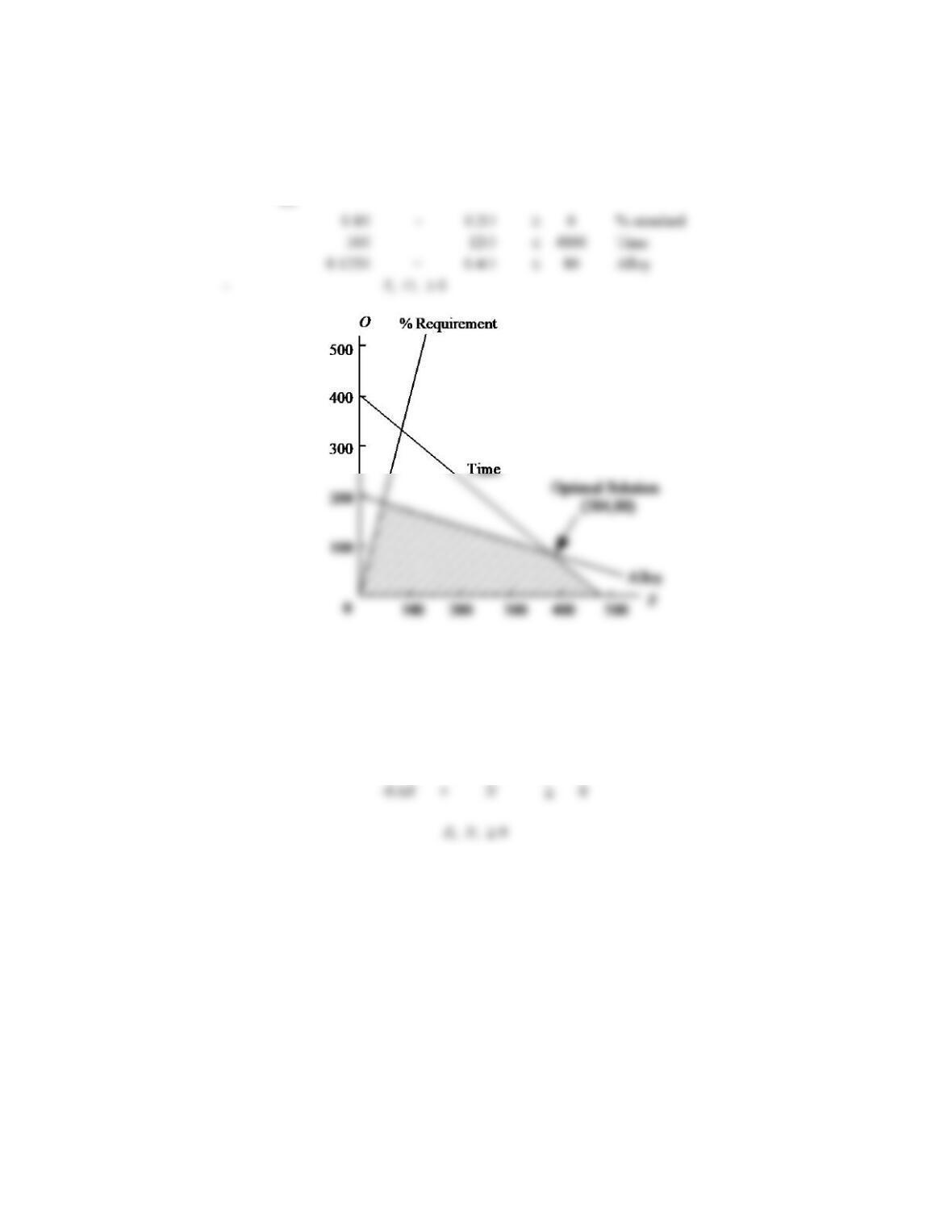
51. Let C = number sent to current customers
N = number sent to new customers
Note:
Number of current customers that test drive = .25 C
Number of new customers that test drive = .20 N
Number sold = .12 ( .25 C ) + .20 (.20 N )
= .03 C + .04 N
200,000
N
Current 2 New
Current Min.
Budget
.03C + .04N = 6000
Chapter 17
52. Let S = number of standard size rackets
O = number of oversize size rackets
Max
10S
+
15O
0.8S
0
% standard
10S
+
12O
4800
Time
+
0.4O
80
Alloy
53. a. Let R = time allocated to regular customer service
N = time allocated to new customer service
Max
1.2R
+
N
s.t.
R
+
N
80
25R
+
8N
800
-0.6R
+
N
0
Markov Processes
b.
Answer Report:
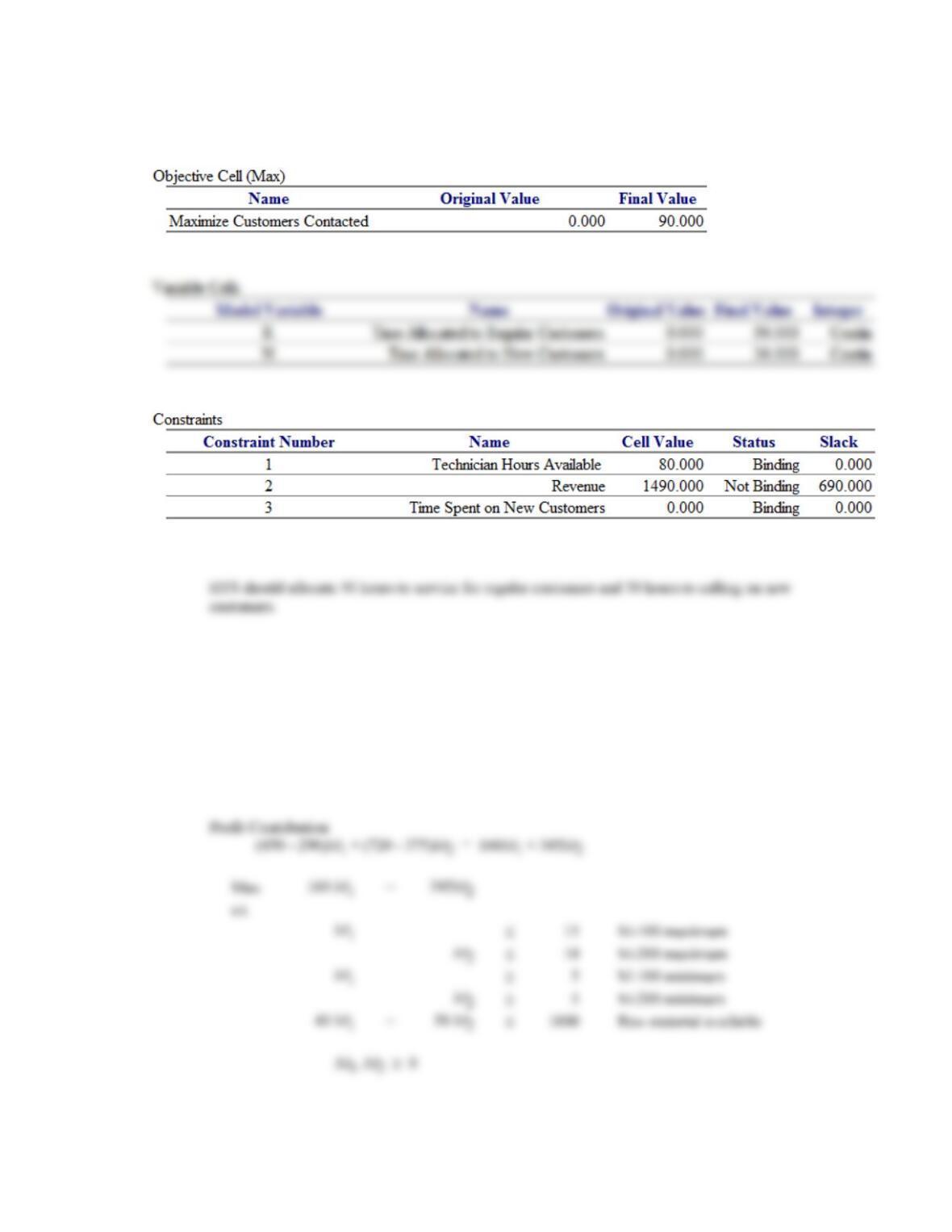
Optimal solution: R = 50, N = 30, value = 90
54. a. Let M1 = number of hours spent on the M-100 machine
M2 = number of hours spent on the M-200 machine
Total Cost
6(40)M1 + 6(50)M2 + 50M1 + 75M2 = 290M1 + 375M2
Total Revenue
25(18)M1 + 40(18)M2 = 450M1 + 720M2
Chapter 17
b. Answer Report:
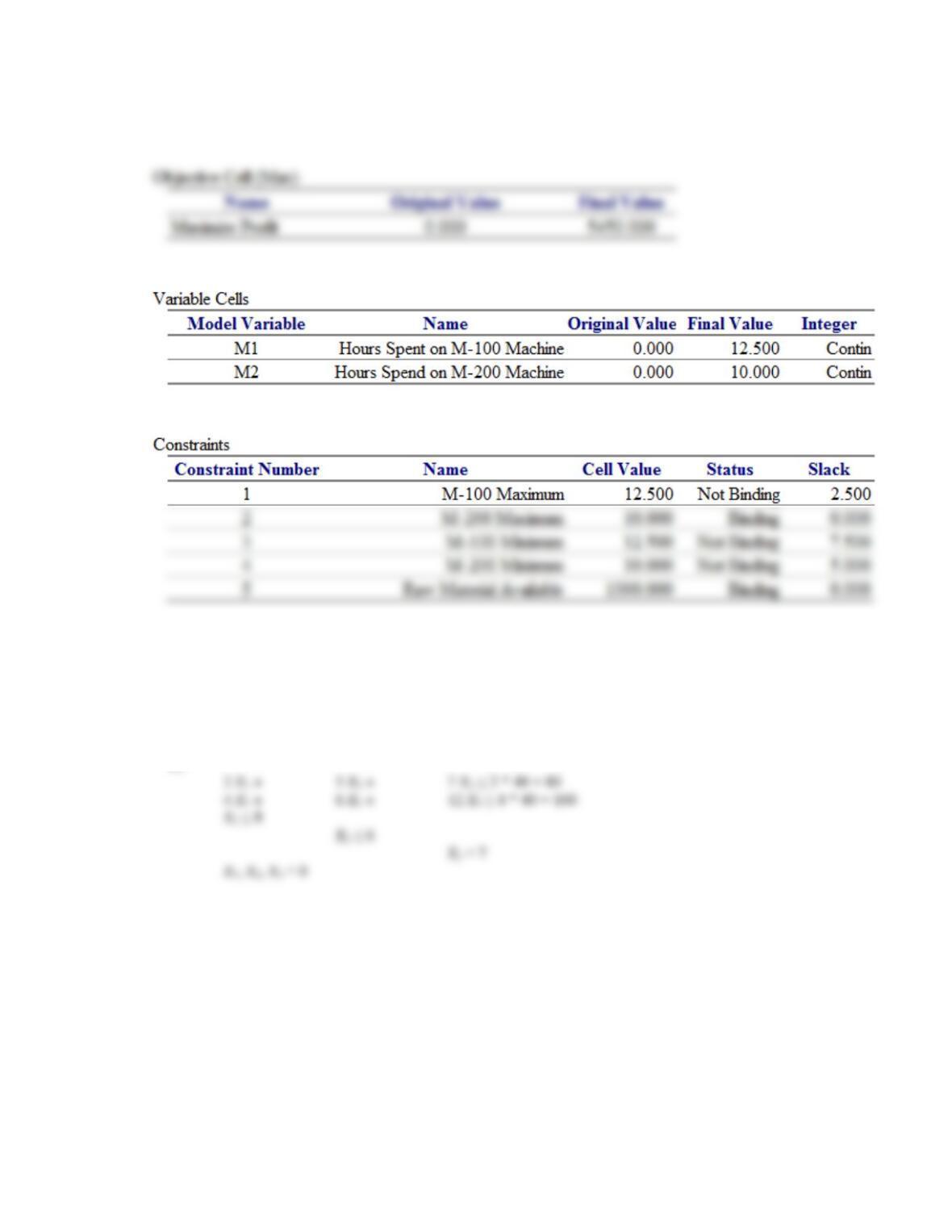
The optimal decision is to schedule 12.5 hours on the M-100 and 10 hours on the M-200.
55. a. Let X1 = Simple HTML projects accepted
X2 = Projects requiring Java/Flash coding accepted
X3 = Projects requiring secure transaction capabilities accepted
Max 3000 X1 + + 5000 X2 + 8000 X3 – 32(2 X1 + 5 X2 + 7 X3) – 36(4 X1 + 6 X2 + 12 X3)
Markov Processes
b. Answer Report:
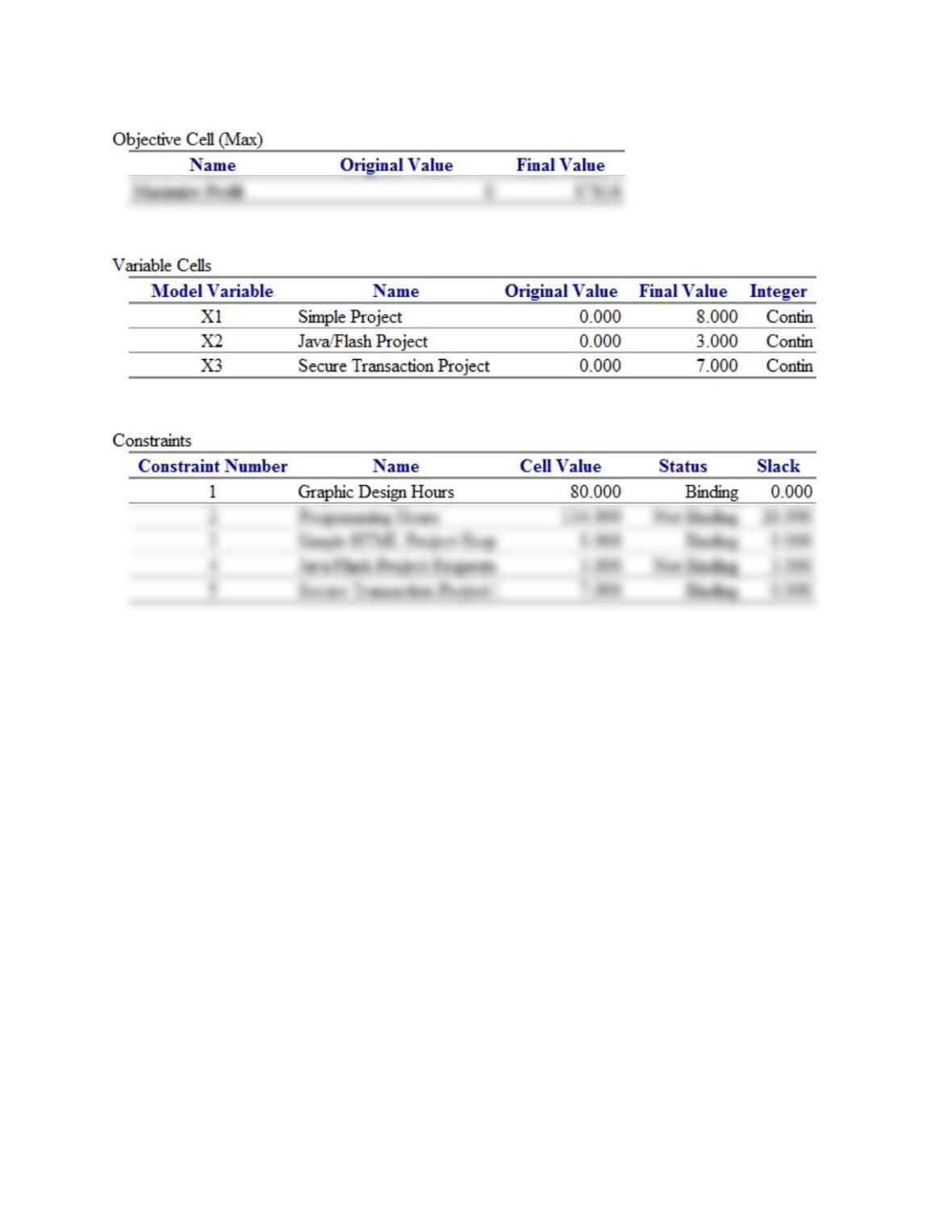
The optimal decision is to accept 8 simple HTML projects, 3 Java/Flash projects and 7 secure transaction
projects for a profit of $87,616.
Chapter 17