Instructor’s Manual – OMSC2 – Collier/Evans – C7 Process Selection, Design, and Improvement
This chapter introduces students to four types of processes used to produce goods and services –
continuous flow, flow shop, job shop, and project – the product-process matrix, the service-
positioning matrix, process and value stream mapping, mistake-proofing, and process
improvement.
One Excel spreadsheet template – Break-Even – is available in MindTap and illustrated in solved
problems.
Questions and problems are provided in four categories:
1. Review questions
2. Discussion questions and experiential activities
The chapter has three cases:
1. Custom Drapes, Inc is the first case study. It requires students to understand the characteristics
of different process types and evaluate the strategic choices an owner of a custom drapery shop
2. Hickory Medical Clinic involves a service process where many patients are dissatisfied with
3. The integrative case study, Hudson Jewelers, with case assignment questions in all chapters,
asks the student to research various parts of the diamond value chain and describe the type of
KEY TERMS
An activity is a group of tasks needed to create and deliver an intermediate or final output.
Continuous flow processes create highly standardized goods or services, usually around the clock
in very high volumes.
Flow shop processes are organized around a fixed sequence of activities and process steps, such
as an assembly line, to produce a limited variety of similar goods or services.
Job shop processes are organized around particular types of general-purpose equipment that are
flexible and capable of customizing work for individual customers.
Option, or assemble-to-order, goods and services are configurations of standard parts,
subassemblies, or services that can be selected by customers from a limited set.
The product-process matrix is a model that describes the alignment of process choice with the
characteristics of the manufactured good.
A product life cycle is a characterization of product growth, maturity, and decline over time.
Reengineering has been defined as “the fundamental rethinking and radical redesign of business
processes to achieve dramatic improvements in critical, contemporary measures of performance,
such as cost, quality, service, and speed.”
REVIEW QUESTIONS
1. Define custom, option, and standard goods and services and give a new example of each. How
does the type of goods and services affect process choice?
Custom, or make-to-order, goods and services are generally produced and delivered as one-
of-a-kind or in small quantities and are designed to meet specific customers’ specifications.
2. Describe the four types of processes used to produce goods and services.
Four principal types of processes are used to produce goods and services (see Exhibit 7.1):
1. Job shop processes are organized around particular types of general-purpose equipment
that are flexible and capable of customizing work for individual customers.
3. What is the (traditional) product life cycle? How does it relate to process design and
selection? Explain how firms make money when their goods or services follow the traditional
product life cycle.
As firms and their products move from introduction to growth, to maturity and to decline
4. Explain the logic and use of the product-process matrix.
The most appropriate match between type of product and type of process occurs along the
.
5. Define a service encounter activity sequence and give three examples.
The service-encounter activity sequence consists of all the process steps and associated
6. Define a pathway and give an example.
A pathway is a unique route through a service system. Pathways can be customer- or
provider-driven, depending on the level of control that the service firm wants to ensure.
7. Explain the differences between customer-routed services and provider-routed services and
give an example of each.
Customer-routed services are those that offer the customer broad freedom to select the
pathways that are best suited for their immediate needs and wants from many possible
pathways through the service delivery system. The customer decides what path to take
on.
8. Explain the logic and use of the service-positioning matrix.
The SPM focuses on the service-encounter level and helps management design a service
system that best meets the technical and behavioral needs of customers (see Exhibit 7.3).
The position along the horizontal axis is described by the sequence of service encounters.
9. What is a process map? How is it used in process design?
A process map (flowchart) describes the sequence of all process activities and tasks necessary
to create and deliver a desired output or outcome. A process map can include the flow of
10. What are the advantages of clearly defining the process boundaries?
A process boundary is the beginning or end of a process. The advantages of a clearly defined
process boundary are that it is easier to obtain senior management support, assign process
11. Explain the concept of the hierarchy of work. How is it useful in process design activities?
Process maps can be drawn at different levels of detail and aggregation, depending on how
the objective of the design. These levels can be described along a hierarchy of work:
• A task is a specific unit of work required to create an output.
In this hierarchy, a process is a subset of a value chain, an activity is a subset of a process,
and a task is a subset of an activity. A task is a specific unit of work required to create an
output. One example is drilling a hole in a steel part or completing an invoice. An activity is
12. What is the value stream? How does a value stream map differ from an ordinary process
map?
The value stream refers to all value-added activities involved in designing, producing, and
13. Describe how to apply process and value stream mapping for process design.
Designing a goods-producing or service-providing process requires six major activities:
1. Define the purpose and objectives of the process.
2. Create a detailed process or value stream map that describes how the process is currently
performed.
A process map documents how work either is, or should be, accomplished, and how the
transformation process creates value. We usually first develop a “baseline” map of how the
14. Why do people make inadvertent mistakes? How does poka-yoke help prevent such mistakes?
People make inadvertent mistakes for a number of reasons, including the following:
• Forgetfulness due to lack of concentration
• Misunderstanding because of the lack of familiarity with a process or procedures
15. Describe the types of errors that service poka-yokes are designed to prevent.
16. What are the possible objectives to improving a process?
Management strategies to improve process designs usually focus on one or more of the
following:
• increasing revenue by improving process efficiency in creating goods and services and
delivery of the customer benefit package;
17. How can process maps be used for improvement?
Key improvement questions include the following:
• Are the steps in the process arranged in logical sequence?
• Do all steps add value? Can some steps be eliminated, and should others be added in
order to improve quality or operational performance? Can some be combined? Should
some be reordered?
18. What is reengineering? How does it differ from other approaches to process improvement?
Reengineering has been defined as “the fundamental rethinking and radical redesign of
business processes to achieve dramatic improvements in critical, contemporary measures of
performance, such as cost, quality, service, and speed.” Reengineering was spawned by the
DISCUSSION QUESTIONS AND EXPERIENTIAL ACTIVITIES
19. What type of process—project, job shop, flow shop, and continuous flow—would most likely
be used to produce the following? Explain your reasoning.
a. Personal computers – flow shop (assembly line)
20. What type of process – project, job shop, flow shop, and continuous flow – would most likely
be used to produce the following?
a. Gasoline – continuous flow
21. List some common processes that you perform as a student. How can you use the knowledge
from this chapter, such as identifying bottlenecks, to improve them?
Example student processes include: studying for a test, applying for a student loan, writing a
term paper, applying for US citizenship, paying rent or automobile loans, moving into or out
22. Use the product-process matrix to explain the implications for Boeing in changing from a
project focus to more of a flow shop process as explained in the box “Rethinking Airplane
Manufacturing Processes. Limit your discussion to one typed page.
As the Product-Process Matrix (Exhibits 7.1 and 7.2) describes as we move from projects to
job shops manufacturing performs more batching, small production order (lot) sizes, and
23. Provide some examples of customer- and provider-routed services that you have
encountered that are different from those described in this chapter. Can you identify any
improvements to these processes?
Customer-routed examples include: visiting a bookstore, checking in a major convention
hotel, health clubs, Club Med, surfing the Internet, museums, taking a cruise, parks,
24. Design a process for one of the following activities:
a. Preparing for an exam
b. Writing a term paper
25. Discuss how sustainability might be incorporated into a process or value chain improvement
initiative. Try to find an example and summarize it in a manner similar to that in the box
feature on Alfa Laval.
One objective of this “green” assignment is to get students motivated w/r to OM. Students
should write something similar to the example of Alfa Laval in the chapter introduction,
26. What sustainability issues are present in the example restaurant order fulfillment process
example (Exhibits 7.6 and 7.7)? What other restaurant processes need to include
sustainability criteria in their design and day-to-day management?
Sustainability refers to an organization’s ability to strategically address current business
needs and successfully develop a long-term strategy that embraces opportunities and
27. Draw a flowchart for a process of interest to you, such as a quick oil-change service, a factory
process you might have worked in, ordering a pizza, renting a car or truck, buying products
on the Internet, or applying for an automobile loan. Identify the points where something
28. Develop a value stream map for the process you flowcharted in Question #27 to identify the
value-added and non-value-added activities. How can you estimate costs and/or revenue for
the process steps?
Answers will depend on the process chosen. It might be difficult for students to actually
29. Identify several sources of errors as a student or in your personal life. Develop some poka-
yokes that might prevent them.
Some typical errors are not getting up on time for class, not completing homework on time,
COMPUTATIONAL PROBLEMS AND EXERCISES
These exercises require you to apply the formulas and methods described in the chapter. The
problems should be solved manually.
30. Carbon dioxide emissions associated with a one-night stay in a hotel room are calculated at
29.53 kg of CO2 per room day for an average hotel. The 200 rooms of your hotel are all
occupied for 2 days during a college football game.
a. How much CO2 did the guests and hotel release into the atmosphere?
The objective of this question to for students to recognize that “processes” emit CO2 and
b. What work and leisure activities, and processes in the hotel generate CO2 emissions?
Provide three examples and explain how carbon dioxide is emitted.
Example hotel processes that directly or indirectly release carbon dioxide into the
atmosphere include:
• Laundry services
• Air conditioning and heating
And, of course, the vehicles that supply the hotel (vendors), airport transport, and
customer vehicles all contribute to the release of CO2 into the atmosphere. Ask your
students, “How can we reduce this release for say, hotel laundry services?” “How can we
design “green hotel processes?” Can we design “green hotels?” Can we plant more trees
on the hotel site? Can we paint the hotel roof white to reflect (not absorb) the sun’s rays
and heat?
OM must now analyze costs, time, quality AND sustainability in process and value chain
design!
If you Google “green hotels” you will get over 2 million hits such as the partial example
below:
And in a nod to the wishes of its environmentally concerned membership, AAA has
For example, in 2007, Florida Governor Charlie Crist signed an executive order mandating
that all state meetings and conventions be held in designated green facilities whenever
31. A JetAir 304 airplane emits 22 kilograms of carbon dioxide per hour while flying. Today, the
plane flew for 8.2 hours on six flights. This emission rate doesn’t include the time on the
ground running its engines and other airport gate and airport emissions.
a. How much carbon dioxide did the JetAir 304 airplane release into the atmosphere today?
The objective of this question to for students to recognize that “processes” emit CO2 and
other pollutants. Therefore, OM manages the vast majority of processes and their
b. What work and leisure activities, and processes in the airline and airport generate CO2
emissions? Provide three examples and explain how carbon dioxide is emitted.
Example airline processes that directly or indirectly release carbon dioxide into the
atmosphere include:
• Refueling services including transport processes
32. In Solved Problem 7.1 on Clear Water Pool Service (CWPS), CWPS replaced it fleet of pool
service vans with hybrid/electric and gasoline-driven systems. This reduced the number of
gallons of gasoline used to 6,000 gallons per year. How many metric tons of carbon dioxide
did not go into Earth’s atmosphere because CWPS changed to hybrid–powered vehicles?
(11,500 – 6,000 gallons) = 5,500 gallons of gasoline not used
33. Assume you are the chief operating officer of the fast food chain with 5,500 stores in North
America. Each store operates 360 days a year and has one heated dryer in the ladies and
men’s restrooms. Each dryer operates 200 times per day per restroom. One pound is 453.6
grams. To dry your hands in a retail store restroom requires zero carbon dioxide emissions if
you let your hands drip dry. If you use one standard size paper towel, 10 grams of CO2 were
generated to manufacturer the towel. If you use a standard heated electric dryer 20 grams of
CO2 are used to generate this energy and operate the dryer.
a. How many pounds of carbon dioxide are released in the atmosphere from the heated
electric hand dryers in the fast-food chain’s stores?
(20 grams of CO2/dryer/time)(200 times/day/dryer)(2 dryers/store)(360 days/year) =
b. Given your answer in (a), how would you have customers dry their hands in the chain’s
fast food stores? What other criteria might be important?
The radical initiative is to eliminate paper towels and heated electric dryers in all 5,500
34. Worthington Machining must decide whether to purchase Process A with specialized metal
folding equipment needing two employees to operate it or Process B with general purpose
folding equipment requiring five employees. Process A requires a fixed cost of $1,430,000
and a variable cost of $14.32 per metal panel. Process B requires a fixed cost of $820,000
and a variable cost of $20.05. Process A is more automated than Process B.
a. What is the break-even quantity between these two processes?
b. If predicted demand for next year is 120,000 panel folds, what process do you
recommend? What is the cost savings?
TCA = FCA + CA x Q = $1,430,000 + $14.32(120,000) = $3,148,400
35. Given the information in Problem 34, what do you recommend if Worthington Machining
can buy folded metal panels of identical size at a price of $27.25 per panel?
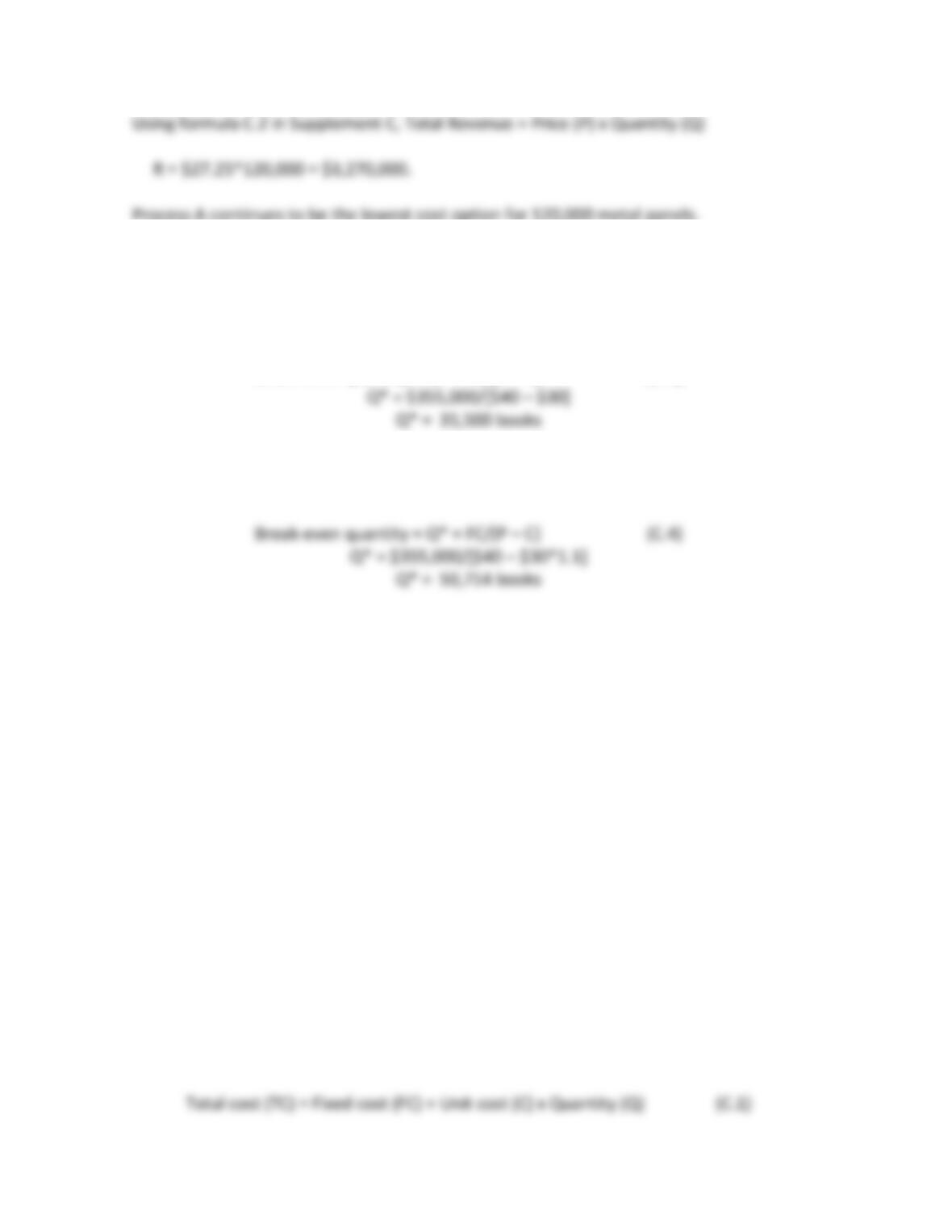
36. A college textbook publisher sells a certain e-book for $40.00. For the current process, the
publisher has fixed cost of $355,000 and a variable cost per book of $30.00.
a. What is the break-even quantity for this book?
Break-even quantity = Q* = FC/[P – C] (C.4)
b. If the variable cost increased 10 percent due to poor operating performance, what is the
new break-even quantity?
c. If through better process efficiency the fixed cost decreases by ten percent and the
variable cost decreases to $27.90, what is the revised break-even quantity?
Revised fixed cost = $355,000*0.9 = $319,500
Break-even quantity = Q* = FC/[P – C] (C.4)
Q* = $319,500/[$40 – $27.90]
Q* = 26,405 books
37. The police department of a major city needs a faster process to do criminal background
checks. They eliminated several vendors and their products because they required to much
retraining and major changes in search process steps. The police department review
committee thought many of these searches might not hold up in court due to process and
verification changes. The two finalists required few changes in the non-online process.
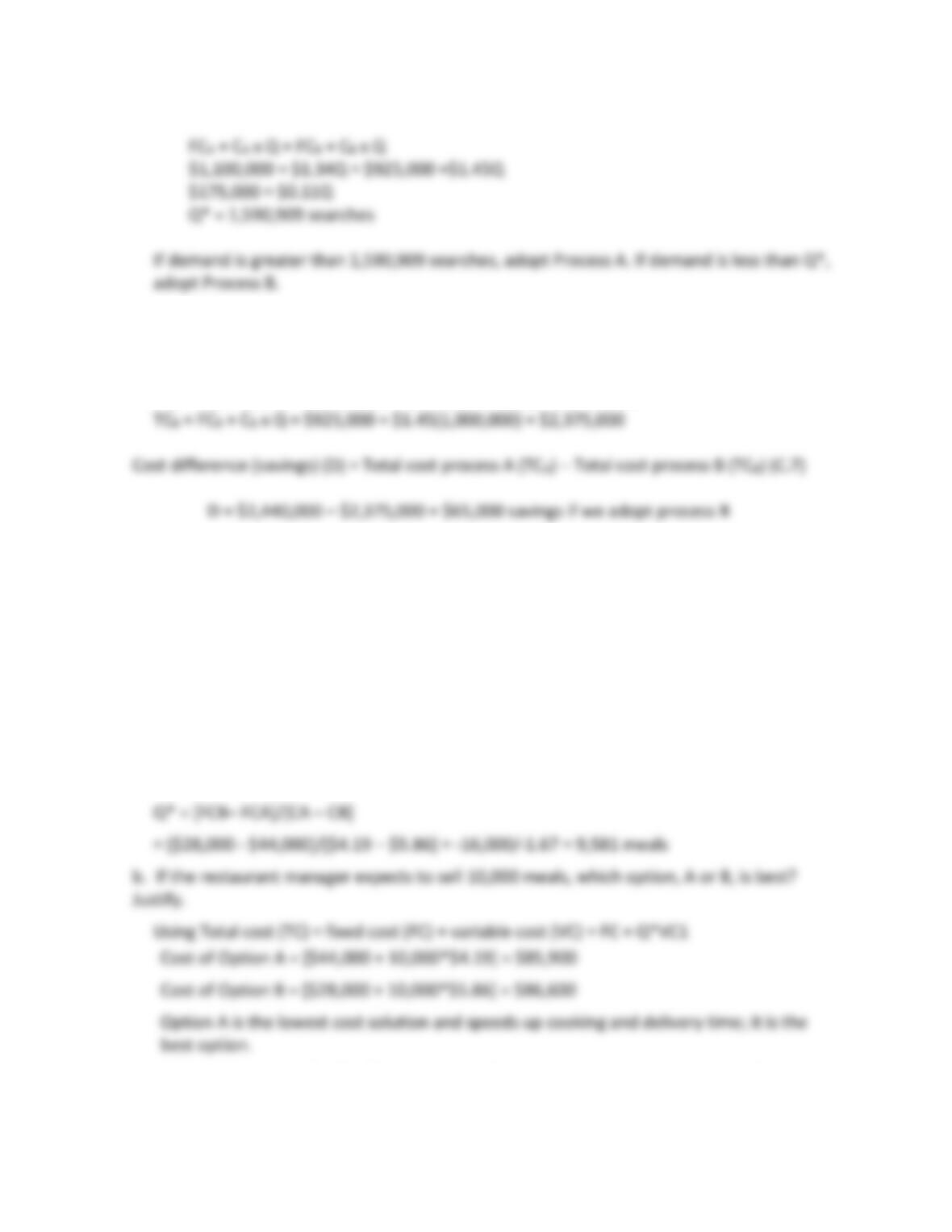
Process A resulted in a fixed cost of $1,100,000 and a variable cost per search of $1.34.
Process B required a fixed cost of $925,000 and a variable cost per search of $1.45.
a. What is the break-even quantity between these two processes?
Using formulas (C.1) and (C.7) in Supplement C, we have
b. If predicted demand for next year is one million searches, what process do you recommend?
What is the cost savings?
TCA = FCA + CA x Q = $1,100,000 + $1.34(1,000,000) = $2,440,000
38. Dot’s Restaurant must decide between two technology and processes in their kitchen. They
only serve dinner after 4 pm on a small island called Sanibel. The restaurant is open 250 days
per year. Dot and her husband, Ham, are retired. They became bored playing golf five times
a week and decided to open this boutique restaurant. Process A uses an induction oven and
microwave process with a fixed cost of $44,000 and a variable cost of $4.19 per meal.
Process B uses a gas fired oven process with heating lamps with a fixed cost of $28,000 and a
variable cost of $5.86 per meal. Process A speeds up cooking and delivery time. The average
selling price per meal is $31.38.
a. What is the break-even quantity?
Using formula (C.11) in Supplement C:
c. Is the restaurant profitable if they purchase the process option you recommend in part
(b)?
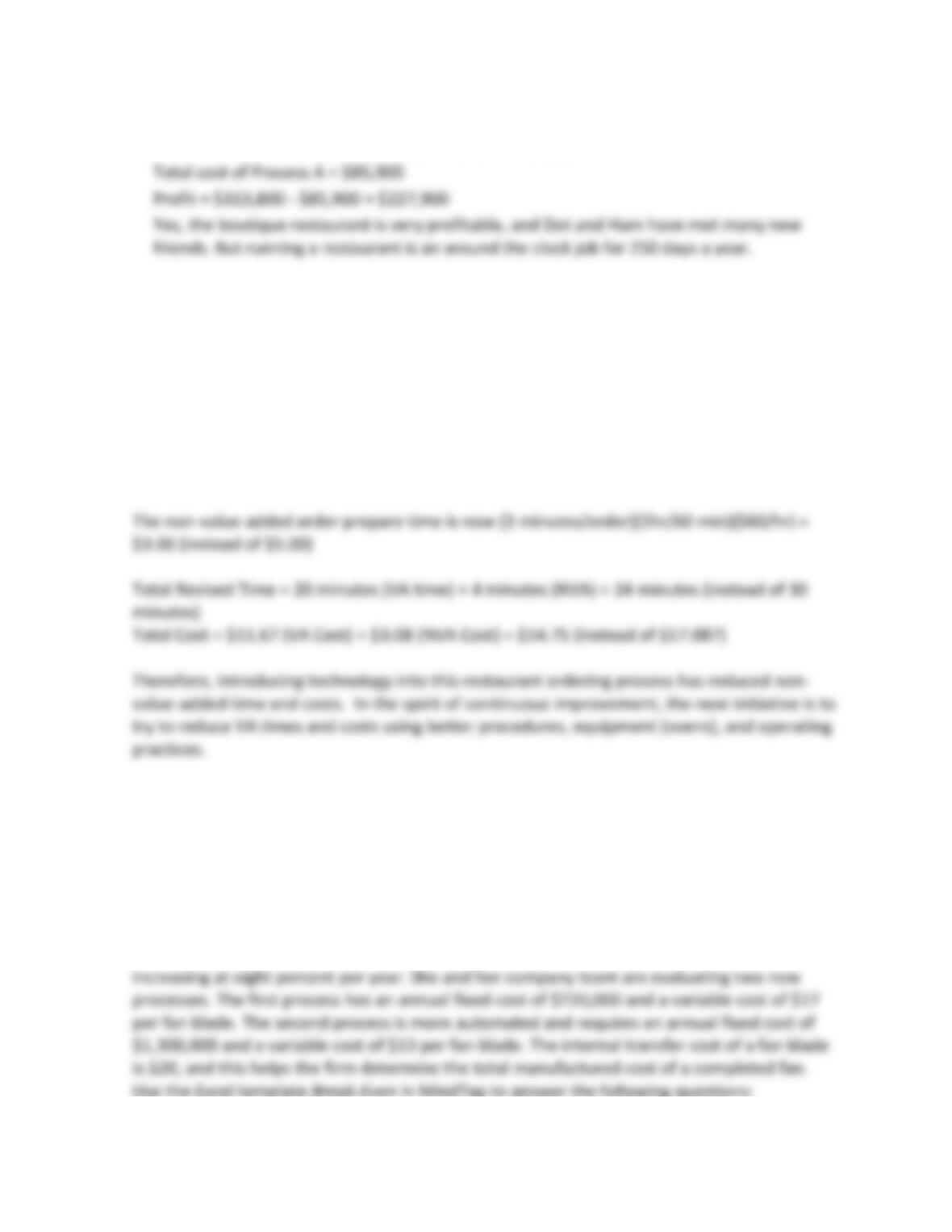
Revenue = Demand (Q)*Price = 10,000*$31.38 = $313,800
39. Refer to Exhibit 7.7, the restaurant value stream map, and recomputed the total value-added
and non-value-added time and cost given the following new information. If a restaurant uses
iPads to place orders and notify waiters when the customer’s order is ready, the time on the
order board (now an electronic order board) decreases from five to one minute, and the
prepared order wait time decreases from five to resume minutes. How might speeding up
the order and delivery process affect customer satisfaction? Explain.
The non-value added order wait time is now (1 minutes/order)(1hr/60 min)($5/hr) = $0.083
(instead of $0.417)
EXCEL-BASED PROBLEMS
For these problems, you may use Excel or the spreadsheet templates in MindTap to assist in your
analysis.
40. Samoset Fans, Inc. manufacturers its fan blades in-house. The owner, Betty Dice, doesn’t
outsource any fan parts except fan motors—all other fans parts are made in-house. There
current process and its equipment are getting old. Maintenance and repair costs are