Instructor Resource
Scandura, Essentials of Organizational Behavior, 3e
SAGE Publishing, 2022
Lecture Notes
Chapter 7: Power and Politics
Learning Objectives
7.1: Define power and influence and provide an organizational example of each.
7.2: Provide examples of each of the five bases of power.
7.3: Identify the most effective influence strategies.
Chapter Summary
Chapter summary here.
Annotated Chapter Outline
I. What Is It Like to Have Power?
A. Having power has strong effects on:
i. Thoughts (cognitions).
a. More optimism, risk-taking, and confidence
ii. Affect (emotions and moods).
a. More emotional display, and sometimes less compassionate and
empathetic
iii. Behavior
a. More likely to act, pursue rewards, and initiate negotiation
b. More likely to be corrupt
Instructor Resource
Scandura, Essentials of Organizational Behavior, 3e
SAGE Publishing, 2022
II. The Difference Between Power and Influence
A. Power: Having the discretion and the means to asymmetrically enforce one’s will
over others
i. Leadership cannot be effective without power over followers.
III. Power
A. Five bases of power in organizations:
i. Coercive
B. Position power: A form of power that comes with a person’s position in the
hierarchy
i. Coercive power: The ability to punish, including threats of punishment
a. Most organizations say they rarely, if ever, use coercive power.
ii. Reward power: The ability to provide incentives
a. Does not significantly affect satisfaction, but does have a positive
influence on performance
iii. Legitimate power: The ability to make a request and get a response due
to the nature of the roles between two people
a. Little influence on job satisfaction or performance
C. Personal power: A form of power derived from personal characteristics of an
individual
Instructor Resource
Scandura, Essentials of Organizational Behavior, 3e
SAGE Publishing, 2022
a. Based on liking, respect, and admiration
b. Most strongly influences satisfaction
D. A Malaysian study found that expert, referent, and reward power were positively
related to satisfaction with the supervisor.
i. Legitimate and coercive power were not.
E. Three outcomes of an influence attempt:
i. Commitment: Also known as internalization; a strong effort is made and
the influenced enthusiastically carries out the request.
F. Zone of indifference: An area in which orders are acceptable without conscious
questioning of their authority
i. Corresponds to the use of these power bases:
a. Expert
b. Legitimate
c. Reward
ii. Follower engagement level is typically “compliance” but may occasionally
be “commitment.”
a. Attempting to develop referent power may help grow engagement
and commitment.
G. Organizational Sources of Power
i. Power is based on how much people depend upon others for necessary
resources.
Instructor Resource
Scandura, Essentials of Organizational Behavior, 3e
SAGE Publishing, 2022
b. Lines of information: Leaders need to know what is happening in
the organization that may affect group goals.
c. Lines of support: A leader must innovate to have an impact on the
organization, which requires support that allows for risk-taking
beyond typical organizational routines.
IV. Influence Strategies
A. Proactive influence tactics: A number of tactics used in influencing others, which
vary in effectiveness and may be used alone or in combination with other tactics
i. Rational persuasion: The use of logical arguments and factual evidence
ii. Apprising: Persuading the target of influence that complying will advance
the target’s career
iii. Inspirational appeals: Making an appeal to values and ideals or seeking
to arouse the target person’s emotions
x. Legitimating tactics: Reminding the target of their role in the
organization in relation to the person making the request
xi. Pressure tactics: Threats, related to coercion.
B. Which Influence Strategies Are the Most Effective?
i. Rational persuasion:
a. Commonly employed by leaders
b. Effective, especially if the leader is seen as an expert
ii. Apprising:
a. More likely to be used with peers or followers than with the boss
Instructor Resource
Scandura, Essentials of Organizational Behavior, 3e
SAGE Publishing, 2022
iii. Inspirational appeals:
a. Can work with all targets of influence
b. Most useful during times of organizational change
ix. Legitimating tactics:
a. Works best with followers rather than peers or superiors
x. Pressure tactics:
a. Should be used sparingly
b. Most commonly found with followers
c. When managers use pressure tactics, followers are more likely to
quit.
xi. Coalition tactics:
a. More likely to be used with peers and bosses
b. Used more when subordinates have poor relationships with their
bosses
c. Should be used carefully, especially with supervisors or other
higher-ups
xiii. Power is simply a stored-up ability to get others to do what you want
them to do.
C. Influence Without Authority
Instructor Resource
Scandura, Essentials of Organizational Behavior, 3e
SAGE Publishing, 2022
i. Power is based on the general dependence postulate: The greater someone
depends upon another person, the more power they have over them.
a. To influence without formal authority, you must assess whether and
how much the target person depends on you.
ii. Law of reciprocity: The nearly universal belief that if someone does
something for you, they should be paid back
V. Impression Management
A. Impression management: A set of behaviors that people use to protect their self-
image or change the way they are seen by others (or both)
i. Three reasons people are motivated to manage impressions:
a. Relevance of the goal of the impressions
b. The value of these goals
c. The difference between their desired and current image
B. When people feel there is a discrepancy between the way they hope to be seen and
how they are currently seen, they are more motivated to manage impressions.
i. Management may be an inauthentic representation of the self, so it’s
Instructor Resource
Scandura, Essentials of Organizational Behavior, 3e
SAGE Publishing, 2022
C. Impression management affects interviews, performance appraisals, and career
success.
D. Maximizing good tactics:
i. Self-promotion: When individuals point out their abilities or
E. Minimizing bad tactics:
i. Intimidation: When people signal their power or potential to punish in
order to be seen as dangerous
ii. Supplication: Where individuals advertise their weakness or
shortcomings to elicit an attribution of being needy
iii. Some additional minimizing bad tactics:
a. Apologies
b. Excuses
c. Justifications
F. Impression management strategies have different focuses:
G. Most relevant strategies for leaders maximize good intentions like exemplification,
ingratiation, and self-promotion.
H. There are two different types of patterns in impression management:
i. Aggressive versus Passive:
a. Aggressive employees use all tactics at high levels of frequency.
b. Passive employees use all tactics at low levels of frequency.
ii. Positive profile:
VI. Perceptions of Organizational Politics
A. Organizational politics: Unsanctioned influence attempts that seek to promote
self-interest at the expense of organizational goals
Instructor Resource
Scandura, Essentials of Organizational Behavior, 3e
SAGE Publishing, 2022
i. General political behavior
a. Acting in a self-serving manner to obtain valued outcomes
C. POP is based on the perceptions of an employee, not necessarily the reality of a
situation.
D. Associations with POP:
i. Decreased job satisfaction
ii. Increased anxiety and stress
iii. Increased turnover
iv. Reduced performance
v. Burnout
vi. Lower citizenship behavior
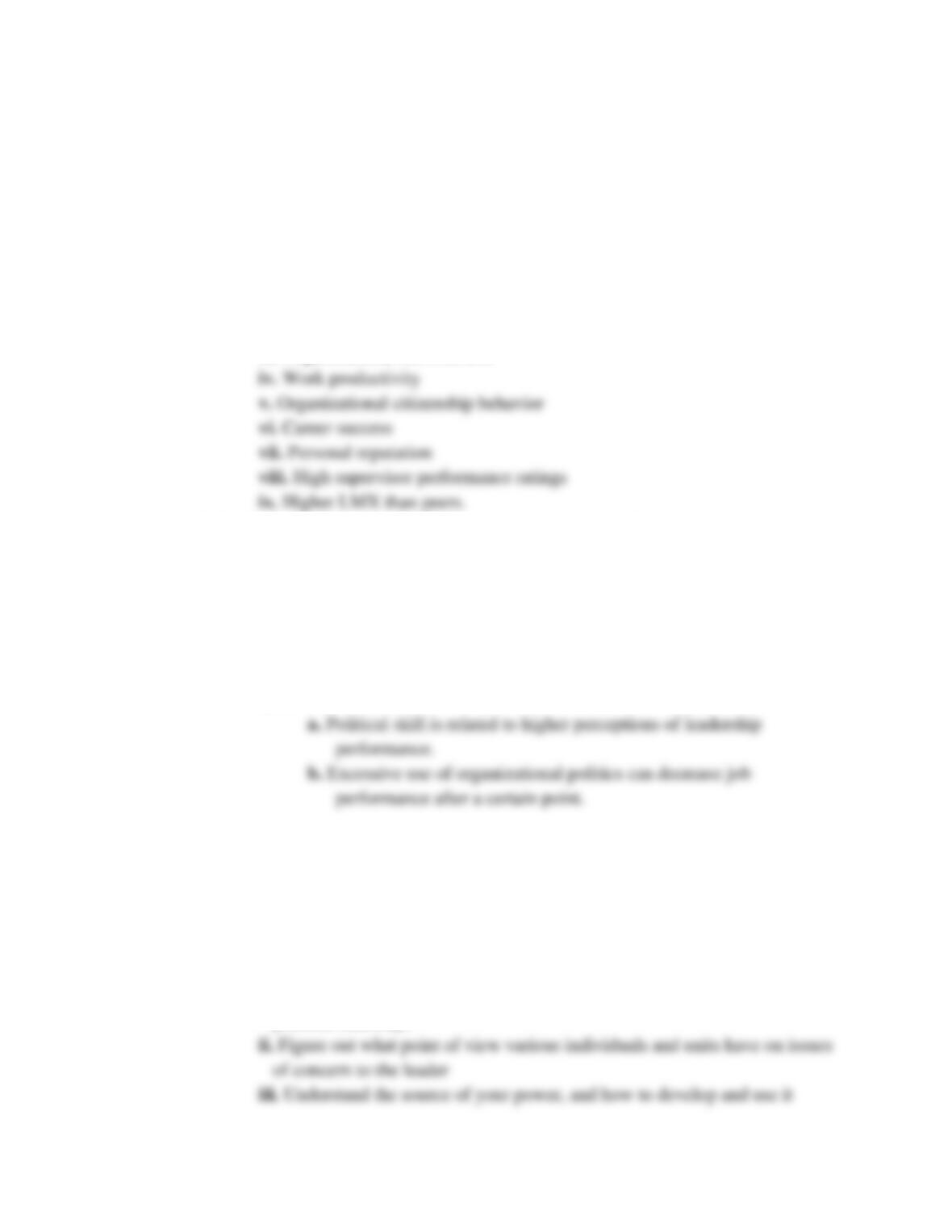
vii. Counterproductive work behavior
E. Potential causes of POP:
i. Job ambiguity
ii. Scarcity of resources
iii. Poor trust climate
F. Job/work context factors have the most influence on POP.
VII. Political Skill
A. Political skill: The ability to effectively understand others at work, and to use such
knowledge to influence others to act in ways that enhance one’s personal and/or
organizational objectives
i. Four sets of behaviors:
a. Networking ability: ability to create a diverse constellation of
contacts both inside and outside of the organization
Instructor Resource
Scandura, Essentials of Organizational Behavior, 3e
SAGE Publishing, 2022
c. Interpersonal influence: ability to adapt influence strategies to
different situations
d. Apparent sincerity: appearing to others as genuine and honest
B. Political skill increases the effectiveness of impression management. Low political
skill and impression management tactics may cause a leader to be viewed
unfavorably.
C. Political skill is positively related to:
i. Self-efficacy
ii. Job satisfaction
iii. Organizational commitment
D. Employees with political skill benefit when leaders establish in-groups and out-
groups.
E. Having Both the Will and the Skill for Politics
i. Will
a. A strong power motive
a. Relates to being viewed as a formal leader in a group
b. Being proactive
ii. Skill
VIII. Leadership Implications: Managing with Power
A. Important to understand the difference between power and influence, as well as
structural versus personal sources of power
B. Skillful leaders understand how to use stored power to get things done and solve
problems.
C. Guidelines for using power:
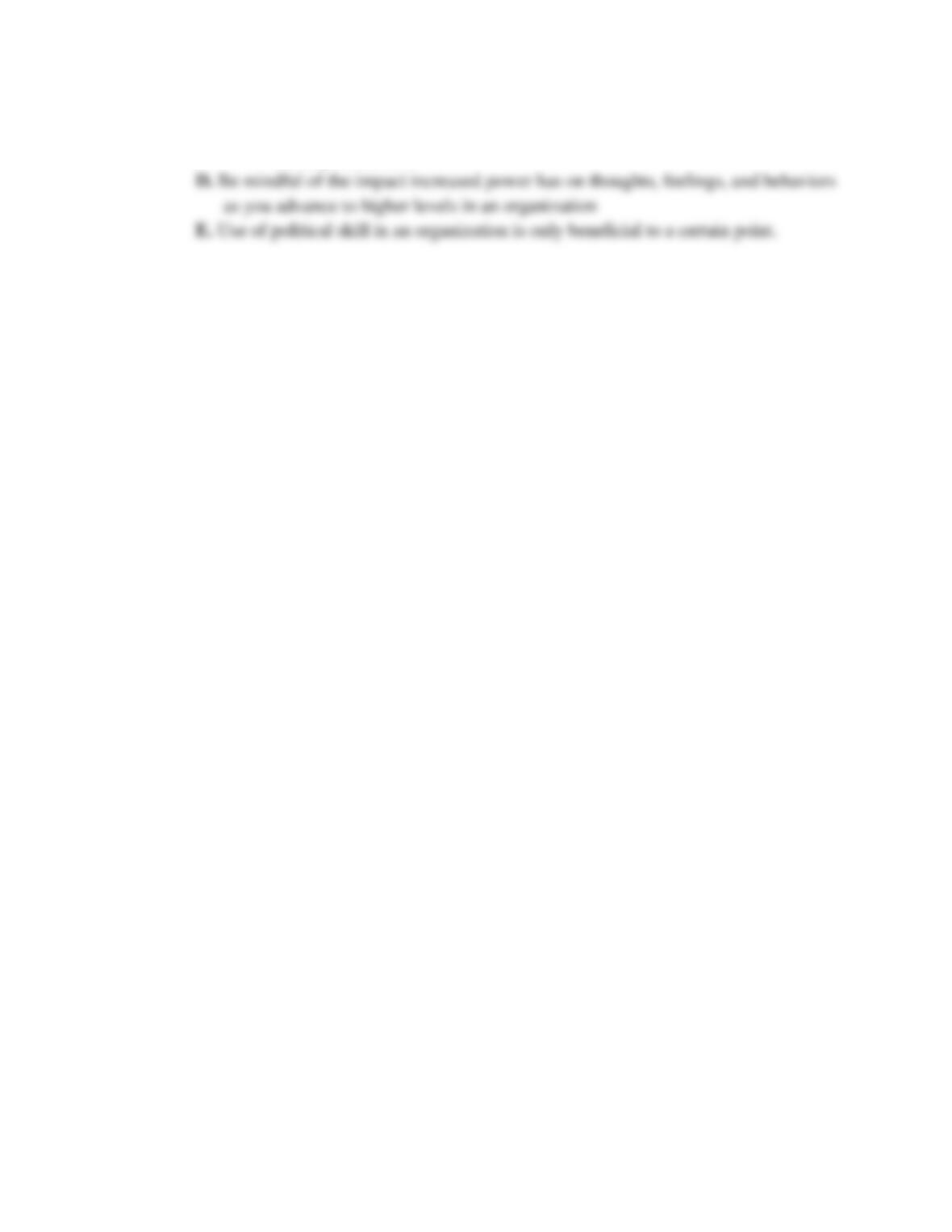
i. Recognize the varying interests of each organization and diagnose the
political landscape
Instructor Resource
Scandura, Essentials of Organizational Behavior, 3e
SAGE Publishing, 2022
iv. Understand the strategies and influence tactics through which power is
developed and used