
Chapter 07 – Work Design and Measurement
7-1
CHAPTER 07
WORK DESIGN AND MEASUREMENT
Teaching Notes
The main topics covered in this chapter are job design and work measurement. You may choose to focus
on one and exclude or de-emphasize the other without affecting material in later chapters. Job design is
basically qualitative while work measurement is basically quantitative. Work sampling can be deleted
from work measurement if desired. However, if you intend to cover simulation, you may want to include
work sampling because it introduces use of a random number table.
Answers to Discussion and Review Questions
2. From the standpoint of management, having workers with specialized skills can substantially
lower the total cost of a product and also requires less training. The disadvantages for
3. a. Job enlargement involves assigning a larger portion of a task to a worker (i.e., horizontal
loading). Job enrichment involves an increase in the level of responsibility for planning and
4. a. Ergonomics is the profession that applies theory, principles, data and methods to job design in

Chapter 07 – Work Design and Measurement
7-2
5. It is a pay system used by organizations to reward workers who undergo training that increases
their skills. It is a portion of a worker’s pay that is based on the knowledge and skill the worker
6. a. Self-directed work teams or self-managed teams are designed to achieve a higher level of
teamwork and employee involvement. They are typically empowered to make changes in the
1. fewer managers
2. better quality
7. Specialization is advantageous in the sense that it allows one to focus concentration on a narrow
aspect of work, and presumably develop an in-depth knowledge of that area. The disadvantage of
8. Motion-study principles are guidelines for designing motion-efficient work procedures (see list
on page 368). They are classified according to principles that apply to the human body, principles
that apply to the work place, and principles that apply to tools and equipment.
9. The need for methods analysis can come from changes in tools and equipment, changes in
product or service design, the introduction of new products, changes in methods or procedures,
11. A time standard reflects the length of time a given task should take a qualified worker who works
12. The information provided by the time study is useful for scheduling, budgeting, manpower
planning, cost and time estimation, designing incentive systems, and so on.

Chapter 07 – Work Design and Measurement
7-3
14. Studying an average worker would involve the least amount of adjustment for performance.
15. Performance rating is subjective, and therefore, open to criticism. In addition, creative and
16. a. The reason for this relates to minor changes in methods, equipment, product design, and so
on which continually occur.
17. Workers may feel that management is trying to increase their workloads, or is trying to maintain
closer control over them. Moreover, some workers may be nervous or feel that they are being
singled out for study for unknown (but ominous!) reasons.
18. [See Table 7–1 ]
19. Work sampling is a proportion of time that a worker or a machine spends on various activities. It
merely requires an analyst to make a brief observation of the work activity at random intervals
Taking Stock
1.
a. Self-directed work teams is a participative management approach that encourages workers to
take on many roles formerly held only by managers. Teams are empowered to make certain

Chapter 07 – Work Design and Measurement
7-4
b. If the standard times are not updated enough, the estimated completion time of many jobs
will be wrong and the resulting plan and the production schedule will be erroneous. This may
eventually adversely affect customer service and efficiency. On the other hand, if the standard
times are updated too frequently, the cost of updating may become unnecessarily large
without providing any benefits because updating did not result in any significant change in
estimating the standard time.
2. Operations uses that information to balance production lines, for workforce planning, for productivity
3. Technology impacts design in two major ways. One relates to processing technology and the other
Critical Thinking
1. High employee turnover could be due to a number of factors. Morale may be low, and pay may be too
low. Employee interviews and managerial observation would be needed to assess the situation. Possible
2. Student answers will vary.
Chapter 07 – Work Design and Measurement
7-5
Memo Writing Exercises
1. Self-directed work teams are responsible for defining and carrying out a segment of work. It is a
participative management approach that encourages workers to take on many roles formerly held
2. Lean Production systems put more emphasis on quality, productivity, flexibility and breakdown
buffers between departments. Therefore, the more knowledgeable the workers are, the more value
Solutions
1.
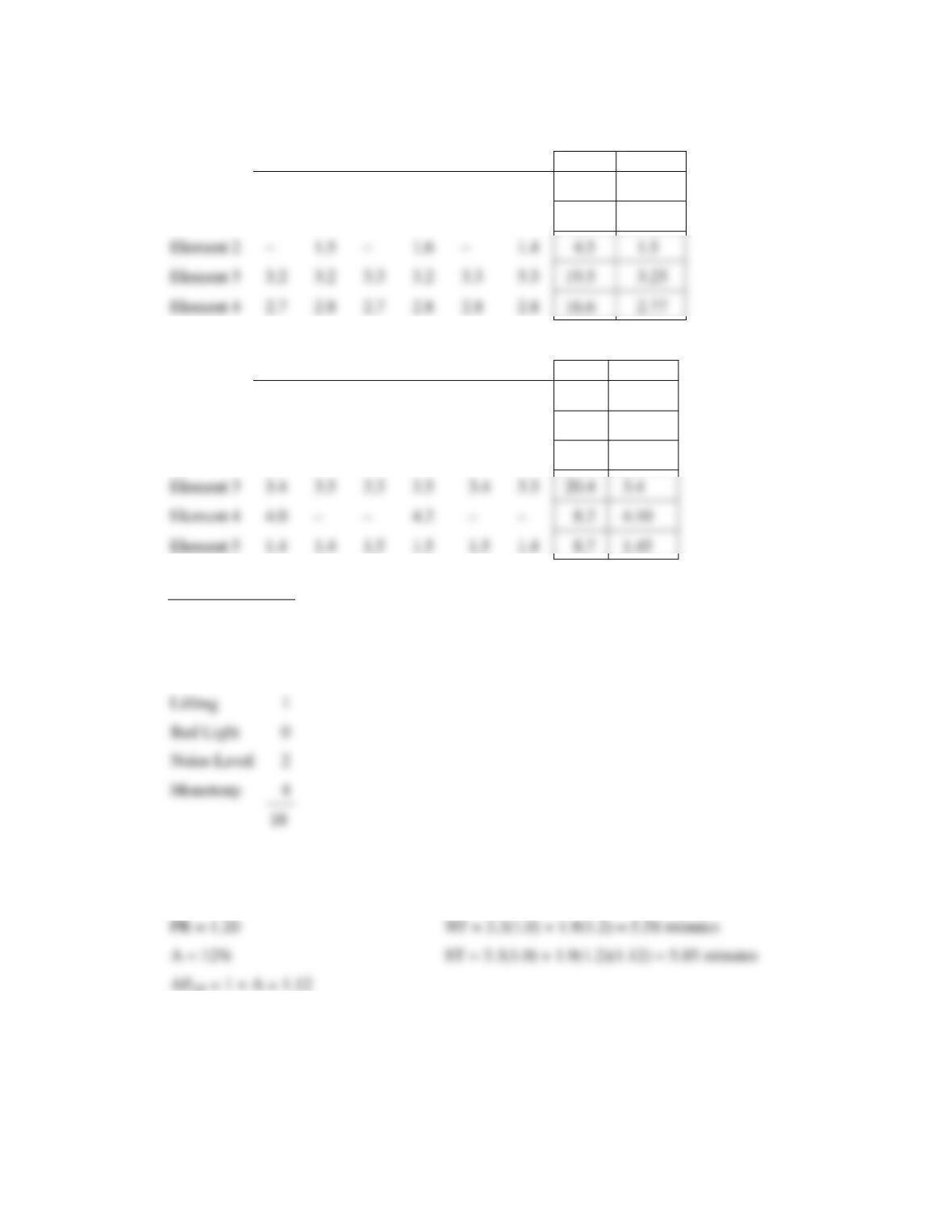
OT = 10.4 minutes
NT = OT x PR = 10.4 x 1.25 = 13.0 minutes
s = 1.2 minutes
ST = NT x AFjob = 13.0 x 1.16 = 15.08 minutes
PR = 1.25
2.
OT = 1.2 minutes
PR = .95
A = 10%
11.111
1
day
AF A
==
−
a.
OT = 1.2 minutes
b.
NT = OT x PR = 1.2 x .95 = 1.14 minutes
ST = NT x AFday = 1.14 x 1.111 = 1.27 minutes
3.
Element
PR
OT
NT
AFjob
ST
1
.90
.46
.414
1.15
2
.85
1.505
1.280
1.15
1.472
3
1.10
.83
.913
1.15
1.050
4
1.00
1.16
1.160
1.15
1.334
Chapter 07 – Work Design and Measurement
7-6
4.
Cycle
1
2
3
4
5
6
Sum
Average
Element 1
4.1
4.0
4.2
4.1
4.1
4.1
24.6
4.1
5.
1
2
3
4
5
6
Sum
Average
Element 1
2.1
2.0
2.2
2.1
2.1
–
10.5
2.1
Element 2
–
1.1
–
1.0
–
1.2
3.3
1.10
Element 3
3.4
3.5
3.3
3.5
3.4
3.3
20.4
3.4
Element 4
4.0
–
–
4.2
–
–
8.2
4.10
Element 5
1.4
1.4
1.5
1.5
1.5
1.4
8.7
1.45
6.
Factor
%
Personal
5
Fatigue
4
Standing
2
Lifting
1
Bad Light
0
Noise Level
2
Monotony
4
18
7.
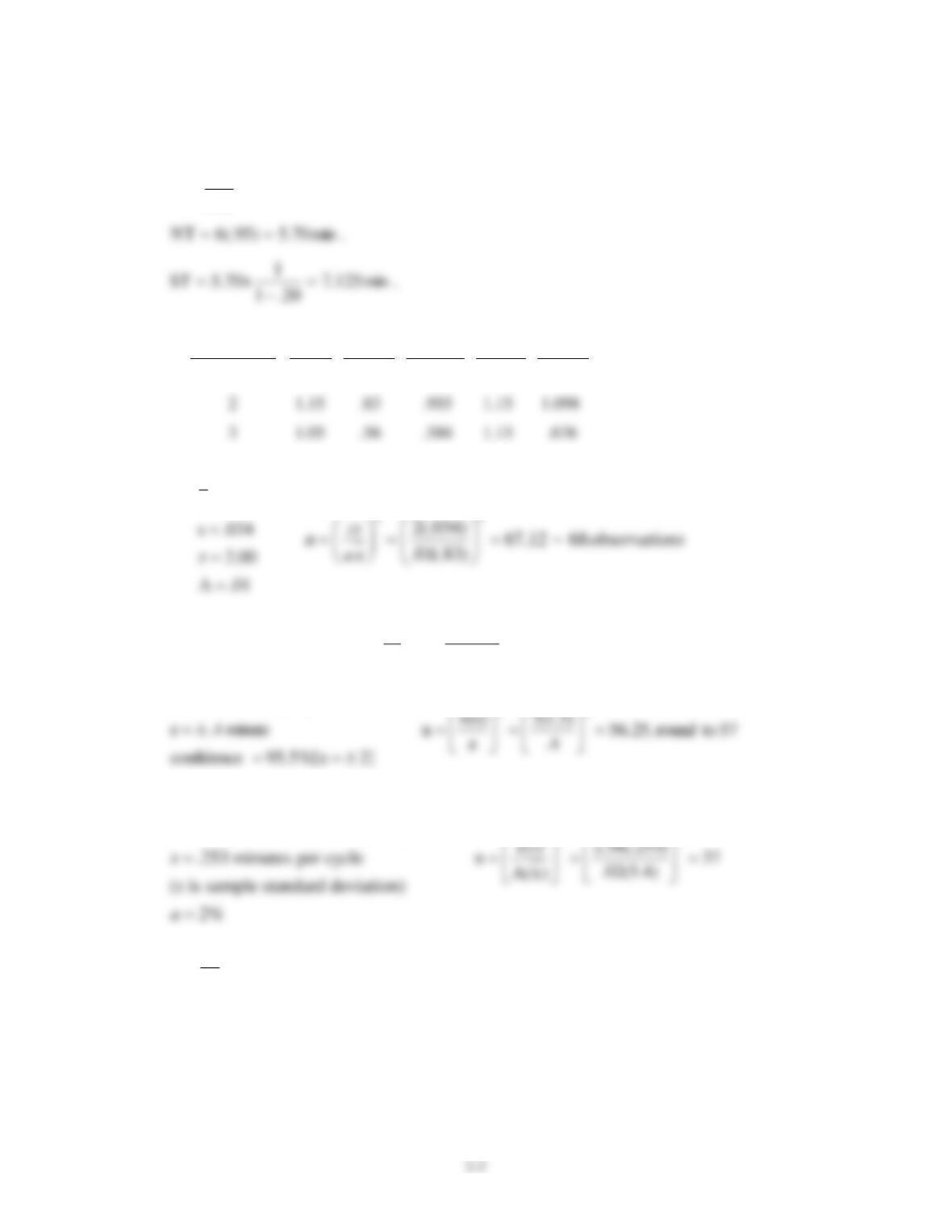
machine time = 3.3 minutes
operator time = 1.9 minutes
[machine] [worker]
PR = 1.20
NT = 3.3(1.0) + 1.9(1.2) = 5.58 minutes
A = 12%
ST = 3.3(1.0) + 1.9(1.2)(1.12) = 5.85 minutes
Element 2
–
1.5
–
1.6
1.4
4.5
Element 3
3.2
3.2
3.3
3.2
3.3
3.3
19.5
3.25
Element 4
2.7
2.8
2.7
2.8
2.8
2.8
16.6
Chapter 07 – Work Design and Measurement
8.
A = 24 + 10 + 14 = 48 minutes per 4 hours
20.
240
48
A
==
9.
a.
Element
PR
OT
NT
A
ST
1
1.10
1.19
1.309
1.15
1.505
1.098
b.
83.x
=
c. e = .01 minutes
47 toround ,24.46
01.
)034(.2
e
zs
n
22
=
=
=
pieceper minutes 5.1s
=
22
99%[ 2]
5.4 minutes per cycle
confidence z
mean time
= =
=
2
2
12.
12.
50
6
p==
n=(z/e)2[p(1 – p)] = (1.96/.05) 2[.12(.88)] = 162.27, rounded up to 163
z = 1.96
e=.05 confidence=.95
10.
11.

Chapter 07 – Work Design and Measurement
7-8
13.
Confidence = .98 [z = 2.33]
14. hour: 1 7 4 4 6 3 1 1
minute: 47 15 24 27 26 38 56 00
Note: minutes greater than 59 have been omitted .
Chronological order:
Observation Time
1 1:00
2 1:47
3 1:56
Chronological Order:
15. Day Hour Minute Observation Date Hour Minute
16 6 30 1 3/15 2 39
32 3 46 2 3/19 4 10
15 4 10 3 3/22 6 30
46 1 37 4 3/24 7 18
19 8 02 5 3/25 0 11
e = .06

Chapter 07 – Work Design and Measurement
7-9
16. Observation Day Time
1 01 4:44
2 11 4:37
3 20 6:17
4 21 5:38
5 21 6:57
Case: Making Hotplates
The case illustrates some benefits of job enlargement. It is shorter and less involved than the second case,
Allstate Automotive Analyzers.
Answers to questions
1. Originally workers were bored and morale was low, apparently because of the specialization of
3. The major change involved giving each worker a greater share of the overall task. This was under
4. If they were to return to the old assembly line, it is conceivable that morale and productivity
would be even lower than before. Once the workers had a taste of the new method, they would
dislike the former setup even more.