Page 1 of 16
Chapter 7: Quality and Innovation in Product and
Process Design
Chapter Outline
• Designing Products for Quality
• The Design Process
• Quality Function Deployment (QFD)
• Technology in Design
• Other Design Methodologies
• Designing for Reliability
• Environmental Considerations in Design
Overview
Prior chapters indicated that quality should be designed into the product as early
in the process as possible and not added only after the initial design is complete. This
chapter discusses the design process and how quality is an integral part. The point is
made that poor quality can be an annoyance or a catastrophe. If a car battery does not
hold a charge, the problem is annoying. However, if a replacement heart valve fails, the
negative results are major.
Page 2 of 16
Discussion Questions
1. Product idea generation initiates the process of designing a product by generating
ideas from external and internal sources. What are some examples of external and
internal sources that are used in this process?
Internal sources are available within the company. The text identifies marketing,
management, research and development (R&D), and employee suggestions.
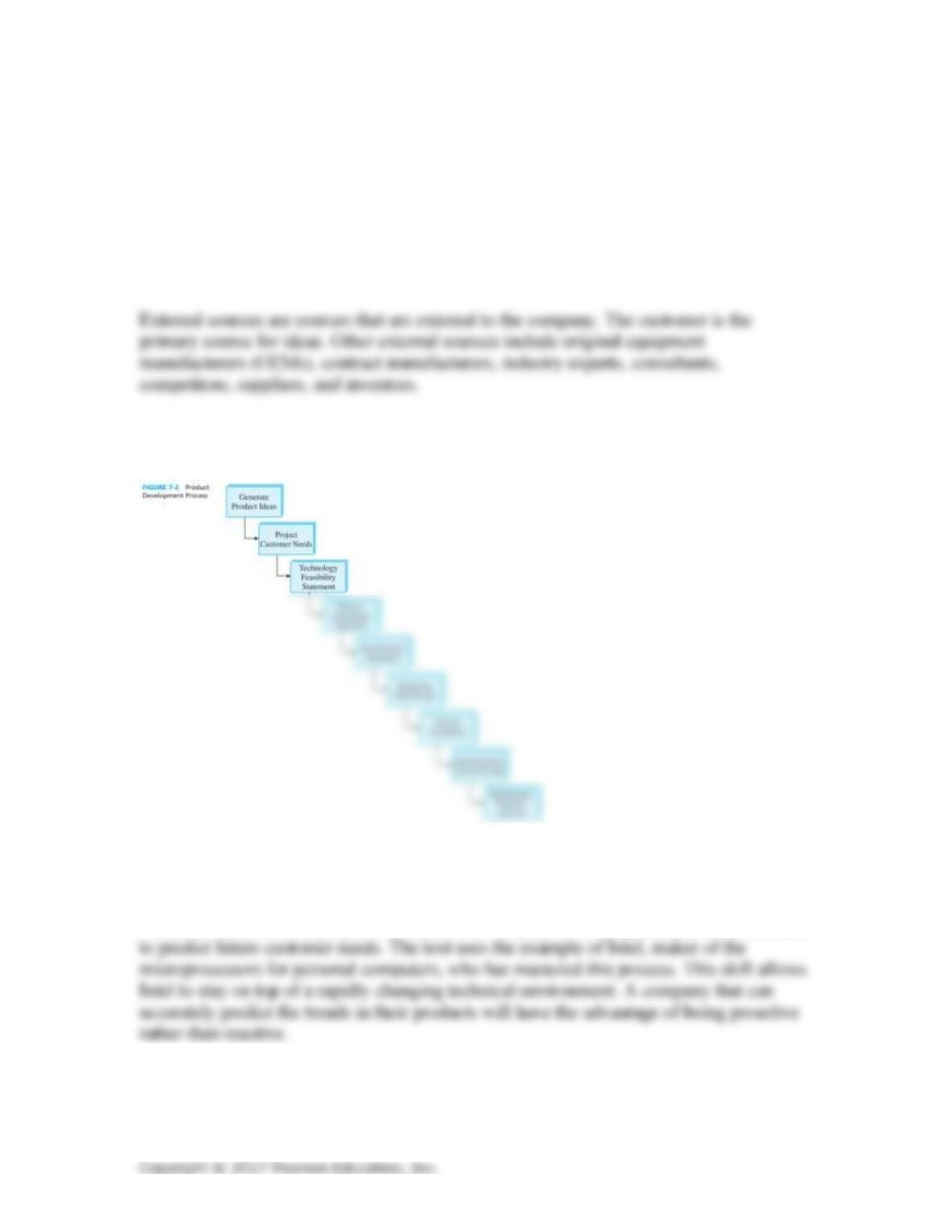
Project idea generation is the first step of the project development process. This process
is described in Figure 7-2.
2. Discuss the concept of consumer future needs projection. Does a firm that excels
in this area have a competitive advantage? Please explain your answer.
Consumer future needs projection, step two of the project development process, uses data
3. What is a technology feasibility statement? Why is it important?
Step three of the project development process includes a statement of feasibility. The
general question is: does the state of the art allow the product or process to be created?
4. Briefly describe the role of computer-aided design (CAD) in the product design
process. How has CAD changed the way that product designers go about their jobs?
Not too long ago, design meant an acre or two of draftsmen drawing plans by hand.
Today’s software has relegated that technique to the dustbin. Computer Aided Design
(CAD) has simplified and streamlined the task of design. A CAD design can also be
On page 161, the text says:
… auto designers once had to place mock-ups of automobiles into wind tunnels to test the
aerodynamics of a design. However, now the wind resistance coefficients for automobiles
Computer aided tools like CAD improve the ability of designers to generate new and
varied designs. In addition, the design process is simplified. For example, whereas auto

5. Describe the concept of concurrent engineering. How does concurrent engineering
improve the product design process?
6. The product life cycle for many products is getting shorter. In what ways does
this trend complicate the product design process? Can you think of any advantages
to shorter product life cycles for firms that have exemplary product design
processes?
As the product life cycle gets shorter, we are finding the roadway more complex. Many
products evolve so quickly that they wind up competing with themselves. On page 166,
the text states:
… product life cycles are becoming shorter. This means that obsolescence is a greater
problem for designers and that the speed at which new product concepts are delivered to
7. What is the role of complementary products in managing the product life cycle?
Complementary products use similar technologies but have a feature that differentiates
them. Bringing out a new product can extend the life on an existing product. A
8. What is meant by design for manufacture?
On page 166, the text asks, “Now that we have designed it, can we make it?” Another

9. The design for maintainability concept states that a product should be designed in
a way that makes it easy for a consumer to maintain it. What product attributes
make it easy for a product to be serviced or maintained?
A common complaint today is that products are cheaper to discard than fix. With a bit of
research, a computer printer can be found for under $50.00. The ink cartridges cost about
the same price. Where is the incentive to keep the printer? On page 169, the text provides
a list of factors that should be considered when “designing for maintainability”:
• Components that are easily replaced
10. What is the over-the-wall syndrome? How can the over-the-wall syndrome be
avoided?
Today’s complex products are generally constructed of many sub-systems. These sub-
systems must operate together. For example, a car has a fuel system, a transmission, a
drive train, and a cooling system. These systems operate interactively. A point where they
do not interface well could spell failure.
11. Define component reliability and system reliability. What is the major difference
between these two concepts?
Component reliability is defined as the “probability” that an individual component will
fail during its anticipated lifespan.
12. Describe the concept of failure modes and effects analysis (FMEA). What is the
end result of an FMEA analysis? What are some of the ancillary benefits that can be
derived through engaging in FMEA?
The texts definition, on page 171, is:
Failure modes and effects analysis (FMEA) systematically considers each component of
FMEA is a systematic procedure that identifies and documents the possible failures
within a system and the effects of these failures. Page 171 lists some of the advantages of
FMEA as:
2. Improvement of a company’s image and its competitiveness
4. Reduction in product development cost
13. What is the primary purpose of conducting a fault-tree analysis?
As with FMEA, fault-tree analysis is an organized manner of analyzing potential areas
for the occurrence of fault. FTA graphically describes the possible combination of
14. Describe a method for identifying ways in which an engineered system could fail.
What is the primary goal of this method of analysis?
1. A description of the product’s function
3. Potential effects each failure mode could have on the end user
Page 7 of 16
5. Preventive measures in place for firmly scheduling by the time production starts
7. A ranking of the difficulty of detection
15. Discuss the importance of product traceability and recall procedures. Why is
product traceability considered an important consumer safety issue?
Some months ago, I brought my wife’s minivan into the dealership for some scheduled
maintenance. While we were in the process of doing the paperwork, the auto technician
16. What environmental considerations are important for product designers? Do
you believe that environmental considerations will become more important or less
important in the future? Explain your answer.
Environmental concerns have been a major news story since Rachel Carson wrote Silent
Spring. The consumer has been educated to look for the environmental concerns of the
products that they buy. This is in addition to the various legal restrictions. On page 175,
17. Compare the job of a product designer 20 years ago to the job of a product
designer today. In your opinion, what has been the single most significant
technological advancement that has changed the job of a product designer?
The increasing rate of change in technology in the last twenty years is unprecedented.
The list might include such concepts and tools as: robotics, integrated computers, new
Page 8 of 16
Case 7-1: Keeping Apple’s IPhone Competitive
1. The case discusses the issues of trade-offs in design. What are some smartphone
trades-offs? Why are these important to consider in design?
2. Choose another product besides a smartphone. What are some important trade–
offs for that product design?
3. How should Apple evaluate the “quality” of its iPhone?
As one reviewer put it, “The iPhone is the smartest smart phone out there. It works just
like the commercials. It is that smooth and usable.” (Source:
http://ergonomics.about.com/od/buyingguide/fr/iphone.htm)
Every aspect of the user experience has been thought out. Using the device and the
How do you know when usability has been enhanced? After a day of playing with the
iPhone, I found myself trying to grab the screen on my laptop with the cursor and flicking
with my touch-pad. It didn’t work, of course.
4. How could Apple improve its design processes for the iPhone?
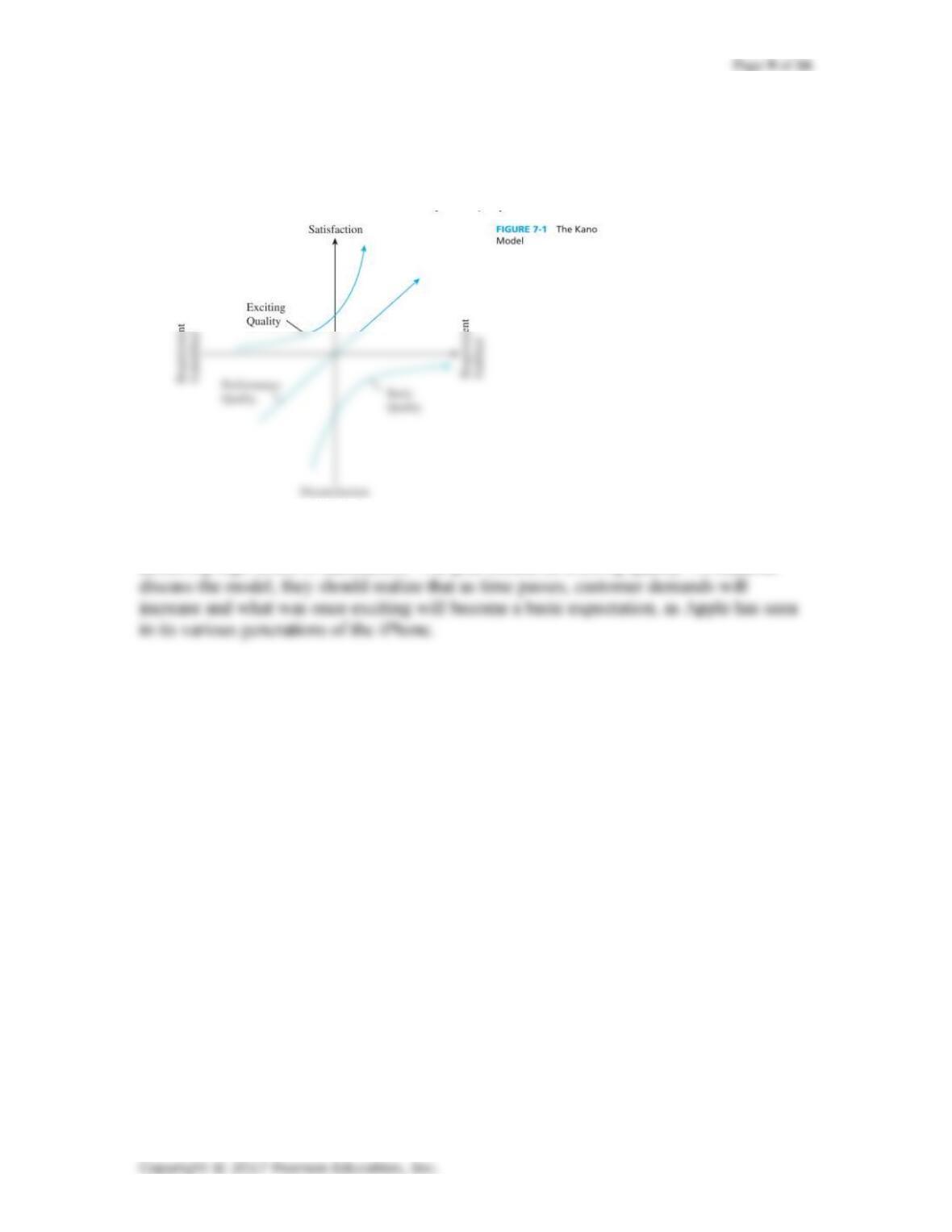
One thing they could keep in mind is the Kano Quality Design Model, shown here.
The model shows that quality is a function of fulfilling customer requirements and
achieving high levels of satisfaction. The goal should be exciting quality. As students
Case 7-2: Nucor Corporation: Producing Quality Steel By Stressing
Sound Management Practices
1. This chapter has emphasized process design. At Nucor, do human resources
processes affect product quality?
Most definitely yes, human resource processes are integral to their success. The success
is summed up at the end of the case:
The amazing thing about Nucor’s success is that it is so simple: Give employees a stake
2. How do Nucor’s management practices affect its capability to produce high-
quality products? Make your answer as substantive as possible.
Nucor’s management practices drive self-motivation. Decisions are driven to the lowest
level. The front line is empowered to make decisions. The front line employees are
3. Would you enjoy working at Nucor? Why or why not?
An employee who does not allow mediocrity to be a personal identity will thrive in this
environment. This management style is pure Theory Y: it appeals to the individuals who
see themselves as self-motivated and self-actualized. The case states that:
In return for the generous compensation package, Nucor holds its employees to a high
standard. Decision-making is pushed down to the factory floor in many instances,

Page 11 of 16
Suggested Answers to End of Chapter Problems
1. Flowchart the design and production process for writing a book such as
Managing Quality: Integrating the Supply Chain. Use the standard process for
designing products in the chapter.
The standard process demonstrated is the chapter is as follows:
• Product idea generation: The author submits a proposal to a publisher. The
proposal is sent out for review. Feedback from the reviewers is used in
determining whether or not to proceed with the project.
• Technology development for process selection: The publishers have existing
relationships with development companies, both domestic and international.
• Final product definition: The author completes the manuscript and submits it to
the publisher, who has it copyedited and develops a final production schedule.
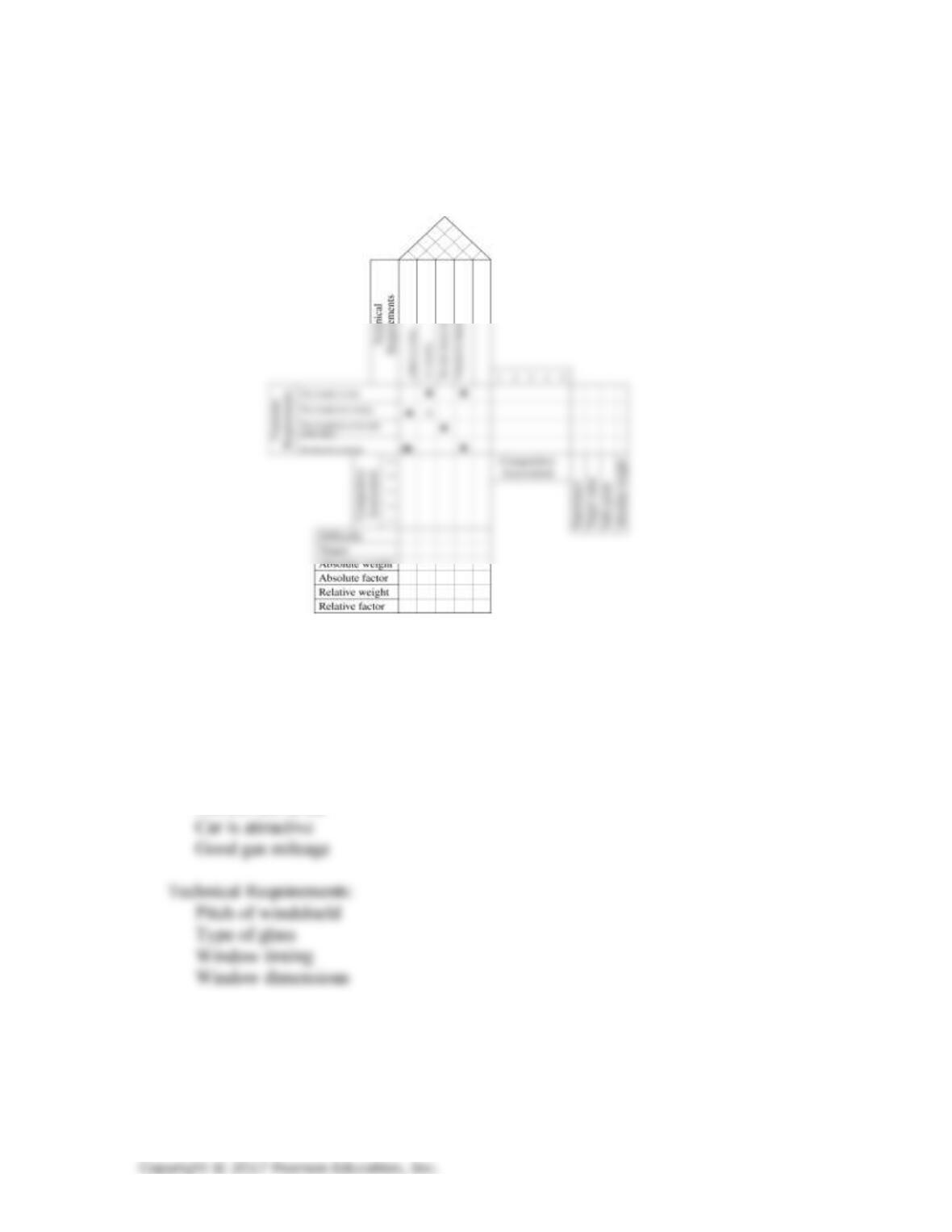
2. Define key customer requirements for a pen. Next, define key technical
requirements for the pen. Create a matrix showing the relationships between
technical and customer requirements using the QFD format.
Answers may vary. This is an example:
Example Customer Requirements:
Pen should not leak.
Page 12 of 16
Uniform ink drop
Ink viscosity
Biometric design elements
Pressure to release ink
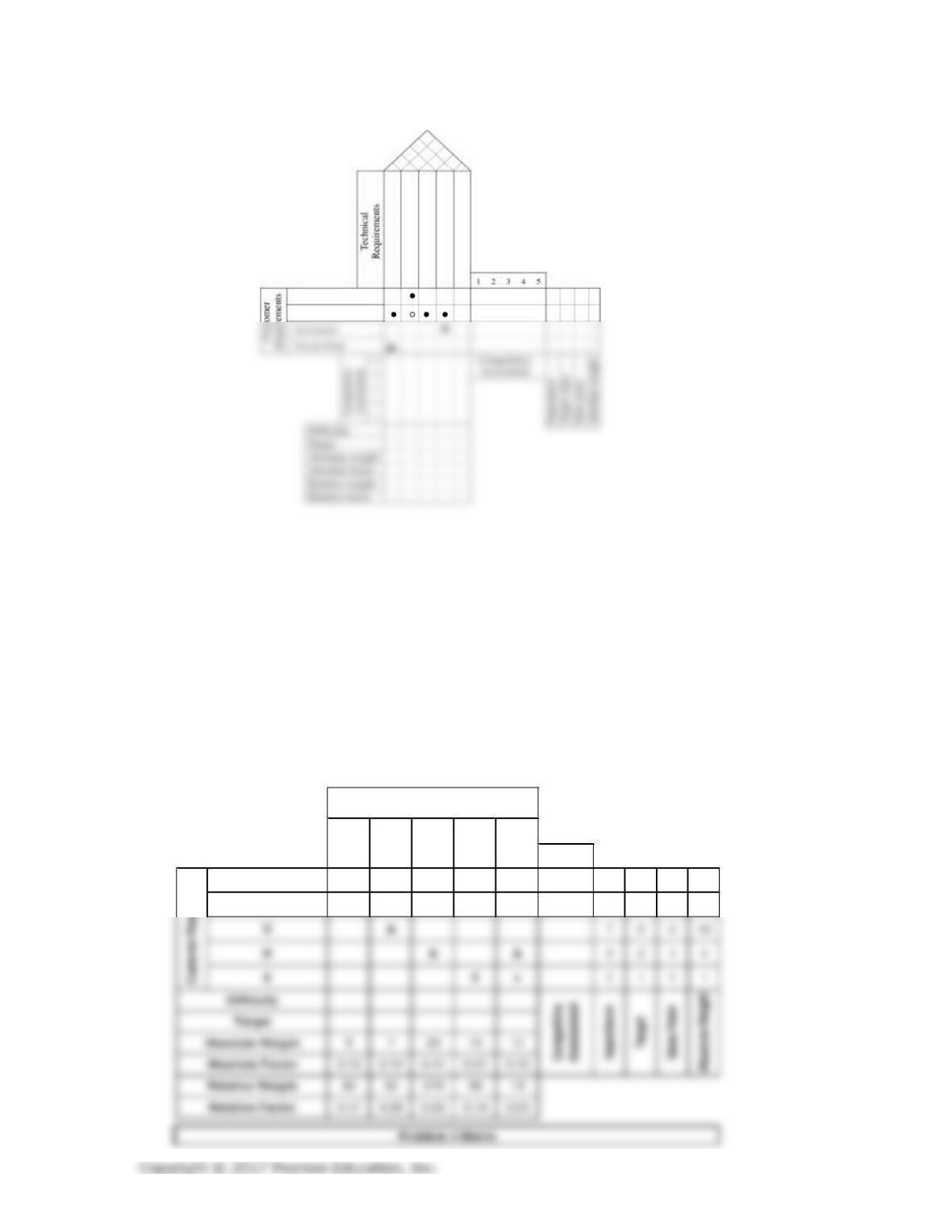
3. Define key customer requirements for an automobile windshield. Next, define
key technical requirements. Create a matrix showing the relationships between
technical and customer requirements using the QFD format.
Customer Requirements:
Good visibility
Not too hot in car
Page 13 of 16
4.
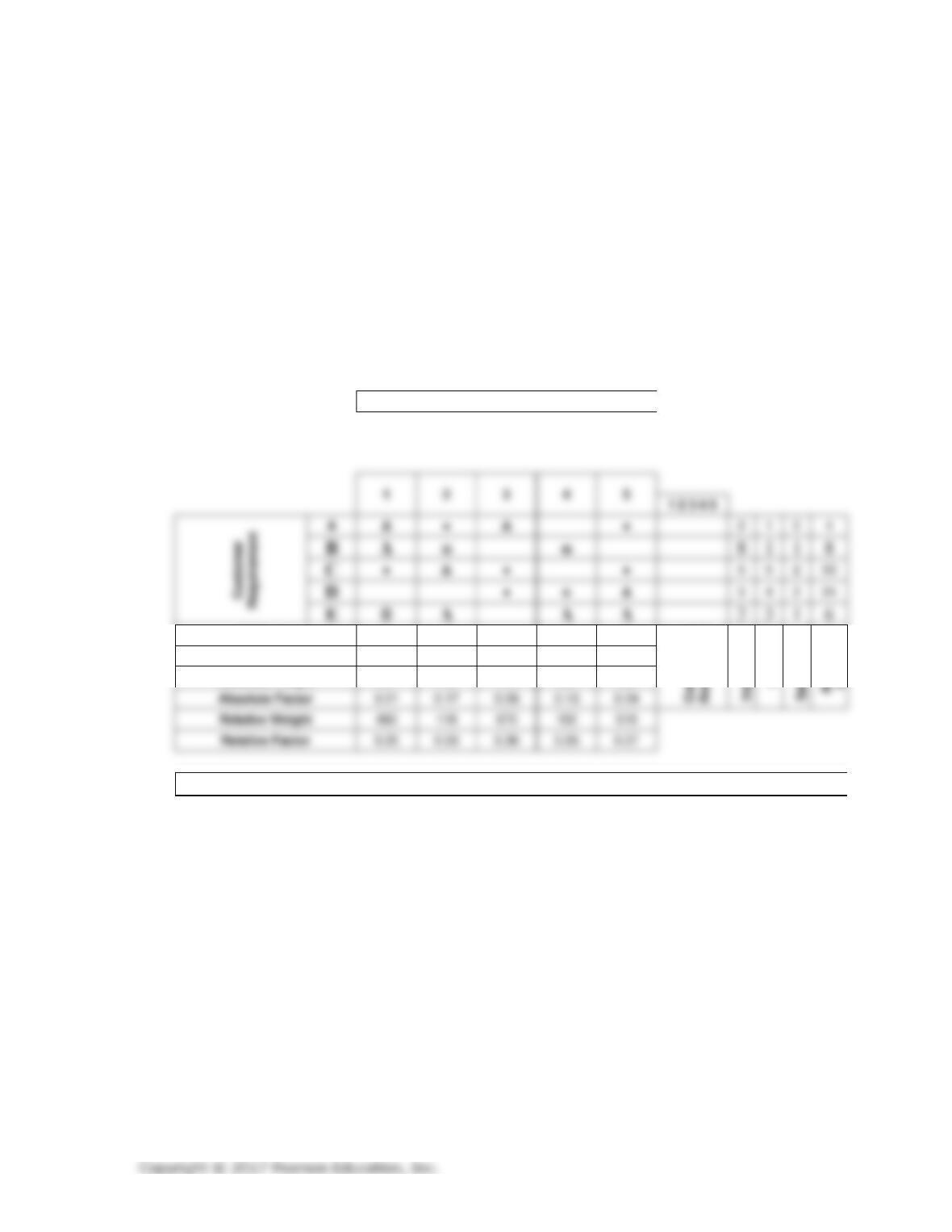
For the QFD problem 4 matrix, compute the:
a. Customer requirements absolute weight
b. Technical requirements absolute weight and factor
c. Technical requirements relative weight and factor
d. Which design and technical factors should be emphasized? Why?
Emphasize technical requirement 3 because its absolute and relative weight factors
are higher than other factors.
Good visibility
Not too hot in car
Pitch of windshield
Type of glass
Window tinting
Window dimensions
C
E
D
1 2 3 4 5
3 5 2 30
4 4 2 32
A
o
o
•
Technical Requirements
1
2
3
4
5
B
Page 14 of 16
5.
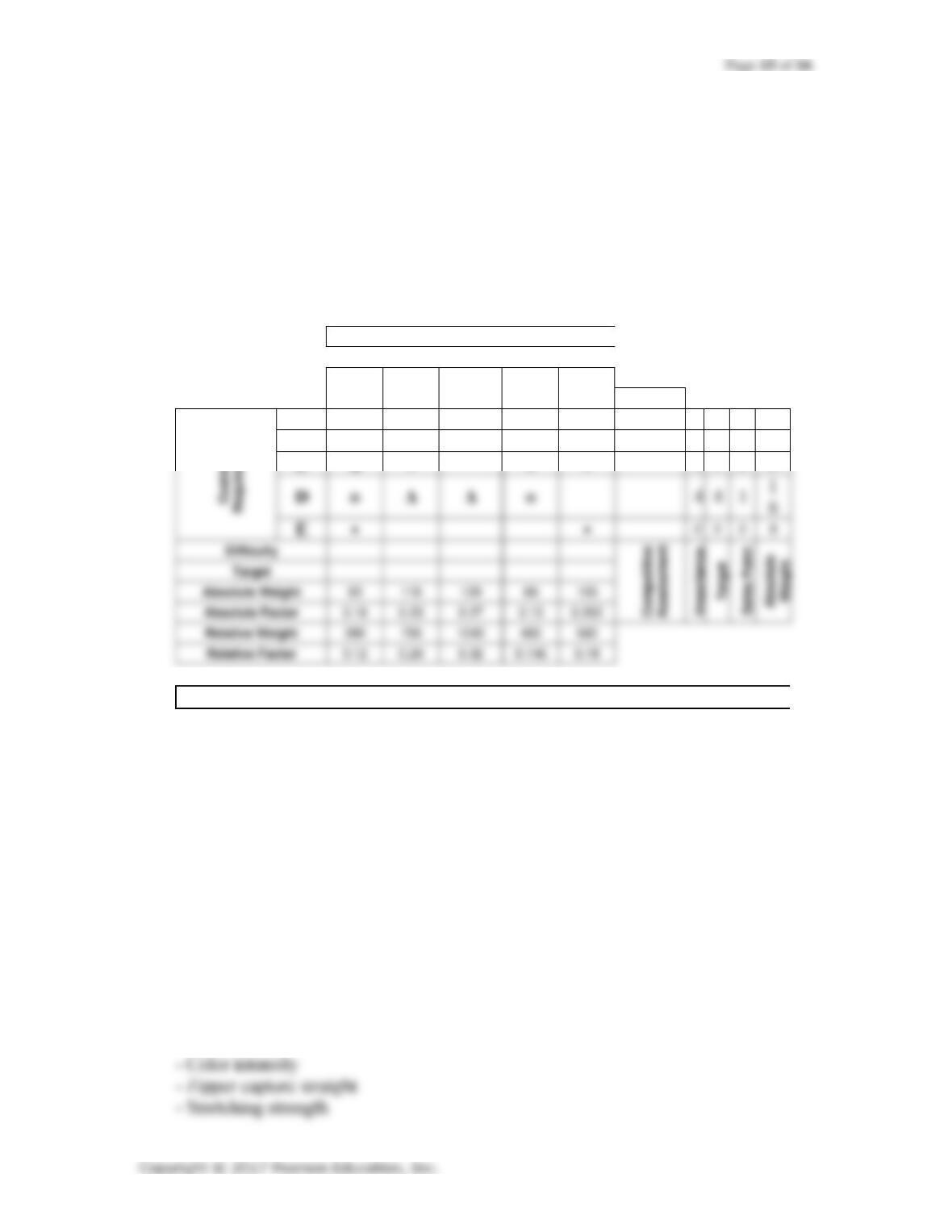
For the QFD problem 5 matrix, compute the
a. Customer requirements absolute weight
b. Technical requirements absolute weight and factor
c. Technical requirements relative weight and factor
d. Which design and technical factors should be emphasized? Why?
Technical Requirement 3 because its absolute and relative weight factors
are higher than other factors.
Technical Requirements
4
8
1
1
2
3
1
Difficulty
Target
Target
Absolute Weight
61
49
74
36
68
Problem 5 Matrix
E
0.202
0.146
6.
7.
For the QFD problem 6 matrix, compute the:
a. Customer requirements absolute weight.
b. Technical requirement absolute weight and factor
c. Technical requirement relative weight and factor
d. Which design and technical factor should be emphasized? Why?
Focus on technical requirement 3 first. That is what has the highest factor when
considering market impact and design imperatives.
Technical Requirements
1
2
3
4
5
1 2 3 4 5
A
●
Δ
●
Δ
6
4
1
24
B
o
●
o
9
5
2
90
C
Δ
●
o
●
9
3
2
54
Problem 6 Matrix
What are the important design elements for a pair of pants?
Respondents may give some of the following responses:
a. Customer requirements
– Do the pants fit properly?
– Are they the correct length?
– Are they the right color?
– Does the zipper work properly?
– Any visible flaws?
b. Technical requirements
– Fabric density

Page 16 of 16
8.
c. Using the QFD format, show the relationships (with strengths, i.e., 1, 3, or
9)
between a and b above.
Using the format in Figure 7-15, develop an FMEA for a pair of women’s
panty hose.