Ch 7, Instructor’s Manual, Business & Society, Carroll 10e
Chapter 7
Business Ethics Essentials
LEARNING OUTCOMES
After studying this chapter, you should be able to:
1. Describe the public’s opinion of business ethics.
3. Analyze economic, legal, and ethical aspects of a decision by using a Venn model.
5. In terms of making moral management actionable, describe and discuss Kohlberg’s three
levels of moral development and Gilligan’s ethics of care.
6. Identify and discuss six major elements of moral judgment.
TEACHING SUGGESTIONS
INTRODUCTION – Chapter 7 introduces concepts and background that are essential to
understanding business ethics. The authors explore a wide range of topics that combine to form
a network within which business decisions are made, how they are made, and how managers
develop their abilities to make them.
KEY TALKING POINTS – Unless students previously have taken a course in moral philosophy,
most will have given little thought to the whole issue of ethical decision-making. Although they
certainly will have opinions regarding what constitutes moral behavior (often very strong
opinions), the majority will have little insight into how they make those decisions. One effective
This chapter focuses on two primary topics—the environment within which business ethics
decisions are made and how managers go about making those decisions. By maintaining a clear
focus on moral judgment, the authors provide students with a strong explanation of that process.
Ch 7, Instructor’s Manual, Business & Society, Carroll 10e
“…there is more to moral development than moral judgment development…” (Moral
Development in the Professions, 1994, page 22). Rest’s four components include:
There is no question that judgment is a critical element in moral behavior, but it is only one
element. Without recognition of the other components, students will not gain a full
understanding of moral behavior within organizations.
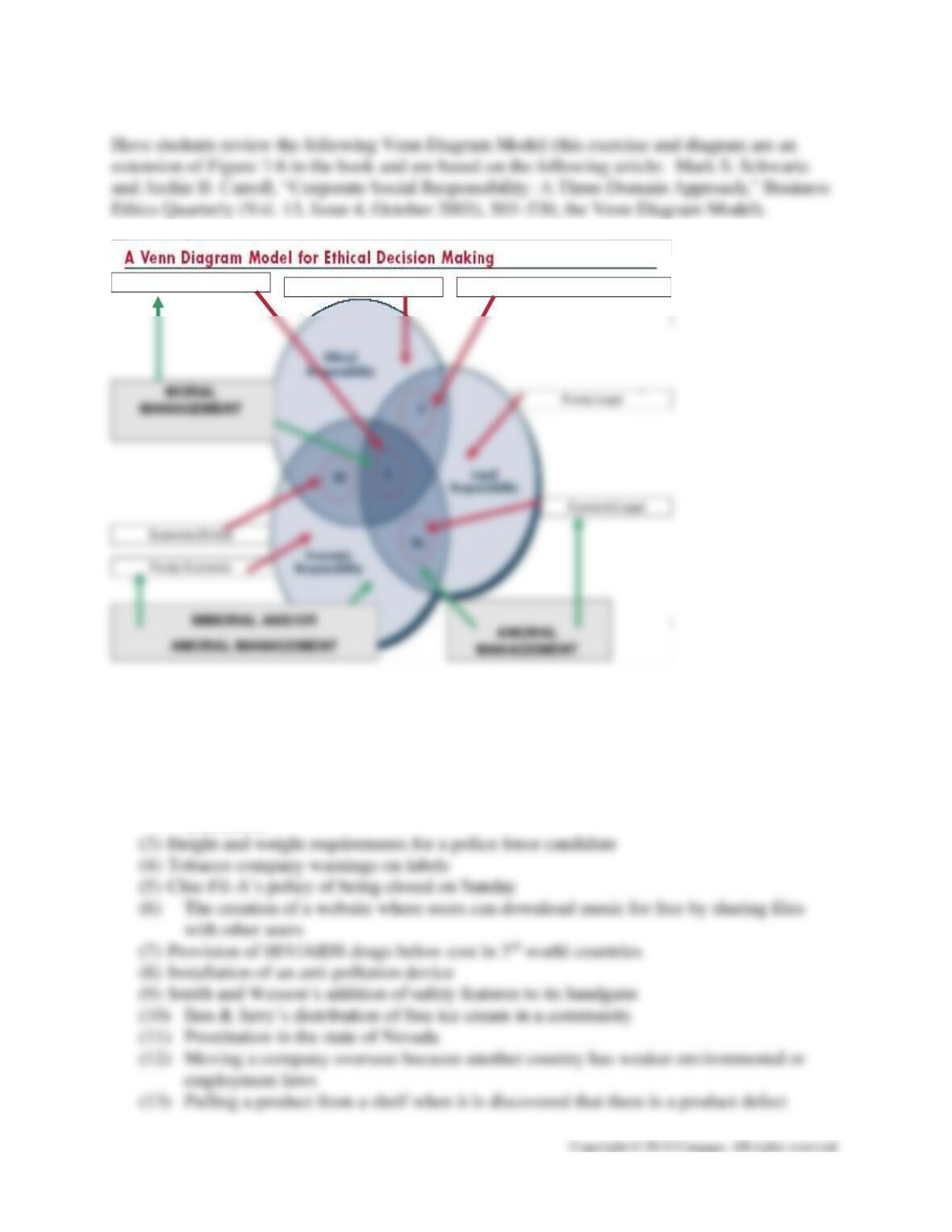
Using the Venn diagram, instructors can demonstrate how economics, ethics and the law affect
PEDAGOGICAL DEVICES – In this chapter, instructors may utilize a combination of:
Cases: 5-Engineered Billing
6-The Waiter Rule: What Makes for a Good CEO?
7-Using Ex-Cons to Teach Business Ethics
8-To Hire or Not to Hire
9-You Punch Mine, I’ll Punch Yours (2)
10-Phantom Expenses
11-Family Business
13-Location, Location, Location
Ethics in Practice Cases:
What Would You Do?
To Hunt or Not to Hunt – That is the Question
Is Resume Inflation and Deception Acceptable?
Ch 7, Instructor’s Manual, Business & Society, Carroll 10e
Are People More Ethical When Being “Watched?”
Spotlight on Sustainability:
Ray Anderson’s Conversion Experience
LECTURE OUTLINE
I. THE PUBLIC’S OPINION OF BUSINESS ETHICS
A. Are the Media Reporting Business Ethics More Vigorously?
B. Is It Society that Is Changing?
II. BUSINESS ETHICS: SOME BASIC CONCEPTS
A. Descriptive versus Normative Ethics
B. The Conventional Approach to Business Ethics
C. Ethics and the Law
D. Making Ethical Judgments
III. ETHICS, ECONOMICS, AND LAW – A VENN MODEL
IV. THREE MODELS OF MANAGEMENT ETHICS
A. Immoral Management
1. Operating Strategy
2. Illustrative Cases
B. Moral Management
1. Operating Strategy
2. Illustrative Cases
a. Navistar
b. Merck
C. Amoral Management
2. Unintentional Amoral Management
a. Unconscious Biases
4. Illustrative Cases
a. Examples
5. Two Hypotheses Regarding the Models of Management Morality
a. Population Hypothesis
V. MAKING MORAL MANAGEMENT ACTIONABLE
VI. DEVELOPING MORAL JUDGMENT
A. Levels of Moral Development
1. Level 1: Preconventional Level
3. Level 3: Postconventional, Autonomous, or Principled Level
4. Ethics of Care Alternative to Kohlberg
B. Different Sources of a Person’s Values
1. Sources External to the Organization: The Web of Values
a. Religious Values
2. Sources Internal to the Organization
VII. ELEMENTS OF MORAL JUDGMENT
A. Moral Imagination
B. Moral Identification and Ordering
C. Moral Evaluation
VIII. SUMMARY
SUGGESTED ANSWERS TO DISCUSSION QUESTIONS
Students should recognize that their answers to these discussion questions should be well
reasoned and supported with evidence. Although some answers will be more correct than others,
students should be aware that simplistic answers to complex questions, problems, or issues such
as these will never be “good” answers.
1. Question: Give a definition of ethical business behavior, explain the components involved
in making ethical decisions, and give an example from your personal experience of the
sources of ethical norms that affect you while making these determinations.
Answer: Ethical business behavior does not mean that no harm is done to anyone. Rather,
ethical business behavior entails being aware of the possible consequences of the firm’s
2. Question: To demonstrate that you understand the three models of management ethics –
moral, immoral, and amoral – give an example from your personal experience of each
type. Do you agree that amorality is a serious problem? Explain.
Answer: Immoral management entails knowingly deciding to engage in “wrong” actions,
often ones that harm others in some way. Moral management, on the other hand, consists
of making moral judgments to do the “right” thing. Immoral management often
concentrates on measures of profitability to the exclusion of other criteria, while moral
3. Question: Give examples from your personal experience of Kohlberg’s Levels 1, 2, and 3.
If you do not think you have ever gotten to Level 3, give an example of what it might be
like.
Answer: Level 1, the preconventional level, focuses on self gratification, and can be seen
in virtually any infant or young child. Unfortunately, adults often display characteristics of
4. Question: Compare your motivations to behave ethically with those listed in Figure 7-14.
Do the reasons given in that figure agree with your personal assessment? Discuss the
similarities and differences between Figure 7-14 and your personal assessment.
Answer: Figure 7-14 is basically a recasting of Kohlberg’s three levels of moral
5. Question: From your personal experience, give an example of a situation you have faced
that would require one of the six elements of moral judgment. Which of these six elements
are most important and why?
Answer: The six elements of moral judgment include moral imagination, moral
GROUP ACTIVITY
Ch 7, Instructor’s Manual, Business & Society, Carroll 10e
Legal/Ethical
Economic/Ethical/Legal
Purely Ethical
Divide students into groups of four to five students and ask them to (1) identify the following
activities as moral, immoral or amoral and (2) categorize the activities as ethical, economic
and/or legal as appropriate:
(1) Enron’s actions of deceiving shareholders by shifting debts from their balance sheet
(2) Arthur Andersen’s ordering the shredding of documents related to their transactions
with Enron
Ch 7, Instructor’s Manual, Business & Society, Carroll 10e
Specifically, students should recognize which responsibilities are being pursued by management
INDIVIDUAL ASSIGNMENT
Distribute the following instructions to each student:
Describe an ethical dilemma that you faced in the workplace and the course of action that you
took. Analyze whether your decision was economically, legally and ethically responsible and