
7-14 CHAPTER 7: LOGIC, SETS, AND COUNTING
·25·24 23
26! 26
n n nn n n nn
32. Combination: the order of selection is not important.
36. Neither.
38. The number of finishes (1st, 2nd, 3rd, 4th, 5th) of the 50 people is the number of permutations of 50 objects
5 at a time. This is:
9! 9! 9 8 7 6!
(9 3)! 6! 6!
= 504
(B) Combination: 93
9!
3!(9 3)!
C = 9!
3!6! = 84
42. There are 13 club cards in a standard 52-card deck:
44. There are only 4 queens in a standard 52-card deck. Therefore there are 0 5-card hands consisting entirely
of queens.
46. O1: Selecting 3 hearts from 13 hearts, 1133
13! 286
3! 10!
NC
48. There are 13 cards of a certain suit in a standard 52-card deck:
EXERCISE 7-4 7-15
50. O1: Selecting a 5 ranks from 13 ranks, 1135
NC
52. O1: Selecting a delegate and an alternate from the 1st department
N1: 12 2
P
56. By definition, it is true that 3!(1)(2) 2nnn n
58. It is false. Take n = 3 and r = 2. Then
nr
C = 32
C = 3!
60. It is false. Take n = 3, r = 2. Then
62. (A) A line segment joins two distinct points. Thus, the total number of
line segments is given by:
(B) Each triangle requires three distinct points. Thus, there are

7-16 CHAPTER 7: LOGIC, SETS, AND COUNTING
64. 73
7! 7! 210
P
(B) Both Jim and Mary must be on the committee. Thus, we need to
choose 2 from the remaining 7 people,
(C) Either Jim or Mary (but not both) must be on the committee.
The number of ways that Mary (but not Jim) will be on the committee is the number of combinations
68. The number of two-card hands is: 44 2
C 1,326.
K = the number of two-card hands with exactly one king.
Q = the number of two-card hands with exactly one queen.
70. 17 8
C= 17 9
C = 24,310

EXERCISE 7-4 7-17
74. (A) There are 14 + 8 + 6 = 28 employees combined. The number of ways that 12 employees out of 28
can be laid off is the number of combinations of 28 objects 12 at a time,
(B) O1: Lay off 5 from the central office
76. (A) O1: Selecting 3 from A
(B) O1: Selecting 2 from A
(D) 4 people regardless of department.
CHAPTER 7 REVIEW
4 is not less than 43; true. (7-1)
2. 2
3 is less than 32 and 34 is less than 43; false. (7-1)
4. If 23 is less than 32, then 34 is less than 43; false. (7-1)
6. If 34 is not less than 43, then 23 is not less than 32; false. (7-1)
8. F; 5 {55, 555} (7-2)
10. F; {1, 2} {1, {1, 2}}. (7-2)
12. 7 is even or 8 is odd: disjunction; false (7 is not even and 8 is not odd). (7-1)
14. 51 is not prime: negation; true (51 = 17 · 3 is not prime). (7-1)
15. Converse: If the square matrix A does not have an inverse, then the square matrix A has a row of zeros.
16. Converse: If the square matrix A has an inverse, then the square matrix A is an identity matrix.
18. {1, 2, 3, 4} {2, 3, 4, 5} = {2, 3, 4} (7-2)
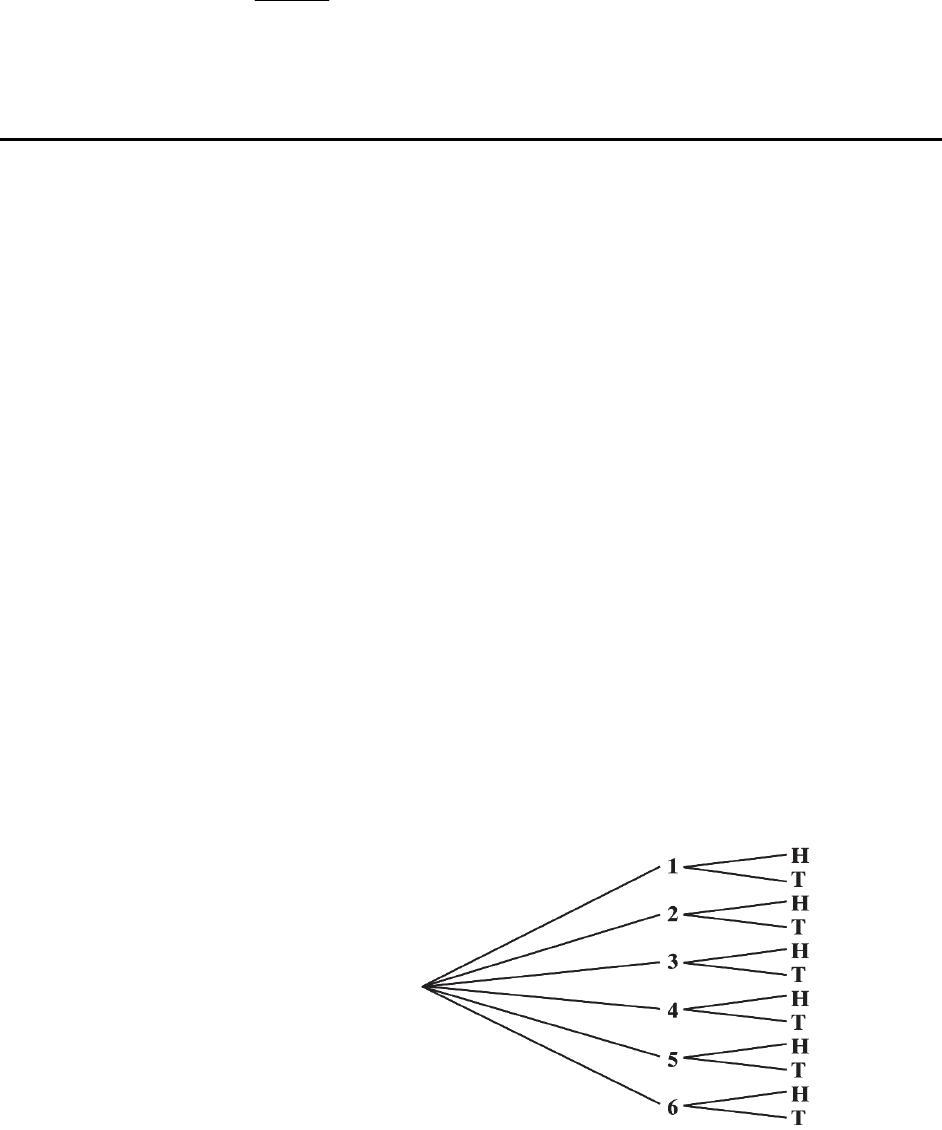
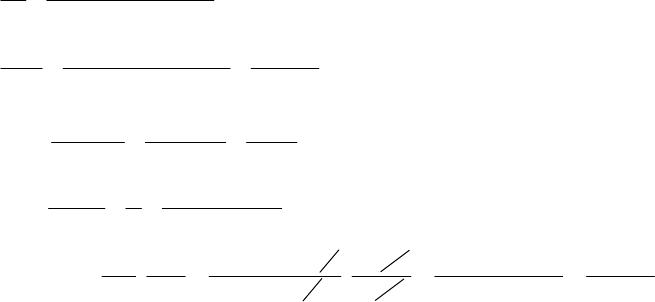
20. (A) We construct the tree diagram
at the right for the experiment:
Total combined outcomes = 12.
CHAPTER 7 REVIEW 7-19
(B) Operation 1: Six possible outcomes, 1, 2, 3, 4, 5, or 6; N1 = 6.
21. (A) n(A) = 30 + 35 = 65
22. (A) ()nA B= 35
23. (10 6) ! 4 ! 24 (7-4)
24. 15! (15 14 13 12 11)10! 360,360
(7-4)
25. 15! (15 14 13 12 11)10! 360,360 3, 003
(7-4)
26. 85
5!(8 5)! 5!3! 6
C
(7-4)
13! 13! 13 12 11 10 9!
13 12!
13 12 11 10 13 223,080 9, 295
29. Operation 1: First person can choose the seat in 6 different ways;
N1 = 6.
Operation 2: Second person can choose the seat in 5 different ways;

7-20 CHAPTER 7: LOGIC, SETS, AND COUNTING
30. This is a permutations problem. The permutations of 6 objects taken
(6 6)!= 6! = 720 (7-4)
31. p q p → q q → p (p → q) (q → p)
T T T T T
32. p q q → p p (q → p)
T T T T
33. p q ¬p ¬q p ¬p q ¬q (p ¬p) → (q ¬q)
T T F F T F F

34. p q ¬q p → q ¬q (p → q)
T T F T F
35. p q ¬p p → q ¬p → (p → q)
T T F T T
36. p q ¬q p ¬q ¬(p ¬q)
T T F T F
38. M K = {n Z | 103 < n < 106} is finite. (7-2)
40. E M = {n Z | n is even and n < 106} is infinite. (7-2)
42. M = {n Z | n < 106}, E′= {n Z | n is odd}
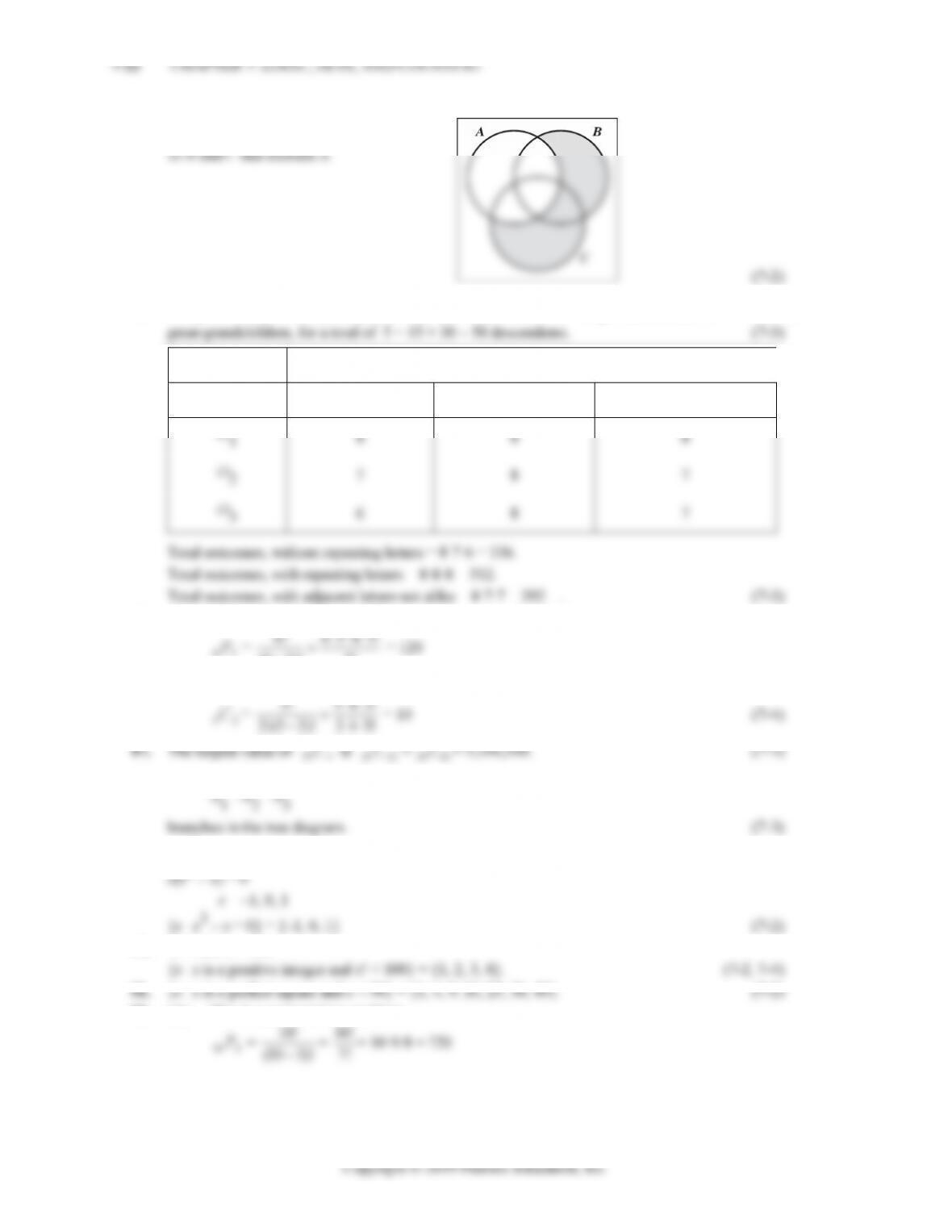
43. ()
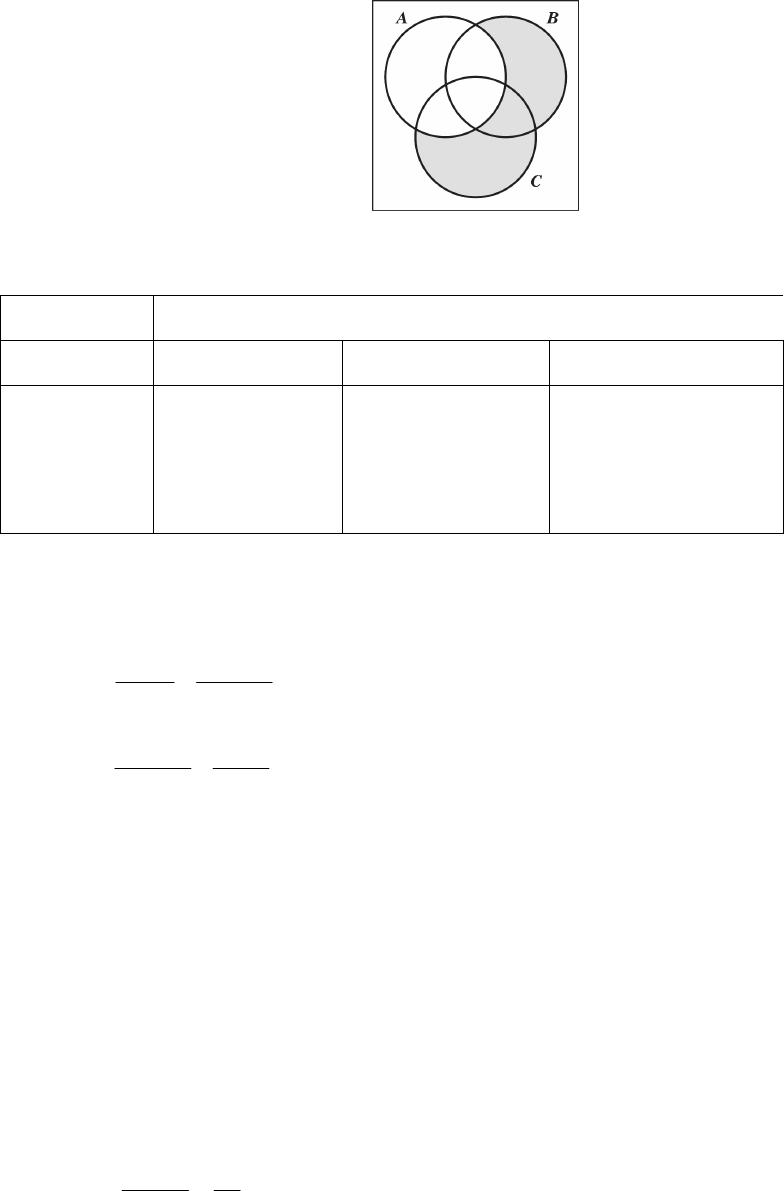
A
BC
are the regions in the union
44. Using the multiplication principle, the man has 5 children, 5 · 3 = 15 grandchildren, and 5 · 3 · 2 = 30
45. Number of ways of completing operation under condition:
Operation No letter repeated Letters can be repeated Adjacent letters not alike
46. (A) This is a permutations problem.
(6 3)! 3!
= 120
(B) This is a combinations problem.
48. By the multiplication principle, there are
49. x3 – x = 0
50. 4! = 24, 5! = 120
52. (A) This is a permutations problem.
CHAPTER 7 REVIEW 7-23
(B) The number of ways in which women are selected for all three positions is given by:
(C) This is a combinations problem.
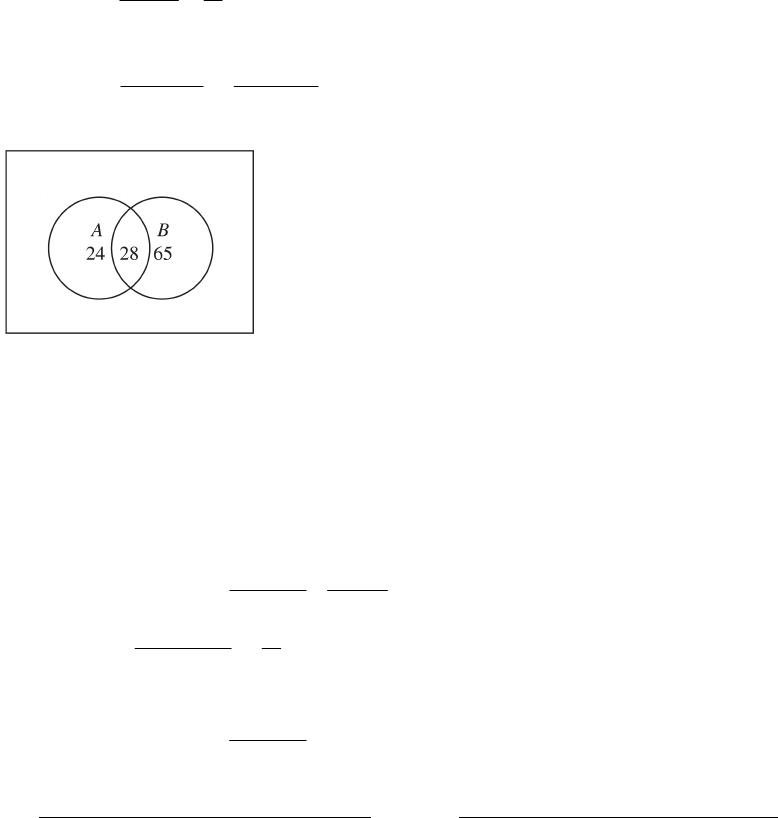
53. Draw a Venn diagram with: A = Chess players, B = Checker players.
Now, n(A B) = 28, n(A B‘) = n(A) – n(A B) = 52 – 28 = 24
54. x = 0; if A B, then there are no elements in A which are not in B. (7-3)
nn
57. False; 1nn
P = !
58. True; for 1 < r < n, !!
!( )!
nr
n
Cn
rn r
(7-4)
59. p q
p q 60. p q p → q
T T T T T T

61. p q ¬p q ¬q ¬p → (q ¬q)
T T F F T
62. p q p q ¬p ¬p → q 63. p q p → q p (p → q)
T T T F T T T T T
T F T F T T F F F
64. p q ¬q p ¬q ¬(p ¬q) p → q
T T F F T T
65. Operation 1: Two possible outcomes, boy or girl, N1 = 2.
Operation 2: Two possible outcomes, boy or girl, N2 = 2.
Operation 3: Two possible outcomes, boy or girl, N3 = 2.
66. nr
C = !
!( )!
n
rn r and nr
P = !
()!
n
nr;
67. The number of routes starting from A and visiting each of the 5 stores exactly once is the number of
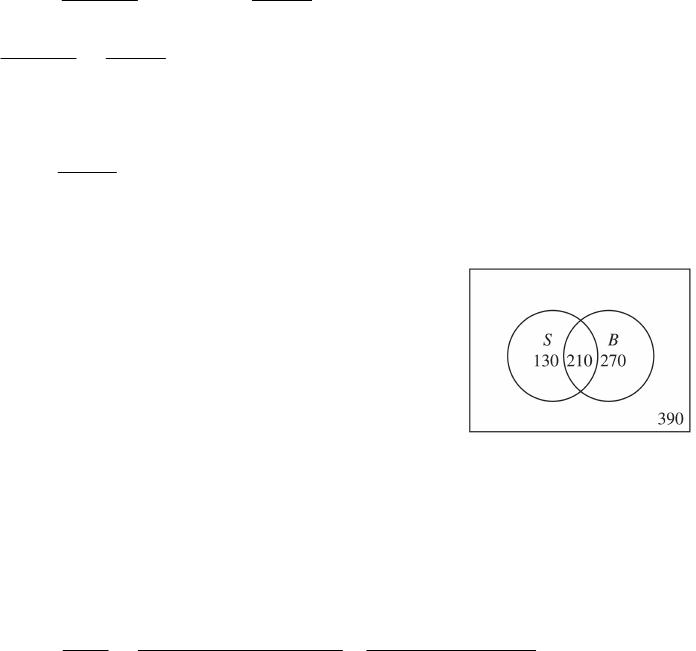
permutations of 5 objects taken 5 at a time, i.e.,
68. Draw a Venn diagram with:
S = people who have invested in stocks, and
B = people who have invested in bonds.
n(S B‘) = 340 – 210 = 130 n(B S‘) = 480 – 210 = 270
69. Since the order of selection does not matter, the number of ways to select 6 from 40 is
= 40 39 38 37 36 35
70. (A) The total number of ways that the 67 names can be ordered is