Chapter 7
International Arbitrage and Interest Rate Parity
Lecture Outline
International Arbitrage
Locational Arbitrage
Triangular Arbitrage
Covered Interest Arbitrage
Comparison of Arbitrage Effects
Interest Rate Parity
Derivation of Interest Rate Parity
Determining the Forward Premium
Graphic Analysis of Interest Rate Parity
How to Test Whether Interest Rate Parity Exists
Variation in Forward Rate Premiums
Forward Premiums Across Maturities
Changes in Forward Premiums Over Time
International Arbitrage and Interest Rate Parity ❖ 2
Chapter Theme
This chapter illustrates how three types of arbitrage (locational, triangular, and covered interest) are
executed. Emphasize that the key to arbitrage from an MNC’s perspective is not the potential profits, but
the relationships that should exist due to arbitrage. The linkage between covered interest arbitrage and
interest rate parity is critical.
Topics to Stimulate Class Discussion
1. Why are quoted spot rates very similar across all banks?
2. Why don’t arbitrage opportunities exist for long periods of time?
3. Present a scenario and ask whether any type of international arbitrage is possible. If so, how would it
be executed and how would market forces be affected?
4. Provide current interest rates of two countries and ask students to determine the forward rate that
would be expected according to interest rate parity.
POINT/COUNTER-POINT:
Does Arbitrage Destabilize Foreign Exchange Markets?
POINT: Yes. Large financial institutions have the technology to recognize when one participant in the
foreign exchange market is trying to sell a currency for a higher price than another participant. They also
recognize when the forward rate does not properly reflect the interest rate differential. They use arbitrage
to capitalize on these situations, which results in large foreign exchange transactions. In some cases, their
arbitrage involves taking large positions in a currency, and then reversing their positions a few minutes
later. This jumping in and out of currencies can cause abrupt price adjustments of currencies and may
create more volatility in the foreign exchange market. Regulations should be created that would force
financial institutions to maintain their currency positions for at least one month. This would result in a
more stable foreign exchange market.
COUNTER-POINT: No. When financial institutions engage in arbitrage, they create pressure on the
price of a currency that will remove any pricing discrepancy. If arbitrage did not occur, pricing
discrepancies would become more pronounced. Consequently, firms and individuals who use the foreign
exchange market would have to spend more time searching for the best exchange rate when trading a
currency. The market would become fragmented, and prices could differ substantially among banks in a
region, or among regions. If the discrepancies became large enough, firms and individuals might even
attempt to conduct arbitrage themselves. The arbitrage conducted by banks allows for a more integrated
foreign exchange market, which ensures that foreign exchange prices quoted by any institution are in line
with the market.
WHO IS CORRECT? Use the Internet to learn more about this issue. Which argument do you support?
Offer your own opinion on this issue.
International Arbitrage and Interest Rate Parity ❖ 3
Answers to End of Chapter Questions
1. Locational Arbitrage. Explain the concept of locational arbitrage and the scenario necessary for it to
be plausible.
2. Locational Arbitrage. Assume the following information:
Beal Bank Yardley Bank
Bid price of New Zealand dollar $.401 $.398
Ask price of New Zealand dollar $.404 $.400
Given this information, is locational arbitrage possible? If so, explain the steps involved in locational
arbitrage, and compute the profit from this arbitrage if you had $1,000,000 to use. What market forces
would occur to eliminate any further possibilities of locational arbitrage?
3. Triangular Arbitrage. Explain the concept of triangular arbitrage and the scenario necessary for it to
be plausible.
4. Triangular Arbitrage. Assume the following information:
Quoted Price
Value of Canadian dollar in U.S. dollars $.90
Value of New Zealand dollar in U.S. dollars $.30
Value of Canadian dollar in New Zealand dollars NZ$3.02
Given this information, is triangular arbitrage possible? If so, explain the steps that would reflect
triangular arbitrage, and compute the profit from this strategy if you had $1,000,000 to use. What
market forces would occur to eliminate any further possibilities of triangular arbitrage?
International Arbitrage and Interest Rate Parity ❖ 4
5. Covered Interest Arbitrage. Explain the concept of covered interest arbitrage and the scenario
necessary for it to be plausible.
6. Covered Interest Arbitrage. Assume the following information:
Quoted Price
Spot rate of Canadian dollar $.80
90-day forward rate of Canadian dollar $.79
90-day Canadian interest rate 4%
90-day U.S. interest rate 2.5%
Given this information, what would be the yield (percentage return) to a U.S. investor who used
covered interest arbitrage? (Assume the investor invests $1,000,000.) What market forces would
occur to eliminate any further possibilities of covered interest arbitrage?
ANSWER:
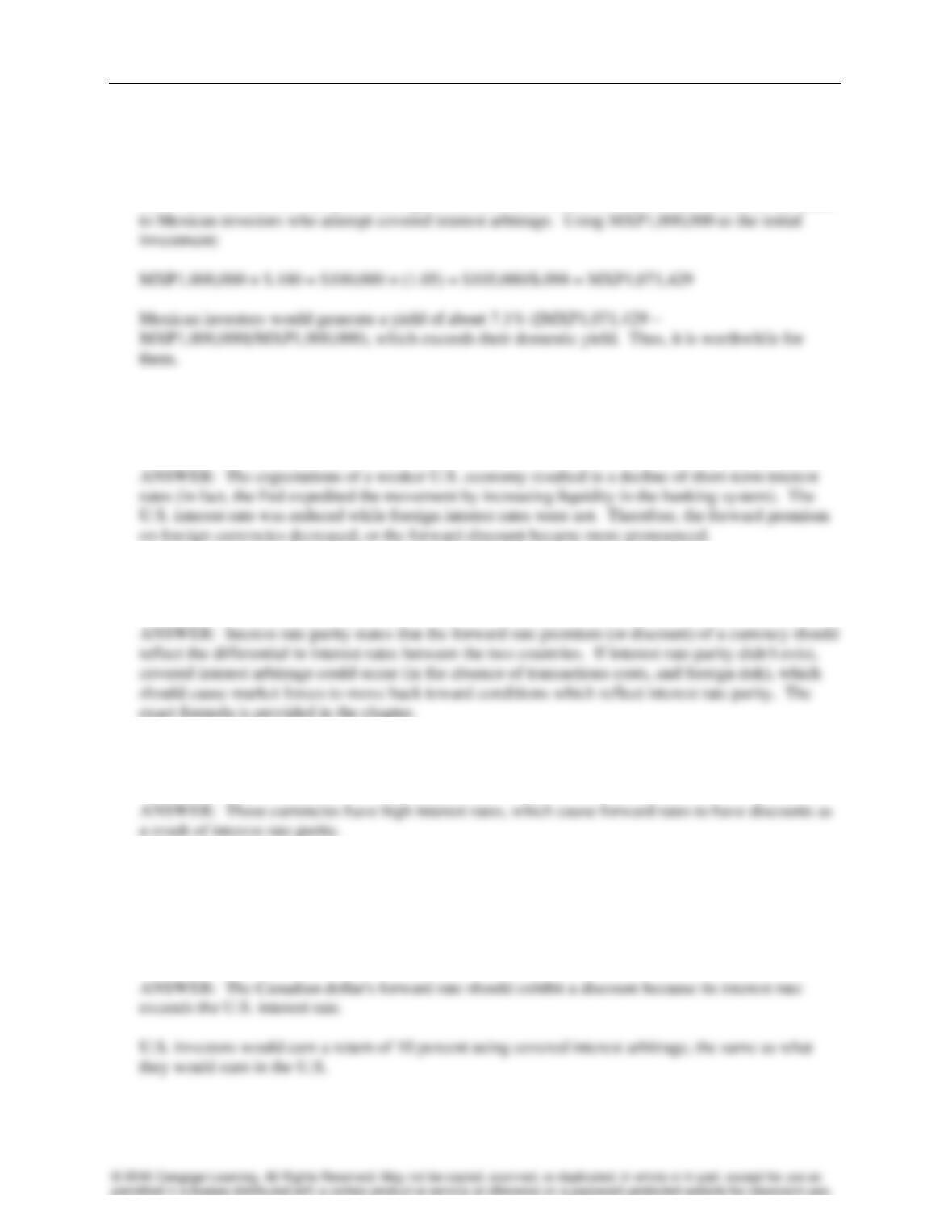
7. Covered Interest Arbitrage. Assume the following information:
Spot rate of Mexican peso = $.100
180-day forward rate of Mexican peso = $.098
180-day Mexican interest rate = 6%
180-day U.S. interest rate = 5%
International Arbitrage and Interest Rate Parity ❖ 5
Given this information, is covered interest arbitrage worthwhile for Mexican investors who have
pesos to invest? Explain your answer.
ANSWER: To answer this question, begin with an assumed amount of pesos and determine the yield
8. Effects of September 11. The terrorist attack on the U.S. on September 11, 2001 caused expectations
of a weaker U.S. economy. Explain how such expectations could have affected U.S. interest rates,
and therefore have affected the forward rate premium (or discount) on various foreign currencies.
9. Interest Rate Parity. Explain the concept of interest rate parity. Provide the rationale for its possible
existence.
10. Inflation Effects on the Forward Rate. Why do you think currencies of countries with high inflation
rates tend to have forward discounts?
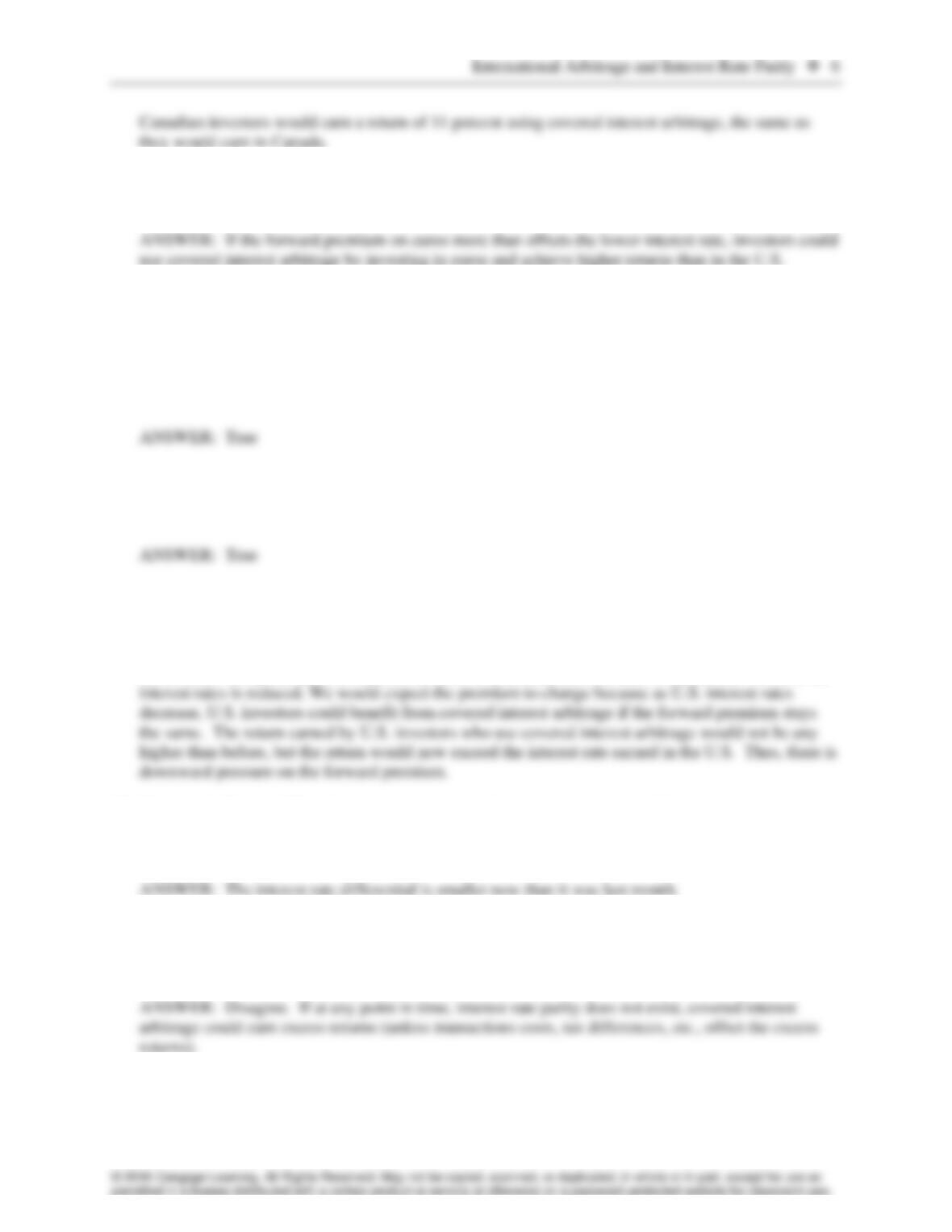
11. Covered Interest Arbitrage in Both Directions. Assume that the existing U.S. one-year interest rate
is 10 percent and the Canadian one-year interest rate is 11 percent. Also assume that interest rate
parity exists. Should the forward rate of the Canadian dollar exhibit a discount or a premium? If U.S.
investors attempt covered interest arbitrage, what will be their return? If Canadian investors attempt
covered interest arbitrage, what will be their return?
12. Interest Rate Parity. Why would U.S. investors consider covered interest arbitrage in France when
the interest rate on euros in France is lower than the U.S. interest rate?
13. Interest Rate Parity. Consider investors who invest in either U.S. or British one-year Treasury bills.
Assume zero transaction costs and no taxes.
a. If interest rate parity exists, then the return for U.S. investors who use covered interest arbitrage
will be the same as the return for U.S. investors who invest in U.S. Treasury bills. Is this
statement true or false? If false, correct the statement.
b. If interest rate parity exists, then the return for British investors who use covered interest arbitrage
will be the same as the return for British investors who invest in British Treasury bills. Is this
statement true or false? If false, correct the statement.
14. Changes in Forward Premiums. Assume that the Japanese yen’s forward rate currently exhibits a
premium of 6 percent and that interest rate parity exists. If U.S. interest rates decrease, how must this
premium change to maintain interest rate parity? Why might we expect the premium to change?
ANSWER: The premium will decrease in order to maintain IRP, because the difference between the
15. Changes in Forward Premiums. Assume that the forward rate premium of the euro was higher last
month than it is today. What does this imply about interest rate differentials between the United States
and Europe today compared to those last month?
16. Interest Rate Parity. If the relationship that is specified by interest rate parity does not exist at any
period but does exist on average, then covered interest arbitrage should not be considered by U.S.
firms. Do you agree or disagree with this statement? Explain.
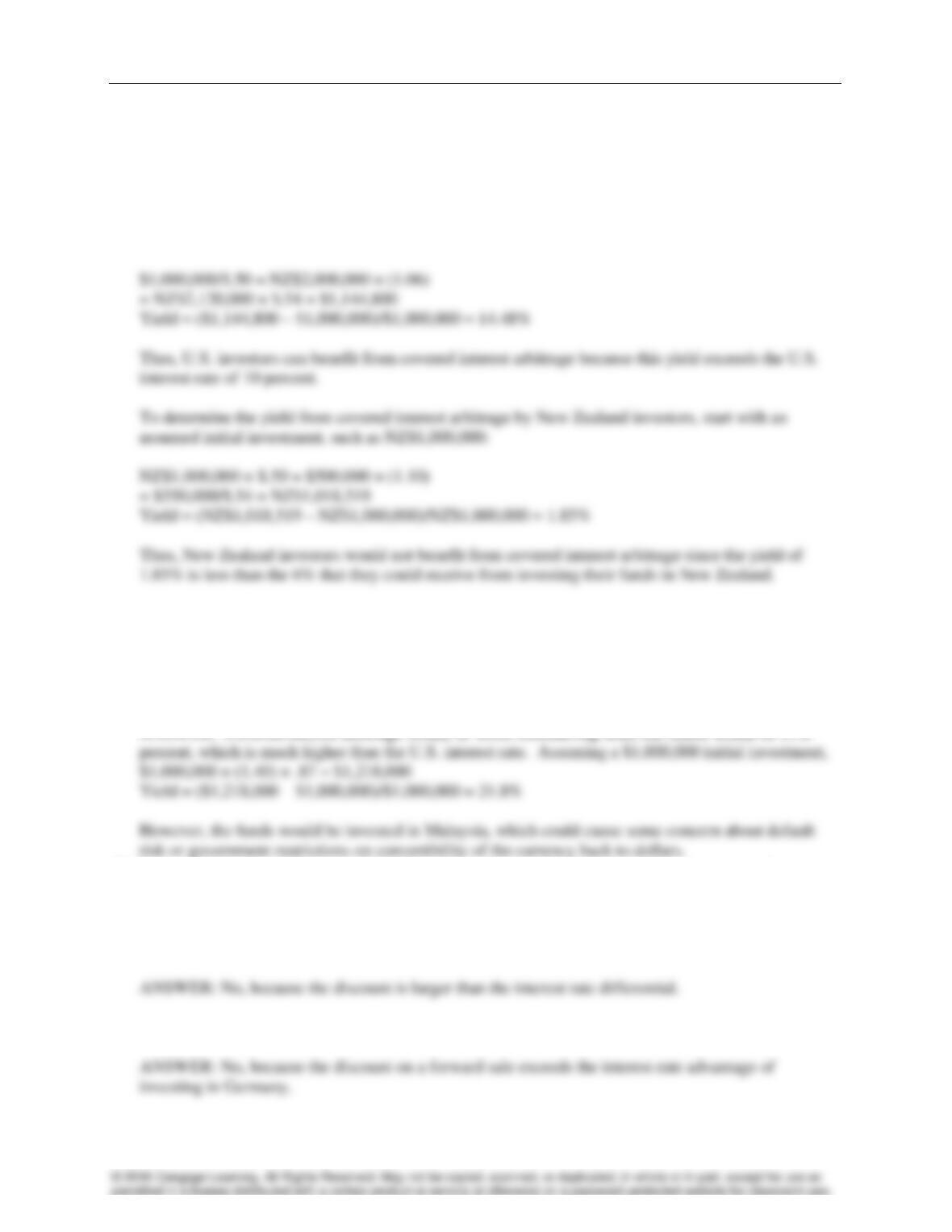
17. Covered Interest Arbitrage in Both Directions. The one-year interest rate in New Zealand is 6
percent. The one-year U.S. interest rate is 10 percent. The spot rate of the New Zealand dollar (NZ$)
International Arbitrage and Interest Rate Parity ❖ 7
is $.50. The forward rate of the New Zealand dollar is $.54. Is covered interest arbitrage feasible for
U.S. investors? Is it feasible for New Zealand investors? In each case, explain why covered interest
arbitrage is or is not feasible.
ANSWER:
To determine the yield from covered interest arbitrage by U.S. investors, start with an assumed initial
investment, such as $1,000,000.
18. Limitations of Covered Interest Arbitrage. Assume that the one-year U.S. interest rate is 11
percent, while the one-year interest rate in Malaysia is 40 percent. Assume that a U.S. bank is willing
to purchase the currency of that country from you one year from now at a discount of 13 percent.
Would covered interest arbitrage be worth considering? Is there any reason why you should not
attempt covered interest arbitrage in this situation? (Ignore tax effects.)
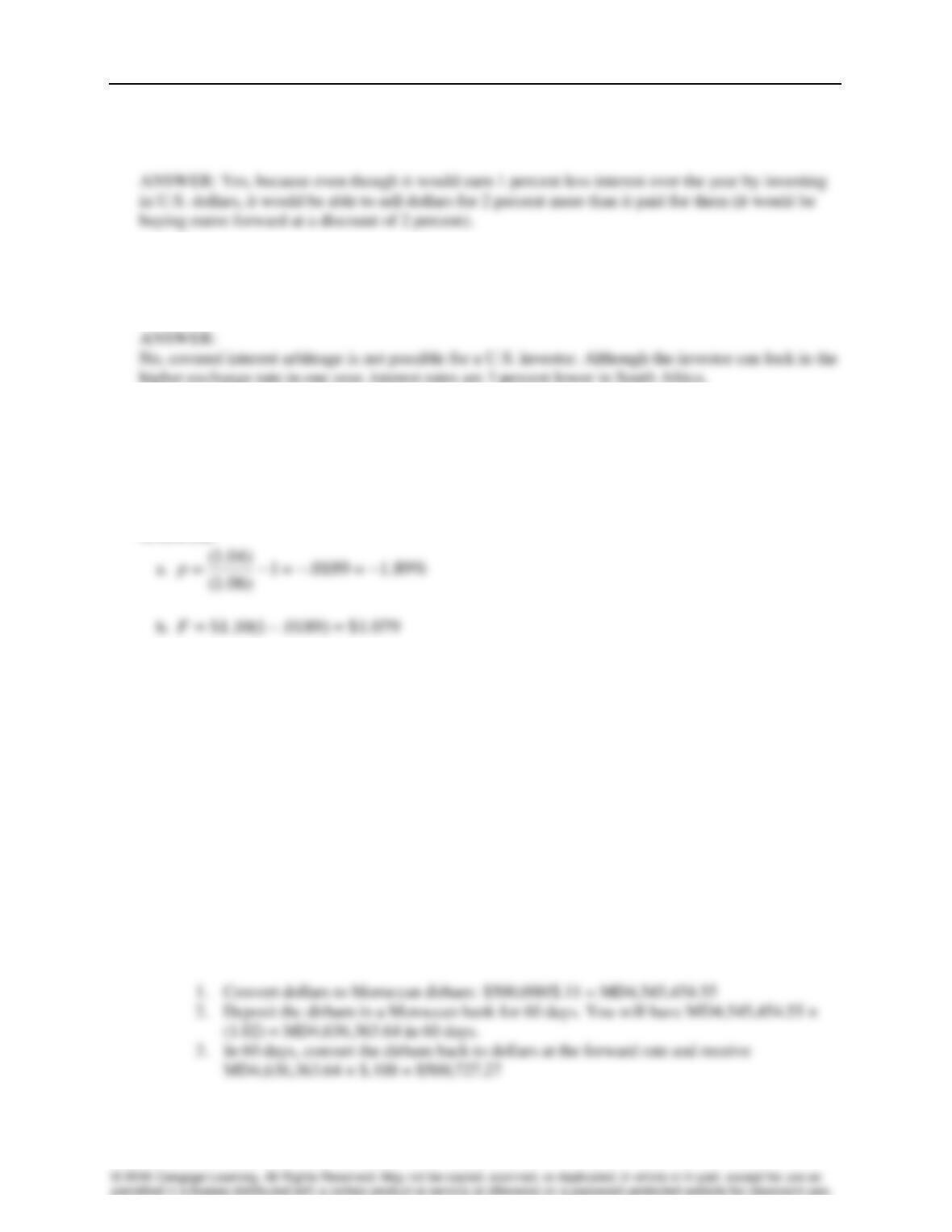
19. Covered Interest Arbitrage in Both Directions. Assume that the annual U.S. interest rate is
currently 8 percent and Germany’s annual interest rate is currently 9 percent. The euro’s one-year
forward rate currently exhibits a discount of 2 percent.
a. Does interest rate parity exist?
b. Can a U.S. firm benefit from investing funds in Germany using covered interest arbitrage?
International Arbitrage and Interest Rate Parity ❖ 8
c. Can a German subsidiary of a U.S. firm benefit by investing funds in the United States through
covered interest arbitrage?
20. Covered Interest Arbitrage. The South African rand has a one-year forward premium of 2 percent.
One-year interest rates in the U.S. are 3 percentage points higher than in South Africa. Based on this
information, is covered interest arbitrage possible for a U.S. investor if interest rate parity holds?
21. Deriving the Forward Rate. Assume that annual interest rates in the U.S. are 4 percent, while
interest rates in France are 6 percent.
a. According to IRP, what should the forward rate premium or discount of the euro be?
b. If the euro’s spot rate is $1.10, what should the one-year forward rate of the euro be?
ANSWER:
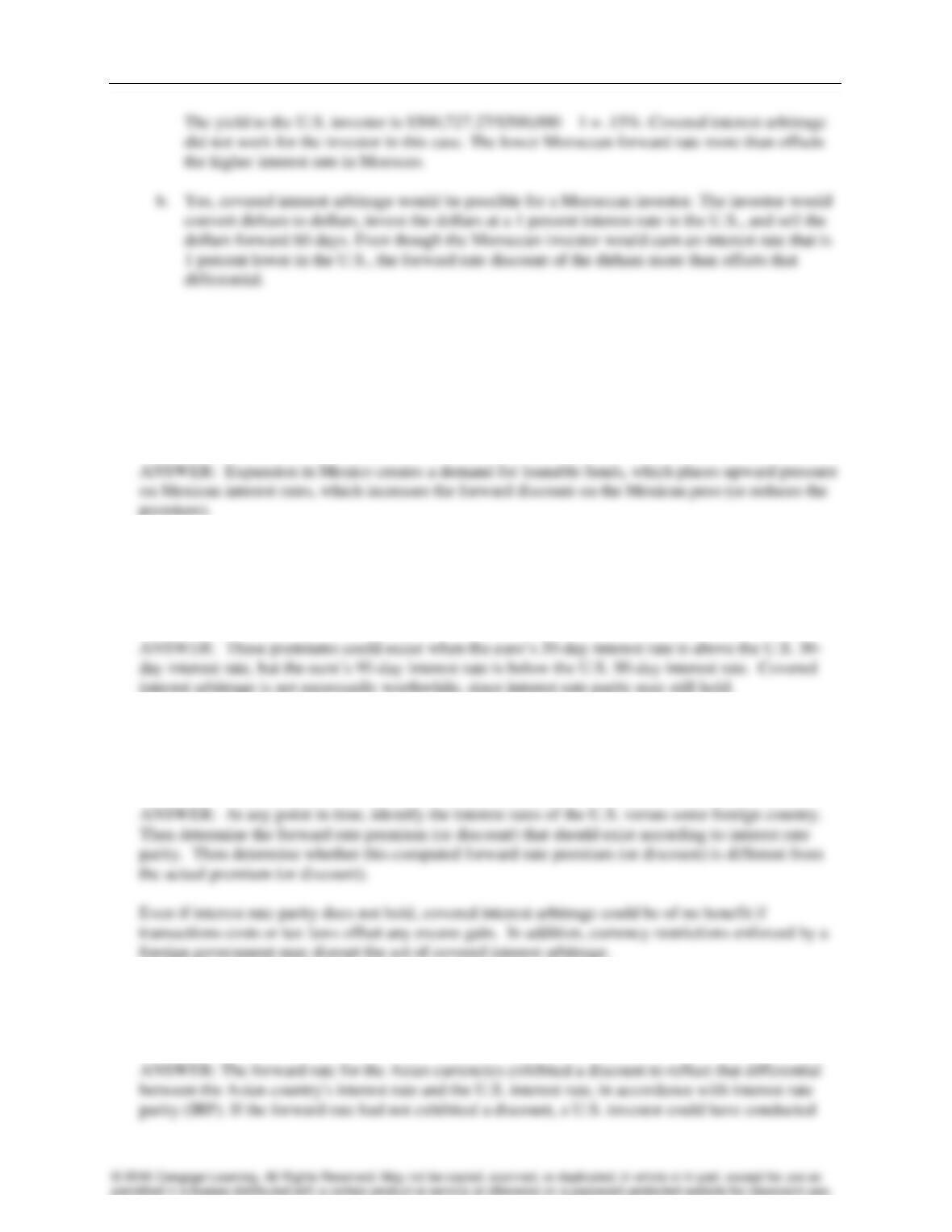
22. Covered Interest Arbitrage in Both Directions. The following information is available:
• You have $500,000 to invest
• The current spot rate of the Moroccan dirham is $.110.
• The 60-day forward rate of the Moroccan dirham is $.108.
• The 60-day interest rate in the U.S. is 1 percent.
• The 60-day interest rate in Morocco is 2 percent.
a. What is the yield to a U.S. investor who conducts covered interest arbitrage? Did covered
interest arbitrage work for the investor in this case?
b. Would covered interest arbitrage be possible for a Moroccan investor in this case?
ANSWER:
a. Covered interest arbitrage would involve the following steps:
International Arbitrage and Interest Rate Parity ❖ 9
Advanced Questions
23. Economic Effects on the Forward Rate. Assume that Mexico’s economy has expanded
significantly, causing a high demand for loanable funds there by local firms. How might these
conditions affect the forward discount of the Mexican peso?
24. Differences among Forward Rates. Assume that the 30-day forward premium of the euro is -1
percent, while the 90-day forward premium of the euro is 2 percent. Explain the likely interest rate
conditions that would cause these premiums. Does this ensure that covered interest arbitrage is
worthwhile?
25. Testing Interest Rate Parity. Describe a method for testing whether interest rate parity exists. Why
are transactions costs, currency restrictions, and differential tax laws important when evaluating
whether covered interest arbitrage can be beneficial?
26. Deriving the Forward Rate. Before the Asian crisis began, Asian central banks were maintaining a
somewhat stable value for their respective currencies. Nevertheless, the forward rate of Southeast
Asian currencies exhibited a discount. Explain.
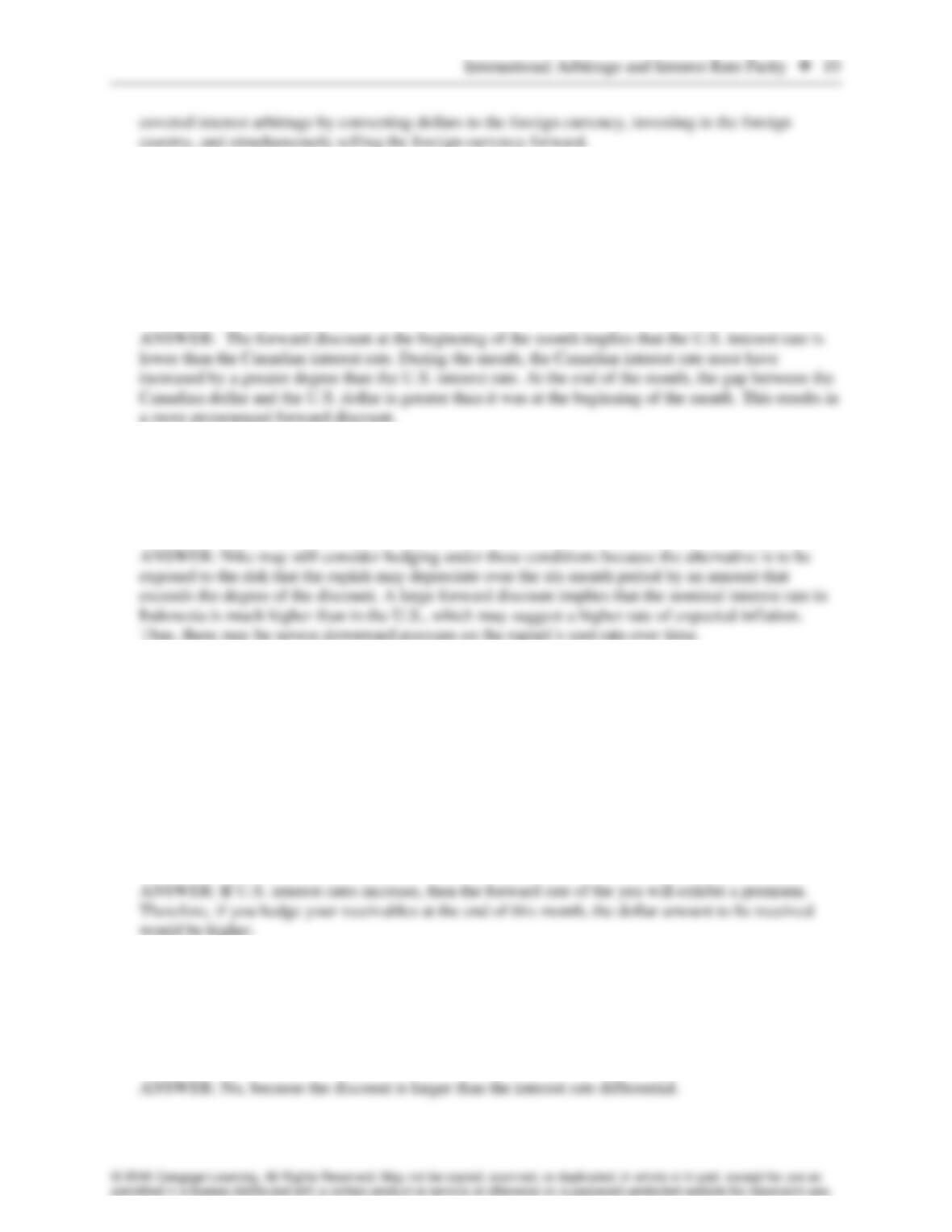
27. Interpreting Changes in the Forward Premium. Assume that interest rate parity holds. At the
beginning of the month, the spot rate of the Canadian dollar is $.70, while the one-year forward rate is
$.68. Assume that U.S. interest rates increase steadily over the month. At the end of the month, the
one-year forward rate is higher than it was at the beginning of the month. Yet, the one-year forward
discount is larger (the one-year premium is more negative) at the end of the month than it was at the
beginning of the month. Explain how the relationship between the U.S. interest rate and the Canadian
interest rate changed from the beginning of the month until the end of the month.
28. Interpreting a Large Forward Discount. The interest rate in Indonesia is commonly higher than the
interest rate in the U.S., which reflects a higher expected rate of inflation there. Why should Nike
consider hedging its future remittances from Indonesia to the U.S. parent even when the forward
discount on the currency (rupiah) is so large?
29. Change in the Forward Premium. At the end of this month, you (owner of a U.S. firm) are meeting
with a Japanese firm to which you will try to sell supplies. If you receive an order from that firm,
you will obtain a forward contract to hedge the future receivables in yen. As of this morning, the
forward rate of the yen and spot rate are the same. You believe that interest rate parity holds.
This afternoon, news occurs that makes you believe that the U.S. interest rates will increase
substantially by the end of this month, and that the Japanese interest rate will not change. However,
your expectations of the spot rate of the Japanese yen are not affected at all in the future. How will
your expected dollar amount of receivables from the Japanese transaction be affected (if at all) by the
news that occurred this afternoon? Explain.
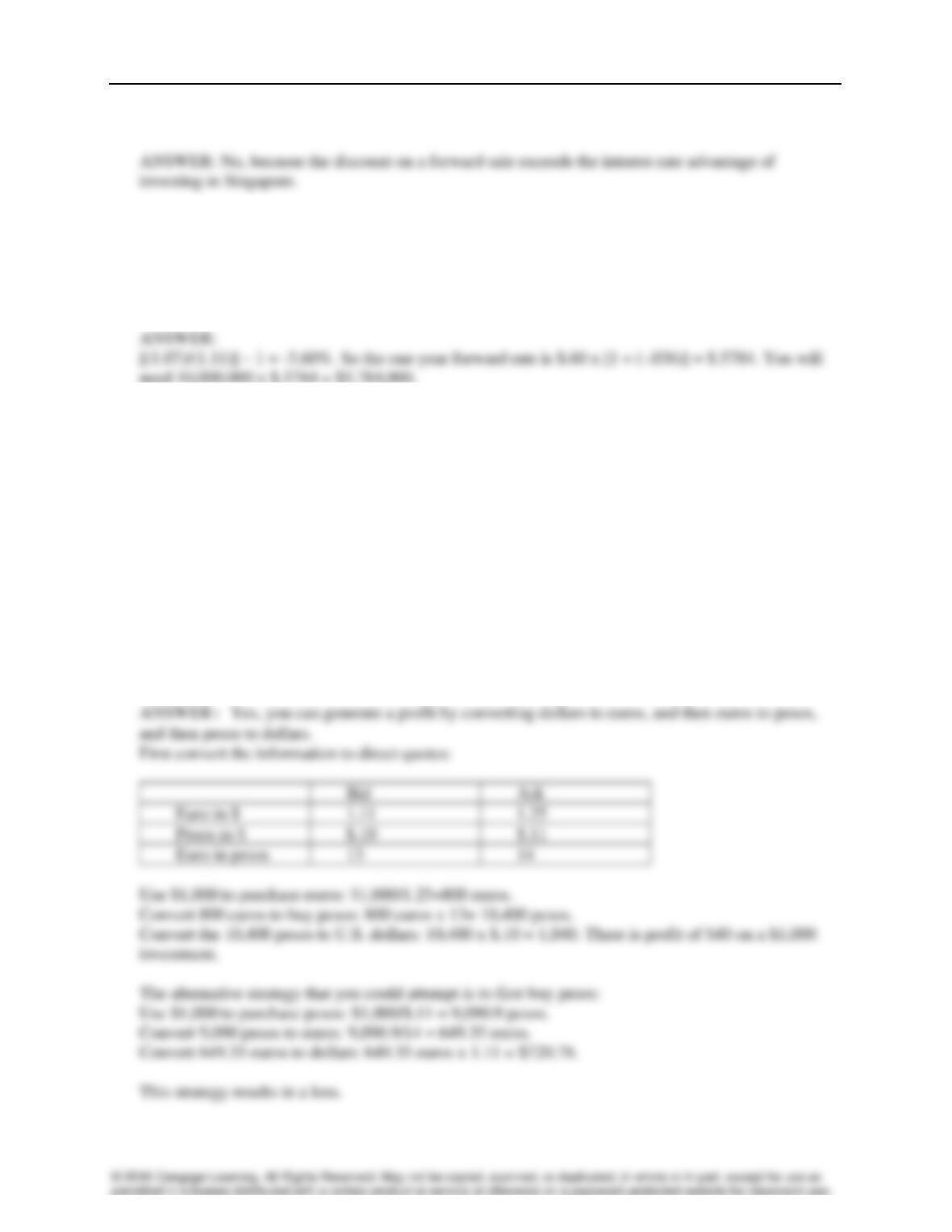
30. Testing IRP. The one-year interest rate in Singapore is 11 percent. The one-year interest rate in the
U.S. is 6 percent. The spot rate of the Singapore dollar (S$) is $.50 and the forward rate of the S$ is
$.46. Assume zero transactions costs.
a. Does interest rate parity exist?
International Arbitrage and Interest Rate Parity ❖ 11
b. Can a U.S. firm benefit from investing funds in Singapore using covered interest arbitrage?
31. Implications of IRP. Assume that interest rate parity exists. You expect that the one-year nominal
interest rate in the U.S. is 7%, while the one-year nominal interest rate in Australia is 11%. The spot
rate of the Australian dollar is $.60. You will need 10 million Australian dollars in one year. Today,
you purchase a one-year forward contract in Australian dollars. How many U.S. dollars will you need
in one year to fulfill your forward contract?
32. Triangular Arbitrage. You go to a bank and are given these quotes:
You can buy a euro for 14 pesos.
The bank will pay you 13 pesos for a euro.
You can buy a U.S. dollar for .9 euros.
The bank will pay you .8 Euros for a U.S. dollar.
You can buy a U.S. dollar for 10 pesos.
The bank will pay you 9 pesos for a U.S. dollar.
You have $1,000. Can you use triangular arbitrage to generate a profit? If so, explain the order of the
transactions that you would execute, and the profit that you would earn. If you can not earn a profit
from triangular arbitrage, explain why.
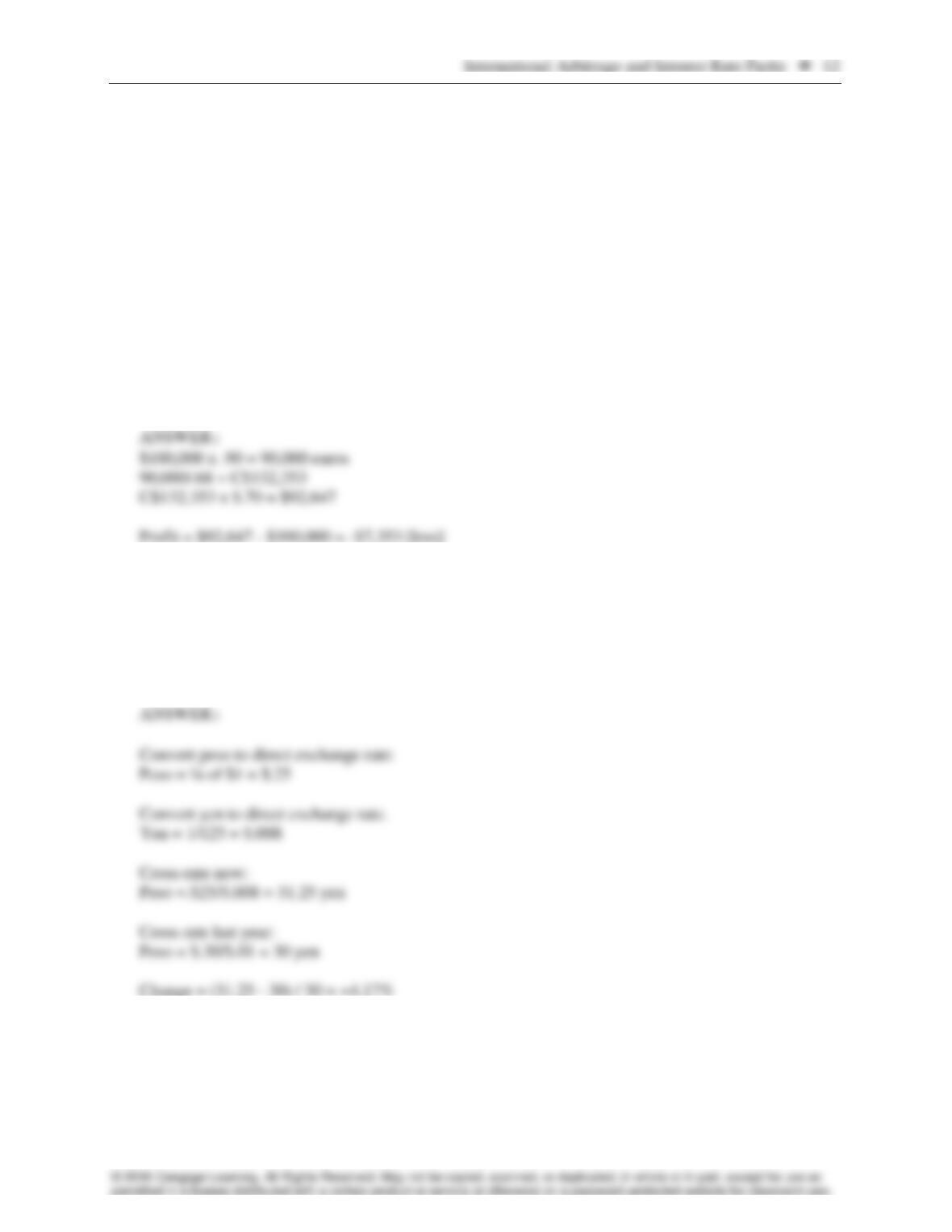
33. Triangular Arbitrage. You are given these quotes by the bank:
You can sell Canadian dollars (C$) to the bank for $.70.
You can buy Canadian dollars from the bank for $.73.
The bank is willing to buy dollars for 0.9 euros per dollar.
The bank is willing to sell dollars for 0.94 euros per dollar. .
The bank is willing to buy Canadian dollars for 0.64 euros per C$.
The bank is willing to sell Canadian dollars for 0.68 euros per C$.
You have $100,000. Estimate your profit or loss if you would attempt triangular arbitrage by
converting your dollars to euros, and then convert euros to Canadian dollars and then convert
Canadian dollars to U.S. dollars.
34. Movement in Cross Exchange Rates. Assume that cross exchange rates are always proper such
that triangular arbitrage is not feasible. While at the Miami airport today, you notice that a U.S. dollar
can be exchanged for 125 Japanese yen, or 4 Argentine pesos at the foreign exchange booth. Last
year, the Japanese yen was valued at $0.01, and the Argentine peso was valued at $.30. Based on this
information, the Argentine peso has changed by what percent against the Japanese yen over the last
year?
35. Impact of Arbitrage on the Forward Rate. Assume that the annual U.S. interest rate is currently
6 percent and Germany’s annual interest rate is currently 8 percent. The spot rate of the euro is $1.10
and the one-year forward rate of the euro is $1.10. Assume that as covered interest arbitrage occurs,
the interest rates are not affected, and the spot rate is not affected. Explain how the one-year forward
rate of the euro will change in order to restore interest rate parity, and why it will change Your