
Chapter 7 – Instructor Reserve Problem Solutions
1. Management at Cirquelectra Corp. is concerned about the amount of scrap being
generated in making an integrated circuit board. The specification was 0.675 ± 0.09 volts
A team was formed to find the root cause of scrap, and they succeeded in finding a way
to reduce the scrap cost to $12.15 per part.
a. What is the Taguchi loss function for this project?
b. What is the Taguchi loss function if the process deviation from target can be reduced
from its current level to 0.05 volts?
Answer
The Taguchi Loss Function is: L(x) = k (x – T)2
a) $12.15 = k (0.09)2
b) L(x) = 1500 (x – T)2
2. A specification for the voltage applied to an integrated circuit made by Cirquelectra Corp.
is 1.50 ± 0.08 volts. It costs $6.40 to scrap the circuit if is outside the specifications.
Determine the Taguchi loss function for this situation.
Answer
The Taguchi Loss Function for an integrated circuit made by Cirquelectra Corp. is:
L(x) = k (x – T)2
3. The weight of a small bag of garden fertilizer at Pescaflora, Inc. is 5.0 ± 0.04 pounds
(lbs.). It costs $0.80 to repackage a bag of fertilizer that is outside the specifications.
Determine the Taguchi loss function for this situation.

Answer
The Taguchi Loss Function is: L(x) = k (x – T)2
4. Durarctic, Inc., produces special freezers used for laboratory experiments. They must be
capable of holding termperatures of -100 ± 0.06 degrees C. Exceeding the limits results in
an estimated loss of $60. Determine the Taguchi loss function.
Answer
The Taguchi Loss Function is: L(x) = k (x – T)2
L(x) = k (x – T)2 = 16667 (x – T)2
5. An electronic component at Oomworks has a specification of 150 ± 0.8 ohms. Scrapping
the component results in a $128 loss.
a. What is the value of k in the Taguchi loss function?
b. If the process is centered on the target specification with a standard deviation of 0.3
ohm, what is the expected loss per unit?
Answer
For Oomworks’ specification of 150 ± 0.8 ohms:
a) L(x) = k (x – T)2
6. A unit filling line at Microfarmosutica, Inc., must fill of 2.5 ± 0.2 ml of eyedrop solution
into each container. It costs $1.10 to scrap a defective unit. A sample of 50 containers
was drawn from the production process, which has been determined to be approximately
normally distributed, and the results, in milliliters can be found in worksheet tab Prob.7-
12 in the Excel file C07Data file on the Student Companion website for this chapter.
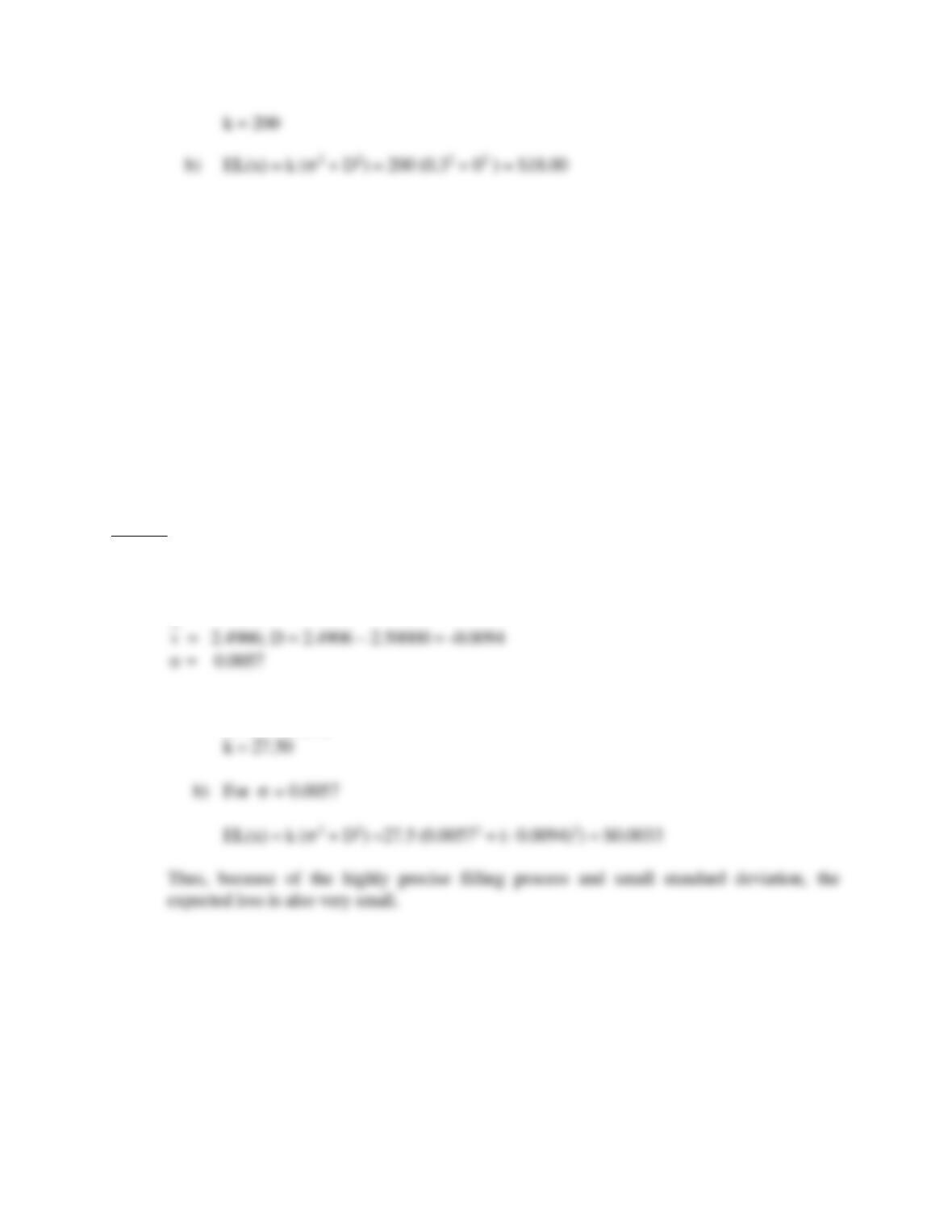
a. What is the value of k in the Taguchi loss function?
b. Determine how much the process varies from the target specification, based on the
mean difference and standard deviation of the sample results. What is the expected loss
per unit?
Answer
For a specification of 2.5 ± 0.2 grams and a $1.10 scrap cost:
Analysis of the dataset for problem 7-12 provides the following statistics:
a) L(x) = k (x – T)2
$1.10 = k (0.2)2
7. The specification for the distance between nozzles on the burner of a high-efficiency
furnace produced by Heetjet Enterprises is 15.00 ± 0.025 mm. The loss due to a defective
burner unit is $40. A sample of 30 burners was drawn from the production process and
the results, in millimeters, can be found in the worksheet tab Prob7-07 in the Excel file
C07DataRsv,xlsx file.
a. Compute the value of k in the Taguchi loss function.
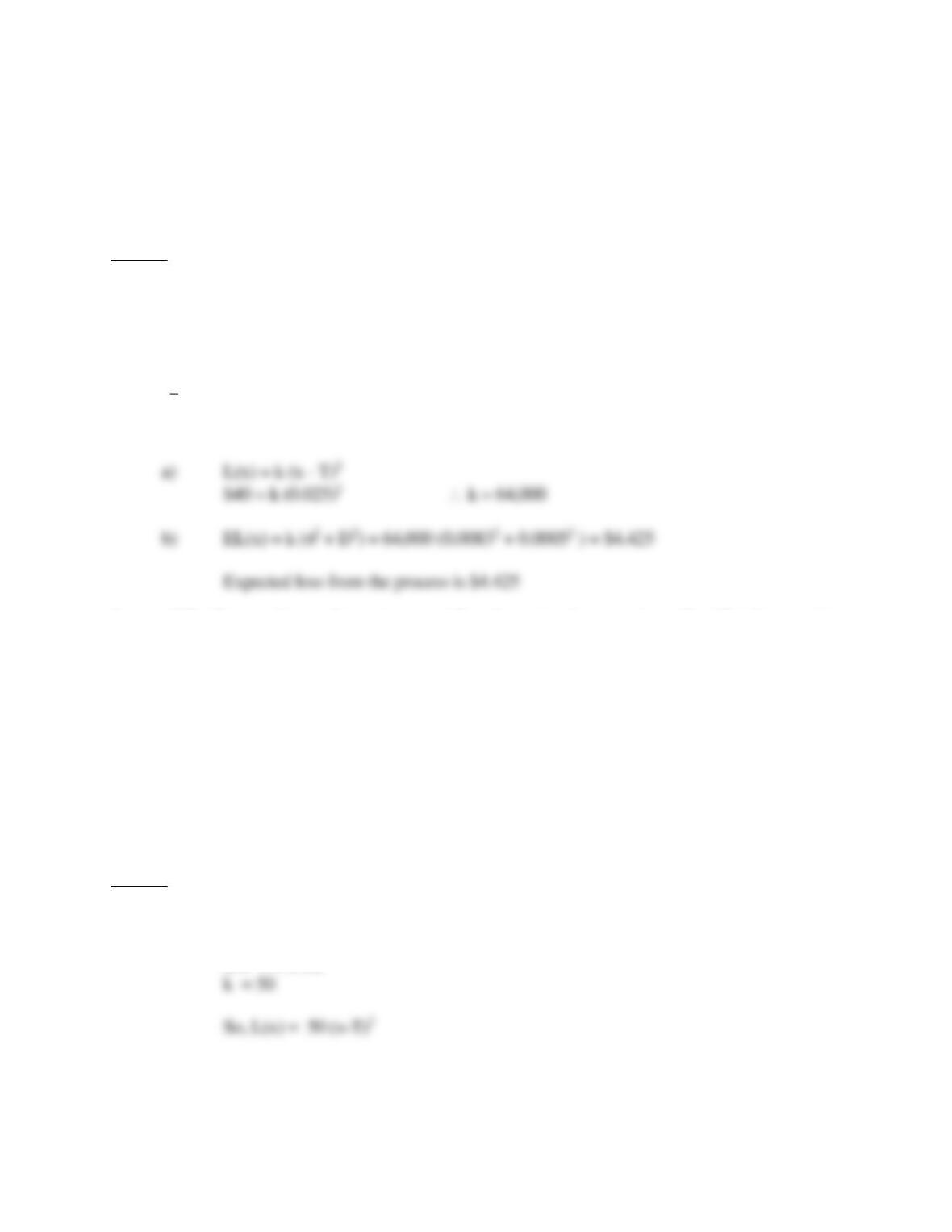
b. What is the expected loss from this process based on the sample data?
Answer
For a specification of 15.000 ± .025 mm and a $40 scrap cost:
Analysis of the dataset (see spreadsheet C7-07InsRsv.xlsx for details) provides the
following statistics:
x
= 15.0005; D = 15.0005 – 15.000 = 0.0005
= 0.0082
8. MikroPower, Inc. makes power supplies for network computers. Specification require
that it draw no more than 100 ± 1.0 watts at peak use. Exceeding these limits results in an
estimated loss of $50. However, the manufacturer can still adjust the wattage in the plant
by changing the circuit at a cost of $4.00.
a. Determine the Taguchi loss function.
b. Suppose the nominal specification remains at 100 watts. At what tolerance should the
integrated circuit be manufactured, assuming that the amount of loss is represented by the
cost of the circuit adjustment?
Answer
a) The Taguchi Loss function is: L(x) = k (x – T) 2
$50 = k (1.0)2
b) The Taguchi Loss function is: L(x) = k (x – T) 2
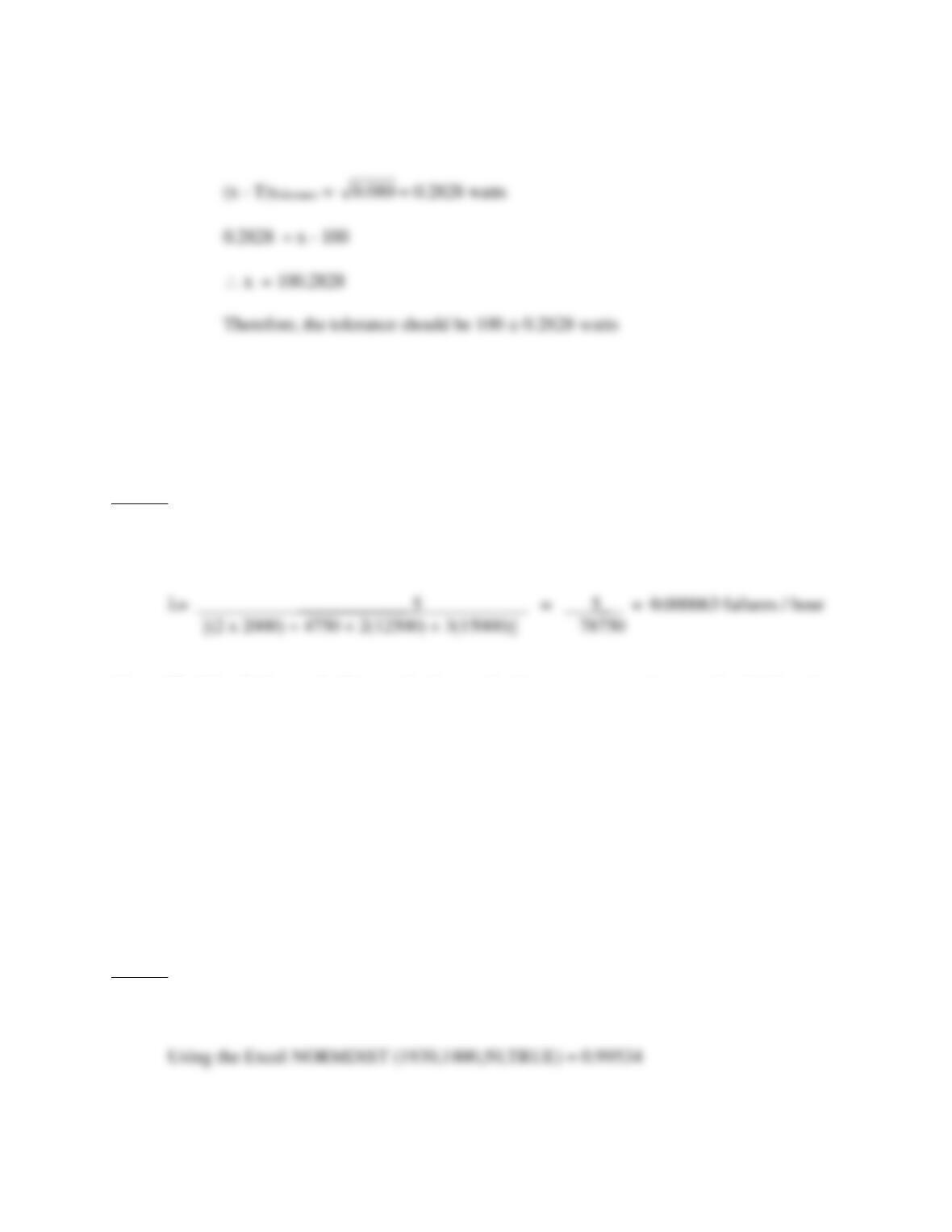
$4.00 = 50 (x-100)2
0.080 = (x – 100)2
9. SirkeTest tested eight microcircuits used for heavy duty use in commercial two-way
radio transceivers in a 15,000-hour test. Compute the failure rate if two failed after 2000,
one after 4750, two after 12,500 hours and the other three ran for the full 15,000 hours
each.
Answer
SirkeTest’s circuits have a failure rate of:
10. The life of a Lapstrake Battery Co. battery for laptop computers is normally distributed
with a mean of 1,800 days and standard deviation of 50 days. Using the Excel functions
(see Chapter 6), determine the following:
a. What fraction of batteries is expected to survive beyond 1930 days?
b. What fraction will survive fewer than 1725 days?
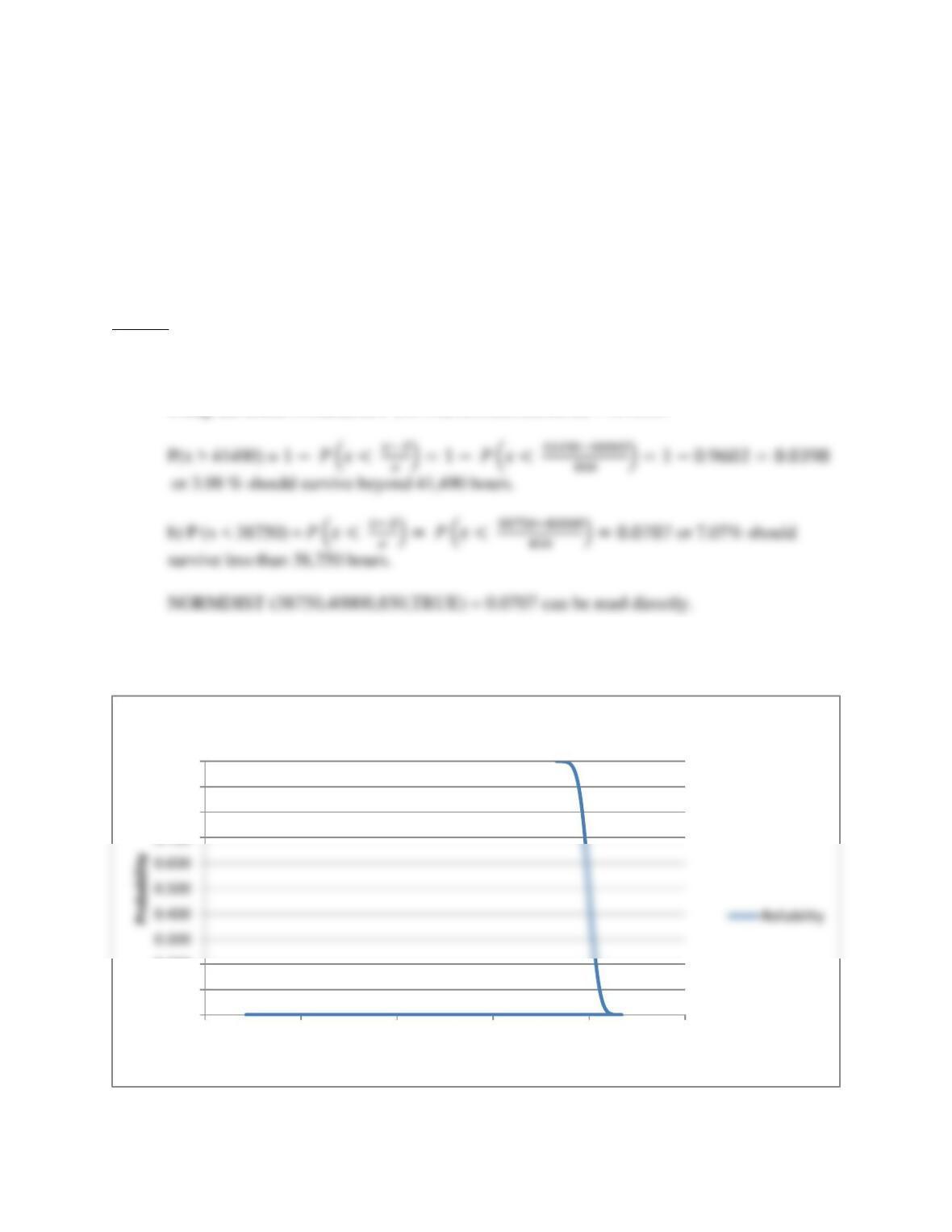
c. Draw a chart of the reliability function using Excel.
d. What length of warranty is needed so that no more than 5 percent of the batteries will
be expected to fail during the warranty period?
Answer
a) P(x > 1930) = 1 – P(x < 1930)
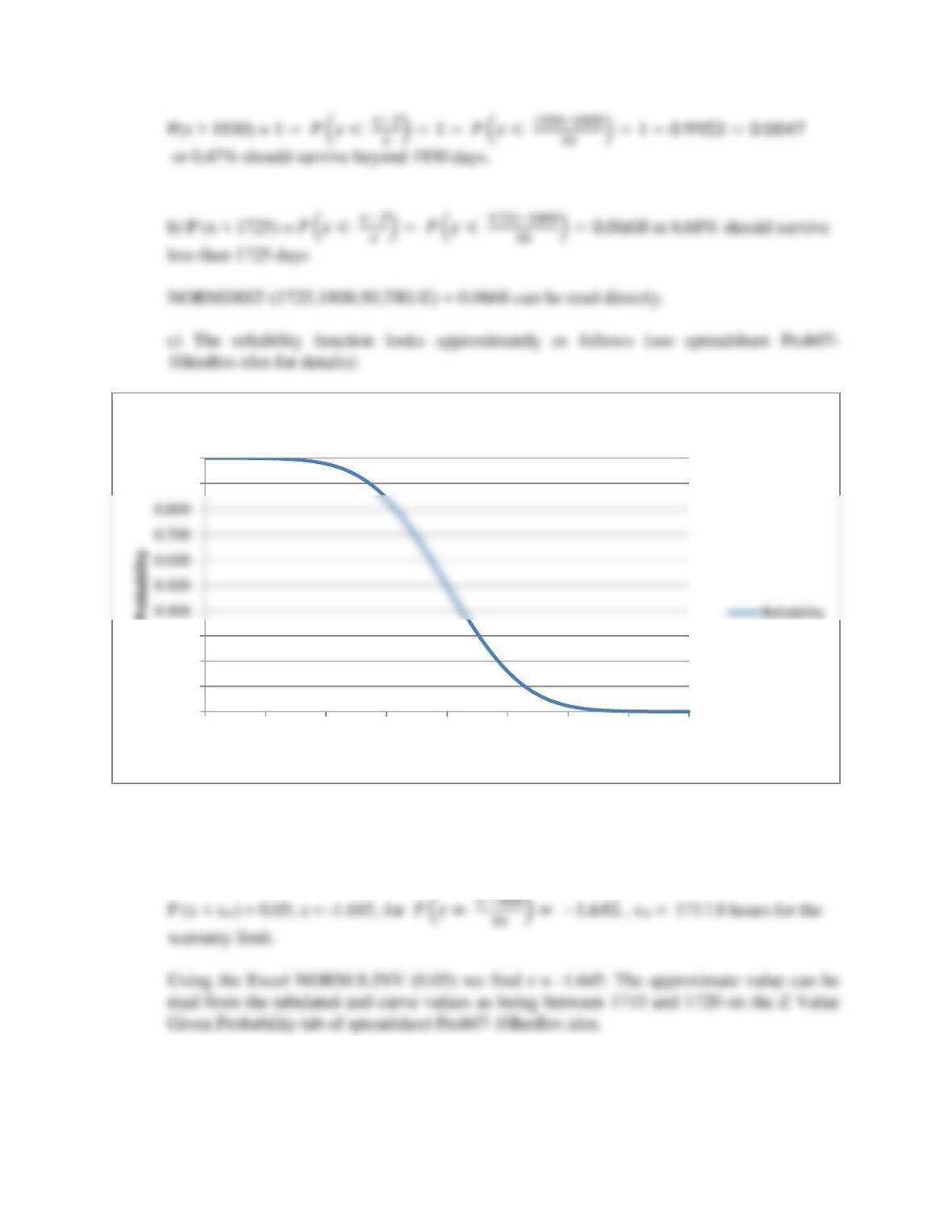
c) Let xw be the limit of the warranty period.
11. Airponents, Inc. monitors an important part that is essential to safe operation of the
engines on airplanes. The part has a mean life of 40,000 operating hours with a standard
0.000
0.100
0.200
0.300
0.900
1.000
1600 1650 1700 1750 1800 1850 1900 1950 2000
Probability
Battery Life – Hours
Reliability Curve
deviation of 850 hours. Using Excel functions (see Chapter 6), determine the following:
a. What fraction of the parts are expected to survive beyond 41,490 hours?
b. What fraction will survive fewer than 38,750 hours?
c. Draw a chart of the reliability function using Excel.
d. What length of warranty is needed so that no more than 3 percent of the parts will be
expected to fail during the warranty period?
Answer
a) P(x > 41490) = 1 – P(x < 41490)
Using the Excel NORMDIST (41490,40000,850,TRUE) = 0.96019
c) The reliability function looks approximately as follows (see spreadsheet Prob07-
11InsRsv.xlsx for details):
0.000
0.100
0.200
0.700
0.800
0.900
1.000
0 10000 20000 30000 40000 50000
Part Life – Hours
Reliability Curve

d) Let xw be the limit of the warranty period.
P (x < xw) = 0.03; z = -1.88, for 𝑃(𝑧 = 𝑥−40000
850 ) = −1.88 , xw = 38402 hours for the
warranty limit.
Using the Excel NORM.S.INV (0.03) we find z = -1.88. The approximate value can be
read from the tabulated and curve values as being between 38,385 and 38,480 on the Z
Value Given Probability tab of spreadsheet Prob07-11InsRsv.xlsx. Thus, if the warranty
limit is set at 38402 hours, less than 3% of the parts will fail before that number of hours is
reached.
12. Flatplane, Inc. makes wide screen flat panel TV’s which have a failure rate of 0.000072
units per hour. What is the reliability function? Assuming an exponential distribution,
what is the probability of failure within 8,000 hours? Calculate your answer using the
appropriate mathematical formula and verify your result using Excel.
Answer
The reliability function for Livelong, Inc.’s monitors is R(T) = 1 – F(T) = e–T
13. A smartphone component made by Sabiophono, Ltd. has a failure rate of = .00005. Find
the mean time to failure (MTTF). What is the probability (assuming an exponential
probability distribution) that the component will not have failed after 7,500 hours of
operation? Calculate your answer using the appropriate mathematical formula and verify
your result using Excel.
Answer
The MTTF for the component is 𝜃 = 1
𝜆= 1
0.00005; so, = 20000
14. The MTBF of an integrated circuit made by InteCirques, Inc.is 11,500 hours. Calculate
the failure rate
Answer
The failure rate () for InteCirques, Inc. integrated circuits is: = 1
15. Reelrad Co. manufacturer of satellite radios purchases electronic components as modules.
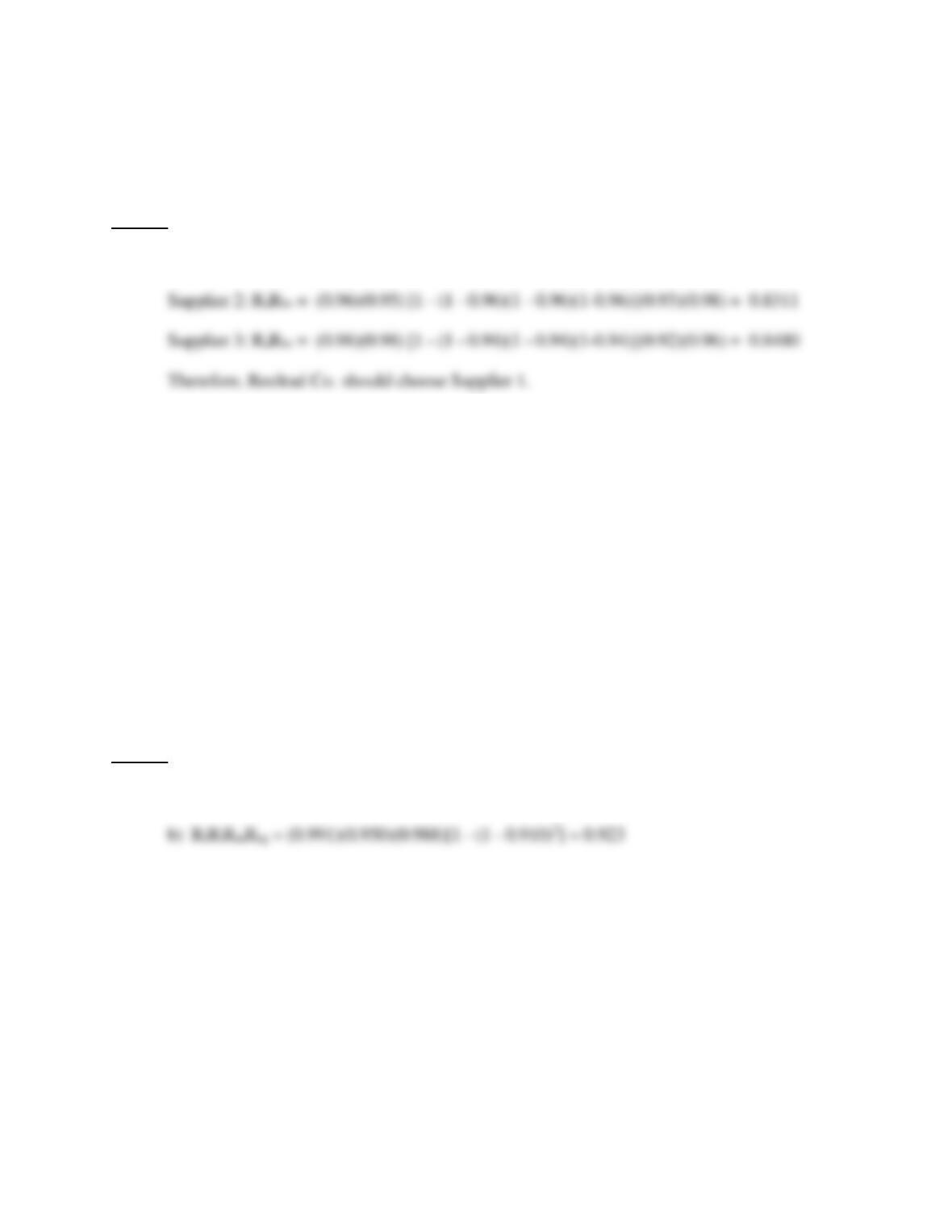
The reliabilities of components differ by supplier (see diagram, below). Suppose that the
configuration of the components is given by:
Note that one very critical component has two modules as “backup” in parallel with the
main unit. The components can be purchased from three different suppliers. The
reliabilities of the components are as follows:
Component Supplier 1 Supplier 2 Supplier 3
A 0.95 0.96 0.98
B 0.97 0.95 0.98
C 0.93 0.96 0.94
D 0.99 0.93 0.92
E 0.99 0.98 0.96
Transportation and purchasing considerations require that only one supplier be chosen.
Which one should be selected if the radio is to have the highest possible reliability?
Answer
Supplier 1: RaRbc = (0.95)(0.97) [1 – (1 – 0.93)(1 – 0.93)(1-0.93)](0.99)(0.99) = 0.9029
16. A production system at Prodocustom, Inc. is used to make one-of-a-kind custom bicycles
for professional cyclists. The system consists of four operations: turning, drilling and
milling, and grinding. Individual parts are transferred from one work center to the next.
Hence, if one machine goes down, the process stops.
a. If the reliabilities of the turning center, the drilling machine, the milling machine, and
the grinder are 0.991, 0.950, 0.988, and 0.910, respectively, what is the reliability of the
system?
b. Suppose that two grinders are available and the system does not stop if one fails. What
is the reliability of the system?
Answer
a) RrRtRmRg = (0.991)(0.950)(0.988)(0.91) = 0.846
17. An electronic guidance system for a Mars exploration project consists of: Components A,
B, C, and D which have reliabilities of 0.985, 0.978, 0.926, and 0.994, respectively. If
they operate sequentially:
a. What is the reliability of the entire system?
b. Suppose the space agency requires a reliability of at least 0.985. Try to find a
configuration that meets this requirement using the minimum number of components,
in serial or parallel configuration.
Answer
a) The reliability of the sequential system, is calculated as:
RaRbRccRd = (0.985)(0.978) (0.926)(0.994) = 0.887
18. Dupliflex, Inc. has a process with three operations that are performed in series. Because
of the nature of the process, machines frequently fall out of adjustment and must be
repaired. To keep the system going, two identical machines are used at each stage; thus, if
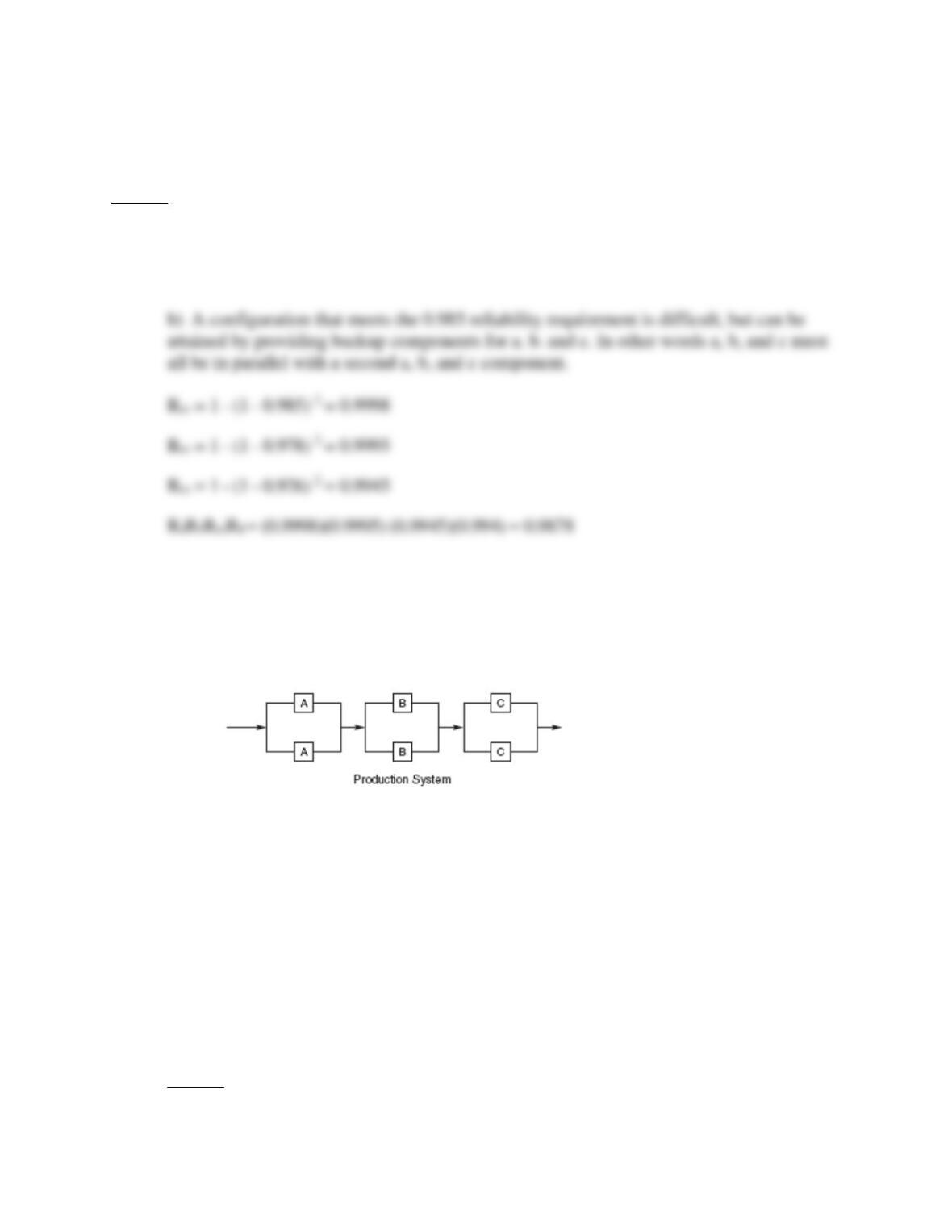
one fails, the other can be used while the first is repaired (see accompanying figure).
The reliabilities of the machines are as follows:
Machine Reliability
A 0.91
B 0.87
C 0.94
a. Analyze the system reliability, assuming only one machine at each stage (all the
backup machines are out of operation).
b. How much is the reliability improved by having two machines at each stage?
Answer

a) RaRbRc = (0.91)(0.87)(0.94) = 0.744