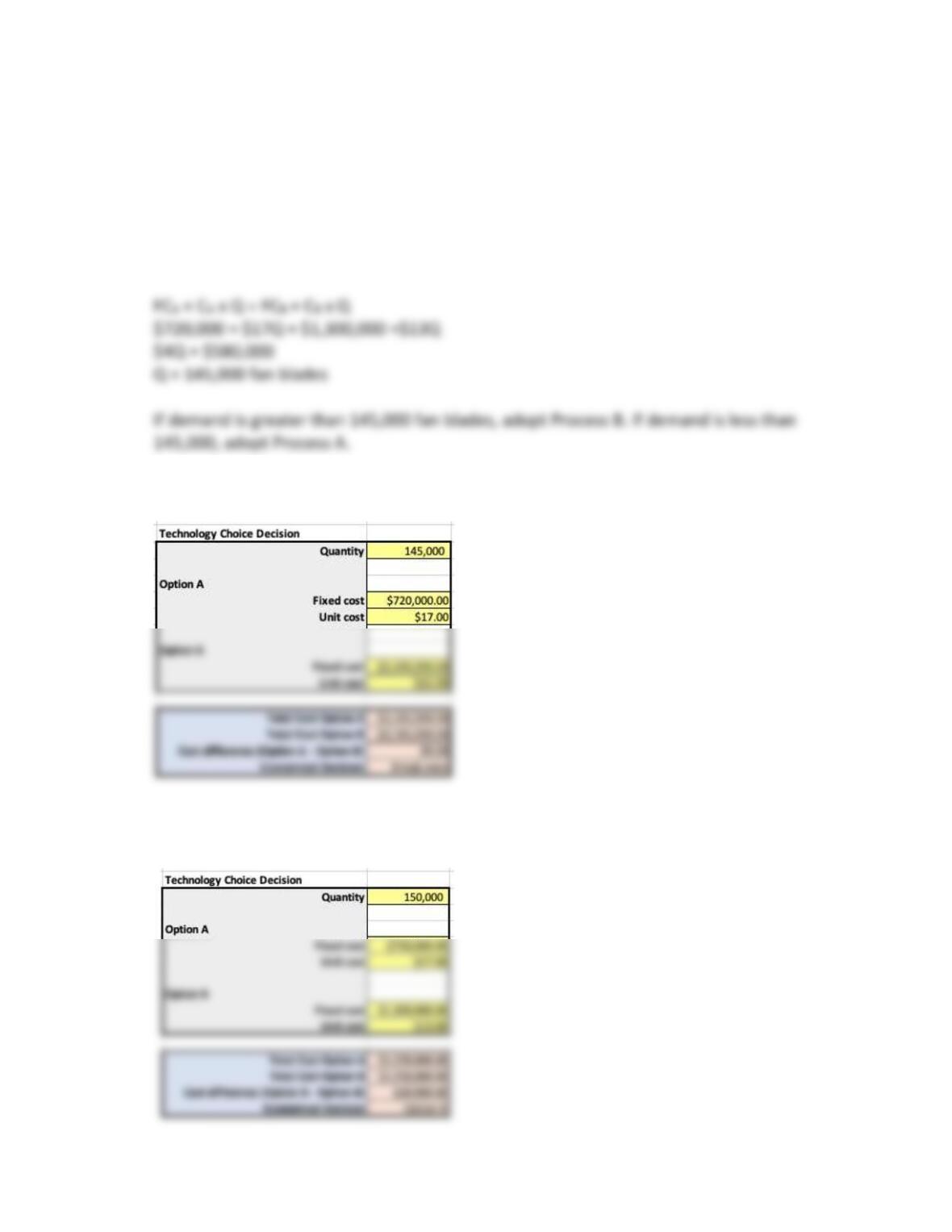
a. What is the break-even quantity between these two processes?
The first process we’ll call Process A and the second Process B.
Using Equations (C.1) and (C.7) in Supplement C, we have
Total cost (TC) = Fixed cost (FC) + Unit cost (C) x Quantity (Q) (C.1)
Use Goal Seek with the Break-Even template:
b. If predicted demand for next year is 150,000 blades, what process do you recommend?
What is the cost savings?
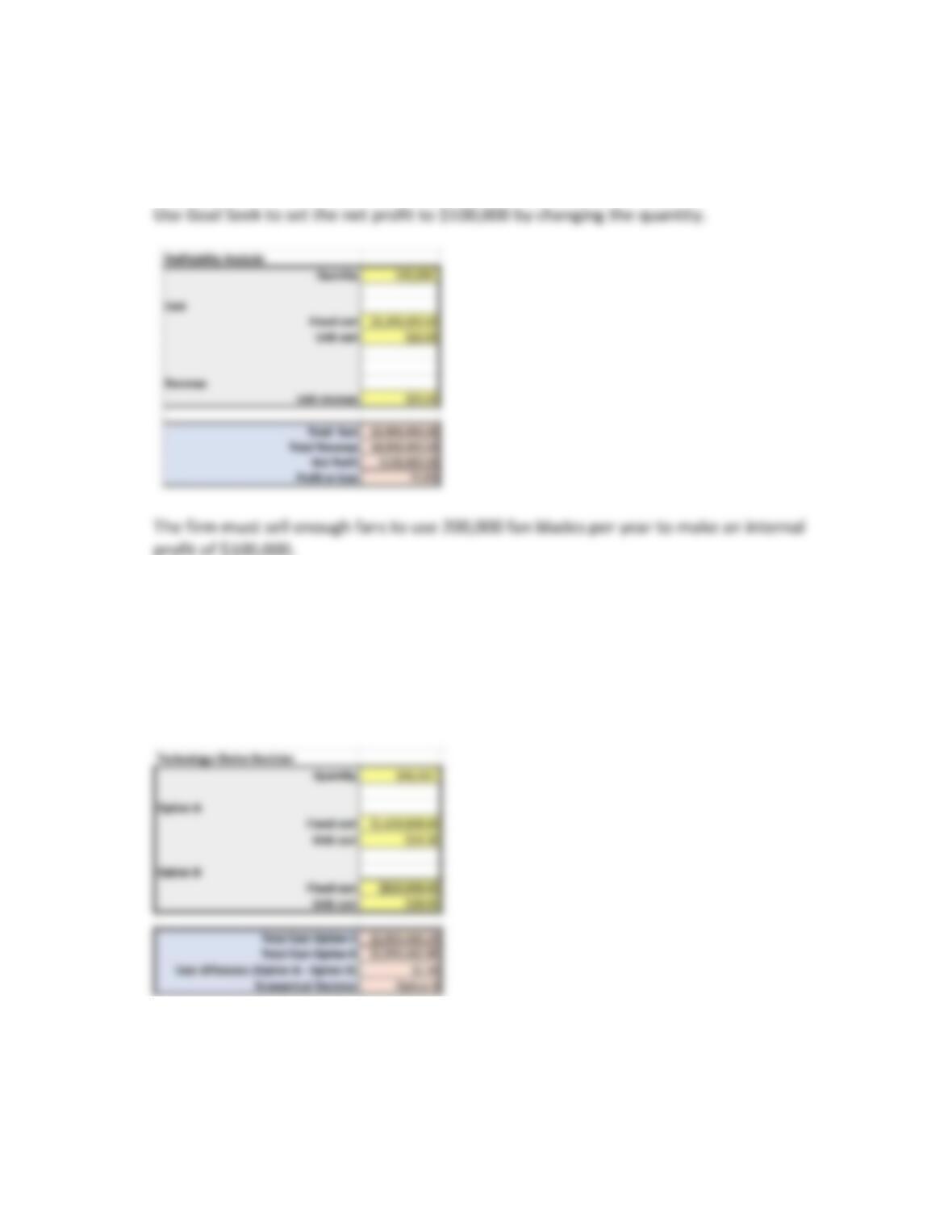
c. What volume of demand does Samoset Fans, Inc need to make an internal profit on fan
blades of $100,000, assuming they installed the process you recommend in part (b)?
41. Rework computational problem 34 (Worthington Machining) using the Break-Even Excel
template in MindTap to answer the following questions:
a. What is the break-even quantity between these two processes?
Using Goal Seek, we have:
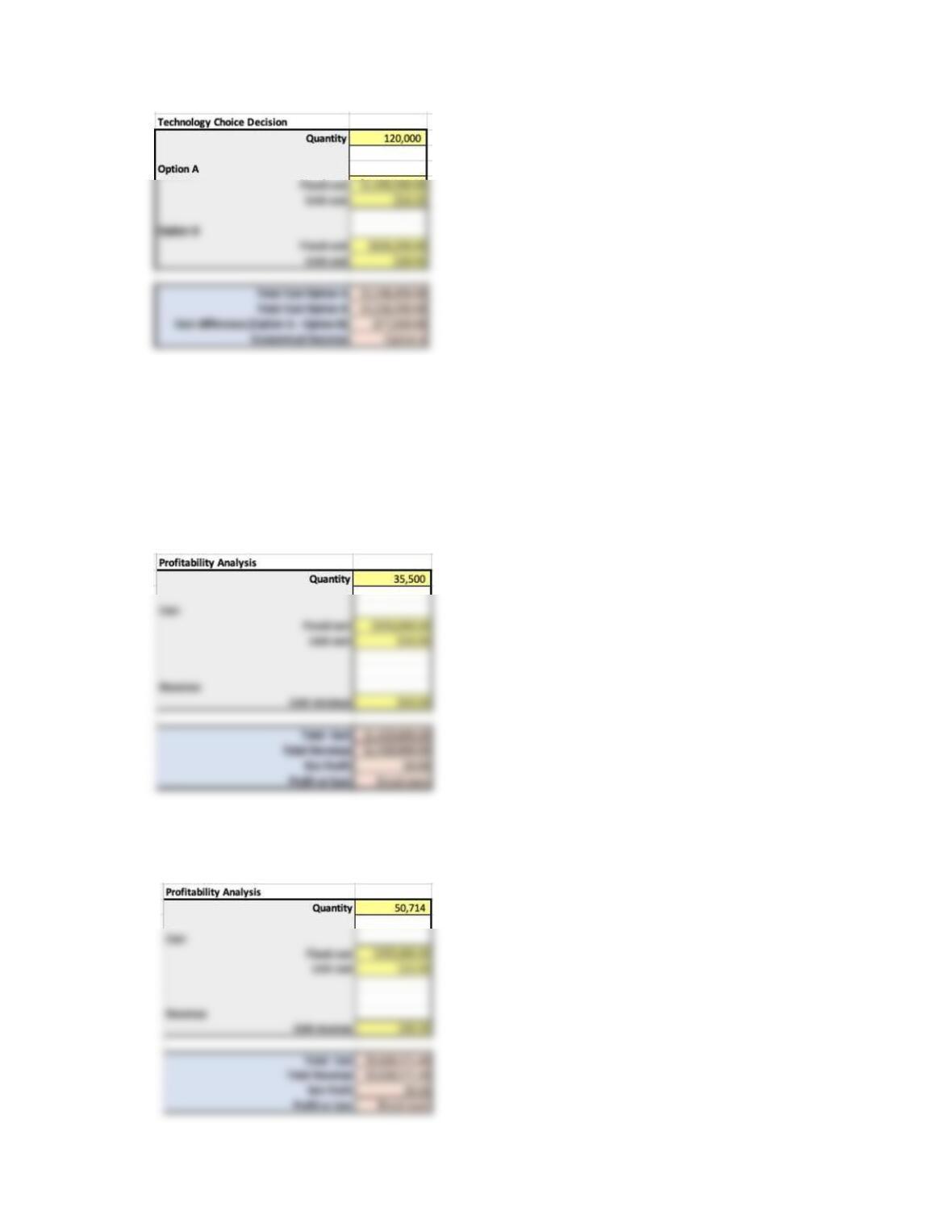
b. If predicted demand for next year is 120,000 panel folds, what process do you
recommend? What is the cost savings?
42. Rework computational problem 36 (college textbook publisher) using the Break-Even
template in MindTap and answer the following questions:
Note that students must use Goal Seek or trial and error to find the breakeven quantities.
a. What is the break-even quantity for this book?
b. If the variable cost increased 10 percent due to poor operating performance, what is the
new break-even quantity?
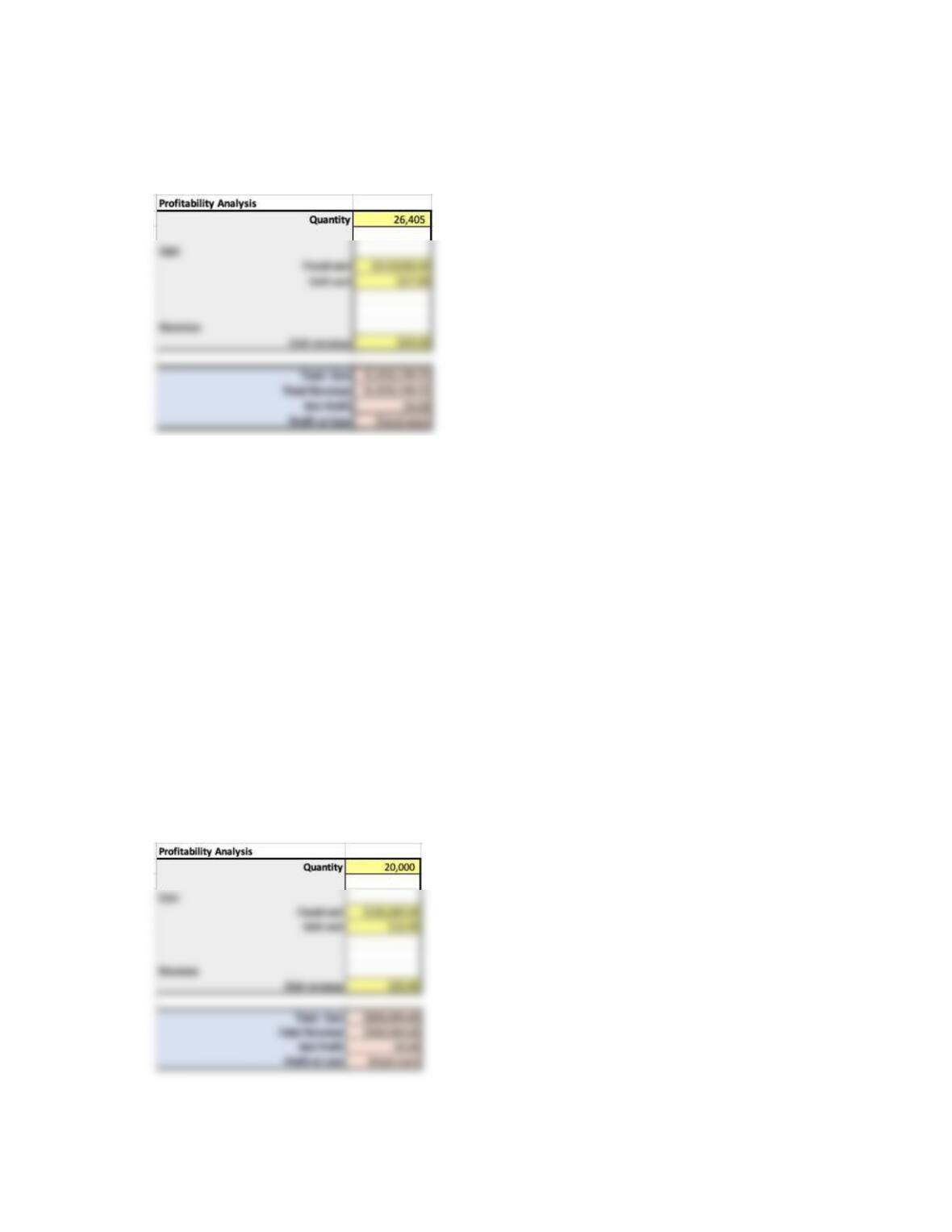
c. If through better process efficiency the fixed cost decreases by ten percent and the
variable cost decreases to $27.90, what is the revised break-even quantity?
43. An automated car wash called Jet Express outside a large Texas city on the beltway is
deciding whether to build and install one dedicated vehicle wash line or have two parallel
wash lines. There are no other cash washes at this intersection and there will be none since
all the land is developed. The second line allows for some economies of scale in total cost.
The monthly fixed cost of one wash line is $15,000 per month or $180,000 per year. This
includes the mortgage payment and taxes on the building, and the wash equipment. The
variable cost for this single line is $16 per vehicle. The fixed cost for two wash lines is
$26,000 per month or $312,000 per year and the variable cost to operate two lines is $13
per vehicle because some wash crews can work both lines. The price of the average interior
and exterior car wash is $25. Use the Excel template Break-Even in MindTap to answer the
following questions:
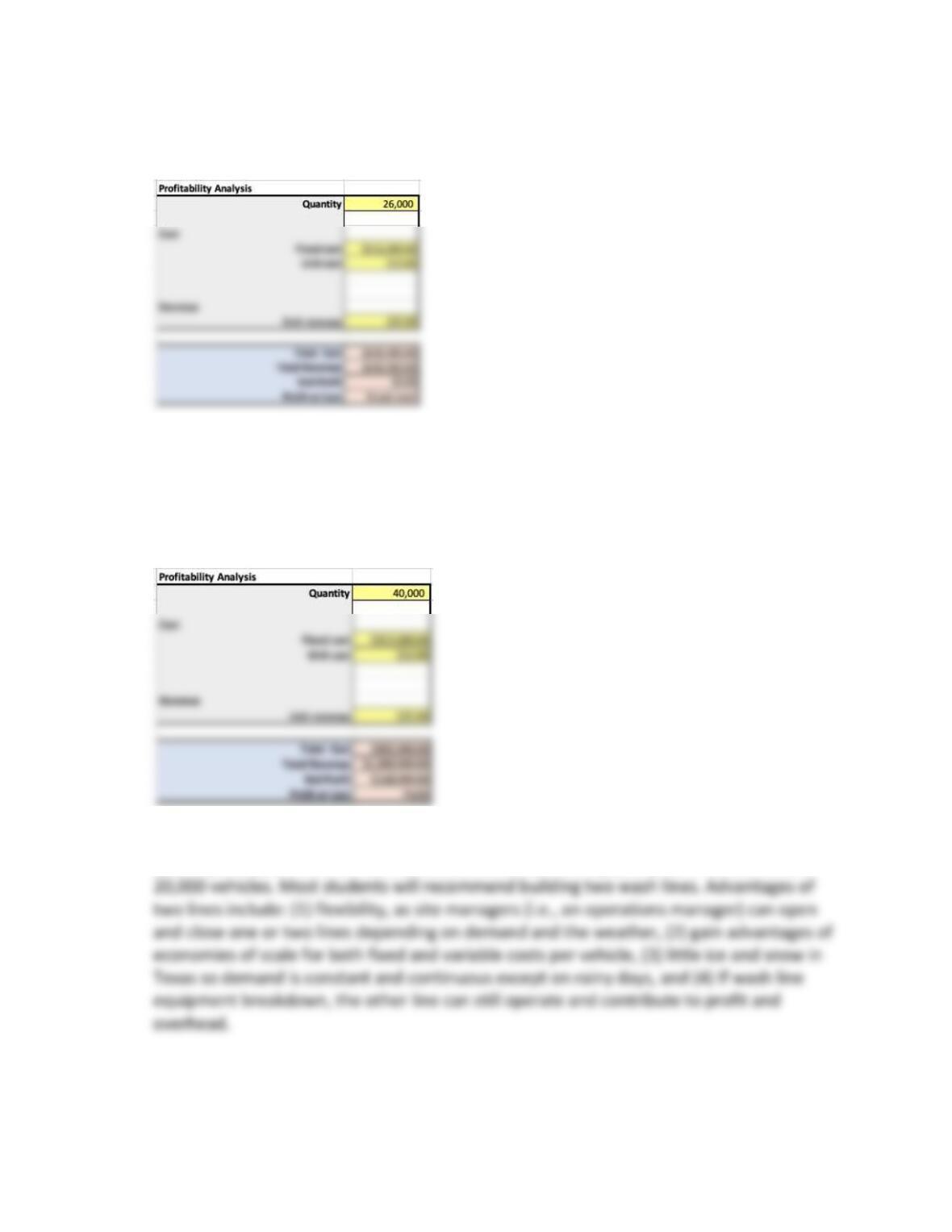
a. What is the break-even quantity for one and two automated wash line?
For one wash line the Excel analysis is as follows with a break-even quantity of 20,000
vehicles per year, found using Goal Seek.
For two wash lines the Excel analysis is as follows with a break-even quantity of 26,000
vehicles per year.
b. Annual forecasts of demand for this site ranges from 20,000 to 40,000 per year. What
would you recommend?
If 40,000 vehicles get a wash at this site with two wash lines, the owners make $168,000
profit.
For a demand of 30,000 vehicles and two wash lines, they make $48,000. The break-even
quantity is 26,000 vehicles with two lines. The break-even quantity for one wash line is
44. The deli at a Metro Supermarket experiences constant and continuous demand. Staffing is a
problem for store managers but several of the employees suggested they buy more deli
The fixed cost includes three parts. First, the fixed costs associated with buying three
more slicing machines and four more weighing scales is $11,000. The current fixed cost of
existing equipment is $7,000. The supermarket accounting department also sets the fixed
cost of the building deli area and cold storage lockers at a $36,000. The predicted variable
cost of the produce plus operating six slicing machines and six scales including labor costs is
$18.15 per customer order. The average deli order costs the customer $19.65. Use the Excel
template Break-Even in MindTap to answer the following questions:
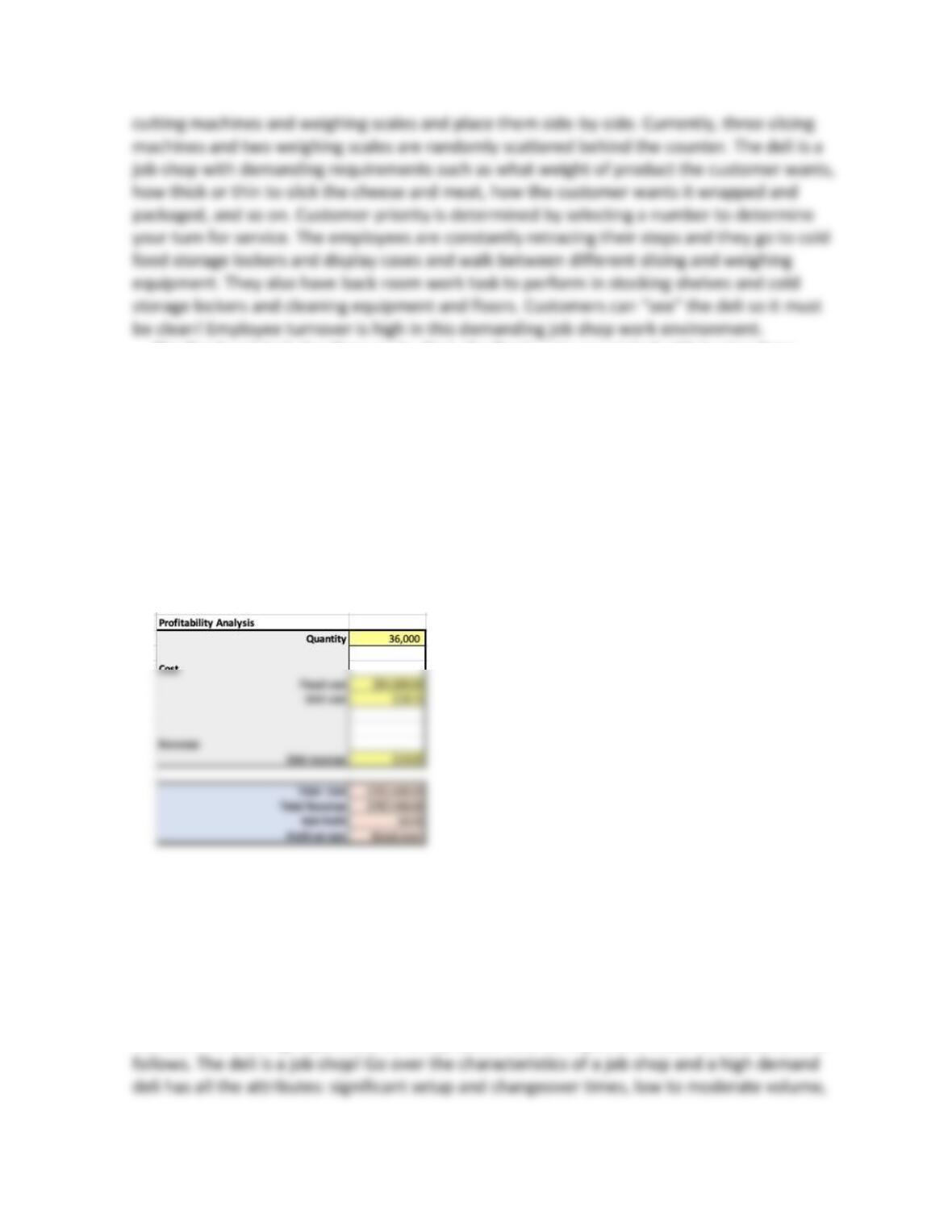
a. What is the break-even quantity in customer orders per year?
Using Goal Seek, we find:
b. How many orders does the deli fill per day at the break-even quantity if the supermarket is
open 360 days a year?
36,000 order/year divided by 360 days/year = 100 deli order per day
c. What type of process is the deli shop within the supermarket? Explain.
The BEA is a learning experience for this problem but an important lesson for students is as
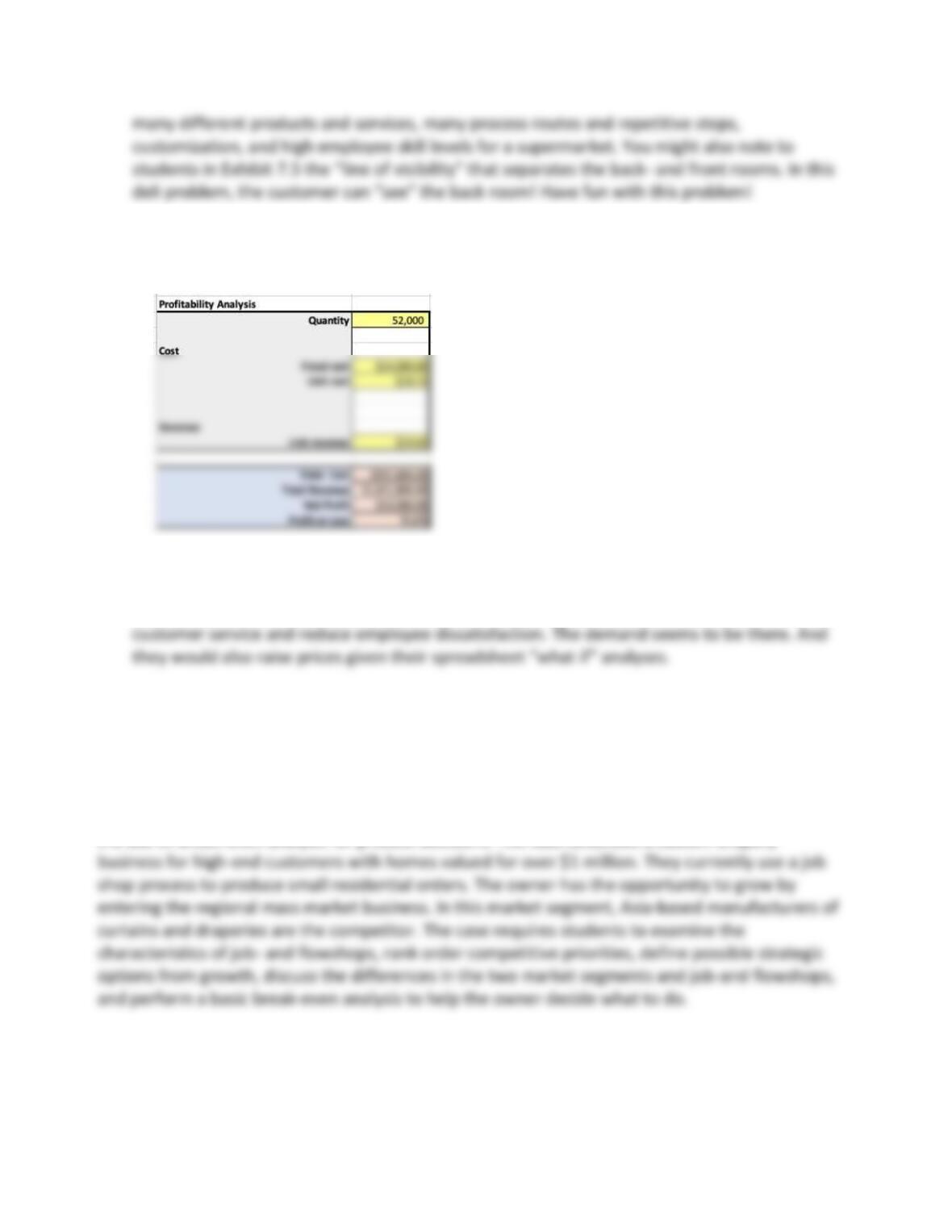
d. If demand was 52,000 orders filled by the deli last year, how much money did the deli
contribute to profits for the supermarket?
e. If you were store manager, would you add the extra machines? Would you raise deli prices?
Most students would add the extra slicing and weighting scale machines to improve
Teaching Note: Custom Drapes, Inc.
Overview
The purpose of the case is expose students to process selection and competitive priority
decisions and understanding the characteristics of job and flow shops. The case also reinforces
Case Questions for Discussion
1. Rank order the competitive priorities for CD’s custom jobs. Rank order the competitive
priorities for the standard drapery business.
For CD’s custom drapery business, the rank order is most likely #1a customer service (service
quality), #1b product quality, #2 delivery time, #3 flexibility, #4 innovation, and #5 price (cost).
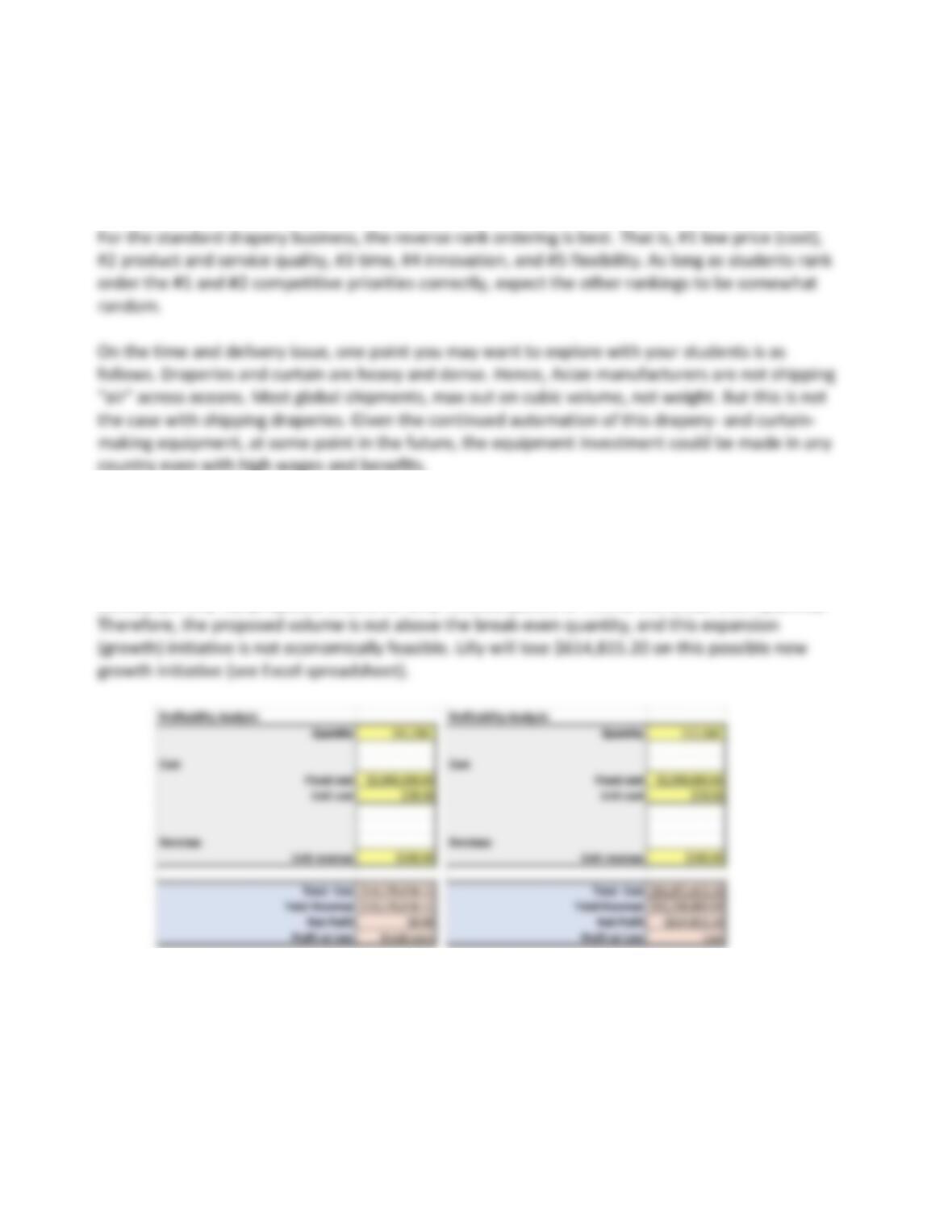
2. What is the break-even quantity (in panels) if Lilly would build the facility and buy the
equipment to produce standard panels?
The break-even quantity using Goal Seek is 141,706 panels (see the Excel template output
3. Should Custom Draperies accept the proposals to manufacture 32 different drapery panels
in order sizes up to 10,000 panels? What are the implications? If the answer is yes, what
other operations and logistics decisions need to be made to support this growth initiative?
If your answer is no, justify and explain.
If student answer is no — The custom drapery business uses a job shop to manufacture the
drapes. As chapter Exhibits 7.1 and 7.2 document, the characteristics of a job shop are high
workforce skills, many different products, customized to customer specifications, small order (lot)
If student answer is yes —- Lilly now must operate two separate businesses, a job shop and a
flowshop, each housed in separate facilities requiring very different skills and processes. Is Lilly
prepared for such challenges? The strategic (long-term) risks are high and the tactical (short–
term) economics are not good.
4. What are the strategic growth options for Custom Draperies?
• Do nothing and continue to focus on custom draperies for high-end customers using a job
shop to manufacturer drapery panels.
5. What are your final recommendations?
The purpose of the case is expose students to process selection and competitive priority
decisions and understanding the characteristics of job and flow shops. The case also reinforces
Other thoughts for instructors
The case focuses on residential draperies but curtain, drapery, and the panel businesses have
Teaching Note: Hickory Medical Clinic
Overview
The Hickory Medical Clinic conducted a patient satisfaction survey to identify areas of
dissatisfaction and opportunities for improving the process design.
Case Questions for Discussion:
1. What conclusions do you reach from the satisfaction survey results? What implications would
this have for a better process design?
The top three dissatisfiers were (in order):
Thus, the front-end part of the service process is very important because it is the “gateway to
2. Propose some process improvements to the flowcharts, and develop new flowchart(s) of the
redesigned processes. Cite key advantages and disadvantages of your flowchart(s).
Students will normally reduce the number of steps in the process and eliminate the receptionist’s
3. How should the organization implement the new process plans?
Any time someone tells employees their job is eliminated, moved, or changed, employees may
react in a positive and/or negative way. What is the firm’s policy on transfers, layoffs, hiring?
Teaching Plan
1. Discuss the role of the satisfaction survey and how the data were collected.
2. Analyze the current process maps for improvement suggestions. Write each down on the
board or overhead.
You might select two students or case teams to present a 10– to 15-minute presentation on the
case questions.
Integrative Case: Hudson Jewelers
A complete teaching note for all chapters is available in the Instructor Resources online.
Chapter 7 Case Questions for Discussion:
1. Research the parts of the diamond value chain and then answer the following question:
How would you describe the type of process used for (a) exploration, (b) diamond mining,
(c) sorting and grading, (d) cutting and polishing centers, (e) trading centers, (f) jewelry
manufacturing, and (g) retail stores? You might want to use the terminology of the product–
process matrix and service positioning matrix, for example.
Students should understand Exhibit 7.1, 7.2 and 7.3. Showing these three exhibits in class is a
Chapter 7 concepts, and then APPLY to the diamond industry. MBAs do much better on this
assignment.
(a) Exploration – projects (geology and satellite analysis, plate tectonics, seismologists, test
setups and drilling) and if many test drilling holes are drilled then we could say it is a job
shop with small batches. Each drill site may present a different situation for the drilling
rigs and its people. Projects are characterized by one–of-a-kind processes, large scale,
resources brought to the site, and a wide variation in tasks and specifications given the
site location and degree of difficulty drilling.
(c) sorting and grading – This process can be described as a flow shop with machines that x-
raying dirt, photo sensors detect the fluorescence of a diamond, and people assess the
quality. Initial sorting is into industrial grade versus retail grade. If the assumption of
large batches of dirt are inspected than one could also characterize the process as a job
shop with large batches of alluvial.
(e) trading centers – these centers are often combined with cutting and polishing operations
where negotiation of price, quality, sources, quantity, the four Cs, and so on. What goes
on here is like a professional service such as stock trading or consulting. This is front room
work that is moderately repeatable service-encounter activity sequence. Site holders act
as a cap on market diamond supply. E-trading, virtual biding, and e-auctions are
beginning to break up these oligopolies.
2. Given the simplified process work activities shown in the worksheet Hudson Jeweler Work
and Process Flow in MindTap, draw the process flowchart, and then answer the following
questions. You must allocate the work content in the worksheet to manufacturing, CAD,
service, front room, and back room to gain insights into where and how this work is
accomplished.
a. For this process, what is the total time in minutes (or equivalent fraction of a day) to
create one woman’s codesigned wedding ring?
b. For this process, what is the total manufacturing time in minutes (or equivalent fraction
of a day) to create one woman’s codesigned wedding ring?
a. For this process, what are the average total work activities in days and minutes to create one
woman’s co-designed wedding ring?
See the spreadsheet below (also available in MindTap). Students can work out identical
b. For this process, what are the average total manufacturing days and minutes to create one
woman’s co-designed wedding ring? What percentage of the total workload is your answer?
1.00 day or 480 minutes of actual work content (processing time) or 59.2% of the total work
content.
c. For this process, what are the average total CAD days and minutes to create one woman’s co–
designed wedding ring? What percentage of the total workload is your answer?
d. For this process, what are the average total service (other than CAD) days and minutes to
create one woman’s co-designed wedding ring? What percentage of the total workload is
your answer?
0.210 days or 100.8 minutes of actual work content (processing time) or 12.4% of total work
content.
e. For this process, what are the average total front room and back room work activities in
days/minutes to create one woman’s co-designed wedding ring? What percentage of the
total workload is your answer?
If we simply add CAD work activities to service activities we get:
• Front Room: 0.48 + 0.210 = 0.69 front room days or 230.4 + 100.8 = 331.2 minutes of
f. How do search, experience, and credence attributes apply to this work breakdown structure?
Explain. Provide examples.
• Backroom activities focus on search attributes.
g. What insights do you gain by evaluating the work content of this process and answering
questions (a) to (f)?
• Students “see” where the most time and resources are used in the “overall” value chain.
That is, how does this one retail store “fit” in the total value chain?
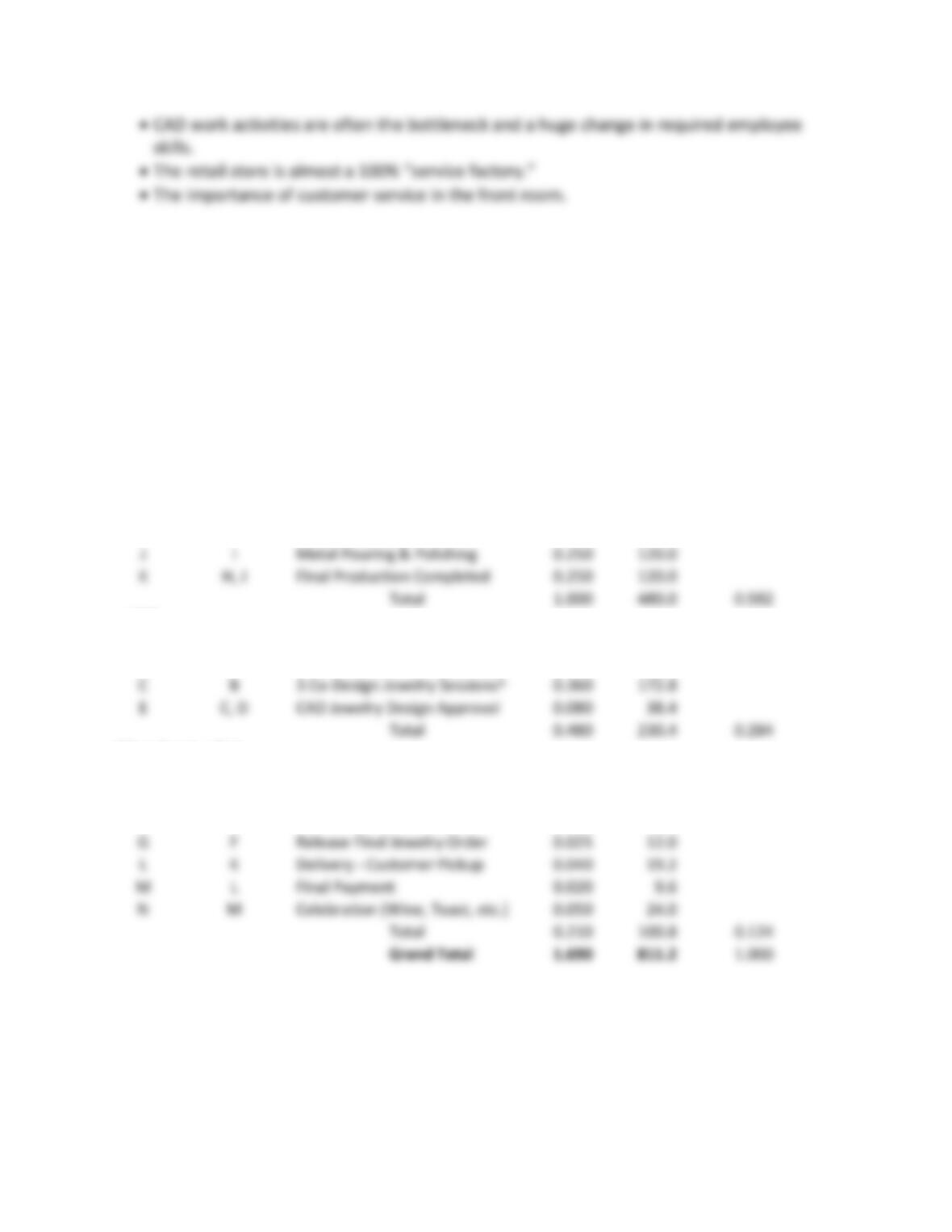
From the table below we see that manufacturing related work activities make up 59.2% of the
total process work content, CAD co-design is 28.4% and other services are 12.4%. Students may
assign different work to different major categories but the objective here is they analyze “process
work content.”
Table of Hudson Jewelry Work & Process Flow Activities
Fraction
of a
Work
Total
Percentage
Activity
Day*
Minutes*
of Total
Time (%)
Manufacturing Only
H
G
Stone (Wholesale) Jeweler
0.200
96.0
I
G
Wax Jewelry Mold
0.300
144.0
J
Metal Pouring & Polishing
0.250
120.0
K
Final Production Completed
0.250
120.0
Total
1.000
480.0
0.592
CAD
Only
B
A
CAD Demo & Jewelry Concept
0.040
19.2
C
B
3 Co-Design Jewelry Sessions^
0.360
172.8
E
CAD Jewelry Design Approval
0.080
38.4
Total
0.480
230.4
0.284
Other Service Only
A
none
Customer 1st Store Visit
0.025
12.0
D
B
Price Quote and Discussion
0.030
14.4
F
E
Partial Payment
0.020
9.6
G
F
Release Final Jewelry Order
0.025
12.0
L
K
Delivery – Customer Pickup
0.040
19.2
L
Final Payment
0.020
9.6
N
Celebration (Wine, Toast, etc.)
0.050
24.0
Total
0.210
100.8
0.124
Grand Total
811.2
1.000
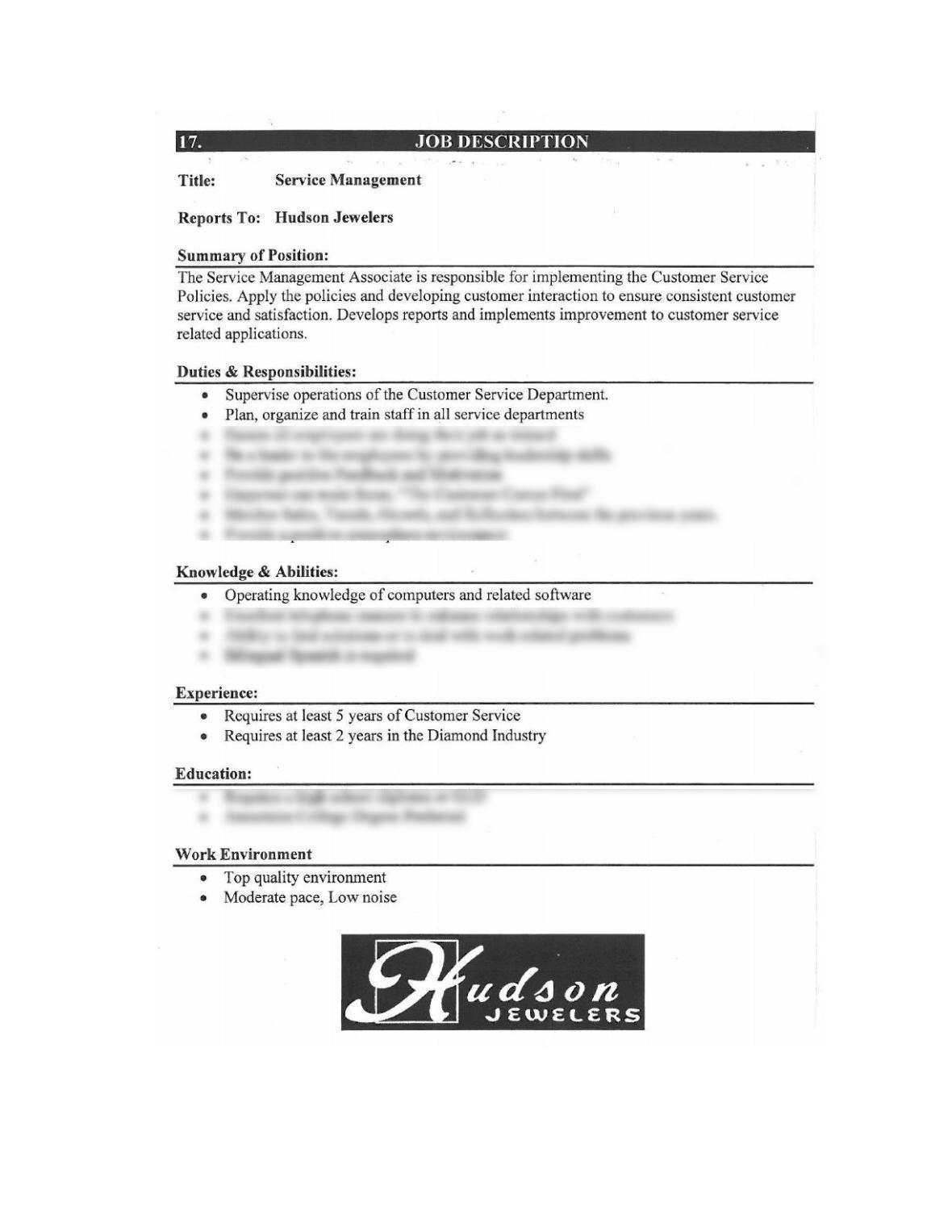
2. Write a job description for a new employee at this store.
The challenge here is writing a job description for three possible types of skills (a) service
management, (b) jewelry expertise, and (c) CAD knowledge and skills. Service management skills
4. Assume that during Lilly’s and Lester’s last visit to the retail store everything was as
described in the case, except the final bill was not ready and Mr. Bill Hudson had lost some
of the paperwork documenting the price of the ring and diamonds. After a 45-minute wait,
Lilly and Lester had figured out a final bill. What is the impact of this “billing service upset”
at the end of the customer’s buying experience? Is billing a primary or peripheral process?
We suggest assigning Question 4 or 5 but not both.
The impact of this end-of-the-value chain “service upset” is negative. The entire customer buying
experience had been extraordinary up to now but ends on an unsettling note. It could ruin (a) the
What must happen at the end of the value chain is a good set of reinforcing service encounters
(service encounter design). This includes the service-provider being professional, polite, and
happy, fulfill customer wants and needs, and present an accurate bill. What must not happen is
the opposite including errors along each step and ignoring other customers as they walk in the
store.
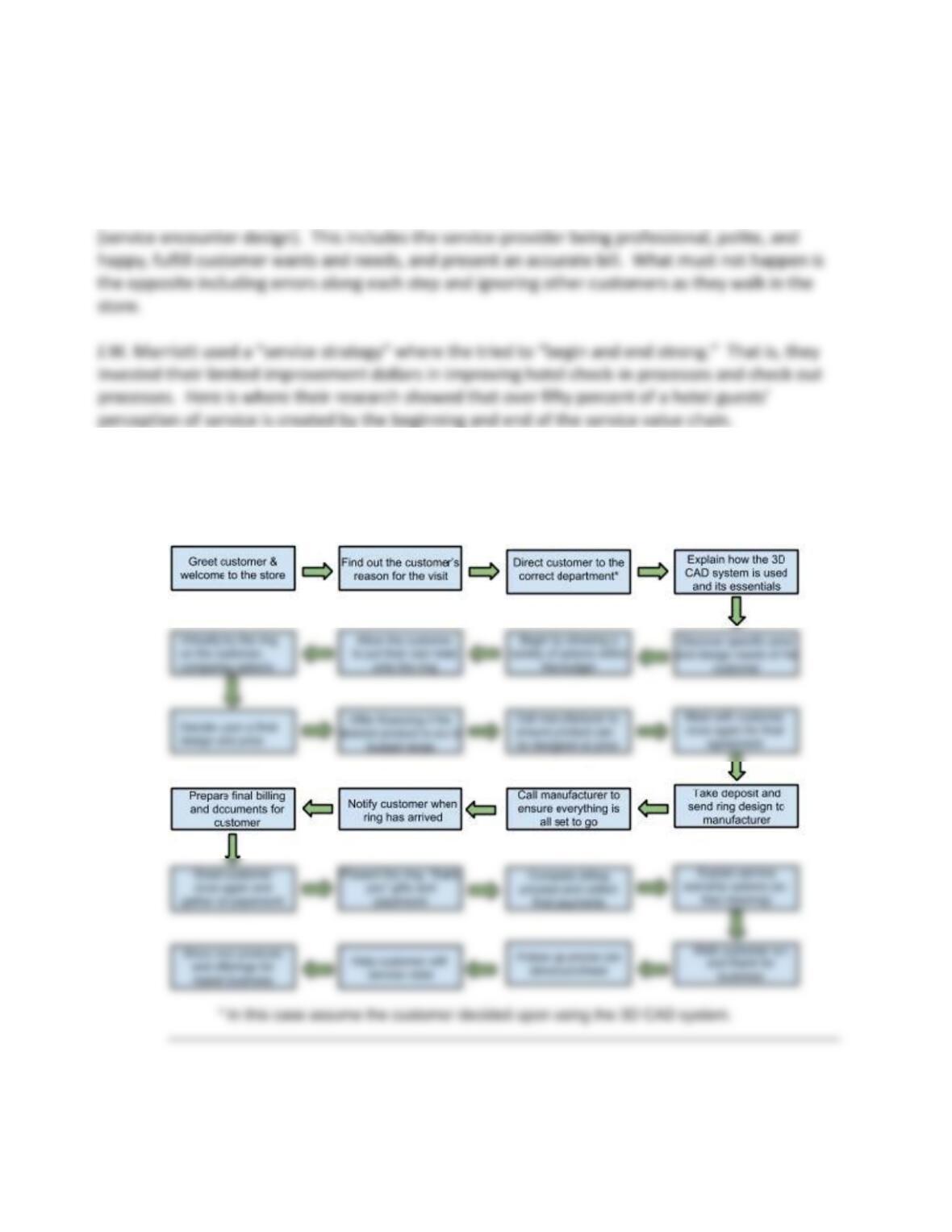
5. Design an ideal diamond-ring customer experience from beginning to end (i.e., make a list
of 10 to 20 steps in the job and process design). Explain what must happen and what must
not happen.
What must happen at the end of the value chain is a good set of reinforcing service encounters
Students will use tables and flowcharts to define their major steps in the “ideal buying process.”
One example is as follows: