Chapter 7
Relevant Costs and Product-Planning Decisions
Concept Questions
1. (LO1—Special-order decisions)
A special order will increase net income when the additional revenue from the
2. (LO1—Special-order decisions: Relevant costs)
In a special-order decision with excess capacity, the relevant costs are likely to
include the variable costs (the costs of direct material, direct labor, and variable
3. (LO2—Make-or-buy decision: relevant costs)
The relevant costs are typically the cost of buying the product from an outside
4. (LO2—Make-or-buy decision: Qualitative factors)
In a make-or-buy decision, the quality of the product, the reliability of the vendor,
5. (LO2—Outsourcing: Disadvantages)
Disadvantages of outsourcing the production of a part include a perceived lack of
6. (LO2—Make-or-buy decision: Relevant costs)
Fixed costs that are unavoidable would be irrelevant, as would be any sunk costs
Solutions Manual
7-2
7. (LO3—Dropping a product line)
The decision to drop a product should be based on many factors. From a
8. (LO4—Limited resources)
9. (LO5—Bottlenecks and the theory of constraints)
Management should focus its time and resources on alleviating the bottleneck by
10. (LO6—Sell or process further)
Brief Exercises
1. (LO1—Special-order pricing decision)
2. (LO2—Make-or-buy decision)
The only relevant cost of making the product is the variable cost of $47 per unit.
Chapter 7: Relevant Costs and Product-Planning Decisions
3. (LO3—Basic drop-a-segment decision)
If the Portland segment is eliminated, the company’s overall income will decrease
by $20,000 as follows:
4. (LO2—Resource utilization decisions and constraints)
a. False
5. (LO6—Decision to sell or process further)
If smoked hams can be sold for $2.25 per pound, the hams should be processed
Exercises
6. (LO1—Special-order pricing decision)
The relevant cost per chair is $11 for direct materials, $7 for direct labor, $2 for
Solutions Manual
7-4
7. (LO1—Special-order decision: Relevant costs)
The relevant unit cost is $5.50 per unit ($2,200,000/400,000 units).
8. (LO1—Special-order pricing decision)
9. (LO1—Special order: Effect on income)
The only relevant cost is the variable cost of $20 per lacrosse stick. The
10. (LO2—Make or buy: Effect on income)
Relevant cost if the company makes the part itself:
Variable costs:
Direct materials $ 3
Direct labor 3
Chapter 7: Relevant Costs and Product-Planning Decisions
11. (LO2—Basic make-or-buy decision)
The only relevant cost of making the product is the variable cost of $56 per unit.
12. (LO2—Outsourcing decision)
The company should accept the offer of $125,000. Outsourcing will allow the
company to avoid $150,000 of labor costs. The depreciation and allocated
overhead costs are neither avoidable nor relevant to the decision.
13. (LO2—Outsourcing decision)
14. (LO3—Impact of dropping a product line)
If Product C is dropped, operating profit will decrease an additional $15,000,
Solutions Manual
7-6
15. (LO3—Impact of dropping a product line)
If Painted rockers are dropped, overall operating profit will not be affected, as the
following calculation shows:
16. (LO4—Limited-resource decision)
To maximize profits, the company should produce the product with the highest
contribution margin per unit of limited resource. In this case, it should produce
Compact Disc 1, which has a CM per machine hour of $4. The relevant
calculations are as follows:
Compact Disc 1 Compact Disc 2
Selling price $ 10 $ 20
17. (LO4—Maximizing contribution margin given a limited resource)
A. The contribution margin for queen beds is $75 per unit ($525 sales price
Chapter 7: Relevant Costs and Product-Planning Decisions
7-7
18. (LO4—Maximizing contribution margin given a limited resource)
A. The contribution margin per limited resource for pigskin
footballs is $137.50 ($500 sales price less the variable cost of
also be considered in this decision.
19. (LO6—Sell-or-process further decision)
The company should sell the units “as is” because all previous costs of
20. (LO6—Sell-or-process further decision)
On the basis of the following computations, DePaulis should finish the chairs,
because the incremental revenue is greater than the incremental costs.
Solutions Manual
7-8
Problems
21. (LO1—Special-order decision: Qualitative factors)
A. Expected level of operating profit:
B. Yes, accepting the special order would increase profits by $8,000:
Increase in incremental revenue (1,000 × $20) $20,000
C. Accepting this special order would increase profits by $27,000,
calculated as follows:
Incremental revenue (3,000 × $19) $57,000
D. The impact of special orders on existing customers is always an important
22. (LO1—Special-order decision: Qualitative factors)
A. The company should accept the special order. The incremental profit is
$1,500, calculated as follows:
Incremental revenues (500 × $8) $4,000
Chapter 7: Relevant Costs and Product-Planning Decisions
7-9
C. Other factors include the possibility of repeat business from this customer,
whether he or she will expect the same price, and the reaction of other
customers if they find out that this special order was sold at a lower price.
D. If regular sales would be affected by the acceptance of the special order,
23. (LO2—Make-or-buy decision: Relevant costs and qualitative factors)
A. The total relevant cost of making the part is $48 per unit, or $480,000,
which includes the costs of direct materials, direct labor, and variable
overhead, as well as 40 percent of the $15 of fixed overhead. (The other
24. (LO2—Make-or-buy decision: Relevant costs and qualitative factors)
A. The total relevant cost of making the part is $48 per unit, or $576,000,
which includes the costs of direct materials, direct labor, and variable
Solutions Manual
7-10
would receive from outsourcing the part.
25. (LO2—Make-or-buy decision: Qualitative factors)
A. From a quantitative perspective, the rope should not be purchased from
B. If the Hemp Division is at full capacity and cannot produce any more
rope, it should continue to manufacture rope for Hammock Products and
purchase 10,000 feet of additional rope at $1.25 per unit from an outside
supplier. This rope can be sold to outsiders at the current price of $2.00
per unit, resulting in a net benefit of $7,500.
26. (LO3—Temporary suspension of operations: Qualitative factors)
A. Some fixed costs will continue to be incurred despite the temporary
closing of the mine. Key employees probably cannot be discharged.
B. Suspension of operations is desirable when sales volume drops below
6,000 units.
Chapter 7: Relevant Costs and Product-Planning Decisions
7-11
If the mine is closed down, fixed costs are $4,000 per month. If the mine
27. (LO3—Decision focus: Eliminating unprofitable segments)
A. The current profit for the company as a whole is $21 million
($9 + $20 – $7 – $1).
B. If the East and West segments are eliminated, the new operating profit
C. Eliminating the East segment with its negative contribution margin is one
28. (LO3—Decision focus: Eliminating unprofitable segments)
A. The current operating profit for the company as a whole is $28 million
Solutions Manual
7-12
allocated to the $8 million of fixed costs now being allocated to craps, the
company’s profit would go down by $6 million.
29. (LO4 and 5—Limited-resource decision)
A. This decision should be based on the contribution margin per hour of
machine time.
Following is the contribution margin per pair of boots:
Men’s Women’s
B. The company can sell 1,000 pairs of each product each month.
Manufacturing 1,000 pairs of men’s boots requires 250 hours of machine
Chapter 7: Relevant Costs and Product-Planning Decisions
30. (LO4 and 5—Limited-resource decision)
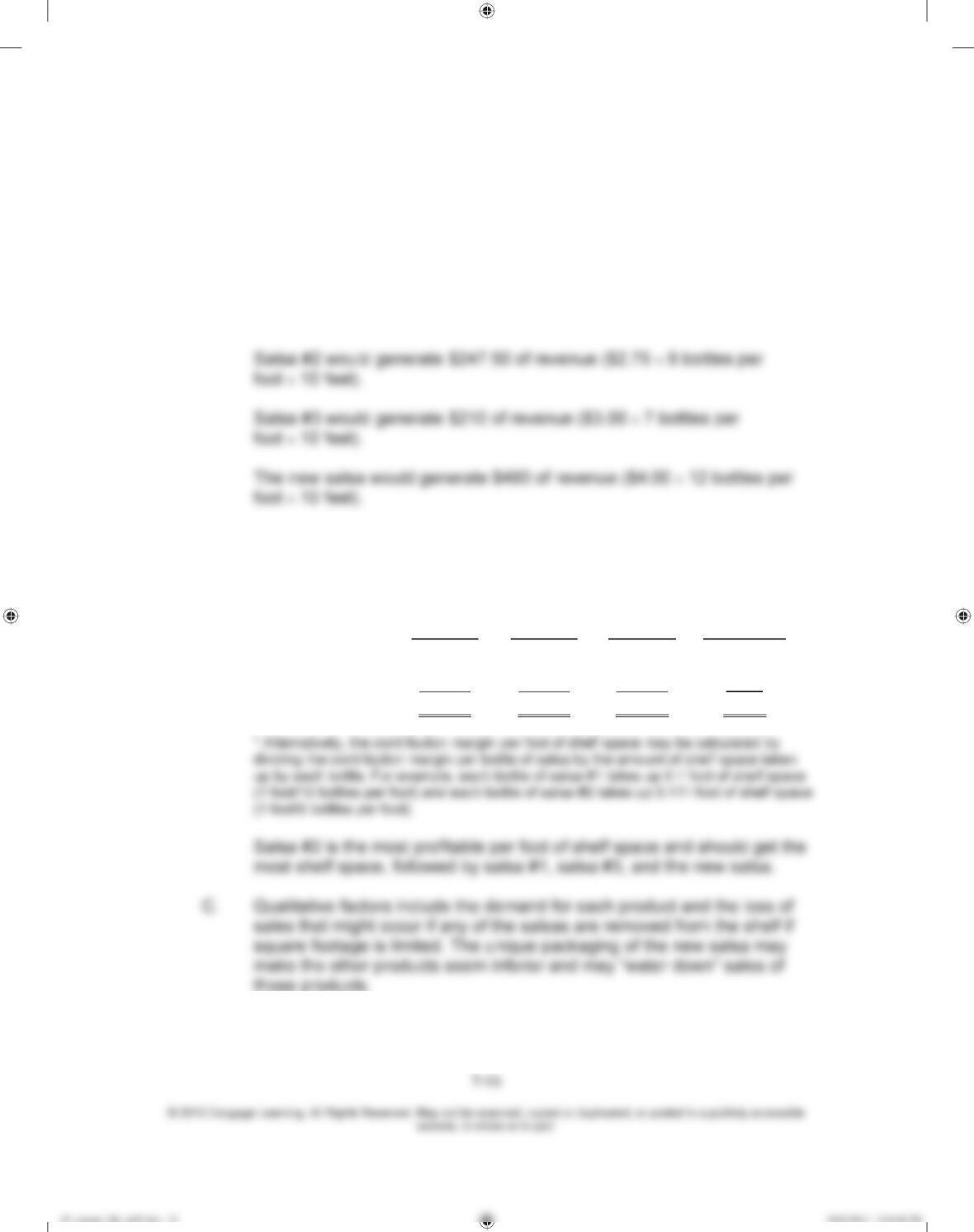
If all bottles of salsa displayed can be sold and all of the salsas are given
the same amount of shelf space, the new salsa would generate the most
revenue, followed by salsa #1, and salsa #2. Salsa #3 would be ranked
last.
A. Salsa #1 would generate $250 of revenue ($2.50 × 10 bottles per
foot × 10 feet).
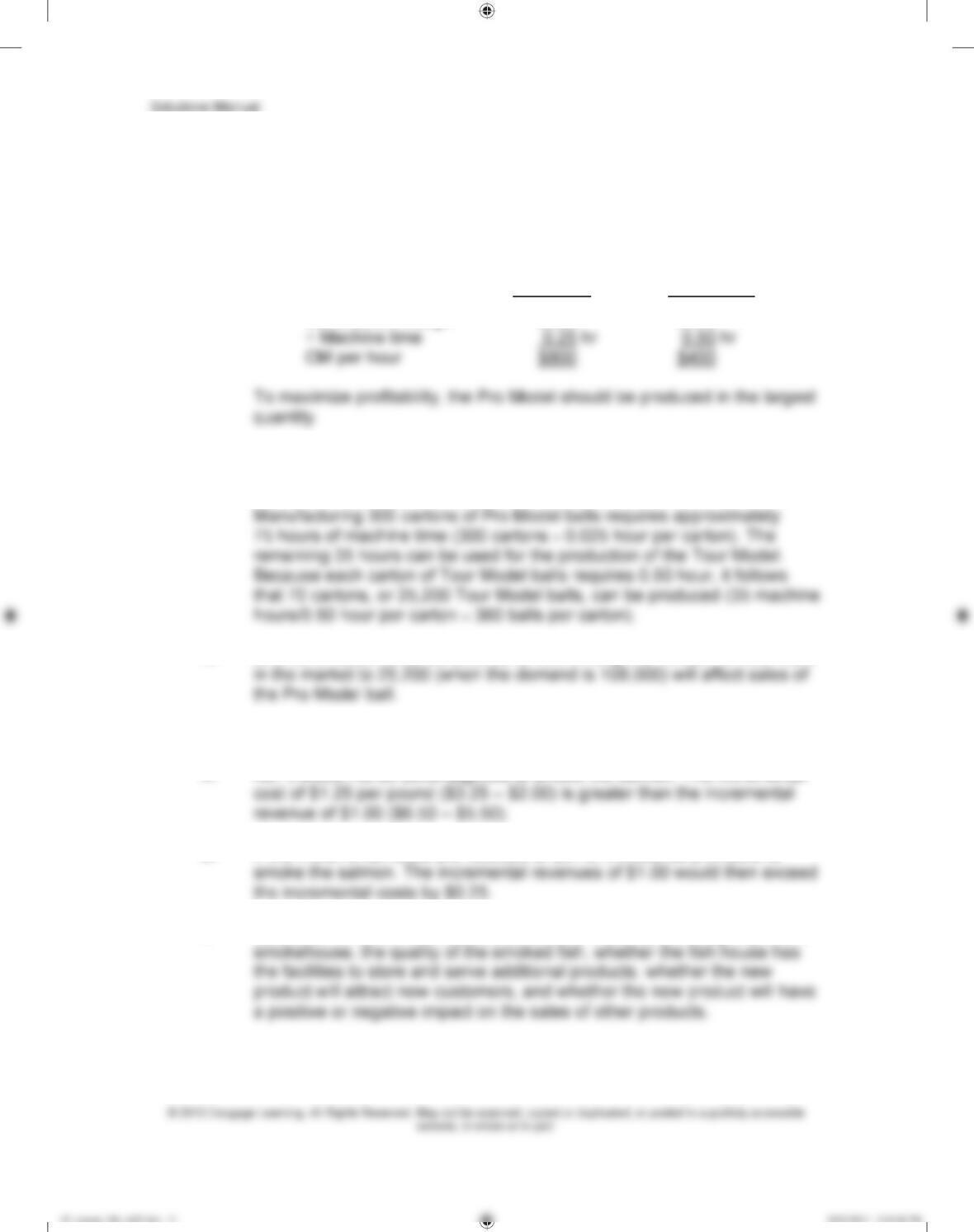
B. Rather than giving each salsa the same amount of shelf space, the salsa
that generates the highest CM per foot of shelf space should be given the
most space. Thus, we have the following calculations:
Salsa #1 Salsa #2 Salsa #3 New Salsa
CM per bottle $ 1.25 $ 1.40 $ 1.50 $0.80
× bottles per foot × 10 × 9 × 7 × 12
CM per foot* $12.50 $12.60 $10.50 $9.60
7-14
31. (LO4 and 5—Limited-resource decision)
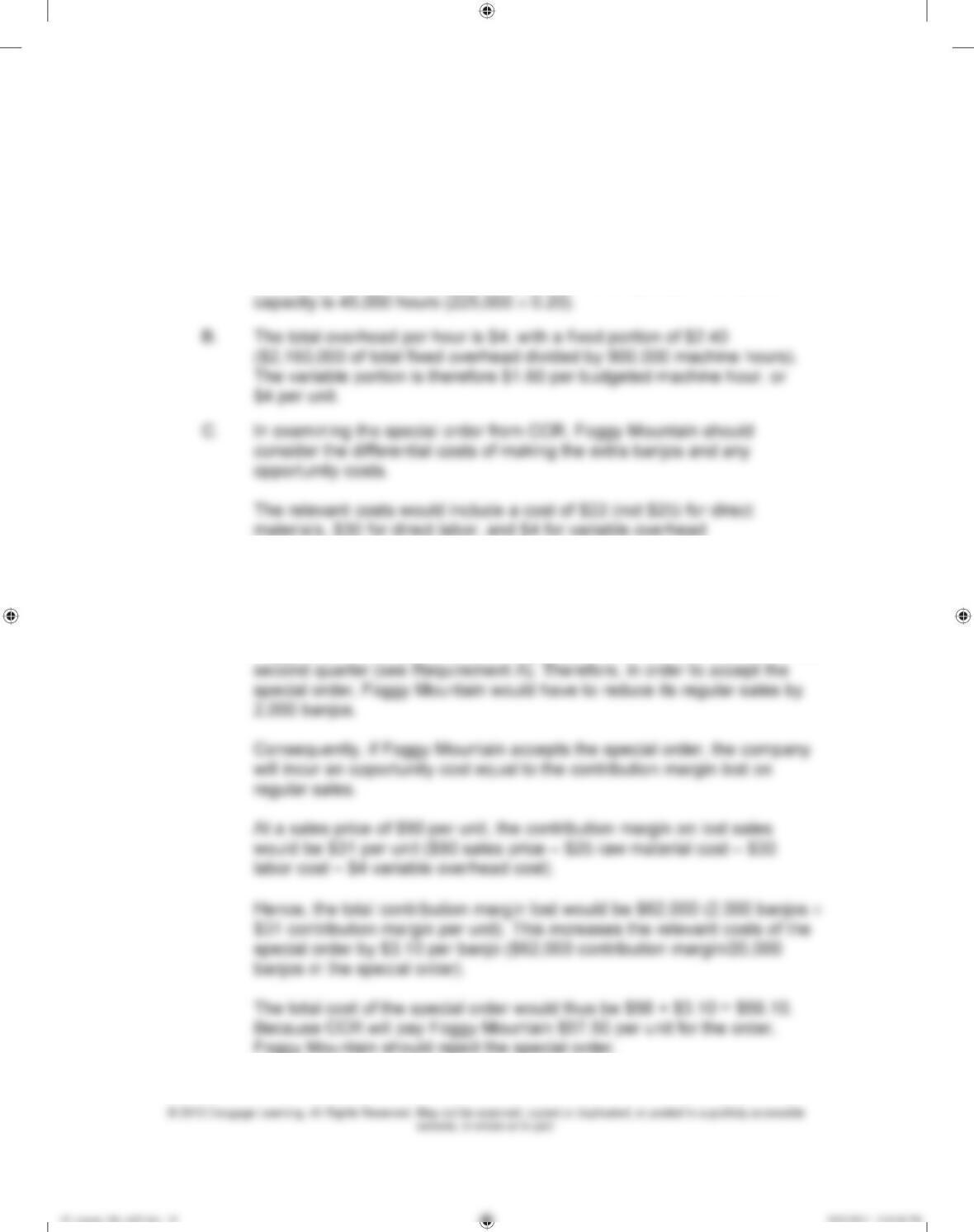
A. This decision should be based on the contribution margin per hour of
machine time.
Following is the contribution margin per carton of balls:
Pro Model Tour Model
Contribution margin $200 $200
B. The maximum sales of each ball are 300 cartons (108,000 balls/360 balls
per carton).
C. One other factor to be considered is how limiting the number of Tour Balls
32. (LO6—Sell-or-process further decision)
A. No, it would not be advantageous to smoke the salmon. The incremental
B. If the incremental costs are reduced to $0.75, it would be profitable to
C. Qualitative factors to be considered are the reliability and longevity of the
Chapter 7: Relevant Costs and Product-Planning Decisions
7-15
Cases
33. (LO1—Comprehensive make-or-buy decision)
A. Under normal conditions, plant capacity is 75,000 machine hours per
month, or 225,000 hours per quarter. The company has estimated that it
will be operating at 80 percent of capacity for the quarter. The excess
($1.60 variable overhead rate × 2.5 hours), for a total of $56.
Foggy Mountain would also incur an opportunity cost equal to $3.10
per banjo, calculated as follows:
Producing 20,000 banjos will require 50,000 machine hours. However,
Foggy Mountain expects to have only 45,000 excess machine hours in the
Solutions Manual
7-16
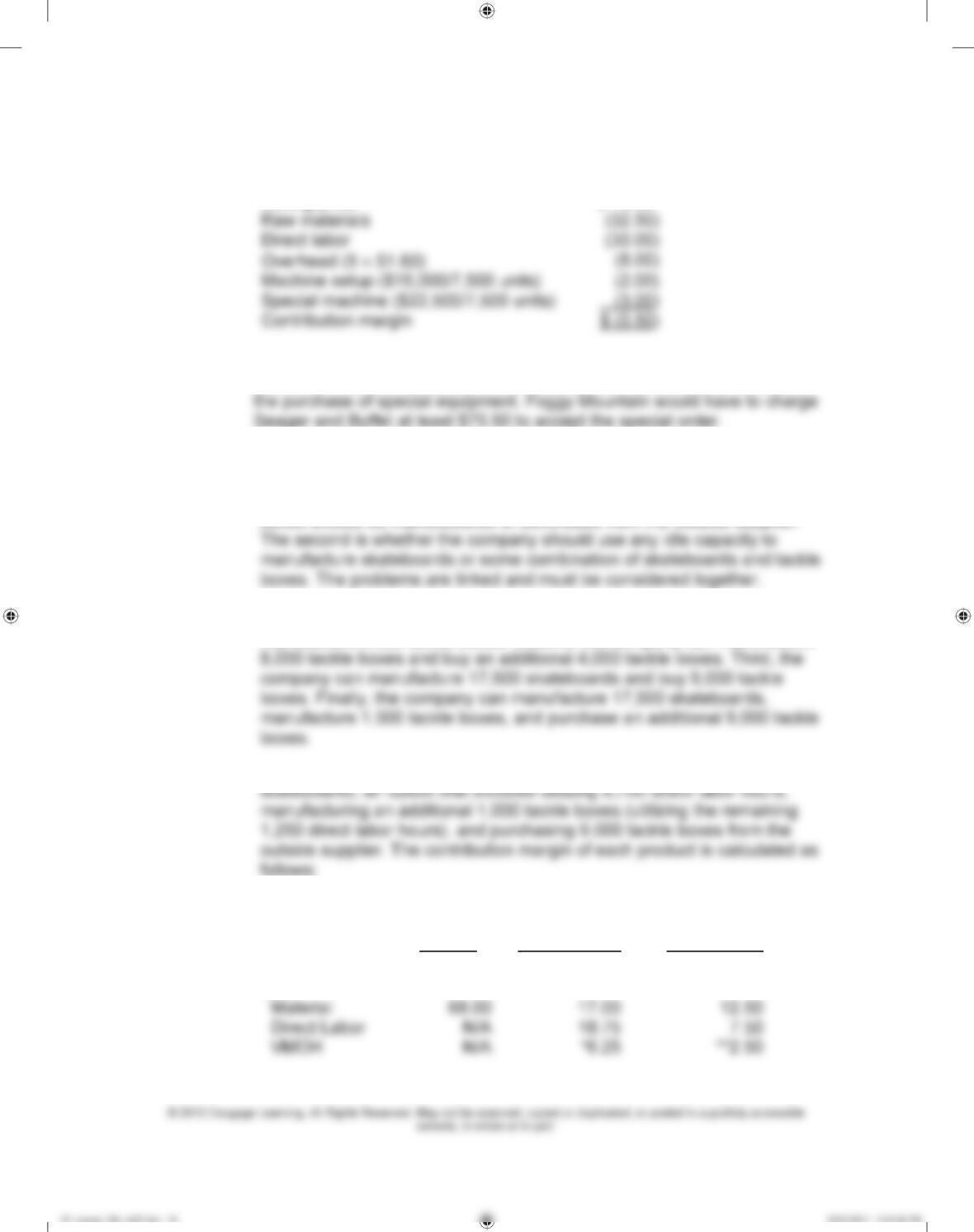
D. The unit contribution is computed as follows:
Selling price $ 75.00
E. The company would lose $0.50 per unit, for a total loss of $3,750
($0.50 × 7,500 units), because of the additional machine setup costs and
34. (LO2 and 4—Decision focus: Comprehensive make-or-buy)
A. The problem for Avery is really twofold. The first problem is whether tackle
boxes should be manufactured or purchased from the outside supplier.
B. Avery has several options. First, the company can continue to
manufacture 8,000 tackle boxes. Second, the company can manufacture
C. The best option from a quantitative perspective is to manufacture 17,500
Purchased
Tackle
Boxes
Manufactured
Tackle Boxes
Manufactured
Skateboards
Selling Price $86.00 $ 86.00 $ 45.00
Less:
Chapter 7: Relevant Costs and Product-Planning Decisions
7-17
Selling & Admin. 4.00 ***11.00 ****3.00
CM $14.00 $33.00 $19.50
CM per direct
labor hour
N/A $26.40
($33/1.25 hr)
$39.00
($19.50/0.5 hr)
On the basis of this analysis, the most profitable product is the
manufactured skateboard, followed by the manufactured tackle box.
Purchased tackle boxes are the least profitable product. Producing 17,500
skateboards will require 8,750 direct labor hours (17,500 × 0.5 hour per
board). Because 10,000 labor hours are available, Avery can manufacture
an additional 1,000 tackle boxes requiring 1,250 direct labor hours. Avery
should then purchase 9,000 tackle boxes (the maximum number that
Craig Products will sell).
D. Qualitative factors include the quality of the product bought from the
outside source, the continuing availability of the product, and the ability of

07_sawyer_SM_ch07.doc 1807_sawyer_SM_ch07.doc 18 10/21/2011 3:33:49 PM10/21/2011 3:33:49 PM