
7-21
LO 7-5. Describe how
information technology (IT) is
helping managers build
strategic alliances and
network structures to increase
efficiency and effectiveness.
POWERPOINT SLIDES 7-36 TO 7-
39
Chapter 07 – Designing Organizational Structure
7-22
Lecturer Enhancer 7.1
ORGANIZING FOR CUSTOMER SERVICE
supported a secondary site which was fully operational and configured to meet the backup processing
requirements of the main production facility.
The situation for Chase was potentially threatening. If on-line systems failed to process even one day’s
worth of transactions, the bank could be subject to serious penalties. Two Digital field service crews were
on the scene before dawn—one downtown and another at one of the bank’s contingency sites.
Simultaneously, a Digital team from manufacturing, sales, and field service banded together, coordinating
overnight delivery of additional parts and peripherals. That same day, the operational site was fully
operational, enabling Chase to successfully complete 95 percent of its business volume. Digital
continuously worked with bank personnel until the main production site was back in business. For Chase
customers, it was business as usual.
Lecture Enhancer 7.2
FLEXIBLE DESIGN EXTENDS TO THE WORKPLACE
Businesses, having become convinced of the value of teamwork, are starting to redesign offices to
accommodate the teams. Braun Inc., a small appliance manufacturer and a Gillette Co. subsidiary,
recently celebrated its move from a traditional office building in Lynnfield, Mass. to a two-story, 38,000-
square-foot site where employees meet at oases furnished with cafe-style tables and chairs, computer
terminals for Internet browsing, and aquariums stocked with exotic fish.
“We wanted to change the rules and create a more open environment that would encourage
communication and collaboration,” said president Bruce Cleverly. “We had already restructured our
business by creating cross-functional teams that allow our finance, logistics, sales, and marketing people
LECTURE ENHANCERS
Chapter 07 – Designing Organizational Structure
7-23
Not surprising, the office-furniture industry has capitalized on the trend, aggressively marketing
flexible furnishings for the flexible workspace. One example: Personal Harbor, a Steelcase Inc.
product that helps companies build their own collaborative office spaces with cabinets on wheels,
screens with dual functions, and other portable furnishings.
To be sure, the much-maligned cubicle of Dilbert fame still exists. But at Braun, the standard cubicle now
includes stylish glass openings that allow employees to see beyond their own gray walls and reflect light
from the banks of windows that line the office.
Braun’s Cleverly described the impetus for creating the new, open office. With company sales expected
to reach the $500 million mark next year, the firm needed more space, giving it a ready-made opportunity
to move to a more open floor plan. So Braun hired architects Jung & Brennan Inc. to draw up plans for
Notes for Topics for Discussion and Action
(Note to Instructors: Students’ answers may vary. The answers given below are only indicative.)
DISCUSSION:
1. Would a flexible or a more formal structure be appropriate for these organizations: (a) a large
department store (b) a Big Four accountancy firm (c) a biotechnology company? Explain your reasoning.
MANAGEMENT IN ACTION
Chapter 07 – Designing Organizational Structure
7-24
A biotechnology firm should also implement a flexible structure, due to the ever-changing and developing
2. Using the job characteristics model as a guide, discuss how a manager can enrich or enlarge
subordinates’ jobs.
A university has many different departments and positions, so a typical job may not be easy to identify.
3. How might a salesperson’s job or a secretary’s job be enlarged or enriched to make it more
motivating?
4. When and under what conditions might managers change from a functional to (a) a product (b) a
geographic, or (c) a market structure?
Chapter 07 – Designing Organizational Structure
7-25
A geographic structure may be adopted when organizations are expanding rapidly both at home and
5. How do matrix structures and product team structures differ? Why is the product team structure more
widely used?
6. As high-powered, low-cost wireless technologies continue to grow, many managers soon may not need
to come to an office to do their jobs but may work at home. What are the pros and cons of such an
arrangement?
Chapter 07 – Designing Organizational Structure
7-26
ACTION
7. Find and interview a manager and identify the kind of organizational structure that his or her
organization uses to coordinate its people and resources. Why is the organization using that structure?
Do you think a different structure would be more appropriate? Which one?
8. With the same or another manager, discuss the distribution of authority in the organization. Does the
manager think that decentralizing authority and empowering employees is appropriate?
9. What are the advantages and disadvantages of business-to-business networks?
Chapter 07 – Designing Organizational Structure
7-27
possible between buyers and sellers on a global basis. The idea is that high-volume, standardized
transactions can help drive down costs at the industry level.
AACSB: Ethics
AACSB: Analytic
Notes for Building Management Skills
Understanding Organizing
Think of an organization with which you are familiar, perhaps one you have worked for— such as a store,
restaurant, office, church, or school. Then answer the following questions.
1. Which contingencies are most important in explaining how the organization is organized? Do you
think it is organized in the best way?
2. Using the job characteristics model, how motivating do you think the job of a typical employee in this
organization is?
BUILDING MANAGEMENT SKILLS

Chapter 07 – Designing Organizational Structure
7-28
Copyright © 2015 McGraw-Hill Education. All rights reserved. No reproduction or distribution without the prior written consent of McGraw-Hill
Education.
Based upon the job characteristics model, the job of a professor should be extremely motivating since
skill variety, task significance, task identity, autonomy and feedback are high. However, this may not be
the case for a member of the university’s administrative staff, such a secretary of a department. Skill
variety may be sufficient if the secretary feels that she uses a wide range of skills, abilities, and
knowledge. However, task identity may be low, since there is little opportunity to complete a job from
start to finish.
Chapter 07 – Designing Organizational Structure
7-29
3. Can you think of any ways in which a typical job could be enlarged or enriched?
4. What kind of organizational structure does the organization use? If it is part of a chain, what kind of
structure does the entire organization use? What other structures discussed in the chapter might allow the
organization to operate more effectively? For example, would the move to a product team structure lead
to greater efficiency or effectiveness? Why or why not?
5. How many levels are there in the organization’s hierarchy? Is authority centralized or decentralized?
Describe the span of control of the top manager and of middle or first-line managers.
Chapter 07 – Designing Organizational Structure
7-30
Copyright © 2015 McGraw-Hill Education. All rights reserved. No reproduction or distribution without the prior written consent of McGraw-Hill
Education.
The president has a large span of control, or many subordinates that he or she directly manages. The
heads of departments, which can be viewed as middle managers, have large spans of control as well. A
professor, which may be viewed as a first line manager, would have a small span of control, perhaps only
over a few graduate students.
6. Is the distribution of authority appropriate for the organization and its activities? Would it be possible
to flatten the hierarchy by decentralizing authority and empowering employees?
7. What are the principal integrating mechanisms used in the organization? Do they provide sufficient
coordination among individuals and functions? How might they be improved?
7-31
8. Now that you have analyzed the way this organization is structured, what advice would you give its
managers to help them improve the way it operates?
AACSB: Analytic
(Note to Instructors: Students’ answers may vary. The answers given below are only indicative.)
Questions
1. What ethical rules (see Chapter 3) should managers use to decide which employees to terminate when
redesigning their hierarchy?
2. Some people argue that employees who have worked for an organization for many years have a claim
on the organization at least as strong as that of its shareholders. What do you think of the ethics of this
position—can employees claim to “own” their jobs if they have contributed significantly to its past
success? How does a socially responsible organization behave in this situation?
AACSB: Ethics
Notes for Small Group Breakout Exercise
MANAGING ETHICALLY
SMALL GROUP BREAKOUT EXERCISE
Chapter 07 – Designing Organizational Structure
7-32
Bob’s Appliances
You are a team of local consultants that Bob has called in to advise him as he makes this crucial choice.
Which structure do you recommend? Why?
AACSB: Analytic
Questions
1. Discuss ways in which you can improve how the current functional structure operates so that it speeds
website development.
2. Discuss the pros and cons of moving to a (a) multidivisional, (b) matrix, or (c) product-team structure
to reduce website development time.
3. Which of these structures do you think is most appropriate, and why?
BE THE MANAGER
Chapter 07 – Designing Organizational Structure
7-33
Case Synopsis: 80% of Zappos Employees No Longer Have a Manager
Zappos announced late last year that it would eliminate titles and traditional managers from its
company. The company says that 80% of its 1,500 employees are now working under Holacracy,
a new organizational philosophy meant to offer workers more flexibility by replacing traditional
job titles with a fluctuating number of roles that each employee is assigned. Rather than being
accountable to a single boss in a traditional hierarchy, each employee reports to the other people
in their “circles.” Each circle has an organizational goal to achieve, and each role that people fill
within the circle is a task necessary for accomplishing that goal.
Questions
1. How might fluctuating job roles affect employees’ productivity?
2. As an employee, what advantages and disadvantages do you see to Holacracy?
3. Search the Internet and outline additional changes that have occurred at Zappos since the
new management structure was implemented. Do you think the structure will be a
success? Why or why not?
Business Insider Case in the News

Chapter 07 – Designing Organizational Structure
7-34
Copyright © 2015 McGraw-Hill Education. All rights reserved. No reproduction or distribution without the prior written consent of McGraw-Hill
Education.
enhanced creativity, communications, and involvement in the company that the system offers.
Students who think Holacracy will not succeed might mention the confusion and insecurity
employees feel because of the new system.
AACSB: Analytic
• Virtual Workplace: Out of Office Reply
• Working in Teams: Cross-Functional Dysfunction
SUPPLEMENTAL FEATURES
MANAGER’S HOT SEAT (MHS)
Chapter 07 – Designing Organizational Structure
7-35
These Instructor’s PowerPoint slides can be used to supplement the lecture material.
INSTRUCTOR’S
POWERPOINT SLIDE 1
Chapter Title
INSTRUCTOR’S
POWERPOINT SLIDE 2
Learning Objectives
INSTRUCTOR’S
POWERPOINT SLIDE 3
Learning Objectives
POWERPOINT SLIDE 4
Designing Organizational
Structure
POWERPOINT SLIDE 5
Organizational Structure
POWERPOINT SLIDE 6
Organizational Design
INSTRUCTOR’S
POWERPOINT SLIDE 7
Figure 7.1 – Factors
INSTRUCTOR’S
POWERPOINT SLIDE 8
Question?
INSTRUCTOR’S
POWERPOINT SLIDE 9
Job Design
INSTRUCTOR’S POWERPOINT SLIDES

Chapter 07 – Designing Organizational Structure
7-36
INSTRUCTOR’S
POWERPOINT SLIDE 10
INSTRUCTOR’S
POWERPOINT SLIDE 11
INSTRUCTOR’S
POWERPOINT SLIDE 12
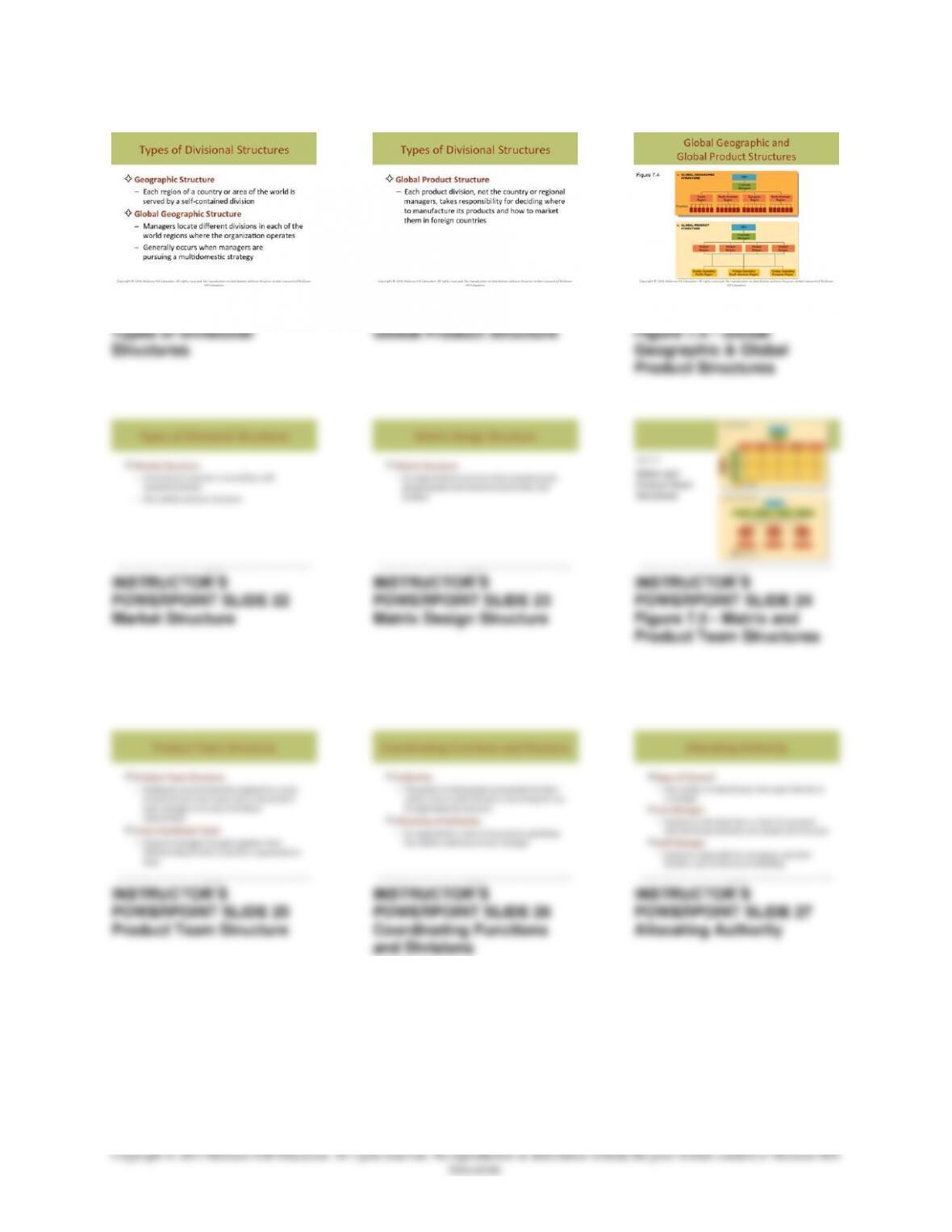
Chapter 07 – Designing Organizational Structure
7-37
INSTRUCTOR’S
POWERPOINT SLIDE 19
INSTRUCTOR’S
POWERPOINT SLIDE 20
INSTRUCTOR’S
POWERPOINT SLIDE 21
and Divisions
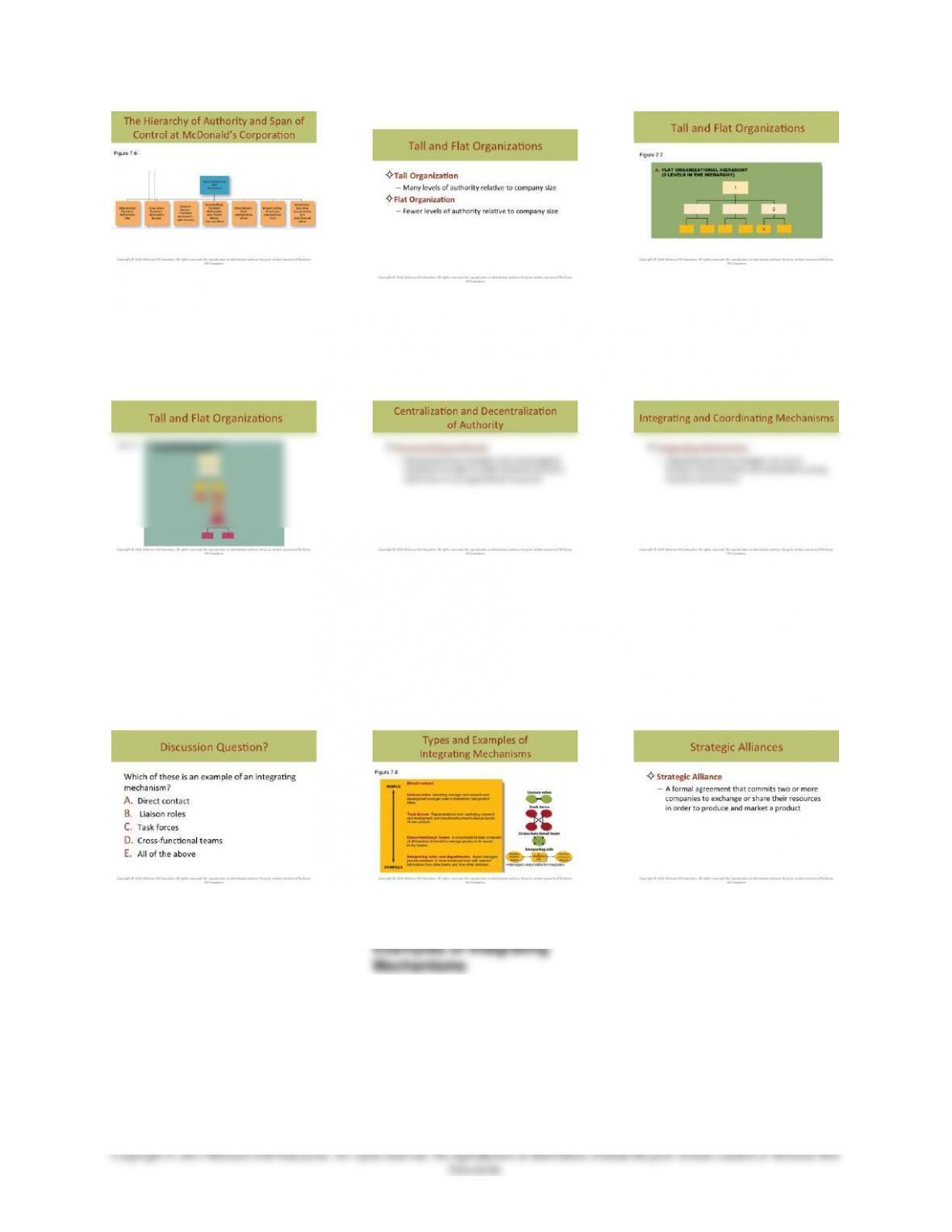
Chapter 07 – Designing Organizational Structure
7-38
INSTRUCTOR’S
POWERPOINT SLIDE 28
Figure 7.6 – The Hierarchy
of Authority at McDonald’s
INSTRUCTOR’S
POWERPOINT SLIDE 29
Tall and Flat Organizations
INSTRUCTOR’S
POWERPOINT SLIDE 30
Figure 7.7 – Tall & Flat
Organizations
INSTRUCTOR’S
POWERPOINT SLIDE 31
Figure 7.7 – Tall & Flat
Organizations
INSTRUCTOR’S
POWERPOINT SLIDE 32
Centralization and
Decentralization of
Authority
INSTRUCTOR’S
POWERPOINT SLIDE 33
Integrating and
Coordinating Mechanisms
INSTRUCTOR’S
POWERPOINT SLIDE 34
Discussion Question?
INSTRUCTOR’S
POWERPOINT SLIDE 35
Figure 7.8 – Types and
INSTRUCTOR’S
POWERPOINT SLIDE 36
Strategic Alliances
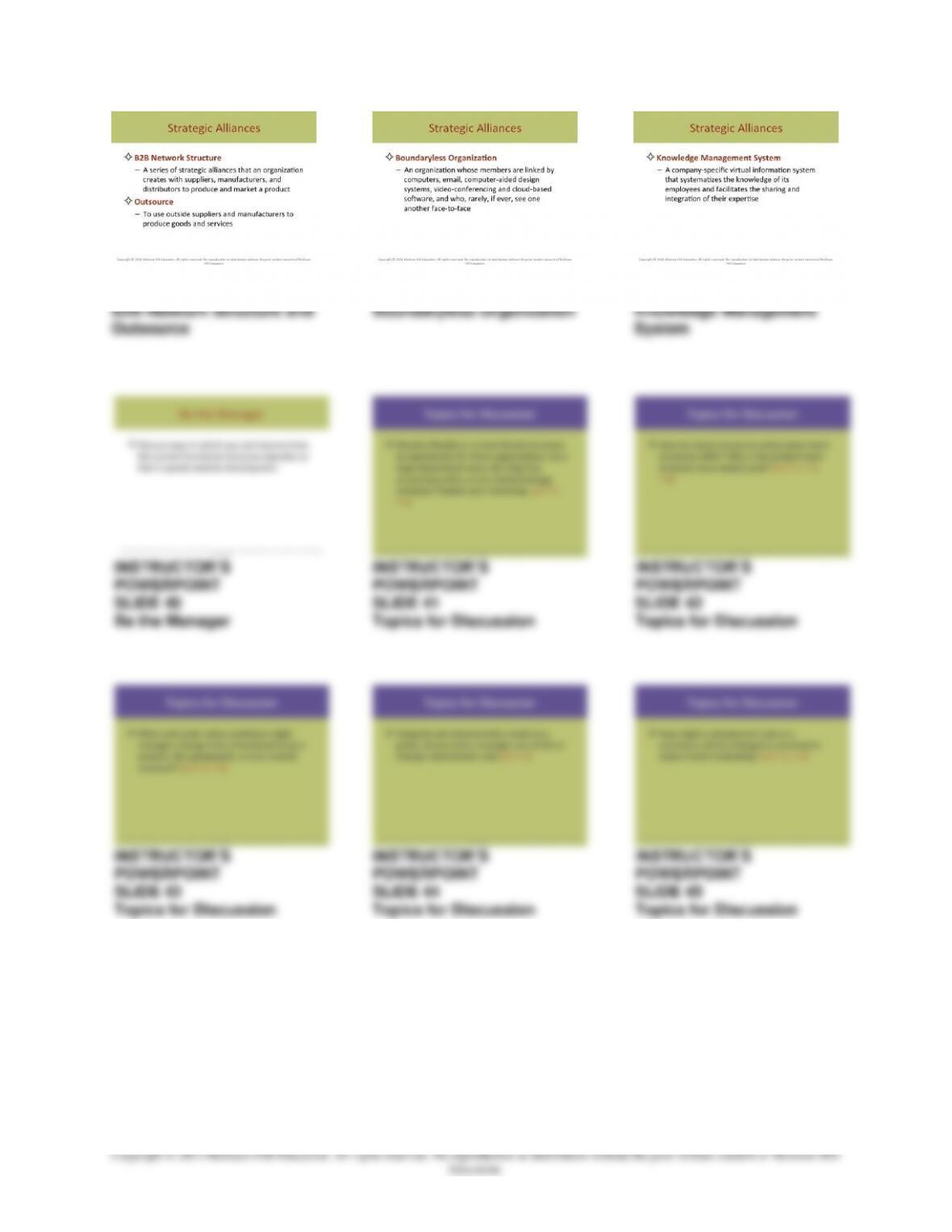
Chapter 07 – Designing Organizational Structure
INSTRUCTOR’S
POWERPOINT SLIDE 37
INSTRUCTOR’S
POWERPOINT SLIDE 38
INSTRUCTOR’S
POWERPOINT SLIDE 39

Chapter 07 – Designing Organizational Structure
7-40
INSTRUCTOR’S
POWERPOINT
SLIDE 46
Topics for Discussion