Chapter 07 – e-Business Systems
7-1
7 e-Business Systems
CHAPTER OVERVIEW
Chapter 7: e-Business Systems describes how information systems integrate and support enterprisewide business
processes, as well as the business functions of marketing, manufacturing, human resource management, accounting,
and finance.
LEARNING OBJECTIVES
After reading and studying this chapter, you should be able to:
1. Identify the following cross-functional enterprise systems, and give examples of how they can provide
significant business value to a company:
a. Enterprise application integration
SUMMARY
• Cross-Functional Enterprise Systems. Major e-business applications and their interrelationships are summarized
in the enterprise application architecture of Figure 7.2 . These applications are integrated cross-functional enterprise
systems such as enterprise resource planning (ERP), customer relationship management (CRM), and supply chain
collaboration systems.
• Transaction Processing Systems. Online transaction processing systems play a vital role in business. Transaction
processing involves the basic activities of (1) data entry, (2) transaction processing, (3) database maintenance, (4)
• Functional Business Systems. Functional business information systems support the business functions of
marketing, production/operations, accounting, finance, and human resource management through a variety of e–
business operational and management information systems summarized in Figure 7.11.
Chapter 07 – e-Business Systems
marketing managers in e-commerce product development and customer relationship decisions, as well as in planning
advertising and sales promotion strategies and developing the e-commerce potential of new and present products and
new channels of distribution.
• Manufacturing. Computer-based manufacturing information systems help a company achieve computer–
integrated manufacturing (CIM), and thus simplify, automate, and integrate many of the activities needed to quickly
• Human Resource Management. Human resource information systems support human resource management in
organizations. They include information systems for staffing the organization, training and development, and
compensation administration. HRM Web sites on the Internet or corporate intranets have become important tools for
providing HR services to present and prospective employees.
• Accounting and Finance. Accounting information systems record, report, and analyze business transactions and
KEY TERMS AND CONCEPTS
1. Accounting Information Systems ():
Accounting information systems record and report business transactions, the flow of funds through an
organization, and produce financial statements. They provide information for the planning and control of
business operations as well as for legal and historical record-keeping.
3. Accounts receivable (295):
A type of transaction processing based accounting system focused on managing payments owed by customers.
4. Batch Processing ():
5. Computer-Aided Manufacturing ():
6. Computer-Integrated Manufacturing ():
An overall concept that stresses that the goals of computer use in factory automation should be to simplify,
automate, and integrate production processes and other aspects of manufacturing.
7. Cross-Functional Enterprise Systems ():

8. E-Business ():
9. Enterprise Application Architecture ():
With an enterprise application architecture, businesses use the Internet and other networks for e-commerce,
10. Enterprise Application Integration ():
Companies use enterprise application integration to connect their major e-business applications. EAI software
11. Enterprise Collaboration Systems ():
12. Financial Management Systems ():
13. Functional Business Systems ():
14. General ledger ():
A type of transaction processing based accounting system serving as the primary record for all of an
organization’s transactions.
15. Human Resource Information Systems ():
16. Interactive Marketing ():
17. Inventory control ():
18. Machine Control ():
The technology of controlling machine tools by computers.
19. Manufacturing Execution Systems ():
7-4
20. Manufacturing Information Systems ():
21. Marketing Information Systems ():
22. Online accounting systems ()
An accounting system that is directly connected to a transaction using internet technologies.
23. Online HRM systems ()
24. Online Transaction Processing Systems ():
A real-time system that captures and process transactions online via the Web.
25. Order processing ():
26. Payroll ():
27. Process Control ():
The use of a computer to control an ongoing physical process such as petrochemical production.
28. Real-time Processing ():
Also called online processing, where data are processed immediately after a transaction.
29. Sales Force Automation ():
30. Targeted Marketing ():
31. Transaction Processing Cycle ():
Chapter 07 – e-Business Systems
7-5
ANSWERS TO REVIEW QUIZ
Q.
A.
Key Term
Q.
A.
Key Term
1
E-business
17
Accounting information systems
2
Cross-functional enterprise systems
18
Online accounting systems
3
Functional business systems
19
Order processing
4
Enterprise application architecture
20
Inventory control
5
Enterprise application integration
21
Accounts receivable
6
Marketing information systems
22
Accounts payable
7
Interactive marketing
23
Payroll
8
Sales force automation
24
General ledger
9
Manufacturing information systems
25
Financial management systems
10
Computer-integrated manufacturing
26
Manufacturing execution systems
11
Computer-aided manufacturing
27
Targeted marketing
12
28
Transaction processing cycle
13
Process control
29
Batch processing
14
Machine control
30
Real-time processing
15
Human resource information systems
31
Online transaction processing system
16
Online HRM systems
ANSWERS TO DISCUSSION QUESTIONS
1. Refer to the Real World Challenge in the chapter, where the difficulty of making a business case for
integration projects is discussed. What could managers do to make the benefits of those projects more
clear? Should these be evaluated as any other IT project?
One thing most business managers understand is costs and profits. The case could be presented in terms of the
current monthly/yearly costs that will be saved by replacing the legacy systems, or in terms of the profits that
Chapter 07 – e-Business Systems
2. Why is there a trend toward cross-functional integrated enterprise systems in business?
Cross-functional systems offer time, cost, and quality savings. Integrated systems also provide managers with
faster access to relevant information, and organizations need to become more nimble in order to respond to
changing markets.
• Sharing of information resources
3. Which of the 13 tools for accounting information systems summarized in Figure 7.18 do you feel are
essential for any business to have today? Which of them do you feel are optional, depending on the type
of business or other factor? Explain.
The author does make the distinction between essential and non–essential. Some of these items on the optional
list have more functional substitutes on the “essential” list, for example “paging” and “voice mail”.
Essential:
• Electronic mail
4. What other solutions could there be for the problem of information systems incompatibility in business
besides EAI systems?
Alternatives to an EAI system, which comprises middleware between disparate business function-oriented
systems, would be to purchase an integrated enterprise-wide suite. Such suites are built to work together.
Chapter 07 – e-Business Systems
7-7
5. What are the most important HR applications a company should offer to its employees via a Web-based
system? Why?
Important HR applications
• Policy references
• Training materials
6. How could sales force automation affect salesperson productivity, marketing management, and
competitive advantage?
Salesperson productivity:
• Puts product and contract information at a salesperson’s fingertips
• Automates error checking
7. How can Internet technologies be involved in improving a process in one of the functions of business?
Choose one example and evaluate its business value.
Students may pick from any number of examples within this chapter. Answers should consider improvements
8. Refer to the Real World Solution in the chapter. What are some of the prerequisites for a successful
implementation of the service-oriented approach, as in Qualcomm’s case? Would it work in any
organizational environment?
The first requirement for successful implementations such as that at Qualcomm is finding a product that

Chapter 07 – e-Business Systems
7-8
9. What are several e-business applications that you might recommend to a small company to help it survive
and succeed in challenging economic times? Why?
Recommendations:
• Web publishing – to create current web presence
10. Refer to the example on virtual worlds in the chapter. How do enterprise collaboration systems
contribute to bottom-line profits for a business?
Contributions
• Cheaper than telephone and travel
ANSWERS TO ANALYSIS EXERCISES
1. Hybrid Application Service Providers
a. Skype offers audio, video, and instant messaging tools (see the Features link at www.skype.com).
Compare the Skype tools to the equivalent Google offerings. Prepare a table in Word or write a one-page
paper (at your instructor’s request) to compare these competing tools. Place Feature, Skype, and Google
as column headers. List individual features under “Feature” in the left-most column. Place the symbol
“●” in the cell if it’s a current feature for each competitor. Leave the cell blank if it isn’t available at all.
Give the table a professional appearance.
This is a practical, product comparison exercise. Students will also gain experience formatting tables and
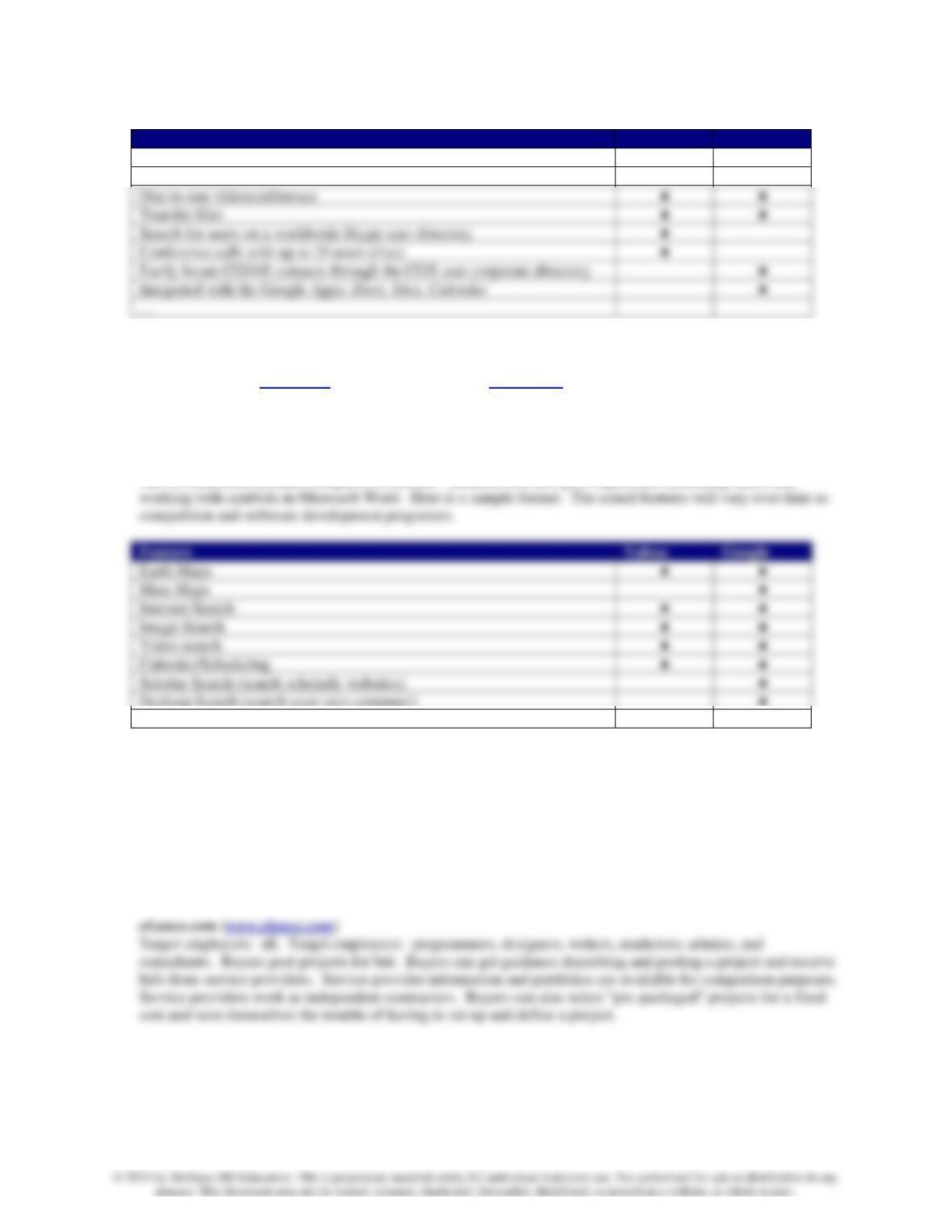
Chapter 07 – e-Business Systems
7-9
Feature
Skype
Google
Instant messaging (IM) and group chat
●
●
PC–to-PC calls (VoIP)
●
●
●
●
Transfer files
●
●
Search for users on a worldwide Skype user directory
●
Conference calls with up to 25 users (free)
●
Easily locate CGIAR contacts through the CGX user corporate directory
●
Integrated with the Google Apps: Docs, Sites, Calendar
●
…
Feature
Yahoo
Google
Earth Maps
●
●
Mars Maps
●
Internet Search
●
●
Image Search
●
●
Calendar/Scheduling
●
●
Scholar Search (search scholarly websites)
●
b. Yahoo and Google are in a heated competition for the same user base. Look up the latest developments
for Yahoo at next.yahoo.com and for Google at labs. google.com . Prepare a table in Word to compare
current and beta features for Yahoo and Google. Place “Feature,” “Google,” and “Yahoo” as column
headers. List individual features under “Feature” in the left–hand column. Place the symbol “•” in the
cell if it’s a current feature for each competitor and the symbol “0” in the cell if it’s a beta feature. Leave
the cell blank if it isn’t available at all. Give the table a professional appearance.
This is a practical, product comparison exercise. Students will also gain experience formatting tables and
Desktop Search (search your own computer)
●
…
2. In Search of Talent
Solutions:
a. Prepare a review for each job site listed above. Include target employers, target employees, and notable
Web site features.
All sites provide buyer and seller information.
Chapter 07 – e-Business Systems
7-10
b. Which site did you find most useful? Why?
Job seekers find it frustrating applying for jobs and receiving generic rejects with “do not reply” e-mail
3. Integrating Data Capture
a. Use a search engine to look up the Supra iBox. Describe the product’s capabilities.
b. Describe the next-generation product you might sell Rosemary once keyless locks become commonplace.
4. Word’s Mail Merge
Solutions:
This is a very powerful tool. Through its “mail merge” feature, Microsoft Word can create customized letters,
a. Download and save “partners.xls” from the MIS 10e OLC.
b. Use Microsoft Word’s mail merge feature to generate name tags sorted by last name and then first name.
Use a suitable name tag template, and format the name tag as illustrated below. Be sure to include first
name, last name, industry, and region. Turn in either the first two pages of the merged names or the
merged file, depending on your professor’s preference.
Chapter 07 – e-Business Systems
7-11
See Data Solutions Disk for a sample merge template and merged document. Students may have difficulty with
5. Federated Search
a) Read up on “federated search”. List the obvious strengths and weaknesses.
Weaknesses
• Searches only sources its been programmed to search – so some useful sources could be omitted
b) Visit DWT’s demo page (http://bit.ly/k31KKb) and run a couple of searches. Run the same searches
through a standard search engine. How does the experience differ? How do the results differ?
• Experience
Three wasn’t any difference as far as writing the query goes. DWT’s query took much longer to run. DWT’s
c) What advantages do you think DWT gains by using web enabled, cloud based applications to manage its
business?
Advantages
• Low cost (or free)
Chapter 07 – e-Business Systems
7-12
ANSWERS TO REAL WORLD CHALLENGE/SOLUTION
Real World Challenge
1. Looking at the situation that Qualcomm faces, how does a large, technology-oriented company get to this
point? What would be some of the underlying reasons that would make the development of separate
applications a priority over careful orchestrated integration?
Underlying causes
• lack of overall vision
2. What does it mean to say that technology can “either constrain or enable its capacity to create and
deliver new products and services”? In which ways?
3. Moving forward, what are some of the alternatives open to Qualcomm? Should it replace its integration
approach with a different one, or rewrite all of its legacy applications from scratch? Or should it do
something in between? What are the advantages and disadvantages of each alternative?
Alternatives:
Continue supporting existing system
Advantages
Rebuild system to integrate more smoothly
Advantages
Chapter 07 – e-Business Systems
7-13
Buy a system off the shelf (OTS) or contract software as a service (SaaS)
Advantages
• faster to to implement
Real World Solution
1. How are services different than the existing point-to–point integration approach? Where does their value
come from?
Difference
• application service calls v. “hard wiring” each application pairing
2. Consider the approach taken by Qualcomm to roll out services into its IT infrastructure. What were its
strong points? Were there any weaknesses? What could they have done differently?
Strong points
• fast to implement
Chapter 07 – e-Business Systems
7-14
ANSWERS TO REAL WORLD CASES
RWC 1: Toyota Europe, Campbell Soup Company, Sony Pictures, and W.W. Grainger
Case Study Questions
1. What does the position of enterprise architect entail? What qualifications or experiences would you think
a good enterprise architect should have? Support your answer with examples from the case.
Enterprise Architect Job Description
• Connect computing systems
2. Consider the different companies mentioned in the case and their experiences with enterprise
architecture. Does this approach seem to work better in certain types of companies or industries than in
others? Why or why not?
Yes
The industries represented in the case varied significantly except in one regard: each business was large with
3. What is the value derived from companies with mature enterprise architectures? Can you see any
disadvantages? Discuss.
Value
• Shared knowledge
Chapter 07 – e-Business Systems
7-15
Real World Activities
1. Service oriented architecture (SOA) is a recent approach to systems development and implementation
that has much in common (and some differences, as well) with enterprise architecture. Go online and
research the similarities and differences. Prepare a report to summarize your work.
Search terms
SOA ERP
Analysis
Enterprise architecture integrates an organization in ways that result in lower IT operating costs (less
2. Have you considered a career as an enterprise architect? What bundle of courses would you put together
to design a major or a track in enterprise architecture? Break into small groups with your classmates to
outline the major areas that should be covered.
Course of study
• BS/MS in computer science
RWC 2: Nationwide Insurance
Case Study Questions
1. The project that Nationwide undertook was quite clearly a success. What made this possible? Discuss
three different practices that helped Nationwide pull this off. Use examples from the case where
necessary.
Success factors
• Top management commitment
2. The case notes that Nationwide had in mind a simple goal, but faced a difficult challenge. Why was this so
difficult?
Difficulties
• Integrating 14 general ledgers
Chapter 07 – e-Business Systems
7-16
3. What is the business value derived from the successful completion of this project? What can executives at
Nationwide do now that could not before? Provide some examples.
Business value
• Financial portfolio risk management
Real World Activities
1. Technologies and systems involved in financial reporting have received a great deal of attention in the
last few years due to renewed regulatory focus on the integrity and reliability of financial information.
Go online and research how companies are deploying technology to deal with these issues. Prepare a
report to summarize your findings.
2. A number of political and cultural issues were involved in the implementation of the “one source of the
truth” approach at Nationwide. Can these obstacles be overcome simply by mandating compliance from
top management? What else should companies do to help ease these transitions? Break into small groups
with your classmates and brainstorm some possible actions.
No
Mandates alone can not work. Implementers need authority, resources, expertise, and accountability as well as