
Chapter 07 – Leadership Behavior
7-1
Leader
Part 2: Focus on the Leader
Chapter 7: Leadership Behavior

Chapter 07 – Leadership Behavior
7-2
Chapter 7 Outline
Leadership Behavior
Introduction
Studies of Leadership Behavior
Why study leadership behavior?

Chapter 07 – Leadership Behavior
7-3
Key Learning Points
Introduction
Rather than describe the values, personality traits, or mental abilities of leaders, this chapter focuses
on describing and assessing what leaders actually do on a day-to-day basis. Once researchers
Studies of Leadership Behavior
Early conceptualizations of leadership developed from the Ohio State and University of Michigan
studies that grouped leader behaviors into task-oriented and people-oriented behavioral dimensions.
The Leadership Pipeline
The Leadership Pipeline is a useful model for explaining where leaders need to spend their time,
what they should be focusing on and what they should be letting go, and the types of behaviors they
Community Leadership
Although organizational competency models have played a pervasive role in selecting, developing,
Assessing Leadership Behaviors: Multirater Feedback Instruments
One popular way to assess leadership behavior is through multirater or 360-degree feedback
assessments, which gather ratings from self, peers, bosses, and followers about specific leadership
behaviors exhibited by a particular leader. 360-degree feedback can give leaders insight into whether
they need to do anything differently to build stronger teams or get better results through others.

Chapter 07 – Leadership Behavior
7-4
Brief Definitions of the Key Terms for Chapter 8
Leader Behavior Description Questionnaire (LBDQ): An early leadership behavior assessment
developed by researchers at Ohio State.
Concern for people: One of the dimensions in the Leadership Grid.
Concern for production: One of the dimensions in the Leadership Grid.
Leadership behavior: A specific action, such as “setting specific performance goals for team members.”
Leadership skill: A well-defined body of knowledge, a set of related behaviors, and clear criteria of
competent performance
Competency models: Models that describe the types of behaviors and skills managers in a particular
organization must exhibit if that organization is going to be successful.
Intrapersonal skills: One of four major categories found in most 360-feedback questionnaires that focus
on adapting to stress, personal drive, and adhering to rules.
Interpersonal skills: One of four major categories found in most 360-feedback questionnaires that focus
on communicating and building relationships with others.
Leadership skills: One of four major categories found in most 360-feedback questionnaires that focus on
building teams and getting results through others.
Business skills: One of four major categories found in most 360-feedback questionnaires that focus on
formulating strategies, solving problems, and building plans.

Chapter 07 – Leadership Behavior
7-5
Overview of the Learning Resources for Chapter 7
Exercise 7-1: What are your Career Prospects as a Leader? This 15-minute self-assessment gives
students information about the kinds of behaviors needed to be a successful leader. Students can discuss
their results in a 15 minute small group session.
Exercise 7-2: The Day in the Life Exercise. In this 40-minute exercise, students identify and estimate the
Exercise 7-4: Exploring Community Leadership. Teams of students analyze local community change
initiatives using the Community Leadership Framework described in Chapter 8. Each group then creates
and delivers a 5–10 minute presentation of their findings.
Exercise 7-5: The Water Glass. This 15-minute experiential exercise shows how people can leverage their
strengths to a much greater extent than they ever imagined.
Exercise 8-7: Coaching Skills Inventory. This assessment gets at the five critical dimensions of effective
coaching behavior and can either be done in class or as a homework assignment. The Coaching Skills
Exercise 7-8: Blind Soccer. This 45 minute session gives students the opportunity to coach others in a
highly competitive exercise.
Case Studies: The minicase, “Paying Attention Pays Off for Andra Rush,” at the end of Chapter 7
provides a number of good leadership behaviors to analyze, and Case Studies #2 and #8 provide examples
of self-defeating behaviors.
Chapter 07 – Leadership Behavior
7-6
Sample Lesson Plans for Chapter 7
Lesson 1: 60 minutes
Pre-work: Exercise 7-3, Comparing and Contrasting 360-Degree Feedback Reports.
Lesson Plan:
• Describe the relationships and differences between traits, abilities, values, and behaviors (10
minutes).
Lesson 2: 65 minutes
Pre-work: Exercise 7-7, Coaching Skills Inventory.
Lesson Plan:
• Start the lesson off with Exercise 7-6, Changing Your Appearance (30 minutes).
Chapter 07 – Leadership Behavior
Minicase, “Paying Attention Pays Off for Andra Rush,” Sample Answers
Question 1: As we have discussed, competency models describe the behaviors and skills managers
need to exhibit if an organization is to be successful. Consider the general competencies found in
Figure 7.3 and apply these to Andra Rush, providing examples of why these competencies apply.
Recall that Figure 7.3 represents the general competencies as the capitalized headings, while the samples
of behaviors listed under each heading represent the more specific skills for each competency category.
Category
Competency
Applies to Andra Rush
Intrapersonal Skills
Personal Character
Personal Leadership
Interpersonal Skills
People Leadership
– Native American heritage and its impact on her
work ethic.
– 3 trucks to 1700 trucks; leader in business
organizations and board member of several
Question 2: Mentoring has played a role in the careers of many successful minorities in leadership
positions. Who could be identified as a coach or mentor for Andra Rush?
Interestingly, although she has been very successful (and continues to excel), there is little to suggest that
Andra Rush has had a coach or mentor (either formal or informal), in the very strict sense of the
Chapter 07 – Leadership Behavior
7-8
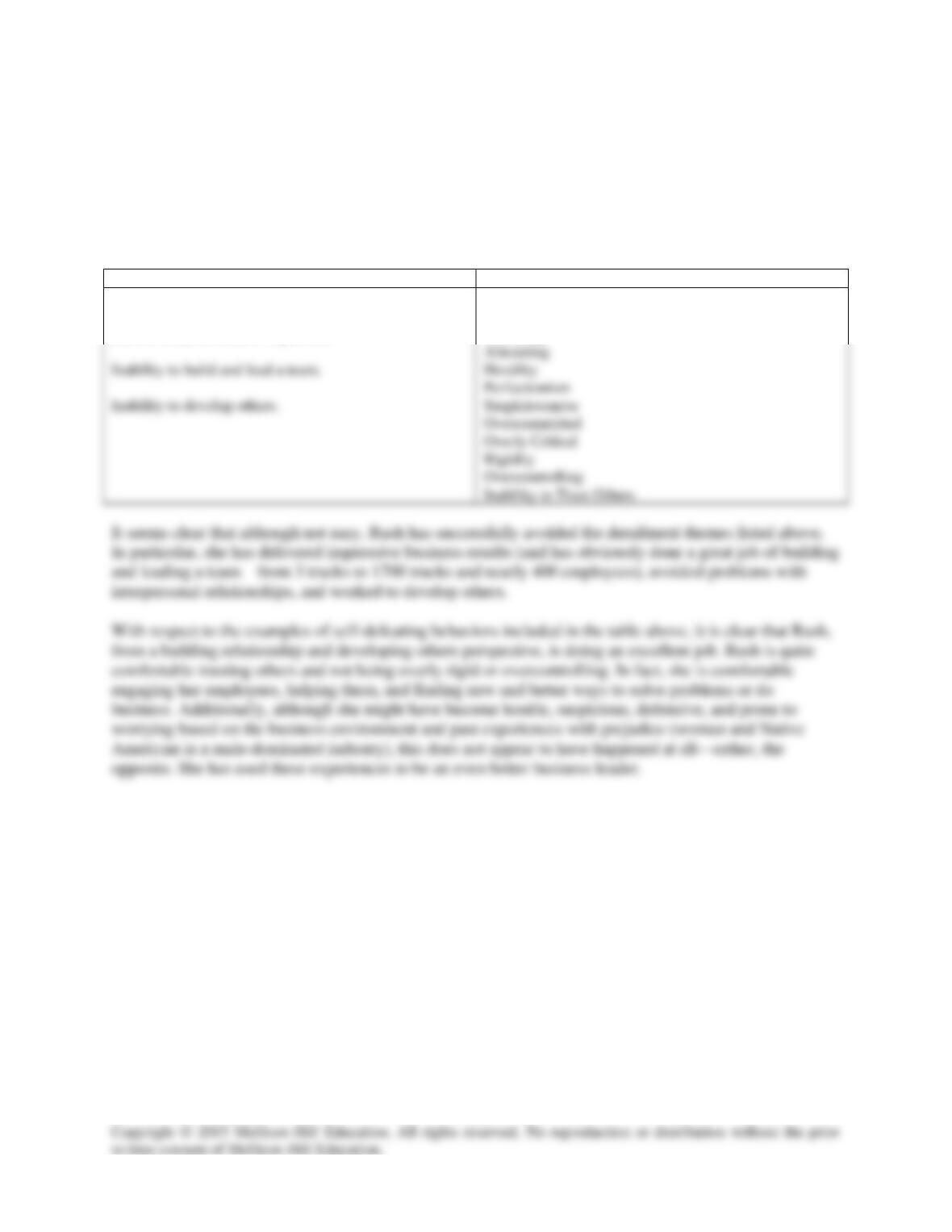
Question 3: Consider some of the managerial derailment themes outlined in this chapter. What
lessons has Andra Rush obviously learned from the failure of others?
It is also possible to ask students to link some of these behaviors to bright-side and dark-side personality
traits (Chapter 15) as well as the specific values outlined in Chapters 5 and 6. The table below also
provides some samples of self-defeating behaviors that can be linked to dark-side personality traits and
ultimately derailment or leadership failure.
Derailment Themes
Samples of Self-Defeating Behaviors
Problems with interpersonal relationships.
Failure to meet business objectives.
Procrastination
Defensiveness
Worrying

Chapter 07 – Leadership Behavior
7-9
Chapter 7 Exercises & Instructions
Exercise 7-1
Exercise Title: What are your Career Prospects as a Leader?
Purpose: To provide students with some insight about their career prospects as a leader.
Summary: Provide the students a copy of the self-quiz on the next page. Students can either take and
score the quiz as a homework assignment or complete it in class. Students should get together in small
Chapter 07 – Leadership Behavior
7-10
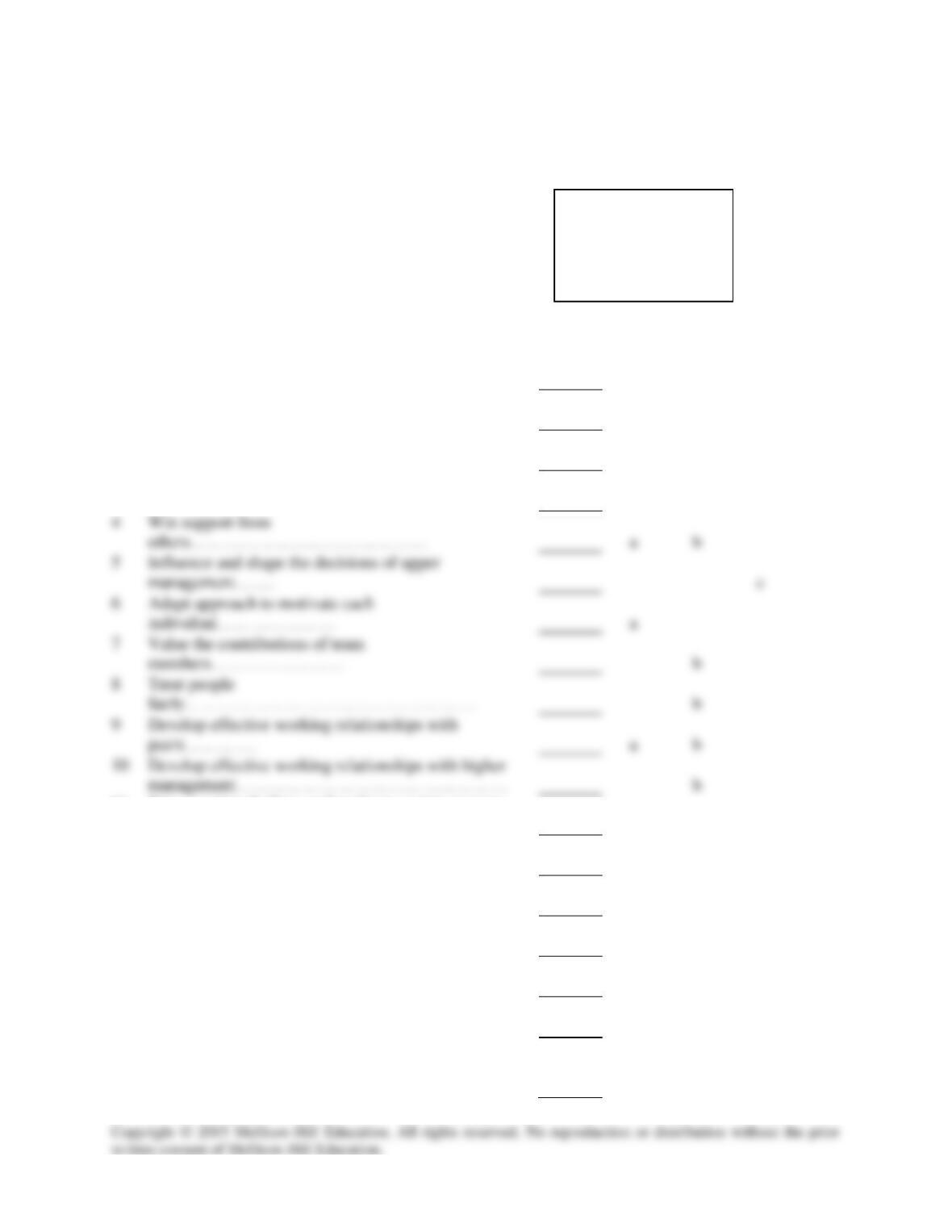
SELF-QUIZ: What Are Your Career Prospects as a Leader?
Directions: Rate the extent to which you perform the following behaviors on your job, using the
following scale:
Item
Scale
(1–5)
1
Process paperwork
efficiently………………………………..
a
c
2
Negotiate persuasively
………………………………………
c
3
Give compelling reasons for
ideas……………………………
c
4
Win support from
5
Influence and shape the decisions of upper
6
Adapt approach to motivate each
7
Value the contributions of team
8
Treat people
9
Develop effective working relationships with
10
Develop effective working relationships with higher
management…………………………………………
b
11
Take people’s feelings and preferences into account
when making decisions……………………………
b
12
Know whom to involve and
when……………………………
b
13
Address and work to resolve
conflict………………………
b
14
Speak effectively in front of a
group…………………………
c
15
Demonstrate poise in front of a
group………………………
c
16
Show consistency between words and
actions……………….
a
b
17
Are
flexible…………………………………………………
a
c
1= not at all
2= to a little extent
3= to some extent
4= to a great extent
5= to a very great extent
Chapter 07 – Leadership Behavior
7-11
18
Work constructively under stress and
19
Initiate activities without being asked to do
20
Make timely
21
Present business data in a useful manner for planning
22
Aggressively pursue ways to increase
23
Accomplish a great
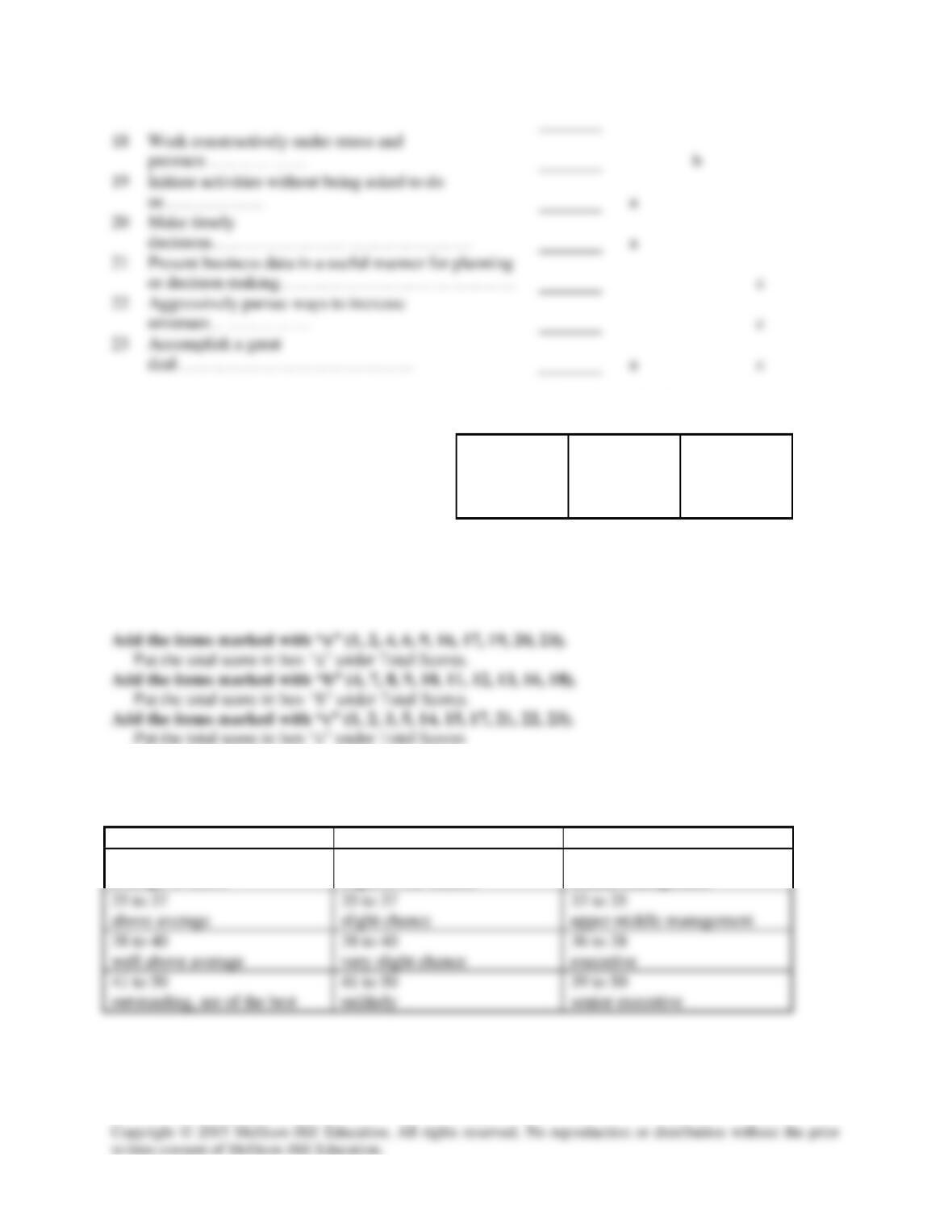
TOTAL SCORES
Put the total score in box “c” under Total Scores
Look up your scores in the table below.
Overall Competence
Derailment Potential
Long Range Potential
10 to 34
average or below
10 to 34
slight to fair chance
10 to 32
middle management
35 to 37
above average
35 to 37
slight chance
33 to 35
upper middle management
38 to 40
38 to 40
36 to 38
41 to 50
41 to 50
39 to 50
What do your results say about you and what it takes to be an effective leader?
A
B
C

Chapter 07 – Leadership Behavior
Exercise 7-2
Exercise Title: The Day in a Life Exercise
Purpose: To help students identify where they spend their time and what this says about being a leader.
Summary: Students should review their day timer, calendar, or whatever they use to keep track of their
time. They should look over the past 3–4 weeks and identify those 5–10 general categories in which they
spend time. They should list the categories and estimate the number of hours they spend each week doing
It will take students about 20 minutes to construct their pie charts and they should be given another 20
minutes to discuss the results in their small groups. The Day in the Life pie chart can also be given as a
homework assignment, which will save class time.

Chapter 07 – Leadership Behavior
7-13
Exercise 7-3
Title: Comparing and Contrasting 360-Degree Feedback Reports
Purpose: To get students familiar with different 360-degree feedback assessment tools.
Summary: Prior to class, have students get on the web and print out a sample 360-degree feedback report
(all students need to do is type “360–degree feedback” into their web browser and they will have access to
75,000 different sites). Students should review the feedback reports and compare them to the four major

Chapter 07 – Leadership Behavior
Exercise 7-4
Title: Exploring Community Leadership
Purpose: To apply the Community Leadership framework to a community change initiative.
Summary: Instructors should ask teams of students to analyze one of the major change initiatives taking
place in the local community using the community leadership framework described in Chapter 7. Teams
should prepare a 5–10 minute presentation that they will deliver to the rest of the class, and the
presentations should describe:
• the community change initiative and why it is important to those supporting it
It could take 20-40 minutes to deliver and discuss all the community change presentations, depending on
the number of teams in the class.