
Chapter 07 – Leadership Behavior
7-15
Exercise 7-5
Exercise Title: The Water Glass
Purpose: To demonstrate that there are a number of additional ways leaders and followers can further
exploit strengths.
Summary: This exercise requires a clear glass, enough water to fill the glass completely to the top, 200
standard paper clips, and a flip chart. Instructors should ask one participant to share a personal strength
with the rest of the group. After the strength is written at the top of the flip chart, participants should
gather around the glass, and the instructor should fill the glass to the very top. Each participant should
then guess how many paper clips the instructor can add to the glass before the water spills over. After the
guesses have been made, the instructor should tell the class to begin a brainstorming session. The class
This exercise typically takes 15-20 minutes.

Chapter 07 – Leadership Behavior
Exercise 7-6
Exercise Title: Changing Your Appearance
Purpose: Demonstrates how difficult it is to change behavioral habits.
Summary: Ask the class to break into groups of three, and have the triads position themselves so that
they are standing back-to-back and cannot see each other. Then ask each member of the triad to change
five things about their personal appearance. They should make the changes in such a way that the others
in the triad cannot tell what they are doing. Give the triads about three minutes to make the changes, and
Once all three team members have been through the guessing procedure, ask the triads to again go back-
to-back and make five more changes. Also state that they need to keep the previous five changes in place
and make five more changes to their personal appearance—they cannot undo the changes they have
already made. Note the class’ reactions to this request—it usually consists of groans, etc. After the
changes have been made, put the groups through the same guessing procedure as described above. The
groups can undo all the changes once all the triads are finished with round 2.
In terms of processing the exercise, it is usually better to take a 5–10 minute break before discussing what
happened. Instructors should point out that this exercise was a metaphor for changing behavior. When
This exercise takes about 30 minutes to complete (including the 5–10 minute break).

Chapter 07 – Leadership Behavior
7-17
Exercise 7-7
Exercise Title: Coaching Skills Inventory
Purpose: To provide insight on the five key skills needed to coach others effectively.
Summary: Both the self and follower versions of the Coaching Skills Inventory take about five minutes
to complete. To obtain self-ratings of coaching skills, students should complete the self version of the
Coaching Skills Inventory and review the implications of their scores in the Scoring Guide. Students in
informal or formal leadership positions can also obtain feedback from others by administering the
follower version of the Coaching Skills Inventory to the people they coach. The Scoring Guide provides

Chapter 07 – Leadership Behavior
7-18
Coaching Skills Inventory (Self Version)
by
Gordon J. Curphy, Ph.D.
Chapter 07 – Leadership Behavior
7-19
Use the following scale to respond to the items:
1———————2————–——3—————–-4——————-5
Strongly Disagree Disagree So-So Agree Strongly Agree
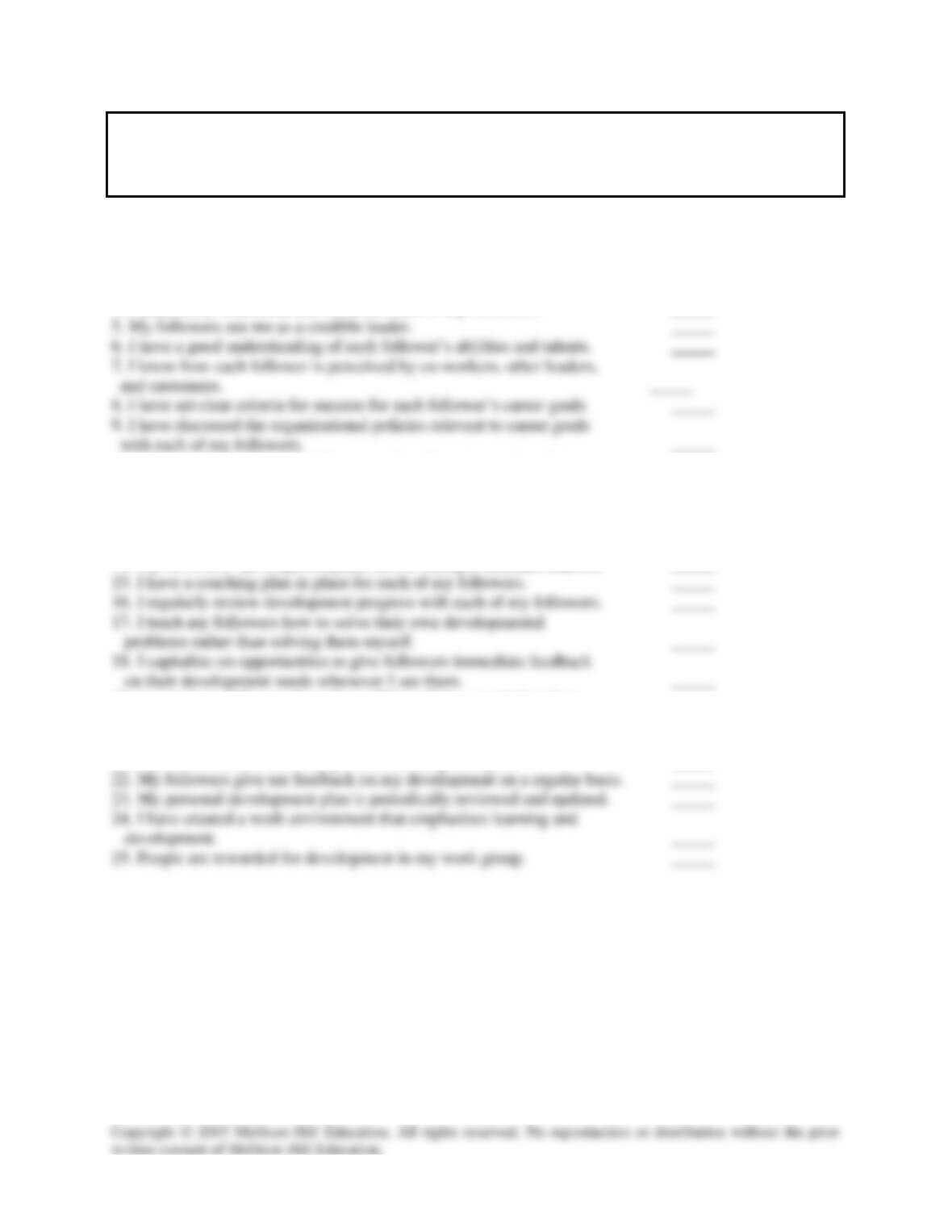
1. I know each of my followers’ short and long term career goals _____
2. I spend a lot of time listening to followers’ perspectives on work issues. _____
3. I share strong, trusting relationships with my followers. _____
4. I understand what motivates or drives each of my followers. _____
10. I have worked with each follower to identify and prioritize their
development needs. _____
11. Each of my followers has a written development plan. _____
12. My followers’ development objectives are aligned with their career goals. _____
13. My followers’ development plans capitalize on on-the-job action steps. _____
14. My followers’ development plans utilize multiple feedback sources. _____
19. I remind my followers how they will benefit by completing their
development plans. _____
20. I help my followers cope with the frustrations of development. _____
21. My followers have seen my personal development plan. _____

Chapter 07 – Leadership Behavior
7-20
Scoring Guide for the Coaching Skills Inventory
Coaching consists of five components, which are Forging a Partnership, Inspiring Commitment, Growing
Skills, Promoting Persistence, and Shaping the Environment. Items 1–5 focus on Forging a Partnership
and ask leaders about the strength of the relationships they share with their followers. This is a key
component of coaching because if followers do not trust their leader they are unlikely to heed his or her
The best coaches are those who practice the behaviors associated with all five components of
coaching. The Coaching Skills Inventory not only provides feedback on overall coaching effectiveness, it
can also indicate which components may need further work. For example, a leader may get relatively high
scores for Forging a Partnership but lower scores for the other components of coaching. This leader has
Chapter 07 – Leadership Behavior
7-21
Scores and interpretive comments for the self-version of the Coaching Skills Inventory are as follows:
Total of Items 1-5: _____ Forging a Partnership Score
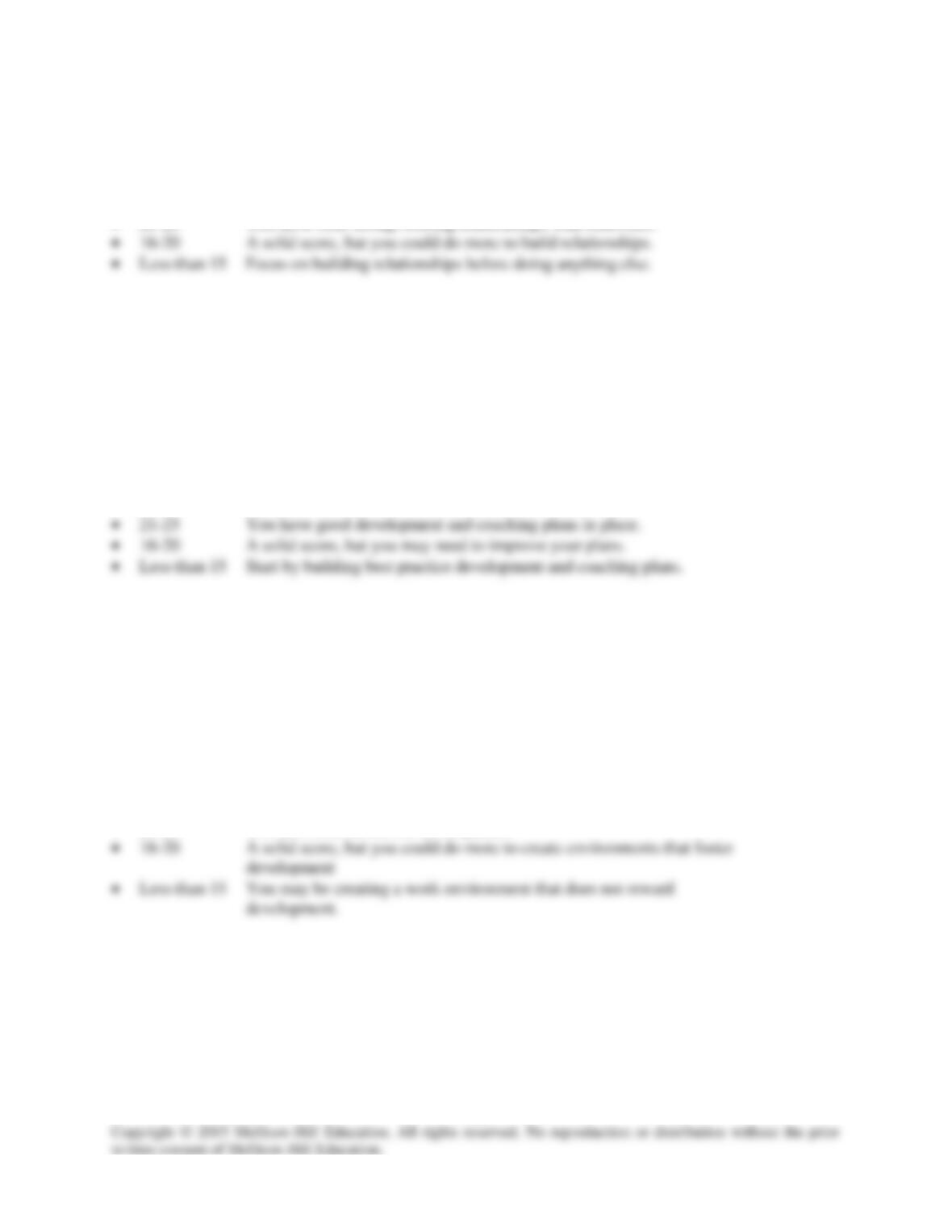
• 21-25 You have built strong, trusting relationships with followers.
Total of Items 6-10: _____ Inspiring Commitment Score
• 21-25 You have clearly identified followers’ development needs.
• 16-20 A solid score, but you could do identify development needs.
• Less than 15 Start by systematically identifying and prioritizing your followers’
development needs.
Total of Items 11-15: _____ Growing Skills Score
Total of Items 16-20: _____ Promoting Persistence Score
• 21-25 You are doing a good job supporting on-going development.
• 16-20 A solid score, but you may need to provide more support.
• Less than 15 Focus on what you do to support development after plans are in
place.
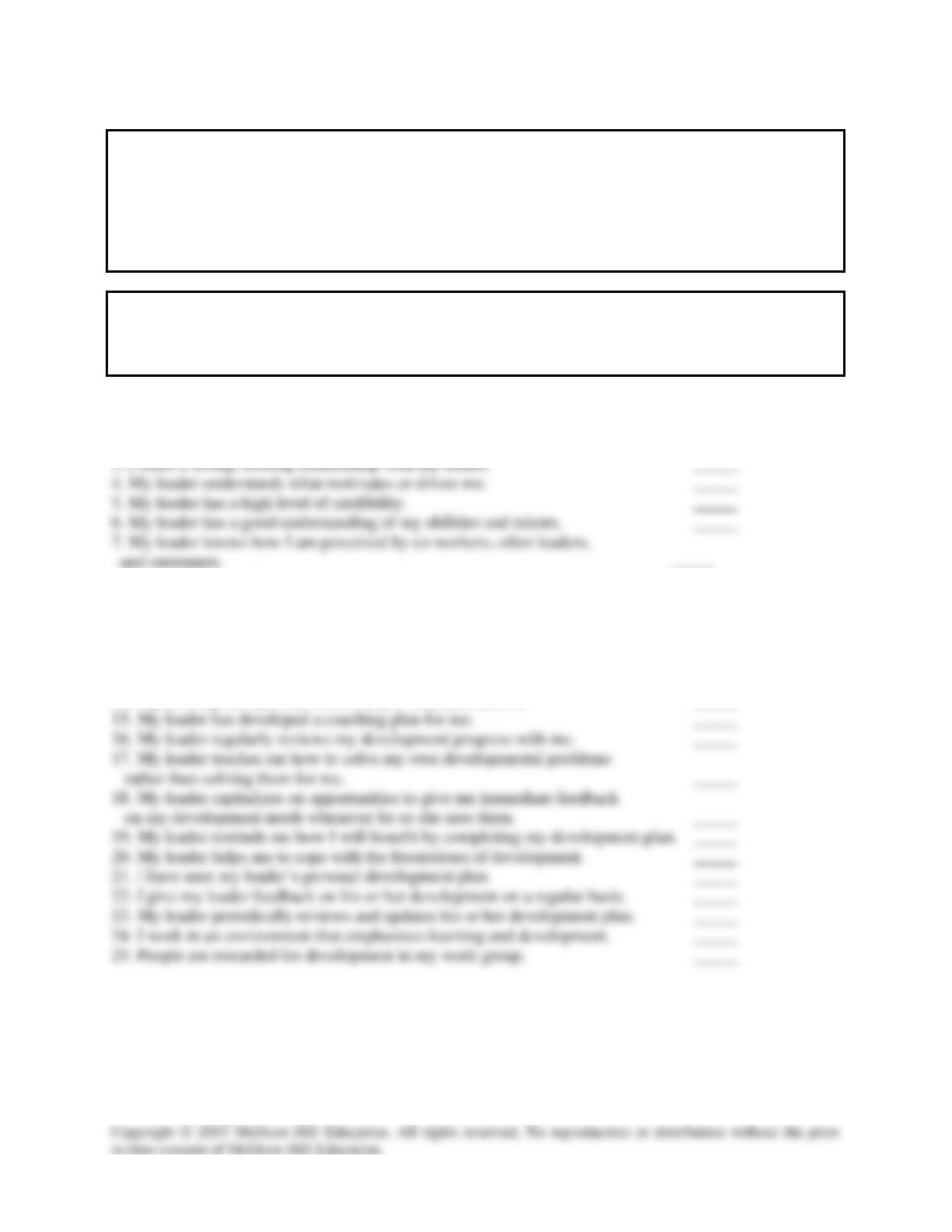
Total of Items 21-25: _____ Shaping the Environment Score
• 21-25 You are a role model for development.
Chapter 07 – Leadership Behavior
7-22
Coaching Skills Inventory (Follower Version)
by
Gordon J. Curphy, Ph.D.
Use the following scale to respond to the items:
1———————2————–——3—————–-4——————-5
Strongly Disagree Disagree So-So Agree Strongly Agree
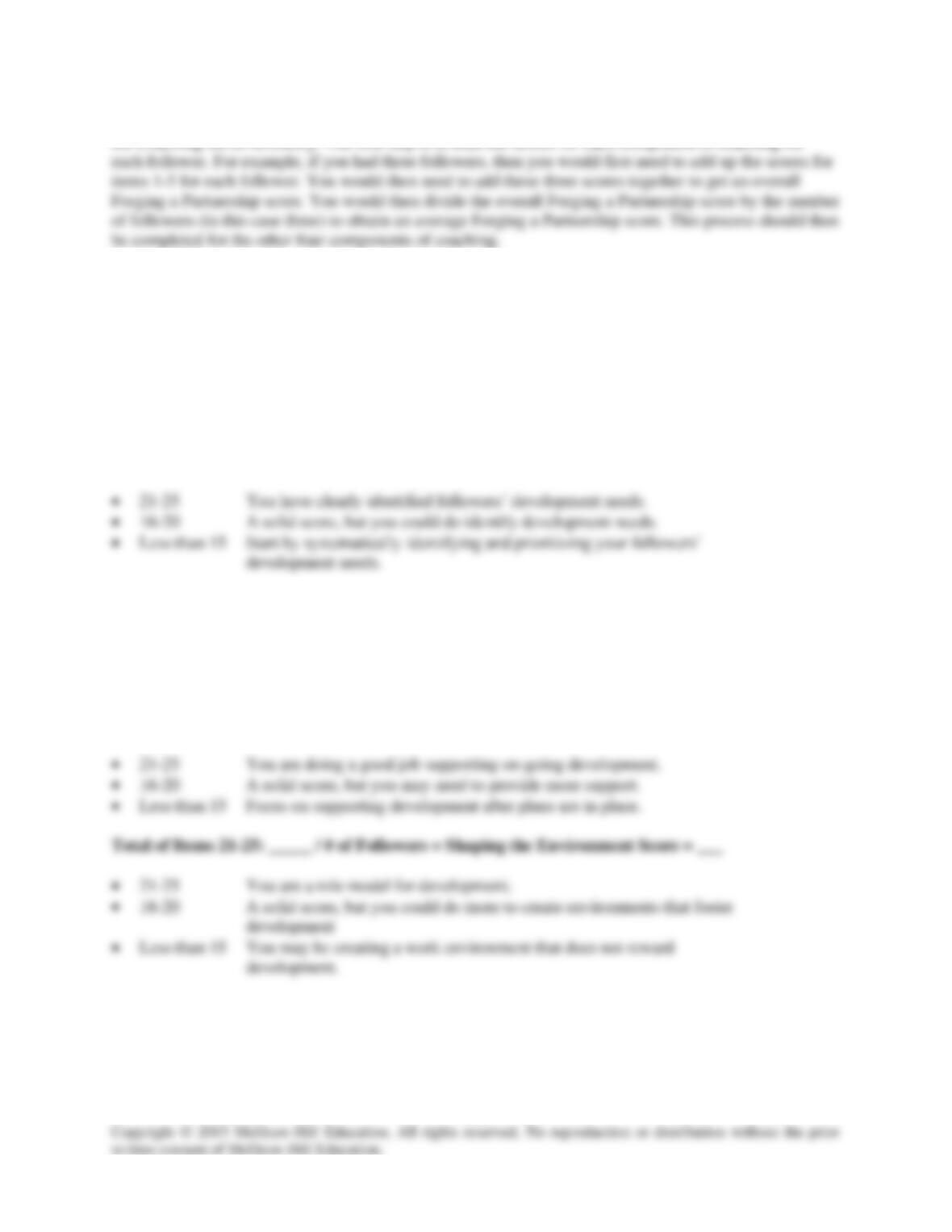
1. My leader knows my short and long term career goals _____
2. My leader spends time listening to my perspective on work issues. _____
8. My leader has outlined clear criteria of success for my career goals. _____
9. My leader has discussed the organizational policies relevant to my career goals. _____
10. My leader has helped me to identify and prioritize my development needs. _____
11. I have a written development plan. _____
12. My development objectives are aligned with my career goals. _____
13. My development plan capitalizes on on-the-job action steps. _____
14. My development plan utilizes multiple feedback sources. _____
Chapter 07 – Leadership Behavior
7-23
Determining scores for the follower version requires several more steps than scoring the self-version of
Scores and interpretive comments for the follower version of the Coaching Skills Inventory are as
follows:
Total of Items 1-5: _____ / # of Followers = Forging A Partnership Score = _____
• 21-25 You have built strong, trusting relationships with followers.
• 16-20 A solid score, but you could do more to build relationships.
• Less than 15 Focus on building relationships before doing anything else.
Total of Items 6-10: _____ / # of Followers = Inspiring Commitment Score = _____
Total of Items 11-15: _____ / # of Followers = Growing Skills Score = _____
• 21-25 You have good development and coaching plans in place.
• 16-20 A solid score, but you may need to improve your plans.
• Less than 15 Start by building best practice development and coaching plans.
Total of Items 16-20: _____ / # of Followers = Promoting Persistence Score = _____

Chapter 07 – Leadership Behavior
7-24
Plotting Self and Follower Scores
Leaders who choose to complete both self and follower versions of the coaching assessment may want to plot their
scores on the graph below. Plotted scores may help leaders better visualize perceptual gaps in their coaching skills.
Use an “o” to denote yourself and an “x” to denote your average follower scores.
Growing Skills: ————+————-+————-+——-——+————+

Chapter 07 – Leadership Behavior
7-25
Exercise 7-8
Exercise Title: Blind Soccer
Purpose: To demonstrate the behaviors essential to effective coaching.
Summary: Instructors should set up parallel obstacle courses consisting of five obstacles per course.
Students should not be allowed to see the obstacle course prior to the exercise.
Instructors should then explain to coaches how the obstacle course works. Coaches must help their
players “shadow” one of the new products through all five product phases. The new product is
represented by a soccer ball, and players must maneuver the ball through or around each of the five
obstacles in the course. Only the players can touch the ball, and the players will be blindfolded prior to
and during this phase of the exercise. The obstacles should be negotiated in the proper sequence, and
coaches will tell players what they need to do. Coaches should be given five minutes to describe the task
to their players, and then all of the players should be blindfolded and led to the obstacle course.
The execution phase of the exercise should begin once both teams are in position at the beginning of the
obstacle course. Instructors should record the amount of time it takes both teams to complete the course.
If time permits, then instructors may want to run the exercise by having members switch both roles and
obstacle courses. Instructors may then want to use the total time for rounds one and two to award the
project.
Chapter 07 – Leadership Behavior
7-26
In terms of a large group debrief, instructors may want to address some of the following processing
questions:
• How did the sub-teams choose players and coaches?
• How did it feel to be blindfolded? Do organizations have individuals who are “blind” to the goals
or mission of the organization?
Obstacle Course *
Sales Sales
Distribution Distribution
* Courses should be identical. Obstacles can be marked out using traffic cones or similar objects which
will be prominent yet safe for participants should they run into them, trip, etc. Cones should be about
three feet apart to form each obstacle. Obstacles should be 12-15 feet from each other.
This exercise takes about 45 minutes to complete.

Chapter 07 – Leadership Behavior
7-27
Additional References/Resources
Bennett, J. L. (2006). An agenda for coaching-related research: A challenge for researchers. Consulting
Psychology Journal: Practice & Research, 58, 240–249.
Bowles, S. V. & Picano, J. J. (2006). Dimensions of coaching related to productivity and quality of life.
Consulting Psychology Journal: Practice & Research, 58, 232–239.
Judge, T.A., Piccolo, R.F., & Ilies, R. (2004). The forgotten ones? The validity of consideration and
initiating structure in leadership research. Journal of Applied Psychology, 89, 36–51.
Kampa-Kokesch, S. & Anderson, M.A. (2001). Executive coaching: A comprehensive review of the
literature. Consulting Psychology Journal, 53, 205–228.
Kaiser, R. K. & Kaplan, R. K. (2006). The deeper work of executive development: Outgrowing
sensitivities. Academy of Management Learning & Education, 5, 463–483.
Peterson, D.B. (2003). Management development: Coaching and mentoring programs. In K. Kraiger
(Ed.), Creating, Implementing, and Managing Effective Training and Development. San Francisco,
CA: Jossey-Bass.
Peterson, D.B. & Hicks, M.D. (1995). Development first: Strategies for self-development. Minneapolis,
MN: Personnel Decisions International.

Chapter 07 – Leadership Behavior
knowledge equally across cultures? Academy of Management Learning & Education, 6, 33–50.
Sonnenfeld, J. & Ward, A. (2007). Firing back: How great leaders rebound after career disasters.
Boston: Harvard Business School Press.
Successful Manager’s Handbook. Minneapolis, MN: Personnel Decisions International.
Judgment Factor: Chapters 5 – 7.
Motivation and Courage Factor: Chapters 16 – 17.