Instructor Resource
Rowe, Cases in Leadership 5e
SAGE Publications, Inc., 2019
Case Notes
Case 7.1: Bank of Baroda: Leadership Challenges
Asha Bhandarker and Snigdha Rai wrote this teaching note as an aid to instructors in the
classroom use of the case Bank of Baroda: Leadership Challenges, No. 9B15C036. This teaching
note should not be used in any way that would prejudice the future use of the case.
This publication may not be transmitted, photocopied, digitized or otherwise reproduced in any
form or by any means without the permission of the copyright holder. Reproduction of this
Teaching Note
Synopsis
Mangalore Devadas Mallya joined Bank of Baroda (BOB) in May 2008 as chairman and
managing director (CMD), coming from Bank of Maharashtra, where he had served as CMD.
BOB is an Indian national bank with several international branches in the United States, the
United Kingdom, Africa and Asia-Pacific. In 2003, BOB ranked seventh compared to other
Indian public-sector banks in terms of growth (see Exhibit TN-1). Under the tenure of the CMD
Teaching Objectives
• To illustrate the role of leadership in managing structural and cultural change in an Indian
public-sector bank.
• To help students understand the role of a leader in building a positive organizational
culture and achieving high organizational performance.
Position in Course
This case is suitable for undergraduate and graduate courses on change management strategy,
change management leadership, and organizational alignment of strategy, structure and culture.
The case can be used to discuss the role of a leader in bringing structural and cultural change in a
hierarchical organization.
Suggested Readings
• Singh, P., & Bhandarker, A. (2011). In search of change maestros (pp. 1–44). New Delhi,
India: Sage Publications.
Instructor Resource
Rowe, Cases in Leadership 5e
SAGE Publications, Inc., 2019
• Palmer, I., Dunford, R., & Akin, G. (2009). Managing organizational change: A multiple
perspectives approach (229–261). Boston, MA: McGraw-Hill Irwin.
Suggested Assignment Questions
1. Are the employees of BOB ready for a cultural change that will bring the bank in line
with modern-day banking in India?
2. What is the model of change that Mallya should follow to bring success to BOB?
Suggested Teaching Strategy
The case focuses primarily on leadership and organizational change. The case delineates the
necessary steps to build cultural change in alignment with structural change in a public-sector
Introduction (20 minutes)
Before moving on to the assignment questions, the complexities of large public-sector
organizations may be discussed in class. The following should be shared with the students:
Instructor Resource
Rowe, Cases in Leadership 5e
SAGE Publications, Inc., 2019
• In an Indian public-sector bank, the CMD can be promoted within the bank or can be
selected from other banks. The discussion should be further guided towards the
Case Discussion (70 minutes)
Now, the instructor may move on to discuss each assignment question with the students for
Analysis
1. Are the employees of BOB ready for a cultural change that will bring the bank in line
with modern-day banking in India?
The instructor can focus on widespread apprehension and speculation about the management
style of the new CMD. The instructor can also discuss the prevailing culture at BOB, which is
bureaucratic and not focused on customer service. It is recommended that the instructor facilitate
the discussion around the following items:
• The majority of the employees are complacent, risk-averse and rule-bound.
Most discussion of resistance to change advocates the importance of breaking resistance to
change at all levels in an organization. The instructor may guide the class discussion around the
Instructor Resource
Rowe, Cases in Leadership 5e
SAGE Publications, Inc., 2019
following points to analyze how Mallya demonstrated three values (trust, transparency and
togetherness) in the first few months of joining, in order to become accepted as part of the bank:
• Mallya continued working with the same top management team without making vast
changes.
The role of regular and open communication in developing and maintaining interpersonal trust
between the CMD and the employees should be elaborated on during the discussion.
2. What is the model of change that Mallya should follow to bring success to BOB?
A successful change requires that all employees be involved and that they have an understanding
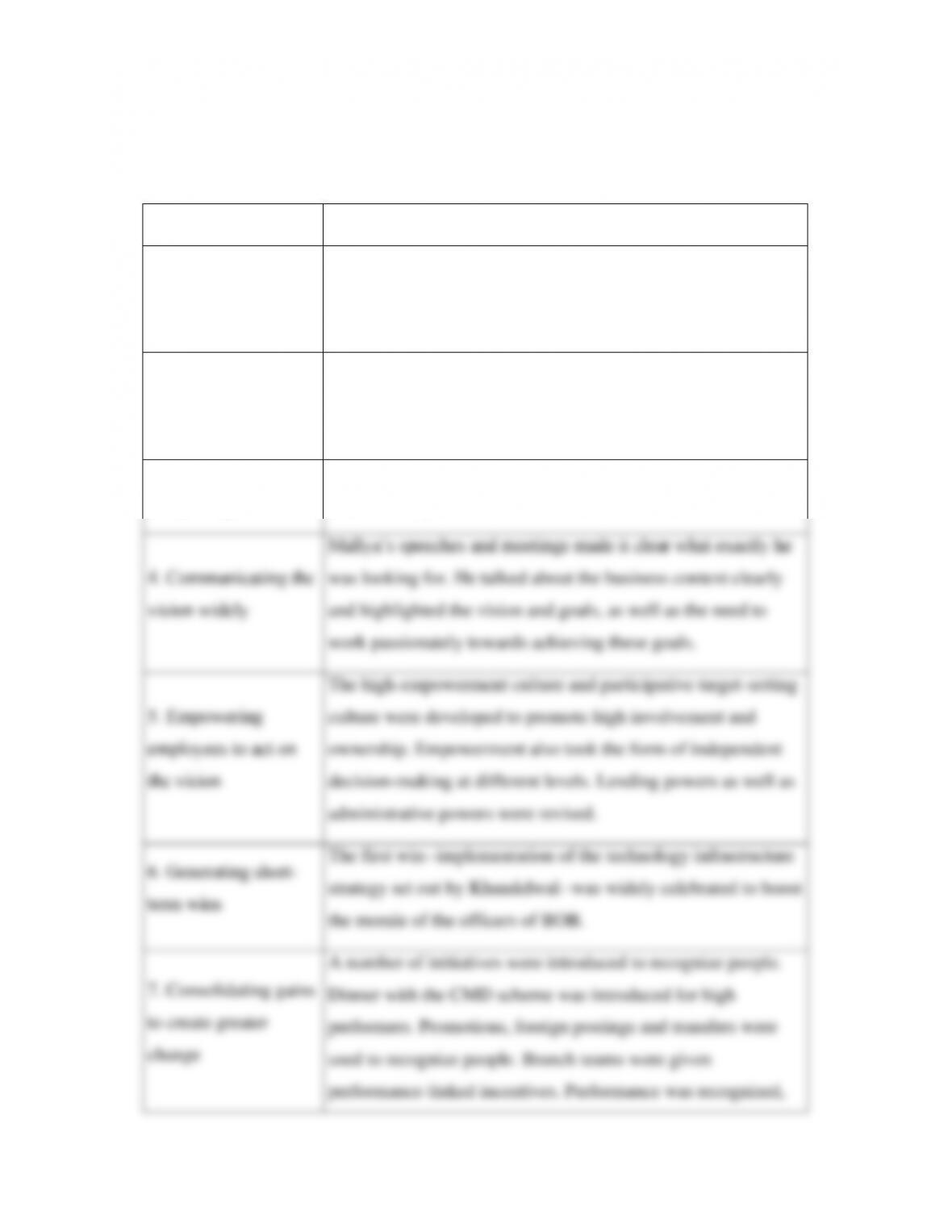
of the need for change. The case of BOB accords with the change and transformation stages
offered by John P. Kotter. See Exhibit TN-2 for a detailed model of change proposed by Kotter.
As per this model, the eight stages of change management include the following:
• Establishing a sense of urgency
• Forming a powerful guiding coalition
Instructor Resource
Rowe, Cases in Leadership 5e
SAGE Publications, Inc., 2019
important. The development of a shared vision and strong commitment to the vision by the
leader and the top management team is another important step in the change process. The vision
of the organization should be actively shared with employees at all levels. Therefore, the leader
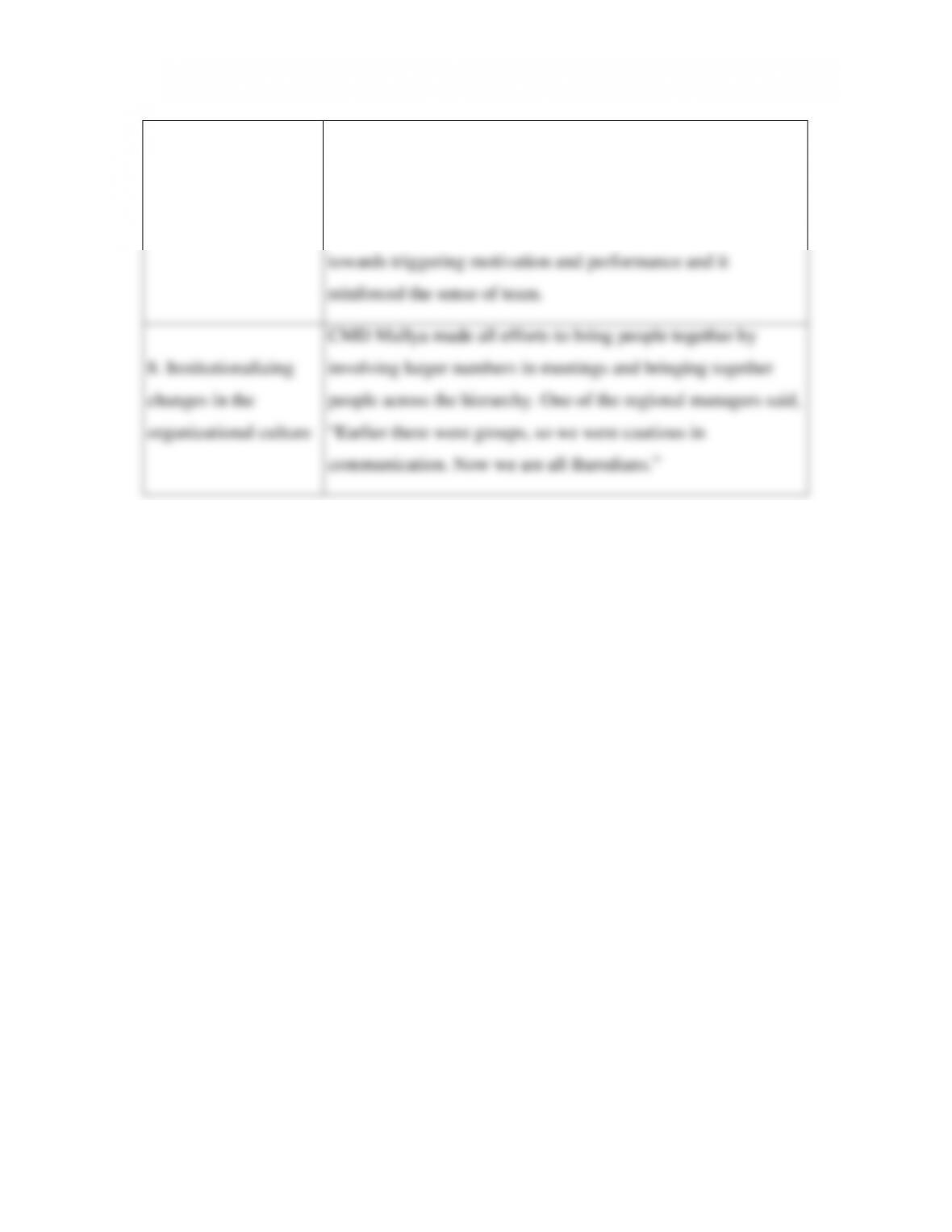
The instructor can also refer to Exhibit TN-3 for more information about the steps taken by
Mallya as per the Kotter model to bring transformational cultural change in BOB.
The instructor should guide the discussion on the following points:
• Maintaining regular and open communication on the vision and organizational goal,
Instructor Resource
Rowe, Cases in Leadership 5e
SAGE Publications, Inc., 2019
3. What kind of leadership style will be effective in the case of BOB?
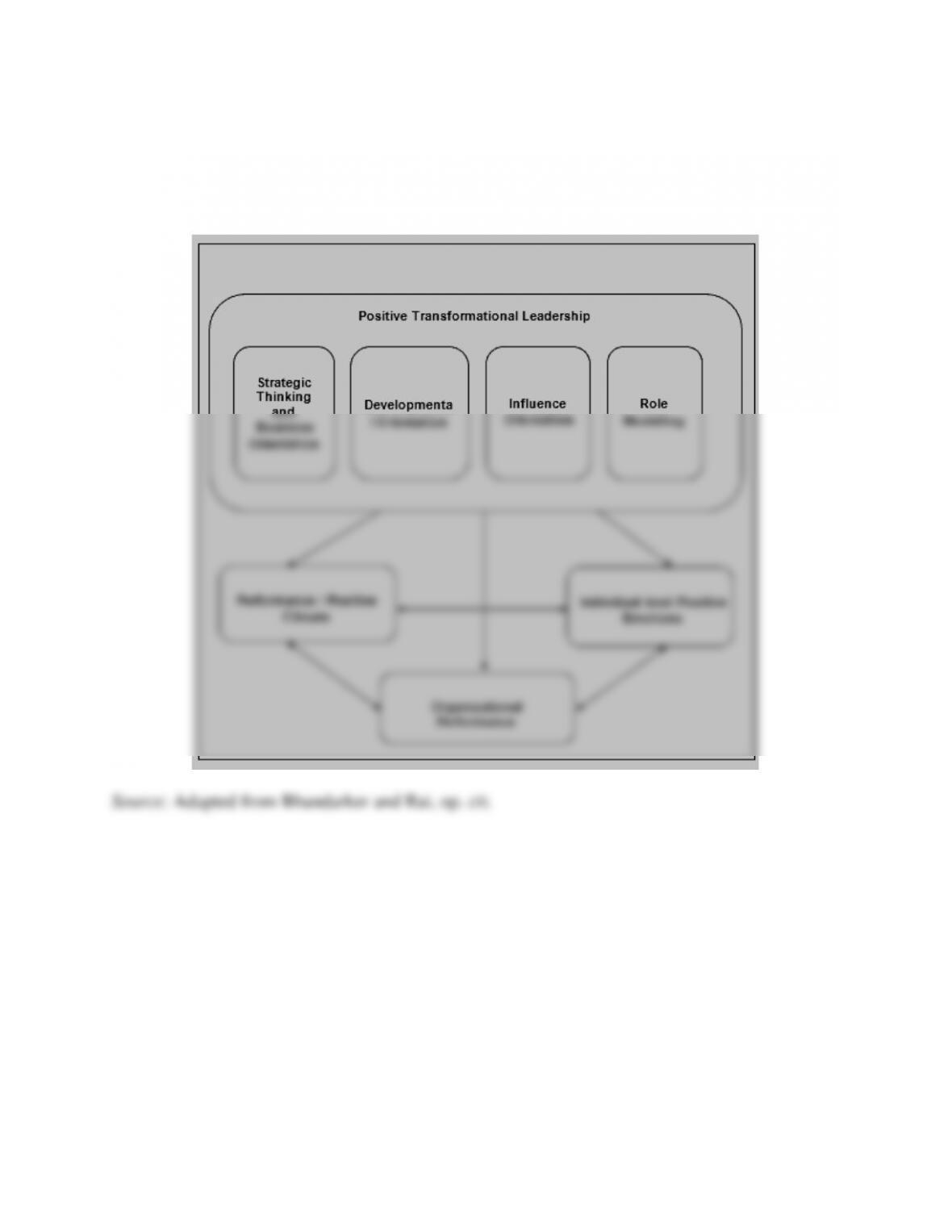
The leadership of Mallya was reported to be a combination of both positive and transformational
styles. The instructor can discuss the following information that defines him as a transformational
and positive leader:
• Strategic and visionary thinking—identifying customer service as the most critical factor
for improving bank performance. Mallya passionately shares the vision of making BOB
Instructor Resource
Rowe, Cases in Leadership 5e
SAGE Publications, Inc., 2019
Overall, Mallya has a performance orientation, but he remains humble and respectful of others’
dignity. The combination of both performance and humility is rarely evident in a public-sector
4. What do you think about Mallya’s strategy to change BOB, from a structural and a
cultural perspective? What do you agree and disagree with?
As competition increases, organizations need to change and transform to stay in business.
Organizations should adapt with the changing environment, and leadership styles should be
modified depending on the state of the organization. The organizational structure and culture in
Instructor Resource
Rowe, Cases in Leadership 5e
SAGE Publications, Inc., 2019
What Happened
Mallya took active steps to communicate the vision of customer focus. Empowerment and
involvement were combined with close monitoring, review and analysis. The review by the CMD
included close guidance on where to focus business development. In addition, interdepartmental


Instructor Resource
Rowe, Cases in Leadership 5e
SAGE Publications, Inc., 2019
Exhibit TN-1
Ranking of Indian Public-Sector Banks in Terms of Growth (%)
2002
2003
2004
2005
2006
2007
2008
2009
BOB
3
7
7
7
4
1
3
2
Punjab National Bank
4
1
3
4
5
6
5
4
Bank of India
6
5
6
6
6
3
2
5
Canara Bank
7
2
2
5
2
5
7
7
United Bank of India
5
3
4
2
1
7
6
1
Oriental Bank of
Commerce
1
6
1
1
7
2
4
6
Corporation Bank
2
4
5
3
3
4
1
3
Instructor Resource
Rowe, Cases in Leadership 5e
SAGE Publications, Inc., 2019
Exhibit TN-2
The Kotter Change Model
Instructor Resource
Rowe, Cases in Leadership 5e
SAGE Publications, Inc., 2019
Exhibit TN-3
Management of change at BOB—Steps Taken by Mallya as per Kotter’s Change Model
Stage
Steps Taken by CMD Mallya
1. Establishing a sense
of urgency
Setting expectations and preparing people were the top
priorities of CMD Mallya. He also spent a lot of time on
establishing comfort and building morale and confidence.
2. Forming a powerful
guiding coalition
Early efforts were made by Mallya to create a homogenous and
unified top team by establishing a connection with stakeholders
and bonding with the top team.
3. Developing a
compelling vision
He developed a vision of making BOB the most admired bank
in the country.
4. Communicating the
vision widely
Mallya’s speeches and meetings made it clear what exactly he
was looking for. He talked about the business context clearly
and highlighted the vision and goals, as well as the need to
work passionately towards achieving these goals.
5. Empowering
employees to act on
the vision
The high-empowerment culture and participative target-setting
culture were developed to promote high involvement and
ownership. Empowerment also took the form of independent
decision-making at different levels. Lending powers as well as
administrative powers were revised.
6. Generating short–
term wins
The first win—implementation of the technology infrastructure
strategy set out by Khandelwal—was widely celebrated to boost
the morale of the officers of BOB.
7. Consolidating gains
to create greater
change
A number of initiatives were introduced to recognize people.
Dinner with the CMD scheme was introduced for high
performers. Promotions, foreign postings and transfers were
used to recognize people. Branch teams were given
performance-linked incentives. Performance was recognized,
Instructor Resource
Rowe, Cases in Leadership 5e
SAGE Publications, Inc., 2019
and there were celebrations when a person did well. There was
public appreciation of performances in meetings. The
introduction of branch-level performance incentives not only
for the manager but for the entire branch went a long way
towards triggering motivation and performance and it
reinforced the sense of team.
8. Institutionalizing
changes in the
organizational culture
CMD Mallya made all efforts to bring people together by
involving larger numbers in meetings and bringing together
people across the hierarchy. One of the regional managers said,
“Earlier there were groups, so we were cautious in
communication. Now we are all Barodians.”
Instructor Resource
Rowe, Cases in Leadership 5e
SAGE Publications, Inc., 2019
Exhibit TN-4
Positive Transformational Leadership, Positive Performance-Oriented Climate and
Organizational Performance